Showing posts with label Rock Island Independents. Show all posts

Friday, August 5, 2022

The Story And Significance Of Joe Guyon - Mr. Everthing For The 1927 Champion New York Giants

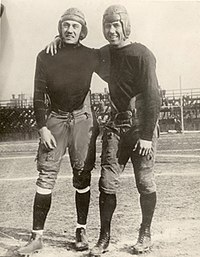
Joseph Napoleon "Big Chief" Guyon was an American Indian from the Ojibwa tribe (Chippewa) who was an American football and baseball player and coach. He played college football at the Carlisle Indian Industrial School from 1912 to 1913 and Georgia Tech from 1917 to 1918 and with a number of professional clubs from 1919 to 1927. He was inducted into the Pro Football Hall of Fame in 1966 and the College Football Hall of Fame in 1971.

Guyon signed to play professional football with the Canton Bulldogs in 1919. After the NFL was organized in 1920, he played seven more seasons with the Washington Senators, Cleveland Indians, Oorang Indians, Rock Island Independents, Kansas City Cowboys, and the New York Giants. From 1919 to 1924, he teamed with another outstanding Indian halfback, Jim Thorpe. They parted ways late in the 1924 season when Guyon left the Independents to go to Kansas City. He stayed with the Cowboys in 1925 while Thorpe went to the Giants.

Two years later in 1927, Guyon became a Giant and he played a major role in leading the New Yorkers to the 1927 NFL championship. Guyon, away from the shadow of Thorpe, enjoyed one of his finest seasons and gained the first significant publicity he had enjoyed since his college days. The 1927 Giants compiled an 11-1-1 record largely on the strength of a superior defensive that allowed only 20 points all season. But Guyon, flashing all of his many abilities – passing, running, punting, tackling and blocking and played a leading role in scoring the necessary points for his team that also finished second in scoring that season.

Guyon coached the Bulldogs of Union University in Jackson, Tennessee in 1919. He returned to Union in 1923 and coached all sports from 1923 to 1927. Union inducted Guyon into its sports hall of fame in 2008.

Guyon coached the backfield of the 1920 Georgia Tech team. He also coached high school football at St. Xavier High School in Louisville, Kentucky from 1931 to 1933, with a 16–7–2 record.

Sources
https://www.pro-football-reference.com/
https://www.profootballarchives.com/index.html
https://americanfootballdatabase.fandom.com/wiki/Football_Wiki
https://www.gridiron-uniforms.com/GUD/controller/controller.php?action=main
https://www.profootballhof.com/hall-of-famers/
 "Joe Guyon's HOF Profile". Pro Football Hall of Fame. Retrieved January 21, 2009.
 "Georgia Tech Boasts All-Southern Eleven". Fort Wayne Journal-Gazette. November 20, 1918. p. 6. Retrieved December 17, 2015 – via Newspapers.com. Open access icon
 "Joe Guyon". College Football Hall of Fame. Football Foundation. Retrieved January 21, 2009.
 C. Richard King (March 10, 2015). Native Americans in Sports. Routledge. p. 137. ISBN 9781317464037.
 Sentinel, Joseph Cress, The (November 8, 2012). "Carlisle vs. Army: 100 years later, game remembered for celebrity players".
 Willis, Chris (May 5, 2017). Walter Lingo, Jim Thorpe, and the Oorang Indians: How a Dog Kennel Owner Created the NFL's Most Famous Traveling Team. Rowman & Littlefield. ISBN 9781442277663.
 Rozendaal, Neal (July 9, 2012). Duke Slater: Pioneering Black NFL Player and Judge. McFarland. ISBN 9780786469574.
 "All-Time Football Team Lists Greats Of Past, Present". Gadsden Times. July 27, 1969.
 Umphlett 1992, p. 142
 Umphlett 1992, p. 141
 Spalding Football Guide. Shawnee Mission, Kansas, NCAA Publishing Service. 1918.
 "Strupper and Guyon of Georgia Tech Are Hailed As Two of the Greatest Pigskin Heroes In Seasons". The Day. November 19, 1917.
 "Jackets Win Double Bill" (PDF). The Technique. October 2, 1917. p. 4. Archived from the original (PDF) on October 30, 2014.
 "Georgia Crushes W. and L." The New York Times. October 21, 1917. p. 118. Retrieved November 10, 2024 – via Newspapers.com.
 McCarty 1988a, p. 5
 McCarty 1988b, p. 15
 "Golden Tornado Wins Great Victory" (PDF). The Technique. December 4, 1917. p. 4.
 Union University (January 1, 1920). Lest We Forget 1920. Student Organizations of Union University.
 "Coach Guyon Leaves Union". Cardinal and Cream. April 8, 1927 – via Union University Archives.
 "Union to induct six into Sports Hall of Fame Nov. 7 - News Release". November 5, 2008.
 "Alumni Events 2008" (PDF). Union University. Retrieved November 10, 2024.
 "Blue Print, 1921". School Yearbooks. Georgia Institute of Technology. January 1, 1921.
 Powers-Beck, Jeffrey (August 16, 2011). ""A Role New to the Race": A New History of the Nebraska Indians" (PDF). Nebraska History. Archived from the original on May 22, 2013.
McCarty, Bernie (February 1988). "Georgia Tech's 1917 backfield, better than the Four Horsemen: Part 1" (PDF). College Football Historical Society Newsletter. 1 (3). Archived from the original (PDF) on March 4, 2016.
McCarty, Bernie (May 1988). "Georgia Tech's 1917 backfield, better than the Four Horsemen: Part 2" (PDF). College Football Historical Society Newsletter. 1 (4). Archived from the original (PDF) on March 4, 2016.
Umphlett, Wiley Lee (1992). Creating the Big Game: John W. Heisman and the Invention of American Football. Westport, CT: Greenwood Publishing Group. p. 141. ISBN 978-0-313-28404-5.

Wednesday, June 8, 2022

The Story And Significance Of Ed Healey - The First NFL Player To Be Sold To Another Club

Edward Francis Healey Jr. was an American football player. Regarded as one of the best linemen in the early days of the National Football League, Healey was inducted into the Pro Football Hall of Fame as part of its second induction class in 1964. He was also named in 1969 to the NFL 1920s All-Decade Team. In 1974, he was also inducted into the College Football Hall of Fame.

A native of Springfield, Massachusetts, Healey played college football at College of the Holy Cross in 1914 and at Dartmouth College in 1916, 1917, and 1919.

Healey played professional football as a tackle in the NFL for the Rock Island Independents from 1920 to 1922 and for the Chicago Bears from 1922 to 1927. He never played for a team with a losing record during his NFL career and, in 1922, became the first player in NFL history to be sold to another team. He was named as a first-team All Pro player by at least one selector for five consecutive years from 1922 to 1926.

Healey was born in 1894 in Indian Orchard, a neighborhood at the northeast end of Springfield, Massachusetts. His parents, Edward F. Healey, Sr., and Nora Healey were the children of Irish immigrants, both born in Massachusetts. His father worked in the street sprinkler business and later as a contractor in the wood business. Healey had four older sisters and one younger sister.

Healey attended Central High School in Springfield, Massachusetts. He then attended and played college football at the College of the Holy Cross in Worcester, Massachusetts, in 1914 and at Dartmouth College in Hanover, New Hampshire, for three years. In Healey's three years with the Dartmouth football program, the teams compiled records of 5–2–2 (1916), 5–3 (1917), and 6–1–1 (1919). Walter Camp reportedly called Healey "the best tackle I ever saw."

Healey began playing professional football with the Rock Island Independents in 1920, the inaugural season of the National Football League (known as the American Professional Football Association until 1922). He helped lead the 1920 Rock Island team to a 6–2–2 record, good for fourth place out of 14 teams.

Healey remained with Rock Island during its 1922 season when the team compiled a 4–2–1 record and finished in fifth place out of 21 teams.

Healey began the 1922 NFL season with Rock Island. The team opened its season with a 19–14 victory over the Green Bay Packers before losing a close game, 10–6, against the Chicago Bears. George Halas, owner, coach and player for the Bears, was impressed with Healey's tough tackling, including tackling of Halas, and bought Healey's contract for $100. Healey thus became the first NFL player to be sold to another club. Healey later recalled his pleasure at joining a team with superior facilities: "At Rock Island, we had no showers and seldom a trainer. At Wrigley Field, we had a nice warm place to dress and nice warm showers."

Healey spent six seasons with the Bears from 1922 to 1927. During Healey's tenure with the Bears, the club never had a losing season, winning at least nine games in five of the six seasons. Healey was selected as a first-team All-Pro by at least one major selector each year from 1922 to 1926.

In 1924, he ran more than 30 yards to tackle teammate Oscar Knop who ran the wrong way after intercepting a pass. In 1925, he was the only player to be selected as a first-team All Pro by Collyers Eye magazine, the Green Bay Press-Gazette, and Joseph Carr. In 1926, the Green Bay Press-Gazette called him "the best tackle in the Pro loop," and Bears owner George Halas later called Healey "the most versatile tackle of all time".

Sources
https://www.pro-football-reference.com/
https://www.profootballarchives.com/index.html
https://americanfootballdatabase.fandom.com/wiki/Football_Wiki
https://www.gridiron-uniforms.com/GUD/controller/controller.php?action=main
https://www.profootballhof.com/hall-of-famers/
 "Ed Healey". Pro-Football-Reference.com. Sports Reference LLC. Retrieved December 10, 2016.
 1900 Census entry for Edward and Nora Healey and family. Son Edward born December 1894. Census Place: Springfield Ward 1, Hampden, Massachusetts; Roll: 652; Page: 32B; Enumeration District: 0570; FHL microfilm: 1240652. Ancestry.com. 1900 United States Federal Census [database on-line].
 1910 Census entry for Edward F. and Nora Healey and family. Son Edward F. Jr., age 15. Census Place: Springfield Ward 1, Hampden, Massachusetts; Roll: T624_591; Page: 5A; Enumeration District: 0596; FHL microfilm: 1374604. Ancestry.com. 1910 United States Federal Census [database on-line].
 Freedman, Lew (September 15, 2008). Chicago Bears: The Complete Illustrated History. MBI Publishing Company. ISBN 9781610600934 – via Google Books.
 The Pnalka, Vol. IV. Senior Class of Central High School in Springfield, Massachusetts. 1913. p. 68.(Edward Francis Healey listed as mid-year freshman).
 The Pnalka, Vol. VII. 1913. p. 72.
 "Ed Healey profile". National Football Foundation. Retrieved December 10, 2016.
 "Dartmouth Big Green School History". SR/College Football. Sports Reference LLC. Retrieved December 11, 2016.
 "Football Pioneers Are Honored". Alexandria (LA) Daily Town Talk. April 28, 1974. p. B4 – via Newspapers.com. Open access icon(The quote attributed to Camp cannot be located in contemporaneous sources and appears dubious insofar as Camp never named Healey to one of his college football All-America teams.)
 "1920 APFA Standings & Team Stats". Pro-Football-Reference.com. Sports Reference LLC. Retrieved December 10, 2016.
 "1921 APFA Standings & Team Stats". Pro-Football-Reference.com. Sports Reference LLC. Retrieved December 10, 2016.
 Howard Roberts, The Story of Pro Football. New York: Rand McNally, 1953, pp. 68-69.
 "Ed Healey statistics," Pro Football Reference, www.pro-football-reference.com
 "Hall of Famers by Year of Enshrinement," Pro Football Hall of Fame, www.profootballhof.com
 "First Sale of 'Pro' Grid Man Made to Bears," Hammond Times, Nov. 28, 1922, p. 12.
 "Bears Buy Healey: Thought First Sale of Gridiron Player," Rock Island Argus, Nov. 27, 1922, p. 12.
 "Ed Healey Bio". Pro Football Hall of Fame. Retrieved December 10, 2016.
 "Chicago Bears Franchise Encyclopedia". Pro-Football-Reference.com. Sports Reference LLC. Retrieved December 10, 2016.
 Larkin, Will (August 7, 2019). "Ranking the 100 best Bears players ever: No. 30 Ed Healey". Chicago Tribune. Retrieved March 6, 2020.
 "1925 NFL All-Pros". Pro-Football-Reference.com. Sports Reference LLC. Retrieved December 11, 2016.
 Chris Willis (2010). The Man Who Built the National Football League: Joe F. Carr. Scarecrow Press. p. 217. ISBN 9780810876705.
 "Chicago Bears Coming Here Sunday With Great Team: Paddy Driscoll, Ed Healey, Trafton, Mohardt, Walquist Listed as Stars of Bruins". The Green Bay Press-Gazette. September 21, 1926. p. 16 – via Newspapers.com. Open access icon
 "Rooney, Six Ex-Players Elected to Pro Grid 'Hall'". Pittsburgh Post-Gazette. February 28, 1964. p. 16 – via Newspapers.com. Open access icon
 "Social Items". St. Louis Post-Dispatch. November 17, 1927. p. 19 – via Newspapers.com. Open access icon
 Harry Warren (December 5, 1949). "Bears' Alumni Gather, Replay Steeler Game". Chicago Tribune. p. 4 – via Newspapers.com. Open access icon
 "Three More Ex-Bears, 2 Packers Voted Into Pro Football's Hall of Fame". Chicago Tribune. February 28, 1964. pp. 3–1 – via Newspapers.com. Open access icon
 "Pro Football Hall of Fame Honoring First Stars". Racine (WI) Sunday Bulletin. August 24, 1969. p. 4B – via Newspapers.com. Open access icon
 "Healey chosen". The Lowell Sun. April 29, 1974. p. 20 – via Newspapers.com. Open access icon
 "Ed Healey Dies". Fort Myers (FL) News-Press. December 11, 1978. p. 2C – via Newspapers.com. Open access icon
 Indiana Death Certificate for Edward F. Healey, born December 28, 1894, died December 9, 1978.
 "Services Held for Pro Football Hall of Famer Ed Healey". Ukiah (CA) Daily Journal. December 13, 1978. p. 5 – via Newspapers.com.

Monday, June 6, 2022

The Story And Significance Of Jimmy Conzelman - The Last Cardinals Head Coach To Win An NFL Title

James Gleason Dunn Conzelman was an American football player and coach, baseball executive, and advertising executive. He was inducted into the Pro Football Hall of Fame in 1964 and was selected in 1969 as a quarterback on the National Football League 1920s All-Decade Team.

A native of St. Louis, Conzelman played college football for the 1918 Great Lakes Navy Bluejackets team that won the 1919 Rose Bowl. In 1919, he was an All-Missouri Valley Conference quarterback for the Washington University Pikers football team. He then played ten seasons as a quarterback, halfback, placekicker, and coach in the National Football League for the Decatur Staleys (1920), Rock Island Independents (1921–1922), Milwaukee Badgers (1922–1924), Detroit Panthers (1925–1926), and Providence Steam Roller (1927–1929). He was also a team owner in Detroit and, as player-coach, led the 1928 Providence Steam Roller team to an NFL championship.

From 1932 to 1939, Conzelman was the head football coach for the Washington University Bears football team, leading the program to Missouri Valley Conference championships in 1934, 1935, and 1939. He served as head coach of the NFL's Chicago Cardinals from 1940 to 1942 and again from 1946 to 1948. He led the Cardinals to an NFL championship in 1947 and Western Division championships in 1947 and 1948. He was also an executive with the St. Louis Browns in Major League Baseball from 1943 to 1945.

Conzelman enrolled at Washington University in St. Louis in 1916. He played freshman football that year but enlisted in the United States Navy when the United States entered World War I in 1917. He was stationed at the Great Lakes Naval Station north of Chicago. During two years of service, he played for the Naval Station's football, baseball, and basketball teams. He also took up boxing while in the Navy and won a championship in the middleweight division. He was the quarterback of the 1918 Great Lakes Navy Bluejackets football team that defeated previously undefeated Navy and then defeated the Mare Island Marines by a 17–0 score in the 1919 Rose Bowl. Conzelman's teammates on the 1918 Great Lakes team included George Halas and Paddy Driscoll, all three of whom were later inducted into the Pro Football Hall of Fame.

After the war, Conzelman turned down offers to become a professional boxer and returned to Washington University in February 1919. He played for the 1919 Washington Pikers football team that compiled a 5–2 record and outscored opponents 127 to 30. Conzelman was selected as the All-Missouri Valley Conference quarterback for 1919. He also was the catcher for the 1920 Washington University baseball team and organized an orchestra, played banjo, and wrote songs while attending Washington University.

During the spring semester of 1920, Conzelman lost his eligibility to play football due to academic deficiencies. His father had also died in May 1919, and he withdrew from school to help support his mother and younger siblings. In June 1920, Conzelman announced that he would not return to Washington University in the fall. He spent the summer leading an orchestra in Arkansas.

In mid-October 1920, Conzelman joined the Decatur Staleys (later renamed the Chicago Bears) of the newly formed American Professional Football Association (later renamed the NFL). He planned to relocate permanently to Decatur and also play for the Staleys baseball and basketball teams. Conzelman was reunited at Decatur with player-coach George Halas, with whom Conzelman had played on the 1918 Great Lakes team. In Conzelman's first game with the Staleys, he scored the game's only touchdown on a 43-yard run. Playing at the halfback position, Conzelman handled punting, placekicking and passing for the Staleys in the important games and was selected as a second-team player on the 1920 All-Pro team. The 1920 Staleys compiled a 10–1–2 record and finished in second place in the league.

In October 1921, Conzelman joined the Rock Island Independents as the team's captain and coach. At age 23, he was one of the youngest coaches in NFL history. He led Rock Island to a 4–1 record during the 1921 season.

After starting the season with Rock Island, Conzelman signed with the Milwaukee Badgers in the middle of their 1922 season. He was the Badgers' coach and a player for the final three games of the 1922 season during which the team went 0–3.

During the 1923 season, Conzelman, as player and coach, led the Badgers to a 7–2–3 record and a third-place finish out of 20 teams in the NFL. Conzelman was also the team's second-highest scorer with four touchdowns and two extra points. During the 1924 season, Conzelman remained with the Badgers as a player only. The team's record fell to 5–8 and 12th place in the NFL.

In 1925, Conzelman organized and became the owner of a new NFL franchise in Detroit, which he named the Detroit Panthers. He reportedly paid a franchise fee of only $50 to the NFL to acquire the Detroit franchise. In addition to being the owner, Conzelman was also the team's coach and a player during the 1925 and 1926 NFL seasons. During the 1925 season, Conzelman's Detroit club compiled an 8–2–2 record, played at Navin Field, and outscored opponents by a combined total of 129 to 39.

During the 1926 season, the Panthers dropped to 4–6–2 and compiled a record of 0–3–2 in the month of November. The team's attendance in Detroit was approximately 3,000 persons per game, not enough for Conzelman to make a profit. Accordingly, in August 1927, Conzelman sold the Detroit franchise back to the NFL for $1,200. Conzelman later recalled: "We simply were ahead of our time in Detroit. The town wasn't quite ready for pro football."


In August 1927, following his decision to sell the Detroit franchise back to the league, Conzelman signed as a player, manager and coach for the Providence Steam Roller. Conzelman brought players Gus Sonnenberg and Eddie Lynch with him from Detroit. Conzelman and Wildcat Wilson were the leading scorers on the 1927 Providence team, each with four touchdowns. The Steam Roller finished the 1927 season an 8–5–1 record and a fifth-place finish in the NFL.

Conzelman led the 1928 Providence team to an 8–1–2 record and the club's first NFL championship. The team's passing combination of Wildcat Wilson to Conzelman was the most effective in the league and accounted for most of the club's yardage until Conzelman twisted knee ligaments on a reception against the Yankees. Despite being unable to play in the second half of the season due to the injury, Conzelman was unanimously voted by his teammates as the team's most valuable player.

In his final season as an NFL player-coach, Conzelman led the 1929 Providence team to a 4–6–2 record.

In the fall of 1931, Conzelman served as the head coach of the St. Louis Gunners, an independent professional football team sponsored by a local field artillery unit of the National Guard. The Gunners posted a 5–2–1 record in 1931. After a game against the NFL's Chicago Cardinals, Chicago captain Ernie Nevers called the Gunners the "best independent club we have ever faced."

In January 1932, Conzelman returned to Washington University in St. Louis as the school's head football coach. He became the school's first alumnus to lead the football team. Over the next eight years, Conzelman led Washington University Bears football team to Missouri Valley Conference championships in 1934, 1935, and 1939, and compiled an overall record of 40–35–2.

In January 1940, Conzelman tendered his resignation as head coach of the Washington University football team, but the resignation was not accepted by the athletic board. The university chancellor directed Conzelman to attend an alumni rally in his support. Conzelman appeared and announced that he would not withdraw his resignation, though he would continue to support the program from the outside. Newspaper accounts indicate that he may have been fired under pressure from a powerful "anti-Conzelman" group of alumni in downtown St. Louis.

In April 1940, Conzelman was hired as the head coach of the NFL's Chicago Cardinals. He replaced Ernie Nevers in the position. In his first stint as head coach of the Cardinals, Conzelmean served three years with the Cardinals from 1940 to 1942, leading the club to a combined three-year record of 8–22.


tenure as head coach of the Cardinals was interrupted by a two-years stint as an administrator in Major League Baseball for the St. Louis Browns. In June 1943, he resigned his job as head coach of the Cardinals and was hired as director of public relations and assistant to Donald Lee Barnes, president and owner of the Browns. He remained with the Browns for two years and was said to be the "secret weapon" of the 1944 St. Louis Browns team that won the American League pennant. Conzelman resigned his post with the club in August 1945.


In late November 1945, Conzelman was hired for a second time to serve as head coach of the Chicago Cardinals starting with the 1946 NFL season. During the 1947 season, the Cardinals with their "Million Dollar Backfield" compiled a 9–3 record and defeated the Philadelphia Eagles in the 1947 NFL Championship Game. Conzelman's 1948 Cardinals team compiled an 11–1 record during the regular season, led the NFL in offense with an average of 32.9 points per game, and lost to the Eagles in the 1948 NFL Championship Game. In their second stint under Conzelman, the Cardinals compiled a 26–9 record from 1946 to 1948.

On January 7, 1949, three weeks after the loss in the 1948 Championship Game, Conzelman resigned as the Cardinals' head coach. He had been working for D'Arcy Advertising Co. for the prior two years during the off-season and stated that he was resigning his coaching position to devote his full efforts to the advertising firm. The Cardinals' management said at the time that Conzelman's resignation was unexpected and "came like a bolt from the blue."
Sources
https://www.pro-football-reference.com/
https://www.profootballarchives.com/index.html
https://americanfootballdatabase.fandom.com/wiki/Football_Wiki
https://www.gridiron-uniforms.com/GUD/controller/controller.php?action=main
https://www.profootballhof.com/hall-of-famers/
 "Jimmy Conzelman". Pro-Football-Reference.com. Sports Reference LLC. Retrieved December 3, 2016.
 Bob Broeg (2000). The 100 Greatest Moments in St. Louis Sports. Missouri History Museum. p. 43. ISBN 1883982316.
 Bill Schubert (1997). "Jimmy Conzelman" (PDF). The Coffin Corner. Pro Football Researchers.
 Walter Barlow Stevens (1909). St. Louis, the Fourth City, 1764-1909, Volume 2. S. J. Clarke Publishing Company. p. 775.
 "New Coach Star at Football, Baseball, Basketball; Is Musician and Songwriter". St. Louis Post-Dispatch. January 22, 1932. p. 2B – via Newspapers.com. Open access icon
 Carnation (McKinley High School yearbook). June 1916. p. 81.
 David Condon (January 22, 1932). "Sports World Mourning for Jimmy Conzelman". Chicago Tribune. p. 2 – via Newspapers.com. Open access icon
 "1919 Washington (MO) Bears Schedule and Results". SR/College Football. Sports Reference LLC. Retrieved December 3, 2016.
 "Conzelman Says He Will Not Be Back". The Des Moines Register. June 28, 1920. p. 4.
 "Died". Dental Health. June 1919. p. 31.
 "Jimmy Conzelman Joins Staley Football Team". St. Louis Post-Dispatch. October 13, 1920. p. 24 – via Newspapers.com. Open access icon
 "Conzelman's 43-Yard Run Nets A Touchdown and Wins for Staley Eleven". St. Louis Post-Dispatch. October 18, 1920. p. 19 – via Newspapers.com. Open access icon
 "Jim Conzelman Gets Position on Second All-Star "Pro" Eleven". St. Louis Post-Dispatch. December 12, 1920. p. 12 – via Newspapers.com. Open access icon
 "Conzelman Is Made Manager: Former Staley Player To Handle Rock Island Football Team". The Decatur Herald. October 21, 1921. p. 4 – via Newspapers.com. Open access icon
 "Jimmy Conzelman Coaching Record". SR/College Football. Sports Reference LLC. Retrieved December 3, 2016.
 "Lauer and Lyle, Pair of Rock Island Stars, Play With Green Bay Sunday". Green Bay Press-Gazette. November 24, 1922. p. 11.
 "1922 Milwaukee Badgers Statistics & Players". Pro-Football-Reference.com. Sports Reference LLC. Retrieved December 4, 2016.
 "1923 Milwaukee Badgers Statistics & Players". Pro-Football-Reference.com. Sports Reference LLC. Retrieved December 4, 2016.
 "1924 Milwaukee Badgers Statistics & Players". Pro-Football-Reference.com. Sports Reference LLC. Retrieved December 4, 2016.
 "Pro Grid Loop Dates Named: Conzelman Has Local Franchise". Detroit Free Press. August 3, 1925. p. 12.
 "Conzelman Is Versatile Stars In Athletics, Music". Detroit Free Press. August 23, 1925. p. 23.
 Richard Bak (1998). A Place for Summer: A Narrative History of Tiger Stadium. Wayne State University Press. p. 252. ISBN 0814325122.
 "1925 Detroit Panthers Statistics & Players". Pro-Football-Reference.com. Sports Reference LLC. Retrieved December 4, 2016.
 "1926 Detroit Panthers Statistics & Players". Pro-Football-Reference.com. Sports Reference LLC. Retrieved December 4, 2016.
 Richard Bak, A Place for Summer, pp. 252–253.
 Richard Bak, A Place for Summer, p. 248.
 "Detroit Surrenders Its National Wheel Football Franchise: Conzelman To Manage Providence; Takes Sonnenberg and Lynch With Him". Green Bay Press-Gazette. August 22, 1927. p. 14 – via Newspapers.com. Open access icon
 "1927 Providence Steam Roller Statistics & Players". SR/College Football. Sports Reference LLC. Retrieved December 3, 2016.
 "1928 Providence Steam Roller Statistics & Players". SR/College Football. Sports Reference LLC. Retrieved December 3, 2016.
 "Jimmy Conzelman "Most Valuable Man" On Greatest Team in "Pro" Football". St. Louis Post-Dispatch. December 9, 1928 – via Newspapers.com. Open access icon
 "Conzelman Still at It". St. Louis Post-Dispatch. October 18, 1929. p. 44 – via Newspapers.com. Open access icon
 "1929 Providence Steam Roller Statistics & Players". SR/College Football. Sports Reference LLC. Retrieved December 3, 2016.
 "1922 Rock Island Islanders Statistics". Baseball-Reference.com.
 "Jimmy Conzelman Minor Leagues Statistics & History". Baseball-Reference.com.
 "1922 Rock Island Islanders minor league baseball Roster on StatsCrew.com". www.statscrew.com.
 Carroll, Bob (1983). "The St. Louis Gunners" (PDF). Coffin Corner. 4 (Annual). Professional Football Researchers Association: 1–2, 10.
 "Jim Conzelman Will Coach Pro Battery Eleven". St. Louis Post-Dispatch. October 21, 1931. p. 7C – via Newspapers.com. Open access icon
 "Jim Conzelman Named Head Football Coach at Washington". St. Louis Post-Dispatch. January 22, 1932. p. 2B – via Newspapers.com. Open access icon
 W. Vernon Tietjen (January 17, 1940). "Conzelman Definitely Resigns As Bears' Grid Coach: Accepts Post on Athletic Council, Cheered by Grads". St. Louis Star-Times. p. 18 – via Newspapers.com. Open access icon
 "Washington Alumni To Probe Firing of Conzelman: Indignant Group to Determine if Coach Was Treated Fairly". St. Louis Star-Times. January 18, 1940. p. 22 – via Newspapers.com. Open access icon
 "Conzelman Is New Cardinal Football Boss: Former Star Will Take Charge at Once". Chicago Daily Tribune. April 11, 1940. p. 30 – via Newspapers.com. Open access icon
 Jack Hemstock (June 3, 1943). "Browns Sign Conzelman As Assistant To Barnes". St. Louis Star-Times. p. 22 – via Newspapers.com. Open access icon
 Wilfrid Smith (June 4, 1943). "Baseball Calls Conzelman To Job In St. Louis". St. Louis Post-Dispatch. p. 23 – via Newspapers.com. Open access icon
 "Conzelman Quits As Browns Aide". Democrat and Chronicle (Rochester, NY). August 25, 1945. p. 11 – via Newspapers.com. Open access icon
 "Conzelman Will Resume Coaching Chicago Cards". St. Louis Post-Dispatch. November 28, 1945. p. 2B – via Newspapers.com. Open access icon
 "1947 Chicago Cardinals Statistics & Players". Pro-Football-Reference.com. Sports Reference LLC. Retrieved December 3, 2016.
 "1948 Chicago Cardinals Statistics & Players". Pro-Football-Reference.com. Sports Reference LLC. Retrieved December 3, 2016.
 "Conzelman, Cardinal Grid Coach, Resigns Post With NFL Titlists". Portland Press Herald. January 8, 1949. p. 7 – via Newspapers.com. Open access icon
 "Jimmy Conzelman Quits As Coach of Grid Cards For Ad Firm Job Here". St. Louis Post-Dispatch. January 8, 1949. p. 6A – via Newspapers.com. Open access icon
 "Conzelman Signs Up For Park Opera Role". St. Louis Post-Dispatch. April 14, 1957. p. 4G – via Newspapers.com. Open access icon
 "Jimmy Conzelman, 72, is Dead; Coached Cardinals to Grid Title". The New York Times. August 1970.
 "American Memorial, Meaux". March 3, 2014.
 "Conzelman, Hinkle Gain Hall of Fame". St. Louis Post-Dispatch. February 28, 1964. p. 1E – via Newspapers.com. Open access icon
 Bill Schubert, "Jimmy Conzelman," The Coffin Corner, vol. 19, no. 1 (1997).
 "Conzelman Nominated To Hall". St. Louis Post-Dispatch. December 7, 1967. p. 1E – via Newspapers.com. Open access icon
 "Conzelman Plaque To Be Dedicated". St. Louis Post-Dispatch. September 11, 1968. p. 2E – via Newspapers.com. Open access icon
 Bob Broeg (August 27, 1969). "'Nice Things' Surprise Modest Jim Conzelman". St. Louis Post-Dispatch. p. 2E – via Newspapers.com. Open access icon
 "Maxvill, Devine In First Class To Enter Washington U. Hall". St. Louis Post-Dispatch. June 24, 1992. p. 8D – via Newspapers.com. Open access icon
 "Honors scheduled". The Arizona Republic. July 31, 2000.
 "Sues Jimmy Conzelman". The St. Louis Star. January 17, 1930. p. 1 – via Newspapers.com. Open access icon
 "Peggy Udell Again Wears Wedding Ring: Mother Announces Former Follies Girl's Marriage to Professional Ball Player". The Philadelphia Inquirer. April 15, 1924. p. 9 – via Newspapers.com. Open access icon
 "Peggy Udell Seeks Divorce". The Great Falls Tribune. July 10, 1924. p. 9 – via Newspapers.com. Open access icon
 "Stork Holds Up Former Follies Girl's Divorce Suit". The Gazette Times (Pittsburgh). July 5, 1925. p. 1 – via Newspapers.com. Open access icon
 "Coach Conzelman To Wed Miss Anna Forrestal Soon". St. Louis Star-Times. December 3, 1936. p. 28 – via Newspapers.com. Open access icon
 "Football Coach Conzelman To Wed Miss Anna Forrestal: Wedding to Take Place at Seminary in Florissant; Third for Athlete". St. Louis Post-Dispatch. December 2, 1936. p. 6C – via Newspapers.com. Open access icon
 Marriage License for James Conzelman and Ann Forrestal, both of St. Louis, issued November 27, 1936, ceremony December 5, 1936. Ancestry.com. Missouri, Marriage Records, 1805–2002 [database on-line].
 "Jimmy Conzelman Dies". St. Louis Post-Dispatch. July 31, 1970. Retrieved July 23, 2016 – via Newspapers.com.
Bob Curran, Pro Football's Rag Days. Englewood Cliffs, NJ: Prentice-Hall, 1969.

Friday, December 3, 2021

Champions Of The USA - The Story of Rock Island Independents


The
 Rock Island Independents were a professional American football team, based in Rock Island, Illinois, from 1907 to 1926. The Independents were a founding National Football League franchise. They hosted what has been retrospectively designated the First National Football League Game on September 26, 1920 at Douglas Park. The Independents were founded in 1907 by Demetrius Clements as an independent football club. Hence, the team was named the "Independents."

In 1926, the Independents left the NFL to become a charter member of the first American Football League, the only NFL team to do so. The Independents then folded along with the entire league in 1927.

Pro Football Hall of Fame alumni Jimmy Conzelman (1920–1921), Joe Guyon (1924), Ed Healey (1920–1922), Duke Slater (1922-1926), and Jim Thorpe (1924–1925) played for the Independents.

The 1920 Rock Island Independents season was the American football franchise's thirteenth season and inaugural season in the American Professional Football Association (APFA). The Independents hosted first ever APFA/National Football League contest on September 26, 1920. After the AFPA had been formed on September 17, 1920, Douglas Park was the venue as the Independents hosted the St. Paul Ideals, winning 48-0 in the new league's first contest.

The Independents entered the season coming off a nine-win, one-loss, one-tie (9–1–1) record in 1919 as an independent team, which the team proclaimed to be the "Champions of the USA". After the 1919 season, several representatives from the Ohio League, another American football league, wanted to form a new professional league; thus, the APFA was created.

A majority of the team stayed from the 1919 team, including the coaching staff, but Keith Dooley was added to the roster. The Independents opened the season with a win against the St. Paul Ideals, a non-APFA team. This was the first game in the history of the APFA. The team played all but one game at their home field, Douglas Park, and ended the season with a 6–2–2 record, which placed the team tied-for-fourth in the league standings.

The Rock Island Independents finished 9–1–1 in their 1919 season, claiming the National Championship. For the 1920 season, the Independents added multiple players to its roster: Keith Dooley, who previously played from 1912–1916; Fred Denfield, Mark Devlin, and Harry Gunderson, who previously played in 1917; Ed Healey, Polly Koch, George Magerkurth, Ed Shaw, Ben Synhorst, Harry Webber, Obe Wenig, and Arnie Wyman. The team lost Wes Bradshaw, Leland Dempsey, Al Jorgenson, Loyal Robb, Fats Smith, Red Swanson, and co-coach John Roche.

After the 1919 season, representatives of the Canton Bulldogs, the Cleveland Tigers, the Dayton Triangles, and the Akron Pros met on August 20, 1920, to discuss the formation of a new league. At the meeting, they tentatively agreed on a salary cap and pledged not to sign college players or players already under contract with other teams. They also agreed on a name for the circuit: the American Professional Football Conference. They then invited other professional teams to a second meeting on September 17.

At that meeting, held at Bulldogs owner Ralph Hay's Hupmobile showroom in Canton, representatives of the Rock Island Independents, the Muncie Flyers, the Decatur Staleys, the Racine Cardinals, the Massillon Tigers, the Chicago Cardinals, and the Hammond Pros agreed to join the league. Representatives of the Buffalo All-Americans and Rochester Jeffersons could not attend the meeting, but sent letters to Hay asking to be included in the league. Team representatives changed the league's name slightly to the American Professional Football Association and elected officers, installing Jim Thorpe as president. Under the new league structure, teams created their schedules dynamically as the season progressed, so there were no minimum or maximum number of games needed to be played. Also, representatives of each team voted to determine the winner of the APFA trophy.

Since there were no playoff system in the APFA until 1932, a meeting was held to determine the 1920 APFA Champions. Each team that showed up had a vote to determine the champions. The Akron Pros were awarded the Brunswick-Balke Collender Cup on April 30, 1921. Ties were not counted in standings until 1972, which is why Akron is credited with a 1.000 winning percentage. The Independents tied for fourth place in the standings. The sportswriter Bruce Copeland compiled the All-Pro list for the 1920 season. Denfield, Lyle, and Novak made the first-team; Wenig and Shaw made the second-team; and Buland and Fitzgerald made the third-team. Of all the players on the roster, only Healey has been enshrined in the Pro Football Hall of Fame.

In 1926, football star Red Grange and his agent, C. C. Pyle, formed the American Football League (AFL) after Pyle was denied ownership of an NFL franchise in New York City.

Talks took hold and the league was formed. Founding American Football League teams for 1926 were the Boston Bulldogs, Brooklyn Horsemen, Chicago Bulls, Cleveland Panthers, Los Angeles Wildcats, Newark Bears, New York Yankees, Philadelphia Quakers and the Rock Island Independents. Rock Island left the NFL to join the new league. The Independents also moved from Douglas Park in Rock Island to Browning Field in neighboring Moline, Illinois for the 1926 season. The Independents were the only NFL team to make the jump to the rival league.

However, the AFL did not pay as much as the NFL did a year prior and Independents players left the team for bigger salaries with other NFL teams. As a result, the Independents ended their season with a 2–6–1 record. Coached by Johnny Armstrong, the Independents played their first three games at Browning Field and then played the rest of their 1926 games as a traveling team. The AFL folded after the season and the Independents were rejected in their attempt to rejoin the NFL. They played as a semi-pro team in 1927, then went out of business.

Now this is my second blog post on the Independents so here is a video on the 2019 Vintage Football game played on September 28th between the Rock Island Independents and the St. Paul Ideals in Douglas Park in Rock Island Illinois. The Independents were and original NFL franchise in 1920 and their game between them and the Ideals on September 26th 1920 was the first game featuring a team from the newly formed NFL. 99 years later, MC22 recorded the rematch of this game.

https://www.youtube.com/watch?v=QwpGy8dzeTc&t=1878s
Sources
https://www.pro-football-reference.com/
https://www.profootballarchives.com/index.html
https://americanfootballdatabase.fandom.com/wiki/Football_Wiki
https://www.gridiron-uniforms.com/GUD/controller/controller.php?action=main
https://www.profootballhof.com/hall-of-famers/
 "NFL founded in Canton - Pro Football Hall of Fame Official Site". www.profootballhof.com.
 "St. Paul Ideals at Rock Island Independents - September 26th, 1920". Pro-Football-Reference.com.
 "Football Firsts - Pro Football Hall of Fame Official Site". www.profootballhof.com.
 "Independents to Launch Their Eleventh Year of Success in Fall Sport," Rock Island Argus, Sept. 30, 1922, p. 17.
 Peterson, Robert W. (1997). Pigskin: The Early Years of Pro Football. Oxford University Press. ISBN 0-19-511913-4.
 "Walter Flanigan". Rock Island Independents.com. Retrieved March 29, 2012.
 "1917 Minneapolis Marines - The Pro Football Archives". profootballarchives.com.
 "1917 Rock Island Independents - The Pro Football Archives". profootballarchives.com.
 Braunwart, Bob; Carroll, Bob (1983). "The Rock Island Independents" (PDF). Coffin Corner. 5 (3). Pro Football Researchers Association: 1–7. Retrieved February 8, 2023.
 "Happy Birthday NFL?" (PDF). The Coffin Corner. 2 (8). Professional Football Researchers Association. 1980. Archived from the original (PDF) on February 6, 2009. Retrieved February 7, 2013.
 "NFL founded in Canton - Pro Football Hall of Fame Official Site". www.profootballhof.com.
 "Sept. 17, 1920 -- The Founding of the NFL - Pro Football Hall of Fame Official Site". www.profootballhof.com.
 "National Football League (NFL)". Encyclopædia Britannica. Retrieved June 21, 2013.
 "Walter Flanigan". Archived from the original on March 4, 2016. Retrieved February 28, 2016.
 "Football History - Pro Football Hall of Fame Official Site". www.profootballhof.com.
 "1920 APFA Standings & Team Stats". Pro-Football-Reference.com.
 "Rock Island Independents 1920 Game Log". Pro-Football-Reference.com.
 "Archived copy" (PDF). Archived from the original (PDF) on March 11, 2012. Retrieved June 9, 2011.
 "Rock Island Independents". Illinois Ancestors. Retrieved March 30, 2012.
 "Sept. 17, 1920 – The Founding of the NFL". Pro Football Hall of Fame. Retrieved July 9, 2012.
 "1922 American Professional Football Association changes name to National Football League". Pro Football Hall of Fame. Retrieved June 29, 2017.
 "First sale of 'Pro' grid man made to Bears". Burlington Gazette. November 28, 1922. p. 11. Retrieved August 20, 2023.
 "GRANGE'S LONG RUN BREAKS FLORIDA TIE; Dashes 70 Yards to Score on Tampa Cardinals -- Bears Win by 17 to 3. STERNAMAN ALSO TALLIES Second Touchdown Follows Star's Sprint in Last Period -- Quarter Makes 11 Points". The New York Times. January 2, 1926.
 Jam, Professor. "History of Professional Football and Stadium Sports in Tampa, Florida". BuccaneersFan.com Fanatical Fan site.
 "Douglas Park". Rock Island, IL.
 "mcubed.net : NCAAF Football : Series records : Illinois vs. Iowa". www.mcubed.net.
 SCHORPP, DOUG. "EXCHANGE: Rock Island game recalls early days of NFL". chicagotribune.com.
 Green, Doug (October 4, 2012). "Moline's Browning Field turns 100". The Quad-City Times.
 "Wharton Field House Home – Wharton Field House / Browning Field – Moline-Coal Valley School District No. 40". www.molineschools.org.
 "1926 Rock Island Independents - The Pro Football Archives". profootballarchives.com.
 "The Pro Football Archives - Pro Football Statistics and History". profootballarchives.com.

Tuesday, May 4, 2021

Who Were The Rock Island Independents?

The Rock Island Independents were a professional American football team, based in Rock Island, Illinois, from 1907–1926. The Independents were a founding National Football League franchise. They hosted what has been retrospectively designated the First National Football League Game on September 26, 1920 at Douglas Park. The Independents were founded in 1907 by Demetrius Clements as an independent football club. Hence, the team was named the "Independents."

In 1926, the Independents left the NFL to become a charter member of the first American Football League, the only NFL team to do so. The Independents then folded along with the entire league in 1927.
On September 26, 1920, the Independents hosted the first official game featuring a team from the APFA. Thus, the Independents' Douglas Park became the site of the first ever National Football League contest. Just nine days after the league had formed, on September 26, 1920, the Independents defeated the St. Paul Ideals 48–0 in the first contest involving a member team of the APFA.

A week later, on October 3, 1920, the Independents defeated the Muncie Flyers 45–0 at Douglas Park in the first full week of APFA league play. 3,100 fans were in attendance as Arnie Wyman, former Minnesota great, made his debut for the Islanders, scoring three touchdowns. This might have been the first NFL game ever played between two NFL teams, however, NFL historical records don't indicate the kickoff time for this game or the other APFA game played that day between the Dayton Triangles and the Columbus Panhandles in Dayton, Ohio.

The Independents posted 4–2–1 records in the league's first year. They had the same record the next two seasons, with five of their six losses in three years coming to George Halas and the Decatur Staleys/Chicago Staleys/Chicago Bears. On June 24, 1922, the APFA changed its name to the National Football League (NFL).

The Independents' overall NFL record was 26–14–9, with five winning seasons in six years. After finishing fourth in 1920, their best overall finish in the National Football League standings was fifth, which they accomplished three times: in 1921 and 1922 under Jimmy Conzelman, and in 1924 under Johnny Armstrong.

In 1926, football star Red Grange and his agent, C. C. Pyle, formed the American Football League (AFL) after Pyle was denied ownership of an NFL franchise in New York City.


Talks took hold and the league was formed. Founding American Football League teams for 1926 were the Boston Bulldogs, Brooklyn Horsemen, Chicago Bulls, Cleveland Panthers, Los Angeles Wildcats, Newark Bears, New York Yankees, Philadelphia Quakers and the Rock Island Independents. Rock Island left the NFL to join the new league. The Independents also moved from Douglas Park in Rock Island to Browning Field in neighboring Moline, Illinois for the 1926 season. The Independents were the only NFL team to make the jump to the rival league.

However, the AFL did not pay as much as the NFL did a year prior and Independents players left the team for bigger salaries with other NFL teams. As a result, the Independents ended their season with a 2–6–1 record. Coached by Johnny Armstrong, the Independents played their first three games at Browning Field and then played the rest of their 1926 games as a traveling team. The AFL folded after the season and the Independents were rejected in their attempt to rejoin the NFL. They played as a semi-pro team in 1927, then went out of business.

The team has 5 members in the Pro Football Hall of Fame. The Hall of Fame alumni are Jimmy Conzelman (1920–1921), Joe Guyon (1924), Ed Healey (1920–1922), Duke Slater (1922-1926), and Jim Thorpe (1924–1925) played for the Independents.
Sources
https://www.pro-football-reference.com/
https://www.profootballarchives.com/index.html
https://americanfootballdatabase.fandom.com/wiki/Football_Wiki
https://www.gridiron-uniforms.com/GUD/controller/controller.php?action=main
https://www.profootballhof.com/hall-of-famers/
 "NFL founded in Canton - Pro Football Hall of Fame Official Site". www.profootballhof.com.
 "St. Paul Ideals at Rock Island Independents - September 26th, 1920". Pro-Football-Reference.com.
 "Football Firsts - Pro Football Hall of Fame Official Site". www.profootballhof.com.
 "Independents to Launch Their Eleventh Year of Success in Fall Sport," Rock Island Argus, Sept. 30, 1922, p. 17.
 Peterson, Robert W. (1997). Pigskin: The Early Years of Pro Football. Oxford University Press. ISBN 0-19-511913-4.
 "Walter Flanigan". Rock Island Independents.com. Retrieved March 29, 2012.
 "1917 Minneapolis Marines - The Pro Football Archives". profootballarchives.com.
 "1917 Rock Island Independents - The Pro Football Archives". profootballarchives.com.
 Braunwart, Bob; Carroll, Bob (1983). "The Rock Island Independents" (PDF). Coffin Corner. 5 (3). Pro Football Researchers Association: 1–7. Retrieved February 8, 2023.
 "Happy Birthday NFL?" (PDF). The Coffin Corner. 2 (8). Professional Football Researchers Association. 1980. Archived from the original (PDF) on February 6, 2009. Retrieved February 7, 2013.
 "NFL founded in Canton - Pro Football Hall of Fame Official Site". www.profootballhof.com.
 "Sept. 17, 1920 -- The Founding of the NFL - Pro Football Hall of Fame Official Site". www.profootballhof.com.
 "National Football League (NFL)". Encyclopædia Britannica. Retrieved June 21, 2013.
 "Walter Flanigan". Archived from the original on March 4, 2016. Retrieved February 28, 2016.
 "Football History - Pro Football Hall of Fame Official Site". www.profootballhof.com.
 "1920 APFA Standings & Team Stats". Pro-Football-Reference.com.
 "Rock Island Independents 1920 Game Log". Pro-Football-Reference.com.
 "Archived copy" (PDF). Archived from the original (PDF) on March 11, 2012. Retrieved June 9, 2011.
 "Rock Island Independents". Illinois Ancestors. Retrieved March 30, 2012.
 "Sept. 17, 1920 – The Founding of the NFL". Pro Football Hall of Fame. Retrieved July 9, 2012.
 "1922 American Professional Football Association changes name to National Football League". Pro Football Hall of Fame. Retrieved June 29, 2017.
 "First sale of 'Pro' grid man made to Bears". Burlington Gazette. November 28, 1922. p. 11. Retrieved August 20, 2023.
 "GRANGE'S LONG RUN BREAKS FLORIDA TIE; Dashes 70 Yards to Score on Tampa Cardinals -- Bears Win by 17 to 3. STERNAMAN ALSO TALLIES Second Touchdown Follows Star's Sprint in Last Period -- Quarter Makes 11 Points". The New York Times. January 2, 1926.
 Jam, Professor. "History of Professional Football and Stadium Sports in Tampa, Florida". BuccaneersFan.com Fanatical Fan site.
 "Douglas Park". Rock Island, IL.
 "mcubed.net : NCAAF Football : Series records : Illinois vs. Iowa". www.mcubed.net.
 SCHORPP, DOUG. "EXCHANGE: Rock Island game recalls early days of NFL". chicagotribune.com.
 Green, Doug (October 4, 2012). "Moline's Browning Field turns 100". The Quad-City Times.
 "Wharton Field House Home – Wharton Field House / Browning Field – Moline-Coal Valley School District No. 40". www.molineschools.org.
 "1926 Rock Island Independents - The Pro Football Archives". profootballarchives.com.
 "The Pro Football Archives - Pro Football Statistics and History". profootballarchives.com.