Showing posts with label Jim Thorpe. Show all posts

Monday, May 4, 2026

The History Of The Portsmouth Shoe-Steels

In Portsmouth, Ohio, the birth of professional football involved one of America’s greatest athletes of all time, in Jim Thorpe and one of the city’s most forgotten civic leaders, in Jack Creasy formed a football team in 1927. Jim Thorpe’s one season in the city as the player-coach of the Shoe-Steels (the precursor of the Spartans), helped build the local support needed for Portsmouth’s entrance into the National Football League. Jack Creasy, on the other hand, was the Portsmouth native and high school athletic star who managed the Shoe-Steels and brought Jim Thorpe out of retirement to play for Portsmouth. Together, Creasy and Thorpe would help give rise to the Portsmouth Spartans (and what is now the Detroit Lions).

At the end of the 1926 season, Jacques 'Jack' Creasy, at the age of 25, purchased the equipment of the Studebaker Presidents -- an amateur football team that had enjoyed moderate success and ignited the excitement of football fans in Portsmouth -- and sought out the financial backing of the city’s two largest employers: the Selby Shoe Company and the Whitaker-Glessner Company, owner of the Portsmouth Steel works in New Boston. By the end of August of 1927, Creasy had enough private commitments to call a public meeting for all parties interested in starting a new team.

Held in the old City Building on Government Square, the Times reported that “Jim Thorpe, former Olympic star, one the best all-around grid players this country has produced, is in the city, to discuss with Manager Creasy the city’s prospects for a football team that will be able to hold its own with other teams in this section.” Creasy’s vision was to anchor the squad with Thorpe as a player-coach. The chance to see Thorpe play in person would drive ticket sales and the former NFL superstar’s ability to recruit top-quality talent would ensure the team had a good chance for a winning season and regional championship.

James Francis Thorpe was born near Prague, Indian Territory (Oklahoma), on the grounds of the Sac and Fox Nation. His birth name was Wa-Tho-Huk, which is most commonly translated as "Bright Path.” At the time of first European contact in the 1600s, the Sac and Fox peoples inhabited the Lake Huron and Lake Michigan regions. After having fought against the United States in the Blackhawk War and losing, the nation was forcibly relocated first to Iowa in the 1830s and then, in the 1870s, to a federal reservation in what became Oklahoma.

Jim Thorpe, as he would become known to the wide world, would be sent to the Carlisle Indian Industrial School in Carlisle, Pennsylvania, where he played for the school's football team and gained national recognition as a two-time “All-American.” Even before his Gold Medal performances at the Stockholm Olympics in 1912, Thorpe was a nationally recognized athlete, known for his Native American ancestry and football playing prowess.

As an “All-American,” Thorpe had been a member of the nation’s original fantasy football team. It was with Major League Baseball, however, where Thorpe first made a living as a paid athlete. Beginning in 1913, Thorpe played six seasons with the New York Giants. In 1915, during the baseball off-season, he returned to football and helped establish the Canton Bulldogs and what became the National Football League, serving nominally as the first President of the NFL from 1920 to 1921.

When Jack Creasy contacted Thorpe in the summer of 1927, the famed athlete, now age 41, was well into the first year of his retirement from professional football. He had led the Canton Bulldogs to three championships before moving to Cleveland, where he played for the NFL Indians in 1922 and 1923. Then, after playing three more seasons with various other NFL teams, Thorpe returned to Canton in 1926 for one last year. By then he was injury-prone and unable to play more than 30 minutes per game. “One must quit sometime,” said Thorpe. “My earning days in athletics are at an end and while sports have been my livelihood, I really played for the love of competition. Now, I have a yearning to hunt and fish back with my people.”

As has become a familiar phenomenon with great sports stars, Thorpe’s announced retirement proved temporary. Job offers would continue to come in. Jack Creasy pursued Thorpe, believing his name would draw attention to a new fully-professional Portsmouth team. By 1927, historian Carl Becker has noted, Thorpe had “lost the decisive edge of his speed and power,” but he had gained “the experience of playing with eight different clubs in the NFL.” His connection with the NFL and his ability to recruit from his extended network of professional players would help Creasy build a new, successful squad.

Following Thorpe’s initial visit to Portsmouth in late August of 1927, H. Coleman Grimes, the City Editor at the Times noted that “Thorpe is regarded as one of the greatest exponents of the game, and should his services be secured here it would mean that Portsmouth would be placed back on the football map.” By all accounts, Thorpe’s first visit to Portsmouth had left him impressed with the community and Creasy’s offer — a 10-game contract that made him both coach and player for the new Portsmouth Shoe-Steels. The amount of Thorpe’s promised salary has been lost to history.

“Jim Thorpe Accepts Terms,” read the Times’ headline. Thorpe telegraphed Creasy on September 8th: “Terms satisfactory. Will report to you not later than next Tuesday. …. I am coming to Portsmouth to play and coach the team and you can believe me, it will be a winner.” Coleman Grimes of the Times proclaimed: “This means that Portsmouth at last will be represented by a real team on the gridiron. …. No other man could boost the game in the Peerless City as much as the colorful and well known athlete. …. Thorpe has played on some wonderful teams and needs no introduction to the football fans of the city. All he asks is their wholehearted support. He will get that and then some. Bring on the Tanks.”

Thorpe arrived in the city on the 12th of September, just under two weeks before the season opener against the Columbus Clothiers. The Times reported, “Jim Thorpe, famous athlete, who will coach the team and represent Portsmouth on the gridiron this season, … will don the spangles tonight and take charge of the candidates in Mound Park. …. He is full of confidence and enthusiasm and already likes Portsmouth and its famous cooperative spirit.” The Times called on “every loyal football fan … to buy a ticket and do his bit boosting the team to success.”

After his first practice session on a field laid out on the hilltop’s Mound Park, Thorpe would finally speak with the local press: “I mean business and Portsmouth is going to have a real eleven this fall, It’s too early to do any forecasting. I’m not prepared to make any statement, and I’m not taking any chances on making any wild statement, but the material looks good and from every indication we are going to have not only a heavy team, but a fast one. A few nights of hard work will tell me better just how we stand. Every man has to work for a job on this squad.”

Thorpe would put together the Shoe-Steels from some thirty players who turned out for a chance to make the team. Creasy ended up with a squad of talented and experienced athletes, drawn from Thorpe’s network and local veterans who had played for the Smoke House and Presidents.

Thorpe’s signing worked. It may be true he was often injured and when he did play it was for fewer minutes than earlier in his career, but the living legend of Thorpe gave confidence to the Portsmouth squad and boosted ticket sales. According to historian Carl Becker, “Creasy and Thorpe imparted to the community a sense of intensity, a determination to win hereto unknown in Portsmouth.” Hope and “a determination to win” fueled the efforts of Jack Creasy and the backers of the Shoe-Steels.

For their team captain, Thorpe’s players chose Jake Pfau, a local baker and veteran of the Presidents and the old Smoke House teams. Jack Creasy would also suit up to be held in reserve as a substitute. The opening game would break local sports attendance records and fueled fans’ visions of a new concrete stadium and sports complex at Labold Field. Over 2,500 were in attendance on September 25th, 1927, to see the Shoe-Steels defeat the Columbus Clothiers by a score of 13-0.

Thorpe, it turned out, never played in the opener due to an infection on his left foot, which required multiple lancings. By doctor’s orders and at the behest of his teammates, Thorpe stayed on the sidelines, where he coached them to victory. Creasy, according to the listed substitutions, saw action as a Center in the second half. Coleman Grimes reported that “many fans were disappointed” by Thorpe’s absence on the field, but the Shoe-Steels “showed that they have real football stuff in them and a lot can be expected of them this season. There were few fumbles and play was fast, the team worked like a well oiled machine.”

Thorpe would play the next Sunday and the team would have a winning record of 4-2 before their most anticipated game with the Ironton Tanks, who were undefeated at the time, with four wins and two ties. Interest in the rivalry ran higher than ever as game day (November 6th) approached. “Greatest Game in History to be played between Jim Thorpe’s Shoe-Steels and Tanks,” read the headline for November 3rd, 1927. The Times noted “the rivalry of the two teams is far known and will draw football fans from all over the tri-state region. It will be the greatest football battle every played in Portsmouth.”

The Peerless City finally had a team (they hoped) that could topple the Tanks and lead them to a regional championship. In the days leading up to the game, Creasy signed new players to bolster his lineup, a practice that was not uncommon in professional football’s early days. The Times reported: “With the addition of the center and backfield players who arrived here Wednesday to start practice on the Portsmouth Shoe-Steels, the players feel confident.” An estimated 4,500-5,000 fans showed up to see if Thorpe’s squad could finally defeat Ironton’s best.

Portsmouth fans would be disappointed, though. The Tanks shut out the Shoe-Steels 18-0. “Tanks Live up to Reputation; Win Easily from Portsmouth” read the headline the next day. Fans and players alike were shocked, but the river city rivals were scheduled to meet a second and final time just two weeks later.

Creasy and Thorpe worked furiously to recruit more players, pulling out all stops to give Portsmouth an edge. To add more size up front, the Shoe-Steels signed linemen Emil Mayer from Catholic University, as well as George Kidnerdine and Chal Joseph from the NFL’s Dayton Triangles.

The rematch would be played in Ironton’s Beechwood Stadium. For the first time in the rivalry’s history, Portsmouth beat the Tanks by a score of 7-0. “Tell it to the Wide World, Shoe-Steels Beat Tanks 7-0,” read the headline. The Portsmouth Shoe-Steels, according to Coleman Grimes, had “won back all lost laurels and redeemed themselves in the eyes of Portsmouth football fans when they decisively defeated the famous Ironton Tanks. For the first time this season the Tanks tasted the bitter dregs of defeat. For the first time in gridiron history a Portsmouth professional team defeated the Tanks.”

“After nine years of history that chalked up nothing but defeat after defeat for a Portsmouth gridiron representative, Jim Thorpe’s Shoe Steels, the River City’s 1927 organization came to Ironton yesterday afternoon with blood in their eye and fire on their cleats, and backed the Tanks into the shadows of defeat.” Grimes concluded that the Portsmouth team had “displayed the best football ever shown on the local turf by a team bearing the colors of the Floodwallers.”

The Times City Editor credited Thorpe and Creasy with putting together the team and whipping the “Floodwallers” into shape. “The gridiron loving populace doff their lids to Coach Jim Thorpe, Manager Jack Creasy and every member of the Steel-Shoes team. .... All season long Thorpe and Creasy insisted that ultimately they would mould a team together that would trounce the Tanks. That sounded like a yarn as it has on previous occasions but the trick was turned and before a record crowd in Ironton. What a grand and glorious feeling.”

The elated Shoe-Steels followed up their victory over Ironton with another win over the Columbus Bobbs (32-0). Then, with interest riding high, Creasy booked an eleventh game, a post-season match against the Ashland Armcos in a contest that would crown a regional champion. But Thorpe’s 10-game contract was up. According to historian Carl Becker, Thorpe “quarreled bitterly” with Creasy, who “offered him a raise but he refused it, sulking over a problem he would not publicly disclose.”

Before the championship game, Thorpe left Portsmouth, returning to his home near Marion, Ohio. He disappeared from local press coverage and into the pages of local sports history. Interestly, on the day of the final game (Sunday, December 4th, 1927), a “special dispatch,” headlined, “Portsmouth Plays Armcos at Ashland, Ky., Today — Jim Thorpe to Lead Invaders,” was published in the columns of the Cincinnati Enquirer. The unnamed correspondent (who was most likely Coleman Grimes, himself) reported that “the game is being billed as the final for the Valley championship, inasmuch as the Armcos have played two ties with the once-feared Ironton (Ohio) Tanks, while Portsmouth has a clean-cut 7-to-0 victory over the Tanks, so that the result of today’s conflict should give the ultimate victors undisputed title to being monarch of the pigskin chasers of the valley.”

Assistant Coach Walter Jean (a native of Chillicothe, Ohio) took over for Thorpe and, as a player-coach, Jean would lead the Shoe-Steels during their final match. Jean had joined the Shoe-Steels midseason, when Creasy recruited him from the Green Bay Packers. Meanwhile, Creasy worked furiously to shore up the team’s lineup and, with Jean’s connections, the Shoe-Steels booked more temporary players from Green Bay -- former Packers Joe Dunn, Eddie Kotel, Rex Enright, and Pid Purdy. But both Purdy and Enright were injured in an auto accident on their way from Wisconsin to Portsmouth. They never suited up and their absence may have changed the outcome of the game.

With some 3,200 fans in attendance at Armco Park in Ashland, but without Thorpe and his Green Bay reinforcements on the field, the Shoe-Steels lost a close 7-6 ballgame. “Creasy seemed on his way to building a team that had some standing in the community. His team had defeated the Tanks and enlisted some support from local newspapers and business interests, and had, apparently, solid players returning in 1928.” Creasy, however, in the words of Carl Becker, “would never again see football played along the river shore.”

Jack Creasy died unexpectedly at the age of 26, on July 14th, 1928. Following an emergency appendectomy at Portsmouth General Hospital, he contracted a fatal case of pneumonia. “Expressions of regret were heard on all sides Sunday over the passing of the affable, likeable, and courteous ‘Jack’ Creasy,” reported the Times. “Few of his friends realized the seriousness of his illness and the announcement of his death came as a cruel blow to them.”

With only months to go until the next season, football fans scrambled to fill the void left by Thorpe and now Creasy. The Times reported that “hundreds of the fans and downtown coaches” were asking “who will carry on the well laid plans of Jacques Creasy in building another powerful football team in Portsmouth this coming season?” The question, according to Coleman Grimes had “become a regular topic of conversation in the smoke shops, on the street corners, and other popular gathering places. …. In Jack Creasy the football fans lost a champion whose greatest desire was to build a football team that could defeat any other team in the Ohio Valley. He came close to reaching his ambition when he headed the Portsmouth Shoe Steels last fall. There was a football team that all Portsmouth will remember and Creasy had planned an even better team for this coming season when the hand of death stilled the heart of that lovable young fellow.”

Jack Creasy’s signing of Jim Thorpe, though mostly a publicity stunt, had worked. As player-coach Thorpe built on the successes of the the old Smoke House teams and the previous season’s Presidents. Thorpe and Creasy led the Shoe-Steels to a victory over the Tanks and a shot at the regional championship. And even though both men were no longer to be seen at Labold Field, Creasy and Thorpe had laid the foundation for professional football in Portsmouth and set the stage for the rise of the NFL Spartans.

Sources
Carl Becker, Home & Away: The Rise and Fall of Professional Football on the Banks of the Ohio, 1919-1934 (Athens: Ohio University Press, 1998).
“New Fixtures Purchased,” Portsmouth Daily Times (25 May 1912).
“Foot Ball Returns Received Every Saturday at The Smoke House,” Portsmouth Daily Times (19 October 1912).
“Football Team Will Practice,” Portsmouth Daily Times (24 October 1912).
"Coming For Easter,” Portsmouth Daily Times (6 April 1917).
"Jack is There,” Portsmouth Daily Times (6 June 1922).
“Team to Organize,” Portsmouth Daily Times (23 August 1922).
"Off for Tuscon,” Portsmouth Daily Times (15 September 1923).
“Smokehouse Eleven Looks Formidable,” Portsmouth Daily Times (28 September 1923).
“Creasy to Leave for Home in East,” Arizona Daily Star (3 June 1925).
"Look Who is Here!” Portsmouth Daily Times (12 June 1925).
“Smoke House Team Practicing,” Portsmouth Daily Times (9 October 1925).
“New Football Team Will Be Organized,” Portsmouth Daily Times (7 September 1926).
"New Football Team,” Portsmouth Daily Times (9 September 1926).
“Studebaker Presidents Enjoy Workout,” Portsmouth Daily Times (14 September 1926).
"Presidents Defeat Ironton Panthers, 7 to 0,” Portsmouth Daily Times (27 September 1926).
“Presidents Win From Merchants 12 to 0 on a Soggy Field,” Portsmouth Daily Times (25 October 1926).
“Simon Labold,” Portsmouth Daily Times (4 April 1927).
“Thorpe, Famous Athlete, May Coach Local Football Team,” Portsmouth Daily Times (30 August 1927).
"Are You Interested in Having Jim Thorpe Coach Football Team?” Portsmouth Daily Times (31 August 1927).
"Jim Thorpe Accepts Terms,” Portsmouth Daily Times (8 September 1927).
“Thorpe is Expected Tonight,” Portsmouth Daily Times (12 September 1927).
“Thorpe Has Infected Foot,” Portsmouth Daily Times (26 September 1927).
"Tanks are Loading for Thorpe Coached Eleven,” Portsmouth Daily Times (4 November 1927).
“Here Is The Tank—Shoe-Steel Battle Sunday,” Portsmouth Daily Times (7 November 1927).
“Hats Off to Creasy, Thorpe and Every Member of Team,” Portsmouth Daily Times (21 November 1927).
“Ironton News Says Tanks Have No Alibis; Admits Better Team Won; So Say We All,” Portsmouth Daily Times (21 November 1927).
"Tell it to the Wide World, Shoe Steels Beat Tanks 7 to 0,” Portsmouth Daily Times (21 November 1927).
“Shoe-Steels Have Powerful Team on Field; Armco Game Will be Greatest of History,” Portsmouth Daily Times (1 December 1927).
“Portsmouth Plays Armcos at Ashland, Ky., Today — Jim Thorpe to Lead Invaders,” Cincinnati Enquirer (4 December 1927).
“Shoe-Steels Drop Heartbreaker to Armoc Team, 7-6,” Portsmouth Daily Times (5 December 1927).
"Last Rites for Popular Jack Creasy Will Be Held Wednesday Afternoon,” Portsmouth Daily Times (16 July 1928).
"Paul G. Williams Suggested as Successor to the Late Jacques Creasy,” Portsmouth Daily Times (7 August 1928).
“Football Enthusiasts to Confer at Dinner Monday: Jean Sends Optimistic Letter and Points Out some Star Players He Would Like to Have on Portsmouth Team,” Portsmouth Daily Times (17 August 1928).
“Optimistic Letter from Jean,” Portsmouth Daily Times (17 August 1928).
“Portsmouth’s 1928 Football Outlook Greatest in Years: Business Men to Meet at Hurth Hotel Tonight to Formulate Plans for Coming Season; May Organize Board,” Portsmouth Daily Times (20 August 1928).
“Portsmouth Football Team Directors Organize Board to Handle Team’s Affairs,” Portsmouth Daily Times (21 August 1928).
“Walter Jean, Football Coach, Expected to Arrive Today,” Portsmouth Daily Times (22 August 1928).
“Former ‘U’ Student Dies in Ohio City,” Arizona Daily Star (3 September 1928).
“Dr. George B. Brown Elected President Portsmouth Football Association,” Portsmouth Daily Times (13 September 1928).
Derrick C. Parker and Andrew Lee Feight, Ph.D., “Jim Thorpe and the Shoe-Steels: Portsmouth, Ohio's First Professional Football Team,” Scioto Historical, accessed May 4, 2026, https://sciotohistorical.org/items/show/131.

Monday, May 9, 2022

Who Were The Pine Village Football Team?

Pine Village professional football started in 1898 and was located near the town fire station. The local team was important Indiana precursor to modern professional football organizations. Clinton Beckett introduced football to Pine Village High School 1898. Town and high school teams played on bottomland, northwest of here, starting local football tradition. Town team, the Villagers, managed by C.J. Shackleton and later by Claire Rhode. Team became "professional" 1915, claiming state and regional championships. Jim Thorpe, All-American, played for Villagers in 1915 Thanksgiving Day game against Purdue All-Stars: Villagers won 29 to 0. Team was a founder of Indiana Football League 1917. Following World War I, the Villagers played intermittently until 1927. The team compiled a 46-16-11 record over its life span.

Sources
https://www.pro-football-reference.com/
https://www.profootballarchives.com/index.html
https://americanfootballdatabase.fandom.com/wiki/Football_Wiki
https://www.gridiron-uniforms.com/GUD/controller/controller.php?action=main
https://www.profootballhof.com/hall-of-famers/

Tuesday, January 11, 2022

Who Were The Oorang Indians?


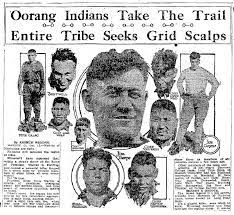
The Oorang Indians were a traveling team in the National Football League from LaRue, Ohio (near Marion). The team was named after the Oorang dog kennels. It was a novelty team put together by the kennels' owner, Walter Lingo, for marketing purposes. All of the players were Native American, with Jim Thorpe as its leading player. They played the 1922 and 1923 NFL seasons. Of the 20 games they played over two seasons, only one was played at "home" in nearby Marion.

With a population well under a thousand people, LaRue is the smallest town ever to have been the home of an NFL franchise, or probably any professional team in any league in the United States.
The Indians franchise began when Lingo first met and became friends with Jim Thorpe, a future NFL Hall of Famer and who was considered the greatest athlete of his time. Thorpe first came to Lingo's defense after neighboring farmers accused the Lingo's Oorang Kennels of raising a nation of sheep killers. Thorpe came to Lingo's aid by testifying that he once knew an Oorang Airedale that had saved the life of a 6-year-old girl, named Mabel, from being trampled by a bull. After that, Lingo and Thorpe became hunting buddies.

In the winter of 1921, Lingo brought Thorpe and Pete Calac, who was a teammate of Thorpe's at the Carlisle Indian School in Pennsylvania, to his plantation in LaRue to hunt for opossum. Lingo would purchase a franchise in the National Football League. At the time, the franchise was priced at $100. However just one of Lingo's Airedales sold for $150. Lingo saw the idea of a franchise as a way of touring the country’s leading cities for the express purpose of advertising his Airedale dogs. Therefore he placed two conditions on the team. The first was that Thorpe had to field an all-Indian team. Secondly, Lingo wanted the team to help run his kennels in addition to playing football. Thorpe and Calac agreed to both terms.

In June 1922, Walter Lingo travelled to Canton, Ohio and purchased an NFL franchise for $100.00. He named his team the Oorang Indians after his kennels and favorite breed of dog. The name stood out to sports and dog fans alike. Lingo also served as the team's business manager.

Jim Thorpe served as a player-coach and recruited players for the team. In keeping with Lingo's wishes that franchise be an all-Indian team, the Oorang Indians consisted of members that were CherokeeMohawkChippewaBlackfeetWinnebagoMissionCaddoSac and FoxSeneca and Penobscot. The team roster included such names as Long Time Sleep, Joe Little Twig, Big Bear, War Eagle, and Thorpe.

Since Lingo’s plan was to advertise his dogs and kennel, the Indians were a traveling team, having only played one home game. That one "home" game was also played in nearby Marion, instead of LaRue since the town did not have a football field. This caused the team to travel week after week to many of major cities in the country. However, despite the hectic schedule, Lingo insisted that the Indians received the very best of care. The same dieticians and the same trainer who fed his Airedales and cared for their well-being, also tended to the Indian team members.

There were two future Hall of Famers on the roster, Thorpe and Joe Guyon, but they did not play much. Thorpe sat out quite a few games and never played more than a half, while Guyon did not join the team until midway through the first season. The Indians defeated the Indianapolis Belmonts, in a snowstorm, 33-0 in their inaugural game, taking home 2,000 in profits and a Cherokee tackle named Chief Johnson, who Thorpe recruited at halftime.

However football was not a priority for Lingo, promoting his kennel was. The pre-game and halftime activities were considered more important than the results of the game, and this entertainment was provided by the players and the Airedale dogs. Because of this lack of interest by Lingo, the Indians turned out not to be a very good team. In fact, they won only three games in two years.

At first the Oorang Indians were an excellent gate attraction. However most fans knew that the team wasn't very good, and they'd already seen the halftime show, so they stayed away. Lingo didn't renew the franchise in 1924. The novelty wore off and Lingo pulled his financial backing. So, at the end of the 1923 season, the Oorang Indians shut down for good. Although the team disbanded in 1924, Lingo’s kennels continued to thrive until the stock market crash of 1929. Lingo then traveled to Minneapolis, Minnesota to promote Oorang dog biscuits. Back in LaRue, Lingo’s wife, Beryl, office secretary Belva Bowdre, and kennel superintendent Carl Sharpe revived the kennels. Although never reaching the success enjoyed in the 1920s, The Oorang Kennel Company continued until Walter Lingo’s death in 1966.

Rather than retiring to the locker room at halftime, the Oorang Indians showed Lingo’s Airedales to the crowd. It was debatable, though, whether the Indians were there to play football or give Airedale exhibitions at halftime. In addition to the exhibitions with the dogs; the Indians, including Thorpe, participated in helping the Oorang Airedales perform tricks for the crowd. However, it was their halftime entertainment that made them such a huge attraction in the early 1920s. There were shooting exhibitions with the dogs retrieving the targets. There were Indian dances and tomahawk and knife-throwing demonstrations. Thorpe would often repeatedly drop kick balls through the uprights from midfield. Nikolas Lassa, also called "Long-Time-Sleep," even wrestled a bear on occasion.
The whole purpose of the Indians was to advertise Lingo's Airedales. The Indians knew that football wasn't important to the owner, so they spent a lot of their time partying and drinking.

In 1922 the night before a game with the Chicago Bears, the Indians went to a Chicago bar called "Everyman's Saloon." At 2:00 a.m., the bartender stopped serving drinks since Illinois law prohibited the sale of alcohol after 2 a.m.. This action upset the Indians who stuffed the bartender in a telephone booth and turned it upside down. The Indians were defeated by the Bears 33-6 just a few hours later.
Another instance in St. Louis occurred when several of the Indians went out drinking for the night. As the night came to an end, the players decided it was time to return to their hotel. They soon found a trolley that could take them back to their rooms, however that particular trolley was headed in the opposite direction. To solve this problem, the Indians players picked up the trolley, and turned it around on the tracks. They then told the conductor the address for their hotel.

The Oorang Indians had to players that would go on to the Hall of Fame in Jim Thorpe and Joe Guyon.

Sources
https://www.pro-football-reference.com/
https://www.profootballarchives.com/index.html
https://americanfootballdatabase.fandom.com/wiki/Football_Wiki
https://www.gridiron-uniforms.com/GUD/controller/controller.php?action=main
https://www.profootballhof.com/hall-of-famers/
"Team Colors – NFL: National Football League – 1922 to Present". ColorWrex. Archived from the original on March 16, 2012. Retrieved March 25, 2012.
 Braunwart, Bob; Caroll, Bob; Horrigan, Joe (1981). "The Oorang Indians" (PDF). Coffin Corner. Vol. 3, no. 1. Pro Football Researchers Association. pp. 1–17. Archived from the original (PDF) on October 14, 2013.
 Harmon, Jeffery G. (May 2011). "Locals Played on Early NFL Team with Thorpe" (PDF). Temecula Historical Society Newsletter. Vol. 11, no. 5. Temecula Historical Society. pp. 1–2. Archived from the original (PDF) on January 30, 2012. Retrieved March 28, 2012.
 1634–1699: McCusker, J. J. (1997). How Much Is That in Real Money? A Historical Price Index for Use as a Deflator of Money Values in the Economy of the United States: Addenda et Corrigenda (PDF). American Antiquarian Society. 1700–1799: McCusker, J. J. (1992). How Much Is That in Real Money? A Historical Price Index for Use as a Deflator of Money Values in the Economy of the United States (PDF). American Antiquarian Society. 1800–present: Federal Reserve Bank of Minneapolis. "Consumer Price Index (estimate) 1800–". Retrieved February 29, 2024.
 Willis, Chris (2002). "Remembering the Oorang Indians, Part II" (PDF). Coffin Corner. 24 (4). Pro Football Researchers Association: 1–3.
 Whitman, Robert Lowell (1984). Jim Thorpe and the Oorang Indians: The N.F.L.'s Most Colorful Franchise. The Hubbard Company. ASIN B000FIUJOO.[page needed]
 Tramel, Jimmie (September 13, 2009). "NFL's Indians were rich in Oklahomans". Tulsa World.
 PFRA, Research (1979). "A Closer Look: 50-YD Dks" (PDF). Coffin Corner. 1 (7). Pro Football Researchers Association: 1. Archived from the original (PDF) on October 4, 2013.
 Willis, Chris. "Remembering the Oorang Indians" (PDF). Coffin Corner. 24 (3). Pro Football Researchers Association: 1–3. Archived from the original (PDF) on February 26, 2012.
 Borowski, Sam (January 5, 1995). "Oorang Indians: One of the First NFL Teams". Indian Country Today. Lakota Times. Archived from the original on September 12, 2017. Retrieved March 28, 2012.
 "History:The Oorang Indians". Pro Football Hall of Fame. Retrieved March 27, 2012.
 "Home of the Oorang Indians". Historical Marker Database. Retrieved March 28, 2012.
 "The Oorang Indians of LaRue, Ohio". MarionHistory.com. Archived from the original on October 14, 2008. Retrieved March 27, 2012.
 History Detectives: Jim Thorpe Ticket, pbs.org, Retrieved July 30, 2012.

Friday, December 10, 2021

The Story And Significance Of Jim Thorpe - The Greatest Athlete There Ever Was


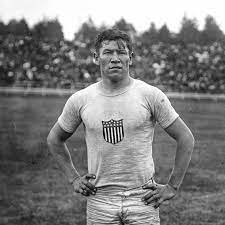
James Francis Thorpe (Sac and Fox (Sauk): Wa-Tho-Huk, translated as "Bright Path"; May 22 or 28, 1887 – March 28, 1953) was an American athlete and Olympic gold medalist. A member of the Sac and Fox Nation, Thorpe was the first Native American to win a gold medal for the United States in the Olympics. Considered one of the most versatile athletes of modern sports, he won two Olympic gold medals in the 1912 Summer Olympics (one in classic pentathlon and the other in decathlon). He also played American football (collegiate and professional), professional baseball, and basketball.
He lost his Olympic titles after it was found he had been paid for playing two seasons of semi-professional baseball before competing in the Olympics, thus violating the contemporary amateurism rules. In 1983, 30 years after his death, the International Olympic Committee (IOC) restored his Olympic medals with replicas, after ruling that the decision to strip him of his medals fell outside of the required 30 days. Thorpe is to date listed as co-champion in both the decathlon and pentathlon events according to official IOC records.
Thorpe grew up in the Sac and Fox Nation in Indian Territory (what is now the U.S. state of Oklahoma). As a youth, he attended Carlisle Indian Industrial School in Carlisle, Pennsylvania, where he was a two-time All-American for the school's football team under coach Pop Warner. After his Olympic success in 1912, which included a record score in the decathlon, he added a victory in the All-Around Championship of the Amateur Athletic Union. In 1913, he played for the Pine Village Pros in Indiana. Later in 1913, Thorpe signed with the New York Giants, and he played six seasons in Major League Baseball between 1913 and 1919. Thorpe joined the Canton Bulldogs American football team in 1915, helping them win three professional championships. He later played for six teams in the National Football League (NFL). He played as part of several all-American Indian teams throughout his career, and barnstormed as a professional basketball player with a team composed entirely of American Indians.
From 1920 to 1921, Thorpe was nominally the first president of the American Professional Football Association (APFA), which became the NFL in 1922. He played professional sports until age 41, the end of his sports career coinciding with the start of the Great Depression. He struggled to earn a living after that, working several odd jobs. He suffered from alcoholism, and lived his last years in failing health and poverty. He was married three times and had eight children, before suffering from heart failure and dying in 1953.
Thorpe has received numerous accolades for his athletic accomplishments. The Associated Press ranked him as the "greatest athlete" from the first 50 years of the 20th century, and the Pro Football Hall of Fame inducted him as part of its inaugural class in 1963. The town of Jim Thorpe, Pennsylvania was named in his honor. It has a monument site that contains his remains, which were the subject of legal action. Thorpe appeared in several films and was portrayed by Burt Lancaster in the 1951 film Jim Thorpe – All-American.
 He first played professional football in 1913 as a member of the Indiana-based Pine Village Pros, a team that had a several-season winning streak against local teams during the 1910s. He signed with the Canton Bulldogs in 1915. They paid him $250 ($6,396 today) a game, a tremendous wage at the time. Before signing him Canton was averaging 1,200 fans a game, but 8,000 showed up for Thorpe's debut against the Massillon Tigers. The team won titles in 1916, 1917, and 1919. Thorpe reportedly ended the 1919 championship game by kicking a wind-assisted 95-yard punt from his team's own 5-yard line, effectively putting the game out of reach.
In 1920, the Bulldogs were one of 14 teams to form the American Professional Football Association (APFA), which would become the National Football League two years later. Thorpe was nominally the APFA's first president, but spent most of the year playing for Canton; a year later, he was replaced as president by Joseph Carr. He continued to play for Canton, coaching the team as well. Between 1921 and 1923, he helped organize and played for the Oorang Indians (LaRue, Ohio), an all-Native American team. Although the team's record was 3–6 in 1922, and 1–10 in 1923, Thorpe played well and was selected for the Green Bay Press-Gazette's first All-NFL team in 1923. This was later formally recognized in 1931 by the NFL as the league's official All-NFL team).
Even though his NFL stats look ordinary, he started his NFL career at 33 he was the first big star in the league and also being the first president of the league is what is most important from his NFL career. Thorpe never played for an NFL championship team. He retired from professional football at age 41, having played 52 NFL games for six teams from 1920 to 1928.
Sources
https://www.pro-football-reference.com/
https://www.profootballarchives.com/index.html
https://americanfootballdatabase.fandom.com/wiki/Football_Wiki
https://www.gridiron-uniforms.com/GUD/controller/controller.php?action=main
https://www.profootballhof.com/hall-of-famers/
Bird, S. Elizabeth (May 2, 1996). Dressing in feathers: the construction of the Indian in American popular culture. London, UK: Avalon. ISBN 978-0-8133-2667-2.
Bloom, John (May 2, 1996). ""There Is Madness in the Air": The 1926 Haskell Homecoming and Popular Representations of Sports in Federal Indian Boarding Schools". In Bird, S. Elizabeth (ed.). Dressing in feathers: the construction of the Indian in American popular culture. London, UK: Avalon. ISBN 978-0-8133-2667-2.
Buford, Kate (2012). Native American Son: the life and sporting legend of Jim Thorpe . Lincoln, Nebraska: University of Nebraska Press. ISBN 978-0-8032-4089-6. OCLC 756837088.
Cava, Pete (Summer 1992). Baseball in the Olympics (PDF). pp. 7–15. Archived from the original (PDF) on August 9, 2017.
Cook, William A. (2011). Jim Thorpe: a biography. Jefferson, N.C: McFarland & Co. ISBN 978-0-7864-6355-8. OCLC 692291486.
Dodge, Robert V. (2013). Which chosen people? Manifest destiny meets the Sioux as seen by Frank Fiske, frontier photographer. New York, N.Y: Algora Publishing. ISBN 978-1-62894-029-9.
Dyreson, Mark (1998). Making the American team: sport, culture, and the Olympic experience. Sport and society. Urbana, Ill.: University of Illinois Press. ISBN 978-0-252-06654-2.
Elfers, James E. (2003). The Tour to End All Tours: the story of major league baseball's 1913-1914 world tour. Lincoln: University of Nebraska Press. ISBN 978-0-8032-6748-0.
Findling, John E.; Pelle, Kimberly D., eds. (2004). Encyclopedia of the modern Olympic movement. Westport, Conn: Greenwood Press. ISBN 978-0-313-32278-5.
Gerasimo, Luisa; Whiteley, Sandra, eds. (2003). The teacher's calendar of famous birthdays. New York: McGraw-Hill. ISBN 978-0-07-141230-8.
Hilger, Michael (2016). Native Americans in the movies: portrayals from silent films to the present. Lanham Boulder New York London: Rowman & Littlefield. ISBN 978-1-4422-4002-5.
Hoxie, Frederick E., ed. (1996). Encyclopedia of North American Indians. Boston, Mass.: Houghton Mifflin. ISBN 978-0-395-66921-1.
Jeansonne, Glen; Luhrssen, David (2006). A time of paradox: America since 1890. Lanham, Md: Rowman & Littlefield. ISBN 978-0-7425-3376-9. OCLC 62109927.
Landrum, Dr. Gene N. (2006). Empowerment: the Competitive Edge in Sports, Business & Life. Brendan Kelly Publishing, Incorporated. ISBN 978-1-89-599724-8.
Lincoln, Kenneth; Slagle, Al Logan (1997). The good red road: passages into Native America. Lincoln: University of Nebraska Press. ISBN 978-0-8032-7974-2.
Magill, Frank Northen, ed. (1987). Great lives from history. Vol. 1 5: American series Sit - Z. Vol. 1. Pasadena, Cal.: Salem Pr. ISBN 978-0-89356-529-9.
Maraniss, David (2022). Path lit by lightning: the life of Jim Thorpe (1st ed.). New York: Simon & Schuster. ISBN 978-1-4767-4841-2.
Neft, David S.; Cohen, Richard M.; Korch, Rick (1994). The Complete History of Professional Football from 1892 to the Present. St. Martin's Press. ISBN 978-0-31-211435-0.
O'Hanlon-Lincoln, Ceane (2004). County chronicles: a vivid collection of Fayette County, Pennsylvania histories. Chicora, PA: Mechling Bookbindery. ISBN 978-0-9744657-8-4.
Quirk, Charles E., ed. (July 10, 2014). Sports and the Law: Major Legal Cases. Taylor & Francis. ISBN 978-1-13-568222-4.
Rendell, Matt, ed. (2004). The Olympics: Athens to Athens, 1896 - 2004. London: Weidenfeld & Nicolson. ISBN 978-0-297-84382-5.
Schaffer, Kay; Smith, Sidonie, eds. (2000). The Olympics at the Millennium: power, politics, and the games. New Brunswick, NJ: Rutgers University Press. ISBN 978-0-8135-2820-5.
Watterson, John Sayle (November 14, 2002). College Football: History, Spectacle, Controversy. Johns Hopkins University Press. ISBN 978-0-80-187114-6.
Wheeler, Robert W. (1979). Jim Thorpe, World's Greatest Athlete. University of Oklahoma Press. ISBN 978-0-80-611745-4.
Williams, Randy (2006). Sports cinema: 100 movies: the best of Hollywood's athletic heroes, losers, myths, and misfits. Pompton Plains, NJ: Limelight Ed. ISBN 978-0-87910-331-6.
Zarnowski, Frank (March 31, 2005). All-Around Men: Heroes of a Forgotten Sport. Scarecrow Press. ISBN 978-0-81-085423-9.
Zarnowski, Frank (2013). The Pentathlon of the Ancient World. Jefferson, NC: McFarland. ISBN 978-0-7864-6783-9.

Friday, December 3, 2021

Who Were The Tampa Cardinals?

The Tampa Cardinals was a barnstorming football team, that played pick-up games, led by future Pro Football Hall of Famer, Jim Thorpe in 1926. During the time, the team was also billed as the St. Petersburg Cardinals and as Lena Vistas. The team was originally organized to play a New Year's Day exhibition against the Chicago Bears of the National Football League in what would be Tampa’s first professional football game. However, the team would later pick up four other games while in Florida. The team has also been referred to as Thorpe's Cardinals.

After the 1925 season, Thorpe formed a team composed primarily of Thorpe's teammates from the NFL’s Rock Island Independents, that would play several games throughout Florida. In a 1926 New Year's Day football exhibition, the Cardinals played against the Chicago Bears led by Red Grange. The game itself was billed as a clash of old vs. new, with Grange, the rising star, taking on Thorpe, the aging legend. During the game Grange rushed for a 70-yard touchdown as the Bears notched a 17-3 victory at Plant Field. This was the first professional football game ever to be played in Tampa.

After the game Thorpe and the core of his Cardinals team remained in Florida to play a few mercenary games under various other names. One game was a win over a Sarasota team constructed by former Florida Gator Robbie Robinson. One week, the Cards were hired to supplement the line-up of the Haven-Villa of Winter Haven, a local club playing out of Winter Haven. The Villas were set to square-off against the Millville Big Blue, a successful independent club from New Jersey that was headed up by Guy Chamberlin. Chamberlin was a friend and former teammate of Thorpe's during their time with the Canton Bulldogs. Despite being scheduled to appear, Thorpe did not take the field during the game. The exact reason for his absence is not clear. The Cardinals, would go on to lose the game 28-7.
In a rematch against Millville was soon scheduled. For the game the Cardinals then headed to St. Petersburg, Florida where they were billed as the St. Petersburg Cardinals. However, this time Millville was now hired to represent Haven-Villa. The game was held at the St. Petersburg Kennel Club in order to accommodate an anticipated large crowd, however the game drew just 300 fans. This time the Cards held Millville to a scoreless tie. A third game was arranged for a few days later in Winter Haven to be played at the local high school stadium. In front of just 500 spectators, the Cardinals were defeated 38-0.
In a fourth game between the two clubs the next day, at Adair Park in Lakeland, in the Cardinals final game in Florida. Thorpe’s team took to the field under the banner of the Lena Vistas while Chamberlin’s team was billed as the Eastern States All-Stars. The Cardinals lost yet again 24-0 to Milleville. The team then ended their season, due a lack of interest that led to a disappointing fan turnout. The team finished their tour of Florida with a 0-4-1 record.
Sources
https://www.pro-football-reference.com/
https://www.profootballarchives.com/index.html
https://americanfootballdatabase.fandom.com/wiki/Football_Wiki
https://www.gridiron-uniforms.com/GUD/controller/controller.php?action=main
https://www.profootballhof.com/hall-of-famers/
Fenton, John. "Ghosts of the Gridiron,Virtual Scrapbook Library, Vol. 8, Thorpe's Cardinals". Archived from the original on October 2, 2015. Retrieved February 7, 2023.
 Fenton, John. "Millville Football & Athletic Club" (PDF). PFRA Annual. Professional Football Researchers Association: 1–9.
 "Thorpe defeats Sarasota squad for 'come back'". Tampa Tribune. January 17, 1926. p. 19. Retrieved February 7, 2023 – via Newspapers.com.
 "Two Great Grid Stars Closed Careers Here". Sarasota Journal. July 14, 1964.

Champions Of The USA - The Story of Rock Island Independents


The
 Rock Island Independents were a professional American football team, based in Rock Island, Illinois, from 1907 to 1926. The Independents were a founding National Football League franchise. They hosted what has been retrospectively designated the First National Football League Game on September 26, 1920 at Douglas Park. The Independents were founded in 1907 by Demetrius Clements as an independent football club. Hence, the team was named the "Independents."

In 1926, the Independents left the NFL to become a charter member of the first American Football League, the only NFL team to do so. The Independents then folded along with the entire league in 1927.

Pro Football Hall of Fame alumni Jimmy Conzelman (1920–1921), Joe Guyon (1924), Ed Healey (1920–1922), Duke Slater (1922-1926), and Jim Thorpe (1924–1925) played for the Independents.

The 1920 Rock Island Independents season was the American football franchise's thirteenth season and inaugural season in the American Professional Football Association (APFA). The Independents hosted first ever APFA/National Football League contest on September 26, 1920. After the AFPA had been formed on September 17, 1920, Douglas Park was the venue as the Independents hosted the St. Paul Ideals, winning 48-0 in the new league's first contest.

The Independents entered the season coming off a nine-win, one-loss, one-tie (9–1–1) record in 1919 as an independent team, which the team proclaimed to be the "Champions of the USA". After the 1919 season, several representatives from the Ohio League, another American football league, wanted to form a new professional league; thus, the APFA was created.

A majority of the team stayed from the 1919 team, including the coaching staff, but Keith Dooley was added to the roster. The Independents opened the season with a win against the St. Paul Ideals, a non-APFA team. This was the first game in the history of the APFA. The team played all but one game at their home field, Douglas Park, and ended the season with a 6–2–2 record, which placed the team tied-for-fourth in the league standings.

The Rock Island Independents finished 9–1–1 in their 1919 season, claiming the National Championship. For the 1920 season, the Independents added multiple players to its roster: Keith Dooley, who previously played from 1912–1916; Fred Denfield, Mark Devlin, and Harry Gunderson, who previously played in 1917; Ed Healey, Polly Koch, George Magerkurth, Ed Shaw, Ben Synhorst, Harry Webber, Obe Wenig, and Arnie Wyman. The team lost Wes Bradshaw, Leland Dempsey, Al Jorgenson, Loyal Robb, Fats Smith, Red Swanson, and co-coach John Roche.

After the 1919 season, representatives of the Canton Bulldogs, the Cleveland Tigers, the Dayton Triangles, and the Akron Pros met on August 20, 1920, to discuss the formation of a new league. At the meeting, they tentatively agreed on a salary cap and pledged not to sign college players or players already under contract with other teams. They also agreed on a name for the circuit: the American Professional Football Conference. They then invited other professional teams to a second meeting on September 17.

At that meeting, held at Bulldogs owner Ralph Hay's Hupmobile showroom in Canton, representatives of the Rock Island Independents, the Muncie Flyers, the Decatur Staleys, the Racine Cardinals, the Massillon Tigers, the Chicago Cardinals, and the Hammond Pros agreed to join the league. Representatives of the Buffalo All-Americans and Rochester Jeffersons could not attend the meeting, but sent letters to Hay asking to be included in the league. Team representatives changed the league's name slightly to the American Professional Football Association and elected officers, installing Jim Thorpe as president. Under the new league structure, teams created their schedules dynamically as the season progressed, so there were no minimum or maximum number of games needed to be played. Also, representatives of each team voted to determine the winner of the APFA trophy.

Since there were no playoff system in the APFA until 1932, a meeting was held to determine the 1920 APFA Champions. Each team that showed up had a vote to determine the champions. The Akron Pros were awarded the Brunswick-Balke Collender Cup on April 30, 1921. Ties were not counted in standings until 1972, which is why Akron is credited with a 1.000 winning percentage. The Independents tied for fourth place in the standings. The sportswriter Bruce Copeland compiled the All-Pro list for the 1920 season. Denfield, Lyle, and Novak made the first-team; Wenig and Shaw made the second-team; and Buland and Fitzgerald made the third-team. Of all the players on the roster, only Healey has been enshrined in the Pro Football Hall of Fame.

In 1926, football star Red Grange and his agent, C. C. Pyle, formed the American Football League (AFL) after Pyle was denied ownership of an NFL franchise in New York City.

Talks took hold and the league was formed. Founding American Football League teams for 1926 were the Boston Bulldogs, Brooklyn Horsemen, Chicago Bulls, Cleveland Panthers, Los Angeles Wildcats, Newark Bears, New York Yankees, Philadelphia Quakers and the Rock Island Independents. Rock Island left the NFL to join the new league. The Independents also moved from Douglas Park in Rock Island to Browning Field in neighboring Moline, Illinois for the 1926 season. The Independents were the only NFL team to make the jump to the rival league.

However, the AFL did not pay as much as the NFL did a year prior and Independents players left the team for bigger salaries with other NFL teams. As a result, the Independents ended their season with a 2–6–1 record. Coached by Johnny Armstrong, the Independents played their first three games at Browning Field and then played the rest of their 1926 games as a traveling team. The AFL folded after the season and the Independents were rejected in their attempt to rejoin the NFL. They played as a semi-pro team in 1927, then went out of business.

Now this is my second blog post on the Independents so here is a video on the 2019 Vintage Football game played on September 28th between the Rock Island Independents and the St. Paul Ideals in Douglas Park in Rock Island Illinois. The Independents were and original NFL franchise in 1920 and their game between them and the Ideals on September 26th 1920 was the first game featuring a team from the newly formed NFL. 99 years later, MC22 recorded the rematch of this game.

https://www.youtube.com/watch?v=QwpGy8dzeTc&t=1878s
Sources
https://www.pro-football-reference.com/
https://www.profootballarchives.com/index.html
https://americanfootballdatabase.fandom.com/wiki/Football_Wiki
https://www.gridiron-uniforms.com/GUD/controller/controller.php?action=main
https://www.profootballhof.com/hall-of-famers/
 "NFL founded in Canton - Pro Football Hall of Fame Official Site". www.profootballhof.com.
 "St. Paul Ideals at Rock Island Independents - September 26th, 1920". Pro-Football-Reference.com.
 "Football Firsts - Pro Football Hall of Fame Official Site". www.profootballhof.com.
 "Independents to Launch Their Eleventh Year of Success in Fall Sport," Rock Island Argus, Sept. 30, 1922, p. 17.
 Peterson, Robert W. (1997). Pigskin: The Early Years of Pro Football. Oxford University Press. ISBN 0-19-511913-4.
 "Walter Flanigan". Rock Island Independents.com. Retrieved March 29, 2012.
 "1917 Minneapolis Marines - The Pro Football Archives". profootballarchives.com.
 "1917 Rock Island Independents - The Pro Football Archives". profootballarchives.com.
 Braunwart, Bob; Carroll, Bob (1983). "The Rock Island Independents" (PDF). Coffin Corner. 5 (3). Pro Football Researchers Association: 1–7. Retrieved February 8, 2023.
 "Happy Birthday NFL?" (PDF). The Coffin Corner. 2 (8). Professional Football Researchers Association. 1980. Archived from the original (PDF) on February 6, 2009. Retrieved February 7, 2013.
 "NFL founded in Canton - Pro Football Hall of Fame Official Site". www.profootballhof.com.
 "Sept. 17, 1920 -- The Founding of the NFL - Pro Football Hall of Fame Official Site". www.profootballhof.com.
 "National Football League (NFL)". Encyclopædia Britannica. Retrieved June 21, 2013.
 "Walter Flanigan". Archived from the original on March 4, 2016. Retrieved February 28, 2016.
 "Football History - Pro Football Hall of Fame Official Site". www.profootballhof.com.
 "1920 APFA Standings & Team Stats". Pro-Football-Reference.com.
 "Rock Island Independents 1920 Game Log". Pro-Football-Reference.com.
 "Archived copy" (PDF). Archived from the original (PDF) on March 11, 2012. Retrieved June 9, 2011.
 "Rock Island Independents". Illinois Ancestors. Retrieved March 30, 2012.
 "Sept. 17, 1920 – The Founding of the NFL". Pro Football Hall of Fame. Retrieved July 9, 2012.
 "1922 American Professional Football Association changes name to National Football League". Pro Football Hall of Fame. Retrieved June 29, 2017.
 "First sale of 'Pro' grid man made to Bears". Burlington Gazette. November 28, 1922. p. 11. Retrieved August 20, 2023.
 "GRANGE'S LONG RUN BREAKS FLORIDA TIE; Dashes 70 Yards to Score on Tampa Cardinals -- Bears Win by 17 to 3. STERNAMAN ALSO TALLIES Second Touchdown Follows Star's Sprint in Last Period -- Quarter Makes 11 Points". The New York Times. January 2, 1926.
 Jam, Professor. "History of Professional Football and Stadium Sports in Tampa, Florida". BuccaneersFan.com Fanatical Fan site.
 "Douglas Park". Rock Island, IL.
 "mcubed.net : NCAAF Football : Series records : Illinois vs. Iowa". www.mcubed.net.
 SCHORPP, DOUG. "EXCHANGE: Rock Island game recalls early days of NFL". chicagotribune.com.
 Green, Doug (October 4, 2012). "Moline's Browning Field turns 100". The Quad-City Times.
 "Wharton Field House Home – Wharton Field House / Browning Field – Moline-Coal Valley School District No. 40". www.molineschools.org.
 "1926 Rock Island Independents - The Pro Football Archives". profootballarchives.com.
 "The Pro Football Archives - Pro Football Statistics and History". profootballarchives.com.

Tuesday, May 4, 2021

Who Were The Rock Island Independents?

The Rock Island Independents were a professional American football team, based in Rock Island, Illinois, from 1907–1926. The Independents were a founding National Football League franchise. They hosted what has been retrospectively designated the First National Football League Game on September 26, 1920 at Douglas Park. The Independents were founded in 1907 by Demetrius Clements as an independent football club. Hence, the team was named the "Independents."

In 1926, the Independents left the NFL to become a charter member of the first American Football League, the only NFL team to do so. The Independents then folded along with the entire league in 1927.
On September 26, 1920, the Independents hosted the first official game featuring a team from the APFA. Thus, the Independents' Douglas Park became the site of the first ever National Football League contest. Just nine days after the league had formed, on September 26, 1920, the Independents defeated the St. Paul Ideals 48–0 in the first contest involving a member team of the APFA.

A week later, on October 3, 1920, the Independents defeated the Muncie Flyers 45–0 at Douglas Park in the first full week of APFA league play. 3,100 fans were in attendance as Arnie Wyman, former Minnesota great, made his debut for the Islanders, scoring three touchdowns. This might have been the first NFL game ever played between two NFL teams, however, NFL historical records don't indicate the kickoff time for this game or the other APFA game played that day between the Dayton Triangles and the Columbus Panhandles in Dayton, Ohio.

The Independents posted 4–2–1 records in the league's first year. They had the same record the next two seasons, with five of their six losses in three years coming to George Halas and the Decatur Staleys/Chicago Staleys/Chicago Bears. On June 24, 1922, the APFA changed its name to the National Football League (NFL).

The Independents' overall NFL record was 26–14–9, with five winning seasons in six years. After finishing fourth in 1920, their best overall finish in the National Football League standings was fifth, which they accomplished three times: in 1921 and 1922 under Jimmy Conzelman, and in 1924 under Johnny Armstrong.

In 1926, football star Red Grange and his agent, C. C. Pyle, formed the American Football League (AFL) after Pyle was denied ownership of an NFL franchise in New York City.


Talks took hold and the league was formed. Founding American Football League teams for 1926 were the Boston Bulldogs, Brooklyn Horsemen, Chicago Bulls, Cleveland Panthers, Los Angeles Wildcats, Newark Bears, New York Yankees, Philadelphia Quakers and the Rock Island Independents. Rock Island left the NFL to join the new league. The Independents also moved from Douglas Park in Rock Island to Browning Field in neighboring Moline, Illinois for the 1926 season. The Independents were the only NFL team to make the jump to the rival league.

However, the AFL did not pay as much as the NFL did a year prior and Independents players left the team for bigger salaries with other NFL teams. As a result, the Independents ended their season with a 2–6–1 record. Coached by Johnny Armstrong, the Independents played their first three games at Browning Field and then played the rest of their 1926 games as a traveling team. The AFL folded after the season and the Independents were rejected in their attempt to rejoin the NFL. They played as a semi-pro team in 1927, then went out of business.

The team has 5 members in the Pro Football Hall of Fame. The Hall of Fame alumni are Jimmy Conzelman (1920–1921), Joe Guyon (1924), Ed Healey (1920–1922), Duke Slater (1922-1926), and Jim Thorpe (1924–1925) played for the Independents.
Sources
https://www.pro-football-reference.com/
https://www.profootballarchives.com/index.html
https://americanfootballdatabase.fandom.com/wiki/Football_Wiki
https://www.gridiron-uniforms.com/GUD/controller/controller.php?action=main
https://www.profootballhof.com/hall-of-famers/
 "NFL founded in Canton - Pro Football Hall of Fame Official Site". www.profootballhof.com.
 "St. Paul Ideals at Rock Island Independents - September 26th, 1920". Pro-Football-Reference.com.
 "Football Firsts - Pro Football Hall of Fame Official Site". www.profootballhof.com.
 "Independents to Launch Their Eleventh Year of Success in Fall Sport," Rock Island Argus, Sept. 30, 1922, p. 17.
 Peterson, Robert W. (1997). Pigskin: The Early Years of Pro Football. Oxford University Press. ISBN 0-19-511913-4.
 "Walter Flanigan". Rock Island Independents.com. Retrieved March 29, 2012.
 "1917 Minneapolis Marines - The Pro Football Archives". profootballarchives.com.
 "1917 Rock Island Independents - The Pro Football Archives". profootballarchives.com.
 Braunwart, Bob; Carroll, Bob (1983). "The Rock Island Independents" (PDF). Coffin Corner. 5 (3). Pro Football Researchers Association: 1–7. Retrieved February 8, 2023.
 "Happy Birthday NFL?" (PDF). The Coffin Corner. 2 (8). Professional Football Researchers Association. 1980. Archived from the original (PDF) on February 6, 2009. Retrieved February 7, 2013.
 "NFL founded in Canton - Pro Football Hall of Fame Official Site". www.profootballhof.com.
 "Sept. 17, 1920 -- The Founding of the NFL - Pro Football Hall of Fame Official Site". www.profootballhof.com.
 "National Football League (NFL)". Encyclopædia Britannica. Retrieved June 21, 2013.
 "Walter Flanigan". Archived from the original on March 4, 2016. Retrieved February 28, 2016.
 "Football History - Pro Football Hall of Fame Official Site". www.profootballhof.com.
 "1920 APFA Standings & Team Stats". Pro-Football-Reference.com.
 "Rock Island Independents 1920 Game Log". Pro-Football-Reference.com.
 "Archived copy" (PDF). Archived from the original (PDF) on March 11, 2012. Retrieved June 9, 2011.
 "Rock Island Independents". Illinois Ancestors. Retrieved March 30, 2012.
 "Sept. 17, 1920 – The Founding of the NFL". Pro Football Hall of Fame. Retrieved July 9, 2012.
 "1922 American Professional Football Association changes name to National Football League". Pro Football Hall of Fame. Retrieved June 29, 2017.
 "First sale of 'Pro' grid man made to Bears". Burlington Gazette. November 28, 1922. p. 11. Retrieved August 20, 2023.
 "GRANGE'S LONG RUN BREAKS FLORIDA TIE; Dashes 70 Yards to Score on Tampa Cardinals -- Bears Win by 17 to 3. STERNAMAN ALSO TALLIES Second Touchdown Follows Star's Sprint in Last Period -- Quarter Makes 11 Points". The New York Times. January 2, 1926.
 Jam, Professor. "History of Professional Football and Stadium Sports in Tampa, Florida". BuccaneersFan.com Fanatical Fan site.
 "Douglas Park". Rock Island, IL.
 "mcubed.net : NCAAF Football : Series records : Illinois vs. Iowa". www.mcubed.net.
 SCHORPP, DOUG. "EXCHANGE: Rock Island game recalls early days of NFL". chicagotribune.com.
 Green, Doug (October 4, 2012). "Moline's Browning Field turns 100". The Quad-City Times.
 "Wharton Field House Home – Wharton Field House / Browning Field – Moline-Coal Valley School District No. 40". www.molineschools.org.
 "1926 Rock Island Independents - The Pro Football Archives". profootballarchives.com.
 "The Pro Football Archives - Pro Football Statistics and History". profootballarchives.com.