Showing posts with label Oorang Indians. Show all posts

Friday, August 5, 2022

The Story And Significance Of Joe Guyon - Mr. Everthing For The 1927 Champion New York Giants

Joseph Napoleon "Big Chief" Guyon was an American Indian from the Ojibwa tribe (Chippewa) who was an American football and baseball player and coach. He played college football at the Carlisle Indian Industrial School from 1912 to 1913 and Georgia Tech from 1917 to 1918 and with a number of professional clubs from 1919 to 1927. He was inducted into the Pro Football Hall of Fame in 1966 and the College Football Hall of Fame in 1971.

Guyon signed to play professional football with the Canton Bulldogs in 1919. After the NFL was organized in 1920, he played seven more seasons with the Washington Senators, Cleveland Indians, Oorang Indians, Rock Island Independents, Kansas City Cowboys, and the New York Giants. From 1919 to 1924, he teamed with another outstanding Indian halfback, Jim Thorpe. They parted ways late in the 1924 season when Guyon left the Independents to go to Kansas City. He stayed with the Cowboys in 1925 while Thorpe went to the Giants.

Two years later in 1927, Guyon became a Giant and he played a major role in leading the New Yorkers to the 1927 NFL championship. Guyon, away from the shadow of Thorpe, enjoyed one of his finest seasons and gained the first significant publicity he had enjoyed since his college days. The 1927 Giants compiled an 11-1-1 record largely on the strength of a superior defensive that allowed only 20 points all season. But Guyon, flashing all of his many abilities – passing, running, punting, tackling and blocking and played a leading role in scoring the necessary points for his team that also finished second in scoring that season.

Guyon coached the Bulldogs of Union University in Jackson, Tennessee in 1919. He returned to Union in 1923 and coached all sports from 1923 to 1927. Union inducted Guyon into its sports hall of fame in 2008.

Guyon coached the backfield of the 1920 Georgia Tech team. He also coached high school football at St. Xavier High School in Louisville, Kentucky from 1931 to 1933, with a 16–7–2 record.

Sources
https://www.pro-football-reference.com/
https://www.profootballarchives.com/index.html
https://americanfootballdatabase.fandom.com/wiki/Football_Wiki
https://www.gridiron-uniforms.com/GUD/controller/controller.php?action=main
https://www.profootballhof.com/hall-of-famers/
 "Joe Guyon's HOF Profile". Pro Football Hall of Fame. Retrieved January 21, 2009.
 "Georgia Tech Boasts All-Southern Eleven". Fort Wayne Journal-Gazette. November 20, 1918. p. 6. Retrieved December 17, 2015 – via Newspapers.com. Open access icon
 "Joe Guyon". College Football Hall of Fame. Football Foundation. Retrieved January 21, 2009.
 C. Richard King (March 10, 2015). Native Americans in Sports. Routledge. p. 137. ISBN 9781317464037.
 Sentinel, Joseph Cress, The (November 8, 2012). "Carlisle vs. Army: 100 years later, game remembered for celebrity players".
 Willis, Chris (May 5, 2017). Walter Lingo, Jim Thorpe, and the Oorang Indians: How a Dog Kennel Owner Created the NFL's Most Famous Traveling Team. Rowman & Littlefield. ISBN 9781442277663.
 Rozendaal, Neal (July 9, 2012). Duke Slater: Pioneering Black NFL Player and Judge. McFarland. ISBN 9780786469574.
 "All-Time Football Team Lists Greats Of Past, Present". Gadsden Times. July 27, 1969.
 Umphlett 1992, p. 142
 Umphlett 1992, p. 141
 Spalding Football Guide. Shawnee Mission, Kansas, NCAA Publishing Service. 1918.
 "Strupper and Guyon of Georgia Tech Are Hailed As Two of the Greatest Pigskin Heroes In Seasons". The Day. November 19, 1917.
 "Jackets Win Double Bill" (PDF). The Technique. October 2, 1917. p. 4. Archived from the original (PDF) on October 30, 2014.
 "Georgia Crushes W. and L." The New York Times. October 21, 1917. p. 118. Retrieved November 10, 2024 – via Newspapers.com.
 McCarty 1988a, p. 5
 McCarty 1988b, p. 15
 "Golden Tornado Wins Great Victory" (PDF). The Technique. December 4, 1917. p. 4.
 Union University (January 1, 1920). Lest We Forget 1920. Student Organizations of Union University.
 "Coach Guyon Leaves Union". Cardinal and Cream. April 8, 1927 – via Union University Archives.
 "Union to induct six into Sports Hall of Fame Nov. 7 - News Release". November 5, 2008.
 "Alumni Events 2008" (PDF). Union University. Retrieved November 10, 2024.
 "Blue Print, 1921". School Yearbooks. Georgia Institute of Technology. January 1, 1921.
 Powers-Beck, Jeffrey (August 16, 2011). ""A Role New to the Race": A New History of the Nebraska Indians" (PDF). Nebraska History. Archived from the original on May 22, 2013.
McCarty, Bernie (February 1988). "Georgia Tech's 1917 backfield, better than the Four Horsemen: Part 1" (PDF). College Football Historical Society Newsletter. 1 (3). Archived from the original (PDF) on March 4, 2016.
McCarty, Bernie (May 1988). "Georgia Tech's 1917 backfield, better than the Four Horsemen: Part 2" (PDF). College Football Historical Society Newsletter. 1 (4). Archived from the original (PDF) on March 4, 2016.
Umphlett, Wiley Lee (1992). Creating the Big Game: John W. Heisman and the Invention of American Football. Westport, CT: Greenwood Publishing Group. p. 141. ISBN 978-0-313-28404-5.

Tuesday, January 11, 2022

Who Were The Oorang Indians?


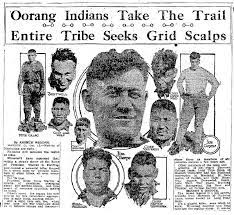
The Oorang Indians were a traveling team in the National Football League from LaRue, Ohio (near Marion). The team was named after the Oorang dog kennels. It was a novelty team put together by the kennels' owner, Walter Lingo, for marketing purposes. All of the players were Native American, with Jim Thorpe as its leading player. They played the 1922 and 1923 NFL seasons. Of the 20 games they played over two seasons, only one was played at "home" in nearby Marion.

With a population well under a thousand people, LaRue is the smallest town ever to have been the home of an NFL franchise, or probably any professional team in any league in the United States.
The Indians franchise began when Lingo first met and became friends with Jim Thorpe, a future NFL Hall of Famer and who was considered the greatest athlete of his time. Thorpe first came to Lingo's defense after neighboring farmers accused the Lingo's Oorang Kennels of raising a nation of sheep killers. Thorpe came to Lingo's aid by testifying that he once knew an Oorang Airedale that had saved the life of a 6-year-old girl, named Mabel, from being trampled by a bull. After that, Lingo and Thorpe became hunting buddies.

In the winter of 1921, Lingo brought Thorpe and Pete Calac, who was a teammate of Thorpe's at the Carlisle Indian School in Pennsylvania, to his plantation in LaRue to hunt for opossum. Lingo would purchase a franchise in the National Football League. At the time, the franchise was priced at $100. However just one of Lingo's Airedales sold for $150. Lingo saw the idea of a franchise as a way of touring the country’s leading cities for the express purpose of advertising his Airedale dogs. Therefore he placed two conditions on the team. The first was that Thorpe had to field an all-Indian team. Secondly, Lingo wanted the team to help run his kennels in addition to playing football. Thorpe and Calac agreed to both terms.

In June 1922, Walter Lingo travelled to Canton, Ohio and purchased an NFL franchise for $100.00. He named his team the Oorang Indians after his kennels and favorite breed of dog. The name stood out to sports and dog fans alike. Lingo also served as the team's business manager.

Jim Thorpe served as a player-coach and recruited players for the team. In keeping with Lingo's wishes that franchise be an all-Indian team, the Oorang Indians consisted of members that were Cherokee, Mohawk, Chippewa, Blackfeet, Winnebago, Mission, Caddo, Sac and Fox, Seneca and Penobscot. The team roster included such names as Long Time Sleep, Joe Little Twig, Big Bear, War Eagle, and Thorpe.

Since Lingo’s plan was to advertise his dogs and kennel, the Indians were a traveling team, having only played one home game. That one "home" game was also played in nearby Marion, instead of LaRue since the town did not have a football field. This caused the team to travel week after week to many of major cities in the country. However, despite the hectic schedule, Lingo insisted that the Indians received the very best of care. The same dieticians and the same trainer who fed his Airedales and cared for their well-being, also tended to the Indian team members.

There were two future Hall of Famers on the roster, Thorpe and Joe Guyon, but they did not play much. Thorpe sat out quite a few games and never played more than a half, while Guyon did not join the team until midway through the first season. The Indians defeated the Indianapolis Belmonts, in a snowstorm, 33-0 in their inaugural game, taking home 2,000 in profits and a Cherokee tackle named Chief Johnson, who Thorpe recruited at halftime.

However football was not a priority for Lingo, promoting his kennel was. The pre-game and halftime activities were considered more important than the results of the game, and this entertainment was provided by the players and the Airedale dogs. Because of this lack of interest by Lingo, the Indians turned out not to be a very good team. In fact, they won only three games in two years.

At first the Oorang Indians were an excellent gate attraction. However most fans knew that the team wasn't very good, and they'd already seen the halftime show, so they stayed away. Lingo didn't renew the franchise in 1924. The novelty wore off and Lingo pulled his financial backing. So, at the end of the 1923 season, the Oorang Indians shut down for good. Although the team disbanded in 1924, Lingo’s kennels continued to thrive until the stock market crash of 1929. Lingo then traveled to Minneapolis, Minnesota to promote Oorang dog biscuits. Back in LaRue, Lingo’s wife, Beryl, office secretary Belva Bowdre, and kennel superintendent Carl Sharpe revived the kennels. Although never reaching the success enjoyed in the 1920s, The Oorang Kennel Company continued until Walter Lingo’s death in 1966.

Rather than retiring to the locker room at halftime, the Oorang Indians showed Lingo’s Airedales to the crowd. It was debatable, though, whether the Indians were there to play football or give Airedale exhibitions at halftime. In addition to the exhibitions with the dogs; the Indians, including Thorpe, participated in helping the Oorang Airedales perform tricks for the crowd. However, it was their halftime entertainment that made them such a huge attraction in the early 1920s. There were shooting exhibitions with the dogs retrieving the targets. There were Indian dances and tomahawk and knife-throwing demonstrations. Thorpe would often repeatedly drop kick balls through the uprights from midfield. Nikolas Lassa, also called "Long-Time-Sleep," even wrestled a bear on occasion.
The whole purpose of the Indians was to advertise Lingo's Airedales. The Indians knew that football wasn't important to the owner, so they spent a lot of their time partying and drinking.

In 1922 the night before a game with the Chicago Bears, the Indians went to a Chicago bar called "Everyman's Saloon." At 2:00 a.m., the bartender stopped serving drinks since Illinois law prohibited the sale of alcohol after 2 a.m.. This action upset the Indians who stuffed the bartender in a telephone booth and turned it upside down. The Indians were defeated by the Bears 33-6 just a few hours later.
Another instance in St. Louis occurred when several of the Indians went out drinking for the night. As the night came to an end, the players decided it was time to return to their hotel. They soon found a trolley that could take them back to their rooms, however that particular trolley was headed in the opposite direction. To solve this problem, the Indians players picked up the trolley, and turned it around on the tracks. They then told the conductor the address for their hotel.

The Oorang Indians had to players that would go on to the Hall of Fame in Jim Thorpe and Joe Guyon.

Sources
https://www.pro-football-reference.com/
https://www.profootballarchives.com/index.html
https://americanfootballdatabase.fandom.com/wiki/Football_Wiki
https://www.gridiron-uniforms.com/GUD/controller/controller.php?action=main
https://www.profootballhof.com/hall-of-famers/
"Team Colors – NFL: National Football League – 1922 to Present". ColorWrex. Archived from the original on March 16, 2012. Retrieved March 25, 2012.
 Braunwart, Bob; Caroll, Bob; Horrigan, Joe (1981). "The Oorang Indians" (PDF). Coffin Corner. Vol. 3, no. 1. Pro Football Researchers Association. pp. 1–17. Archived from the original (PDF) on October 14, 2013.
 Harmon, Jeffery G. (May 2011). "Locals Played on Early NFL Team with Thorpe" (PDF). Temecula Historical Society Newsletter. Vol. 11, no. 5. Temecula Historical Society. pp. 1–2. Archived from the original (PDF) on January 30, 2012. Retrieved March 28, 2012.
 1634–1699: McCusker, J. J. (1997). How Much Is That in Real Money? A Historical Price Index for Use as a Deflator of Money Values in the Economy of the United States: Addenda et Corrigenda (PDF). American Antiquarian Society. 1700–1799: McCusker, J. J. (1992). How Much Is That in Real Money? A Historical Price Index for Use as a Deflator of Money Values in the Economy of the United States (PDF). American Antiquarian Society. 1800–present: Federal Reserve Bank of Minneapolis. "Consumer Price Index (estimate) 1800–". Retrieved February 29, 2024.
 Willis, Chris (2002). "Remembering the Oorang Indians, Part II" (PDF). Coffin Corner. 24 (4). Pro Football Researchers Association: 1–3.
 Whitman, Robert Lowell (1984). Jim Thorpe and the Oorang Indians: The N.F.L.'s Most Colorful Franchise. The Hubbard Company. ASIN B000FIUJOO.[page needed]
 Tramel, Jimmie (September 13, 2009). "NFL's Indians were rich in Oklahomans". Tulsa World.
 PFRA, Research (1979). "A Closer Look: 50-YD Dks" (PDF). Coffin Corner. 1 (7). Pro Football Researchers Association: 1. Archived from the original (PDF) on October 4, 2013.
 Willis, Chris. "Remembering the Oorang Indians" (PDF). Coffin Corner. 24 (3). Pro Football Researchers Association: 1–3. Archived from the original (PDF) on February 26, 2012.
 Borowski, Sam (January 5, 1995). "Oorang Indians: One of the First NFL Teams". Indian Country Today. Lakota Times. Archived from the original on September 12, 2017. Retrieved March 28, 2012.
 "History:The Oorang Indians". Pro Football Hall of Fame. Retrieved March 27, 2012.
 "Home of the Oorang Indians". Historical Marker Database. Retrieved March 28, 2012.
 "The Oorang Indians of LaRue, Ohio". MarionHistory.com. Archived from the original on October 14, 2008. Retrieved March 27, 2012.
 History Detectives: Jim Thorpe Ticket, pbs.org, Retrieved July 30, 2012.

Friday, December 10, 2021

The Story And Significance Of Jim Thorpe - The Greatest Athlete There Ever Was


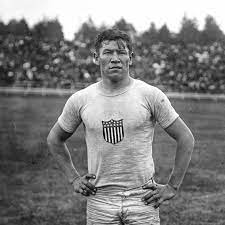
James Francis Thorpe (Sac and Fox (Sauk): Wa-Tho-Huk, translated as "Bright Path"; May 22 or 28, 1887 – March 28, 1953) was an American athlete and Olympic gold medalist. A member of the Sac and Fox Nation, Thorpe was the first Native American to win a gold medal for the United States in the Olympics. Considered one of the most versatile athletes of modern sports, he won two Olympic gold medals in the 1912 Summer Olympics (one in classic pentathlon and the other in decathlon). He also played American football (collegiate and professional), professional baseball, and basketball.
He lost his Olympic titles after it was found he had been paid for playing two seasons of semi-professional baseball before competing in the Olympics, thus violating the contemporary amateurism rules. In 1983, 30 years after his death, the International Olympic Committee (IOC) restored his Olympic medals with replicas, after ruling that the decision to strip him of his medals fell outside of the required 30 days. Thorpe is to date listed as co-champion in both the decathlon and pentathlon events according to official IOC records.
Thorpe grew up in the Sac and Fox Nation in Indian Territory (what is now the U.S. state of Oklahoma). As a youth, he attended Carlisle Indian Industrial School in Carlisle, Pennsylvania, where he was a two-time All-American for the school's football team under coach Pop Warner. After his Olympic success in 1912, which included a record score in the decathlon, he added a victory in the All-Around Championship of the Amateur Athletic Union. In 1913, he played for the Pine Village Pros in Indiana. Later in 1913, Thorpe signed with the New York Giants, and he played six seasons in Major League Baseball between 1913 and 1919. Thorpe joined the Canton Bulldogs American football team in 1915, helping them win three professional championships. He later played for six teams in the National Football League (NFL). He played as part of several all-American Indian teams throughout his career, and barnstormed as a professional basketball player with a team composed entirely of American Indians.
From 1920 to 1921, Thorpe was nominally the first president of the American Professional Football Association (APFA), which became the NFL in 1922. He played professional sports until age 41, the end of his sports career coinciding with the start of the Great Depression. He struggled to earn a living after that, working several odd jobs. He suffered from alcoholism, and lived his last years in failing health and poverty. He was married three times and had eight children, before suffering from heart failure and dying in 1953.
Thorpe has received numerous accolades for his athletic accomplishments. The Associated Press ranked him as the "greatest athlete" from the first 50 years of the 20th century, and the Pro Football Hall of Fame inducted him as part of its inaugural class in 1963. The town of Jim Thorpe, Pennsylvania was named in his honor. It has a monument site that contains his remains, which were the subject of legal action. Thorpe appeared in several films and was portrayed by Burt Lancaster in the 1951 film Jim Thorpe – All-American.
 He first played professional football in 1913 as a member of the Indiana-based Pine Village Pros, a team that had a several-season winning streak against local teams during the 1910s. He signed with the Canton Bulldogs in 1915. They paid him $250 ($6,396 today) a game, a tremendous wage at the time. Before signing him Canton was averaging 1,200 fans a game, but 8,000 showed up for Thorpe's debut against the Massillon Tigers. The team won titles in 1916, 1917, and 1919. Thorpe reportedly ended the 1919 championship game by kicking a wind-assisted 95-yard punt from his team's own 5-yard line, effectively putting the game out of reach.
In 1920, the Bulldogs were one of 14 teams to form the American Professional Football Association (APFA), which would become the National Football League two years later. Thorpe was nominally the APFA's first president, but spent most of the year playing for Canton; a year later, he was replaced as president by Joseph Carr. He continued to play for Canton, coaching the team as well. Between 1921 and 1923, he helped organize and played for the Oorang Indians (LaRue, Ohio), an all-Native American team. Although the team's record was 3–6 in 1922, and 1–10 in 1923, Thorpe played well and was selected for the Green Bay Press-Gazette's first All-NFL team in 1923. This was later formally recognized in 1931 by the NFL as the league's official All-NFL team).
Even though his NFL stats look ordinary, he started his NFL career at 33 he was the first big star in the league and also being the first president of the league is what is most important from his NFL career. Thorpe never played for an NFL championship team. He retired from professional football at age 41, having played 52 NFL games for six teams from 1920 to 1928.
Sources
https://www.pro-football-reference.com/
https://www.profootballarchives.com/index.html
https://americanfootballdatabase.fandom.com/wiki/Football_Wiki
https://www.gridiron-uniforms.com/GUD/controller/controller.php?action=main
https://www.profootballhof.com/hall-of-famers/
Bird, S. Elizabeth (May 2, 1996). Dressing in feathers: the construction of the Indian in American popular culture. London, UK: Avalon. ISBN 978-0-8133-2667-2.
Bloom, John (May 2, 1996). ""There Is Madness in the Air": The 1926 Haskell Homecoming and Popular Representations of Sports in Federal Indian Boarding Schools". In Bird, S. Elizabeth (ed.). Dressing in feathers: the construction of the Indian in American popular culture. London, UK: Avalon. ISBN 978-0-8133-2667-2.
Buford, Kate (2012). Native American Son: the life and sporting legend of Jim Thorpe . Lincoln, Nebraska: University of Nebraska Press. ISBN 978-0-8032-4089-6. OCLC 756837088.
Cava, Pete (Summer 1992). Baseball in the Olympics (PDF). pp. 7–15. Archived from the original (PDF) on August 9, 2017.
Cook, William A. (2011). Jim Thorpe: a biography. Jefferson, N.C: McFarland & Co. ISBN 978-0-7864-6355-8. OCLC 692291486.
Dodge, Robert V. (2013). Which chosen people? Manifest destiny meets the Sioux as seen by Frank Fiske, frontier photographer. New York, N.Y: Algora Publishing. ISBN 978-1-62894-029-9.
Dyreson, Mark (1998). Making the American team: sport, culture, and the Olympic experience. Sport and society. Urbana, Ill.: University of Illinois Press. ISBN 978-0-252-06654-2.
Elfers, James E. (2003). The Tour to End All Tours: the story of major league baseball's 1913-1914 world tour. Lincoln: University of Nebraska Press. ISBN 978-0-8032-6748-0.
Findling, John E.; Pelle, Kimberly D., eds. (2004). Encyclopedia of the modern Olympic movement. Westport, Conn: Greenwood Press. ISBN 978-0-313-32278-5.
Gerasimo, Luisa; Whiteley, Sandra, eds. (2003). The teacher's calendar of famous birthdays. New York: McGraw-Hill. ISBN 978-0-07-141230-8.
Hilger, Michael (2016). Native Americans in the movies: portrayals from silent films to the present. Lanham Boulder New York London: Rowman & Littlefield. ISBN 978-1-4422-4002-5.
Hoxie, Frederick E., ed. (1996). Encyclopedia of North American Indians. Boston, Mass.: Houghton Mifflin. ISBN 978-0-395-66921-1.
Jeansonne, Glen; Luhrssen, David (2006). A time of paradox: America since 1890. Lanham, Md: Rowman & Littlefield. ISBN 978-0-7425-3376-9. OCLC 62109927.
Landrum, Dr. Gene N. (2006). Empowerment: the Competitive Edge in Sports, Business & Life. Brendan Kelly Publishing, Incorporated. ISBN 978-1-89-599724-8.
Lincoln, Kenneth; Slagle, Al Logan (1997). The good red road: passages into Native America. Lincoln: University of Nebraska Press. ISBN 978-0-8032-7974-2.
Magill, Frank Northen, ed. (1987). Great lives from history. Vol. 1 5: American series Sit - Z. Vol. 1. Pasadena, Cal.: Salem Pr. ISBN 978-0-89356-529-9.
Maraniss, David (2022). Path lit by lightning: the life of Jim Thorpe (1st ed.). New York: Simon & Schuster. ISBN 978-1-4767-4841-2.
Neft, David S.; Cohen, Richard M.; Korch, Rick (1994). The Complete History of Professional Football from 1892 to the Present. St. Martin's Press. ISBN 978-0-31-211435-0.
O'Hanlon-Lincoln, Ceane (2004). County chronicles: a vivid collection of Fayette County, Pennsylvania histories. Chicora, PA: Mechling Bookbindery. ISBN 978-0-9744657-8-4.
Quirk, Charles E., ed. (July 10, 2014). Sports and the Law: Major Legal Cases. Taylor & Francis. ISBN 978-1-13-568222-4.
Rendell, Matt, ed. (2004). The Olympics: Athens to Athens, 1896 - 2004. London: Weidenfeld & Nicolson. ISBN 978-0-297-84382-5.
Schaffer, Kay; Smith, Sidonie, eds. (2000). The Olympics at the Millennium: power, politics, and the games. New Brunswick, NJ: Rutgers University Press. ISBN 978-0-8135-2820-5.
Watterson, John Sayle (November 14, 2002). College Football: History, Spectacle, Controversy. Johns Hopkins University Press. ISBN 978-0-80-187114-6.
Wheeler, Robert W. (1979). Jim Thorpe, World's Greatest Athlete. University of Oklahoma Press. ISBN 978-0-80-611745-4.
Williams, Randy (2006). Sports cinema: 100 movies: the best of Hollywood's athletic heroes, losers, myths, and misfits. Pompton Plains, NJ: Limelight Ed. ISBN 978-0-87910-331-6.
Zarnowski, Frank (March 31, 2005). All-Around Men: Heroes of a Forgotten Sport. Scarecrow Press. ISBN 978-0-81-085423-9.
Zarnowski, Frank (2013). The Pentathlon of the Ancient World. Jefferson, NC: McFarland. ISBN 978-0-7864-6783-9.