Showing posts with label President. Show all posts

Monday, January 26, 2026

The Story And Significance Of Bill Polian - Turned Around Two Franchises And Built One From The Ground Up

William Patrick Polian Jr. is an American former professional football executive. He rose to league prominence as the general manager of the Buffalo Bills, building a team that participated in four straight Super Bowls—the most consecutive appearances by any team—but lost each time. Following his stint in Buffalo, Polian went on to become the general manager of the expansion Carolina Panthers. He then served as general manager and team president of the Indianapolis Colts of the National Football League from 1998 to 2011, where they reached two Super Bowls, winning Super Bowl XLI. He subsequently served as an NFL analyst for ESPN. Polian was elected to the Pro Football Hall of Fame in 2015. Polian co-founded the now-defunct Alliance of American Football in 2018.

Throughout the course of his career, Polian was awarded the NFL Executive of the Year award an NFL record six times, winning it twice with the Bills, twice with the Panthers, and twice with the Colts.

Polian began his career in professional football as a scout for the Montreal Alouettes in 1976, followed Marv Levy to the Kansas City Chiefs in 1978, eventually leaving the team in 1982 and joining the Chicago Blitz of the United States Football League, as personnel director in 1983. The Blitz shut down in 1984, and Polian moved back to the Canadian Football League, where he assembled a Grey Cup winning team with the Winnipeg Blue Bombers. Early on in his career, he was a coach for the now defunct football teams at Manhattan College and the Trinity School, both in New York City.

Polian was general manager for the Buffalo Bills from 1986 to 1992. When Polian was promoted to general manager of the Bills on December 30, 1985, the Bills were suffering from back-to-back 2–14 seasons and fan interest was at an all-time low. Polian was originally hired as director of pro personnel for the Bills on August 2, 1984. Polian was instrumental in the signing of Bruce Smith to his first NFL contract, after which he was promoted to GM in 1985. While GM of the Bills, Polian won the NFL Executive of the Year Award twice, in 1988 and in 1991. After the 1992 season, on February 4, 1993, after the Bills had appeared in, and lost, their third straight Super Bowl, Polian was fired as general manager.

In 2012, Polian became the 28th inductee into the Buffalo Bills Wall of Fame.

Polian was general manager of the Carolina Panthers from 1995 to 1997. He tried to create the quickest Super Bowl winner in history, and nearly did so, building a team that went to the NFC Championship Game in only its second year of existence. This feat led him to a promotion, becoming not just the GM, but the president of the Indianapolis Colts.

In 1998, Polian was hired as president and decided to build through the draft as the Indianapolis Colts would have the No. 1 overall pick for 1998; the Colts picked Peyton Manning. In 2002, Polian hired head coach Tony Dungy.

During his tenure, the Colts led the NFL with eight consecutive playoff appearances and seven consecutive seasons of 12 or more regular-season victories. They won seven division titles (1999, 2003–07, 09), won Super Bowl XLI against the Chicago Bears, and made a second Super Bowl appearance in Super Bowl XLIV under coach Jim Caldwell but lost to the New Orleans Saints. From 2000 to 2009, the Colts (115–45) set the NFL mark for most wins in a decade, and their nine playoff berths tied the NFL record set by Dallas in the 1970s. Polian stepped down as general manager in 2009, being succeeded by his son Chris, but remained with the team as president and vice-chairman.

In 2006, according to Jay Glazer of FOX Sports, Polian reportedly shoved a New York Jets employee by pinning him against a wall, for placing speakers too close to the field during warmups. The league required Polian to issue a written apology to the Jets employee.

Polian and his son Chris were fired by owner Jim Irsay after the Colts finished with a 2–14 record in the 2011 season.

On January 31, 2015, it was announced that Polian had been elected to the Pro Football Hall of Fame. On January 1, 2017, Polian became the 13th inductee into the Indianapolis Colts Ring of Honor.

In March 2018, Polian announced the creation of an off-season professional football league, called the Alliance of American Football, which he co-founded with Charlie Ebersol. The league began playing in February 2019, with television broadcasts produced by CBS Sports, and airing on CBS, CBS Sports Network, TNT, and NFL Network. On April 2, 2019, the league's football operations were suspended by controlling owner Thomas Dundon, who purchased his stake in the league shortly after it began play.

In January 2022, the Chicago Bears brought in Polian to help lead their search for a new head coach and general manager. The Bears went on to hire Colts defensive coordinator Matt Eberflus and Kansas City Chiefs director of player personnel Ryan Poles for the respective positions.

Polian is married to Eileen and has four kids: Lynn, Chris, Brian, and Dennis. Polian has nine grandkids: Annie, William, Jack, Caroline, Kate, Aidan, Charlotte, Finn, and Millie. Polian joined ESPN in 2012 as an NFL analyst.

Sources
Vecsey, George (December 14, 1990). "Bronx Man Comes Home, Sort Of". New York Times. Retrieved September 5, 2014.
 "Bill Polian". Indiana Football Hall of Fame. Retrieved September 5, 2014.
 Garfien, Chuck (February 1, 2017). "The story of the Chicago Blitz and the craziest trade in sports history". NBC Sports Chicago. Retrieved September 6, 2018.
 "Player BIO | Pro Football Hall of Fame Official Site". www.profootballhof.com. Retrieved September 6, 2018.
 "Bill Polian". Greater Buffalo Sports Hall of Fame. July 25, 2012. Retrieved May 4, 2015.
 Choinski, Bill (October 7, 2011). "1985 Buffalo Bills – The Cornerstone". BillsZone.com. Retrieved September 1, 2018.
 Turney, John (February 20, 2018). "NFL Executive of the Year Awards". Pro Football Journal. Retrieved September 1, 2018.
 Gaughan, Mark (February 5, 1993). "Polian firing shocks players". The Buffalo News. Archived from the original on May 12, 2016. Retrieved May 12, 2016.
 Carucci, Vic (February 7, 1993). "Wilson confirms 'friction' led to Polian firing". The Buffalo News. Archived from the original on May 12, 2016. Retrieved May 12, 2016.
 "Finally, Carolina Panthers give Dave Gettleman his shot | CharlotteObserver.com". www.charlotteobserver.com. Archived from the original on February 15, 2013. Retrieved May 22, 2022.
 Shaugnessy, Dan (November 3, 2006). "To battle, on and about the field". The Boston Globe. Retrieved September 2, 2018.
 Farmer, Sam (October 22, 2006). "Unable, and perhaps unwilling, to perform". Los Angeles Times. Retrieved September 2, 2018.
 "Peyton Manning: Firing 'very tough'". ESPN.com. January 3, 2012. Retrieved September 2, 2018.
 Wells, Mike (January 31, 2015). "Former Colts general manager Bill Polian selected to Pro Football Hall of Fame". ESPN.com. Retrieved September 2, 2018.
 Davis, Victoria T. (January 1, 2017). "Bill Polian inducted into Colts Ring of Honor". TheIndyChannel.com. Retrieved September 2, 2018.
 Pedersen, Erik (March 20, 2018). "New Pro Football League Leapfrogs XFL, Unveils Plans For 2019 Kickoff & CBS Deal". Deadline. Retrieved September 6, 2018.
 Spangler, Todd (March 20, 2018). "New Pro Football League Sets 2019 Debut With CBS Sports Pact". Variety. Retrieved September 6, 2018.
 Kercheval, Ben (April 2, 2019). "AAF operations suspended, league's future in doubt after eight games of first season". cbssports.com. Retrieved April 2, 2019.
 "AAF to immediately suspend operations". ESPN. ESPN. April 2, 2019. Retrieved April 2, 2019.
 Mayer, Larry. "Quick Hits: Polian 'a great resource' to Bears". Chicago Bears.
 Finley, Patrick (January 31, 2022). "Ryan Poles: Matt Eberflus' defensive style got my attention". Chicago Sun-Times.
 "Bill Polian - My Life of Dad - Life of Dad". Life of Dad. October 20, 2014. Archived from the original on September 7, 2018. Retrieved September 6, 2018.
 Keefer, Zak. "How Polian turned the Colts and became a Hall of Famer". Indianapolis Star. Retrieved September 6, 2018.
 "Bill Polian: NFL Front Office Insider". ESPNMediaZone.com. Retrieved September 2, 2018.

Wednesday, December 15, 2021

The Story And Significance Joe Carr - The Man Who Established The NFL In The Early Years

Joseph Francis Carr
 was an American sports executive in American football, baseball, and basketball. He is best known as the president of the National Football League from 1921 until 1939. He was also one of the founders and president of the American Basketball League (ABL) from 1925 to 1927. He was also the promotional director for Minor League Baseball's governing body from 1933 to 1939, leading an expansion of the minor leagues from 12 to 40 leagues operating in 279 cities with 4,200 players and attendance totaling 15,500,000.
A native and lifelong resident of Columbus, Ohio, Carr worked in his early years as a machinist for the Panhandle Division of the Pennsylvania Railroad and a sports writer for a Columbus newspaper. While working for the Panhandle Division, he founded the Famous Panhandle White Sox baseball team in approximately 1900. He also revived the Columbus Panhandles football team in 1907, manning the team with railroad employees. The Panhandles became one of the inaugural members of the American Professional Football Association (APFA), which was renamed the National Football League (NFL) in 1922.
From 1921 until his death in 1939, Carr served as president of the NFL. He oversaw the growth of the league from is origins, principally in small or medium-sized cities in Ohio, Indiana, and Illinois into a national league with teams in major cities. During his tenure, many of the NFL's premier franchises were established, including the New York Giants, Pittsburgh Steelers, Philadelphia Eagles, Detroit Lions and Washington Redskins. Called the "Father of Professional Football", Carr was one of the 17 inaugural inductees into Pro Football Hall of Fame in 1963.
In 1900, Carr organized a baseball team made up of employees of the railroad's Panhandle Division. The team, known as the Famous Panhandle White Sox, played in the Capital City League and the Saturday Afternoon League in Columbus for several years. According to the Chicago Tribune, Carr's Panhandle club "gained a reputation in semi-professional ranks throughout the country."
In 1907, Carr began a long association with the sport of football. He obtained permission from the Panhandle Athletic Club to reorganize the Columbus Panhandles football team, a team that had been formed in 1900 or 1901 and disbanded in 1904. He secured players from the railroad shop where he worked. The core of Carr's Panhandles teams were six Nesser brothers who worked at the shop and were excellent athletes. To save on expenses, the players, who were railroad employees, used their passes to ride the train for free and practiced during the lunch hour on the railroad yards. Over the next 13 years, the Panhandles became known as a traveling team, as Carr saved money on travel expenses and stadium rental by playing mostly road games. In 1921, the Fort Wayne Journal called the Panhandles the "most renowned professional football aggregation in the country."
Carr also continued his association with professional baseball while running the Panhandles, serving for several years as the secretary/treasurer and later president of the Ohio State League, a minor league baseball circuit.
As early as 1917, Carr was one of the leading advocates of a plan to develop a national professional football league. Sources are not in agreement as to what role, if any, he played in the formation of the American Professional Football Association (APFA), which later became the National Football League. However, once the APFA was formed in 1920, Carr's Panhandles played in the league's inaugural season. The 1920 Panhandles team played only one home game and compiled a 2–7–2 record.
In 1900, Carr organized a baseball team made up of employees of the railroad's Panhandle Division. The team, known as the Famous Panhandle White Sox, played in the Capital City League and the Saturday Afternoon League in Columbus for several years. According to the Chicago Tribune, Carr's Panhandle club "gained a reputation in semi-professional ranks throughout the country."

In 1907, Carr began a long association with the sport of football. He obtained permission from the Panhandle Athletic Club to reorganize the Columbus Panhandles football team, a team that had been formed in 1900 or 1901 and disbanded in 1904. He secured players from the railroad shop where he worked. The core of Carr's Panhandles teams were six Nesser brothers who worked at the shop and were excellent athletes. To save on expenses, the players, who were railroad employees, used their passes to ride the train for free and practiced during the lunch hour on the railroad yards. Over the next 13 years, the Panhandles became known as a traveling team, as Carr saved money on travel expenses and stadium rental by playing mostly road games. In 1921, the Fort Wayne Journal called the Panhandles the "most renowned professional football aggregation in the country." 
Carr also continued his association with professional baseball while running the Panhandles, serving for several years as the secretary/treasurer and later president of the Ohio State League, a minor league baseball circuit.
As early as 1917, Carr was one of the leading advocates of a plan to develop a national professional football league. Sources are not in agreement as to what role, if any, he played in the formation of the American Professional Football Association (APFA), which later became the National Football League. However, once the APFA was formed in 1920, Carr's Panhandles played in the league's inaugural season. The 1920 Panhandles team played only one home game and compiled a 2–7–2 record.
At the annual meeting of the APFA held in Akron, Ohio, on April 30, 1921, Carr was elected as the organization's president. He was re-elected president in January 1922, and he held that position for 18 years until his death in 1939.
Carr moved the APFA's headquarters to Columbus, drafted a league constitution and by-laws, gave teams territorial rights, developed membership criteria for the franchises, and issued standings for the first time, so that the APFA would have a clear champion. Carr also began cleaning up other problems. By 1925, he introduced a standard player's contract, fashioned after the ones being used in pro baseball, so players couldn't jump from one team to another. Carr also declared that players under contract from the previous season could not be approached by another team unless first declared a free agent, thus introducing the reserve clause to professional football.
In the early 20th century, college football was the dominant version of the sport, and professional teams would sometimes pay college players to play for them, often under assumed names. The practice was considered questionable ethically, resulting in taint being associated with the professional game. In order to remove the taint, and to engender peaceful relations with the college game, Carr made it one of his first goals as league president to impose a strict ban of the use of college football players. Indeed, at the same meeting at which Carr was elected president, the APFA adopted a rule prohibiting teams from using players who had not completed their college course.
Carr enforced the ban with vigor. During the 1921 APFA season, two or three college players from Notre Dame played for the Green Bay Acme Packers under assumed names. The incident resulted in the players losing their amateur status and being barred from further college football participation. In January 1922, Carr responded with the severest possible action, kicking the Packers out of the APFA. A few months later, a group headed by future Hall of Famer Curly Lambeau applied for and was granted the Green Bay franchise.
The 1925 Chicago Cardinals-Milwaukee Badgers scandal followed four years later. In December 1925, four high school students played for the Milwaukee Badgers in a game against the Chicago Cardinals. Carr responded by imposing stiff penalties. The Milwaukee club was fined $500 and given 90 days within which to "dispose of all its club assets at which time the management must retire from the league." The Cardinals were fined $1,000 for their prior knowledge of the violation, and Cardinal player Art Foltz was temporarily banned from the league for life for having "induced the boys to play".
The issue arose again when Red Grange, star halfback of the University of Illinois football team, signed with the Chicago Bears. Grange played his final college game on November 21, signed with the Bears the next day, and appeared in his first professional game on November 26. Two weeks later, Ernie Nevers signed a professional football contract for $50,000. To help ease tensions and promote the professional game in the college circles, Carr established a rule prohibiting college players to sign with professional teams until after their class had graduated. These decisions gave the NFL credibility and much needed support from the colleges and universities from across the country.
Carr faced numerous challenges as the league's president. One of the principal challenges was expanding the league to a national scope. In 1920, 11 of the league's 14 teams were located in Ohio, Indiana, and Illinois, including franchises in small cities such as Akron, Decatur, Rock Island, Canton, Hammond and Muncie. Carr believed that the league needed to model itself after Major League Baseball with teams in the country's largest cities. In 1922, the APFA changed its name to the National Football League, reflecting Carr's goal of building a professional football league that was national in scope.
Another challenge was fostering stability in the league's membership. In 1921, the APFA had 21 teams. Through the 1920s, NFL franchises were constantly setting up and then folding. From 1920 through 1932, 19 teams lasted one year and 11 teams lasted two years. During his tenure as league president, Carr sought to recruit financially capable owners to operate teams in the nation's largest cities. He oversaw the establishment of successful teams in the nation's largest cities, including the following:
In January 1922, George Halas was granted a franchise to operate the Chicago Bears at Cubs Park. Halas took over the franchise previously known as the Decatur Staleys, which under Halas' leadership had won the APFA championship and begun paying its home games in Chicago in October 1921. Halas acquired ownership of the club from A. E. Staley and remained the owner of the Bears until his death in 1983.
In 1930, he moved the Dayton Triangles to Brooklyn as the Brooklyn Dodgers. The Brooklyn team remained with the NFL through the 1944 season. In 1932, Carr oversaw the founding of the Boston Redskins under the ownership of George Preston Marshall. He also oversaw the move of the Redskins to Washington, D.C., in 1937. In 1933, he added the Philadelphia Eagles to the NFL with Bert Bell as owner. Bell would later follow Carr as NFL president. Also in 1933, Carr added Pittsburgh Steelers (originally called the Pirates) under the ownership of Art Rooney. As a testament to Carr's pursuit of stable ownership, the Rooney family continues to own the Steelers. In 1934, he oversaw the move of the Portsmouth Spartans to Detroit, where they were renamed the Detroit Lions. In 1937, the Cleveland Rams joined the NFL. (The Rams moved to Los Angeles nine years later.)
At the same time, many of the teams in smaller cities either moved or were dissolved altogether. One of the casualties was Carr's original team, the Panhandles. They were renamed the Tigers in 1923, and played for four more seasons before dissolving after the 1926 season. By 1937, the National Football League had reduced its membership to ten teams with nine of the ten teams located in major cities that also had Major League Baseball teams. Only Green Bay, Wisconsin, lacked a major league baseball team. By placing teams in big cities, Carr gave the NFL gained the foundation of stability it needed to survive during the Great Depression.
In 1925, the Pottsville Maroons, a first year NFL team, played an exhibition game against a team of former Notre Dame stars including the famous "Four Horsemen". The game was played at Philadelphia's Shibe Park, which was within the protected territory of the Frankford Yellow Jackets, who were playing a league game just a few miles away at Legion Field. On three occasions prior to the game, Carr reportedly warned the Pottsville management not to play the game, "under all penalties that the league could inflict". Ignoring Carr's warnings, the game went on as scheduled. However, the Maroons stated that Carr knew of the game and had allowed it to take place. For this act, the Pottsville Maroons were fined $500 and had their franchise forfeited; as a result, the team was stripped of their NFL title, which was given to the Chicago Cardinals. However Carr's decision and handling of the situation is still being protested by many sports historians, as well as by the people of Pottsville, Pennsylvania, and controversy still lingers about who actually won the 1925 NFL Championship, since the Maroons had earlier beaten Chicago and were actually awarded the league championship before they were suspended.
In 1925, and after rejecting applications submitted by numerous candidates seeking to operate a franchise in New York City, Carr recruited Tim Mara to start a club in New York City known as the New York Giants. The Mara family became one of the leading families in the NFL over the next 80 years, as both Tim Mara and his son, Wellington Mara, having been inducted into the Pro Football Hall of Fame.
Carr was inducted into the inaugural Pro Football Hall of Fame in 1963.
Sources
https://www.pro-football-reference.com/
https://www.profootballarchives.com/index.html
https://americanfootballdatabase.fandom.com/wiki/Football_Wiki
https://www.gridiron-uniforms.com/GUD/controller/controller.php?action=main
https://www.profootballhof.com/hall-of-famers/
Chris Willis (200). The Man Who Built the National Football League:Joe F. Carr. Scarecrow Press, Inc. pp. 8–9. ISBN 0810876701.
 Ancestry.com. Ohio, Births and Christenings Index, 1774-1973 [database on-line]. Provo, UT, USA: Ancestry.com Operations, Inc., 2011. Original data: "Ohio Births and Christenings, 1821-1962." Index. FamilySearch, Salt Lake City, Utah, 2009, 2011. Index entries derived from digital copies of original and compiled records.
 1880 Census entry for Michael Karr and family. Son Joseph age 7 months, born the prior October. Year: 1880; Census Place: Columbus, Franklin, Ohio; Roll: 1017; Family History Film: 1255017; Page: 411D; Enumeration District: 039; Image: 0164. Ancestry.com and The Church of Jesus Christ of Latter-day Saints. 1880 United States Federal Census [database on-line].
 1900 Census entry for Michael Carr and family. Son Joseph F. born October 1879. Year: 1900; Census Place: Columbus Ward 9, Franklin, Ohio; Roll: 1268; Page: 2B; Enumeration District: 0077; FHL microfilm: 1241268. Ancestry.com. 1900 United States Federal Census [database on-line].
 Willis 2010, p. 9.
 Willis 2010, p. 14.
 Willis 2010, p. 13.
 Willis 2010, pp. 15-16.
 Census entry for Joseph F. Carr, age 30, employed as a machinist in a railroad shop. Year: 1910; Census Place: Columbus Ward 4, Franklin, Ohio; Roll: T624_1181; Page: 12A; Enumeration District: 0077; FHL microfilm: 1375194. Ancestry.com. 1910 United States Federal Census [database on-line].
 Willis 1910, p. 16.
 "Carr, President of Pro Football League, Dead". Chicago Tribune. May 21, 1939. p. Part 2, pages 1–2.
 Some sources indicate that Carr became affiliated with the Panhandles football team in 1904, but Chris Willis in his authoritative biography of Carr found that his involvement with the football club began in 1907.
 Willis 1910, pp. 28-32.
 Willis 2010, p. 33.
 Joe Horrigan (1984). "Joe Carr" (PDF). Coffin Corner. 6 (5–6). Professional Football Researchers Association: 1–4.
 "Renowned Columbus Panhandles are Pro's Foes Sunday". Fort Wayne Sentinel. November 8, 1921. p. 10.
 "Columbus Player on the League Meeting Tuesday". The Marion (OH) Star. February 23, 1910. p. 6.
 "Official Schedule of the Ohio State League". Portsmouth (OH) Daily Times. April 23, 1915. p. 14.
 "May Expand To Eight Clubs: President Joe Carr Foresees Fine Season For Ohio State League". The Courier-Journal. January 10, 1916. p. 7.
 "Professional Football: League May Be Organized Including Ohio Cities". The Enquirer, Cincinnati. January 4, 1917. p. 7.
 Willis, 2010, p. 133-134.
 "1920 Columbus Panhandles". Pro-Football-Reference.com. Sports Reference LLC. Retrieved May 25, 2016.
 "College Players Will Be Barred By Professionals". The Pittsburgh Press. May 2, 1921. p. 21.
 "Football Men Draw Drastic Laws to Protect Collegians". Democrat and Chronicle. January 29, 1922. p. 43.
 "Defends Professional Game: C. F. Carr Says Paid Athletes Are Upholding Football". The Enquirer, Cincinnati. November 3, 1923. p. 14.
 Frank Smith (December 15, 1921). "Straight From the Shoulder". Chicago Daily Tribune. p. 16.
 "Packers Dropped From Pro League". The Post-Crescent. January 31, 1922. p. 10.
 "Football Clubs Penalized When Break League Rule". Florence Morning News. December 30, 1925. p. 3.
 ""Red" Plays the Same Old Game". The Decatur Daily Review. November 26, 1925. p. 1.
 "Ernie Nevers to Get $50,000 for 'Pro' Football". St. Louis Post-Dispatch. December 12, 1925. p. 8.
 Chris Willis (2003). "Joe Carr VisionU" (PDF). Coffin Corner. 25 (5). Professional Football Researchers Association: 1–3.
 "Pro Football Heads Oust Green Bay". The Republican and Times. February 1, 1922. p. 7.
 "Art Rooney Seeks Pro Football Franchise". The Pittsburgh Press. May 3, 1933. p. 27.
 "American Basketball League Is Formed By Cleveland Meeting". The Huntington (IN) Press. April 26, 1925. p. 6.
 "untitled". The Indianapolis Star. December 24, 1926. p. 16.
 "untitled". The Enquirer, Cincinnati. April 9, 1927. p. 16.
 "Senators Acquire Pitcher Stryker". The Indianapolis Star. January 5, 1931. p. 13.
 "Minor League Head Urges Preps Continue Baseball". The News-Palladium. January 26, 1933. p. 9.
 Jim Emerson (April 30, 1939). "Minor League Baseball Now In Healthiest State -- Carr". The Times, Hammond, Indiana (UP story). p. 39.
 Willis, 2010, p. 49-50.
 Willis, 2010, p. 62.
 Willis, 2010, p. 73.
 "Carr Elected For 10 Years". El Paso Herald-Post. February 10, 1939. p. 11.
 "Grid Mogul Dead: Carr Dies in Columbus". The Pittsburgh Press. May 21, 1939. p. Sports 1.
 "Joe F. Carr Stricken With Heart Attack". The Des Moines Register. September 22, 1937. p. 16.
 "Carr Is Improving". The Enquirer, Cincinnati. October 30, 1937. p. 12.
 "Sportsmen to Attend When Joe Carr, Professional Football President, Is Buried". The Enquirer, Cincinnati. May 23, 1939. p. 18.
 "Trophy Is Proposed To Honor Memory Of Pro Grid Chief". The Enquirer, Cincinnati. June 5, 1939. p. 13.
 "Storck Named President". The Pittsburgh Press. July 23, 1939. p. 16.
 "Helms Foundation Starts Football Hall of Fame". The Arizona Republic. August 3, 1950. p. 26.
 Chester L. Smith (July 27, 1962). "NFL Hall of Fame Designed To Allow For Changing Times". The Pittsburgh Press. p. 20.
 "'Milestone Men' of Pro Game: All-Time Grid 'Dream Backfield' Heads 17 Hall of Fame Nominees". The Daily Courier (UPI story). January 29, 1963. p. 7.
 "Portraits of First Pro Hall Inductees". The Daily Courier (UPI story). January 29, 1963. p. 7.
 "Canton (O.) Awaits Pro Football Hall Opening Saturday". The Pittsburgh Press. September 5, 1963. p. 42.
 George Halas (November 22, 1979). "Halas reminisces about birth of professional football". Kokomo (Ind.) Tribune. p. 28.
 Chris Willis (2010). The Man Who Built the National Football League. Scarecrow Press. ISBN 978-0810876705.
Peterson, Robert W. (1997). Pigskin: The Early Years of Pro Football. Oxford University Press. ISBN 0-19-511913-4.
Roberts, Howard (1953). The Story of Pro Football. New York:Rand McNally and Company.

Friday, December 10, 2021

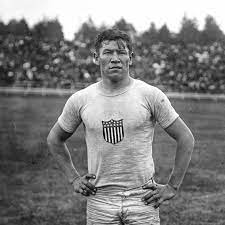
The Story And Significance Of Jim Thorpe - The Greatest Athlete There Ever Was


James Francis Thorpe (Sac and Fox (Sauk): Wa-Tho-Huk, translated as "Bright Path"; May 22 or 28, 1887 – March 28, 1953) was an American athlete and Olympic gold medalist. A member of the Sac and Fox Nation, Thorpe was the first Native American to win a gold medal for the United States in the Olympics. Considered one of the most versatile athletes of modern sports, he won two Olympic gold medals in the 1912 Summer Olympics (one in classic pentathlon and the other in decathlon). He also played American football (collegiate and professional), professional baseball, and basketball.
He lost his Olympic titles after it was found he had been paid for playing two seasons of semi-professional baseball before competing in the Olympics, thus violating the contemporary amateurism rules. In 1983, 30 years after his death, the International Olympic Committee (IOC) restored his Olympic medals with replicas, after ruling that the decision to strip him of his medals fell outside of the required 30 days. Thorpe is to date listed as co-champion in both the decathlon and pentathlon events according to official IOC records.
Thorpe grew up in the Sac and Fox Nation in Indian Territory (what is now the U.S. state of Oklahoma). As a youth, he attended Carlisle Indian Industrial School in Carlisle, Pennsylvania, where he was a two-time All-American for the school's football team under coach Pop Warner. After his Olympic success in 1912, which included a record score in the decathlon, he added a victory in the All-Around Championship of the Amateur Athletic Union. In 1913, he played for the Pine Village Pros in Indiana. Later in 1913, Thorpe signed with the New York Giants, and he played six seasons in Major League Baseball between 1913 and 1919. Thorpe joined the Canton Bulldogs American football team in 1915, helping them win three professional championships. He later played for six teams in the National Football League (NFL). He played as part of several all-American Indian teams throughout his career, and barnstormed as a professional basketball player with a team composed entirely of American Indians.
From 1920 to 1921, Thorpe was nominally the first president of the American Professional Football Association (APFA), which became the NFL in 1922. He played professional sports until age 41, the end of his sports career coinciding with the start of the Great Depression. He struggled to earn a living after that, working several odd jobs. He suffered from alcoholism, and lived his last years in failing health and poverty. He was married three times and had eight children, before suffering from heart failure and dying in 1953.
Thorpe has received numerous accolades for his athletic accomplishments. The Associated Press ranked him as the "greatest athlete" from the first 50 years of the 20th century, and the Pro Football Hall of Fame inducted him as part of its inaugural class in 1963. The town of Jim Thorpe, Pennsylvania was named in his honor. It has a monument site that contains his remains, which were the subject of legal action. Thorpe appeared in several films and was portrayed by Burt Lancaster in the 1951 film Jim Thorpe – All-American.
 He first played professional football in 1913 as a member of the Indiana-based Pine Village Pros, a team that had a several-season winning streak against local teams during the 1910s. He signed with the Canton Bulldogs in 1915. They paid him $250 ($6,396 today) a game, a tremendous wage at the time. Before signing him Canton was averaging 1,200 fans a game, but 8,000 showed up for Thorpe's debut against the Massillon Tigers. The team won titles in 1916, 1917, and 1919. Thorpe reportedly ended the 1919 championship game by kicking a wind-assisted 95-yard punt from his team's own 5-yard line, effectively putting the game out of reach.
In 1920, the Bulldogs were one of 14 teams to form the American Professional Football Association (APFA), which would become the National Football League two years later. Thorpe was nominally the APFA's first president, but spent most of the year playing for Canton; a year later, he was replaced as president by Joseph Carr. He continued to play for Canton, coaching the team as well. Between 1921 and 1923, he helped organize and played for the Oorang Indians (LaRue, Ohio), an all-Native American team. Although the team's record was 3–6 in 1922, and 1–10 in 1923, Thorpe played well and was selected for the Green Bay Press-Gazette's first All-NFL team in 1923. This was later formally recognized in 1931 by the NFL as the league's official All-NFL team).
Even though his NFL stats look ordinary, he started his NFL career at 33 he was the first big star in the league and also being the first president of the league is what is most important from his NFL career. Thorpe never played for an NFL championship team. He retired from professional football at age 41, having played 52 NFL games for six teams from 1920 to 1928.
Sources
https://www.pro-football-reference.com/
https://www.profootballarchives.com/index.html
https://americanfootballdatabase.fandom.com/wiki/Football_Wiki
https://www.gridiron-uniforms.com/GUD/controller/controller.php?action=main
https://www.profootballhof.com/hall-of-famers/
Bird, S. Elizabeth (May 2, 1996). Dressing in feathers: the construction of the Indian in American popular culture. London, UK: Avalon. ISBN 978-0-8133-2667-2.
Bloom, John (May 2, 1996). ""There Is Madness in the Air": The 1926 Haskell Homecoming and Popular Representations of Sports in Federal Indian Boarding Schools". In Bird, S. Elizabeth (ed.). Dressing in feathers: the construction of the Indian in American popular culture. London, UK: Avalon. ISBN 978-0-8133-2667-2.
Buford, Kate (2012). Native American Son: the life and sporting legend of Jim Thorpe . Lincoln, Nebraska: University of Nebraska Press. ISBN 978-0-8032-4089-6. OCLC 756837088.
Cava, Pete (Summer 1992). Baseball in the Olympics (PDF). pp. 7–15. Archived from the original (PDF) on August 9, 2017.
Cook, William A. (2011). Jim Thorpe: a biography. Jefferson, N.C: McFarland & Co. ISBN 978-0-7864-6355-8. OCLC 692291486.
Dodge, Robert V. (2013). Which chosen people? Manifest destiny meets the Sioux as seen by Frank Fiske, frontier photographer. New York, N.Y: Algora Publishing. ISBN 978-1-62894-029-9.
Dyreson, Mark (1998). Making the American team: sport, culture, and the Olympic experience. Sport and society. Urbana, Ill.: University of Illinois Press. ISBN 978-0-252-06654-2.
Elfers, James E. (2003). The Tour to End All Tours: the story of major league baseball's 1913-1914 world tour. Lincoln: University of Nebraska Press. ISBN 978-0-8032-6748-0.
Findling, John E.; Pelle, Kimberly D., eds. (2004). Encyclopedia of the modern Olympic movement. Westport, Conn: Greenwood Press. ISBN 978-0-313-32278-5.
Gerasimo, Luisa; Whiteley, Sandra, eds. (2003). The teacher's calendar of famous birthdays. New York: McGraw-Hill. ISBN 978-0-07-141230-8.
Hilger, Michael (2016). Native Americans in the movies: portrayals from silent films to the present. Lanham Boulder New York London: Rowman & Littlefield. ISBN 978-1-4422-4002-5.
Hoxie, Frederick E., ed. (1996). Encyclopedia of North American Indians. Boston, Mass.: Houghton Mifflin. ISBN 978-0-395-66921-1.
Jeansonne, Glen; Luhrssen, David (2006). A time of paradox: America since 1890. Lanham, Md: Rowman & Littlefield. ISBN 978-0-7425-3376-9. OCLC 62109927.
Landrum, Dr. Gene N. (2006). Empowerment: the Competitive Edge in Sports, Business & Life. Brendan Kelly Publishing, Incorporated. ISBN 978-1-89-599724-8.
Lincoln, Kenneth; Slagle, Al Logan (1997). The good red road: passages into Native America. Lincoln: University of Nebraska Press. ISBN 978-0-8032-7974-2.
Magill, Frank Northen, ed. (1987). Great lives from history. Vol. 1 5: American series Sit - Z. Vol. 1. Pasadena, Cal.: Salem Pr. ISBN 978-0-89356-529-9.
Maraniss, David (2022). Path lit by lightning: the life of Jim Thorpe (1st ed.). New York: Simon & Schuster. ISBN 978-1-4767-4841-2.
Neft, David S.; Cohen, Richard M.; Korch, Rick (1994). The Complete History of Professional Football from 1892 to the Present. St. Martin's Press. ISBN 978-0-31-211435-0.
O'Hanlon-Lincoln, Ceane (2004). County chronicles: a vivid collection of Fayette County, Pennsylvania histories. Chicora, PA: Mechling Bookbindery. ISBN 978-0-9744657-8-4.
Quirk, Charles E., ed. (July 10, 2014). Sports and the Law: Major Legal Cases. Taylor & Francis. ISBN 978-1-13-568222-4.
Rendell, Matt, ed. (2004). The Olympics: Athens to Athens, 1896 - 2004. London: Weidenfeld & Nicolson. ISBN 978-0-297-84382-5.
Schaffer, Kay; Smith, Sidonie, eds. (2000). The Olympics at the Millennium: power, politics, and the games. New Brunswick, NJ: Rutgers University Press. ISBN 978-0-8135-2820-5.
Watterson, John Sayle (November 14, 2002). College Football: History, Spectacle, Controversy. Johns Hopkins University Press. ISBN 978-0-80-187114-6.
Wheeler, Robert W. (1979). Jim Thorpe, World's Greatest Athlete. University of Oklahoma Press. ISBN 978-0-80-611745-4.
Williams, Randy (2006). Sports cinema: 100 movies: the best of Hollywood's athletic heroes, losers, myths, and misfits. Pompton Plains, NJ: Limelight Ed. ISBN 978-0-87910-331-6.
Zarnowski, Frank (March 31, 2005). All-Around Men: Heroes of a Forgotten Sport. Scarecrow Press. ISBN 978-0-81-085423-9.
Zarnowski, Frank (2013). The Pentathlon of the Ancient World. Jefferson, NC: McFarland. ISBN 978-0-7864-6783-9.