Showing posts with label 1926. Show all posts

Monday, August 1, 2022

Who Were The Philadelphia Quakers (AFL)?

The Philadelphia Quakers were a professional American football team that competed in the first American Football League in 1926 and won the league's only championship.

Owned by L. S. Conway, the Quakers played their home games in Sesquicentennial Stadium on Saturdays because of Pennsylvania’s Blue laws prohibiting work or business on Sundays. Coached by Bob Folwell, the majority of the team played their college football in Pennsylvania. The Quakers had nine players (including Century Milstead, Charlie Way, Butch Spagna, and Bull Behman) who had previously played for various National Football League teams. The combined experience gave the team an edge in line play, particularly on defense (the Quakers yielded only five points per game for the 1926 season). The addition of All-American Glenn Killinger merely added to the defensive riches: he intercepted four passes in his league debut (November 4, 1926, in a 24-0 victory over the Rock Island Independents).

Unlike half of their league opponents, the Quakers had no financial connection with league founders C. C. Pyle and Red Grange. In addition to having a championship team, the Quakers drew well in the stadium in the midst of the Sesquicentennial Exposition. When the fair ended (early November), the audience in the soon-to-be renamed Municipal Stadium diminished, but still drew well when the Quakers defeated the New York Yankees 13-7 on a Bob Dinsmore punt return that decided the game - and the league championship (November 27, 1926).

At the time of the championship-clinching game, the AFL had only four active teams (the Quakers, the Yankees, the Los Angeles Wildcats, and the Chicago Bulls), three of which were being subsidized by C. C. Pyle and Red Grange. The latter three teams played games in the last two weeks of the season while the Quakers started challenging National Football League teams for a “pro football championship game.” The NFL champions Frankford Yellow Jackets were the first to refuse, claiming that their postseason schedule had been already set. Additional challenges by the Quakers were unanswered until Tim Mara, owner of the seventh place New York Giants, accepted the challenge, scheduling a game for December 12, 1926, at the Polo Grounds.

As the Yankees and the Bulls were playing the AFL's last official game (a 7-3 Yankees victory in Comiskey Park), the Quakers and the Giants were battling in front of 5000 fans in the middle of a driving snowstorm. While the score was only 3–0 at halftime, Quaker errors led to the Giants winning the game 31–0. Both the Quakers and the AFL were no more.

At the end of the season, former NFL player Wilfred Smith of the Chicago Tribune presented a combined NFL-AFL All-Pro team in his column. Three Quakers were named to the second team: George Tully, Bull Behman, and Al Kreuz.

Upon the completion of a New York Yankees 7–3 victory over the Chicago Bulls in Comiskey Park on December 12, 1926, the first AFL was officially dead. The simultaneous 31-0 drubbing of the Quakers by the New York Giants in the Polo Grounds left the AFL champions in a similar state.

It was, however, not the end of the professional football career for five Philadelphia Quakers. The following men were on rosters of NFL teams in the 1927 season. Bob Beattie played for the1927 New York Yankees, 1929 Orange Tornadoes, 1930 Newark Tornadoes. Bull Behman played for the1927–31 Frankford Yellow Jackets (player-coach 1930–31). Adrian Ford played for the 1927 Pottsville Maroons, 1927 Frankford Yellow Jackets. Century Milstead played for the 1927–28 New York Giants. George Tully played for the 1927 Frankford Yellow Jackets.

On the other hand, the pro football careers of several former NFL players ended with the 1926 Quakers. Charlie Cartin played for the 1925 Frankford Yellow Jackets. Saville Crowther played for the 1925 Frankford Yellow Jackets. Doc Elliott played for the 1922–23 Canton Bulldogs, 1924–25 Cleveland Bulldogs. Glenn Killinger played for the 1921 Canton Bulldogs, 1926 New York Giants. Johnny Schott played for the 1920-23 Buffalo All-Americans. Butch Spagna played for the 1920 Cleveland Tigers, 1920-21 Buffalo All-Americans, 1924-25 Frankford Yellow Jackets. George Sullivan played for the 1924-25 Frankford Yellow Jackets. Whitey Thomas played for the 1924 Frankford Yellow Jackets. Charlie Way played for the 1921 Canton Bulldogs, 1924 Frankford Yellow Jackets.

The Quakers name and history traces back to the Philadelphia Quakers, who were operated by the Union Athletic Association of Phoenixville and played one season under Conway's ownership in 1921. The Quakers of that year, who had a perfect season and claimed the mythical national championship under the "Union AA" name in 1920, took advantage of the Saturday game schedule required by Pennsylvania's blue laws and would often "moonlight" the next day as members of the Buffalo All-Americans. The National Football League caught wind of this scheme and forced the moonlighting players to choose one team or the other. That team was poised to join the National Football League in 1922, but for reasons unexplained remained independent and instead merged into the Frankford Yellow Jackets that year.

Sources
https://www.pro-football-reference.com/
https://www.profootballarchives.com/index.html
https://americanfootballdatabase.fandom.com/wiki/Football_Wiki
https://www.gridiron-uniforms.com/GUD/controller/controller.php?action=main
https://www.profootballhof.com/hall-of-famers/
 "A.F.L. Fields Nine Teams" New York Times, July 17, 1926
 David S. Neft, Richard M. Cohen, and Rick Korch, The Football Encyclopedia: The Complete History of Professional Football, From 1892 to the Present (St. Martin’s Press 1994), ISBN 0-312-11435-4
 1926 American Football League from Elias Sports Bureau and Pro Football Research Association Linescore Committee Archived June 5, 2015, at the Wayback Machine
 Crippen, Ken. Who Really Won in 1921? Archived September 29, 2007, at the Wayback Machine History of Pro Football in Western New York.
 Ghosts of the Gridiron: Union Quakers. Professional Football Researchers Association.
 1926 American Football League from Elias Sports Bureau and Pro Football Research Association Linescore Committee Archived June 5, 2015, at the Wayback Machine
 David S. Neft, Richard M. Cohen, and Rick Korch, The Football Encyclopedia: The Complete History of Professional Football, From 1892 to the Present (St. Martin’s Press 1994), ISBN 0-312-11435-4
 David S. Neft, Richard M. Cohen, and Rick Korch, The Football Encyclopedia: The Complete History of Professional Football, From 1892 to the Present (St. Martin’s Press 1994), ISBN 0-312-11435-4
 1926 American Football League from Elias Sports Bureau and Pro Football Research Association Linescore Committee Archived June 5, 2015, at the Wayback Machine
 "New York Giants Beat Quakers in Slop, 31-0" – The Philadelphia Record, December 13, 1926
 1926 All Pros[permanent dead link] – John Hogrogian, citing Chicago Tribune, December 19, 1926
 The Grange War: 1926[permanent dead link] – Bob Carroll, Professional Football Researchers Association
 David S. Neft, Richard M. Cohen, and Rick Korch, The Football Encyclopedia: The Complete History of Professional Football, From 1892 to the Present (St. Martin's Press 1994), ISBN 0-312-11435-4

Friday, July 29, 2022

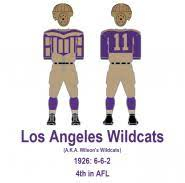
Who Were The Los Angeles Wildcats (AFL)?

The Los Angeles Wildcats (also reported in various media as Pacific Coast Wildcats, Los Angeles Wilson Wildcats and Wilson's Wildcats) was a traveling team of the first American Football League that was not based in its nominal home city but in Chicago, Illinois (it trained in Rock Island). Coached by Jim Clark, the team was designed to be a showcase for University of Washington star back George “Wildcat” Wilson. Compared to most traveling teams in professional football, the Wildcats were successful, compiling a 6–6–2 record in the only season of the team's – and the league's – existence.

The existence of the Wildcats began with the 1926 formation of the American Football League by C. C. Pyle, a sports agent who represented star back Red Grange. Pyle's application for a National Football League franchise in New York was rejected as Tim Mara, owner of the New York Giants objected to Pyle proposed intrusion into the Giants’ territory. Armed with a five-year lease at Yankee Stadium, Pyle subsequently announced the formation of the American Football League as a showcase for his client.

The league was also a showcase for another Pyle client who was an All-American on the West Coast: Wildcat Wilson. Because of the limitations of train (or bus) travel, the National Football League extended only from the Atlantic coast westward to Kansas City, Missouri, and Pyle wanted to tap the talent of college football players along the Pacific. His solution was novel (and one that the more established NFL would copy quickly): establish a traveling team nominally representing Los Angeles and headed by Wilson. The team would be based in Moline, Illinois (home of the Rock Island Independents, which jumped from the NFL to the AFL) and would have no home stadium. Virtually all of the players of the team attended colleges sited west of the Rocky Mountains.

The team was owned by C. C. Pyle and Red Grange, who also owned another AFL team (the New York Yankees) and had stock in a third (the Chicago Bulls). The three teams and league champion Philadelphia Quakers were the only four teams (of the original nine) still in existence at the end of league play on December 12, 1926. Upon the completion of a barnstorming tour, the Wildcats closed up shop after only one year of existence.

As the team began league play, it became evident that Wilson was not the only weapon that the Wildcats had. Coach Jim Clark had the versatile Mal Bross for either rushing and receiving duties; ends Ray Flaherty and Jim Lawson dutifully caught passes from Wilson, while Duke Morrison ran when Wilson did not take the ball. Furthermore, no fewer than four Wildcats handled the kicking job at one time or another.

Originally scheduled to play only 10 games, the Wildcats played additional contests as last-minute “fill-in” opponents as one team after another in the American Football League folded or otherwise left the league. Immediately after tying the Chicago Bulls in Comiskey Park, the team trekked to Toronto’s Maple Leaf Stadium for a game with the New York Yankees, which also played games on back-to-back days. The Yankees won, 29–0. It was not the first weekend in which the Wildcats played on consecutive days (they actually did so on three other weekends); their Thanksgiving Day contest with the Bulls (a scoreless tie) was their third in a five-day stretch.

By the end of October, the Cleveland Panthers and Newark Bears have closed up shop; the Brooklyn Horsemen merged with their NFL cousins, the Brooklyn Lions in early November, and the Boston Bulldogs, a team that was subsidized by Pyle’s money dropped out. In the four weeks from the departure of Cleveland and the exit of Boston, scheduling “holes” were filled by the two traveling teams of the AFL: the Wildcats and the Rock Island Independents... that is, until November 21, when the Independents – charter members of both the NFL and the AFL – joined the exodus from the younger league by calling it quits after a 3–0 loss to the Bulls. With only two weeks remaining in the season, the Wildcats, Yankees, and Bulls – three teams owned (or co-owned) by Pyle and Grange – and the Philadelphia Quakers were the last teams remaining, with only the Quakers reporting a profit.

Only two official AFL games were left to play in December 1926. On the 5th, the Wildcats shut out the Bulls 5–0 on a frozen field in Comiskey Park, while the Bulls hosted the Yankees the following Sunday as the visiting team wrapped up the 1926 season of the American Football League with a 7–3 victory. At the same time, in a snowstorm at the Polo Grounds, the league champion Quakers were crushed, 31–0, by the New York Giants in a game that marked the end of the American Football League, December 12, 1926.

Two days after the end of the 1926 season (and of the AFL), the Wildcats and the New York Yankees started a series of exhibition games as the two Pyle-owned teams went on a barnstorming tour of the American South and West. The two teams competed in Atlanta (a 7–7 draw), Birmingham, Alabama (a 14–3 Yankees win), Dallas, Texas (a 17-14 Yankees win), Beaumont, Texas (a 34–0 Wildcats win), and San Antonio (a 20–14 Yankees win) before traveling to California for games against the independent Hollywood Generals (whom the Wildcats defeated, 26–7, in Wrigley Field of Los Angeles) and the NFL's traveling team, the Los Angeles Buccaneers (the Wildcats won, 17–0, in a game played in San Francisco).

With the dissolution of the American Football League (Pyle's Yankees were preparing to join the NFL under an arrangement with New York Giants owner Tim Mara, who acquired the assets of the defunct Brooklyn Horsemen), the Wildcats ceased to exist after the game in San Francisco. Wildcat Wilson joined the Providence Steam Roller for the 1927 NFL season. Wilson was not the only 1926 Wildcat to join an NFL roster for the 1927 season. Mal Bross played for the Green Bay Packers. Ted Bucklin played for the Chicago Cardinals. Walden Erickson played for the Pottsville Maroons. Ray Flaherty played for the New York Yankees. Ted Illman played for the Chicago Cardinals. Jim Lawson played for the New York Yankees. Ray Stephens played for the New York Yankees. John Vesser played for the Chicago Cardinals Flaherty continued to play until 1935 (taking 1930 off to teach college football), then became head coach of the Washington Redskins in 1937. He became a member of the Pro Football Hall of Fame in 1976.

Sources
https://www.pro-football-reference.com/
https://www.profootballarchives.com/index.html
https://americanfootballdatabase.fandom.com/wiki/Football_Wiki
https://www.gridiron-uniforms.com/GUD/controller/controller.php?action=main
https://www.profootballhof.com/hall-of-famers/
1926 American Football League from Elias Sports Bureau and Pro Football Research Association Linescore Committee Archived June 5, 2015, at the Wayback Machine
 Schedules and scores of the teams in the 1926 American Football League Archived July 13, 2009, at the Wayback Machine – “Ghosts of the Gridiron”
 "Grangemen and Wildcats Tie, 7-7, in Muddy Contest". The Atlanta Constitution. December 15, 1926. p. 13. Retrieved August 13, 2020 – via Newspapers.com. Open access icon
 "Wildcats Lose To Red Grange Team". Selma Times-Journal. AP. December 17, 1926. p. 6. Retrieved August 13, 2020 – via Newspapers.com. Open access icon
 "Small Dallas Crowd Sees Red Grange's Team Beat Wilson's". The Austin American. AP. December 20, 1926. p. 5. Retrieved August 2, 2020 – via Newspapers.com. Open access icon
 "Wilson Wildcats Defeat Grange". The Austin Statesman. December 23, 1926. p. 8. Retrieved August 13, 2020 – via Newspapers.com. Open access icon
 "Grangemen Win At San Antonio". The Austin Statesman. December 27, 1926. p. 2. Retrieved August 13, 2020 – via Newspapers.com. Open access icon
 "Wilson's Wildcats Win". Pittsburgh Gazette Times. January 10, 1927. p. 10. Retrieved August 13, 2020 – via Newspapers.com. Open access icon
 David S. Neft, Richard M. Cohen, and Rick Korch, The Football Encyclopedia: The Complete History of Professional Football, From 1892 to the Present (St. Martin’s Press 1994), ISBN 0-312-11435-4

Wednesday, July 27, 2022

Who Were The Chicago Bulls (AFL)?

The Chicago Bulls were a professional American football team that competed in the first American Football League in 1926. Owned by Joey Sternaman (brother of Chicago Bears co-owner Dutch Sternaman), the Bulls also had AFL founders C. C. Pyle and Red Grange as shareholders (Pyle and Grange were also the co-owners of the New York Yankees and the Los Angeles Wildcats of the AFL). Joey Sternaman was also the coach and blocking back for the Bulls throughout their brief existence.

The newly minted Bulls had adverse effects on the more established NFL. First, the Bulls leased Comiskey Park, forcing the Chicago Cardinals to play in the (older and much smaller) Normal Field. Second, the Bulls made an offer for Cardinals star Paddy Driscoll that the reigning NFL champions could not match (Cardinals owner Chris O'Brien arranged a trade with the Bears, who did match the Bulls' offer to Driscoll, keeping him in the established league but knocking the Cardinals out of championship contention). Failing to sign Driscoll, the Bulls built up their roster by signing up men who played their college football in the American Midwest.

Despite playing in front of 16,000 people in their first home game (against the Yankees on October 17, 1926), the Bulls were generally a poor attraction despite the star power of Joey Sternaman. Most of the Bulls games – both at home and away – were played in front of 4000 people or fewer. Attendance at Bulls games were often a reflection of the drawing power of their opponents. The team's first game (at Newark) was played in front of only 2000 people in Davids' Stadium on September 26; the Bulls played the last three official games of the American Football League: in front of 15,000 in Yankee Stadium on November 28 against the Yankees, in front of 3000 in Comiskey Park on December 5 against the Wildcats, and in front 8000 in Comiskey Park on December 12 against the Yankees. With the conclusion of the last game. The AFL and the Chicago Bulls became history, and Sternaman returned to the Chicago Bears.

Upon the completion of a New York Yankees' 7-3 victory over the Bulls in Comiskey Park on December 12, 1926, the first AFL was officially dead. Although Joey Sternaman was the official owner of the team, the bills were paid by C. C. Pyle, who decided to cut his losses by dissolving his (and Red Grange's) interest in the team as the Yankees and the Wildcats went on a barnstorming tour of the American South and West Coast. As a result, the Bulls were no more viable as an entity than the AFL. Its fate was officially sealed when Sternaman returned to the Chicago Bears and the Yankees entered the National Football League (with New York Giants owner Tim Mara technically the owner in a lease arrangement for the defunct Brooklyn Lions franchise).

As Sternaman continued his career, he was not the only former Chicago Bull to join an NFL team's roster after the dissolution of the AFL. Mush Crawford played for 1927 New York Yankees. John Fahay played for 1929 Minneapolis Red Jackets. Aubrey Goodman played for 1927 Chicago Cardinals. Ojay Larson played for 1929 Chicago Bears, 1929 Chicago Cardinals. Dick Stahlman played for 1929 & 1930 New York Giants, 1931–1932 Green Bay Packers, 1933 Chicago Bears. Red Strader played for 1927 Chicago Cardinals (later became head coach for the 1948–1949 New York Yankees (AAFC), 1950-51 New York Yanks (NFL), and 1955 San Francisco 49ers). Jim Tays played for 1927 Dayton Triangles, 1930 Newark Tornadoes, 1930 Staten Island Stapletons. Buck White played for 1927–1929 Chicago Bears. While Garland Buckeye's professional football career ended with the folding of the Bulls, his major league baseball career continued, pitching for the Cleveland Indians in 1927–1928 and the New York Giants in 1928.

Sources
https://www.pro-football-reference.com/
https://www.profootballarchives.com/index.html
https://americanfootballdatabase.fandom.com/wiki/Football_Wiki
https://www.gridiron-uniforms.com/GUD/controller/controller.php?action=main
https://www.profootballhof.com/hall-of-famers/
David S. Neft, Richard M. Cohen, and Rick Korch, The Football Encyclopedia: The Complete History of Professional Football, From 1892 to the Present (St. Martin's Press 1994), ISBN 0-312-11435-4
 George Gipe, The Great American Sports Book (Doubleday 1978) ISBN 0-385-13091-0
 "A.F.L. Fields Nine Teams The New York Times, July 17, 1926
 David S. Neft, Richard M. Cohen, and Rick Korch, The Football Encyclopedia: The Complete History of Professional Football, From 1892 to the Present (St. Martin's Press 1994), ISBN 0-312-11435-4
 David S. Neft, Richard M. Cohen, and Rick Korch, The Football Encyclopedia: The Complete History of Professional Football, From 1892 to the Present (St. Martin's Press 1994), ISBN 0-312-11435-4
 1926 American Football League from Elias Sports Bureau and Pro Football Research Association Linescore Committee Archived June 5, 2015, at the Wayback Machine
 The Grange League – Professional Football Researchers Association (1997)
 David S. Neft, Richard M. Cohen, and Rick Korch, The Football Encyclopedia: The Complete History of Professional Football, From 1892 to the Present (St. Martin's Press 1994), ISBN 0-312-11435-4
 George Gipe, The Great American Sports Book (Doubleday 1978) ISBN 0-385-13091-0
 David S. Neft, Richard M. Cohen, and Rick Korch, The Football Encyclopedia: The Complete History of Professional Football, From 1892 to the Present (St. Martin's Press 1994), ISBN 0-312-11435-4
 John Thorn and Pete Palmer with Michael Gershman, Total Baseball: The Ultimate Encyclopedia of Baseball, Third Edition (HarperPerennial 1993) ISBN 0-06-273189-0

Tuesday, January 25, 2022

Who Were The Cleveland Panthers?


The Cleveland Panthers were a professional American football team. They were an independent team founded in 1919 from the remains of the Youngstown Patricians. The Panthers played, with various degrees of success, continuously from 1919 and eventually, as fewer opponents played them each year after 1926, sputtered to a quiet folding in 1933.

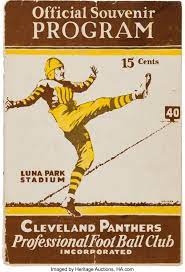
The Panthers competed in the first American Football League (AFL), founded by Charles "Cash and Carry" Pyle (1882–1939), in 1926. The Panthers, owned by General Charles X. Zimmerman (1865–1926) (the vice president of the AFL), played their home games in old Luna Bowl in Luna Park. Coached by Ray E. Watts, the team drew its players from Ohio colleges and universities and raided the rosters of early National Football League (NFL) teams based in Ohio.

The veteran squad led by tailback Al Michaels was one of only two AFL franchises (the other was the New York Yankees) to average more than 12 points per game. Other former Cleveland Bulldogs Dave Noble and Doc Elliott helped provide offensive firepower, while two-sport star Cookie Cunningham excelled at end, scoring twice on long passes in an October 3, 1926, game against the Los Angeles Wildcats.

In terms of fan support, the Panthers appeared to have had a good start, defeating the Yankees in their first game, at Luna Bowl in front of a reported 22,000 people, but after a second home victory (17-13, against the Wildcats) in which the attendance figures were apparently not reported, and a third straight home win (this time 23-7 against the Rock Island Independents) in front of only 7000 people, it was becoming evident that the Panthers were in trouble despite being in first place with an undefeated record. A 19-12 defeat in front of only 3000 spectators in Chicago's baseball Comiskey Park (the stadium of the Chicago White Sox), foreshadowed the inevitable as the similarly-troubled Newark Bears withdrew from the league on October 24, 1926.

The next week, the Panthers returned home to old Luna Park for a rematch with the Los Angeles Wildcats, a hard-fought game dominated by defense, with Cleveland guard Al Nesser dictating much of the game until a fourth quarter fumble by Al Michaels led to the only score of the game in a 6-0 Wildcats win. While the game was stellar, the attendance was not: only 1000 fans saw it. The following week Stearns Advertising Co. sued the team for $1,000, and the court placed it in receivership. The players were stranded on the road in Philadelphia. The team was disfranchised by the league and disbanded.

Four Panthers subsequently found roster spots on AFL and NFL teams to complete the 1926 season, while six who had played in the NFL had their professional football careers end with the demise of the Cleveland Panthers. The exodus from the AFL continued through November 1926, and after the last official game was played (December 12, 1926), the league itself went out of business.

Immediately after the sudden dissolution of the Panthers, four of the team's members managed to join other rosters in either the NFL or the AFL. Doc Elliot found a spot in the eventual AFL champion Philadelphia Quakers, while Al Nesser returned to the NFL, this time playing for the New York Giants. Guy Roberts and Jack Sack both found a new "home" with the Canton Bulldogs. While Sack finished his career in 1926 and Elliott was out of professional football until 1931, the other two former members continued their careers after the end of the first AFL.

The Panthers returned in 1927 but as an independent semi-professional team managed by George T. Jones, who been the secretary for the team under owner Zimmerman (who died in 1926). The team folded in 1933.

After Cleveland received a franchise to play in the All-America Football Conference (AAFC) in 1944, the team's head coach, Paul Brown (1908-1991), was reluctant to use his own name, while the Panthers name still had popular support in a newspaper contest.

However, Jones still held the rights to the "Panthers" name, and he demanded several thousand dollars from team owner Arthur B. McBride for the use of the name. However, after Brown told McBride "That old Panthers team failed, I want no part of that name", McBride refused to pay. He reopened the contest, and selected the Browns name for his team; Brown ultimately acquiesced, and so the team would be named the Cleveland Browns. The Browns joined the National Football League (NFL) from the AAFC in 1950, and continue to play in the NFL today.

The Panthers nickname would be revived in the NFL in 1993, when an expansion team was awarded to Charlotte, North Carolina: the Carolina Panthers.

Sources
https://www.pro-football-reference.com/
https://www.profootballarchives.com/index.html
https://americanfootballdatabase.fandom.com/wiki/Football_Wiki
https://www.gridiron-uniforms.com/GUD/controller/controller.php?action=main
https://www.profootballhof.com/hall-of-famers/
 "History of Pro Football in Buffalo". Archived from the original on February 14, 2012. Retrieved November 1, 2012.
 Sye, Roy. Cleveland Panthers all known games. Professional Football Researchers Association.
 "A.F.L. Fields Nine Teams", The New York Times, July 17, 1926
 David S. Neft, Richard M. Cohen, and Rick Korch, The Football Encyclopedia: The Complete History of Professional Football, From 1892 to the Present (St. Martin's Press 1994), ISBN 0-312-11435-4
 1926 American Football League from Elias Sports Bureau and Pro Football Research Association Linescore Committee Archived June 5, 2015, at the Wayback Machine
 "CLEVELAND PANTHERS - The Encyclopedia of Cleveland History". Case Western Reserve University and Western Reserve Historical Society. Retrieved May 1, 2017.

Wednesday, January 19, 2022

Who Were The New York Yankees Of The AFL/NFL?

The New York Yankees were a short-lived professional American football team from 1926 to 1929. The team was a member of the first American Football League in 1926, and later the National Football League from 1927 to 1929. They played their home games at Yankee Stadium. The team featured Hall of Famer Red Grange at halfback.

The Yankees arose as a result of a contract dispute between Grange and his previous team, the NFL's Chicago Bears. During the early 1920s, Grange was the star attraction for the Bears, and his play had done a lot to promote the fledgling NFL. However Red's agent C. C. "Cash and Carry" Pyle challenged the Bears owner George Halas in 1926, by stating that Red's contract was owned by himself, and not Halas. Pyle then approached Halas to demand for Grange a generous salary and one-third ownership of the Bears. Halas refused.

Pyle then took his quest for an NFL franchise to the NFL's 1926 winter meeting. There he showed to the other owners that he had the rights to Grange. As a result, he wanted an NFL team of his own and he wanted it in New York City's Yankee Stadium. If he would be denied, Pyle threatened to start his own league. However a market in the New York market was not available. Tim Mara held exclusive NFL rights to the New York Giants. Mara had just struggled through his first year as an owner, and was saved from financial disaster ironically by Grange's exhibition appearance. Nearing the end of their first season, the Giants had gone largely unnoticed by New York fans and newspapers, and Giants' owner Tim Mara was deeply in the red. But Grange's appearance drew 73,000 people to the Polo Grounds; in one afternoon Mara was in the black financially, and professional football had gained new respect among New York's influential sportswriters. Now Pyle wanted to take away half of Mara's market.

The other franchise owners backed Mara, however they did not want to lose Grange and his drawing power. They were well aware of what a game against Grange could mean to their finances. They were also aware that Pyle might actually carry out a threat to start a new league if they refused his request. As a result, the league proposed a compromise. It was proposed that Pyle could have his "New York" franchise but it would be located in Brooklyn, which was a part of New York City. However Pyle had already gone ahead and rented Yankee Stadium, and that was where he intended to play. Rejecting the NFL's offer, he set out to make good on his threat. With his new New York Yankees franchise as its flagship, Pyle put together a league called the American Football League.

Once the league was under way, Grange lived up to his reputation and drew well wherever he played. 22,000 spectators turned out in Philadelphia to watch the Yankees play the Philadelphia Quakers. In comparison, an NFL game a week later in the same stadium between the Frankford Yellow Jackets and the New York Giants drew only 10,000. However, the league would still fold at the end of the season. However Pyle's Yankees were given the NFL franchise that was asked for in the first place.

While the bulk of the AFL disappeared with the demise of the league, two of its members had an official existence after the 1926 season. Although the Brooklyn Horsemen disbanded after its last NFL game, the team's franchise was never withdrawn or canceled by the league. New York Giants owner Tim Mara was awarded the Horsemen franchise in payment of a debt and proceeded to lease it to C. C. Pyle for his New York Yankees team. The agreement between the two rivals limited the number of home games that the Yankees were permitted to play in its namesake stadium (four in 1927) and forced to be primarily a road team displaying the talents of Red Grange. This arrangement lasted for three years: the Yankees were no more after the 1929 season. Grange played for the Yankees in 1927, however he sat out the next season with a bad leg, and then returned to the Bears where he played until 1934. He then coached the Bears from 1942 until 1948.

Sources
https://www.pro-football-reference.com/
https://www.profootballarchives.com/index.html
https://americanfootballdatabase.fandom.com/wiki/Football_Wiki
https://www.gridiron-uniforms.com/GUD/controller/controller.php?action=main
https://www.profootballhof.com/hall-of-famers/
 "Profootball history1".
 David S. Neft, Richard M. Cohen, and Rick Korch, The Football Encyclopedia: The Complete History of Professional Football, From 1892 to the Present (St. Martin's Press 1994), ISBN 0-312-11435-4

Tuesday, January 18, 2022

Who Were The Brooklyn Lions And The Brooklyn Horsemen?

The Brooklyn Lions were a National Football League team that played in the 1926 NFL season. The team was formed as the league's counter-move to the first American Football League, which enfranchised a team called the Brooklyn Horsemen, a professional football team that competed in the 1926 AFL season.

In the months before the regular season began, both leagues battled with each other for fan support and the right to play at Ebbets Field. The NFL emerged as the winner, as the Lions signed the lease to use the stadium on July 20.

On November 12, 1926, the Horsemen withdrew from the AFL and merged with Lions. The new team created by the merger was initially called the Brooklyn Lions and competed in the NFL from November 22, 1926. For the last three games of the 1926, the team used the Horsemen name to finish the season. After three consecutive losses by shutout, the merged team winked out of existence.

Coached by Punk Berryman, the Lions featured Rex Thomas and Herm Bagby, two members of the backfield who could play either tailback or wingback. On defense, Thomas also snared four interceptions. Unfortunately, the team was only slightly more consistent in its play than the Horsemen, and after the November 7 game against the Kansas City Cowboys (a 10–9 loss at Ebbets Field), the Lions merged with the Horsemen. At the time of the merger, the Lions had compiled a 2–5 win-loss record.

The Horsemen of the first AFL were owned by boxing promoter Humbert Fugazy and played their home games in Brooklyn's Commercial Field. Coached by Eddie McNeely, the Horsemen got the team name after McNeely's signing of Elmer Layden and Harry Stuhldreher, two of Notre Dame's Four Horsemen. While the team's first game was decided by a 60-yard touchdown pass from Stuldreher to Ed Harrison, the team had trouble maintaining a steady offense (and, ultimately maintaining a fan base). After losses to the Los Angeles Wildcats and Boston Bulldogs in front of decreasing crowds, a scheduled game at Ebbets Field against league leader (and eventual champion) Philadelphia Quakers was cancelled due to inclement weather. On November 7, 1926, the Horsemen played their last AFL game, a 21–13 loss to the New York Yankees, and then merged with their NFL cousins, the Brooklyn Lions, to complete the season in the NFL.

The result of the merger was derisively dubbed the Horse-Lions by the local media, but initially (November 14, 1926) the merged team played under the Brooklyn Lions banner. The new team, with eight members of the now-defunct AFL team, trounced the Canton Bulldogs 19–0 in front of a small crowd in Ebbets Field. In a last-ditch effort to attract paying fans, the Lions then adopted the Horsemen nickname of the old AFL team... and lost the last three games of their existence by shutout.

Eight men played for both the Horsemen in the AFL and the Lions/Horsemen in the NFL: Fullback Earl Britton, End Ted Drews, End Ed Harrison, Guard Red Howard, Center Ted Plumridge, Tailback Harry Stuhldreher, Guard Tarzan Taylor. In addition, guard Hec Garvey was on the rosters of no fewer than four teams in the AFL or NFL in 1926: the Hartford Blues (NFL), the Horsemen (AFL), the Lions (NFL), and the New York Yankees.

Sources
https://www.pro-football-reference.com/
https://www.profootballarchives.com/index.html
https://americanfootballdatabase.fandom.com/wiki/Football_Wiki
https://www.gridiron-uniforms.com/GUD/controller/controller.php?action=main
https://www.profootballhof.com/hall-of-famers/
David S. Neft, Richard M. Cohen, and Rick Korch, The Football Encyclopedia: The Complete History of Professional Football, From 1892 to the Present (St. Martin’s Press 1994), ISBN 0-312-11435-4
 L.H. Baker, Football: Facts and Figures. New York: Farrar and Rinehart, 1945, p. 657.
 https://www.youtube.com/A1HJF0wrCoQ?si=WmgYaqZrZB87jk87 [bare URL]
 "A.F.L. Fields Nine Teams", The New York Times, July 17, 1926

Monday, January 17, 2022

Who Were The Los Angeles Buccaneers?

The Los Angeles Buccaneers were a traveling team in the National Football League during their one season 1926, ostensibly representing the city of Los Angeles, California. Like the Los Angeles Wildcats of the first American Football League, the team never actually played a league game in Los Angeles. It was operated out of Chicago with players from California colleges. The historian Michael McCambridge has stated that the Buccaneers originally planned to play in the Los Angeles Memorial Coliseum and became a road team only after the Coliseum Commission banned pro teams from its stadium. However, the difficulty of transcontinental travel in the era before modern air travel must have been a major factor in the decision to base the team in the Midwest. The last game of the Buccaneers' existence was an exhibition game against the Wildcats in San Francisco, with the Buccaneers being shut out, 17-0, on January 23, 1927. Its lone "home game" was an exhibition game against the AFL's New York Yankees in January 1927.

Sources
https://www.pro-football-reference.com/
https://www.profootballarchives.com/index.html
https://americanfootballdatabase.fandom.com/wiki/Football_Wiki
https://www.gridiron-uniforms.com/GUD/controller/controller.php?action=main
https://www.profootballhof.com/hall-of-famers/
 "Ongoing Research Project: Los Angeles Buccaneers". Rci.rutgers.edu. Retrieved May 14, 2010. see https://crab.rutgers.edu/users/maxymuk/home/ongoing/la.html retrieved September 29, 2024
 McCambridge, Michael: America's game: the epic story of how pro football captured a nation (Random House, 2005), pp. 16–17
 "Settlement between SoCal cities clears NFL stadium hurdle". NFL.com. Archived from the original on September 26, 2009.
 Maxymuk, John. "Los Angeles Buccaneers (1926)". Ongoing Research Project. Rutgers University. Retrieved June 18, 2015.

Friday, December 3, 2021

Who Were The Tampa Cardinals?

The Tampa Cardinals was a barnstorming football team, that played pick-up games, led by future Pro Football Hall of Famer, Jim Thorpe in 1926. During the time, the team was also billed as the St. Petersburg Cardinals and as Lena Vistas. The team was originally organized to play a New Year's Day exhibition against the Chicago Bears of the National Football League in what would be Tampa’s first professional football game. However, the team would later pick up four other games while in Florida. The team has also been referred to as Thorpe's Cardinals.

After the 1925 season, Thorpe formed a team composed primarily of Thorpe's teammates from the NFL’s Rock Island Independents, that would play several games throughout Florida. In a 1926 New Year's Day football exhibition, the Cardinals played against the Chicago Bears led by Red Grange. The game itself was billed as a clash of old vs. new, with Grange, the rising star, taking on Thorpe, the aging legend. During the game Grange rushed for a 70-yard touchdown as the Bears notched a 17-3 victory at Plant Field. This was the first professional football game ever to be played in Tampa.

After the game Thorpe and the core of his Cardinals team remained in Florida to play a few mercenary games under various other names. One game was a win over a Sarasota team constructed by former Florida Gator Robbie Robinson. One week, the Cards were hired to supplement the line-up of the Haven-Villa of Winter Haven, a local club playing out of Winter Haven. The Villas were set to square-off against the Millville Big Blue, a successful independent club from New Jersey that was headed up by Guy Chamberlin. Chamberlin was a friend and former teammate of Thorpe's during their time with the Canton Bulldogs. Despite being scheduled to appear, Thorpe did not take the field during the game. The exact reason for his absence is not clear. The Cardinals, would go on to lose the game 28-7.
In a rematch against Millville was soon scheduled. For the game the Cardinals then headed to St. Petersburg, Florida where they were billed as the St. Petersburg Cardinals. However, this time Millville was now hired to represent Haven-Villa. The game was held at the St. Petersburg Kennel Club in order to accommodate an anticipated large crowd, however the game drew just 300 fans. This time the Cards held Millville to a scoreless tie. A third game was arranged for a few days later in Winter Haven to be played at the local high school stadium. In front of just 500 spectators, the Cardinals were defeated 38-0.
In a fourth game between the two clubs the next day, at Adair Park in Lakeland, in the Cardinals final game in Florida. Thorpe’s team took to the field under the banner of the Lena Vistas while Chamberlin’s team was billed as the Eastern States All-Stars. The Cardinals lost yet again 24-0 to Milleville. The team then ended their season, due a lack of interest that led to a disappointing fan turnout. The team finished their tour of Florida with a 0-4-1 record.
Sources
https://www.pro-football-reference.com/
https://www.profootballarchives.com/index.html
https://americanfootballdatabase.fandom.com/wiki/Football_Wiki
https://www.gridiron-uniforms.com/GUD/controller/controller.php?action=main
https://www.profootballhof.com/hall-of-famers/
Fenton, John. "Ghosts of the Gridiron,Virtual Scrapbook Library, Vol. 8, Thorpe's Cardinals". Archived from the original on October 2, 2015. Retrieved February 7, 2023.
 Fenton, John. "Millville Football & Athletic Club" (PDF). PFRA Annual. Professional Football Researchers Association: 1–9.
 "Thorpe defeats Sarasota squad for 'come back'". Tampa Tribune. January 17, 1926. p. 19. Retrieved February 7, 2023 – via Newspapers.com.
 "Two Great Grid Stars Closed Careers Here". Sarasota Journal. July 14, 1964.