Showing posts with label St.Louis Cardinals. Show all posts

Wednesday, February 5, 2025

The Story And Significance Of Emmitt Thomas - Led The AFL And NFL In Interceptions In A Season

Emmitt Earl Thomas is an American former professional football player and coach in the National Football League. He played college football at the now defunct Bishop College. He played professionally as a cornerback for the Kansas City Chiefs of the NFL. He owns the Chiefs all-time interception record with 58, which places him ninth on pro football's all-time list. Thomas was inducted to the Pro Football Hall of Fame after being nominated by the Seniors Committee.

Thomas became a coach after his playing career. He won Super Bowl IV as a player with the Chiefs and Super Bowl XXII and Super Bowl XXVI as an assistant coach with the Washington Redskins.

Thomas made the Chiefs team as an undrafted free agent from Bishop College in Dallas; he was an AFL All-Star in 1968 and made the NFL's AFC-NFC Pro Bowl four times (1971, 1972, 1974, 1975) after the Chiefs joined the NFL in the 1970 AFL-NFL Merger. He was also selected All-Pro three times. In the 1969 season, he led all pro football with 9 interceptions, which he returned for 146 yards and a touchdown, helping his team win the AFL Championship and the fourth and last AFL-NFL World Championship Game, which the Chiefs won 23–7 over the NFL champion Vikings. Thomas recorded an interception in the Kansas City victory. In 1974, he led the NFL in interceptions (12), return yards (214), and return touchdowns (2).

Thomas retired from playing after 13 seasons; he finished his pro football career with 58 interceptions, which he returned for 937 yards and five touchdowns. He also recovered four fumbles, gained 64 yards returning punts, and returned 29 kickoffs for 673 yards. He played in 181 career games, tying for the fifth-most in club annals, and his 58 interceptions are a franchise record.

Thomas was inducted to the Pro Football Hall of Fame in 2008. He was officially inducted at the Enshrinement Ceremony where his bust, sculpted by Scott Myers, was unveiled on August 2, 2008.

Thomas has been an assistant coach in the NFL since 1981. Before being named interim head coach of the Atlanta Falcons on December 12, 2007, after the resignation of Bobby Petrino, Thomas was the Falcons' Senior Defensive Assistant/Secondary Coach. After Petrino's sudden departure left the team in shambles, Thomas attempted to unite the Atlanta locker room, and was able to lead the Falcons to a season-ending victory over the Seattle Seahawks. On January 24, 2008, new Falcons head coach Mike Smith announced that Thomas would remain on staff as assistant head coach. Thomas was voted into the Pro Football Hall of Fame along with Darrell Green and Art Monk, two players he coached during Super Bowl runs with the Washington Redskins. On January 13, 2010, his contract expired and was not renewed by the Falcons.

On February 1, 2010, he was hired as the secondary coach of the Kansas City Chiefs. On February 12, 2019, Thomas announced his retirement from coaching.

Thomas resides in Kansas City, Missouri. He married Jacqueline Heafley in 1983, and they remained married until her death on August 21, 2017. He has one son, Derek, and one daughter, Dedra, from a previous marriage with ex-wife Dianne Thomas. Derek now resides in Las Vegas, Nevada, doing numerous coaching jobs. Dedra Thomas is currently a legal nurse consultant in Kansas City, Mo. Thomas has a total of eight grandkids: Keydron, Keynan, Kierrah, Kyandria, Bailey, Samantha, Jade and Shane.

Sources
https://www.pro-football-reference.com/
https://www.profootballarchives.com/index.html
https://americanfootballdatabase.fandom.com/wiki/Football_Wiki
https://www.gridiron-uniforms.com/GUD/controller/controller.php?action=main
https://www.profootballhof.com/hall-of-famers/
 "Emmitt Thomas Stats, Height, Weight, Position, Draft, College". Pro-Football-Reference.com. Retrieved December 29, 2023.
 "Thomas on nfl.com". nfl.com. Retrieved December 15, 2007.
 "Thomas on Atlanta Falcons.com". atlantafalcons.com. Archived from the original on December 14, 2007. Retrieved December 17, 2007.
 Kansas City Star February 2, 2008
 "Years - Hall of Famers - Pro Football Hall of Fame Official Site". www.profootballhof.com.
 "Chiefs Defensive Backs Coach Emmitt Thomas to Retire after Coaching 38 NFL Seasons". Chiefs.com.

Wednesday, January 15, 2025

The Story And Significance Of Roger Wehrli - Five Time First Team All-Pro In The 1970s

Roger Russell Wehrli is an American former professional football cornerback who played for his entire 14-year career with the St. Louis Cardinals of the National Football League from 1969 until 1982. He was a seven-time Pro Bowler after playing college football for the Missouri Tigers, where he was a consensus All-American and a first-round draft choice by the Cardinals in 1969. He was inducted to the College Football Hall of Fame in 2003 and the Pro Football Hall of Fame in 2007.

Wehrli's outstanding attribute was his speed. Originally expected to be taken in the third round, he ran a 4.5 40-yard dash and vaulted into the first round. Hall of Fame quarterback Roger Staubach has called Wehrli the best cornerback he played against, and claims that the term "shutdown corner" originated as a description of Wehrli. Although he only played on five winning teams and only went to the playoffs in non-strike years twice, he is considered one of the best cornerbacks in the history of the game.

In his career, Wehrli had 40 career interceptions for 309 yards and recovered 19 fumbles. He was elected to the Pro Football Hall of Fame in 2007. When inducted into the Pro Football Hall of Fame, he became the second Missouri player to be elected, joining former tight end Kellen Winslow, who was enshrined in 1995. Wehrli was inducted into the Cardinals Ring of Honor on October 14, 2007.

An All-Rookie choice in 1969, Wehrli was voted All-Pro in 1970 and was a consensus All-NFC selection including being voted to the Pro Bowl. In 1971, Wehrli was 2nd team All-Pro by the NEA and again was a consensus All-NFC choice and was selected to his second Pro Bowl. In 1972 Wehrli was moved to safety by the Cardinals coaching staff where he played alongside Hall of Famer Larry Wilson. He returned to right cornerback in 1973.

In 1974 Wehrli was again All-Pro and he made his third Pro Bowl and was a consensus All-NFC selection. The following year, 1975 though 1977, he was a consensus All-pro and consensus All-NFC player and a Pro Bowler. In 1978 Wehrli's only post-season honor was being honorable mention All-NFC by UPI as his Cardinal team struggled under new coach Bud Wilkinson. In 1979 Wehrli had a fine season and was a consensus All-NFC pick and made his seventh Pro Bowl. In 1981, after 12 seasons as right cornerback (except for 1972), Wehrli switched to the left side. In his first start at the other corner, he broke up two passes and made four tackles as the Cards shut out the Buffalo Bills, 24–0.

In his 14 seasons, Wehrli played in 193 games. In addition to his starting defensive back duties, he was the holder on the place-kicks. In that role he scored a touchdown in 1982 on a fake field goal.

Sources
https://www.pro-football-reference.com/
https://www.profootballarchives.com/index.html
https://americanfootballdatabase.fandom.com/wiki/Football_Wiki
https://www.gridiron-uniforms.com/GUD/controller/controller.php?action=main
https://www.profootballhof.com/hall-of-famers/
 "Cardinals All-Time Team: Cornerbacks – Roger Wehrli - '69-'82". Revenge of the Birds blog. SBNation. August 1, 2009. Retrieved June 17, 2016.
 Miklasz, Bernie (February 4, 2007). "Hall of Fame for Wehrli? Roger that". St. Louis Post-Dispatch. Archived from the original on February 7, 2007. Retrieved December 1, 2013.

Monday, May 20, 2024

The Story And Significance Of Dan Dierdorf - Six Time All-Pro At Offensive Tackle

Daniel Lee Dierdorf is an American sportscaster and former football player. He played 13 seasons (1971–1983) as an offensive tackle for the St. Louis Cardinals of the National Football League.

Dierdorf played college football for the Michigan Wolverines from 1968 to 1970 and was selected as a consensus All-American in 1970 and a first-team All-Big Ten Conference player in 1969 and 1970. He was inducted into the University of Michigan Athletic Hall of Honor in 1996 and the College Football Hall of Fame in 2000.

Playing in the NFL for St. Louis, he was selected by the National Football League Players Association as the Offensive Lineman of the Year for three consecutive years from 1976 to 1978. Between 1974 and 1980, he played in the Pro Bowl six times and was chosen as a first-team All-Pro five times. He was named to the NFL 1970s All-Decade Team and was inducted into the Pro Football Hall of Fame in 1996.

Since his playing career ended, Dierdorf has worked as a broadcaster. He worked for the American Broadcasting Company (ABC) from 1987 to 1999, including 12 seasons as color analyst on Monday Night Football. He was then part of the NFL on CBS team as an announcer for 15 years from 1999 to 2013. Since 2014, he has been the color analyst for Michigan Wolverines football radio broadcasts. In 2008, Dierdorf received the Pete Rozelle Radio-Television Award from the Pro Football Hall of Fame.

Dierfdorf was selected by the St. Louis Cardinals in the second round (43rd overall pick) of the 1971 NFL draft. As a rookie in 1971, he appeared in 12 games, six as a starter. During the 1972 and 1973 seasons, Dierdorf became a fixture in the Cardinals' offensive line, starting all 14 games both years. However, the Cardinals continued to struggle, compiling identical 4–9–1 records all three years. Dierdorf played at the offensive guard and offensive tackle positions in 1971 and 1972 before settling in at the offensive tackle in 1973.

From 1974 to 1976, Dierdorf started every game at right tackle for the Cardinals during a three-year span in which the team compiled records of 10–4, 11–3, and 10–4 under head coach Don Coryell. In 1977, Dierdorf sustained a broken jaw and missed two games to injury as the Cardinals fell to 7–7. In 1978, Dierdorf started all 16 games at right tackle for the Cardinals.

During his peak years from 1974 to 1978, Dierdorf was regarded as one of the best offensive linemen in the NFL. He was selected by the National Football League Players Association as the Offensive Lineman of the Year for three consecutive years from 1976 to 1978. The Cardinals' offensive line, led by Dierdorf, Conrad Dobler, and Tom Banks, led the NFL with the fewest sacks allowed for three years (and the National Football Conference for five years) in the mid-1970s. In 1975, the group set an NFL record, allowing only eight sacks in 14 games.

Dierdorf did not allow a sack during the entire 1976 and 1977 seasons. His streak ended in the first game of the 1978 season when Chicago Bears defensive end Tommy Hart tallied two sacks against Dierdorf. Dierdorf had not given up a sack since the 1975 NFC Divisional playoff game when Jack Youngblood sacked Jim Hart.

Dierdorf was selected to play in the Pro Bowl for five consecutive years from 1974 to 1978. Dierdorf also received first-team All-NFL honors as follows: in 1975 from the Pro Football Writers Association (PFWA); in 1976 from the Associated Press (AP), PFWA, Newspaper Enterprise Association (NEA), and Pro Football Weekly (PFW); in 1977 from AP, PFWA, NEA, and PFW; and in 1978 from AP, PFWA, NEA, PFW. He was named as the NFC choice for the NFLPA/Coca-Cola Offensive Lineman of the Year Award three straight years (1976–78) and was the Seagram's Seven Crowns of Sports Offensive Lineman of the Year in 1975. He also won the Forrest Gregg Award for NFL Offensive Lineman of the Year in 1975.

On September 9, 1979, Dierdorf sustained torn ligaments in his left knee during an extra point attempt in the second quarter of the second game of the season against the New York Giants. After the game, Dierdorf said, "The knee was completely out of the socket. It moved a couple of inches off to the side. My leg was all twisted around and my foot was pointing in the wrong direction. It was painful. Very painful." Dierdorf was carried off the field on a stretcher, underwent knee surgery, and missed the remainder of the 1979 season.

Dierdorf returned to the Cardinals in 1980, starting all 16 games for the team at right tackle in both the 1980 and 1981 seasons. In 1980, he was selected to play in the Pro Bowl and was selected as a first-team All-NFL player by the NEA. In 1982, Dierdorf moved to center and was the starter at that position for all nine games in a strike-shortened season.

In 1983, Dierdorf returned to his right tackle position and appeared in seven games, only four as a starter. On October 11, 1983, after the Cardinals began the season with a 1–5 record, Dierdorf announced that he would retire at the end of the 1983 season. At the press conference announcing his retirement, Dierdorf said, "This was an easy decision for me to make. . . . Physically, I just can't play the type of game I want to." He added: "Ninety-five percent of me is sad that I'm retiring, but my knees are very, very happy."

In January 1984, after retiring as a player, Dierdorf was hired as an afternoon talk show host by KMOX radio in St. Louis. In the fall of 1984, he also worked as a color analyst on radio broadcasts of Missouri Tigers football and St. Louis Cardinals football games. In late 1984, he also added St. Louis Blues hockey broadcasts to his repertoire. In the fall of 1985, Dierdorf was hired by CBS as part of its broadcast team for NFL games. He worked on CBS broadcasts of NFL games in 1985 and 1986.

In April 1987, Dierdorf was hired by ABC to join Al Michaels and Frank Gifford on Monday Night Football broadcasts. He spent 12 seasons on Monday Night Football before resigning the post in early 1999.

During his affiliation with ABC, Dierdorf also served as a blow-by-blow boxing commentator in 1989, beginning with Meldrick Taylor's first defense of his championship, served as a correspondent for the network's coverage of the 1988 Winter Olympics in Calgary, and called play-by-play of some College Football on ABC games in the early 1990s.

In April 1999, Dierdorf signed with CBS and was paired with Verne Lundquist as the network's No. 2 NFL broadcasting team. After week 2 of the 2000 season, Lundquist was moved to CBS' lead college football team, and Dierdorf served as commentator for Dick Enberg from 2000 to 2005. Lundquist would partner up with Dierdorf in week 1 in 2003 and 2005. He also partnered up with Kevin Harlan in week 1 of 2001, Ian Eagle in week 1 of 2002, and Todd Blackledge in week 1 of 2004 while Enberg was covering the US Open tennis on CBS. During the 2006 NFL season, Dierdorf was paired with Greg Gumbel as CBS' No. 2 NFL pairing behind Jim Nantz and Phil Simms. He remained paired with Gumbel for eight seasons from 2006 to 2013.

On November 20, 2013, Dierdorf announced that the 2013 NFL season would be his last as an analyst. "It has become a challenge for me to travel to a different NFL city every week, so it's time to step aside." Dierdorf's final broadcast for CBS was an AFC divisional playoff game on January 11, 2014, between the Indianapolis Colts and New England Patriots.

On April 17, 2014, Dierdorf was introduced as the new color analyst for Michigan Wolverines football radio broadcasts. He was paired with former college teammate Jim Brandstatter, who did play-by-play, on Michigan games. Brandstatter was Dierdorf's backup on the offensive line, at strong tackle. Dierdorf and Brandstatter both retired from broadcasting after the 2021 season.

In 1994 and 1995, Dierdorf was a finalist for election to the Pro Football Hall of Fame, but he narrowly missed the required 29 votes on both occasions. In January 1996, he received the required vote count and was elected to the Pro Football Hall of Fame.

In addition to his election into the Pro Football Hall of Fame in 1996. Dierdorf was named to the University of Michigan Athletic Hall of Honor in October 1996. He was inducted into the College Football Hall of Fame in 2000. In 2001, Dierdorf was named to the Michigan Sports Hall of Fame. In 2002, Dierdorf received a star on the St. Louis Walk of Fame. In August 2006, Dierdorf became one of eight charter inductees into the Arizona Cardinals Ring of Honor.

In 2008, Dierdorf received the Pete Rozelle Radio-Television Award from the Pro Football Hall of Fame. The award was presented to Dierdorf for "longtime exceptional contributions to radio and television in professional football."

Dierdorf and his wife, Debbie, continue to live in St. Louis. They have two adult children.

Dierdorf was the co-proprietor, along with former Cardinals quarterback Jim Hart, of Dierdorf and Hart's, a St. Louis steakhouse which closed in 2013 after almost 30 years in business. Dierdorf also is one of the investors of KTRS radio in St. Louis.

Sources
https://www.pro-football-reference.com/
https://www.profootballarchives.com/index.html
https://americanfootballdatabase.fandom.com/wiki/Football_Wiki
https://www.gridiron-uniforms.com/GUD/controller/controller.php?action=main
https://www.profootballhof.com/hall-of-famers/
Pro-Football-Reference.com. Sports Reference LLC. Retrieved October 8, 2016.
 Larry Stewart (July 26, 1996). "Dierdorf's One-Mile Trip Takes Him to Hall of Fame". Los Angeles Times.
 Scheiderer, Dave (May 13, 1967). "East Cinder Victory 'Taylor' Made". Akron Beacon Journal. p. B5 – via Newspapers.com. Open access icon
 Baumgardner, Nick (December 8, 2019). "Bump's boys: Bump Elliott's Michigan legacy will be cherished forever". The New York Times.
 "Beware! Dierdorf Is Coming". St. Louis Post-Dispatch. August 4, 1971. p. 18A – via Newspapers.com. Open access icon
 "University of Michigan Football Rosters". Bentley Historical Library. Retrieved October 5, 2016.
 "1968 Football Team". Bentley Historical Library, University of Michigan. Retrieved October 8, 2016.
 Jack Patterson (November 20, 1968). "Dierdorf: Michigan Monster Man". The Akron Beacon Journal. p. G3 – via Newspapers.com. Open access icon
 George Langford (November 17, 1968). "Ohio, Michigan Win; Meet on Saturday; Johnson Gets 347 Yards, Scores Five Times To Help Michigan Beat Wisconsin 34 to 9". Chicago Tribune.
 Oliver E. Kuechle (November 18, 1968). "Wisconsin Defeat Summed Up in but 2 Words -- Ron Johnson". The Milwaukee Journal. pp. 2–12. Archived from the original on May 2, 2016. Retrieved October 8, 2016.
 "Podolak, Meskimen Make All-Big 10: 4 Ohio State, 6 Michigan Men Picked". Cedar Rapids Gazette. November 26, 1968.
 "Mandich, Dierdorf Key U-M Charge". Lansing State Journal. October 16, 1969. p. G1 – via Newspapers.com. Open access icon
 "1969 Football Team". Bentley Historical Library, University of Michigan. Retrieved October 8, 2016.
 "Dierdorf Surprised To Be Named Top Lineman". The Holland, Michigan Evening Sentinel. November 26, 1969. p. 21 – via Newspapers.com. Open access icon
 "No Hawks Named All-Big Ten" (PDF). The Daily Iowan. November 26, 1969. p. 6.
 "Bucks Head All-Big Ten". Oshkosh Daily Northwestern. November 28, 1969. p. 16 – via Newspapers.com.
 Central Press, pt. 2
 "1970 Football Team". Bentley Historical Library, University of Michigan. Retrieved October 8, 2016.
 "Bo Presents Rare Orchid: Dan Dierdorf Recipient of Verbal Praise". The News-Palladium (AP story). October 14, 1970. p. 36 – via Newspapers.com. Open access icon
 "2014 NCAA Football Records: Consensus All-America Selections" (PDF). National Collegiate Athletic Association (NCAA). 2014. p. 7. Archived from the original (PDF) on November 26, 2018. Retrieved February 10, 2015.
 "Theisman Edges Heisman Winner". Gazette Telegraph. December 10, 1970 – via Newspapers.com. Open access icon
 "FWAA All-America Since 1944" (PDF). Football Writers Association of America. Archived from the original (PDF) on March 4, 2019. Retrieved October 8, 2016.
 "3 Buckeyes on NEA All-American". The Times-Recorder. November 29, 1970 – via Newspapers.com. Open access icon
 "All-American UPI Football Selections". Daily Independent Journal. December 1, 1970 – via Newspapers.com. Open access icon
 "Bucks, Michigan Top All-Big Ten Team". Jacksonville (Ill.) Journal. December 1, 1970. p. 10 – via Newspapers.com.
 "Buckeyes place 6 on all-Big Ten team". The Bryan Times (AP story). November 27, 1970. p. 10.
 "Shrine Game: East Club Is Selected". Statesman (Salem, OR). December 1, 1970. p. 15 – via Newspapers.com. Open access icon
 "Player Selected for Annual Hula Bowl". Ogden Standard-Examiner. December 20, 1970. p. 4C – via Newspapers.com. Open access icon
 Jeff Meyers (October 2, 1974). "Dierdorf's 'Market Value] At An Ebb". St. Louis Post-Dispatch. p. 2E – via Newspapers.com. Open access icon
 "Chicago/St. Louis/Phoenix/Arizona Cardinals Franchise Encyclopedia". Pro-Football-Reference.com. Sports Reference LLC. Retrieved October 11, 2016.
 "Dan Dierdorf Bio". Pro Football Hall of Fame. Retrieved October 11, 2016.
 "Dan Dierdorf Highlights". Pro Football Hall of Fame. Retrieved October 11, 2016.
 John Sonderegger (July 31, 1983). "Veteran of Trenches Dierdorf Enjoys Training Camp Rigors". St. Louis Post-Dispatch. p. B1 – via Newspapers.com. Open access icon
 "Dierdorf Will Be Out For Season". St. Louis Post-Dispatch. September 10, 1979. p. 1C – via Newspapers.com. Open access icon
 Tom Barnidge (September 30, 1979). "Dierdorf Finds Crutches Tougher Than Joe Greene". St. Louis Post-Dispatch. p. 2E – via Newspapers.com. Open access icon
 John Sonderegger (July 24, 1980). "Dierdorf Anxious To Test Knee". St. Louis Post-Dispatch. p. 2B – via Newspapers.com. Open access icon
 John Sonderegger (October 11, 1983). "Dierdorf Will Retire After Season". St. Louis Post-Dispatch. pp. C1, C6 – via Newspapers.com. Open access icon
 Eric Mink (January 26, 1984). "Status Report At KMOX Radio". St. Louis Post-Dispatch. p. 6D – via Newspapers.com. Open access icon
 Eric Mink (February 6, 1984). "Dierdorf Reverses Field". St. Louis Post-Dispatch. p. 6D – via Newspapers.com. Open access icon
 "Dierdorf Keeps His Sports Lines Open". St. Louis Sports-Dispatch. June 10, 1985. p. 3C – via Newspapers.com. Open access icon
 "Dierdorf Blazes New Trail For Jocks-Turned-Broadcasters". St. Louis Post-Dispatch. September 29, 1985. p. 10D – via Newspapers.com. Open access icon
 "Dierdorf Has Dream Come True". St. Louis Post-Dispatch. April 14, 1987. p. 5B – via Newspapers.com. Open access icon
 Dan Caesar (February 5, 1999). "Dierdorf leaves "Monday Night Football" team: Lack of progress on contract prompts St. Louisan to step down". St. Louis Post-Dispatch. pp. D1, D7 – via Newspapers.com. Open access icon
 "Dierdorf hired by CBS". Journal Gazette (Mattoon, IL). April 15, 1999. p. B2 – via Newspapers.com. Open access icon
 "Bettis Makes a Smooth Transition From Football". Los Angeles Times. September 7, 2006. p. D8 – via Newspapers.com. Open access icon
 Brinson, Will. "CBS Sports' Dan Dierdorf to retire after 2013 NFL season". CBS Sports. Retrieved November 20, 2013.
 "Sportline". USA Today. January 11, 2014. p. C8 – via Newspapers.com. Open access icon
 Dan Caesar (April 18, 2014). "Media Views: Alum Dierdorf to broadcast Michigan games". St. Louis Post-Dispatch.
 Zach Shaw (October 16, 2015). "Best seats in the house: Brandstatter and Dierdorf carry on Michigan broadcasting tradition". The Michigan Daily.
 Jim Thomas (January 28, 1996). "He's In: Dierdorf Makes Hall of Fame; Cardinals' No. 72 Elected After 2 Disappointments". St. Louis Post-Dispatch. pp. 1, 4 – via Newspapers.com. Open access icon
 "Hall of Honor will induct 9 from U-M". Detroit Free Press. October 17, 1996. p. 2C – via Newspapers.com. Open access icon
 "Dierdorf among picks for College Hall of Fame". St. Louis Post-Dispatch. April 26, 2000. p. D6 – via Newspapers.com. Open access icon
 "Daniel Lee (Dan) Dierdorf". michigansportshof.org. Michigan Sports Hall of Fame. Retrieved December 18, 2019.
 "Five new inductees make 100 stars on the sidewalk". St. Louis Post-Dispatch. May 13, 2002. pp. D1, D2 – via Newspapers.com. Open access icon
 St. Louis Walk of Fame. "St. Louis Walk of Fame Inductees". stlouiswalkoffame.org. Archived from the original on October 31, 2012. Retrieved April 25, 2013.
 "Honors scheduled". The Arizona Republic. July 31, 2006. p. C5 – via Newspapers.com. Open access icon
 "Dierdorf wins HOF's Rozelle Awards". The Southern Illinoisan. July 9, 2008. p. 2C – via Newspapers.com. Open access icon
 Joe Holleman (April 25, 2013). "Dierdorf & Hart's to close May 18". St. Louis Post-Dispatch.

Monday, April 22, 2024

The Story And Significance Of Jackie Smith - Highest Average Yards Per Catch Among All Tight Ends In NFL History

Jackie Larue Smith is an American former football tight end who played in the National Football League for the St. Louis Cardinals and the Dallas Cowboys. He played college football for the Northwestern State Demons. He was inducted into the Pro Football Hall of Fame in 1994.

Smith was selected by the St. Louis Cardinals in the tenth round (129th overall) of the 1963 NFL draft, based on the recommendation of Jack Rockwell, then a Cardinals trainer and a part-time scout, who saw him in a spring game during his senior season, where he showed enough speed to stand out. He was a part of a group of 10 rookies that made the team that year.

He was originally projected to play flanker, but was named the starter at tight end after Taz Anderson was injured. In the fifth game of the season against the Pittsburgh Steelers, he posted 212 yards and 2 touchdowns on 9 receptions, while playing a key role in a 24–23 win. He would not relinquish his starter position and would become a team co-captain.

Besides being a talented receiver, Smith displayed elite conditioning and ran with great determination, not only avoiding tacklers but also running through them. He was an excellent blocker, in an era where the tight ends were expected to block more than feature their receiving skills. He was the team starting punter from 1964 to 1966, until Chuck Latourette took over the role.

His best season came in 1967, when in 14 games he registered 56 receptions for 1,295 (third on the league), 21.5 yard-average per reception and 9 touchdowns. Smith proved his durability by playing in 121 straight games, until suffering torn ligaments in the ninth game of the 1971 season.

In 1974 and 1975, he was a part of the NFC East divisional champions. In 1975, although he played in only 9 games, he contributed to the Cardinals setting an NFL record by allowing only 8 sacks in 14 games.

Injuries that included a problem with the arch in one foot and a spinal condition (his arms would go numb after being tackled) affected him in his last two years.

In 1976, he was passed on the depth chart by J. V. Cain and was relegated to a backup role. On December 4, 1977, he announced his retirement after playing 15 seasons and 198 games. In August 1978, it was reported in the media that the Cardinals contacted Smith to return, but no contract was offered.

Smith played in five straight Pro Bowls and posted more than 40 receptions in seven seasons. He is tied for the most seasons played in a Cardinals uniform with 15 and had a string of 45 straight games with at least one reception. Despite his individual accomplishments, the franchise's success proved fleeting, as the Cardinals only made the playoffs twice in Smith's 15 seasons with them, and were eliminated both times in their first round, with Smith catching only one pass in each game.

On January 29, 1994, Smith was officially voted into the Pro Football Hall of Fame in Canton, Ohio, as the third tight end to ever receive this honor and recognized as one of the key players that helped revolutionize the position. In 1994, he was inducted into the Missouri Sports Hall of Fame. In 2001, he was inducted into the St. Louis Walk of Fame. In 2009, he was inducted into the St. Louis Sports Hall of Fame.

In late September 1978, the Cowboys needed to add depth at tight end after Jay Saldi fractured his arm in the fourth game of the season against the St. Louis Cardinals. Head coach Tom Landry called Smith on Monday, September 25, looking to convince him to come back from retirement and sign with the defending Super Bowl champions on September 28.

He reported to the team on Thursday, September 28, and provided depth against the Washington Redskins three days later. Although he was the oldest player (38 years old) in the Dallas Cowboys roster, not many could keep up with his running ability.

During the regular season, he was used as a blocking tight end in goal-line formations and did not record a start or a reception. He received a game ball for his blocking after a win against the Philadelphia Eagles.

In the NFC divisional playoff game against the Atlanta Falcons, the Cowboys were behind 20–13 in the third quarter and their starting quarterback Roger Staubach was out of the game with a concussion. Backup quarterback Danny White found Smith in the end zone (one of his 3 receptions) to tie the game and contribute to a 27–20 comeback win.

Smith eventually made his only trip to the Super Bowl, which would end up leaving a mark on his career. With the Cowboys trailing the Pittsburgh Steelers 21–14 in the third quarter of Super Bowl XIII, Smith dropped a third-down pass in the end zone from Staubach, so instead of tying the score, the team had to settle for a field goal. Although this wasn't the only critical play or turning point of the game and Staubach has also stated at different times that it was a poorly thrown pass, because it was such an iconic play, Smith was singled out in the media for the 35–31 loss. ESPN ranked Smith's dropped pass in the end zone #24 on their list of "100 Greatest Super Bowl Moments".

Smith retired again, even though the Cowboys still wanted him back for the 1979 season. At the time, Smith's 7,918 career receiving yards were the most ever by an NFL tight end, until he was surpassed by Ozzie Newsome's 7,980 yards in 1990. His 16.5 yards per catch average is currently the highest among all tight ends in the Hall of Fame.

Smith has worked in the marketing of Hobie Cat boats, including pedal kayaks and the Mirage Pro Angler. He has performed the national anthem at different sporting events.

Sources
https://www.pro-football-reference.com/
https://www.profootballarchives.com/index.html
https://americanfootballdatabase.fandom.com/wiki/Football_Wiki
https://www.gridiron-uniforms.com/GUD/controller/controller.php?action=main
https://www.profootballhof.com/hall-of-famers/
"Jackie Smith Stats, Height, Weight, Position, Draft, College". Pro-Football-Reference.com. Retrieved March 30, 2025.
 "Jackie Smith | Pro Football Hall of Fame". pfhof. Retrieved March 30, 2025.
 Brock, Todd (May 30, 2021). "Stars of the Cowboys' Past: Super Bowl drop doesn't define Jackie Smith's Hall of Fame career (USA Today)". Cowboys Wire. Retrieved March 30, 2025.
 "Gold Jacket Spotlight: Jackie Smith Never Quit | Pro Football Hall of Fame". pfhof. Retrieved March 30, 2025.
 Smith, Don (1994). "Jackie Smith: Revolutionary Receiver" (PDF). Coffin Corner. 16 (6).
 Baskin, Ben (January 19, 2016). "Jackie Smith talks extensively about the drop that almost ruined his life". Sports Illustrated. Retrieved January 22, 2021.
 "Jackie Smith (1980) - N-Club Hall of Fame". Northwestern State University Athletics. Retrieved March 30, 2025.
 "Louisiana Sports Hall of Fame Inductee". Archived from the original on June 30, 2018. Retrieved January 23, 2021.
 Dunne, Tyler (November 24, 2022). "Tears & Beers: How Jackie Smith found himself". www.readoptional.com. Retrieved March 30, 2025.
 "1963 NFL Draft Listing". Pro-Football-Reference.com. Retrieved March 30, 2025.
 Olderman, Murray (November 21, 1963). "Three P's Make a Pro – Cards' Rookies Master 'Em; Preparation, Passion, Pride". The Florence Times. Florence, Alabama. Retrieved December 20, 2021.
 "Large Group Impressive: Mackey, Flatley Top NFL Rookies". Sarasota Journal. Sarasota, Florida. Associated Press. October 29, 1963. Retrieved December 20, 2021.
 "Big Red Tackles Powerful Green Bay Packers Sunday". The Southeast Missourian. Cape Girardeau, Missouri. October 18, 1963. Retrieved December 20, 2021.
 "Pittsburgh Steelers at St. Louis Cardinals - October 13th, 1963". Pro-Football-Reference.com. Retrieved March 30, 2025.
 Underwood, Bob (July 23, 2023). "The 10 Greatest Big Red Games From the 1960s". THE BIG RED ZONE. Retrieved March 30, 2025.
 "Chuck Latourette Stats, Height, Weight, Position, Draft, College". Pro-Football-Reference.com. Retrieved March 30, 2025.
 "1967 NFL Pro Bowlers". Pro-Football-Reference.com. Retrieved March 30, 2025.
 "1966 NFL Pro Bowlers". Pro-Football-Reference.com. Retrieved March 30, 2025.
 "1968 NFL All-Pros". Pro-Football-Reference.com. Retrieved March 30, 2025.
 "1969 NFL Pro Bowlers". Pro-Football-Reference.com. Retrieved March 30, 2025.
 "1970 NFL Pro Bowlers". Pro-Football-Reference.com. Retrieved March 30, 2025.
 "Jackie Smith Out for Year". Pittsburgh Post-Gazette. November 19, 1971. Retrieved December 20, 2021.
 "John Mackey Stats, Height, Weight, Position, Draft, College". Pro-Football-Reference.com. Retrieved March 30, 2025.
 "John Mackey | Pro Football Hall of Fame". pfhof. Retrieved March 30, 2025.
 "Mike Ditka Stats, Height, Weight, Position, Draft, College". Pro-Football-Reference.com. Retrieved March 30, 2025.
 "Mike Ditka | Pro Football Hall of Fame | Pro Football Hall of Fame". pfhof. Retrieved March 30, 2025.
 Detillier, Mike (October 16, 2011). "The rise of the tight end". The Courier. Retrieved March 30, 2025.
 "1974 St. Louis Cardinals Rosters, Stats, Schedule, Team Draftees". Pro-Football-Reference.com. Retrieved March 30, 2025.
 "1975 St. Louis Cardinals Rosters, Stats, Schedule, Team Draftees". Pro-Football-Reference.com. Retrieved March 30, 2025.
 Urban, Darren (October 30, 2024). "The Historical - And Current - Context Of Sack-Less Protection Streak". Arizona Cardinals. Retrieved March 30, 2025.
 "Record-Holding Smith To Retire". The Blade. Toledo, Ohio. December 6, 1977. Retrieved December 20, 2021.
 "Jackie Smith returns". The Michigan Daily. Ann Arbor, Michigan. September 29, 1978. Retrieved December 20, 2021.
 https://www.sports-reference.com/stathead/tiny/pNQiQ
 https://www.sports-reference.com/stathead/tiny/lEyIt
 "Divisional Round - St. Louis Cardinals at Minnesota Vikings - December 21st, 1974". Pro-Football-Reference.com. Retrieved March 30, 2025.
 "Divisional Round - St. Louis Cardinals at Los Angeles Rams - December 27th, 1975". Pro-Football-Reference.com. Retrieved March 30, 2025.
 "Jackie Smith Out To Have 'Super' Fun". Florence Times–Tri-Cities Daily. Florence, Alabama. January 18, 1979. Retrieved December 20, 2021.
 "Former Cardinal Signs With Dallas". The Victoria Advocate. Victoria, Texas. September 29, 1978. Retrieved December 20, 2021.
 "'Happy As A Town Hog In Slop'". Evening Independent. St. Petersburg, Florida. January 1, 1979. Retrieved December 20, 2021.
 Katz, Michael (January 22, 1979). "Henderson Says he's not ashamed". The Day. New London, Connecticut. Retrieved December 20, 2021.
 "Jackie Smith dream became a nightmare". The Gazette. Montreal. Associated Press. January 22, 1979. Retrieved December 20, 2021.
 Jackson, Kevin; Merron, Jeff; Schoenfield, David. "100 Greatest Super Bowl Moments". ESPN Page 2. Retrieved December 20, 2021.
 "Ozzie Newsome, Executive Vice President, Baltimore Ravens". www.baltimoreravens.com. Retrieved March 30, 2025.
 "Ozzie Newsome Stats, Height, Weight, Position, Draft, College". Pro-Football-Reference.com. Retrieved March 30, 2025.
 "Pro Football TE Hall of Fame Monitor". Pro-Football-Reference.com. Retrieved March 30, 2025.
 "For combined seasons, up to 2025, played TE, in the regular season, sorted by descending Receiving Yds". Stathead.
 Moore, Tim. "Jackie Smith". St Louis Sports Hall of Fame. Retrieved March 30, 2025.
 "Missouri Sports Hall of Fame Inductee". Retrieved January 22, 2021.
 St. Louis Walk of Fame. "St. Louis Walk of Fame Inductees". stlouiswalkoffame.org. Archived from the original on October 31, 2012. Retrieved April 25, 2021.
 "St. Louis Sports Hall of Fame Inductee". Retrieved January 22, 2021.
 Glynn Harris (July 24, 2008). "Pleasure at the Pump". Louisiana Sportsman. Retrieved January 23, 2021.
 Hotop, Justin (March 29, 2018). "Smith speaks to students on character". Perryville News.

Wednesday, November 15, 2023

The Story And Significance Of Don Maynard - First Receiver To Reach 10,000 Yards Receiving

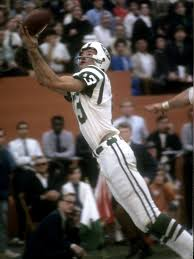
Donald Rogers Maynard was an American professional football player who was a wide receiver known for playing for the New York Jets in the National Football League. He also played with the New York Giants and St. Louis Cardinals; and the Shreveport Steamer of the World Football League (WFL).

Maynard was a four-time AFL All-Star and played for the Super Bowl III champions. The Jets retired Maynard's No. 13 in his honor. He was inducted into the Pro Football Hall of Fame and included on the AFL All-Time Team.

Nicknamed "Country", the quick and sure-handed Maynard was perhaps the most productive receiver of his day, setting career records for total receiving yards as well as yards per reception.

Maynard grew up in Texas. His father was a cotton broker, and with the family constantly moving, Maynard attended 13 schools, including five high schools. As a senior at Colorado City High School in Colorado City, Texas, he lettered in football, basketball, and track.

Maynard played collegiately for Rice University (one year), then for Texas Western College (now the University of Texas at El Paso). In three seasons (1954–56) with the Miners, he caught only 28 passes but averaged 27.6 yards per reception and recorded 10 touchdowns. As a running back, he had 843 yards rushing on 154 attempts for a 5.4 average and also returned punts and kickoffs. He amassed 2,283 all-purpose yards, while also intercepting 10 passes playing defensive back.

The New York Giants selected Maynard in the ninth round, with the 109th overall selection, of the 1957 NFL Draft. In 12 games as a rookie, he had 12 rushes for 45 yards (3.8 yards per carry), caught five passes for 84 yards (a 16.8 yard average), and played on special teams. After being released by the Giants during their 1959 training camp, he played one season in the Canadian Football League with the Hamilton Tiger-Cats, catching just one pass for 10 yards. In the off-season, he worked as a plumber and a teacher.

Maynard became the first player to sign with the New York Titans in 1960 (the team was renamed the Jets in 1963). This came about because the Titans' first head coach, Sammy Baugh, had coached against Maynard in college and knew his talent. Although scorned by the New York press as an "NFL reject" in 1960, he teamed with Art Powell to form the first professional wide receiver tandem to each gain over 1,000 yards on receptions in a season, with the pair achieving this milestone again in 1962. Over the next 13 years Maynard put up receiving numbers that would earn him a spot in the Pro Football Hall of Fame in 1987.

Collecting 72 pass receptions in his first year as a Titan, he went on to compile four more seasons with 50 or more catches and 1,000 yards receiving, and held the professional football record for total receptions and yards receiving. A four-time AFL All-Star, he is sixth in all-time pro football touchdown receptions, and is a member of the AFL All-Time Team.

In 1965, Maynard was teamed with rookie quarterback Joe Namath. Maynard had 1,218 yards on 68 receptions and 14 touchdowns in Namath's first season (Namath had 22 touchdown passes that year). In 1967, Maynard caught 1,434 of Namath's historic 4,007 passing yards. The receiving yards were a career-high for Maynard and led the league; he also had 71 receptions, 10 touchdowns, and averaged 20.2 yards per catch. In the 1968 season opener against Kansas City, Maynard had 200+ receiving yards for the first time in his career and passed Tommy McDonald as the active leader in receiving yards, where he remained for the next six seasons until his retirement. He added a career-best 228 yards in Game 10 against the Oakland Raiders. Maynard had 57 receptions for 1,297 yards (22.8 yards per catch) and 10 of Namath's 15 touchdowns that year. In the 1968 AFL Championship Game, a 27–23 Jets victory over the Oakland Raiders, Maynard caught six passes for 118 yards and two touchdowns. His 14-yard catch in the first quarter gave the Jets the lead and his six-yard catch in the fourth quarter proved to be the game winner. The Jets won Super Bowl III, 16–7 over the NFL's Baltimore Colts, which was hailed as the first "upset" in Super Bowl history. Maynard played, but had no catches while suffering the effects of a hamstring injury in the AFL title game.

Maynard played four more seasons with the Jets after Super Bowl III including being named first-team all-Pro in 1969. But long-simmering tensions between him and Jets’ Coach Weeb Ewbank boiled over in 1973. He reported late to Jets' camp that summer and, six weeks later on September 10, Ewbank unceremoniously traded him to the St. Louis Cardinals for a future draft pick. He appeared in the Redbirds’ first two games for rookie head coach Don Coryell and caught one pass for 18 yards but didn’t play in the club’s next two contests and was released October 10. Two months later, on December 12, Maynard signed as a free agent with the playoff-bound Los Angeles Rams. The Rams were coached by Chuck Knox, who’d mentored the New York Jets' offensive line during four of Maynard's prime seasons in Gotham – 1963-'66. The Rams, however, didn't activate Maynard for their final game of that regular season nor their 27-16 divisional playoff loss to the Dallas Cowboys in Texas Stadium two days before Christmas.

His NFL playing career at an apparent end, the 39-year-old Maynard caught on with the Houston Texans / Shreveport Steamer of the embryonic World Football League the next summer. But he had just five receptions for the club, which was forced to abruptly move from Houston in September 1974 when Texans' owner R. Steven Arnold unloaded the financially floundering franchise on a group of investors from Shreveport, Louisiana. Maynard retired as an active player after that tumultuous season but was hired by the newly christened Steamer’s as their receivers' coach. Maynard remained in that role until the organization – and league – folded for good in October 1975.

As a player, Maynard did not wear a chin strap on his helmet, instead using special cheek inserts that held the helmet tightly in place.

One of only 20 players who were in the AFL for its entire 10-year existence, Maynard was also one of only seven players who played their entire AFL careers with one team. Maynard finished his career with 633 receptions for 11,834 yards and 88 touchdowns. His 18.7 yards per catch is the highest for anyone with at least 600 receptions. Maynard was the first receiver to reach 10,000 yards and retired as pro football's all-time leader in receptions and yards receiving. Charley Taylor passed him in career receptions in 1975, while Maynard's yardage mark stood until 1986, when Charlie Joiner surpassed him.

Following his NFL career, Maynard went on to participate in many charity-sponsored events. He also participated in the coin toss in Super Bowl XXXIII along with his former teammates, in honor of the 40th anniversary of the 1958 NFL Championship, which is also known as "The Greatest Game Ever Played". He was also once named the grand marshal in the annual El Paso Sun Bowl Thanksgiving Parade. He worked as a math and industrial arts teacher, sold a variety of products, and was a financial planner.

Later in his life, Maynard lived in both El Paso and in Ruidoso, New Mexico to be close to his son and daughter and two grandchildren. His son was also a coach in the Canadian Football League with the Winnipeg Blue Bombers in 1990.

Maynard and his wife Marilyn (Weaver), whom he met when she was a student at Texas Western, were married in December 1955 after his junior season. She predeceased him. Maynard died from complications of dementia, among other ailments, at a care facility in Ruidoso on January 10, 2022, at the age of 86.

Sources
https://www.pro-football-reference.com/
https://www.profootballarchives.com/index.html
https://americanfootballdatabase.fandom.com/wiki/Football_Wiki
https://www.gridiron-uniforms.com/GUD/controller/controller.php?action=main
https://www.profootballhof.com/hall-of-famers/
Sargent, Jim (2005). "Don Maynard - Best Big-Time Receiver for New York's Titans and Jets" (PDF). The Coffin Corner. 27 (1). Professional Football Researchers Association. Archived from the original (PDF) on September 4, 2012.
 "Dan Maynard Bio". University of Texas at El Paso Official Athletic Site. Archived from the original on October 24, 2014. Retrieved October 24, 2014.
 "Hall of Fame - 2004 Inductees". University of Texas at El Paso Official Athletic Site. 2014. Archived from the original on October 24, 2014. Retrieved October 24, 2014.
 "Don Maynard Stats". pro-football-reference.com.
 "Super Bowl 2014: Former Jets great Don Maynard was almost a Green Bay Packer". January 26, 2014.
 "Don Maynard". Pro Football Hall of Fame Official Site.
 "Maynard to Be Honored". The New York Times. August 8, 1987. Retrieved October 3, 2009.
 "Who is on El Paso sports, athletic Mount Rushmore?". Elpasotimes.com. Retrieved January 10, 2022.
 "Don Maynard Career Game Log". Pro-Football-Reference.com.
 "2021 Super Bowl Sunday: When, Where, & More". NFL.com.
 Doug Grow, “Maynard Brings ‘Trade Secrets,” St. Louis Post Dispatch; Sept. 12, 1973
 “Maynard Joins Rams To Help In Playoffs;” Pomona, California Progress Bulletin; Dec. 13, 1973
 “Maynard Says Joe Wasn’t Like Image;” The Shreveport Journal; July 31, 1975
 Bob Ingram; “As I Was Saying;” El Paso Herald Post; June 7, 1975
 "OH, HOW GENTLY FLOWS THIS DON - Sports Illustrated Vault". SI.com. July 23, 1973. Retrieved January 10, 2022.
 Seppy, Tom (December 22, 1975). "Turnovers topple Redskins". Free Lance-Star. Fredericksburg, Virginia. Associated Press. p. 10. Retrieved January 13, 2022.
 "Largent, Joiner Set Reception Records". The New York Times. AP. October 7, 1986. p. D28. Retrieved January 13, 2022.
 "Pro Football Hall of Famer, New York Jets great Don Maynard dies at age 86". ESPN.com. January 10, 2022. Retrieved January 10, 2022.
 Goldstein, Richard (January 10, 2022). "Don Maynard, Hall of Fame Receiver for Champion Jets, Dies at 86". The New York Times. Retrieved January 10, 2022.

Wednesday, May 3, 2023

The Story And Significance Of Larry Wilson - Named To The NFL 75th Anniversary All-Time Team At Free Safety

Larry Frank Wilson was an American professional football player who was a free safety with the St. Louis Cardinals of the National Football League. An eight-time Pro Bowl selection, he played his entire 13-year career with the Cardinals and remained on the team's payroll until 2003, long after the team moved to Arizona in 1988.

Wilson was inducted into the Pro Football Hall of Fame in 1978, his first year of eligibility, was named to the NFL 75th Anniversary All-Time Team in 1994 and was named to the NFL 100th Anniversary All-Time Team in 2019.

Despite his skill and adaptability, Wilson's small size (he was only six feet tall) resulted in him not being selected until the 7th round of the 1960 NFL draft by the Chicago Cardinals. The draft was held in November 1959, and the franchise moved to St. Louis before the start of the 1960 season.

Shortly before Wilson's signing, defensive coordinator Chuck Drulis crafted a play that called for the free safety to take part in a blitz. The play was code-named "Wildcat", but Drulis didn't think he had anyone with the skills and athleticism to run it until Wilson's arrival. Drulis was impressed enough with Wilson that he persuaded the Cardinals to convert him to free safety. When the Cardinals first ran the safety blitz, the pressure was severe since most teams did not (and still do not) expect a defensive back to take part in a pass rush. This single play also helped to set up today's defenses where a blitz can come from anywhere. Wilson became so identified with the play that "Wildcat" became his nickname.

Wilson was named All-Pro six times in his career and represented the Cardinals on eight Pro Bowl teams. During 1966, he had at least one interception in seven consecutive games, en route to a 10-pick season that led his league. Fellow Idahoan Jerry Kramer, a guard for the Green Bay Packers and author of Instant Replay, called Wilson "the finest football player in the NFL." Kramer described Wilson's play during an October 30, 1967 game, "...he fired up their whole team ... his enthusiasm was infectious."

Wilson is renowned for not only playing, but intercepting a pass, with casts on both hands due to broken wrists. On the September 18, 2006 edition of SportsCenter, Mike Ditka challenged Terrell Owens' toughness by not playing for 2–4 weeks due to a broken finger. He cited Wilson's interception with casts on both hands as proof of a tougher football player. He ended his career with 52 career picks for 800 yards and five touchdowns, as well as 14 fumble recoveries for 173 yards and 2 more scores.

Wilson retired after the 1972 season. He is one of the few players to have played in the NFL for at least 10 years without having taken part in an official playoff game. The closest he came to postseason play was in 1964, when the Cardinals played in and won the Playoff Bowl, a postseason third-place game. It was one of only five winning seasons the Cardinals had during his 13-year career.

Following his retirement as a player, Wilson was named secondary coach and director of scouting. He stepped down as secondary coach after the 1973 season. In 1977, he was named general manager, a post he would hold (under various titles) for the next 17 years. He also served as interim head coach in 1979 after the dismissal of Bud Wilkinson. Wilson added the title of vice president in 1988, after the team's move to Arizona. He stepped down as GM in 1993, but remained as vice president until his retirement after the 2002 season.

Wilson was inducted into the Pro Football Hall of Fame in 1978, making him one of four Hall of Famers to have never played in the postseason. In 1999, he was ranked number 43 on The Sporting News' list of the 100 Greatest Football Players, making him the highest-ranked player to have played a majority of his career with the Cardinals. The team has also retired his uniform number 8. In 2007, NFL Network ranked him ninth on its list of the "Top 10 Draft Steals" in NFL history. Wilson was named to the NFL 75th Anniversary All-Time Team in 1994 and was named to the NFL 100th Anniversary All-Time Team in 2019.

Wilson was married to Nancy Wilson for over forty years and had two children. He died on September 17, 2020 in Scottsdale, Arizona.
Sources
https://www.pro-football-reference.com/
https://www.profootballarchives.com/index.html
https://americanfootballdatabase.fandom.com/wiki/Football_Wiki
https://www.gridiron-uniforms.com/GUD/controller/controller.php?action=main
https://www.profootballhof.com/hall-of-famers/
Benson, Lee (February 3, 1978). "Football returns favor, surprises Wilson". Deseret News. p. B8.
 "Wilson looks to future after taking general manager's role". Mohave Daily Miner. Kingman, Arizona. Associated Press. September 7, 1988. p. 6.
 "Larry Wilson ends 43-year career with Cardinals". Daily Courier. Sedona, Arizona. Associated Press. April 15, 2003. p. 11A.
 "Hall inducts Wilson". Deseret News. UPI. July 29, 1978. p. 3A.
 "Ewbank, Alworth lead five new Hall of Fame pro grid entries". Lodi News-Sentinel. California. UPI. January 24, 1978. p. 11.
 "75th Anniversary All Time Team". National Football League. 1994. Retrieved February 5, 2015.
 Battista, Judy. "NFL's All-Time Team: Defensive backs, special teams revealed". NFL.com.
 Belson, Ken (September 18, 2020). "Larry Wilson, Who Made Safety an N.F.L. Threat, Dies At 82". New York Times.
 Nelson, Rett (August 28, 2021). "Monument honoring NFL Hall-of-Famer from Rigby unveiled and dedicated at Trojan's stadium". East Idaho News. Retrieved December 6, 2024.
 Underwood, Bob (March 24, 2020). "Big Red Legends: Larry Wilson". THE BIG RED ZONE. Retrieved December 6, 2024.
 "Larry Wilson, 1938 - 2020 | Pro Football Hall of Fame". pfhof. Retrieved December 6, 2024.
 "Town Honors All Pro Athlete Larry Wilson". Idaho Statesman (Boise, Idaho). July 2, 1967. p. 11.
 Lasley, Kevin R. Great Athletes, Larry Wilson. Salem Press.
 "Northern Idaho Schools Take Team Honors in State Track Meet". The Idaho Statesman (Boise, Idaho). May 20, 1956. p. 13.
 "Larry Wilson honored in hometown | Pro Football Hall of Fame". pfhof. Retrieved December 5, 2024.
 Woods, Greg (August 26, 2021). "The complicated legacy of Larry Wilson at Rigby". Post Register. Retrieved December 5, 2024.
 "Utah Athletics Mourns the Passing of Larry Wilson". University of Utah Athletics. September 18, 2020. Retrieved December 5, 2024.
 Kostecka, Ryan (October 4, 2020). "Former Utah great Larry Wilson passed away at the age of 82". Utah Utes On SI. Retrieved December 6, 2024.
 "1960 AFL Draft Listing". Pro-Football-Reference.com. Retrieved December 5, 2024.
 "Larry Wilson | Pro Football Hall of Fame". pfhof. Retrieved December 5, 2024.
 Urban, Darren (September 28, 2020). "Cardinals Hall Of Famer Larry Wilson Passes Away". www.azcardinals.com. Retrieved December 6, 2024.
 "Larry Wilson Stats, Height, Weight, Position, Draft, College". Pro-Football-Reference.com. Retrieved December 5, 2024.
 Cox, Seth (September 18, 2020). "Arizona Cardinals legend Larry Wilson has passed away". Revenge of the Birds. Retrieved December 5, 2024.
 Harner, Andrew (November 11, 2020). "Arizona Cardinals Hall of Fame Players: A Complete History". SI. Retrieved December 6, 2024.
 Donahue, Ben (February 1, 2022). "The Life And Career Of Larry Wilson (Complete Story)". Pro Football History. Retrieved December 9, 2024.
 Underwood, Bob (December 27, 2019). "Cardinals Defensive Coordinator Chuck Drulis: Innovator, Controversial". THE BIG RED ZONE. Retrieved December 9, 2024.
 Somers, Kent (September 18, 2020). "Larry Wilson, lifetime Cardinals icon and an NFL all-time great, dies at age 82". The Arizona Republic. Retrieved December 9, 2024.
 "Jerry Norton Stats, Height, Weight, Position, Draft, College". Pro-Football-Reference.com. Retrieved December 9, 2024.
 Shrake, Edwiin (November 1965). "THE OUTLAW AND THE WANT-TO CARDS". Sports Illustrated. 23 (18).
 Pollack, Joe (1968). "Cardinals 1968 Official Guide, St. Louis Football Cardinals Guide and Record Book, Cardinals Coaching Staff, Chuck Drulis Assistant Coach (p. 6)" (PDF).
 "Cards' Wilson to get control of operations". The Arizona Republic. September 3, 1988. p. 101.
 "1966 NFL Pro Bowlers". Pro-Football-Reference.com. Retrieved May 18, 2025.
 "1966 Awards Voting". Pro-Football-Reference.com. Retrieved May 18, 2025.
 "1966 Green Bay Packers Rosters, Stats, Schedule, Team Draftees". Pro-Football-Reference.com. Retrieved May 18, 2025.
 "1966 St. Louis Cardinals Rosters, Stats, Schedule, Team Draftees". Pro-Football-Reference.com. Retrieved May 18, 2025.
 "Arizona Cardinals Career Defensive Leaders | The Football Database". FootballDB.com. Retrieved December 9, 2024.
 Rohan, Tim (June 22, 2017). "The Playoff Bowl: The Worst Kind of Garbage Time". SI. Retrieved December 6, 2024.
 Dillon, Dennis (November 15, 2022). "1964 "Mud Bowl" Tie Cost Big Red Chance for Title". THE BIG RED ZONE. Retrieved December 6, 2024.
 "The Playoff Bowl: A Post Season Exhibition". RetroCards. November 21, 2016. Retrieved December 6, 2024.
 "Arizona Cardinals Team Records, Leaders, and League Ranks". Pro-Football-Reference.com. Retrieved December 6, 2024.
 "How many Pro Football Hall of Famers never made the playoffs?". March 17, 2018.
 "Joe Thomas | Pro Football Hall of Fame". pfhof. Retrieved December 6, 2024.
 "Unitas QBs NFL Team". Tampa Tribune. September 7, 1969. p. 34.
 "From the Hall of Fame Archives: The 1960's All-Decade Team". NFL.com. Retrieved December 6, 2024.
 "From the Hall of Fame Archives: The 1970's All-Decade Team". NFL.com. Retrieved December 6, 2024.
 "The Sporting News 100 Greatest Players of All-Time". Future Football Legends. Retrieved December 6, 2024.
 "1967 NFL Pro Bowlers". Pro-Football-Reference.com. Retrieved May 18, 2025.
 "1968 NFL Pro Bowlers". Pro-Football-Reference.com. Retrieved May 18, 2025.
 "1969 NFL Pro Bowlers". Pro-Football-Reference.com. Retrieved May 18, 2025.
 "1963 NFL Pro Bowlers". Pro-Football-Reference.com. Retrieved May 18, 2025.
 "1965 NFL Pro Bowlers". Pro-Football-Reference.com. Retrieved May 18, 2025.
 "Non quarterbacks and running backs who received an MVP vote - Professional Football Researchers Association Forum". www.profootballresearchers.com. Retrieved December 5, 2024.
 "Arizona Cardinals: Every Individual Award Winner in Franchise History". Raising Zona. June 21, 2022. Retrieved December 6, 2024.
 "NFL's top 10 draft steals in league history". NFL.com. Retrieved December 6, 2024.
 Kramer, J. (1968). Instant Replay: The Green Bay diary of Jerry Kramer. New York: The World Publishing Company, p. 173.
 "Cardinals fire Bud Wilkinson; Larry Wilson interim coach". Pittsburgh Press. November 29, 1979. p. C-14.
 "Cardinals Hall Of Famer Larry Wilson Passes Away". www.azcardinals.com. Retrieved December 5, 2024.
 "100 Greatest, Greatest Plays, NFL 100". NFL.com. Retrieved December 6, 2024.
 "Larry Wilson – Missouri Sports Hall of Fame". Retrieved December 6, 2024.
 Moore, Tim. "Larry Wilson". St Louis Sports Hall of Fame. Retrieved December 6, 2024.
 "Ring of Honor members". www.azcardinals.com. Retrieved December 6, 2024.
 Belson, Ken (September 18, 2020). "Larry Wilson, Who Made Safety an N.F.L. Threat, Dies at 82". The New York Times.
 "Cardinals Hall Of Famer Larry Wilson Passes Away". www.azcardinals.com. Retrieved September 18, 2020.

Tuesday, April 10, 2018

History Of The Arizona Cardinals

aThe history of the Arizona Cardinals is extraordinary compared to most franchises in the NFL. The Cardinals compete in the National Football League as a member of the league’s National Football Conference West division. The Cardinals were founded as the Morgan Athletic Club in 1898, and are the oldest continuously run professional football team in the United States. The team was established in Chicago and was a charter member of the NFL (APFA which the league was called its first two years) in 1920. Along with the Chicago Bears, the club is one of two NFL charter member franchises still in operation since the league’s founding, the other being the Bears (back then known as the Staleys). The club  moved to St. Louis decades later in 1960 and played in that city through 1987 then moved to Phoenix. 
The franchise has won two NFL championships, both while it was in Chicago. The first occurred in 1925, but is the subject of controversy, with supporters of the Pottsville Maroons believing that Pottsville should have won the title. The title back then was earned by having the best record which the Maroons did. After they earned the title they went to play the best college team after the season which was against NFL rules so they forfeited the title to the Cardinals because they had the second best record. Their second title, and the first to be won in a championship game, came in 1947. They returned to the title game to defend in 1948, but lost in the rematch 7–0 in a snowstorm in Philadelphia.
Since winning the championship in 1947, the team suffered many losing seasons, and currently holds the league’s longest active championship drought, at 68 consecutive seasons. In 2012 the Cardinals became the first NFL franchise to lose 700 games since its inception. The Cardinals are the only NFL team who have never lost a playoff game at home, with a 5-0 record. The Cardinals have had recent success going to the NFC Championship in 2008-2009 season and in 2015-2016 season.aaa. 
aa
Notes:
Spelled List=Lsit
The Cardinals did not play in the 1949 Championship which I said they went to the title game to lose to the Eagles the next two years.
Sorry for the Screencast-O-Matic blocking the corner of the video but using VSDC video editor I did not have a subscription so I had to record off the screen.
This an original video done by me but the photos are not mine and neither is the music.
Bibliography: