Showing posts with label HOF 1978. Show all posts

Wednesday, May 3, 2023

The Story And Significance Of Larry Wilson - Named To The NFL 75th Anniversary All-Time Team At Free Safety

Larry Frank Wilson was an American professional football player who was a free safety with the St. Louis Cardinals of the National Football League. An eight-time Pro Bowl selection, he played his entire 13-year career with the Cardinals and remained on the team's payroll until 2003, long after the team moved to Arizona in 1988.

Wilson was inducted into the Pro Football Hall of Fame in 1978, his first year of eligibility, was named to the NFL 75th Anniversary All-Time Team in 1994 and was named to the NFL 100th Anniversary All-Time Team in 2019.

Despite his skill and adaptability, Wilson's small size (he was only six feet tall) resulted in him not being selected until the 7th round of the 1960 NFL draft by the Chicago Cardinals. The draft was held in November 1959, and the franchise moved to St. Louis before the start of the 1960 season.

Shortly before Wilson's signing, defensive coordinator Chuck Drulis crafted a play that called for the free safety to take part in a blitz. The play was code-named "Wildcat", but Drulis didn't think he had anyone with the skills and athleticism to run it until Wilson's arrival. Drulis was impressed enough with Wilson that he persuaded the Cardinals to convert him to free safety. When the Cardinals first ran the safety blitz, the pressure was severe since most teams did not (and still do not) expect a defensive back to take part in a pass rush. This single play also helped to set up today's defenses where a blitz can come from anywhere. Wilson became so identified with the play that "Wildcat" became his nickname.

Wilson was named All-Pro six times in his career and represented the Cardinals on eight Pro Bowl teams. During 1966, he had at least one interception in seven consecutive games, en route to a 10-pick season that led his league. Fellow Idahoan Jerry Kramer, a guard for the Green Bay Packers and author of Instant Replay, called Wilson "the finest football player in the NFL." Kramer described Wilson's play during an October 30, 1967 game, "...he fired up their whole team ... his enthusiasm was infectious."

Wilson is renowned for not only playing, but intercepting a pass, with casts on both hands due to broken wrists. On the September 18, 2006 edition of SportsCenter, Mike Ditka challenged Terrell Owens' toughness by not playing for 2–4 weeks due to a broken finger. He cited Wilson's interception with casts on both hands as proof of a tougher football player. He ended his career with 52 career picks for 800 yards and five touchdowns, as well as 14 fumble recoveries for 173 yards and 2 more scores.

Wilson retired after the 1972 season. He is one of the few players to have played in the NFL for at least 10 years without having taken part in an official playoff game. The closest he came to postseason play was in 1964, when the Cardinals played in and won the Playoff Bowl, a postseason third-place game. It was one of only five winning seasons the Cardinals had during his 13-year career.

Following his retirement as a player, Wilson was named secondary coach and director of scouting. He stepped down as secondary coach after the 1973 season. In 1977, he was named general manager, a post he would hold (under various titles) for the next 17 years. He also served as interim head coach in 1979 after the dismissal of Bud Wilkinson. Wilson added the title of vice president in 1988, after the team's move to Arizona. He stepped down as GM in 1993, but remained as vice president until his retirement after the 2002 season.

Wilson was inducted into the Pro Football Hall of Fame in 1978, making him one of four Hall of Famers to have never played in the postseason. In 1999, he was ranked number 43 on The Sporting News' list of the 100 Greatest Football Players, making him the highest-ranked player to have played a majority of his career with the Cardinals. The team has also retired his uniform number 8. In 2007, NFL Network ranked him ninth on its list of the "Top 10 Draft Steals" in NFL history. Wilson was named to the NFL 75th Anniversary All-Time Team in 1994 and was named to the NFL 100th Anniversary All-Time Team in 2019.

Wilson was married to Nancy Wilson for over forty years and had two children. He died on September 17, 2020 in Scottsdale, Arizona.
Sources
https://www.pro-football-reference.com/
https://www.profootballarchives.com/index.html
https://americanfootballdatabase.fandom.com/wiki/Football_Wiki
https://www.gridiron-uniforms.com/GUD/controller/controller.php?action=main
https://www.profootballhof.com/hall-of-famers/
Benson, Lee (February 3, 1978). "Football returns favor, surprises Wilson". Deseret News. p. B8.
 "Wilson looks to future after taking general manager's role". Mohave Daily Miner. Kingman, Arizona. Associated Press. September 7, 1988. p. 6.
 "Larry Wilson ends 43-year career with Cardinals". Daily Courier. Sedona, Arizona. Associated Press. April 15, 2003. p. 11A.
 "Hall inducts Wilson". Deseret News. UPI. July 29, 1978. p. 3A.
 "Ewbank, Alworth lead five new Hall of Fame pro grid entries". Lodi News-Sentinel. California. UPI. January 24, 1978. p. 11.
 "75th Anniversary All Time Team". National Football League. 1994. Retrieved February 5, 2015.
 Battista, Judy. "NFL's All-Time Team: Defensive backs, special teams revealed". NFL.com.
 Belson, Ken (September 18, 2020). "Larry Wilson, Who Made Safety an N.F.L. Threat, Dies At 82". New York Times.
 Nelson, Rett (August 28, 2021). "Monument honoring NFL Hall-of-Famer from Rigby unveiled and dedicated at Trojan's stadium". East Idaho News. Retrieved December 6, 2024.
 Underwood, Bob (March 24, 2020). "Big Red Legends: Larry Wilson". THE BIG RED ZONE. Retrieved December 6, 2024.
 "Larry Wilson, 1938 - 2020 | Pro Football Hall of Fame". pfhof. Retrieved December 6, 2024.
 "Town Honors All Pro Athlete Larry Wilson". Idaho Statesman (Boise, Idaho). July 2, 1967. p. 11.
 Lasley, Kevin R. Great Athletes, Larry Wilson. Salem Press.
 "Northern Idaho Schools Take Team Honors in State Track Meet". The Idaho Statesman (Boise, Idaho). May 20, 1956. p. 13.
 "Larry Wilson honored in hometown | Pro Football Hall of Fame". pfhof. Retrieved December 5, 2024.
 Woods, Greg (August 26, 2021). "The complicated legacy of Larry Wilson at Rigby". Post Register. Retrieved December 5, 2024.
 "Utah Athletics Mourns the Passing of Larry Wilson". University of Utah Athletics. September 18, 2020. Retrieved December 5, 2024.
 Kostecka, Ryan (October 4, 2020). "Former Utah great Larry Wilson passed away at the age of 82". Utah Utes On SI. Retrieved December 6, 2024.
 "1960 AFL Draft Listing". Pro-Football-Reference.com. Retrieved December 5, 2024.
 "Larry Wilson | Pro Football Hall of Fame". pfhof. Retrieved December 5, 2024.
 Urban, Darren (September 28, 2020). "Cardinals Hall Of Famer Larry Wilson Passes Away". www.azcardinals.com. Retrieved December 6, 2024.
 "Larry Wilson Stats, Height, Weight, Position, Draft, College". Pro-Football-Reference.com. Retrieved December 5, 2024.
 Cox, Seth (September 18, 2020). "Arizona Cardinals legend Larry Wilson has passed away". Revenge of the Birds. Retrieved December 5, 2024.
 Harner, Andrew (November 11, 2020). "Arizona Cardinals Hall of Fame Players: A Complete History". SI. Retrieved December 6, 2024.
 Donahue, Ben (February 1, 2022). "The Life And Career Of Larry Wilson (Complete Story)". Pro Football History. Retrieved December 9, 2024.
 Underwood, Bob (December 27, 2019). "Cardinals Defensive Coordinator Chuck Drulis: Innovator, Controversial". THE BIG RED ZONE. Retrieved December 9, 2024.
 Somers, Kent (September 18, 2020). "Larry Wilson, lifetime Cardinals icon and an NFL all-time great, dies at age 82". The Arizona Republic. Retrieved December 9, 2024.
 "Jerry Norton Stats, Height, Weight, Position, Draft, College". Pro-Football-Reference.com. Retrieved December 9, 2024.
 Shrake, Edwiin (November 1965). "THE OUTLAW AND THE WANT-TO CARDS". Sports Illustrated. 23 (18).
 Pollack, Joe (1968). "Cardinals 1968 Official Guide, St. Louis Football Cardinals Guide and Record Book, Cardinals Coaching Staff, Chuck Drulis Assistant Coach (p. 6)" (PDF).
 "Cards' Wilson to get control of operations". The Arizona Republic. September 3, 1988. p. 101.
 "1966 NFL Pro Bowlers". Pro-Football-Reference.com. Retrieved May 18, 2025.
 "1966 Awards Voting". Pro-Football-Reference.com. Retrieved May 18, 2025.
 "1966 Green Bay Packers Rosters, Stats, Schedule, Team Draftees". Pro-Football-Reference.com. Retrieved May 18, 2025.
 "1966 St. Louis Cardinals Rosters, Stats, Schedule, Team Draftees". Pro-Football-Reference.com. Retrieved May 18, 2025.
 "Arizona Cardinals Career Defensive Leaders | The Football Database". FootballDB.com. Retrieved December 9, 2024.
 Rohan, Tim (June 22, 2017). "The Playoff Bowl: The Worst Kind of Garbage Time". SI. Retrieved December 6, 2024.
 Dillon, Dennis (November 15, 2022). "1964 "Mud Bowl" Tie Cost Big Red Chance for Title". THE BIG RED ZONE. Retrieved December 6, 2024.
 "The Playoff Bowl: A Post Season Exhibition". RetroCards. November 21, 2016. Retrieved December 6, 2024.
 "Arizona Cardinals Team Records, Leaders, and League Ranks". Pro-Football-Reference.com. Retrieved December 6, 2024.
 "How many Pro Football Hall of Famers never made the playoffs?". March 17, 2018.
 "Joe Thomas | Pro Football Hall of Fame". pfhof. Retrieved December 6, 2024.
 "Unitas QBs NFL Team". Tampa Tribune. September 7, 1969. p. 34.
 "From the Hall of Fame Archives: The 1960's All-Decade Team". NFL.com. Retrieved December 6, 2024.
 "From the Hall of Fame Archives: The 1970's All-Decade Team". NFL.com. Retrieved December 6, 2024.
 "The Sporting News 100 Greatest Players of All-Time". Future Football Legends. Retrieved December 6, 2024.
 "1967 NFL Pro Bowlers". Pro-Football-Reference.com. Retrieved May 18, 2025.
 "1968 NFL Pro Bowlers". Pro-Football-Reference.com. Retrieved May 18, 2025.
 "1969 NFL Pro Bowlers". Pro-Football-Reference.com. Retrieved May 18, 2025.
 "1963 NFL Pro Bowlers". Pro-Football-Reference.com. Retrieved May 18, 2025.
 "1965 NFL Pro Bowlers". Pro-Football-Reference.com. Retrieved May 18, 2025.
 "Non quarterbacks and running backs who received an MVP vote - Professional Football Researchers Association Forum". www.profootballresearchers.com. Retrieved December 5, 2024.
 "Arizona Cardinals: Every Individual Award Winner in Franchise History". Raising Zona. June 21, 2022. Retrieved December 6, 2024.
 "NFL's top 10 draft steals in league history". NFL.com. Retrieved December 6, 2024.
 Kramer, J. (1968). Instant Replay: The Green Bay diary of Jerry Kramer. New York: The World Publishing Company, p. 173.
 "Cardinals fire Bud Wilkinson; Larry Wilson interim coach". Pittsburgh Press. November 29, 1979. p. C-14.
 "Cardinals Hall Of Famer Larry Wilson Passes Away". www.azcardinals.com. Retrieved December 5, 2024.
 "100 Greatest, Greatest Plays, NFL 100". NFL.com. Retrieved December 6, 2024.
 "Larry Wilson – Missouri Sports Hall of Fame". Retrieved December 6, 2024.
 Moore, Tim. "Larry Wilson". St Louis Sports Hall of Fame. Retrieved December 6, 2024.
 "Ring of Honor members". www.azcardinals.com. Retrieved December 6, 2024.
 Belson, Ken (September 18, 2020). "Larry Wilson, Who Made Safety an N.F.L. Threat, Dies at 82". The New York Times.
 "Cardinals Hall Of Famer Larry Wilson Passes Away". www.azcardinals.com. Retrieved September 18, 2020.

Monday, May 1, 2023

The Story And Significance Of Ray Nitschke - Named The NFL's All-Time Top Linebacker By The NFL In Honor Of The NFL's 50th Anniversary

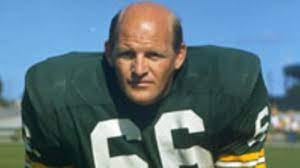
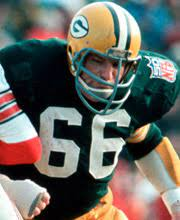
Raymond Ernest Nitschke was an American professional football player who spent his entire 15-year career as a middle linebacker in the National Football League with the Green Bay Packers. Enshrined in the Pro Football Hall of Fame in 1978, he was the anchor of the defense for head coach Vince Lombardi in the 1960s, leading the Packers to five NFL championships and victories in the first two Super Bowls.

Growing up in the outskirts of Chicago, Nitschke had idolized the Bears and he hoped to be chosen by them in the 1958 NFL Draft, held on December 2, 1957. However, he was chosen by the Green Bay Packers late in the third round (36th overall) of what is considered the greatest draft in the franchise's history. It included three other significant Packers of the 1960s, linebacker Dan Currie of Michigan State (3rd overall), fullback Jim Taylor of LSU (15th overall) and right guard Jerry Kramer of Idaho (39th overall). Their rookie season in 1958 under first-year head coach Ray "Scooter" McLean was dismal, with just one win and one tie for the worst record in the 12-team league. Nitschke wore number 33 in 1958 and 66 the rest of his career with the Packers.

A month after the 1958 season ended, Vince Lombardi was hired as head coach. Nitschke became a full-time starter in 1962, the anchor of a disciplined defense that helped win five NFL titles and the first two Super Bowls in the 1960s. He was the MVP of the 1962 NFL Championship Game, accepting the prize of a 1963 Chevrolet Corvette. In the game, Nitschke recovered two fumbles and deflected a pass that was intercepted. The Packers won 16–7 and finished the season with a 14–1 record. In Super Bowl I, Nitschke contributed six tackles and a sack. In Super Bowl II, Nitschke led Green Bay's defense with nine tackles.

Nitschke remained a starter through the 1970 season, but in 1971 he was benched by new coach Dan Devine and became a reserve to Jim Carter. At the end of the 1972 season, the 9–4 Packers traveled to New Orleans to play the 2–10–1 Saints on December 17 at Tulane Stadium, which turned out to be Nitschke's last regular season game. He recorded the only pass reception of his career, a 34-yard gain after a blocked Packer field goal attempt, and they won 30–20 to finish at 10–4, their best regular season record since 1966. Green Bay had clinched the NFC Central division title the week before at Minnesota for their first playoff berth in five seasons. In the divisional round of the playoffs on Christmas Eve, Green Bay lost 16–3 at Washington. Nitschke returned for a 16th training camp in 1973, then retired in late August.

Nitschke was known for his strength and toughness, exhibited prior to his third season in 1960. On the Packers' practice field on September 1, a 1,000-pound steel coaching tower was blown over by a strong gust of wind, on top of Nitschke. (It was erroneously first reported as 5,000 lb.) Lombardi ran over to see what had happened, but when told it had fallen on Nitschke, said, "He'll be fine. Get back to work!" According to Nitschke's biography, a spike was driven into his helmet, but did not injure him. The helmet (with the hole) is currently on display in the Packer Hall of Fame in Green Bay. Although Nitschke was known for his hard hitting, he was an athletic all-around linebacker who also intercepted 25 passes over his career.

His No. 66 was retired in 1983, the fourth of six numbers retired by the Packers. The only other Lombardi-era player to have his number retired is quarterback Bart Starr, whose number 15 was retired in 1973. Also, the team has named one of its two outdoor practice fields "Ray Nitschke Field". Prior to its retirement, number 66 had remained in circulation and was last worn in 1983 by offensive lineman Lawrence Pfohl, who would go on to fame as a professional wrestler under the ring name Lex Luger.

In 1969, he was named the NFL's all-time top Linebacker by the NFL in honor of the NFL's 50th Anniversary. Thus he is the only linebacker to have made both the NFL's 50th and 75th Anniversary Teams.

He was elected to the Pro Football Hall of Fame in 1978. Every year, the Pro Football Hall of Fame has a luncheon the day before its induction ceremony, attended by most of the living members and honoring the new inductees. Nitschke always spoke at this luncheon, telling the new inductees what a great honor they were receiving, and that they were now members of the greatest team of them all. Following his death, the Hall named the luncheon after him. He was elected to the Wisconsin Athletic Hall of Fame in 1981.

Upon the election of former teammate Henry Jordan to the Pro Football Hall of Fame on the eve of Super Bowl XXIX in Miami Gardens, Florida, Nitschke flew down to Florida to participate in the game's coin-toss ceremonies, joining three other 75th Anniversary Team representatives--Otto Graham (1950s), Mean Joe Greene (1970s) and Gale Sayers (1960s), all three of whom had been announced as representatives of their respective decades in the ceremony months prior to the PFHOF election—as well as three of Jordan's fellow Class of 1995 newcomers, all of whom represented the 1980s: Kellen Winslow, Lee Roy Selmon, and then-U.S. Congressman Steve Largent, who ended the pregame ceremonies by flipping the coin.

In 1999, he was ranked number 18 on The Sporting News' list of the 100 Greatest Football Players, making him the highest-ranked player coached by Vince Lombardi, second among Packers behind Don Hutson, and third among linebackers behind Lawrence Taylor and Dick Butkus.

The Ray Nitschke Memorial Bridge, a twin-leaf bascule bridge over the Fox River on Main Street (US 141) in Green Bay, was named in honor of Nitschke. The bridge was constructed in 1998 to replace the former Main Street Bridge built in 1923.
Sources
https://www.pro-football-reference.com/
https://www.profootballarchives.com/index.html
https://americanfootballdatabase.fandom.com/wiki/Football_Wiki
https://www.gridiron-uniforms.com/GUD/controller/controller.php?action=main
https://www.profootballhof.com/hall-of-famers/
McGinn, Bob (March 9, 1998). "Packers legend Nitschke dies". Milwaukee Journal Sentinel. p. 1A. Archived from the original on March 2, 2016. Retrieved January 24, 2016.
 Goldstein, Richard (March 9, 1998). "Ray Nitschke, 61, linebacker during Packers' glory years". The New York Times. Retrieved January 23, 2016.
 "Fierce linebacker anchored Packers". Toledo Blade. Ohio. Associated Press. March 9, 1998. p. 13.
 Gruver, 2002 pg. 20
 Gruver, 2002 pg. 21
 Gruver, 2002 pg. 25
 Gruver, 2002 pg. 29
 Gruver, 2002 pg. 37
 Gruver, 2002 pg. 44
 Gruver, 2002 pg. 62
 "The face of a smashmouth approach".
 Gruver, 2002 pg. 54
 Markus, Robert (January 25, 1972). "Along the sports trail". Chicago Tribune. p. 3-3. Retrieved August 23, 2022 – via newspapers.com.
 Cary, Bill (August 29, 1973). "No. 66 Is Gone – But Forgotten? Hardly". The Reporter. p. 27. Retrieved August 19, 2022 – via newspapers.com.
 Lea, Bud (December 18, 1972). "Packers leave 'em laughing". Milwaukee Sentinel. p. 1, part 2.[permanent dead link]
 Beldsoe, Terry (December 18, 1972). "Packers get last laugh in slapstick game". Milwaukee Journal. p. 14, part 2.[permanent dead link]
 "Packers win division title". Milwaukee Sentinel. December 11, 1972. p. 1, part 1.
 Lea, Bud (December 25, 1972). "Redskins burst Packers' bubble". Milwaukee Sentinel. p. 1, part 2.
 Johnson, Chuck (August 28, 1973). "Nitschke retires, with some reluctance". Milwaukee Journal. p. 11, part 2.[permanent dead link]
 Lea, Bud (August 29, 1973). "Ray of hope dies for old pro Nitschke". Milwaukee Sentinel. p. 1, part 2.[permanent dead link]
 "'No hard feelings' says Ray Nitschke". Spokesman-Review. Spokane, Washington. (Associated Press). August 29, 1973. p. 17.
 "5,000 pound tower falls on Nitschke". Milwaukee Sentinel. Associated Press. September 2, 1960. p. 3, part 2.[permanent dead link]
 "Crashing tower falls on player". Lewiston Morning Tribune. Idaho. Associated Press. September 2, 1960. p. 10.
 "(Photos)". Milwaukee Journal. Associated Press. September 2, 1960. p. 11, part 2.[permanent dead link]
 "Chicago Tribune - Historical Newspapers".
 "Nitschke OK: Vince names vet starters". Milwaukee Sentinel. Associated Press. September 3, 1960. p. 4, part 2.[permanent dead link]
 Gruver, 2002 pg. 103-105
 "MEAN ON SUNDAY: The Autobiography of Ray Nitschke" Kirkus Reviews. September 1, 1973.
 Ray Nitschke - Class of 1978 Green Bay Packers.
 Venci, Scott (September 18, 2018). "Green Bay Packers passed on Larry Pfohl who became Lex Luger". Press Gazette Media. Retrieved April 7, 2025.
 Hofmann, Dale (July 29, 1978). "Hard nosed Ray Nitschke just a softie over induction". Milwaukee Sentinel. p. 4, part 2. Archived from the original on March 2, 2016. Retrieved January 24, 2016.
 Christl, Cliff. "Ray Nitschke". Packers.com. Archived from the original on September 29, 2023. Retrieved September 20, 2023.
 Bridgehunter Main Street Bridge (New) Archived December 11, 2013, at the Wayback Machine
 Merit Award: Moveable Span "Ray Nitschke Memorial Bridge" Archived September 21, 2013, at the Wayback Machine
Gruver, Edward (2002), Nitschke. Lanham:Taylor Trade Publishing. ISBN 1-58979-127-4
Kaplan, Richard (1970), Great Linebackers of the NFL, ISBN 0-394-90152-5

Monday, April 24, 2023

The Story And Significance Of Tuffy Leemans - Received First Or Second Team All-Pro Honors From 1936 Through 1942

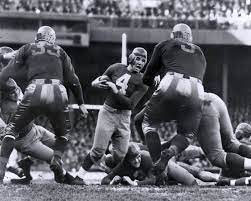
Alphonse Emil "Tuffy" Leemans was an American professional football player who was a fullback and halfback who played on both offense and defense for the New York Giants of the National Football League. He was inducted into the Pro Football Hall of Fame in 1978 and was named in 1969 to the NFL 1930s All-Decade Team.

A native of Superior, Wisconsin, Leemans played college football for Oregon's freshman team in 1932 and for George Washington from 1933 to 1935. He was drafted by the Giants in the second round of the 1936 NFL Draft and played eight years for the Giants from 1936 to 1943. He led the NFL as a rookie with 830 rushing yards and was selected as a first-team All-Pro in 1936 and 1939. He was also selected to play in the Pro Bowl in 1938 and 1941 and helped lead the Giants to the 1938 NFL Championship and the 1939 and 1941 NFL Championship Games.

After his playing career ended, Leemans worked briefly as a backfield coach for the Giants and at George Washington. He also operated a laundry and dry cleaning business and a duckpin bowling alley.

Leemans was drafted by the New York Giants in the second round (18th overall pick) of the 1936 NFL Draft. Wellington Mara, son of Giants owner Tim Mara, saw Leemans play for George Washington and recommended to his father that the Giants sign him. Mara later said, "If I'm remembered for nothing else, I'd like to be remembered for discovering Tuffy Leemans."

In his first NFL season, Leemans played at the fullback position for the Giants and led the NFL with 830 rushing yards and an average of 69.2 rushing yards per game. He also impressed with his defensive play at the safety position. He was the only rookie to be honored by the NFL as a first-team player on the 1936 All-Pro Team. After the season ended, Leemans reported that he found it easier to make long gains in the NFL rather than college, citing better blocking in the professional ranks.

Following rumors that he intended to retire from professional football after one season, Leemans signed a contract in August 1937 to return to the Giants. During the 1937 season, Leemans did not have the same level of success as in 1936. Hank Soar took over as the Giants' leading rusher in 1937, and Leemans gained only 429 rushing yards, roughly half his total from the prior year. Despite the reduced offensive output, Leemans continued to garner credit for his overall play and was selected by the NFL and the New York Daily News as a second-team player on the 1937 All-Pro Team.

Leemans also played professional basketball during the off-season, joining the Heurich Brewers in Washington, D.C., after the 1937 NFL season.

Leemans continued to be one of the NFL's leading players, . He received first-team honors in 1936 and 1939 and second-team honors in each of the remaining years. He was also selected to play in the Pro Bowl in 1938 and 1941. He ranked second in the NFL in rushing yardage in 1938 with 463 yards and third in 1940 with 474 yards. He also helped lead the Giants to the 1938 NFL Championship as well as the 1939 and 1941 NFL Championship Games.

On December 7, 1941, the Giants celebrated "Tuffy Leemans Day," presenting him with a silver tray and $1,500 in defense bonds. The radio broadcast of the game on WOR was interrupted with an announcement of the Japanese attack on Pearl Harbor, and an urgent announcement was made at the Polo Grounds asking William J. Donovan (wartime head of the Office of Strategic Services) to call Operator 19 in Washington. However, most of the spectators and players at the Polo Grounds remained unaware of the attack until after the game. Leemans' attempts to enlist in the Navy and Army during World War II were rejected on multiple occasions due to defective hearing in one ear caused by a concussion sustained in a football game as well as poor eyesight.

Leemans retired from football after the 1942 season. He signed on as a backfield coach with the Giants in 1943, but shortly before the season started, he opted to return as a player for one final year. He appeared in 10 games during the 1943 season, only one as a starter. He retired again after the 1943 season.

appeared in 80 NFL games with the Giants from 1936 to 1943. He totaled 3,132 rushing yards on 919 carries (3.4 yards per carry) and 17 rushing touchdowns, 2,318 passing yards and 25 passing touchdowns, 422 receiving yards on 28 receptions, and 339 yards on punt and kickoff returns. Leemans also played on defense. Alex Wojciechowicz, a fellow Pro Football Hall of Fame inductee who played against Leemans, recalled: "Leemans was probably greater on defense than he was on offense. He was a bugger on defense, all over the field, always in on the action."

After his playing career ended, Leemans continued for one year as the Giants' backfield coach in 1944.

However, he retired from coaching in August 1945 to devote his time to his laundry business.

He returned to coaching in 1946 as the part-time backfield coach for the George Washington Colonials while continuing to operate his laundry and dry cleaning business.

Leemans also coached football at St. John's College High School and Archbishop Carroll High School, both in Washington, D. C.

In June 1937, after his great rookie season, Leemans married Theodora Rinaldi at St. Michael's Catholic Church in Silver Spring, Maryland. They remained married for 41 years (until Leemans' death) had two children, Joseph, who died in 1977, and Diane.

Leemans and his wife lived in Silver Spring, Maryland. Leemans operated a duckpin bowling alley known as Tuffy Leemans' Glenmont Lanes. He also operated a laundry and dry cleaning business in the Washington, D. C., and Silver Spring dating back to and following his years as a football player. He was also active in the Washington D.C. Touchdown Club and was elected as the organization's president in 1956.

In 1969, Leemans was selected as one of the backs on the NFL 1930s All-Decade Team.

In 1978, Leemans was inducted into the Pro Football Hall of Fame. At the induction ceremony, he was introduced by his high school football coach Peter Guzy. In his speech, Leemans mentioned two of his teammates, Mel Hein, the Hall of Fame center, and Leland Shaffer, who Leemans credited as "my top blocker".

Leemans' weight rose in his later years to 300 pounds from his playing weight of 180 pounds. In January 1979, less than six months after his induction into the Hall of Fame, Leemans died from a heart attack at age 66 at his condominium in Hillsboro Beach, Florida. He was interred at Gate of Heaven Cemetery in Silver Spring.
Sources
https://www.pro-football-reference.com/
https://www.profootballarchives.com/index.html
https://americanfootballdatabase.fandom.com/wiki/Football_Wiki
https://www.gridiron-uniforms.com/GUD/controller/controller.php?action=main
https://www.profootballhof.com/hall-of-famers/
"Tuffy Leemans". Pro-Football-Reference.com. Sports Reference LLC. Retrieved October 3, 2017.
 1930 U.S. Census entry for Joseph Leemans and family. Son Alphonse age 17 born in Wisconsin. Census Place: Superior, Douglas, Wisconsin; Roll: 2570; Page: 1B; Enumeration District: 0042; FHL microfilm: 2342304. Ancestry.com. 1930 United States Federal Census [database on-line].
 Draft Registration Card for Joseph Leemans dated June 5, 1917. Registration State: Wisconsin; Registration County: Douglas; Roll: 1674994; Draft Board: 2. Ancestry.com. U.S., World War I Draft Registration Cards, 1917-1918 [database on-line].
 Addie, Bob (January 20, 1979). "'Tuffy' Leemans Dies". The Washington Post.
 The Oregana (University of Oregon yearbook), 1933, pp. 187, 254.
 "Leemans Has Fine Record on Gridiron". The Hartford Daily Courant. December 20, 1935. p. 24 – via Newspapers.com.
 Barry Gottehrer, The Giants of New York: The History of Professional Football's Most Fabulous Dynasty. New York: G.P. Putnam's Sons, 1963; pp. 134–135.
 "Wellington Mara: A Giant" (PDF). The Coffin Corner. Pro Football Researchers. 1997. Retrieved October 3, 2017.
 "Herber Sets New Passing Records in Pro Football". Chicago Tribune. December 10, 1936. p. 26 – via Newspapers.com.
 "Leemans Signs Grid Contract". The Evening News. August 11, 1937. p. 13 – via Newspapers.com.
 "Alphonse Leemans". Pro Football Hall of Fame. Retrieved October 3, 2017.
 "Pro Football Not So Tough Says Leemans". Chicago Tribune. December 10, 1936. p. 26 – via Newspapers.com.
 "1937 New York Giants Statistics & Players". Pro-Football-Reference.com. Sports Reference LLC. Retrieved October 3, 2017.
 "Leemans, Pro Gridder, Joins Brewers Quintet". Cumberland Sunday Times. December 12, 1937. p. 6 – via Newspapers.com.
 "Lazy Sunday turned into Day of Infamy". Longview News-Journal (from New York Times Service). December 7, 1980. p. 6 – via Newspapers.com.
 "Tuffy Leemans Day turned tragic in 1941". The Washington Times. December 5, 2005.
 "Tuffy Leemans Is Rejected by Army". Journal and Courier. July 8, 1943. p. 19 – via Newspapers.com.
 "Mel Hein, Leemans To Leave Pro Ranks". Arizona Republic. December 3, 1942. p. 14 – via Newspapers.com.
 "Leemans to Play Again With Football Giants". The Brooklyn Daily Eagle. October 8, 1943. p. 13 – via Newspapers.com.
 "Leemans Put Giants on NFL Map". Asbury Park Press. January 24, 1979. p. C6 – via Newspapers.com.
 "Hutson, Herber Head Selections For 1930s Team". Fremont (OH) News-Messenger. August 26, 1969. p. 11 – via Newspapers.com.
 "'Tuffy' Leemans Inducted Into Hall". Fort Lauderdale News and Sun-Sentinel. July 30, 1978. p. 8C.
 "Giants Appoint Assistant Coach". Arizona Republic. February 29, 1944. p. 9 – via Newspapers.com.
 "One-Minute Sport Page". Corsicana Daily Sun. August 22, 1945. p. 7 – via Newspapers.com.
 "Tuffy Leemans Chosen". The Cincinnati Enquirer. April 21, 1946. p. 26 – via Newspapers.com.
 ""Tuffy" Leemans Wed to Theodora Rinaldi". The Eau Claire Leader. June 13, 1937. p. 10 – via Newspapers.com.
 "Obituary information for Diane Leemans Kelley".
 "'Tuffy's Place' to close". The Gazette. July 31, 2002. Archived from the original on October 3, 2017. Retrieved October 3, 2017.
 "Marshall, Leemans Rivals In Business". Cumberland Evening Times. December 18, 1939. p. 10 – via Newspapers.com.
 "untitled". Press and Sun-Bulletin. February 21, 1948. p. 13.
 "Tuffy Leemans Named Touchdown Club Prexy". Green Bay Press-Gazette. September 26, 1956. p. 23 – via Newspapers.com.
 "Tuffy Leemans Dies; Giants' Star Was 66". The New York Times. January 20, 1979.

Wednesday, April 19, 2023

The Story And Significance Of Weeb Ewbank - Only Coach To Win A Championship In Both The National Football League And American Football League

Wilbur Charles "Weeb" Ewbank was an American professional football coach. He led the Baltimore Colts to consecutive NFL championships in 1958 and 1959 and the New York Jets to victory in Super Bowl III in January 1969. He is the only coach to win a championship in both the National Football League and American Football League (AFL).

Raised in Indiana, Ewbank attended Miami University in Ohio, where he was a multi-sport star who led his baseball, basketball, and football teams to state championships. He immediately began a coaching career after graduating, working at Ohio high schools between 1928 and 1943, when he entered the U.S. Navy during World War II. While in the military, Ewbank was an assistant to Paul Brown on a service football team at Naval Station Great Lakes outside of Chicago. Ewbank was discharged in 1945 and coached college sports for three years before reuniting with Brown as an assistant with the Cleveland Browns, a professional team in the All-America Football Conference (AAFC). The Browns won all four AAFC championships. They joined the NFL with the league's merger in 1950, winning the championship that year.

Ewbank left the Browns after the 1953 season to become head coach of the Colts, a young NFL team that had struggled in its first season. In 1956, Ewbank brought in quarterback Johnny Unitas, who quickly became a star and helped lead a potent offense that included wide receiver Raymond Berry and fullback Alan Ameche to an NFL championship in 1958. The Colts repeated as champions in 1959, but the team's performance slipped over the next three seasons and Ewbank was fired three weeks after their final game of the 1962 season. He was soon picked up by the Jets, a team in the still new AFL. While his first few years were unsuccessful, Ewbank helped build the Jets into a contender after signing Alabama quarterback Joe Namath in 1965. The Jets won the AFL championship in 1968, and then went on to win Super Bowl III in one of the biggest upsets in NFL history.

Ewbank, who was known as a mild-mannered coach who favored simple but well-executed strategies, retired after the 1973 season and settled in Oxford, Ohio. He was inducted into the Pro Football Hall of Fame in 1978, and died twenty years later in Oxford on November 17, 1998, the 30th anniversary of the "Heidi Game".

Shortly after graduating from Miami in 1928, Ewbank took his first coaching job at Van Wert High School in Van Wert, Ohio, overseeing the football, basketball, and baseball teams. He remained there until 1930, when he moved back to Oxford and took a position coaching football and basketball at McGuffey High School, a private institution run by Miami University. He also taught physical education at Miami. Ewbank took a break from coaching in 1932 to pursue a master's degree at Columbia University in New York City and filled in as Miami's basketball coach in 1939 after the previous coach left for another job, but otherwise held his coaching positions at McGuffey until 1943. Under his tutelage, the school's Green Devils football team had a win–loss record of 71–21 (.772) in thirteen seasons. This included a streak of three undefeated seasons between 1936 and 1939 and one season – 1936 – where the team did not allow any scoring by opponents.

Ewbank joined the U.S. Navy in 1943 as American involvement in World War II intensified. He was assigned for training to Naval Station Great Lakes north of Chicago, where Paul Brown, a former classmate who succeeded him as Miami's starting quarterback, was coaching the base football team. Brown had become a successful high school coach in Ohio before being named head football coach at Ohio State University in 1941. At Great Lakes, Ewbank was an assistant to Brown on the football team and coached the basketball team.

Following his discharge from the Navy at the end of the war in 1945, Ewbank became the backfield coach under Charles "Rip" Engle at Brown University. He also was head coach of the basketball team in the 1946–47 season, his only one at Brown.

Ewbank's next stop was as head football coach at Washington University in St. Louis for the 1947 and 1948 seasons. Ewbank guided the Bears to a 14–4 record in two seasons, (5–3 in 1947, 9–1 in 1948).

Despite his success in St. Louis, Ewbank quit his job when he was given the chance to serve as an assistant under Paul Brown, who by 1949 was coaching the Cleveland Browns, a professional team in the All-America Football Conference (AAFC). Ewbank was brought in to oversee the Browns' linemen after backfield coach John Brickels quit to take a job at Miami University and tackles coach Bill Edwards left to become the head coach at Vanderbilt University. Ewbank expected to coach quarterbacks, having played the position in college, but Brown insisted that he oversee the tackles. "He knew I'd have to work very hard at this job and bring a fresh approach", Ewbank said many years later.

Led by quarterback Otto Graham, fullback Marion Motley, and ends Dante Lavelli and Mac Speedie, the Browns won the AAFC championship in 1949, their fourth straight title. The AAFC folded after the season, and the Browns were absorbed by the more established National Football League. The team finished the 1950 season with a 10–2 record and won the NFL championship by beating the Los Angeles Rams. The Browns reached the NFL championship each year between 1951 and 1953, but lost once to the Rams and twice to the Detroit Lions.

Ewbank got his first professional head coaching job in early 1954 for the NFL's Baltimore Colts, a franchise that had started play the previous year. While it was a step up for Ewbank, Brown encouraged him not to take the job and told him he would not be successful. After Ewbank took the job, Brown accused him of passing information about the Browns' draft targets to the Colts. Brown had insisted that he stay with the Browns through the 1954 draft, and NFL commissioner Bert Bell agreed. During the draft, Ewbank allegedly sent the names of players Brown liked to the Colts through Baltimore sportswriter John Steadman, including end Raymond Berry, who went on to have a long and successful career.

The Colts struggled in Ewbank's first years as head coach, posting records of 3–9 in 1954 and 5–6–1 in 1955. In 1956, however, the team signed quarterback Johnny Unitas after he was cut by the Pittsburgh Steelers. Ewbank brought in Otto Graham to tutor Unitas, who complemented an improving team that included Berry, fullback Alan Ameche, halfback Lenny Moore and defensive back Don Shula.

The Colts began the 1956 season with a 3–3 record, and calls for Ewbank's firing intensified – just as they had the previous year. Team owner Carroll Rosenbloom supported him, however, saying that while he had considered a coaching change in the past, Ewbank could stay with the Colts "forever – or until he fouls up". When he came to Baltimore, Ewbank had promised to create a system like Paul Brown's in Cleveland, but said he would need time to turn the team into a winner. The Colts finished 1956 with a 5–7 record.

The team made a turnaround the following year, posting a 7–5 record, but still finished third in the NFL's Western Division behind the San Francisco 49ers and Detroit Lions. The team improved further in 1958, winning the Western Division with a 9–3 record and earning a spot in the NFL championship game against the New York Giants. Led by Unitas, Berry and Ameche, the team won the game 23–17 in sudden-death overtime. Often referred to as "The Greatest Game Ever Played", the championship was watched by a large national audience on television and helped make professional football one of the most viewed sports in the U.S. Ewbank was named coach of the year by the Associated Press and United Press International after the season.

Baltimore finished with a 9–3 record for the second year in a row in 1959 and repeated as NFL champions. The team's performance fell off in subsequent years, however, and after posting a 7–7 record in 1962, Rosenbloom fired Ewbank three weeks later. He was succeeded by former player Don Shula, a 33-year-old assistant coach with the Lions.

His legacy as a coach is mixed. Some remember Ewbank as a humble coach who had a good sense of humor and tried to stay out of the spotlight. He could also be harsh with his players, however. Before the 1958 championship game, he gave a speech telling his stars they needed to improve and had barely made the team. Unitas, he said, was obtained "with a seventy-five-cent phone call" and Ameche wasn't liked or wanted. Ewbank was not universally liked by his players. Second-string running back Jack Call later said the team won "in spite of, not because of" Ewbank. Other players saw him as overly easygoing, saying that while he was able to build teams up, he became too relaxed once he reached the top. Hall of Famer Raymond Berry stated in his book All the Moves I Had, "What it amounts to is that Ewbank knew exactly what he wanted his team to do and how to get them to do it well... Being under Weeb's system was the number one reason why Unitas and I had the careers we had." 

In his autobiography, which he partially dedicated to Weeb Ewbank, Hall of Famer Art Donovan had this to say about his former coach: "When Weeb and Joe Thomas came in and introduced the keying defense—one that depended upon quickness and a players's ability to read offenses—man, I was in hog heaven. Weeb Ewbank made Arthur J. Donovan, Jr., a Hall of Fame football player. I loved him for that; I always will love him for that. I can honestly say that Weeb Ewbank became and remains one of the most important, cherished people in my life. With that out of the way, I can also honestly say that Weeb was a screwball who held insane grudges, concentrated too much on what I considered the unimportant aspects of the game, thought he was smarter than God, and deep down inside was one mean sonofabitch."

Ewbank remains the longest tenured head coach in the history of the Baltimore Colts.

A five-man syndicate led by Sonny Werblin bought the New York Titans franchise of the American Football League (AFL), an NFL competitor, as part of bankruptcy proceedings in 1963. Shortly thereafter, the team changed its name to the New York Jets and hired Ewbank in April as its head coach and general manager. Ewbank took over a team that had not had a winning record in its first three years of existence and hired a coaching staff that included Chuck Knox, Walt Michaels, and Clive Rush, all future head coaches. When he was hired, Ewbank said he had a five-year plan to succeed in Baltimore, and "I don't see why we can't build a winner here in five years."

While the Jets won their first three games with Ewbank as coach, his first several years were unsuccessful. The team, meanwhile, had to deal with numerous logistical issues stemming from its second-tier status among New York's sports teams. The Jets switched stadiums from the Polo Grounds in Manhattan after the 1963 season to the new Shea Stadium in Queens, but shared it with baseball's New York Mets. Concerned about possible damage to the stadium's natural turf, the Mets would not allow the Jets to practice at Shea, forcing the team to hold practices at the Rikers Island jail complex. The Jets posted 5–8–1 records for three consecutive seasons (1963–1965).

Despite limited on-field success in Ewbank's first years, the Jets began to put the pieces of a winning team in place. In 1964, they outbid cross-town NFL rival New York Giants for Matt Snell, a top running back prospect out of Ohio State. Linebacker Larry Grantham became a consistent All-Pro selection and safety Dainard Paulson had 12 interceptions in 1964, which remains a team record. An even bigger coup came in 1965, when the Jets signed Joe Namath, a star quarterback at Alabama under coach Bear Bryant. The St. Louis Cardinals selected Namath as the twelfth overall pick of the NFL draft, but Namath later said he chose the Jets in part because he got along with Ewbank and was impressed by how he had developed Unitas while with the Colts.

Namath quickly became a star for the Jets. The team improved to 6–6–2 in 1966 and 8–5–1 in 1967, when Namath became the first to throw for more than 4,000 yards in a single season. By 1968, Ewbank's team was becoming one of the top teams in the AFL. All of its main starters returned from the year before, and the Jets brought in All-Pro guard Bob Talamini from the Houston Oilers. The Jets started with a 3–2 record, but won eight of nine to finish the regular season 11–3 and win the AFL East Division by four games. One of the Jets' losses in 1968 was on the road in mid-November against the Oakland Raiders that later came to be known as the Heidi Game. After Jim Turner kicked a field goal for the Jets that gave them a 32–29 lead with just over a minute left to play, NBC cut away from the game to a scheduled broadcast of the children's movie Heidi. The Raiders went on to win the game by scoring two touchdowns in the final 42 seconds. Ewbank's wife Lucy called the locker room to congratulate him on the win, only to learn the team had lost.

The Jets' first-place finish in their division in 1968 set up a rematch with the Raiders – the defending AFL champions and winners of the AFL West – for the league championship. Namath threw three touchdowns as the Jets won 27–23, putting them through to the third World Championship game, a matchup between the winner of the AFL and NFL now known as Super Bowl III. The Jets were 17-point underdogs to the Colts, who had continued to succeed after Ewbank's departure with Unitas at quarterback and Shula as head coach. Nevertheless, Namath publicly guaranteed a Jets win before the game, which rankled Ewbank. Ewbank liked that the Colts were favored, thinking it would make them complacent, and did not want to agitate them by boasting about the Jets' chances.

Ewbank and the Jets played an unconventional game against the Colts, opting for an uncharacteristically conservative strategy in part because star wideout Don Maynard was nursing a hamstring injury. Also on film, the Jets noticed the Colts while talented on defense, were very predictable. They did not shift out of a defense once it was called from the sideline. So Namath called most of the plays at the line of scrimmage after viewing the Colts' defense instead of calling the offensive plays in the huddle. The tactic worked against the Colts, and the Jets built a 16–0 lead going into the game's fourth quarter by relying on Snell's running and Namath's ability to complete short passes against a steady Colts' blitz. Snell had 121 yards on 30 carries. The Jets' defense, meanwhile, held back a Colts offense that scored 460 points throughout the team's 15–1 regular- and post-season record up to that point. New York intercepted four Baltimore passes, three thrown by Earl Morrall, who was substituting for an injured Unitas and one by Unitas who entered the game in the second half. The Jets won the game 16–7, aided by Ewbank's familiarity with many of the Colts' players and strategies.

The Jets had a 10–4 record in 1969, but lost a divisional playoff to the Kansas City Chiefs. Ewbank was named the AFL's coach of the year after the season, but the team did not post a winning record in any of the following four years. In December 1972, Ewbank announced that he would retire as head coach after the 1973 season, saying he wanted to spend more time with his wife. He continued as general manager, however, and was named the team vice president. Charley Winner, the former coach of the St. Louis Cardinals and the husband of Ewbank's daughter Nancy, was appointed as his replacement in early 1973. The 1973 Jets season is the subject of the book The Last Season of Weeb Ewbank by Paul Zimmerman. After the team lost seven of its first eight games in 1974, Ewbank resigned as vice president and general manager. He agreed to coach quarterbacks at Columbia University in 1975.

Ewbank moved back to Oxford in retirement and wrote a book in 1977 called Football Greats. He was inducted into the Pro Football Hall of Fame in 1978, but said later that year that he was glad to be out of coaching. With the expansion of the NFL, he said, talent had become diluted and fielding a good team was difficult. Coaches, meanwhile, customarily took the blame for a team's failures, and the sport had become too violent.
Sources
https://www.pro-football-reference.com/
https://www.profootballarchives.com/index.html
https://americanfootballdatabase.fandom.com/wiki/Football_Wiki
https://www.gridiron-uniforms.com/GUD/controller/controller.php?action=main
https://www.profootballhof.com/hall-of-famers/
"Ewbank to resign as Baltimore coach". Pittsburgh Post-Gazette. Associated Press. January 8, 1963. p. 15.
 "Colts fire Ewbank, pick Shula". Pittsburgh Press. UPI. January 8, 1963. p. 29.
 "Colts' grid shift boss' own idea". Pittsburgh Post-Gazette. Associated Press. January 9, 1963. p. 16.
 "Cradle of Coaches: Weeb Ewbank" (PDF). Miami University Libraries. Archived from the original (PDF) on April 29, 2015. Retrieved August 6, 2013.
 Anderson, Dave (September 18, 1994). "His Championship Seasons: Ewbank Reflects". The New York Times. Archived from the original on March 6, 2016. Retrieved August 6, 2013.
 "Ewbank, Wilbur "Weeb"". Indiana Football Hall of Fame. Archived from the original on March 4, 2016. Retrieved August 6, 2013.
 Clark, Jan (December 21, 1973). "Ewbank, Logan Top List of 8 More Indiana Football Hall of Famers". Palladium-Item. p. 11. Retrieved October 5, 2020 – via Newspapers.com.Open access icon
 Gifford & Richmond 2008, p. 168.
 "Miami Has Tiny Star in Ewbank". Cleveland Plain Dealer. Oxford, O. December 2, 1927. p. 28. He is Miami's smallest athlete, yet one of the most versatile in the Ohio Conference. He weighs only 146 pounds and stands 5 feet 7 inches. Ewbank is the only man at Miami who has won three "M's" since the start of 1927. He copped them as forward on the basketball team, centerfielder on the baseball outfit and quarterback on the football squad.
 "Miami Yearly Results". College Football Data Warehouse. Archived from the original on March 1, 2014. Retrieved August 6, 2013.
 "'Famous Phi's' from Phi Delta Theta Chapters nationwide". Purdue Phi Delta Theta. Archived from the original on October 20, 2013. Retrieved August 6, 2013.
 "TSD Athletic Hall of Fame". Talawanda School District. Archived from the original on August 7, 2013. Retrieved August 7, 2013.
 Kurz 1983, p. 37.
 Markoe & Jackson 2002, p. 269.
 Cantor 2008, p. 15.
 Cantor 2008, pp. 29–44.
 Cooper, John. "From the Stacks: Weeb Ewbank and the Cradle of Coaches". Miami University Library. Archived from the original on June 11, 2014. Retrieved August 7, 2013.
 "Weeb Ewbank Is Named New Hoop Coach at Brown". Nashua Telegraph. Providence, R.I. Associated Press. May 24, 1946. p. 9. Retrieved August 7, 2013.
 Broeg 2000, p. 78.
 "Ewbank Is New Browns' Coach". Cleveland Plain Dealer. March 1, 1949. p. 21.
 Piascik 2007, pp. 123–128.
 Cantor 2008, p. 203.
 Piascik 2007, pp. 144–146.
 Piascik 2007, pp. 140–143.
 "1950 Cleveland Browns Statistics & Players". Pro Football Reference. Archived from the original on September 17, 2013. Retrieved August 7, 2013.
 "NFL legend Ewbank dead at 91". CNN Sports Illustrated. Associated Press. November 18, 1998. Archived from the original on August 7, 2013. Retrieved August 7, 2013.
 "Baltimore Colts Select Ewbank". Eugene Register-Guard. Baltimore. United Press International. January 15, 1954. p. 2B. Retrieved August 7, 2013.
 Piascik 2007, p. 310.
 Cantor 2008, p. 140.
 "1954 Baltimore Colts Statistics & Players". Pro Football Reference. Archived from the original on October 1, 2013. Retrieved August 7, 2013.
 "1955 Baltimore Colts Statistics & Players". Pro Football Reference. Archived from the original on October 19, 2013. Retrieved August 7, 2013.
 "Colts Vindicate Weeb Ewbank". Dayton Beach Morning Journal. Baltimore. Associated Press. October 31, 1958. p. 12. Retrieved August 7, 2013.
 "1956 Baltimore Colts Statistics & Players". Pro Football Reference. Archived from the original on September 22, 2013. Retrieved August 7, 2013.
 "1957 NFL Standings, Team & Offensive Statistics". Pro Football Reference. Archived from the original on July 12, 2013. Retrieved August 7, 2013.
 "1958 Baltimore Colts Statistics & Players". Pro Football Reference. Archived from the original on September 17, 2013. Retrieved August 7, 2013.
 Gifford & Richmond 2008, pp. 224–228.
 Gifford & Richmond 2008, pp. 5–9.
 "1959 Baltimore Colts Statistics & Players". Pro Football Reference. Archived from the original on September 17, 2013. Retrieved August 7, 2013.
 "Baltimore Colt Coach Ewbank Fired, Replaced By Shula". Lodi News-Sentinel. Baltimore. United Press International. January 9, 1963. p. 10. Retrieved August 7, 2013.
 Gifford & Richmond 2008, p. 90.
 Gifford & Richmond 2008, p. 170.
 Berry, Raymond (2016). All the Moves I Had. Lyons Press. pp. 61, paragraph 6. ISBN 978-1-4930-1780-5.
 Donovan, Arthur (1987). Fatso: Football When Men Were Really Men. W. Morrow. p. 135. ISBN 0-688-07340-9.
 "Baltimore/Indianapolis Colts Coaches". Pro-Football-Reference.com. Retrieved September 27, 2025.
 "Year in Review – 1963". New York Jets. Archived from the original on July 16, 2013. Retrieved August 7, 2013.
 Cannizzaro 2011, p. 20.
 "Jets name Ewbank as new coach". Pittsburgh Post-Gazette. Associated Press. April 16, 1963. p. 18.
 "1963 New York Jets Statistics & Players". Pro Football Reference. Archived from the original on September 29, 2013. Retrieved August 8, 2013.
 "1964 New York Jets Statistics & Players". Pro Football Reference. Archived from the original on August 21, 2013. Retrieved August 8, 2013.
 "1965 New York Jets Statistics & Players". Pro Football Reference. Archived from the original on July 27, 2013. Retrieved August 8, 2013.
 Cannizzaro 2011, pp. 20–21.
 Cannizzaro 2011, p. 21.
 "1966 New York Jets Statistics & Players". Pro Football Reference. Archived from the original on August 17, 2013. Retrieved August 8, 2013.
 "1967 New York Jets Statistics & Players". Pro Football Reference. Archived from the original on September 27, 2013. Retrieved August 8, 2013.
 Cannizzaro 2011, p. 22.
 Cannizzaro 2011, p. 26.
 Cannizzaro 2011, p. 27.
 Cannizzaro 2011, p. 28.
 Cannizzaro 2011, p. 29.
 Cannizzaro 2011, pp. 28–29.
 Cannizzaro 2011, p. 32.
 Cannizzaro 2011, pp. 30, 32.
 Cannizzaro 2011, pp. 33–34.
 "1969 New York Jets Statistics & Players". Pro Football Reference. Archived from the original on August 9, 2013. Retrieved August 8, 2013.
 "1970 New York Jets Statistics & Players". Pro Football Reference. Archived from the original on September 29, 2013. Retrieved August 8, 2013.
 "1971 New York Jets Statistics & Players". Pro Football Reference. Archived from the original on September 30, 2013. Retrieved August 8, 2013.
 "1972 New York Jets Statistics & Players". Pro Football Reference. Archived from the original on September 17, 2013. Retrieved August 8, 2013.
 "1973 New York Jets Statistics & Players". Pro Football Reference. Archived from the original on September 17, 2013. Retrieved August 8, 2013.
 "Weeb Leans Toward End Of Coaching". The Victoria Advocate. New York. Associated Press. December 19, 1972. p. 2B. Retrieved August 7, 2013.
 "Winner Takes Over Reigns As N.Y. Jets New Coach". Sarasota Herald-Tribune. New York. Associated Press. December 18, 1973. p. 4–C. Retrieved August 8, 2013.
 Zimmerman, Paul (1974). The Last Season of Weeb Ewbank. Farrar, Straus and Giroux. ISBN 0374184623.
 "Heat's Off Weeb Now". The Evening Independent. New York. Associated Press. November 17, 1974. p. 3–C. Retrieved August 8, 2013.
 Herman, Robin (December 13, 1974). "Ewbank to Help Columbia Quarterbacks". The New York Times. p. 40. Archived from the original on March 6, 2014. Retrieved August 8, 2013.
 Anderson, Dave (September 26, 1977). "The Jets may have lost, but they beat up the Colts". The Miami News. East Rutherford, N.J. New York Times News Service. p. 2B. Retrieved January 10, 2025 – via Newspapers.com.
 Grimsley, Will (November 3, 1978). "Ewbank happy to be out of coaching". St. Joseph News-Press. New York. Associated Press. p. 2C. Retrieved August 8, 2013.
 "Weeb Ewbank's sphere of influence". ESPN.com. May 22, 2013. Archived from the original on August 16, 2013. Retrieved August 8, 2013.
 "Weeb Ewbank Record, Statistics, and Category Ranks". Pro-Football-Reference.com. Archived from the original on August 18, 2013. Retrieved August 8, 2013.
 "All-Time AFL Team – DEFENSE". Pro Football Hall of Fame. Archived from the original on July 24, 2013. Retrieved August 8, 2013.
 "Hall of Fame Inductees". Miami University. Archived from the original on August 5, 2013. Retrieved August 8, 2013.
 Blevins 2012, p. 65.
 "Jets Unveil Ring of Honor, Class of 2010". New York Jets. July 20, 2010. Archived from the original on December 28, 2010. Retrieved August 8, 2013.
 Wallace, William N. (November 18, 1998). "Weeb Ewbank, 91, Hall of Fame Coach of Jets, Is Dead". The New York Times. p. 15.
 Klingaman, Mike (September 4, 2014). "Catching Up With ... Former Colts coach Charley Winner". Baltimore Sun. Retrieved January 10, 2025.
Blevins, David (2012). College Football Awards: All National and Conference Winners Through 2010. Jefferson, North Carolina: McFarland. ISBN 978-0-7864-4867-8.
Broeg, Bob (2000). The 100 Greatest Moments in St. Louis Sports. St. Louis: Missouri History Museum Press. ISBN 978-1-883982-31-7.
Cannizzaro, Mark (2011). New York Jets: The Complete Illustrated History. Minneapolis: MVP Books. ISBN 978-0-7603-4063-9.
Cantor, George (2008). Paul Brown: The Man Who Invented Modern Football. Chicago: Triumph Books. ISBN 978-1-57243-725-8.
Gifford, Frank; Richmond, Peter (2008). The Glory Game:How the 1958 NFL Championship Changed Football Forever. New York: Harper Collins. ISBN 978-0-06-154255-8.
Kurz, Bob (1983). Miami of Ohio, the Cradle of Coaches. Troy, Ohio: Troy Daily News. ISBN 978-99932-691-6-8.
Markoe, Arnold; Jackson, Kenneth T., eds. (2002). The Scribner Encyclopedia of American Lives, Thematic Series: Sports Figures. New York: Charles Scribner's Sons. ISBN 978-0-684-80665-5.
Piascik, Andy (2007). The Best Show in Football: The 1946–1955 Cleveland Browns. Lanham, Maryland: Taylor Trade Publishing. ISBN 978-1-58979-571-6.

Monday, April 17, 2023

The Story And Significance Of Lance Alworth - Seven Consecutive Seasons With Over 1000 Receiving Yards

Lance Dwight Alworth, nicknamed “Bambi”, is an American former professional football player who was a wide receiver for the San Diego Chargers of the American Football League (AFL) and National Football League and Dallas Cowboys of the NFL. Often considered one of the greatest wide receivers of all time, he played for 11 seasons, from 1962 through 1972, and was elected to the Pro Football Hall of Fame in 1978. He was the first player inducted whose playing career was principally in the AFL. Alworth is also a member of the College Football Hall of Fame.

Alworth was chosen in the first round (eighth overall) of the 1962 NFL draft by the San Francisco 49ers. The American Football League's Oakland Raiders selected him with their first pick (ninth overall) in the second round of the 1962 AFL Draft, and then traded his rights to the San Diego Chargers in return for halfback Bo Roberson, quarterback Hunter Enis, and offensive tackle Gene Selawski. Alworth opted to sign with the Chargers instead of the 49ers. The Chargers kept Alworth at flanker. His slender build, speed, grace, and leaping ability earned him the nickname "Bambi."

In his rookie season, Alworth had just 10 receptions in 4 games (though three were for touchdowns). His second year was a different story, as he set franchise records in receptions (61), yards (1,205), and touchdowns (11), earning the UPI's AFL Most Valuable Player award. He had 4 receptions for 77 yards, including a 48-yard touchdown, in San Diego's AFL championship win over the Boston Patriots. He was selected as an AFL Western Division All-Star for the first of seven consecutive seasons, as well as an AFL All-League flanker for the first of six seasons, selected by his peers from 1963 to 1966, and by newspaper wire services from 1967 to 1968.

Over the next six seasons (1964–1969), Alworth broke his own franchise receiving records several times, and also led the league in receptions, receiving yards, receiving touchdowns, and total touchdowns three times each. He shattered the record for most consecutive seasons with over 1,000 receiving yards (7, previously 3, now held by Jerry Rice with 11), and was the first player with back-to-back seasons averaging 100+ receiving yards per game, both of which led the league. The 1966 season was particularly noteworthy, because he led the league in five categories. He still shares the record for the most regular-season games with 200+ yards receiving (5), and had a franchise-record streak of 96 consecutive games with a reception.

Alworth formed a formidable tandem with Chargers quarterback John Hadl, and is considered by many to be the best wide receiver in all professional football during the 1960s. He is a member of the AFL All-Time Team. He was the first of only a few American Football League stars to be featured on the cover of Sports Illustrated, which like other media of the 1960s, showed a distinct bias for the NFL. Sports Illustrated even went so far as to declare Alworth the "Top Pro Receiver" in December 1965,[9] this at a time when many claimed the AFL had inferior players. Alworth's productivity sharply declined in 1970 (35 catches for 608 yards), and he was traded to Dallas at the end of the season. See below for his numerous franchise records with the Chargers.

On May 19, 1971, Alworth was traded to the Dallas Cowboys, for his final two seasons. In exchange, the Chargers received Tony Liscio, Pettis Norman, and Ron East.

In Super Bowl VI following the 1971 season, he scored the game's first touchdown, which was a 7-yard touchdown pass from Roger Staubach in the Cowboys' 24-3 victory over the Miami Dolphins. Alworth would later call the two receptions he made in Super Bowl VI (one that converted a third and long and the other for the touchdown) the two most important catches of his career.

Alworth finished his 11 AFL/NFL seasons with 543 receptions for 10,266 yards. He also rushed for 129 yards, returned 29 punts for 309 yards, gained 216 yards on 10 kickoff returns, and scored 87 touchdowns (85 receiving and 2 rushing).

In 1972, he was inducted to the San Diego Hall of Champions. In 1977, he was inducted in the Chargers Hall of Fame. In 1978, he became the first San Diego Charger and the first player who had played in the AFL to be inducted into the Pro Football Hall of Fame. He chose to be presented at the Canton, Ohio ceremony by Oakland Raiders owner Al Davis, his former position coach at San Diego, who had much to do with the success of the AFL.

Alworth's number 19 was retired by the Chargers in 2005. In 1970, he was selected as a member of the AFL All-Time Team, and in 1994, he was named to the NFL 75th Anniversary All-Time Team, the only player to be named to both teams.

In 1979, he was inducted into the Arkansas Sports Hall of Fame. In 1988, he was inducted into the Mississippi Sports Hall of Fame.

In 1999, he was ranked number 31 on The Sporting News' list of the 100 Greatest Football Players, making him the highest-ranking Charger and the highest-ranking player to have spent more than one season in the AFL.

In 2014, he was inducted into the Southwest Conference Hall of Fame.

Sources
https://www.pro-football-reference.com/
https://www.profootballarchives.com/index.html
https://americanfootballdatabase.fandom.com/wiki/Football_Wiki
https://www.gridiron-uniforms.com/GUD/controller/controller.php?action=main
https://www.profootballhof.com/hall-of-famers/
Kenyon, David (October 3, 2018). "The Top 10 NFL Wide Receivers of All Time". Bleacher Report. Archived from the original on April 5, 2022. Retrieved August 16, 2022.
 Harrison, Elliot (March 8, 2016). "Ten best receivers of all time". NFL.com. Archived from the original on June 3, 2022. Retrieved August 16, 2022.
 Tallent, Aaron (February 18, 2022). "25 Greatest Wide Receivers in NFL History". AthlonSports.com. Archived from the original on April 5, 2022. Retrieved August 16, 2022.
 Patuto, Greg (May 15, 2020). "Ranking The 20 Greatest NFL Wide Receivers Of All Time". ClutchPoints. Archived from the original on February 7, 2022. Retrieved August 16, 2022.
 "Lance Dwight "Bambi" Alworth (1940–)". encyclopediaofarkansas.net. Retrieved September 26, 2023.
 "Lance Dwight "Bambi" Alworth (1940–)". Encyclopedia of Arkansas. June 16, 2023. Retrieved December 2, 2024.
 "Pro Football 101: Lance Alworth ranks No. 46 on all-time list". FOX Sports. Retrieved September 20, 2024.
 "Lance "Bambi" Alworth". College Football Hall of Fame. Football Foundation. Retrieved May 28, 2009.
 Eiland, William U (2002) [1992]. Dawson, Dawn P (ed.). Great Athletes. Vol. 1 (Revised ed.). Salem Press. pp. 52–54. ISBN 1-58765-008-8.
 Sinn, Donn (December 28, 2002). "More Did You Know". 49ers.com. San Francisco Forty Niners. Archived from the original on August 7, 2011. Retrieved May 28, 2009.
 Shrake, Edwin (December 13, 1965). "They All Go Bang! At Bambi". Sports Illustrated. p. 32. Archived from the original on February 3, 2018. Retrieved December 12, 2017.
 finishing second in the AFL to Art Powell in the latter two categories.
 In the 1965 and 1966 seasons. Prior to this, only 10 players had ever had a 100+ yards/game season. Julio Jones holds the record with four consecutive seasons (2013-).
 Tied with Calvin Johnson, who also has a 200+ yard playoff game to his credit.
 Center, Bill (January 5, 2014). "No finer Chargers WR than Lance Alworth". San Diego Union-Tribune. Retrieved January 13, 2017.
 Buck, Ray (February 29, 2008). "Trading wasn't always so difficult in the NFL". Star-Telegram. Retrieved December 3, 2011.
 "Super Bowl VI Box Score: Dallas 24, Miami 3". Nfl.com. February 7, 2016. Retrieved January 28, 2017.
 "Alworth AFL's first Hall of Fame member". Star-News. July 27, 1978. p. 4–D. Retrieved March 10, 2016.
 Scholfield, Steve (July 14, 2005). "Chargers to honor AFL icon Alworth". North County Times. Archived from the original on May 13, 2012.
 Allen (August 28, 2014). "Nine Razorbacks to be inducted into SWC Hall of Fame". NashvilleSportsMix. Archived from the original on March 29, 2016. Retrieved January 28, 2017.
 Massey, Evan (October 23, 2018). "Odell Beckham Jr. Becomes The Second-Fastest Player In NFL History To Achieve This Feat". ClutchPoints. Retrieved April 29, 2025.
 "Archived copy". www.pro-football-reference.com. Archived from the original on July 29, 2020. Retrieved January 11, 2022.
 "See Julio Jones snatch a TD catch over Malcolm Butler". October 23, 2017.
 "Inside the Numbers: Odell at 50 games".
 Also second place, and twice tied for fourth.
 "Lance Dwight "Bambi" Alworth (1940-)". Encyclopedia of Arkansas. Retrieved January 28, 2017.
 Hall, Grant (December 24, 2006). "Alworth Still Going Strong At 66 - Arkansas - Scout". arkansas.scout.com. Retrieved January 28, 2017.
 "Extra Space Storage - Press Releases". Ir.extraspace.com. June 17, 2013. Retrieved January 28, 2017.
 "All Aboard Mini Storage Sells Self-Storage Portfolio For $195.1 Million To Extra Space Storage". modernstoragemedia.com. September 13, 2013. Retrieved September 9, 2023.
 "Extra Space Agrees to Buy 20 Self-Storage Facilities for $196M". insideselfstorage.com. June 17, 2013. Retrieved September 9, 2023.
 Faraudo, Jeff (November 8, 2022). "Cal Football: Brian Driscoll Talks About His Hall of Fame Grandpa - Lance Alworth". Sports Illustrated. Retrieved November 22, 2022.
 "Brian Driscoll - Football". California Golden Bears Athletics. Retrieved September 12, 2024.