Showing posts with label HOF 1975. Show all posts

Wednesday, March 8, 2023

The Story And Significance Of Jim Taylor - First Player In NFL History To Rush For Over 1,000 Yards For Five Consecutive Seasons

James Charles Taylor was an American professional football player who was a fullback in the National Football League for ten seasons, with the Green Bay Packers from 1958 to 1966 and with the expansion New Orleans Saints in 1967. With the Packers, Taylor was invited to five straight Pro Bowls and won four NFL championships, as well as a victory in the first Super Bowl. He was recognized as the NFL Most Valuable Player after winning the rushing title in 1962, beating out Jim Brown. An aggressive player and fluent trash talker, Taylor developed several personal rivalries throughout his career, most notably with New York Giants linebacker Sam Huff. This confrontational attitude, combined with his tenacious running style, a penchant for contact, and ability to both withstand and deliver blows, earned him a reputation as one of the league's toughest players.

Playing college football for Louisiana State University (LSU), Taylor led the Southeastern Conference (SEC) in scoring in 1956 and 1957 and earned first-team All-America honors as a senior. He was selected by the Packers in the second round of the 1958 NFL Draft and was used sparingly as a rookie, but with the arrival of coach Vince Lombardi in 1959 Taylor soon became the team's all-purpose back, especially when only a few yards were needed. In this role, his spirited performance against the Giants in the 1962 NFL Championship Game came to define his mental and physical toughness.

Taylor finished his career after carrying 1,941 times for 8,597 yards and 83 touchdowns. He was the first player to record five straight seasons of at least 1,000 rushing yards. His 81 rushing touchdowns for the Packers remains a franchise record by a wide margin, and his 8,207 rushing yards with the team has been surpassed only once. Taylor was inducted into the Pro Football Hall of Fame in 1976. He is a member of the Green Bay Packers Hall of Fame and his number 31 jersey is retired by the Saints.

Taylor was selected by the Packers in the second round of the 1958 NFL draft, the 15th overall pick, taken in December 1957 while Lisle Blackbourn was still the head coach. His rookie contract was worth $9,500. That draft for the Packers included future stars Dan Currie (3rd), Ray Nitschke (36th), and Jerry Kramer (39th), but the 1958 team finished with the worst record in the league (and the franchise's worst ever, through 2016), under first-year NFL head coach Ray "Scooter" McLean. Taylor was used sparingly as a rookie, but in the penultimate game at Kezar Stadium, he gained 137 yards on 22 carries in a 48–21 loss to the San Francisco 49ers, and his running style brought cheers from the San Francisco fans. With a one-year contract that was not to be renewed, McLean resigned days after the season and was replaced by Vince Lombardi in January 1959.

When Lombardi took over, Taylor became the feature back for the Packers, especially in short yardage situations. Taylor teamed with backfield mate, halfback Paul Hornung, to form a tandem that Green Bay fans affectionately called "Thunder and Lightning", due to Taylor's power and Hornung's agility. In 1960, Taylor rushed for 1,101 yards on a league-high 230 carries and scored 11 touchdowns. The Packers finished with an 8–4 record and met the Philadelphia Eagles in the 1960 NFL Championship Game. They were defeated 17–13, despite 24 carries for 105 yards and six catches for 46 yards from Taylor.[20] Following the season, Taylor was invited to his first Pro Bowl, where he tied a Pro Bowl record by scoring three touchdowns in the Western Conference's 35–31 victory over the East.

In the 1960s, Lombardi implemented the "Packers sweep" play in which guards Jerry Kramer and Fuzzy Thurston rapidly pulled out from their normal positions and led blocking for Hornung and Taylor. It became an integral part of the Packers' offense throughout the decade. In 1961, Taylor carried 243 times for 1,307 yards and led the league with 15 rushing touchdowns. For the second year in a row, his rushing yards total was second to Jim Brown of the Cleveland Browns. Taylor was selected as the second-team fullback behind Brown on the United Press International (UPI) All-Pro team, and finished second in voting behind Brown for the Associated Press (AP) team. The Packers again reached the NFL title game, this time defeating the New York Giants with a 37–0 shutout. Taylor had 69 yards on 14 attempts while playing despite badly damaged ribs, as Hornung carried most of the load for Green Bay.

Taylor's most productive season was 1962. With Hornung missing most of the season due to injury, Taylor picked up the slack. He set a league record by scoring 19 touchdowns and won the NFL rushing title with 1,474 yards, notable for being the only season in which Jim Brown did not lead the league during his nine-year career. He became the third player in NFL history to lead the league in both rushing yards and total points scored, following Steve Van Buren and Brown. He was named the "Player of the Year" by the AP, and was also awarded the Jim Thorpe Trophy by the Newspaper Enterprise Association (NEA) as the NFL's players' choice for league MVP. He earned first-team All-Pro honors from the AP, UPI, and NEA.

Taylor's performance in Green Bay's 16–7 win over the Giants in the 1962 NFL Championship Game came to define his mental and physical toughness. In frigid conditions at Yankee Stadium, Taylor carried 31 times for 85 yards and scored the Packers' only touchdown against what was considered the league's best defense, both statistically and by reputation. Lombardi entrusted Taylor with the ball, as he was confident his fullback would be able to move the offense and not turn it over. The game was highlighted by the fierce rivalry between Taylor and Giants linebacker Sam Huff. The two clashed on nearly every play and engaged in trash talk throughout the game.

Taylor withstood a tremendous amount of punishment throughout the game. At one point in the first quarter, he bit his tongue while being tackled by Huff, causing him to swallow blood for the rest of the game. He also required six stitches at halftime to close a gash on his elbow. Some players wondered if he could even play in the second half. "Taylor isn't human," said Huff. "No human being could have taken the punishment he got today." Taylor described the contest in the locker room after the game, saying, "I never took a worse beating on a football field. The Giants hit me hard, and then I hit the ground hard. I got it both ways. This was the toughest game I've ever played ... I just rammed it down their throats by letting my running do my talking. They couldn't rattle me ... I think Huff hit me with his elbow after a tackle. Anyway, I cut my tongue of all things." Additionally, Taylor was playing while sick; two weeks later, he learned he had hepatitis, which contributed to his 15-pound weight loss prior to the game.

The animosity between Taylor and the Giants carried over into the 1963 preseason, as the second quarter of an exhibition game between Green Bay and New York began with Taylor drawing a personal foul penalty for roughing up Giants defensive end Andy Robustelli. Taylor had a slow start to the 1963 season as he recovered from numerous injuries and his bout of hepatitis, but still managed another 1,000-yard season. He again eclipsed 1,000 yards in 1964, becoming the first player to record five straight 1,000-yard rushing seasons. He also began to see more use as a receiver out of the backfield during his later career. His specialty in the passing game was catching short swing passes from quarterback Bart Starr. His most productive season as a receiver was 1964, as he caught 38 passes for a career-high 354 yards and three touchdowns. That season also included an 84-yard touchdown run in a win over the Detroit Lions, the longest run of his career and the longest of any player in the NFL that year. He made his final Pro Bowl appearance after the 1964 season and the last in a string of five straight. Despite the productivity from Taylor, the Packers missed the postseason in 1963 and 1964. They returned to the postseason in 1965, where Taylor carried 50 times for 156 yards over two games. He gained 96 of those yards during the Packers' 23–12 win over the Browns in the 1965 NFL Championship Game, second to Hornung's 105. Taylor was named the game's most outstanding player by SPORT magazine and received a Chevrolet Corvette.

During his ninth season in 1966, Taylor did not sign a new one-year contract and instead played out his option; he made no secret that it was likely his last season with the Packers. With the retirement of Jim Brown, he became the active leader in career rushing yards. He caught a career-high 41 passes that year but recorded the fewest rushing yards since his second season. The Packers finished atop the Western Division with a 12–2 record and defeated the Dallas Cowboys in the 1966 NFL Championship Game for their fourth NFL title in six years. In January 1967, Taylor and the Packers played in the first AFL–NFL World Championship Game, known retroactively as Super Bowl I, in Los Angeles Memorial Coliseum. They easily defeated the Kansas City Chiefs 35–10. Taylor was the top rusher of the game with 56 rushing yards and a touchdown on a Packer Sweep play, with his score being the first rushing touchdown in Super Bowl history. "It was just good blocking on a weak-side sweep play," said Taylor of his touchdown run. "It's a cakewalk when you get the blocking. It was just like we had been doing the last five or six years." The game was his final with the Packers.

In July 1967, Taylor left the Packers for the expansion New Orleans Saints to play under head coach Tom Fears, a Hall of Fame receiver and a former assistant coach for five seasons in Green Bay under Lombardi. He was signed to four one-year contracts with the Saints, worth $68,000 for 1968 and $72,000 for each subsequent season. The Saints also signed Hornung, though he retired prior to the 1967 season. Taylor recorded his lowest rushing statistics since his rookie season, but was still
relatively productive as a receiver, catching 38 passes. Prior to the 1968 season, he was relegated to special teams duties, and as a result he refused to play in that week's exhibition game. Taylor retired from pro football in September, at the end of training camp.

Taylor finished his ten-year playing career with 8,597 yards and 83 rushing touchdowns, highlighted by his five straight 1,000-yard rushing seasons from 1960 to 1964. He was the first running back in NFL history to rush for over 1,000 yards for five consecutive seasons. Taylor also caught 225 passes for 1,756 yards and 10 touchdowns, and returned seven kickoffs for 185 yards, giving him a total of 10,539 net yards and 93 touchdowns. He holds many Packers records, including both career and single-season touchdowns. His 8,207 rushing yards with the Packers remained a franchise record until Ahman Green surpassed it on November 8, 2009. His single-season yardage mark of 1,474 in 1962 was not surpassed by a Packer until Green ran for 1,883 yards in 2003—a 16-game season, as opposed to the 14-game 1962 season. At retirement, Taylor's 83 career rushing touchdowns placed him behind only Brown.

Taylor was inducted into the Green Bay Packers Hall of Fame in 1975. The following year, he was elected to the Pro Football Hall of Fame. He was the first Packers player from the Lombardi era to be inducted. Marie Lombardi, Vince's widow, was chosen as Taylor's presenter. In 2014, The Times-Picayune ranked Taylor 23rd on its list of Louisiana's all-time greatest athletes. He was elected to the Louisiana Sports Hall of Fame in 1974 and the Wisconsin Athletic Hall of Fame in 2001. His number 31 jersey is retired by the Saints. The Pro Football Hall of Fame selection committee named Taylor to its NFL 1960s All-Decade Team, which comprised the best players of the 1960s at each position.

Taylor became a successful businessman after his football career. He was commissioner of the United States Rugby League in 1978 and attempted to start a 12-team competition. He also maintained his physical condition well after his playing days; he participated in the Superstars competition in 1977 and finished fourth in 1979. In 1982, Taylor did play-by-play with Paul Hornung for TigerVision, LSU's pay-per-view broadcasts. In 2000, aged 65, he was jogging five to six miles daily to stay in shape. Taylor was diagnosed with hepatitis C in 1989, but it was found to be dormant by 2000. Taylor died on October 13, 2018, at the age of 83, at a hospital, in Baton Rouge; no cause was given. The Tigers honored Taylor with a moment of silence before their 36-16 victory over Georgia at Tiger Stadium.
Sources
https://www.pro-football-reference.com/
https://www.profootballarchives.com/index.html
https://americanfootballdatabase.fandom.com/wiki/Football_Wiki
https://www.gridiron-uniforms.com/GUD/controller/controller.php?action=main
https://www.profootballhof.com/hall-of-famers/
"Jim Taylor Stats". Pro-Football-Reference.com. Sports Reference LLC. Archived from the original on December 28, 2016. Retrieved December 14, 2016.
 MulĂ©, Marty (2006). Game of My Life LSU Tigers: Memorable Stories of Tigers Football. Skyhorse Publishing. pp. 232–237. ISBN 1613215738.
 Clements, Mark (March 9, 2013). "NFL great Jim Taylor honored at Baton Rouge High". The Advocate. Archived from the original on January 31, 2016. Retrieved January 16, 2016.
 "Jim Taylor – Super Bowl Honor Roll". Baton Rouge High School Foundation. January 7, 2016. Archived from the original on December 19, 2015. Retrieved January 16, 2016.
 Higgins, Ron (July 30, 2014). "LSU and Packer great Jim Taylor is No. 23 on Louisiana's list of all-time top 51 athletes". The Times-Picayune. Archived from the original on February 2, 2016. Retrieved January 16, 2016.
 "Jim Taylor College Stats". Sports Reference. Archived from the original on March 31, 2017. Retrieved January 1, 2017.
 Smith, Corbett (February 2011). "Doak Walker Legends Award: Ex-Packer Jim Taylor was a hard-hitting legend". The Dallas Morning News. SportsDay. Archived from the original on December 20, 2016. Retrieved December 15, 2016.
 Vincent, Herb (2008). LSU Football Vault: The History of the Fighting Tigers. Whitman Publishing, LLC. p. 65. ISBN 978-0794824280.
 Gangi, Ted. "FWAA All-America" (PDF). Sportswriters.net. Archived (PDF) from the original on December 27, 2015.
 Bailey, Mercer (December 2, 1957). "Phillips, Michaels, Taylor Head All-Southeastern Football Team". Park City Daily News. p. 7. Archived from the original on May 20, 2016. Retrieved December 15, 2016.
 "Phillips And Wilson Are All-Conference". The Anniston Star. November 29, 1957. p. 11.
 "Taylor and Nitschke sign Packer pacts". Milwaukee Sentinel. Associated Press. January 22, 1958. p. 4, part 2.
 Feely, Mike (February 18, 1977). "Ex-Packer Jim Taylor Stays In Shape". Sarasota Herald-Tribune. p. 1E. Archived from the original on April 29, 2016. Retrieved December 14, 2016.
 Kleinpeter, Jim (August 31, 2016). "Jim Taylor provides solid connection between LSU and Lambeau Field". The Times-Picayune. Archived from the original on November 6, 2016. Retrieved January 2, 2017.
 Johnson, Chuck (December 8, 1958). "Taylor a bright spot in Bays' black day". p. 13, part 2.
 "Taylor cheers McLean". Milwaukee Sentinel. Associated Press. December 8, 1958. p. 3, part 2.
 Goska, Eric (2003). Green Bay Packers: A Measure of Greatness (illustrated ed.). Krause Publications. p. 423. ISBN 0873497015. Retrieved January 3, 2017.
 "Jim Taylor Bio". Pro Football Hall of Fame. Archived from the original on December 20, 2016. Retrieved December 14, 2016.
 Hendricks, Martin (January 21, 2009). "Hornung set the solid-gold standard". Milwaukee Journal Sentinel. Archived from the original on December 20, 2016. Retrieved December 14, 2016.
 "Green Bay Packers at Philadelphia Eagles - December 26th, 1960". Pro-Football-Reference.com. Sports Reference LLC. Archived from the original on January 14, 2017. Retrieved December 14, 2016.
 "West pros sidetrack East, 35–31, in thriller". Pittsburgh Post-Gazette. Associated Press. January 16, 1961. p. 16. Archived from the original on May 13, 2016. Retrieved December 14, 2016.
 Gruver, Ed (1997). "The Lombardi Sweep" (PDF). The Coffin Corner. 19 (5). Archived (PDF) from the original on September 7, 2015. Retrieved December 14, 2016.
 "Moore on UPI NFL Team; Thurston Top Vote-Getter". Reading Eagle. United Press International. December 26, 1961. p. 17. Retrieved December 15, 2016.
 "Packers, Giants Dominate All-Stars". The Nevada Daily Mail. Associated Press. December 20, 1961. p. 8. Retrieved December 15, 2016.
 Strickler, George (January 1, 1962). "Green Bay 37, New York 0!". Chicago Tribune. p. 1, part 6. Archived from the original on October 10, 2017. Retrieved December 14, 2016.
 "1962: Green Bay Packers @ New York Giants". Golden Football Magazine. Archived from the original on October 18, 2016. Retrieved December 14, 2016.
 "Running to Daylight". Pro Football Hall of Fame. November 9, 2009. Archived from the original on December 20, 2016. Retrieved December 15, 2016.
 "Green Bay's Jim Taylor Third Man In NFL History To Win Rushing And Scoring Titles". The Lewiston Daily Sun. Associated Press. December 20, 1962. p. 23. Retrieved December 16, 2016.
 Myers, Bob (December 14, 1962). "Packers Jim Taylor NFL Player Of Year". The Evening Standard. Associated Press. p. 12. Archived from the original on February 2, 2017. Retrieved January 31, 2017.
 Olderman, Murray (December 18, 1962). "Thorpe Trophy Won By Packer Fullback". The Evening Sun. Newspaper Enterprise Association. p. 10. Retrieved January 31, 2017 – via Newspapers.com.
 Lea, Bud (November 8, 2000). "Jim Taylor's fearless game stands test of time". Milwaukee Journal Sentinel. Archived from the original on December 20, 2016. Retrieved December 14, 2016.
 Pennington, Bill (January 16, 2008). "Out of the Icebox, the N.F.L. Caught Fire". The New York Times. Archived from the original on December 20, 2016. Retrieved December 14, 2016.
 Hendricks, Martin (November 13, 2012). "1962 title game was one of the Packers' best". Milwaukee Journal Sentinel. Archived from the original on December 20, 2016. Retrieved December 14, 2016.
 Page, Joseph S. (2010). Pro Football Championships Before the Super Bowl: A Year-by-Year History, 1926–1965. McFarland. p. 183. ISBN 978-0786457854. Retrieved December 21, 2016.
 Gola, Hank (January 19, 2008). "Giants vs. Green Bay is battle for ages". New York Daily News. Archived from the original on December 20, 2016. Retrieved December 15, 2016.
 Berghaus, Bob (2011). The First America's Team: The 1962 Green Bay Packers. Clerisy Press. p. 15. ISBN 978-1578604432. Retrieved December 22, 2016.
 "Green Bay Puts Down Giants 24–17 In Wild Holiday Pro Football Clash". The Evening Courier. United Press International. September 3, 1963. p. 6. Retrieved December 21, 2016.
 Rathet, Mike (November 4, 1963). "Jim Taylor's Back In The Swing As Packers Head For 3rd Crown". Gadsden Times. Associated Press. p. 7. Retrieved December 22, 2016.
 "Detroit Lions at Green Bay Packers - November 8th, 1964". Pro-Football-Reference.com. Sports Reference LLC. Archived from the original on June 28, 2016. Retrieved December 16, 2016.
 "Cleveland Browns at Green Bay Packers - January 2nd, 1966". Pro-Football-Reference.com. Sports Reference LLC. Archived from the original on December 18, 2016. Retrieved December 16, 2016.
 "Taylor is winner of new Corvette". Youngstown Vindicator. Associated Press. January 3, 1966. p. 18. Retrieved December 16, 2016.
 "Jim Taylor playing out his option". Free Lance-Star. Fredericksburg, Virginia. Associated Press. October 24, 1966. p. 16. Archived from the original on March 10, 2016. Retrieved October 25, 2015.
 "Vince bans scribe after Taylor story". Spokesman-Review. Spokane, Washington. Associated Press. October 25, 1966. p. 15. Archived from the original on March 10, 2016. Retrieved October 25, 2015.
 Kuechle, Oliver E. (October 27, 1966). "The case of Jim Taylor of Green Bay". Milwaukee Journal. p. 17, part 2.
 "Starr guns Packers to wild title victory". Spokesman-Review. Associated Press. January 2, 1967. p. 16. Archived from the original on May 12, 2017. Retrieved December 16, 2016.
 Lewis, Ted (February 2, 2016). "Louisiana was well-represented in the first Super Bowl". The Advocate. Archived from the original on December 20, 2016. Retrieved December 16, 2016.
 "Super Bowl 1 - NFL Super Bowl Anthology". NFL.com. Archived from the original on May 2, 2016. Retrieved December 16, 2016.
 Lea, Bud (July 7, 1967). "Packers get top pick, player for Taylor". Milwaukee Sentinel. p. 1, part 2.
 "Jim Taylor, Saints huddle". Daytona Beach Morning Journal. September 10, 1968. p. 7.
 "Jim Taylor's fate undetermined". Spartanburg Herald. Associated Press. September 10, 1968. p. 12.
 "Taylor ends career". Milwaukee Journal. September 10, 1968. p. 13.
 Rollow, Cooper (October 1, 1961). "When Green Bay Needs Inches—or Yards—It Hands the Ball to Jarrin' Jim Taylor". Chicago Tribune. pp. 34–35. Archived from the original on January 4, 2017. Retrieved January 3, 2017. At 215 pounds, Jim Taylor is not pro football's biggest fullback but he could be its toughest.
 "Huff describes difficulty in tackling Packers bully". Quebec Chronicle-Telegraph. Associated Press. November 8, 1962. p. 13. Retrieved December 17, 2016.
 "Night Train, Jimmy Hill, John Henry are 'meanest'". Baltimore Afro-American. October 6, 1964. p. 14. Archived from the original on August 15, 2022. Retrieved September 26, 2016.
 Maxymuk, John (2003). Packers by the Numbers: Jersey Numbers and the Players who Wore Them (illustrated ed.). Big Earth Publishing. pp. 140–142. ISBN 1879483904.
 Rabalais, Scott (August 27, 2016). "Reintroduce yourself to Green Bay Packers legend Jimmy Taylor -- LSU's Tiger from Titletown". The Advocate. Archived from the original on December 20, 2016. Retrieved December 18, 2016.
 "Violent world of Sam Huff tastes salty, says a bitter Jim Taylor". Evening Independent. Associated Press. January 30, 1963. p. 11A. Archived from the original on June 11, 2016. Retrieved December 17, 2016.
 "TV Blackout Stirs Exodus". The Pentagraph. Associated Press. December 31, 1962. p. 8. Archived from the original on January 4, 2017. Retrieved January 3, 2017 – via Newspapers.com.
 Lea, Bud (October 16, 1961). "Taylor, Starr rout Browns, 49-17". Milwaukee Sentinel. p. 2, part 2.[permanent dead link]
 Johnson, Chuck (October 16, 1961). "Taylor and Packers crush Browns, 49-17". Milwaukee Journal. p. 12, part 2.[permanent dead link]
 "Green Bay Packers at Cleveland Browns - October 15th, 1961". Pro-Football-Reference.com. Sports Reference LLC. Archived from the original on April 19, 2017. Retrieved December 22, 2016.
 "Ahman Green retiring with Packers". ESPN.com. ESPN. Associated Press. August 11, 2011. Archived from the original on April 9, 2016. Retrieved March 29, 2016.
 "Jeff Duncan: You won't see a Saints player wear jersey Nos. 8 or 9 again. Here's why". June 16, 2022.
 Christl, Cliff. "Jim Taylor". Packers.com. Archived from the original on June 1, 2023. Retrieved September 20, 2023.
 D'amato, Gary (November 30, 2001). "Wisconsin Athletic Hall of Fame elects five". Milwaukee Journal Sentinel. p. 47.
 "NFL's All-Decade Team of 1960s". Pro Football Hall of Fame. January 15, 2010. Archived from the original on January 15, 2017. Retrieved December 18, 2016.
 "U.S. rugby league formed". St. Petersburg Times. August 16, 1978. p. 3C. Archived from the original on May 19, 2016. Retrieved December 14, 2016.
 Lasswell, Doug (February 18, 1977). "14 Superstars compete for big money today". Sarasota Herald-Tribune. Florida. p. 1E. Archived from the original on November 20, 2015. Retrieved October 25, 2015.
 "Pros compete in 'Superstars'". Ocala Star-Banner. Florida. Associated Press. February 20, 1977. p. 5C. Archived from the original on November 20, 2015. Retrieved October 25, 2015.
 Wolf, Bob (February 15, 1979). "Packers' Taylor still an athlete". Milwaukee Journal. p. 3, part 3.
 "LSU's Brodhead has Eye of Tiger(Vison)". newspapers.com. September 9, 1982. Archived from the original on July 16, 2018. Retrieved July 15, 2018.
 Christl, Cliff (October 13, 2018). "Former Packers FB Jim Taylor dies at 83". www.packers.com. Archived from the original on March 23, 2022. Retrieved August 15, 2022.
 Goldstein, Richard (October 13, 2018). "Jim Taylor, Hall of Fame Fullback for the Green Bay Packers, Dies at 83". The New York Times. ISSN 0362-4331. Archived from the original on April 23, 2022. Retrieved August 15, 2022.
 Caron, Emily (October 13, 2018). "Hall of Fame fullback Jim Taylor dies at 83". Sports Illustrated. Archived from the original on April 23, 2020. Retrieved August 15, 2022.
 Shook, Nick (October 13, 2018). "Hall of Fame fullback Jim Taylor dies at 83". National Football League. Retrieved October 13, 2018.

Monday, March 6, 2023

The Story And Significance Of Len Ford - Recovered 20 Fumbles In His Career, An NFL Record At The Time He Retired

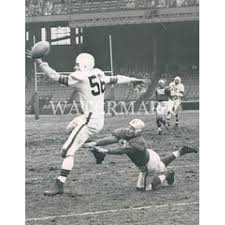
Leonard Guy Ford Jr. was an American professional football player who was an offensive and defensive end from 1948 to 1958. He played college football for the University of Michigan and professional football for the Los Angeles Dons, Cleveland Browns and Green Bay Packers. He was inducted into the Pro Football Hall of Fame in 1976 and the University of Michigan Athletic Hall of Honor in 1996.

Ford was an all-city athlete at his high school in Washington, D.C., and attended Morgan State University after graduating in 1944. After a brief stint in the U.S. Navy the following year, he transferred to Michigan, where he played on the Michigan Wolverines football team as an offensive and defensive end. He played for Michigan from 1945 to 1947 and was a member of the undefeated 1947 team that has been selected as the best team in the history of Michigan football.

Ford was passed over in all 32 rounds of the 1948 NFL Draft, but was selected by the Los Angeles Dons of the rival All-America Football Conference (AAFC), where he played for two seasons as an offensive and defensive end. After the AAFC dissolved in 1949, Ford played eight seasons as a defensive end for the Cleveland Browns. During those eight seasons, the Browns advanced to the NFL championship game seven times, won three championships, and allowed the fewest points in the NFL six times. Ford was one of the dominant defensive players of his era, having a rare combination of size and speed that helped him disrupt opposing offenses and force fumbles. He was selected as a first-team All-NFL player five times and played in four Pro Bowls. He was also one of two defensive ends named to the National Football League 1950s All-Decade Team.

Ford was traded to the Packers in 1958, but played there just one season before retiring. He worked for the Detroit recreation department from 1963 to 1972. He suffered a heart attack and died in 1972 at age 46.

Despite his accomplishments in college, Ford was passed over in all 32 rounds of the 1948 NFL Draft during a time when most professional teams did not employ African-Americans. (The following year, George Taliaferro became the first African-American to be selected in an NFL draft.) He was selected, however, by the Los Angeles Dons of the rival All-America Football Conference (AAFC) in the third round of the 1948 AAFC Draft. He signed with the Dons in April 1948.

Playing as a right end opposite Joe Aguirre, Ford had 31 catches for 598 yards and seven touchdowns in 1948. As was the case at Michigan, Ford also worked on defense and was one of the AAFC's most successful pass-rushers. The Dons, meanwhile, finished the regular season with a 7–7 record, good for third place in the AAFC West. Ford played basketball in the off-season for the New York Renaissance, an all-black professional team in the National Basketball League. He did not play basketball at Michigan, the Big Ten Conference having maintained racial segregation of basketball until 1950.

Ford had 36 catches for 577 yards and one touchdown in 1949, while the Dons fell to 4–8. The AAFC struggled financially during Ford's time with the Dons. Its teams competed with NFL franchises for fans' attention and player talent – the Dons shared a city with the NFL's Los Angeles Rams.[7] By late 1949, team owners came to an agreement under which the Cleveland Browns, San Francisco 49ers and Baltimore Colts joined the NFL and the rest of the league's teams, including the Dons, folded.

After the AAFC disbanded, the Browns selected Ford in the second round of the 1950 AAFC dispersal draft, created to reallocate former Dons, Buffalo Bills and Chicago Hornets players. Ford signed with the Browns in July 1950.

Cleveland head coach Paul Brown converted Ford into solely a defensive end as two-platoon systems gained popularity after 1950. Ford bulked up to 260 pounds and quickly became a fixture of Cleveland's defense alongside linebacker Bill Willis and defensive back Warren Lahr. He was one of five black players for Cleveland – the others were Willis, punter Horace Gillom and fullbacks Emerson Cole and Marion Motley – at a time when many other teams had never signed a black player. The Browns, in fact, had roughly a third of the black players in the NFL on their roster. Cleveland sports writer Chuck Heaton later recalled that Ford was "a leader, particularly with the black players on the squad."

Led by an offense that featured Motley, quarterback Otto Graham and ends Mac Speedie and Dante Lavelli, the 1950 Browns finished the regular season with a 10–2 record and won the 1950 NFL Championship Game over the Los Angeles Rams.

In a mid-October game against the Chicago Cardinals, an elbow by Pat Harder broke Ford's nose, cheekbone, and maxilla (upper jaw), knocked out two teeth, loosened several teeth and chipped another. Ford, who had been fighting with Harder throughout the game, punched him following the play, resulting in a penalty, his ejection from the game and a $50 ($563 in 2021 dollars) fine. NFL commissioner Bert Bell withdrew the fine when the damage to Ford's face was revealed. Ford's facial injuries were so severe that a plastic surgery was required, "virtually rebuilding the big end's face." The Browns' long-time team doctor, Vic Ippolito, described Ford's injuries as "a sickening sight."

Because of the injury, Ford started only four regular-season games in 1950. However, he asked to be reinstated for the 1950 NFL Championship Game. Head coach Paul Brown agreed to allow Ford to suit up after receiving approval from the team doctor and arranging for a special mask to be built to protect Ford from further injury. Ford had been on a liquid diet until late November and dropped from 240 to 215 pounds, though he was back up to 223 pounds shortly before the championship game. As the championship game got underway, Ford sat on the bench as the Rams moved the ball 82 yards down the field for a touchdown. Browns head coach Paul Brown knew the defense had to tighten, and he called on Ford to enter the game. The Cleveland Plain Dealer later called this "one of Len Ford's great moments." Paul Brown stated that Ford "showed me that day he really was a man." Brown later recalled that Ford was the team's "only real hope of plugging a hole" and recalled one sequence as a defining moment in the game.

The Browns' defense held the Rams scoreless in the fourth quarter, and the Browns won the championship game by a 30-28 score in their first season in the league.

Ford continued to excel as a pass-rusher in 1951, when the Browns again advanced to the NFL Championship Game but lost to the Rams. He recovered four fumbles during the season and was named a first-team All-Pro by both the Associated Press (AP) and the United Press International (UPI). He was also named to the Pro Bowl, the NFL's all-star game. Ford's dominating play allowed Brown to assign him to two offensive linemen, giving Cleveland the latitude to put four men on the line and use three linebackers in what is now known as the 4–3 defense. Cleveland's defensive coach Blanton Collier later recalled the thinking behind moving Ford: "We knew we had to get him in closer where his talents as a pass rusher could best be utilized. So we moved both tackles in and dropped the linebackers off the outside. It may have been the beginning of today's 4–3 defense." Collier also noted that "Len was very aggressive and had that touch of meanness in him that you find in most defensive players."

The 1952 Browns had eight regular-season wins and won the NFL's East Division, but lost to the Detroit Lions in the 1952 NFL Championship Game. Ford, meanwhile, extended his run of dominance against opposing offenses in an era before the quarterback sack was a recorded statistic. For the second consecutive year, he was named a first-team All-Pro by both the AP and UPI and was selected for the Pro Bowl.

The 1953 Browns compiled an 11-1 record and again advanced to the NFL Championship Game, losing to the Detroit Lions. For the third consecutive year, Ford was named a first-team All-Pro by both the AP and UPI and was selected for the Pro Bowl.

Willis and Motley retired after the 1953 season, but Ford and Don Colo continued to anchor the defense alongside Lahr in the secondary. The 1954 Browns lost two of their first three games, but finished the season with a 9–3 record and returned to win the 1954 NFL Championship Game over the Lions.[54] Ford had two interceptions in the Browns' 56–10 win over the Lions, including one which he returned 45 yards to set a new NFL playoff record. Ford recovered a career-high five fumbles in 1954, and he was selected as a first-team All-Pro by the AP and UPI for the fourth year in a row. He was also selected to play in his fourth consecutive Pro Bowl.

The 1955 Browns compiled a 9–2–1 record in 1955 and won the 1955 NFL Championship Game against the Los Angeles Rams, helped by a strong defensive effort and six interceptions of quarterback Norm Van Brocklin. Ford was selected as a first-team All-Pro by the UPI, the Newspaper Enterprise Association (NEA) and the New York Daily News. He was named a second-team All-Pro by the AP.

Graham and many of the players that had helped propel the Browns to a series of championship game appearances retired before the 1956 season. The 1956 team finished 5–7 that year, its first-ever losing record.

By 1957, there was speculation that Ford, then age 31, might not make the Browns' roster. Ford arrived at training camp well above his playing weight, and rookie Bob Mischak was given Ford's spot in August. When Mischak withdrew from the team, the spot was awarded to another rookie, Paul Wiggin. Ford worked to shed pounds during training camp and worked to train the young defensive players, including Wiggin and Bill Quinlan. Rookie running back Jim Brown recalled that Ford pulled him aside during the 1957 training camp and gave him advice on dealing with the Browns' head coach Paul Brown. Ford advised the rookie to keep his mouth shut and do as the coach set during practice and waiting until game day: "Run it your way in the game and hope it works, and if it does, don't say anything. Just make your yardage and act like it was a mistake."

Ford was slowed for several weeks during the 1957 season by a severely bruised shoulder, but the Browns, led by Jim Brown, reached the 1957 NFL Championship Game, losing to the Lions. Cleveland's defense allowed the fewest points in the NFL in six of Ford's eight seasons with the team.

In May 1958, the Browns traded Ford to the Green Bay Packers in exchange for a draft choice. Green Bay coach Ray McLean said at the time that he acquired Ford for his talent at putting pressure on the quarterback and noted that "he's one of the toughest guys in the league to block because of his speed, size and agility." The 1958 Green Bay team won just one game in Ford's lone season there. Ford suffered multiple broken fingers before the last game of the 1958 season, and, because he was unable to play, the Packers refused to pay Ford the final $916.66 due on his contract. In 1961, Ford sued the Packers in Wayne County Circuit Court in Detroit to collect the $916.66 plus $10,000 for alleged damage to his reputation caused by the Packers' releasing him.

Ford recovered 20 fumbles in his career, an NFL record at the time he retired as a player. He was successful in part because of his combination of quickness and size. Few players of his era who were as tall and big as he was could move as fast; only Larry Brink of the Rams was close to him in proportions.

In 1969, Ford placed second in voting for the greatest defense end in NFL history. He was edged out by Gino Marchetti. He and Marchetti were selected as the defensive ends on the National Football League 1950s All-Decade Team.

In 1976, Ford was posthumously inducted into the Pro Football Hall of Fame. He was selected for induction by the 27-man media board that had responsibility for selections at that time.

He was also inducted into the University of Michigan Athletic Hall of Honor in 1996.

Sources
https://www.pro-football-reference.com/
https://www.profootballarchives.com/index.html
https://americanfootballdatabase.fandom.com/wiki/Football_Wiki
https://www.gridiron-uniforms.com/GUD/controller/controller.php?action=main
https://www.profootballhof.com/hall-of-famers/
"Len Ford Stats, News and Video - WR". NFL.com. Archived from the original on July 17, 2023. Retrieved July 17, 2023.
 1930 U.S. Census for Leonard G. Ford and family. Census Place: Washington, Washington, District of Columbia; Roll: 302; Page: 8A; Enumeration District: 0338; Image: 245.0; FHL microfilm: 2340037. Ancestry.com. 1930 United States Federal Census [database on-line].
 1940 U.S. Census for Leonard Ford and family. Census Place: Washington, District of Columbia, District of Columbia; Roll: T627_569; Page: 8B; Enumeration District: 1-460. Ancestry.com. 1940 United States Federal Census [database on-line].
 Smith, Don (1984). "Len Ford" (PDF). The Coffin Corner. 6 (7&8). Archived from the original (PDF) on December 18, 2010. Retrieved September 1, 2013.
 "Len Ford, Wolves' Ace End, 'Grew Right Out of Backfield'". The Milwaukee Journal. October 9, 1947. p. 2. Archived from the original on November 20, 2015. Retrieved November 19, 2015.
 "Len Ford of Browns Fame Dies". Cleveland Plain Dealer. March 14, 1972. pp. D1, D4.
 "Len Ford". Morgan State University. Archived from the original on August 8, 2014. Retrieved September 1, 2013.
 "Len Ford". JockBio. Archived from the original on August 8, 2014. Retrieved September 1, 2013.
 Anton, Todd W.; Bill Nowlin (2013). When Football Went to War. Triumph Books. pp. 112–113. ISBN 9781600788451.
 Bloomfield, Gary L. Duty, Honor, Victory: America's Athletes in World War II. Guilford, Conn: Lyons Press, 2003, page 250, ISBN 1592280676
 1947 Michiganensian, p. 269.
 "1945 Football Roster". Bentley Historical Library, University of Michigan. Archived from the original on August 8, 2014. Retrieved August 5, 2014.
 "1945 Football Team". Bentley Historical Library, University of Michigan. Archived from the original on September 22, 2011. Retrieved August 5, 2014.
 "Michigan Downs Minnesota, 26 to 0; Wolverines Take To The Air In Little Brown Jug Game". The New York Times. Ann Arbor, Mich. November 4, 1945. Archived from the original on March 12, 2016. Retrieved September 4, 2013.
 "1946 Football Roster". Bentley Historical Library, University of Michigan. Archived from the original on September 19, 2014. Retrieved August 5, 2014.
 "1946 Football Team". Bentley Historical Library, University of Michigan. Archived from the original on May 19, 2011. Retrieved August 5, 2014.
 "Purdue, Indiana To Seek First Conference Wins". Kokomo Tribune. September 30, 1946. p. 7. Archived from the original on March 4, 2016. Retrieved October 2, 2018.
 Jerry Alexander (November 14, 1946). "Ford Familiar Figure To Football Fans This Fall: Husky End Looks To Coaching or Pro Football After Obtaining Degree in Physical Education". The Michigan Daily. p. 3. Archived from the original on July 14, 2020. Retrieved February 11, 2020 – via Bentley Historical Library.
 "Wolverines Keep Title Hopes Alive". Youngstown Vindicator. Ann Arbor. United Press International. November 17, 1946. Archived from the original on November 20, 2015. Retrieved September 5, 2013.
 "1946 Football Roster". Bentley Historical Library, University of Michigan. Archived from the original on August 8, 2014. Retrieved August 5, 2014.
 Jones, Todd (2007). "Michigan". In MacCambridge, Michael (ed.). ESPN Big Ten College Football Encyclopedia. ESPN Enterprises. p. 60. ISBN 978-1-933060-49-1.
 "Sports". The Michiganensian. 52: 92–106. 1948. Archived from the original on May 6, 2016. Retrieved September 5, 2013.
 John F. Mayhew (October 9, 1947). "End Len Ford Bids To Become One of M's Greats". The Owosso Argus-Press. p. 17. Archived from the original on November 20, 2015. Retrieved November 19, 2015.
 "Maize and Blue Downs Scrappy Buckeyes, 21-0". The Michigan Daily. January 1, 1948. p. 9. Archived from the original on November 20, 2015. Retrieved November 19, 2015.
 Bagnato, Andrew (September 25, 1997). "1947: When Michigan And Notre Dame Both Finished No. 1". Chicago Tribune. Archived from the original on November 20, 2015. Retrieved September 6, 2013.
 Smits, Ted (December 3, 1947). "Notre Dame, Michigan Dominate AP All-America". St. Petersburg Times. New York. Associated Press. p. 20. Archived from the original on November 20, 2015. Retrieved September 3, 2013.
 Chamberlain, Charles (November 24, 1947). "Michigan Lands Four Places on AP's All Big-Nine Grid Team". The Owosso Argus-Press. Chicago. Associated Press. p. 14. Archived from the original on November 20, 2015. Retrieved September 5, 2013.
 "10 Michiganders On Star Eleven". The Miami News. Chicago. International News Service. June 16, 1948. p. 5B. Retrieved September 5, 2013.[permanent dead link]
 "African-Americans in Pro Football: Pioneers, Milestones and Firsts". Pro Football Hall of Fame. Archived from the original on September 26, 2014. Retrieved August 4, 2014.
 "1948 AAFC Draft" (PDF). All-America Football Conference Encyclopedia. Pro Football Researchers. p. 1. Archived from the original (PDF) on June 17, 2013. Retrieved September 5, 2013.
 "Len Ford of Michigan Signed by Los Angeles". The Milwaukee Journal. April 16, 1948. p. 13. Archived from the original on November 20, 2015. Retrieved November 19, 2015.
 "Len Ford NFL Football Statistics". Pro Football Reference. Archived from the original on August 19, 2013. Retrieved September 2, 2013.
 Piascik 2007, p. 153.
 "1948 Los Angeles Dons Statistics & Players". Pro Football Reference. Archived from the original on September 22, 2013. Retrieved September 5, 2013.
 Piascik 2007, p. 299.
 "Rens Tackle Syracuse" (PDF). The New York Age. January 29, 1949. p. 11. Archived (PDF) from the original on October 2, 2018. Retrieved September 6, 2013.
 "1949 Los Angeles Dons Statistics & Players". Pro Football Reference. Archived from the original on September 22, 2013. Retrieved September 5, 2013.
 Piascik 2007, pp. 140–144.
 Piascik 2007, pp. 83, 140–144.
 "Allocation Draft" (PDF). Pro Football Researchers. Archived from the original (PDF) on June 17, 2013. Retrieved September 5, 2013.
 "Len Ford Signs With Pro Browns". St. Petersburg Times. July 12, 1951. p. 10. Archived from the original on November 20, 2015. Retrieved November 19, 2015.
 Piascik 2007, pp. 153–154.
 Piascik 2007, p. 158.
 Chuck Heaton (March 15, 1972). "Len Ford Rates with the Greatest". Cleveland Plain Dealer. p. E1.
 Piascik 2007, pp. 180–181.
 "1950 Cleveland Browns Statistics & Players". Pro Football Reference. Archived from the original on September 21, 2013. Retrieved September 14, 2013.
 Howard Sauerbrei (October 17, 1950). "Bell Rescinds Slugging Fine When Notified Ford Undergoes Facial Surgery: Browns' Star Out Indefinitely". Cleveland Plain Dealer. p. 27.
 1634–1699: McCusker, J. J. (1997). How Much Is That in Real Money? A Historical Price Index for Use as a Deflator of Money Values in the Economy of the United States: Addenda et Corrigenda (PDF). American Antiquarian Society. 1700–1799: McCusker, J. J. (1992). How Much Is That in Real Money? A Historical Price Index for Use as a Deflator of Money Values in the Economy of the United States (PDF). American Antiquarian Society. 1800–present: Federal Reserve Bank of Minneapolis. "Consumer Price Index (estimate) 1800–". Retrieved February 29, 2024.
 "A doctor's diary". Cleveland Plain Dealer. January 29, 1978. p. 3-2.
 Harold Sauerbrei (December 21, 1950). "Len Ford Rejoins Browns, May See Action In Title Game Sunday: Star End to Don Mask For Battle". Cleveland Plain Dealer. p. 27.
 Jack Clary (December 21, 1980). "December 24, 1950: A Great Day for the Browns". Cleveland Plain Dealer. pp. 166–170.
 Piascik 2007, pp. 230–234.
 Chuck Heaton. "Grid Hall of Fame taps Ford". Cleveland Plain Dealer. p. 1-C.
 "1953 Cleveland Browns". Pro-Football-Reference.com. Sports Reference LLC. Archived from the original on July 26, 2014. Retrieved August 2, 2014.
 "1954 Cleveland Browns". Pro-Football-Reference.com. Sports Reference LLC. Archived from the original on July 10, 2014. Retrieved August 2, 2014.
 "Browns Set 13 Playoff Records". The Pittsburgh Press. December 24, 1954. Archived from the original on November 20, 2015. Retrieved November 19, 2015.
 "Len Ford Sets Record In NFL Title Game". Jet. January 6, 1955. p. 53. Archived from the original on June 3, 2016. Retrieved November 19, 2015.
 "1955 Cleveland Browns". Pro-Football-Reference.com. Sports Reference LLC. Archived from the original on July 10, 2014. Retrieved August 2, 2014.
 "1956 Cleveland Browns". Pro-Football-Reference.com. Sports Reference LLC. Archived from the original on August 2, 2014. Retrieved August 2, 2014.
 Piascik 2007, pp. 366–367.
 Chuck Heaton (December 18, 1957). "Ford's Comeback Is One of the Bright Spots for Browns". Cleveland Plain Dealer. p. 31.
 Jim Brown (November 15, 1964). "Jim Brown's Own Story: "Off My Chest"". Cleveland Plain Dealer. p. C-1.
 Chuck Heaton (December 6, 1957). "Wiggin May Play Key Role Sunday: Rapidly Improving Defensive End Set to Replace Ailing Lenny Ford at Detroit". Cleveland Plain Dealer. p. 35.
 "Len Ford". Pro Football Hall of Fame. Archived from the original on December 16, 2013. Retrieved September 6, 2013.
 "Packers Acquire Browns' Ford". The Milwaukee Sentinel. May 19, 1958. p. Pt. 2, pg. 2. Archived from the original on November 20, 2015. Retrieved November 19, 2015.
 "Browns Trade Lennie Ford to Packers". St. Joseph Gazette. Cleveland. Associated Press. May 20, 1958. p. 7. Archived from the original on November 20, 2015. Retrieved September 6, 2013.
 "1958 Green Bay Packers". Pro-Football-Reference.com. Sports Reference LLC. Archived from the original on October 16, 2014. Retrieved August 2, 2014.
 "Lenny Ford Files Suit". The Owosso Argus-Press. December 20, 1961. p. 17. Archived from the original on November 20, 2015. Retrieved November 19, 2015.
 "Len Ford sues Packers for 10G". The Baltimore Afro-American. January 6, 1962. p. 17. Archived from the original on November 20, 2015. Retrieved November 19, 2015.
 "Len Ford of U-M Fame Joins Hall". Detroit Free Press. January 27, 1976. pp. 1C, 5C. Archived from the original on September 18, 2023. Retrieved February 11, 2020.
 Piascik 2007, p. 300.
 "Unitas, Brown, Sayers Make All-Time NFL Team". The Sunday Times. September 7, 1969. p. 43. Archived from the original on September 18, 2023. Retrieved February 11, 2020 – via Newspapers.com.
 "Graham, Huff on All-1950s Pro Football Selections". Racine Sunday Bulletin. August 31, 1969. p. 6C. Archived from the original on February 4, 2020. Retrieved February 11, 2020 – via Newspapers.com. Open access icon
 "Athletic Hall of Honor". Bentley Historical Library. Archived from the original on September 9, 2013. Retrieved September 6, 2013.
 "Ford, Leonard "Lenny"". The Encyclopedia of Cleveland History. Archived from the original on August 8, 2014. Retrieved September 6, 2013.
 A. S. "Doc" Young (September 15, 1955). "Inside Sports". Jet. p. 57. Archived from the original on May 17, 2016. Retrieved November 19, 2015.
 "So-Called White Backlash Not Shown in Maryland". Jet. November 24, 1966. p. 11. Archived from the original on May 6, 2016. Retrieved November 19, 2015.
 Dennis Lustig (December 6, 1970). "Whatever happened to ... Lenny Ford". The Cleveland Plain Dealer. p. 4-C.
 "Heart Attack Proves Fatal To M's Lennie Ford at 46". Detroit Free Press. March 14, 1972. p. 4C. Archived from the original on February 14, 2020. Retrieved February 14, 2020.
 "Leonard (Len) Ford". The Sporting News. April 1, 1972. p. 46.
 "Heart Attack Kills Len Ford, Ex-Packer". The Milwaukee Journal. March 14, 1972. p. 16. Archived from the original on November 20, 2015. Retrieved November 19, 2015.
 Gregory S. Simms (October 23, 1980). "Newcombe is upset about alcohol abuse". Cleveland Plain Dealer. p. 3-D.
 "Lenny Ford Great End". The Spokesman-Review (AP story). January 27, 1976. Archived from the original on November 20, 2015. Retrieved November 19, 2015.
Piascik, Andy (2007). The Best Show in Football: The 1946–1955 Cleveland Browns. Lanham, MD: Taylor Trade Publishing. ISBN 978-1-58979-571-6.

Thursday, February 23, 2023

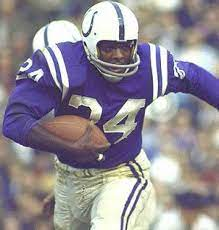
The Story And Significance Of Lenny Moore - 111 Total Touchdowns In 143 Regular-Season Games

Leonard Edward Moore is an American former professional football player who played both halfback and flanker in the National Football League for the Baltimore Colts from 1956 to 1967. He played college football for Penn State Nittany Lions. He was named the NFL Rookie of the Year in 1956 and was selected to the Pro Bowl seven times. Moore was inducted into the Pro Football Hall of Fame in 1975.

Moore's achievements at Penn State did not go unnoticed by scouts from the NFL, and he was drafted by the Colts in the first round of 1956 with the ninth pick.

Moore was both a great runner and receiver, lining up in the backfield as a halfback and split wide as a flanker, and was equally dangerous at both positions in the Colts' offense run by quarterback Johnny Unitas. Moore averaged at least seven yards per carry in three seasons, and has a career average of 4.8 yards per carry. He had 40 receptions for 687 yards and seven touchdowns in 1957, the first of five years in which he would have 40 or more catches. In an era of pounding running games, Moore was a glimpse of things to come in the NFL, with a career average of 30 receptions per year out of the backfield.
During his rookie season in 1956, Moore established himself as one of the most well-rounded runners and receivers in the league, and won the NFL Rookie of the Year award. In 1958, he caught a career-high 50 passes for 938 yards and seven touchdowns in helping the Colts win the NFL championship. In 1959, Moore had 47 receptions for 846 yards and six touchdowns as the Colts repeated as champions.

Moore was injured in 1962, a knee injury, and lost his starting job in 1963 from the knee injury. In 1964, he had one of his best statistical seasons when he scored 20 touchdowns, helping to lead the Colts to a 12–2 regular-season record and a trip to the NFL Championship Game for the third time in seven seasons. He was voted by his fellow players as the Most Valuable Player, a remarkable award considering he played most of the season with complications from appendicitis, and gave credence to the claim that he was one of the toughest players in the NFL. He also won Comeback Player of the Year Award in 1964.

Moore scored a touchdown in an NFL-record 18 consecutive appearances starting in 1963 and continuing through the entire 1964 season, ending in 1965. This record stood for 40 years until being equaled by LaDainian Tomlinson in 2005.[6] Because his streak was interrupted by a five-game absence due to injury in 1963, he does not hold the NFL's official record for consecutive games rushing for a touchdown.

Moore faced the difficult task of being an African American in the NFL during the 1950s and 1960s. Most teams averaged about six African American players on their roster during his time in the league. His race also came into question after his retirement in 1968 when he was not given a long-term contract with CBS Television, ending his attempt to be the first black sports broadcaster for CBS.

Moore occasionally speaks to student groups about his experiences as a black football player during an era when, in the words of Baltimore Sun sportswriter Rick Maese, "Moore could travel with his teammates but couldn't always eat in the same restaurant, couldn't always stay at the same hotel, couldn't always fraternize with them the same way out of the locker room as he had in it."
"There was never anybody ever closer than me and the guys that I played football with on that Baltimore team – on the field," Moore told the Sun. "We were just like glue. One for all, all for one." But "once they blew the whistle and the game was over, they (the white players) went their way, we (the black players) went our way. We split. It was race."

Fellow NFL player Ollie Matson mentored Moore and warned him that "'they're going to call you the big N. You're going to hear it all. So don't get yourself all worked up, because it's going to happen.'"

Moore retired from professional football after the 1967 season. In 12 seasons and 143 regular-season games he scored 111 total touchdowns, accumulated 11,213 total yards, made seven Pro Bowls, and five all-NFL teams. His uniform number 24 was retired by Baltimore, and in 1969 a sportswriters' poll named him to the NFL's 50th Anniversary Team.

In 1975 Moore was elected to the Pro Football Hall of Fame, and was named to the NFL's 1950s All Decade Team. In 1999, The Sporting News' ranked Moore 71st on its list of the 100 Greatest Football Players. He is the only player in NFL history to have at least 40 receiving touchdowns and 40 rushing touchdowns.

Football Outsiders, in their book Pro Football Prospectus 2007, named six of his seasons among the top 500 running back seasons of all time, which was tied for the 5th most seasons among the top 500 of any player. Moore's retired number is honored along with all of the other Baltimore Colts retired numbers in M&T Bank Stadium in Baltimore, home of the Baltimore Ravens.

On January 19, 2008, Moore was inducted into the East-West Shrine Game Hall of Fame class. Moore was an honorary captain for Penn State's game versus Syracuse on September 12, 2009. It was the first
time a former Penn State player has been invited to participate in the pre-game coin toss. Moore is a member of The Pigskin Club of Washington, D.C. National Intercollegiate All-American Football Players Honor Roll.

Moore retired in 2010 from the Maryland Department of Juvenile Services after 26 years of service. His job with the state included traveling to middle and high schools, mixing and mingling with at-risk children, trying to keep them straight. He was a keynote speaker for churches, organizations and youth groups, teaching children and adults about the risks of drugs and he worked to improve the lives of troubled teens.

On October 8, 2013, Moore had a road in Baltimore County named after him in his honor.
Moore's charity work includes raising money for the fight against scleroderma. He holds an annual
benefit dinner in memory of his son Leslie, who died at 43 of that disease.
Sources
https://www.pro-football-reference.com/
https://www.profootballarchives.com/index.html
https://americanfootballdatabase.fandom.com/wiki/Football_Wiki
https://www.gridiron-uniforms.com/GUD/controller/controller.php?action=main
https://www.profootballhof.com/hall-of-famers/
 NFL Films (August 15, 2016), #94: Lenny Moore | The Top 100: NFL's Greatest Players | NFL Films, retrieved December 17, 2018
 "Sports Reference CFB". Retrieved December 31, 2016.
 "College Days: Lenny Moore | Pro Football Hall of Fame Official Site". www.profootballhof.com. Retrieved September 12, 2020.
 "Flanker-Running Back Lenny Moore". NFL Internet Press. Retrieved December 23, 2016.
 "Pro Football Reference - Lenny Moore". Pro-Football-Reference.com. Retrieved December 27, 2016.
 Lenny Moore with Jeffrey Jay Ellish, All Things Being Equal: The Autobiography of Lenny Moore. Champaign, IL: Sports Publishing LLC, 2005; p. 110.
 Moore's record tied by Tomlinson - Pro Football Hall of Fame
 Maese, Rick (February 20, 2009). "Ex-Colt Moore's 'real story' grabs students' attention". The Baltimore Sun. Baltimore, Maryland. Retrieved October 12, 2015.
 Person, Joseph (July 18, 2023). "NFL 100: At No. 92, Lenny Moore was the league's dual-threat running back before it was popular". The New York Times. ISSN 0362-4331. Retrieved November 3, 2024.
 "East-West Shrine Game Announces Hall of Fame Class". East-West Shrine Game press release. Archived from the original on February 22, 2008. Retrieved January 22, 2008.
 Rudel, Neil (September 9, 2009). "Moore amazed in return to State College". Williamsport Sun-Gazette.
 "Catching up with Lenny Moore". David Selig. Baltimore Sun. November 21, 2011. Retrieved December 31, 2016.
 "Randallstown road to be renamed after legendary Colts running back Lenny Moore". BaltimoreNewsJournal.com. Archived from the original on October 8, 2013. Retrieved October 7, 2013.
Lenny Moore with Jeffrey Jay Ellish, All Things Being Equal: The Autobiography of Lenny Moore. Champaign, IL: Sports Publishing LLC, 2005.
George Sullivan, The Great Running Backs. New York: G. P. Putnam's Sons, 1972; pp. 107–113.

Tuesday, February 21, 2023

The Story And Significance Of Dante Lavelli - In The 1950 NFL Championship Game, Dante Caught 11 Passes, Then A Record, And Scored Two Touchdowns

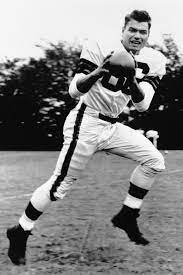
Dante Bert Joseph "Gluefingers" Lavelli was an American professional football player who was an end for the Cleveland Browns in the All-America Football Conference (AAFC) and National Football League from 1946 to 1956. Starring alongside quarterback Otto Graham, fullback Marion Motley, placekicker Lou Groza and fellow receiver Mac Speedie, Lavelli was an integral part of a Browns team that won seven championships during his 11-season career. Lavelli was known for his sure hands and improvisations on the field. He was also renowned for making catches in critical situations, earning the nickname "Mr. Clutch". "Lavelli had one of the strongest pairs of hands I've ever seen," Browns coach Paul Brown once said of him. "When he went up for a pass with a defender, you could almost always count on him coming back down with the ball."

Lavelli grew up in Hudson, Ohio and played football, baseball and basketball at his local high school. After graduating, he enrolled at Ohio State University, where he played only a handful of games before he was drafted for service in the U.S. Army during World War II. Returning in 1945 after serving in Europe, he joined the Browns in the team's first-ever season in the AAFC. Helped by Lavelli's play, the Browns won each of the AAFC's championships before the league dissolved in 1949 and the team was absorbed by the NFL. Cleveland continued to succeed in the NFL, winning championships in 1950, 1954 and 1955. Lavelli, who helped found the National Football League Players Association toward the end of his career, retired after the 1956 season.

After retiring from football, Lavelli held a variety of coaching and scouting jobs and was active in NFL alumni affairs. He also ran a furniture store in Rocky River, Ohio. He was elected to the Pro Football Hall of Fame in 1975. He died in a Cleveland hospital in 2009.

On arrival at Ohio State, Lavelli roomed with Les Horvath and Don McCafferty and played on the freshman team under coach Trevor Rees. Brown switched Lavelli to end (the position is now called wide receiver). His playing time with the football team was limited, however, due to injury. He became a first-string end as a sophomore in 1942, but was ailing from a charley horse in his thigh and sat out the first game of the season against a Fort Knox military team. He had recovered by the third game of the season and started in a game against Southern California. Lavelli was hit in the knee while grabbing for a pass near the end of the game, however, he broke a bone. He was sidelined for the rest of the season. The Buckeyes won the college football national championship that year.

After the 1942 season, Lavelli was drafted by the U.S. Army as American involvement in World War II intensified. After basic training and a number of other specialized courses on land-sea assaults, he was sent with the 28th Infantry Division to fight in the European Theatre of World War II. There his division landed on Omaha Beach, part of the Allied invasion of Germany-occupied France in 1944. He was involved with American forces in Germany's Battle of the Bulge offensive and in the Siege of Bastogne later the same year. One in five members of his division was killed in battle.

After returning from the war, Lavelli was again offered a chance to play baseball with the Tigers. He saw a matchup in late 1945 between the National Football League's New York Giants and Washington Redskins and noticed that a former teammate at Ohio State named Sam Fox was an end for the Giants. "I thought if he could make the grade, so could I," Lavelli later said. When Paul Brown offered him a chance to play on a new professional team he was coaching in the All-America Football Conference (AAFC) in 1946, Lavelli jumped at the opportunity. He was given a $500 bonus ($6,948 in today's dollars) for signing with the team, called the Cleveland Browns.

Lavelli attended the Browns' first training camp in 1946. Competition was fierce for a spot on the roster, but Lavelli was one of the men who made it. He was up against a number of National Football League veterans and former college stars. "The toughest game I ever played in was the first intrasquad scrimmage game," he said later. "Nobody talked to each other for two days." He joined an offense that featured quarterback Otto Graham, fullback Marion Motley, placekicker Lou Groza and fellow end Mac Speedie. Lavelli quickly became Graham's top passing target and led the AAFC in receiving as a rookie with 40 receptions and 843 yards. The Browns made it to the league championship that season, and Lavelli caught the game-winning touchdown in a 14–9 victory over the AAFC's New York Yankees. The victory "didn't mean so much then, but as time goes on, it builds," Lavelli said in 2008.

The Browns won the AAFC championship again in 1947. Lavelli finished second in the league in receiving behind his teammate Speedie. Both Lavelli and Speedie were named to all-AAFC teams, as they had been in 1946. Lavelli broke his leg in a preseason game in 1948 and sat out seven weeks. He came back later in the year and helped Cleveland finish a perfect season, catching a touchdown pass in a 31–21 win over the AAFC's Brooklyn Dodgers in the championship game. In a game against the Los Angeles Dons the following year, Lavelli caught four touchdowns and had 209 receiving yards, an AAFC record. In 1949 Cleveland won the AAFC championship for the fourth year in a row. The AAFC dissolved before the 1950 season and three of its teams, including the Browns, were absorbed by the more established National Football League. Lavelli was the AAFC's all-time leader in yards per catch and second in receiving yards behind Speedie.

As the Browns won in the AAFC, Lavelli continued his studies at Ohio State between seasons and got his degree in 1949. He married Joy Wright of Brecksville, Ohio that year.

When Cleveland entered the NFL in 1950, questions lingered about whether the team could sustain its early dominance. The Browns, however, began the season by beating the defending NFL champions, the Philadelphia Eagles. Dante Lavelli recalls, "The game I'll never forget is the first game we played in the National Football League. We beat the Philadelphia Eagles, 35-10. We went back to Cleveland the next day and waiting for us was something else we could be proud of. The press has asked Bert Bell, commissioner of the NFL, what he thought of the game. 'The Browns are the greatest football club I ever saw,' he said."

The team finished with a 10–2 regular-season record and reached the championship game after winning a playoff game against the New York Giants. In the championship against the Los Angeles Rams, Lavelli caught 11 passes – then a record for a title game – and had two touchdown receptions. The Browns won the game 30–28.

Cleveland reached the NFL championship game the following year but lost to the Rams. The 1952 and 1953 seasons followed a similar pattern: the Browns made it to the championship game but lost both times to the Detroit Lions. Lavelli was named to the Pro Bowl in 1951 and 1953. He was seventh in the NFL in receiving yards in 1951, with 586. He gained 783 receiving yards in 1953, the fifth-highest total in the league.

Over the years, Lavelli developed a reputation for making big plays when they counted most, as he had done with his touchdown reception in the Browns' first championship game in 1946. He was nicknamed "Mr. Clutch" in a Pittsburgh Steelers scouting report, although "Gluefingers" – a name bestowed upon him by Browns announcer Bob Neal – was more widely used. He practiced with Graham tirelessly to refine routes and was not afraid to run over the middle, where he risked a pounding from defenders when the ball came his way. "Dante was the greatest guy at catching a ball in a crowd that I have ever seen," Brown once said. Among other innovations, he and Graham also mastered sideline patterns at a time when few teams used them.

The Browns won another championship in 1954, thanks in part to a strong regular-season performance from Lavelli. Lavelli led the team in receiving that year and made the Pro Bowl after the Browns beat the Lions for their second NFL title. A third NFL championship followed in 1955. In the championship game against the Rams, Lavelli caught a touchdown in the second quarter and scored a second time on a 50-yard pass just before the end of the first half. The Browns won 38–14.

Lavelli initially planned to retire in 1955 but came back for a final year in 1956, when the Browns posted a 5–7 record, the team's first-ever losing season. In his 11-year career, Lavelli caught 386 passes for 6,488 yards and 62 touchdowns. He was a confident receiver, former teammates said in later years. He could often be heard calling for Graham to throw him the ball while running routes. He was also known for his ability to improvise on the field. In a 1955 game against the Eagles in slippery conditions, he caught the winning touchdown with less than a minute left by swinging around the goalpost with his arm to get open.

During his Browns career, Lavelli was involved in the creation of the National Football League Players Association. The concept of a union to represent players in league matters was hatched in Lavelli's basement in 1954. Lavelli and two teammates, Abe Gibron and George Ratterman, met every Wednesday to discuss the union. They approached Creighton Miller, a Cleveland lawyer and former Notre Dame star who had worked briefly as an assistant coach with the Browns, for help. The union was founded at a meeting before the NFL championship game in 1956. The following year, the players got $50 per exhibition game, a $5,000 minimum salary, injury pay and medical care. The union is now the primary representative of players in labor negotiations and disputes with the NFL.

After retiring from football, Lavelli ran an appliance business on Cleveland's west side. From 1961 through 1963, he served as an assistant to Graham, who was coaching college stars in the annual College All-Star Game. Lavelli was also an assistant coach with the Browns and a scout for the Chicago Bears. He later owned a furniture store in Rocky River, Ohio and had an interest in two bowling alleys. He had a hand in founding the NFL Alumni Association, a charitable organization.

Lavelli was elected to the Pro Football Hall of Fame in 1975, joining former teammates Graham, Motley and Groza and coach Paul Brown. Later in life, he golfed and attended NFL alumni events and lobbied to get the NFL to recognize his and other players' AAFC statistics. The NFL refused to incorporate AAFC statistics into its own when the league dissolved and the Browns became part of the NFL, in contrast to the NFL's recognition of statistics from the American Football League (AFL) following the AFL-NFL merger. Lavelli called it a "double standard". He died in 2009 at 85 at Fairview Hospital in Cleveland and is buried in St. Mary's Cemetery, Hudson, OH. He and his wife Joy had three children, Lucinda, Edward and Lisa; as well as four grandchildren, Aaron, Noah, Luke and Danielle; and two great-grandsons, Alexander, Warren and Harrison. Hudson High's stadium is named in honor of him.

The Akron Community Foundation established a Dante Lavelli Scholarship Fund in 2010 to help Hudson High athletes pay for college. "He was one of the best I’d ever seen," Willie Davis, a defensive end who played for the Browns shortly after Lavelli retired, said. "He set the mold with his running patterns and catching the ball." After Lavelli retired, Graham praised his abilities and remembered his eagerness to get his hands on the ball. "He was always coming into the huddle and telling me he was open and that I should throw to him," Graham said. "He wasn't saying that to be a big shot. He just loved to play. If he was open by a few inches, he'd be yelling, 'Otto, Otto.' Many a time when I was stuck and heard that voice I would throw it in his direction and darned if he didn't come down with it. He had fantastic hands."
Sources
https://www.pro-football-reference.com/
https://www.profootballarchives.com/index.html
https://americanfootballdatabase.fandom.com/wiki/Football_Wiki
https://www.gridiron-uniforms.com/GUD/controller/controller.php?action=main
https://www.profootballhof.com/hall-of-famers/
 Keim 1999, p. 54.
 Heaton 2007, p. 172.
 Steinberg 1992, p. 93.
 Keim 1999, p. 51.
 Litsky, Frank (January 21, 2009). "Dante Lavelli, Cleveland Browns Receiver Known as Gluefingers, Dies at 85". The New York Times. Archived from the original on October 14, 2017. Retrieved July 14, 2012.
 Boyer 2006, p. 33.
 Cantor 2008, pp. 205–206.
 Steinberg 1992, p. 94.
 Pluto, Terry (January 24, 2009). "Lavelli caught everything, but his family insists they received the most". Cleveland Plain Dealer. Archived from the original on October 7, 2012. Retrieved July 14, 2012.
 Steinberg 1992, p. 95.
 Keim 1999, p. 53.
 Piascik 2007, p. 22.
 Piascik 2007, p. 29.
 Piascik 2007, p. 45.
 Piascik 2007, p. 65.
 Piascik 2007, p. 64.
 Grossi 2008, p. 14.
 Piascik 2007, p. 82.
 Piascik 2007, p. 109.
 Piascik 2007, pp. 118–119.
 Piascik 2007, p. 134.
 Piascik 2007, p. 146.
 Piascik 2007, p. 141.
 Piascik 2007, p. 149.
 Heaton 2007, p. 174.
 Piascik 2007, p. 145.
 Piascik 2007, p. 164.
 Billings, Bob (April 1975). "Dante Lavelli Recalls: THE GAME I"LL NEVER FORGET". Football Digest. 4: 56–60.
 Piascik 2007, pp. 173–176.
 Heaton 2007, p. 173.
 Piascik 2007, pp. 178–181.
 Piascik 2007, p. 233.
 Piascik 2007, pp. 253, 281.
 Piascik 2007, pp. 235, 284.
 "1951 NFL Leaders and Leaderboards". Pro Football Reference. Archived from the original on August 31, 2012. Retrieved September 13, 2012.
 "1953 NFL Leaders and Leaderboards". Pro Football Reference. Archived from the original on September 4, 2012. Retrieved September 13, 2012.
 Steinberg 1992, p. 96.
 Piascik 2007, p. 315.
 Piascik 2007, p. 325.
 Piascik 2007, pp. 316, 319.
 Piascik 2007, p. 340.
 Piascik 2007, p. 341.
 Piascik 2007, p. 366.
 Keim 1999, pp. 53–54.
 Piascik 2007, p. 73.
 Anderson, Dave (September 26, 1982). "The "Erased" Labor Leader". The New York Times. Archived from the original on December 17, 2010. Retrieved July 16, 2012.
 "About Us". NFLPlayers.com. Archived from the original on October 11, 2012. Retrieved July 16, 2012.
 Heaton, Chuck (December 14, 1956). "Lavelli Aims to Add to Impressive Figures in Farewell Game With Cards". Cleveland Plain Dealer. p. 55. Football will become but a memory for the 33-year-old veteran after Sunday afternoon when he returns to his west side appliance business.
 "College All-Star Gridders Begin Training Thursday". The Milwaukee Journal. Associated Press. July 9, 1961. p. 4. Retrieved July 16, 2012.[permanent dead link]
 "U-M's Miller Named To College All-Stars". The Miami News. Miami News Wire Services. June 10, 1962. p. 2C. Retrieved July 16, 2012.[permanent dead link]
 "College Stars, Packers Battle". Eugene Register-Guard. Associated Press. July 28, 1963. p. 3B. Retrieved July 16, 2012.
 "Browns Hall of Famer Dante 'Gluefingers' Lavelli dies at 85". NFL.com. Associated Press. January 21, 2009. Archived from the original on September 26, 2015. Retrieved July 16, 2012.
 "Cleveland Browns legend Dante Lavelli remembered". Retrieved September 6, 2020.
 "Dante Lavelli Stadium". Hudsonexplorers.com. Archived from the original on May 4, 2011. Retrieved July 16, 2012.
 "Dante Lavelli Scholarship Fund". Akron Community Foundation. Archived from the original on November 5, 2016. Retrieved September 13, 2012.
Boyer, Mary Schmitt (2006). Browns Essential. Chicago: Triumph Books. ISBN 978-1-57243-873-6.
Cantor, George (2008). Paul Brown: The Man Who Invented Modern Football. Chicago: Triumph Books. ISBN 978-1-57243-725-8.
Grossi, Tony (2004). Tales From the Browns Sideline. Champaign, IL: Sports Publishing LLC. ISBN 978-1-58261-713-8.
Heaton, Chuck (2007). Browns Scrapbook: A Fond Look Back at Five Decades of Football, from a Legendary Cleveland Sportswriter. Cleveland: Gray & Company. ISBN 978-1-59851-043-0.
Keim, John (1999). Legends by the Lake: The Cleveland Browns at Municipal Stadium. Akron, OH: University of Akron Press. ISBN 978-1-884836-47-3.
Piascik, Andy (2007). The Best Show in Football: The 1946–1955 Cleveland Browns. Lanham, MD: Taylor Trade Publishing. ISBN 978-1-58979-571-6.
Steinberg, Donald (1992). Expanding Your Horizons: Collegiate Football's Greatest Team. Pittsburgh, PA: Dorrance Publishing. ISBN 978-0-8059-3323-9.

Wednesday, February 15, 2023

The Story And Significance Of George Connor - In Eight Seasons, He Was Named A First-Team All-Pro Five Times

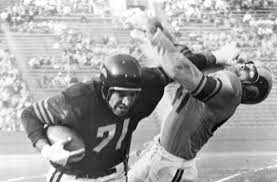
George Leo Connor was an American professional football player for the Chicago Bears of the National Football League from 1948 to 1955. He played offensive tackle on offense, and on defense was recognized as one of the sport's first linebackers. He is a member of the Pro Football Hall of Fame and of the College Football Hall of Fame. He attended both the College of the Holy Cross and the University of Notre Dame. He won the first Outland Trophy as the best college lineman in 1946. Sportswriter Grantland Rice once observed Connor was "the closest thing to a Greek God since Apollo."

After graduating, Connor received an offer from the Cleveland Browns of the All-America Football Conference, but chose to sign with his hometown Chicago Bears in 1948 for $13,000 a year guaranteed for three years, a high salary at the time for a lineman. He played for the Bears from 1948 through 1955. In eight seasons, he was named a first-team All-Pro five times, and was an invitee to the first four Pro Bowls. At first exclusively a tackle on defense, in a game in 1949 Bears head coach George Halas ordered Connor to stand upright outside the end in an attempt to thwart the running of Philadelphia Eagles halfback Steve Van Buren. The plan worked, as Connor held Van Buren in check and the Bears handed the Eagles their only loss of the season. "We always set high standards for George Connor and he exceeded them," said Halas. He became one of the first big, mobile linebackers in the NFL. Connor retired during training camp in 1956, still bothered by a knee injury sustained in 1954.

In 1963, Connor was inducted into the College Football Hall of Fame. He was enshrined in the Pro Football Hall of Fame with the class of 1975. He is a member of the National Football League 1940s All-Decade Team, selected by the Pro Football Hall of Fame committee in 1969 to honor the best players of the 1940s.

For several years Connor was a color commentator on CBS telecasts of NFL games, often working with lead announcer Jack Drees.

Connor worked as a manufacturers' representative in Chicago after his retirement from the NFL. He died in Evanston, Illinois on March 31, 2003, aged 78 after a long illness.

Sources
https://www.pro-football-reference.com/
https://www.profootballarchives.com/index.html
https://americanfootballdatabase.fandom.com/wiki/Football_Wiki
https://www.gridiron-uniforms.com/GUD/controller/controller.php?action=main
https://www.profootballhof.com/hall-of-famers/
 "Chicago | Bears in the Hall – George Connor". Chicagobears.com. Archived from the original on November 2, 2017. Retrieved December 10, 2016.
 Hayes, Neil (August 10, 2008). "Little Big Man: Smallest of infants turned out to be one of the giants of college and pro football" (PDF). Chicago Sun-Times. Archived from the original on March 26, 2016. Retrieved December 10, 2016.
 "Miller and White of Notre Dame Gain All-America Football Posts" (PDF). The New York Times. December 8, 1943. (subscription required)
 "Reflections of the Dome – April 2003". Irishlegends.com. Retrieved December 10, 2016.
 Litsky, Frank (April 2, 2003). "George Connor, 78, Standout For Notre Dame and the Bears". The New York Times. Retrieved December 10, 2016.
 "George Connor, 78; Hall of Fame Linebacker for the Chicago Bears". Los Angeles Times. April 2, 2003. Retrieved December 10, 2016.
 "George Connor Bio :: Notre Dame Football :: UND.COM :: The Official Site of Notre Dame Athletics". Und.Com. Retrieved December 10, 2016.
 "George Connor was football's first linebacker". The Marion Star. November 10, 1984. Retrieved January 17, 2020 – via Newspapers.com.
 "George Connor Stats". Pro-Football-Reference.com. Sports Reference LLC. Retrieved December 10, 2016.
 "Football's First Linebacker". Sarasota Herald-Tribune. December 9, 1984. p. 9. Retrieved December 10, 2016.
 "NFL's All-Decade Team of the 1940s". Pro Football Hall of Fame. January 8, 2010. Retrieved December 10, 2016.
Jack Connor, Connor: The Life Story of George Connor. Chicago: Chicago Publishing, 2002.
Bob Curran, Pro Football's Rag Days. Englewood Cliffs, NJ: Prentice-Hall, 1969; pp. 191–199.