Pro Football Historian (PFH) is a blog page written by Flint Given. Pro Football Historian or PFH is a page to inform people on prior NFL events that people might not know about. Learning about teams from the 1920s or even the first few NFL World Championships in the 1930s fascinates me. It's these kinds of events that I want to discuss in this blog. Hopefully you are interested and will continue to check up on my blogs.
William Lewis Shaw is an American former professional football player who played as a guard for the Buffalo Bills in the American Football League (AFL). After playing college football for the Georgia Tech Yellow Jackets, he was drafted by the Bills. Shaw was the prototypical "pulling guard" who despite his size held his own against much bigger defensive linemen like Ernie Ladd, Earl Faison and Buck Buchanan. He won three straight Eastern Division titles and two American Football League championships in 1964 and 1965 with Buffalo.
Shaw was a first-team All-American Football League selection four times (1963–1966) and second-team All-AFL in 1968 and 1969. He played in eight American Football League All-Star Games and was named to the All-Time All-AFL Team. He made the All-Decade All-pro football team of the 1960s. Shaw played his entire career in the American Football League, and retired after the 1969 season.
Shaw is the only player ever inducted to the Pro Football Hall of Fame without ever playing in the NFL. (The Bills, along with the rest of the AFL, merged with the NFL the season following his retirement.) He is also a member of the Greater Buffalo Sports Hall of Fame and the Bills' 50th Anniversary Team.
Shaw participated in sports throughout his entire youth. He played end in high school football at a small school right outside of Vicksburg until the school decided to drop football. His father moved the family into town so Shaw could continue to play football at Carr Central. Weighing in at 188 pounds Shaw played offensive and defensive tackle at Carr his senior year.
Billy Shaw was drafted by the Dallas Cowboys and the Buffalo Bills in the 1961 NFL and AFL Drafts, respectively, and decided to sign with the Bills. Shaw did well at both blocking for the pass and for the run. With Bills' running backs tending to be more durable than fast, Shaw was the perfect guard. He could stay in front of the runners far down field. Shaw was known as "the driving force of the offensive unit." Shaw was a first-team All-American Football League selection four times (1963–1966) and second-team All-AFL in 1968 and 1969. He played in eight American Football League All-Star Games and was named to the All-Time All-AFL Team. He made the All-Decade All-pro football team of the 1960s. Shaw played his entire career in the American Football League, and retired after the 1969 AFL season. The 1962-1964 Bills are still ranked among the best in rushing touchdowns in a season in the team's record book.
Shaw married Patsy in 1960.
Shaw was inducted into Pro Football Hall of Fame in 1999. During his speech, he forgot to thank his wife. After taking pictures, he went back on stage and got on his knees and apologized.
Pro Football Hall of Famer Billy Shaw — a shining star of American Football League — dies
Horrigan, Joe (1999). "An Aw Shucks Guy" (PDF). Coffin Corner. 21 (4). Retrieved October 5, 2024.
BILLY SHAW: MISSISSIPPI SPORTS HALL OF FAME INDUCTEE
Billy Shaw, a Singular Hall of Fame Lineman, Dies at 85, The New York Times
"Billy Shaw." Professional Football Hall of Fame. Pro Football Hall of Fame, 1999. Web. September 21, 2011.
GEORGIA TECH MOURNS PASSING OF BILLY SHAW
"Bills are saddened by the loss of Pro Football Hall of Fame guard Billy Shaw". Buffalobills.com. Retrieved October 5, 2024.
Brown, Chris. "Bills All-Time draft memories: Billy Shaw." Buffalo Bills. Buffalo Bills, March 16, 2010. Web. September 28, 2011. Archived May 24, 2011, at the Wayback Machine.
Carucci, Vic (January 31, 1999). "Billy Shaw finally handed his ticket to Canton". The Buffalo News. Archived from the original on September 22, 2016. Retrieved September 21, 2016.
Felser, Larry (January 31, 1999). "Shaw savors the moment". The Buffalo News. Archived from the original on September 22, 2016. Retrieved September 21, 2016.
"10 years after speech, Billy Shaw's still apologizing". ESPN.com. August 8, 2009. Retrieved August 15, 2024.
"Greater Buffalo Sports Hall of Fame Profile". Buffalosportshallfame.com. July 31, 2012. Retrieved August 15, 2024.
Maiorana, Sal (October 4, 2024). "Billy Shaw, Pro Football Hall of Famer and Buffalo Bills great, dead at 85". Democrat and Chronicle. USA Today. Retrieved October 4, 2024.
Gordon, Grant (October 4, 2024). "Bills legend, Hall of Fame guard Billy Shaw dies at 85". NFL. Retrieved October 4, 2024.
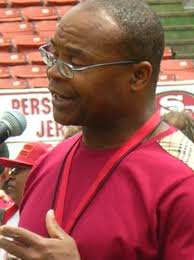
Ozzie Newsome Jr. is an American professional football executive and former player who is the executive vice president of player personnel of the Baltimore Ravens of the National Football League. Newsome was a tight end for the NFL's Cleveland Browns, and was general manager of the Ravens from 1996 to 2018. Newsome has been inducted into both the College Football Hall of Fame (1994) and the Pro Football Hall of Fame (1999), and is widely regarded as one of the greatest tight ends of all time.
Newsome was drafted in the first round with the 23rd pick in the 1978 NFL draft for the Cleveland Browns. He was named the Browns' Offensive Player of the Year his rookie year, the first time in 25 years that a rookie had received that honor. Newsome went to the Pro Bowl in 1981, 1984 and 1985. In 1984, Newsome set a franchise record for receiving yards in a game (191) that stood for 29 years until it was broken in 2013 by Josh Gordon (who recorded 237 and 261 yards in back-to-back games). In 1986, Newsome won the Ed Block Courage Award for playing with injuries, and in 1990, he won the Byron "Whizzer" White NFL Man of the Year Award for his community service. Though he was never able to play in a Super Bowl, Cleveland made the playoffs seven times during Newsome's career, and made three trips to the AFC championship game.
Newsome finished his career with 662 receptions and 7,980 yards, both Cleveland franchise records, and 47 touchdowns, fifth all-time. When he retired, he was the all-time leader in receptions and yards amongst all NFL tight ends. In 1999, Newsome was inducted into the Pro Football Hall of Fame.
Newsome was a front office executive with the Cleveland Browns from 1991 until their relocation to Baltimore in 1996; he has remained an executive with the Baltimore Ravens since their inaugural season. On November 22, 2002, Newsome was named the first general manager of the Ravens, making him the first African-American to occupy that position in the NFL.
Newsome earned his first Super Bowl ring when the Ravens defeated the New York Giants 34–7 in Super Bowl XXXV in 2001, and earned a second ring after the Ravens defeated the San Francisco 49ers in Super Bowl XLVII by a score of 34–31 in 2013.
Ravens owner Steve Bisciotti announced on February 2, 2018, that Newsome would step down following the 2018 season and assistant general manager Eric DeCosta would become the team's new GM. Although DeCosta is the team's general manager, Newsome is still employed by the Ravens in an active and significant role and he is listed as executive vice president on the Ravens Official Website.
Ozzie Newsome Jr. (born March 16, 1956) is an American professional football executive and former player who is the executive vice president of player personnel of the Baltimore Ravens of the National Football League. Newsome was a tight end for the NFL's Cleveland Browns, and was general manager of the Ravens from 1996 to 2018. Newsome has been inducted into both the College Football Hall of Fame (1994) and the Pro Football Hall of Fame (1999), and is widely regarded as one of the greatest tight ends of all time.
Newsome played for Alabama, where he started for all four years of his college career. Nicknamed "The Wizard of Oz", Newsome made the College Football All-America Team in 1977 and assisted the Crimson Tide to a 42–6 overall record during his four seasons. In total, Newsome amassed 102 receptions for 2,070 receiving yards and 16 touchdowns, while also returning 40 punts for 301 yards. His 20.3 average yards per catch was a Southeastern Conference record for over 20 years. Newsome was named the Alabama Player of the Decade for the 1970s. He was a two-time All-SEC player (in 1976 and 1977), and named SEC Lineman of the Year in 1977 by the Birmingham Quarterback Club and the Atlanta Touchdown Club. In 1994, Newsome was enshrined in the College Football Hall of Fame. Coach Paul "Bear" Bryant called him "the greatest end in Alabama history and that includes Don Hutson. A total team player, fine blocker, outstanding leader, great receiver with concentration, speed, hands."
Newsome was drafted in the first round with the 23rd pick in the 1978 NFL draft for the Cleveland Browns. He was named the Browns' Offensive Player of the Year his rookie year, the first time in 25 years that a rookie had received that honor. Newsome went to the Pro Bowl in 1981, 1984 and 1985. In 1984, Newsome set a franchise record for receiving yards in a game (191) that stood for 29 years until it was broken in 2013 by Josh Gordon (who recorded 237 and 261 yards in back-to-back games). In 1986, Newsome won the Ed Block Courage Award for playing with injuries, and in 1990, he won the Byron "Whizzer" White NFL Man of the Year Award for his community service. Though he was never able to play in a Super Bowl, Cleveland made the playoffs seven times during Newsome's career, and made three trips to the AFC championship game.
Newsome finished his career with 662 receptions and 7,980 yards, both Cleveland franchise records, and 47 touchdowns, fifth all-time. When he retired, he was the all-time leader in receptions and yards amongst all NFL tight ends. In 1999, Newsome was inducted into the Pro Football Hall of Fame.
Newsome was a front office executive with the Cleveland Browns from 1991 until their relocation to Baltimore in 1996; he has remained an executive with the Baltimore Ravens since their inaugural season. On November 22, 2002, Newsome was named the first general manager of the Ravens, making him the first African-American to occupy that position in the NFL.
Newsome earned his first Super Bowl ring when the Ravens defeated the New York Giants 34–7 in Super Bowl XXXV in 2001, and earned a second ring after the Ravens defeated the San Francisco 49ers in Super Bowl XLVII by a score of 34–31 in 2013.
Ravens owner Steve Bisciotti announced on February 2, 2018, that Newsome would step down following the 2018 season and assistant general manager Eric DeCosta would become the team's new GM. Although DeCosta is the team's general manager, Newsome is still employed by the Ravens in an active and significant role and he is listed as executive vice president on the Ravens Official Website.
In 2003, Newsome received the United States Sports Academy's highest honor, the Eagle Award, in recognition of his significant contributions to international sport.
Newsome is a member of the Cleveland Browns' "Ring of Honor", becoming a member of the first class inducted on September 19, 2010.
Strauss, Max (February 21, 2011). "Hall of Fame Tight End, Current Ravens General Manager, Ozzie Newsome Interview". prointerviews.org.
Schexnayder, C.J. (July 9, 2012). "SB Nation College Football Hall Of Fame Inductee Ozzie Newsome". SBNation. Retrieved September 26, 2012.
"Ozzie Newsome Jr". The Encyclopedia of Alabama. January 18, 2012. Archived from the original on March 7, 2012. Retrieved January 21, 2010.
Brandon Larrabee (July 9, 2012). "Alabama's Ozzie Newsome Inducted Into SB Nation College Football Hall Of Fame". SBNation. Retrieved September 26, 2012.
Ozzie "The Wizard of Oz" Newsome at the College Football Hall of Fame
Bob Gain (January 26, 2008). "Players reflections on Paul W. "Bear" Bryant". TideSports.com. Archived from the original on February 1, 2013.
"Josh Gordon sets NFL record". ESPN. December 2013. Retrieved December 2, 2013.
Steve King. "Hall of Fame Ozzie Newsome - Tight End". Sports Reference. Archived from the original on March 13, 2013. Retrieved September 29, 2012.
"Hall of Famers Ozzie Newsome". Pro Football Hall of Fame. Retrieved September 29, 2012.
"History: African-Americans in Pro Football". Pro Football Hall of Fame. Retrieved September 29, 2012.
"Super Bowl XLVII - San Francisco 49ers vs. Baltimore Ravens - February 3rd, 2013". Pro-Football-Reference.com. Retrieved November 8, 2017.
"Ravens GM Ozzie Newsome to step down after 2018". NFL.com. Retrieved August 11, 2019.
"Ozzie Newsome's new title? New Ravens GM thinking consigliere". ESPN. January 31, 2019. Retrieved April 21, 2020.
"Ravens". www.baltimoreravens.com. Retrieved April 10, 2022.
"Ozzie Newsome Jr". The Encyclopedia of Alabama. Retrieved September 29, 2012.
Barry Barnes (August 26, 2010). "Ozzie Newsome to Receive Honor at Cleveland Browns Stadium". AOL News.
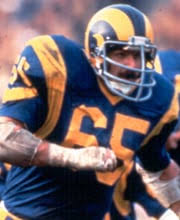
Thomas Lee Mack is an American former football guard who played for the Los Angeles Rams of the National Football League. He was inducted into the Pro Football Hall of Fame in 1999.
A native of Cleveland, Ohio, Mack played college football as an end and tackle for the Michigan Wolverines from 1963 to 1965. He was a starter on the 1964 Michigan team that won the Big Ten Conference championship and defeated Oregon State in the 1965 Rose Bowl. He was selected as a first-team All-Big Ten player in 1965 and was inducted into the University of Michigan Athletic Hall of Honor in 2006.
Mack was selected by the Rams with the second overall pick of the 1966 NFL draft and played at left guard for the Rams for 13 seasons from 1966 to 1978. During his NFL career, Mack played in 11 Pro Bowls and appeared in 184 consecutive games, 176 as a starter, over 13 seasons.
Mack was selected by the Los Angeles Rams in the first round, as the second overall pick, in the 1966 NFL draft. During Mack's rookie season with the Rams, starter Don Chuy was injured during the fifth game of the season, allowing Mack to move into the lineup. He started nine games during the 1966 season and became a fixture for the Rams at the left guard position for the next 13 seasons. During his NFL career, Mack never missed a game due to injury, appearing in 184 consecutive contests, the third longest streak in Rams history behind Merlin Olsen and Jack Youngblood.
During Mack's career with the Rams, the club enjoyed a .720 winning percentage with a won-lost-tie record of 129–48–7, won their division eight times (1967, 1969, and 1973–1978), and reached four NFC championship games. In 1973, the Rams scored led the NFL with 388 points (27.7 points/game). In 1974, the Rams lost to the Minnesota Vikings by four points in the 1974 NFC Championship Game, with a controversial penalty call against Mack costing the Rams a touchdown. The Rams had the ball at the one-yard line on second down when the Vikings' Alan Page made contact with Mack; the referee called illegal procedure on Mack, but replays showed that Mack had not moved. After the game, Mack insisted he had not moved but credited Page with "a smart play" in making contact since a penalty, if called against the Vikings, would have been meaningless.
Mack was selected to 11 Pro Bowls, the first coming after his second season in 1967. He missed only one Pro Bowl appearance the rest of his career (1976). Mack's 11 invitations earned him a third-place tie with Bob Lilly and Ken Houston for the most selections of all time. Mack was selected first-team All-Pro four times (1969, 1971, 1973, 1974) and second-team All-Pro four times (1968, 1970, 1972, and 1975). In addition, he was named All-NFC eight times between 1970 and 1978.
Mack announced in late November 1978 that he would retire at the end of the 1978 NFL season. He was inducted into the Pro Football Hall of Fame in 1999.
After retiring from football, Mack worked as an engineer, using the engineering degree he received at the University of Michigan. He eventually became a lobbyist for Bechtel Group, Inc. Mack has a daughter named Carrie who attended Quince Orchard High School in Gaithersburg, MD (Class of 1992).
"Tom Mack". Pro-Football-Reference.com. Sports Reference LLC. Retrieved March 25, 2015.
"Ray Mack". Baseball-Reference.com. Sports Reference LLC. Retrieved March 26, 2015.
"Distinguished Eagle Scouts" (PDF). Scouting.org. Archived from the original (PDF) on March 12, 2016. Retrieved March 25, 2015.
"All-Time Football Roster Database". University of Michigan, Bentley Historical Library. Retrieved March 25, 2015.
Anthony Broome (October 18, 2012). "TBHR Chats With NFL Hall of Famer Tom Mack". The Big House Reports. Archived from the original on April 2, 2015.
"1964 Football Team". University of Michigan, Bentley Historical Library. Retrieved March 25, 2015.
"1965 Football Team". University of Michigan, Bentley Historical Library. Retrieved March 25, 2015.
"Grabowski Big Ten Choice". Cape Girardeau Southeast Missourian. November 24, 1965. p. 3B.
Michigan Athletic Hall of Honor. Bentley Historical Library (archives of the University of Michigan and the Michigan Athletic Department) website. Retrieved September 9, 2011.
"Fraternity Men in the Pro Football Hall of Fame" (PDF). North American Inter-Fraternity Conference. Retrieved March 25, 2015.
"Mack To Rams". Ocala Star-Banner. November 28, 1965. p. 24.
"It Was a Bruiser For Rams Tom Mack". Lewiston Evening Journal (AP story). October 13, 1966. p. 26.
"Tom Mack". Times Daily. August 6, 1999. p. 10E.
"'I Didn't Move,' Claims Rams' Tom Mack". Sarasota Journal. December 30, 1974. p. 2C.
"Tears Fall As Vikes Top LA, 14-10". Pittsburgh Post-Gazette. December 30, 1974. p. 14.
"Veteran Lineman Tom Mack Announces His Retirement". The Pittsburgh Press. November 25, 1978. p. A-10.
"Michigan alum Mack inducted into Pro Football Hall of Fame". The Michigan Daily. August 9, 1999. p. 14.
Gene Wojciechowski (December 7, 1987). "Tom Mack: Once a Force in Rams' Offensive Line, Now He's a Lobbyist Who Reasons". Los Angeles Times.
Eric Demetric Dickerson is an American former football running back who played in the National Football League for 11 seasons. Dickerson played college football for the Mustangs of Southern Methodist University and was recognized as an All-American. He was selected second overall in the 1983 NFL draft by the Los Angeles Rams, and later played for the Indianapolis Colts, Los Angeles Raiders, and Atlanta Falcons. During his NFL career, he rushed for over 13,000 yards. He holds the NFL's single-season rushing record with 2,105 yards, set in 1984. Dickerson was inducted into the Pro Football Hall of Fame in 1999 and, in 2019, was named to the NFL 100th Anniversary All-Time Team. He is widely regarded as one of the greatest running backs of all time. He wore prescription goggles throughout his career due to myopia.
Before the 1983 NFL draft, the Houston Oilers said they would draft Dickerson second if they did not make a trade. Dickerson’s family opposed him playing for the Oilers, although Dickerson himself was merely cool about doing so, while, like John Elway Dickerson would have flatly refused to play for the Baltimore Colts had they drafted him. A trade with the Oilers saw the Los Angeles Rams acquire the second pick, which they used to draft Dickerson. Although he considered going to the Los Angeles Express in the United States Football League, Dickerson ultimately decided to play for the Rams. An immediate success, he established rookie records for most rushing attempts (390), most rushing yards gained (1,808) and most touchdowns rushing (18), including another two receiving touchdowns. His efforts earned him All-Pro, Pro Bowl, Player of the Year and Rookie of the Year honors.
In his second season, Dickerson continued his onslaught on the NFL record book becoming a member of the 2,000-yard club. Twelve times in 1984 he gained more than 100 yards rushing, breaking the record of 100-yard games in a season held by O. J. Simpson. His 2,105 total yards rushing beat Simpson's 1973 NFL season record of 2,003 yards (Dickerson having reached 2,007 yards after 15 games), but since the NFL expanded the regular season from 14 to 16 games in 1978, Dickerson had the benefit of playing in two additional games. No one has since rushed for more yards in a single NFL season. Dickerson's 5.6 yards per carry led the Rams to a playoff berth in 1984.
Although he rushed for 1,234 yards in 1985 while missing the first two games due to a contract dispute, Dickerson missed the Pro Bowl for the first time in his young NFL career. He did go on to rush for a playoff record 248 yards against the Dallas Cowboys in post-season play.
The 1985 season marked the beginning of ongoing contract disputes between Dickerson and the Rams. In 1987, after playing just three games for the Rams during the strike-shortened 1987 season, Dickerson was traded to the Indianapolis Colts in one of the NFL's biggest trades ever at that time. In a three-team deal, the Colts traded linebacker Cornelius Bennett, whom they drafted but were unable to sign to a contract, to the Buffalo Bills for their first-round pick in 1988, first- and second-round picks in 1989, and running back Greg Bell. The Colts in turn traded Bell and the three draft choices from Buffalo plus their own first- and second-round picks in 1988, their second-round pick in 1989, and running back Owen Gill to the Rams for Dickerson. With the picks the Rams took running back Gaston Green, wide receiver Aaron Cox, linebacker Fred Strickland, running back Cleveland Gary, linebacker Frank Stams, and defensive back Darryl Henley. The trade reunited Dickerson with Ron Meyer, who had left SMU after Dickerson's junior season to take the head coaching position in New England and who was hired by the Colts in 1986 following Rod Dowhower's firing.
Although he played in just nine games with the Colts that year, he still managed to gain 1,011 yards to finish the season with 1,288. Also, he spearheaded a late season Colts run that helped the team to their first winning season (and first playoff berth) in 10 years.
In 1988, Dickerson, with 1,659 yards rushing, became the first Colt to lead the league in rushing since Alan Ameche in 1955. This would mark the apogee of Dickerson's career with the Colts (although he would gain 1,311 yards rushing in 1989). Also, 1989 was the year that he passed the 10,000-yard mark, becoming the fastest player ever to do so (91 games), accomplishing the feat faster than greats like Jim Brown (98 games), Barry Sanders (103 games), Emmitt Smith (106 games), and LaDainian Tomlinson (106 games). By 1989, he had set a new NFL record with seven straight seasons of more than 1,000 yards rushing, and led the league for four of those seasons. With the retirement of Tony Dorsett at the end of 1988, he became the leader among active players in career rushing yards, a position he occupied until his own retirement in 1993.
However, injuries, further contract disputes, and suspensions clouded his final two seasons with the Colts. Dickerson, at 29, was the highest-paid running back in the NFL, receiving an annual reported salary of $1.4 million. Following prolonged contract disputes, the fed-up Colts placed him on the inactive list before the start of the 1990 season where he stayed for 7 weeks and lost more than $600,000 in salary. In his sixth game back from suspension, he rushed for 143 yards against the Bengals on 22 carries, this effort lifted him past Jim Brown to third place on the NFL career rushing list behind Walter Payton and Tony Dorsett. He was again suspended in November 1991, and amidst injuries and age, managed to run for only 536 yards that season. The Colts finished the year bottoming out with a 1–15 record.
Dickerson has described the trade to Indianapolis as the worst moment of his career, and stated that he disliked his time with the Colts.
On April 26, 1992, Dickerson was traded by the Colts to the Los Angeles Raiders for their fourth- and eighth-round picks in the 1992 draft. There were occasional flashes of greatness—107 yards against the Broncos, 103 against the Chargers, where he recorded his 63rd and 64th career 100-yard games—but those would be his last. Dickerson also scored on a 40-yard touchdown run, reminiscent of his prime, in front of a nationally televised Monday Night audience in a game against Kansas City. That year, he led the team in rushing attempts and yards. However, he suffered from splitting carries with Marcus Allen by having the latter finish the second half.
The following season, Dickerson was traded to the Atlanta Falcons on July 7, 1993, for a sixth-round draft pick. He played in a backup role, making his final national televised appearance during the Monday Night Football game on September 27, 1993, when the Falcons hosted the Pittsburgh Steelers in a losing effort. The Falcons traded Dickerson and third-year cornerback Bruce Pickens to the Green Bay Packers for running back John Stephens on October 13, 1993.
The trade came a week after Dickerson said he had been told that the Falcons were waiving him because Coach Jerry Glanville wanted to use younger players. The next day, Falcons officials said that there had been a misunderstanding and that Dickerson had not been placed on waivers. Dickerson retired as the second leading rusher of all time after failing a physical with the Packers.
On August 29, 2017, Dickerson signed a one-day contract to officially retire as a member of the Los Angeles Rams.
McVey, Rob (April 16, 2022). "25 Greatest Running Backs in NFL History". Athlon Sports. Archived from the original on August 10, 2022. Retrieved August 10, 2022. At 6-foot-3, Dickerson was not your prototypical running back, but he was one of the most successful backs to ever tote the pigskin. No one in NFL history has rushed for more yards in a single season than Dickerson (2,105 in 1984). Dickerson ranks ninth on the all-time rushing list and won four rushing titles during his Hall of Fame career.
Kenyon, David (October 3, 2018). "The Top 10 NFL Running Backs of All Time". Bleacher Report. Archived from the original on August 10, 2022. Retrieved August 10, 2022.
Gordon, Roger. "Eric Dickerson: Well-Traveled Runner Had a Knack for Eluding Tacklers" (PDF). ProFootballResearchers.org. The Free Press, Canton, Ohio, August 1, 1999; republished online at The Coffin Corner vol. 27, no. 3 (2005). Archived from the original (PDF) on November 26, 2010. Retrieved July 30, 2015.
Harvey, Randy (February 6, 2013). "After 34 years, Eric Dickerson repaid a debt to A&M". Houston Chronicle. Retrieved July 30, 2015.
"Sealy Gridder Reneges On Pledge To Ink Aggie Pact". The Galveston Daily News. February 15, 1979. Retrieved February 11, 2008.
"Pony Exce$$". 30 for 30. Episode 30. April 10, 2009. ESPN.
"Eric Dickerson knows irony of talking NIL at his alma mater since SMU got so-called 'death penalty'". AP News. December 4, 2024. Retrieved August 9, 2025.
Coleman, Madeline (January 19, 2022). "Eric Dickerson Admits Origin of Legendary Gold Trans Am". Sports Illustrated. Retrieved July 1, 2023.
"Eric's College Days at SMU". EricDickerson29.com. Eric Dickerson. Archived from the original on June 4, 2003. Retrieved July 30, 2015.
"Eric Dickerson". Pro Football Hall of Fame.
"Dickerson Not Eager To Be Oiler". Austin American-Statesman. April 23, 1983. p. C2.
"SMU's Dickerson Cool to Prospect of Oilers". The San Francisco Examiner. April 22, 1983. p. F6.
"Rams, Oilers Trade Drafts". The Sacramento Bee. April 24, 1983. p. C4.
"History: Eric Dickerson Trade". ProFootballHOF.com. Retrieved July 30, 2015.
"NFL Game Center: Game Recap - Baltimore Ravens at San Diego Chargers - 2007 12". NFL.com. National Football League.
"Colts Suspend Dickerson". Los Angeles Times. August 30, 1990. Retrieved March 10, 2015.
Harvin, Al (November 8, 1991). "Colts Suspend Dickerson, Citing His 'Insubordination'". The New York Times. Retrieved February 27, 2015.
"Eric Dickerson on Learning to Love the Rams Again (Almost)". si.com. Sports Illustrated. February 10, 2022.
"1993 NFL Transactions. Trades - October". National Football League. Retrieved December 3, 2020.
"Eric Dickerson to sign one-day contract, retire as a Ram". NFL.com. August 29, 2017. Retrieved December 21, 2019.
NFL Retired Numbers, Player Deaths, and the Stories Behind Them by Chase Stuart, February 7, 2013
Wilson, Josh (October 8, 2013). "Colts to Add Hall of Famers Marshall Faulk, Eric Dickerson to Ring of Honor". StampedeBlue.com. Archived from the original on October 10, 2013. Retrieved July 30, 2015.
"Eric Dickerson". Pro Football Hall of Fame. Archived from the original on May 27, 2010. Retrieved May 28, 2013.
"NFF Announces Storied 2020 College Football Hall of Fame Class Presented by ETT". National Football Foundation. March 11, 2020. Retrieved August 23, 2020.
Eric Dickerson at IMDb
http://laradio.com September 13, 2016
"Pro Football Hall of Famer Eric Dickerson Joins FOX Sports". Fox Sports. August 21, 2017. Archived from the original on August 22, 2017. Retrieved December 30, 2024.
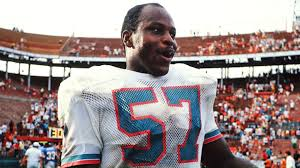
Dwight Eugene Stephenson is an American former professional football player who was a center for the Miami Dolphins of the National Football League from 1980 to 1987. He played college football for the Alabama Crimson Tide. Stephenson was inducted into the Pro Football Hall of Fame in 1998.
Stephenson was drafted by Don Shula and the Miami Dolphins in the second round of the 1980 NFL draft. He was used on special teams only until late in the 1981 season, when starting center Mark Dennard was injured. A few seasons later, Stephenson was "universally recognized as the premier center in the NFL".
With the exceptionally explosive Stephenson as offensive captain, the Dolphins offensive line gave up the fewest sacks in the NFL for a record six straight seasons, from 1982 to 1987, which doubled the length of the previous record. He retired from pro football in 1987, after sustaining a left knee injury in a play involving New York Jets Marty Lyons and Joe Klecko.
Stephenson was voted as an All-Pro five consecutive times from 1983 to 1987. He was selected to play on five Pro Bowl squads over the same span. He was named AFC Offensive Lineman of the Year by the NFLPA five consecutive times (1983–87) and voted the Seagram's Seven Crowns of Sports Offensive Lineman of the Year three consecutive times (1983–85). He started at center in the AFC Championship Game three times, in 1982, 1984, and 1985. He was the starting center in the Dolphins' two most recent Super Bowl appearances: Super Bowl XVII and Super Bowl XIX. In 1985, Stephenson was the recipient of the NFL Man of the Year Award for "outstanding community service and playing excellence."
On December 12, 1994 Stephenson was added to the Miami Dolphins Honor Roll.
Despite the brevity of his career, in 1999, Stephenson was ranked number 84 on The Sporting News' list of the 100 Greatest Football Players. Also in 1999, he was inducted into the Virginia Sports Hall of Fame, and in 2011, Stephenson was inducted into the Hampton Roads Sports Hall of Fame, for his contributions to sports in southeastern Virginia.
In 1998, Stephenson was inducted into the Pro Football Hall of Fame. He was quoted as saying that "I know I’m not going to make every block, but I don’t like to ever get beat. That’s what keeps me motivated. There’s always the next play to get ready for.”
In 2005, Stephenson was named the Walter Camp Man of the Year.
He is the namesake of Pro Football Focus' annual Dwight Stephenson Award, honoring the player the website considers best in the NFL regardless of position.
After retiring from football, as of 2013, Stephenson had worked as a construction manager and general contractor in Florida. He remains a strong supporter of the University of Alabama's football team.
"Dwight Stephenson". Pro Sports Transactions. Retrieved September 7, 2024.
"Dwight Stephenson | Pro Football Hall of Fame Official Site".
"1998 Pro Football Hall of Fame Ballot". Pro-Football-Reference.com.
"Dwight Stephenson Chat Transcript". profootballhof.com. Pro Football Hall of Fame. October 20, 2000. Retrieved October 3, 2016.
Johnson, Dave (July 31, 1998). "Dwight Stephenson: From Hampton To Canton: On The Center Stage". Daily Press. Archived from the original on October 5, 2016. Retrieved October 3, 2016.
"UPI All-America Team". The Salina Journal. December 5, 1978. p. 13. Retrieved October 3, 2016.
"Southern Cal star White repeats as All-America". The Pantagraph. December 5, 1979. p. B4. Retrieved October 3, 2016.
"UPI All-America: Trojans Grab 3 Berths". The Daily News (Huntingdon). December 4, 1979. p. 5. Retrieved October 3, 2016.
"Dwight Stephenson Bio". Pro Football Hall of Fame. Retrieved October 3, 2016.
Smothers, Jimmy (February 7, 1986). "Just Scribblin' On Sports". Gadsden Times. p. D1. Retrieved October 3, 2016.
"The Dwight Stephenson Award". profootballfocus.com. Pro Football Focus. January 10, 2013. Retrieved October 3, 2016.
Hicks, Tommy (March 9, 2013). "Football played huge role in Dwight Stephenson's life (photos & video)". The Birmingham News. Retrieved October 3, 2016.
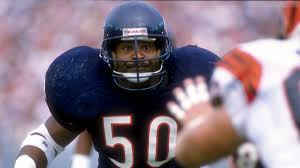
Michael Singletary, nicknamed "Samurai Mike", is an American former football player and coach. He played as a linebacker for the Chicago Bears of the National Football League. After playing college football for the Baylor Bears, Singletary was selected by the Bears in the second round of the 1981 NFL draft and was known as "the Heart of the Defense" for their Monsters of the Midway defense in the mid-1980s. He was part of their Super Bowl XX championship team that beat the New England Patriots. Singletary was inducted into the Texas Sports Hall of Fame in 1995 and into the Pro Football Hall of Fame in 1998.
Singletary later pursued a career as a coach, first as a linebackers coach for the Baltimore Ravens, then as the linebackers coach for the San Francisco 49ers. In 2008, the 49ers promoted Singletary to the head coaching position after previous head coach Mike Nolan was fired during the season, and he remained in that position until he was fired after the 49ers were eliminated from playoff contention with one game remaining in the 2010 season. He has also coached for the Los Angeles Rams, the Memphis Express of the now-defunct Alliance of American Football (AAF), and a brief two-season stint as the head coach of a high school team.
At 6 feet, 230 pounds, Singletary became a starting linebacker in the Chicago Bears defense in the seventh game of his rookie season. In a game against the Kansas City Chiefs, his third as a starter, Singletary gave a remarkable defensive performance, recording 10 tackles and forcing a fumble. He was a nearly unanimous all-rookie selection. Singletary started 172 games for the Bears during his 12-year career, the second-most in club history. An intense player, he finished as the Bears' first- or second-leading tackler each of his last 11 seasons. He amassed an impressive 1,488 career tackles, 885 of which were solo efforts. He missed playing just two games, both in 1986. He made 7 interceptions and 12 fumble recoveries.
In a game against the Denver Broncos in 1990 he had a personal-best performance when he recorded 10 solo tackles and 10 assists. Selected to play in a team record 10 Pro Bowls, Singletary was All-Pro eight times, and All-NFC every year from 1983 to 1991.
He led the Bears to a 15–1 season in 1985. The "46" defense invented by Buddy Ryan allowed Singletary to be unblocked on virtually every play. That season, he recorded 109 solo tackles (52 assists), 3 sacks, 1 interception, 3 fumble recoveries, 1 forced fumble, and 10 defended passes. He won the NFL Defensive Player of the Year,[8] and led a defense that was ranked 1st overall (1st against the rush; 3rd against the pass).
Throughout the 1985 playoffs, Singletary provided stellar efforts in all 3 games. In the divisional game against the New York Giants at home, Singletary recovered a fumble early in the 1st quarter and a sack of quarterback Phil Simms on a 3rd down early in the 3rd quarter. The Bears went on to win 21–0. In the NFC Championship Game vs. the Los Angeles Rams, Singletary and the Bears dominated again. Coach Mike Ditka said that the day before the game, he was talking to the offense while Singletary was in the next room giving the defense a motivational speech. While it started out quiet, within minutes, Samurai Mike was screaming at the top of his lungs and the defensive players were throwing chairs and knocking over tables. The next day, he provided a memorable play where he stopped Eric Dickerson behind the line of scrimmage on third-and-short early in the 2nd quarter. The Bears would eventually go to win Super Bowl XX by beating the New England Patriots 46–10. In the game, Singletary broke up a pass that would have gone for a touchdown, delivered jarring hits to New England running back Craig James all game, and tied a Super Bowl record with 2 fumble recoveries.
Singletary was named NFL Defensive Player of the Year by the Associated Press in 1985 and 1988. He was elected to the College Football Hall of Fame in 1995 and to the Pro Football Hall of Fame in 1998. In 1999, he was ranked number 56 on The Sporting News' list of the 100 Greatest Football Players.
In 2002, a group of alumni at Baylor University promoted Singletary for the school's open head coaching position, holding a conference call (which included Mike Ditka and Dave McGinnis) with the university administration. The position ultimately went to Guy Morriss. Singletary at the time had no head or assistant coaching experience and the university president later stated that they wanted to hire a coach with prior "head coaching experience."
In 2003, Singletary became the linebackers coach for the Baltimore Ravens.
Following the 2004 season, the San Francisco 49ers hired Ravens defensive coordinator Mike Nolan to be their head coach, and Singletary left the Ravens with Nolan to be San Francisco's assistant head coach and linebackers coach. In 2007, Singletary interviewed for the head coaching job of the Dallas Cowboys and San Diego Chargers, but was ultimately passed over.
With Morriss leaving Baylor after the 2007 season, Singletary appeared to be the leading candidate for his replacement, and expressed interest in the job. On November 19, 2007, Baylor athletic director Ian McCaw flew to San Francisco to interview Singletary. However, Singletary decided against taking the position, which instead went to Art Briles. Singletary's son Matt was a freshman on the Baylor team in 2007.
Singletary became the interim head coach of the 49ers after Nolan was fired on October 20, 2008. Singletary instantly made a statement in San Francisco by sending tight end Vernon Davis to the locker room with more than 10 minutes remaining in his head coaching debut, a 34–13 loss to the Seattle Seahawks on October 26, 2008. Davis was penalized 15 yards for slapping Seattle safety Brian Russell after a reception. In a post-game press conference, Singletary called Davis' actions "uncoachable" and said that he would rather play with a 10-man squad than have to deal with an apathetic 11-man squad. He boldly declared in that same speech, "I want winners!", which became a staple on billboards around the Bay Area during his coaching tenure. It was later reported that during halftime of their game against the Seahawks, Singletary intentionally dropped his pants while giving a speech to illustrate just how poorly the 49ers had played in the first half.
Taking over the 2–5 49ers team, Singletary was able to finish the season 5–4 under his leadership (for a final team record of 7–9). On December 28, 2008, after a 27–24 come-from-behind victory over the Washington Redskins, Singletary was offered the team's long-term head coaching position, and signed a four-year, $10 million contract as the 49ers' head coach.
After leading the 49ers to a positive finish in 2008, Singletary helped the team jump out to a 3–1 overall start in the 2009 season. Despite a last-second loss to the Brett Favre-led Minnesota Vikings in Week 3, the 49ers recorded wins against the reigning NFC champion Arizona Cardinals and NFC West divisional rival Seattle Seahawks and St. Louis Rams.
While the 49ers were being blown out by the visiting Atlanta Falcons in Week 5, Singletary lost his temper over his team's poor play; afterward, he expressed remorse for his actions, saying how he wished he "had more coaching etiquette" while reiterating how he would "get better at those things as time goes on." In the weeks to come, Singletary and offensive coordinator Jimmy Raye would drastically alter the 49ers' game plan, opting to start quarterback Alex Smith in place of Shaun Hill while adopting more of a spread offense. The new game plan had mixed results, as the 49ers posted a 2–5 record from Week 7 to Week 13 and struggled to maintain their playoff hopes. In a Week 14 Monday Night Football matchup against the Arizona Cardinals, however, Singletary and his coaching staff were better able to integrate running back Frank Gore into the spread offense and pulled off an impressive 24–9 victory.
With this momentum and their slim playoff hopes still alive, the 49ers visited the Philadelphia Eagles in Week 15, and lost 27–13. After the game, a disappointed Singletary emphasized his team's continued need to improve, but still backed Smith as the team's starting quarterback. Singletary helped the 49ers end the season on a high note with victories against the Detroit Lions and St. Louis Rams to reach 8–8, the team's first non-losing season since 2002.
Five players on the 2009 team were named to play in the NFL Pro Bowl. Those players were Patrick Willis, Andy Lee, Vernon Davis, Frank Gore, and Justin Smith.
Also in 2009, Singletary joined other members of the 1985 Chicago Bears in resurrecting the Super Bowl Shuffle for a Boost Mobile commercial broadcast during Super Bowl XLIV.
The 49ers began the 2010 season with an 0–5 record, marking their worst start since 1979. The team's first win of the season came in Week 6 by defeating the Oakland Raiders. In Week 10, San Francisco narrowly defeated the St. Louis Rams, 23–20 in overtime. At home, the 49ers suffered their first home shut out since October 3, 1977, in a 21–0 loss to the Tampa Bay Buccaneers on November 21. A rematch occurred with the Rams on December 26, which the 49ers lost 25–17, eliminating them from playoff contention. After the game the 49ers fired Singletary. Defensive line coach Jim Tomsula took over for the final week of the season.
On January 18, 2011, Singletary confirmed that he had agreed to join the Minnesota Vikings coaching staff as the linebackers coach/assistant to the head coach.
After being out of the league since 2014, Singletary interviewed with the New York Giants for their vacant linebacking coach position. Giants head coach Ben McAdoo and Singletary both worked together with the 49ers in 2005. The Giants eventually hired former Philadelphia Eagles assistant Bill McGovern for the position.
On June 28, 2016, Singletary announced in an interview with a radio station that he would be returning to the coaching ranks as an advisor for the Los Angeles Rams defense. The move reunited Singletary with former Bears teammate and then-Rams head coach Jeff Fisher.
On May 10, 2018, Singletary was named head coach of the Memphis Express of the Alliance of American Football. The Express went 2–6 before the league cancelled the rest of the season. The league eventually ceased operations altogether.
On March 29, 2018, Singletary accepted a job at Trinity Christian Academy in Addison, Texas. He left the school in December 2019 after going 1–21 in two seasons.
Singletary, an ordained minister, is a devout evangelical Christian. Singletary said in an interview with the 700 Club, "To me, Christ means everything. I know that He's got my back no matter what I do. So that gives me all the freedom in the world to be the man that He's called me to be."
Singletary and his wife, Kim, have seven children. His son Matt joined Baylor University's roster in 2007 as a freshman defensive end. However, Matt transferred to California Polytechnic State University where he was a junior defensive end. Singletary's nephew, Vantz, is a linebackers coach at Liberty University and previously coached under Mike when he coached with the 49ers.
"San Francisco 49ers sack Singletary as coach after elimination". ESPN. December 27, 2010. Archived from the original on September 20, 2017. Retrieved September 19, 2017.
Knapp, Gwen (November 22, 2009). "49ers coach Singletary: hard head, open mind". SFGate. Archived from the original on January 9, 2016. Retrieved January 18, 2016.
Hersh, Phil (September 7, 1986). "Complex Man, Simple Goal: To Be The Best. Ever". Chicago Tribune. Archived from the original on February 12, 2016. Retrieved January 18, 2016.
Warren, Lee (November 26, 2015). "NFL's Mike Singletary - Pentecostal preacher's son - in 'A Football Life' on NFL Network". Christian Examiner. Archived from the original on February 12, 2016. Retrieved January 18, 2016.
""IRON" MIKE SINGLETARY – Minister of Defense and Linebacker" (PDF). Go To Ball. Archived (PDF) from the original on February 12, 2019. Retrieved February 10, 2019.
Calling the Shots. Chicago: Contemporary Books. 1986. ISBN 0809248816.
America's Game: The Super Bowl Champions, "#2. 1985 Chicago Bears." CBS, February 3, 2007.
"Bears Trounce Patriots, 46-10, in Super Bowl". Los Angeles Times. January 27, 1986. Retrieved October 31, 2023.
Stewart, Mandel (November 27, 2002). "Attention, Baylor: Coaching call too crucial to waste". Sports Illustrated. Archived from the original on November 3, 2012. Retrieved December 28, 2008.
Barron, David (December 12, 2002). "Morriss 'ready to go to work' / Baylor introduces coach". Houston Chronicle. Archived from the original on October 20, 2012. Retrieved December 28, 2008.
"Ex-Baylor star Singletary expresses interest in Baylor job". Dallasnews.com. November 9, 2007. Archived from the original on October 28, 2008. Retrieved November 25, 2010.
"Waco, Texas news, sports, weather, events, classifieds & more - Wacot ..." February 5, 2013. Retrieved August 2, 2017.
Article in Star Telegram [dead link]
"Matt Singletary, player profile". Baylorbears.cstv.com. February 22, 1988. Archived from the original on April 18, 2009. Retrieved November 25, 2010.
"Niners fire Nolan after 2-5 start". NFL.com. October 20, 2008. Archived from the original on March 27, 2012. Retrieved November 25, 2010.
"Singletary puts stamp on Niners with hard-line stance". NFL.com. October 27, 2008. Archived from the original on March 7, 2009. Retrieved November 25, 2010.
"Singletary turning around 49ers his way". FOX Sports. October 17, 2009. Retrieved August 9, 2022.
Singletary dropped pants at halftime to make point to 49ers, ESPN.com, October 30, 2008
"San Francisco 49ers 2010 Schedule - 49ers Home and Away - ESPN". ESPN. Archived from the original on April 24, 2010. Retrieved November 25, 2010.
"Atlanta Falcons vs. San Francisco 49ers - Recap - October 11, 2009 - ESPN". ESPN. October 11, 2009. Archived from the original on October 15, 2009. Retrieved November 25, 2010.
Pisar, Christopher (October 29, 2009). "Alex Smith, the 49ers and the "spread offense"". Niners Nation. Archived from the original on July 14, 2011. Retrieved November 25, 2010.
"Arizona Cardinals vs. San Francisco 49ers - Recap - December 14, 2009 - ESPN". ESPN. December 14, 2009. Archived from the original on November 2, 2010. Retrieved November 25, 2010.
"San Francisco 49ers vs. Philadelphia Eagles - Recap - December 20, 2009 - ESPN". ESPN. December 20, 2009. Archived from the original on November 2, 2010. Retrieved November 25, 2010.
Knapp, Gwen (December 26, 2009). "Why does Singletary believe in Smith?". The San Francisco Chronicle. Archived from the original on February 25, 2010. Retrieved April 29, 2021.
"San Francisco 49ers Team Records, Leaders, and League Ranks". Pro-Football-Reference.com. Retrieved December 25, 2024.
Greenberg, Jon (January 15, 2010). "Chicago Bears' "Super Bowl Shuffle" an enduring, endearing sports moment". ESPN.com. Retrieved October 13, 2023.
49ers lose to Eagles, fall to 0–5 for first time since 1979 Archived June 28, 2011, at the Wayback Machine, October 10, 2010, www.mercurynews.com Archived March 8, 2007, at the Wayback Machine, Retrieved 10/11/10.
"Niner Insider". The San Francisco Chronicle. Archived from the original on December 30, 2010. Retrieved December 27, 2010.
"Mike Singletary out, D-line aide in at S.F." ESPN. December 26, 2010. Retrieved October 30, 2022.
Daniel Stern interview, ESPN 1000 AM, Chicago, January 18, 2011.
"Singletary to join Frazier, will coach Vikings' LBs". ESPN.com. Associated Press. January 18, 2011. Retrieved April 19, 2025.
Anderson, Josina (January 21, 2016). "I'm told former #49ers head coach Mike Singletary is interviewing with the #Giants today for their linebackers coach position". Archived from the original on November 8, 2020. Retrieved August 2, 2017.
Stapleton, Art (January 23, 2016). "Giants hire BC's Bill McGovern as linebackers coach". The Record. Woodland Park, New Jersey. Archived from the original on January 27, 2016. Retrieved October 30, 2022.
Benjamin, Cody (May 10, 2018). "Mike Singletary will coach Memphis team in upcoming Alliance of American Football". CBSSports.com. Archived from the original on May 15, 2018. Retrieved May 14, 2018.
Bair, Scott (May 22, 2020). "Ex-49ers coach Mike Singletary out after two years at Texas high school". NBC Sports Bay Area. Retrieved October 30, 2022.
"Mike Singletary Record, Statistics, and Category Ranks". Pro-Football-Reference.com. October 9, 1958. Archived from the original on September 19, 2010. Retrieved November 25, 2010.
Bloom, Mike (March 16, 2022). "A New Celebrity Survival Show! Meet the Cast of the CBS Series Beyond the Edge". Parade. Archived from the original on February 16, 2022. Retrieved March 22, 2022.
Little, Aaron M (August 25, 2010). "Mike Singletary: 'Christ Means Everything'". The 700 Club. Archived from the original on March 22, 2022.
"Vantz Singletary Coach Profile". KU Athletics official site. Archived from the original on September 18, 2011.
Michael Anthony Muñoz is an American former football offensive tackle who played for 13 seasons with the Cincinnati Bengals of the National Football League. He played college football for the USC Trojans. In 2022, an ESPN panel named Muñoz as the greatest offensive tackle in NFL history. He was inducted into the Pro Football Hall of Fame in 1998.
Muñoz was the third overall pick in the 1980 NFL draft by the Cincinnati Bengals. His selection was viewed as a major risk by many pundits since knee problems limited the 6 ft. 6 in., 280-pound Muñoz to just a combined 16 games in his final two college seasons.
Muñoz became a starter in his rookie season and remained a fixture at left tackle for the Bengals for 13 seasons and is considered one of the greatest offensive linemen - if not the greatest - in NFL history. Despite his history of injuries, Muñoz missed just three games during his first 12 seasons. His rigorous workout routine included working out in the weight room he had installed in his home and running three to four miles every day. In addition to his talents as a blocker, Anthony Muñoz was also a capable receiver, notching seven receptions for 18 yards and scoring four touchdowns on tackle-eligible plays, including one in 1984 from rookie quarterback Boomer Esiason against the Cleveland Browns in Cleveland.
Muñoz played in two Super Bowls during his time with the Bengals, XVI and XXIII, both narrow losses to the San Francisco 49ers.
After missing much of the 1992 season battling knee and shoulder injuries, Muñoz attempted to play a 14th season with the Tampa Bay Buccaneers, but he was released before the season started and decided to retire shortly after.
Muñoz was the Offensive Lineman of the Year in 1981, and 1988, and was awarded the NFL Players Association Lineman of the Year honors in 1981, 1985, 1988, and 1989. The NFL Alumni Association voted Munoz the Offensive Lineman of the Year four times (1987, 1989–1991). He won the Seagram's Seven Crowns of Sports award for Offensive Lineman of the Year in 1981 and 1986.
At the time of his retirement, his Pro Bowl selections were tied with Tom Mack for the most ever by an offensive lineman in league history, and also set the Bengals franchise record. In 1994, Muñoz was named to the National Football League 75th Anniversary All-Time Team. In 1999, he was ranked #17 on Sporting News' list of the 100 greatest football players and was the highest-ranked offensive lineman. In 2010, he was ranked #12 on the NFL Network's The Top 100: NFL's Greatest Players list and again was the highest-ranked offensive lineman.
In 1998, Muñoz was enshrined in the Pro Football Hall of Fame. He was the first exclusive Cincinnati Bengals player to be enshrined. Shortly after receiving the honor, Muñoz's hometown of Ontario, California, renamed its Colony Park "Anthony Muñoz Hall of Fame Park". The renaming ceremony was held on June 26, 1998, and was attended by Muñoz, his family, city officials, and Ontario residents.
Muñoz was a member of the Bengals inaugural Ring of Honor class in 2021.
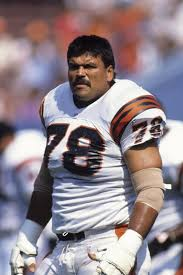
While the Bengals have not officially retired it, they have not reissued the number 78 since Muñoz left the team.
Muñoz appeared in two motion pictures: 1980's Borderline as "Guatemalan" and 1983's The Right Stuff (an Academy Award nominee for Best Picture) as "Gonzalez".
From 1994 to 1995, Muñoz served as a color commentator on Fox Sports' NFL telecasts and has for many years been color commentator for TV broadcasts of Bengals' preseason games.
Since 1992, Muñoz has starred in a series of commercials for the Cincinnati-area furniture store Furniture Fair.
In 2002, the Anthony Muñoz Foundation was created to consolidate Muñoz's charitable activities and encourages area individuals and businesses to "...impact area youth mentally, physically and spiritually". In 2004, Muñoz served on a panel to select the year's recipient of the Walter Payton Award. On November 14, 2012, Allstate dedicated a Hometown Hall of Famers plaque to Muñoz at Chaffey High School. On October 8, 2015, Muñoz received the Congressional Hispanic Caucus Institute (CHCI) Medallion of Excellence for his contributions to the Hispanic community.
Muñoz attended a celebrity flag-football game at Candlestick Park, the last event before the demolition of the stadium in 2014. He describes the event:
The final touchdown pass, there were probably 30,000 people in that stadium viewing a bunch of old guys playing a flag football game, but to see (Montana) throw to (DeBartolo) for the final touchdown there and to hear the fans go crazy and to see the admiration from these former players like Ronnie Lott and Joe Montana; that to me was impressive... to me, that's what it's all about.
Muñoz is of Mexican–American descent and met his wife at USC; they married during his sophomore year in 1978. They have two children. His son Michael played offensive lineman at Tennessee where he was an All-America and went undrafted in 2005. His daughter, Michelle, played basketball at Tennessee and later transferred to Ohio State.
Muñoz is a Christian. He has said, “My faith is everything for me in my life, college, my 13 years playing in the NFL. Now that I've been retired from the NFL it continues to be the most important thing in my life.”
"The NFL's GOAT at every offensive position: Why a panel of experts judged Jim Brown the best running back ever". ESPN.com. May 19, 2023. Retrieved April 8, 2024.
"Hometown Hero: Hall of Famer Anthony Munoz reconnects with Chaffey High". Press Telegram. November 14, 2012. Retrieved April 16, 2025.
"Anthony Munoz can go home again, to the thrill of football campers". Daily Bulletin. July 23, 2016. Retrieved April 16, 2025.
"USC Legends Anthony Muñoz". Archived from the original on June 29, 2006. Retrieved July 20, 2006.
"Anthony Muñoz's return sparked USC's 1980 Rose Bowl victory over Ohio State". Los Angeles Daily News. December 28, 2017.
"Anthony Muñoz's return sparked USC's 1980 Rose Bowl victory over Ohio State". Los Angeles Daily News. December 28, 2017.
"1980 NFL Draft Listing". Pro-Football-Reference.com. Retrieved September 28, 2025.
"Anthony Muñoz - Pro Football Hall of Fame Official Site". Profootballhof.com. Retrieved August 8, 2017.
"PLAYING FOR THE BUCS". ChicagoTribune.com. July 20, 1993.
profootballresearchers.org Archived October 7, 2010, at the Wayback Machine
TSN Presents - Football's 100 Greatest Players Archived November 5, 2005, at the Wayback Machine
"Chaffey High School Alumni Association". Chaffey.org. Retrieved August 8, 2017.
"Bengals Ring Of Honor Anchored By Hall-of-Famers Paul Brown And Munoz". Bengals.com.
"Bengals number 78 history". ProFootballReference.com.
"Anthony Munoz". IMDb. Retrieved August 8, 2017.
"The Story of ed and Anthony". YouTube.
About the AMF Archived July 23, 2008, at the Wayback Machine
"Connect Landing Page - Pro Football Hall of Fame Official Site". Profootballhof.com. Retrieved August 8, 2017.
"NFL Hall of Famer Anthony Munoz and Education Advocate Sonia Gutierrez to Receive CHCI Highest". Prnewswire.com (Press release). Retrieved August 8, 2017.
Miller, Ira (January 29, 2016). "Family approach leads Eddie DeBartolo to steps of Hall of Fame". United Press International. Retrieved January 22, 2019.
"Hispanic Football Hall Of Fame Established To Celebrate Hispanic Excellence In The Game". National Football League. September 17, 2025. Retrieved October 8, 2025.
"Mason | The Enquirer". Masonbuzz.com. Retrieved August 8, 2017.
Newhan, Ross (November 13, 1985). "His Faith Produced Miracles : Munoz Needed It to Come Back and Excel in the NFL". Los Angeles Times. Retrieved February 22, 2023.
"Anthony Munoz Has Been a Man of Faith for 44 Years". Retrieved February 22, 2023
Thomas Franklin McDonald was an American football flanker who played in the National Football League for the Philadelphia Eagles, the Dallas Cowboys, the Los Angeles Rams, the Atlanta Falcons, and the Cleveland Browns. He played college football as a halfback for the Oklahoma Sooners. He is a member of the Pro Football Hall of Fame and College Football Hall of Fame.
McDonald was selected by the Philadelphia Eagles in the third round of the 1957 NFL draft. As a rookie, he was moved to wide receiver after he replaced an injured Bill Stribling in the ninth game of the season, making a 61-yard reception and a 25-yard receiving touchdown from quarterback Sonny Jurgensen.
He was a part of the team that won the 1960 NFL Championship against Vince Lombardi’s Green Bay Packers. In the contest, he had a 35-yard touchdown reception from quarterback Norm Van Brocklin.
In 1961, he led the NFL in receiving yards (1,144) and touchdowns (13). Against the New York Giants, he had 7 receptions for 237 yards and 2 touchdowns, which still is a franchise single-game record.
On March 20, 1964, he was traded to the Dallas Cowboys in exchange for Sam Baker, John Meyers, and Lynn Hoyem.
In 1964, he was switched from flanker to split end, because the Cowboys already had an accomplished flanker in Franklin Clarke and split end Billy Howton had just retired. Looking to improve the receiving corps to help the young quarterback Don Meredith, they also traded with the Pittsburgh Steelers to get Buddy Dial.
In his only season with the club, he registered 46 receptions for 612 yards (13.3 average) and 2 touchdowns (one of them against the Eagles). In 1965, with the emergence of rookie Bob Hayes he was traded to the Los Angeles Rams in exchange for placekicker Danny Villanueva on May 14.
McDonald recorded a career-high 67 receptions for 1,036 yards and 9 touchdowns in 1965. He was selected to his last Pro Bowl. In 1967 he was traded to the Atlanta Falcons in exchange for a draft choice.
On September 10, 1968, he was waived following a season with 33 receptions for 436 yards and 4 touchdowns.
In 1968, McDonald was picked up by the Cleveland Browns for whom he caught 7 receptions for 113 yards and one touchdown. With the retirement of Raymond Berry the previous year, McDonald was technically the league's active leader in career receiving yards during the off-season but was surpassed in Game 1 by Don Maynard.
His last NFL game was the 1968 NFL Championship Game against the Baltimore Colts. On March 15, 1969, he announced his retirement from pro football.
Williamson, Brandon. "Sigma Nu fraternity voluntarily leaves campus after membership declines". OU Daily. Retrieved February 14, 2020.
"Tom McDonald Joins Cowboys". Retrieved January 7, 2018.
"Los Angeles: Rams Get McDonald". Retrieved January 7, 2018.
"Rams Trade McDonald To Falcons To Trim Roster". Retrieved January 7, 2018.
"Tommy McDonald Quits Football". Retrieved January 7, 2018.
"Classic catches up with Tommy McDonald". Retrieved January 7, 2018.
"Items For The Auction of May 19th & 20th, 2006". Retrieved January 7, 2018.
Montag, Madison (May 17, 2022). "Ray Didinger's play "Tommy and Me" coming to Hershey Theater". www.abc27.com. abc27. Archived from the original on August 25, 2022. Retrieved May 23, 2023.
"Pro Football Hall of Famer Tommy McDonald dies at 84". NFL.com. Retrieved September 24, 2018.
TOMMY MCDONALD, 1934-2018
"The driving force behind Chronic Traumatic Encephalopathy (CTE)". Concussion Legacy Foundation. Archived from the original on July 2, 2023. Retrieved July 2, 2023.
Ken Belson and Benjamin Mueller (June 20, 2023). "Collective Force of Head Hits, Not Just the Number of Them, Increases Odds of C.T.E. The largest study of chronic traumatic encephalopathy to date found that the cumulative force of head hits absorbed by players in their careers is the best predictor of future brain disease". The New York Times. Retrieved July 2, 2023.
Paul James Krause is an American former football safety who played in the National Football League for the Minnesota Vikings and the Washington Redskins. Gifted with a great frame, speed and range, Krause established himself as a defensive force against opposing wide receivers. He led the league with 12 interceptions as a rookie before going on to set the NFL career interceptions record with 81 and was inducted into the Pro Football Hall of Fame in 1998. Krause was selected eight times to the Pro Bowl during his 16 seasons in the NFL.
Krause was drafted in the second round of the 1964 NFL draft by the Washington Redskins. In his rookie season, he led the NFL in interceptions with 12, including interceptions in seven straight games, and was named to the All-NFL first team. He was named to his first of eight Pro Bowls and was second only to teammate Charley Taylor for the NFL Rookie of the Year award.
Although he intercepted 28 passes in his first four seasons with the Redskins, he was traded to the Minnesota Vikings for linebacker Marlin McKeever and a seventh-round draft choice in the 1968 NFL draft.
Krause played with the Vikings until he retired after the 1979 season. During that time, he was one of 11 players to play in all four of the Vikings Super Bowl appearances (Super Bowl IV, VIII, IX, and XI). Krause recorded an interception in Super Bowl IV and a fumble recovery in Super Bowl IX.
Krause was often referred to as the Vikings "center fielder" because of his success as an interscholastic baseball player and his ability to catch interceptions.
He currently holds the all-time interception record in the NFL with 81, which he returned for 1,185 yards and three touchdowns. He set the record in 1979 against the Los Angeles Rams, in the second quarter of a 27-21 overtime loss with his 81st interception coming in the final quarter. The previous record of 79 was held by Emlen Tunnell, another former Hawkeye who played for the New York Giants and the Green Bay Packers from 1948 to 1961.
Krause recovered 19 fumbles, returning them for 163 yards and three touchdowns. Krause only missed two games due to injuries in 16 seasons.
In 1994, Krause was elected to the Board of County Commissioners for Dakota County, Minnesota. He served for twenty years and he did not seek re-election in 2014.
Currently, Krause is involved in real estate development and insurance, and he owns several restaurants, including the Dairy Delite in Lakeville, Minnesota. He previously owned a golf course in Elk River, Minnesota.
Krause was named to the Iowa Sports Hall of Fame in 1985, the Pro Football Hall of Fame in 1998, and the Boys & Girls Clubs of Sarasota County Sports Hall of Fame on May 7, 2004.
Krause is married to his wife, Pam, and has two daughters, Mandi and Zendi, and one son, Blair.
In 1995, Pam Krause was severely injured in a car accident near their home in Lakeville, Minnesota when she was hit by a truck. She spent five and a half months in a coma, but survived and is recuperating.
"NFL's all-time interceptor | Pro Football Hall of Fame Official Site".
"Paul Krause". profootballhof.com. Pro Football Hall of Fame. Retrieved January 9, 2019.
"Paul Krause, University of Iowa, 1985". Des Moines Register. Retrieved June 18, 2008.
"Pro Football Hall of Fame honors Paul Krause". TheGoal.com. Retrieved June 18, 2008.
"Paul Krause College Stats".
"Paul Krause's HOF Profile". Pro Football Hall of Fame. Retrieved June 18, 2008.
"Championship - Cleveland Browns at Minnesota Vikings - January 4th, 1970". Pro-Football-Reference.com.
"Intercepting NFL's highest honor: Krause remembered for roaming in football's center field". CNN/SI. August 1, 1998. Retrieved December 5, 2011.
"Paul Krause's Enshrinement Speech Transcript". Pro Football Hall of Fame. 1998. Retrieved December 5, 2011.
"Number of seasons player meets criteria, in the regular season, requiring Interceptions >= 10, sorted by descending instances". Stathead. Retrieved January 29, 2026.
Belden, Dylan (March 28, 2014). "Paul Krause to retire from Dakota County Board". startribune.com. StarTribune. Retrieved January 9, 2019.
"2007: Year in Review". Downtown Lakeville. Archived from the original on August 20, 2008. Retrieved June 18, 2008.
"Redskins Great Krause Honored". Washington Redskins. Archived from the original on March 24, 2006. Retrieved June 18, 2008.