Pro Football Historian (PFH) is a blog page written by Flint Given. Pro Football Historian or PFH is a page to inform people on prior NFL events that people might not know about. Learning about teams from the 1920s or even the first few NFL World Championships in the 1930s fascinates me. It's these kinds of events that I want to discuss in this blog. Hopefully you are interested and will continue to check up on my blogs. Check out the website at https://profootballhistorian.lovable.app/
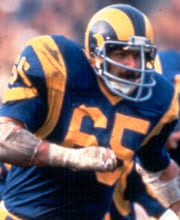
Thomas Lee Mack is an American former football guard who played for the Los Angeles Rams of the National Football League. He was inducted into the Pro Football Hall of Fame in 1999.
A native of Cleveland, Ohio, Mack played college football as an end and tackle for the Michigan Wolverines from 1963 to 1965. He was a starter on the 1964 Michigan team that won the Big Ten Conference championship and defeated Oregon State in the 1965 Rose Bowl. He was selected as a first-team All-Big Ten player in 1965 and was inducted into the University of Michigan Athletic Hall of Honor in 2006.
Mack was selected by the Rams with the second overall pick of the 1966 NFL draft and played at left guard for the Rams for 13 seasons from 1966 to 1978. During his NFL career, Mack played in 11 Pro Bowls and appeared in 184 consecutive games, 176 as a starter, over 13 seasons.
Mack was selected by the Los Angeles Rams in the first round, as the second overall pick, in the 1966 NFL draft. During Mack's rookie season with the Rams, starter Don Chuy was injured during the fifth game of the season, allowing Mack to move into the lineup. He started nine games during the 1966 season and became a fixture for the Rams at the left guard position for the next 13 seasons. During his NFL career, Mack never missed a game due to injury, appearing in 184 consecutive contests, the third longest streak in Rams history behind Merlin Olsen and Jack Youngblood.
During Mack's career with the Rams, the club enjoyed a .720 winning percentage with a won-lost-tie record of 129–48–7, won their division eight times (1967, 1969, and 1973–1978), and reached four NFC championship games. In 1973, the Rams scored led the NFL with 388 points (27.7 points/game). In 1974, the Rams lost to the Minnesota Vikings by four points in the 1974 NFC Championship Game, with a controversial penalty call against Mack costing the Rams a touchdown. The Rams had the ball at the one-yard line on second down when the Vikings' Alan Page made contact with Mack; the referee called illegal procedure on Mack, but replays showed that Mack had not moved. After the game, Mack insisted he had not moved but credited Page with "a smart play" in making contact since a penalty, if called against the Vikings, would have been meaningless.
Mack was selected to 11 Pro Bowls, the first coming after his second season in 1967. He missed only one Pro Bowl appearance the rest of his career (1976). Mack's 11 invitations earned him a third-place tie with Bob Lilly and Ken Houston for the most selections of all time. Mack was selected first-team All-Pro four times (1969, 1971, 1973, 1974) and second-team All-Pro four times (1968, 1970, 1972, and 1975). In addition, he was named All-NFC eight times between 1970 and 1978.
Mack announced in late November 1978 that he would retire at the end of the 1978 NFL season. He was inducted into the Pro Football Hall of Fame in 1999.
After retiring from football, Mack worked as an engineer, using the engineering degree he received at the University of Michigan. He eventually became a lobbyist for Bechtel Group, Inc. Mack has a daughter named Carrie who attended Quince Orchard High School in Gaithersburg, MD (Class of 1992).
"Tom Mack". Pro-Football-Reference.com. Sports Reference LLC. Retrieved March 25, 2015.
"Ray Mack". Baseball-Reference.com. Sports Reference LLC. Retrieved March 26, 2015.
"Distinguished Eagle Scouts" (PDF). Scouting.org. Archived from the original (PDF) on March 12, 2016. Retrieved March 25, 2015.
"All-Time Football Roster Database". University of Michigan, Bentley Historical Library. Retrieved March 25, 2015.
Anthony Broome (October 18, 2012). "TBHR Chats With NFL Hall of Famer Tom Mack". The Big House Reports. Archived from the original on April 2, 2015.
"1964 Football Team". University of Michigan, Bentley Historical Library. Retrieved March 25, 2015.
"1965 Football Team". University of Michigan, Bentley Historical Library. Retrieved March 25, 2015.
"Grabowski Big Ten Choice". Cape Girardeau Southeast Missourian. November 24, 1965. p. 3B.
Michigan Athletic Hall of Honor. Bentley Historical Library (archives of the University of Michigan and the Michigan Athletic Department) website. Retrieved September 9, 2011.
"Fraternity Men in the Pro Football Hall of Fame" (PDF). North American Inter-Fraternity Conference. Retrieved March 25, 2015.
"Mack To Rams". Ocala Star-Banner. November 28, 1965. p. 24.
"It Was a Bruiser For Rams Tom Mack". Lewiston Evening Journal (AP story). October 13, 1966. p. 26.
"Tom Mack". Times Daily. August 6, 1999. p. 10E.
"'I Didn't Move,' Claims Rams' Tom Mack". Sarasota Journal. December 30, 1974. p. 2C.
"Tears Fall As Vikes Top LA, 14-10". Pittsburgh Post-Gazette. December 30, 1974. p. 14.
"Veteran Lineman Tom Mack Announces His Retirement". The Pittsburgh Press. November 25, 1978. p. A-10.
"Michigan alum Mack inducted into Pro Football Hall of Fame". The Michigan Daily. August 9, 1999. p. 14.
Gene Wojciechowski (December 7, 1987). "Tom Mack: Once a Force in Rams' Offensive Line, Now He's a Lobbyist Who Reasons". Los Angeles Times.
George Francis Musso was an American professional football player who spent his entire 12-year career as a guard and offensive tackle for the Chicago Bears of the National Football League. He was inducted into the Pro Football Hall of Fame in 1982.
Musso attended Millikin University and was a standout in football, basketball, baseball, and track. Millikin was in the "Little 19" conference that included such teams as Eureka, Lombard, and Augustana. In 1929, Musso played against future President Ronald Reagan, who played guard for Eureka College and weighed about 175 pounds; Eureka lost to Musso and Millikin 45–6. Musso was already larger than most linemen of his era, playing college ball at 6' 2", 255 pounds. In 1933, Musso played in the East-West All-Star game, held in Chicago; it was there he first got the attention of George Halas.
Halas, who had doubts the small school Musso could make it in the NFL, offered Musso a $90 a game contract (this was half rate for regular players at that time). Musso agreed and, although he struggled at first, became the centerpiece of the Bears line for 12 years. One reason the Bears of that era were called "Monsters of the Midway" was their imposing size—Musso, who played professionally at 270 pounds, was one of the largest Bears and one of the largest players in the league. His teammates called him "Moose." He played offensive tackle until 1937 when he moved to guard. He was the first to win All-NFL at two positions; tackle (1935), and guard (1937). He played middle guard or nose tackle on defense his entire career. Musso captained the Chicago Bears for nine seasons, playing on the line with other NFL notables as Link Lyman, Joe Kopcha, Walt Kiesling, Bulldog Turner, Joe Stydahar, and Danny Fortmann. He played in seven NFL championship games, with the Bears winning four (1933, 1940, 1941, and 1943). He was inducted to the Pro Football Hall of Fame in 1982. Of note, in 1935 as an NFL lineman, Musso played against Gerald Ford of Michigan in the 1935 College All-Star game. Without a doubt, Musso is the only NFL player, to have played against two U.S. Presidents.
Musso retired to Edwardsville, Illinois, and began a restaurant business. He served as the Madison County, Illinois, sheriff and treasurer from the 1950s through the 1970s. He died in his home in Edwardsville in 2000.