Showing posts with label Los Angeles Wildcats. Show all posts

Wednesday, March 1, 2023

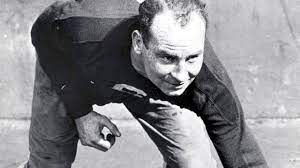
The Story And Significance Of Ray Flaherty - Won Three NFL Championship Teams, One As A Player And Two As A Head Coach

Raymond Paul Flaherty was an American football player and coach in the National Football League, and a member of the Pro Football Hall of Fame. He was part of three NFL Championship teams, one as a player and two as a head coach.

Flaherty began his professional football career in 1926 with the Los Angeles Wildcats of the American Football League, a team of western players based in Illinois. It played all its games on the road in its only season, which ended with a post-season barnstorming tour through the South against league rival New York Yankees. Flaherty then played in the National Football League for eight seasons, first with the Yankees (1927–1928) with Red Grange, until the franchise folded following the 1928 season. He joined the New York Giants, 1929 through the 1935 season, except for 1930, when he returned to Spokane as the head coach at his alma mater, Gonzaga. He also coached the Bulldog basketball team for a season (1930–1931). At the end of the 1935 season, Flaherty's jersey number 1 was 'taken out of circulation', thus making Flaherty the first professional football player to have his number retired.

At age 26, Flaherty played a season of minor league baseball in 1930, as a second baseman with the Providence Grays of the Eastern League.

Following his playing career, Flaherty was hired by George Preston Marshall, owner of the NFL's Boston Redskins, as head coach for the 1936 season. The team won the division title that year, then relocated to Washington, D.C. for the 1937 season, and picked up future hall of fame quarterback Sammy Baugh in the first round of the 1937 NFL draft. In seven seasons at the helm of the Redskins, Flaherty won four division titles (1936, 1937, 1940, 1942) and two NFL Championships (1937, 1942). Among his innovations on offense, Flaherty is credited with inventing the screen pass in 1937.

The Redskins held their 1940 training camp in Spokane at Gonzaga; the previous year's camp was also held in Spokane County, at Eastern Washington College in Cheney. In 1941 and 1942, the Redskins trained in California in San Diego at Brown Military Academy.

Flaherty served as an officer in the U.S. Navy during World War II, then returned to pro football in 1946 as a head coach in the new All-America Football Conference (AAFC). With the New York Yankees, he won division titles in each of his two full seasons at the helm, but lost to the Cleveland Browns in the title games. After a poor start in 1948, owner Dan Topping relieved Flaherty of his duties in mid-September. Several months later he was hired as head coach of the AAFC's Chicago Hornets, known as the Rockets in their three previous seasons. He was inducted into the Pro Football Hall of Fame in 1976 for his contributions as a coach.

After the end of the AAFC in 1949, Flaherty returned to the Spokane area to enter private business as a beverage distributor, and lived in nearby northern Idaho. During football season, he was a part-time columnist for the Spokane Daily Chronicle. A college friend of Bing Crosby, Flaherty participated in the singer's Spokane memorial service in 1977.

After an extended illness, Flaherty died in 1994 in Hayden, Idaho at the age of 90; he and his wife Jackie (1921–2007) are buried at St. Thomas Cemetery in Coeur d'A
lene.
Sources
https://www.pro-football-reference.com/
https://www.profootballarchives.com/index.html
https://americanfootballdatabase.fandom.com/wiki/Football_Wiki
https://www.gridiron-uniforms.com/GUD/controller/controller.php?action=main
https://www.profootballhof.com/hall-of-famers/
Blanchette, John (July 20, 1994). "NFL legend Ray Flaherty dies". Spokesman-Review. Spokane, Washington. p. C1.
 Blanchette, John (November 2, 1983). "Papa Bear met his match in Ray Flaherty". Spokesman-Review. Spokane, Washington. p. C1.
 Godes, Kerry (March 30, 1987). "Gonzaga Prep selects six for its new Hall of Fame". Spokane Chronicle. Washington. p. C5.
 "Ray Flaherty Gonzaga coach". Spokesman-Review. Spokane, Washington. May 4, 1980. p. 1, sports.
 "RAY FLAHERTY". Gonzaga Bulldogs. Retrieved August 8, 2024.
 Derrick, Merle (January 27, 1976). "Flaherty honored". Spokane Daily Chronicle. Washington. p. 17.
 "Irish casaba tossers hit winning stride; play Spokane Sparklers Saturday night". Spokane Daily Chronicle. Washington. January 7, 1931. p. 15.
 Berry, Allison (February 2, 2012). "Top 10 Things You Didn't Know About the New York Giants". Time Magazine. p. 7.
 Eisen, Michael. "Malik Nabers to wear No. 1 with permission from Flaherty family". www.giants.com. Retrieved August 29, 2024.
 "Flaherty to coach Boston Redskins". Spokane Daily Chronicle. Washington. Associated Press. December 24, 1935. p. 1.
 Blanchette, John (July 22, 1994). "Flaherty earned due respect". Spokesman-Review. p. C1.
 "Legends: Flaherty in 'same class'". Ellensburg Daily Record. Washington. UPI. September 4, 1980. p. 8.
 "Flaherty sends Redskins into first practice grind". Spokane Daily Chronicle. Washington. August 6, 1940. p. 11.
 "Pro grid squad begins practice". Spokesman-Review. Spokane, Washington. August 8, 1939. p. 11.
 "Redskins will train on Gonzaga field starting August 6". Spokane Daily Chronicle. Washington. July 24, 1940. p. 11.
 Johnson, Bob (January 19, 1959). "Woo Redskins". Spokane Daily Chronicle. Washington. p. 13.
 Johnson, Bob (January 28, 1972). "Two trips west". Spokane Daily Chronicle. Washington. p. 13.
 "Training camp history". Redskins RVA. Retrieved February 7, 2014.
 "Yankees "fire" Ray Flaherty as grid coach". Spokesman-Review. Spokane, Washington. Associated Press. September 18, 1948. p. 11.
 "Ray Flaherty named coach of Chicago Rockets". Pittsburgh Press. United Press. January 30, 1949. p. 24.
 "Ray Flaherty to get Chappuis and others". Spokane Daily Chronicle. Washington. United Press. February 1, 1949. p. 11.
 Missildine, Harry (January 27, 1976). "Flaherty named to pro grid hall". Spokesman-Review. Spokane, Washington. p. 11.
 "Ray Flaherty gains Hall induction today". Spokesman-Review. Spokane, Washington. Associated Press. July 24, 1976. p. 13.
 Hewins, Jack (August 22, 1951). "Flaherty won't coach unless offer "too good to decline" appears". Spokesman-Review. Spokane, Washington. Associated Press. p. 13.
 "Flaherty to conduct football dope column". Spokane Daily Chronicle. Washington. September 3, 1954. p. 11.
 "Flaherty experts on football again". Spokane Daily Chronicle. Washington. September 5, 1958. p. 11.
 "Crosby service set". Spokane Daily Chronicle. Washington. October 17, 1977. p. 3.
 Smith, Jim (October 19, 1977). "Memorial rites held for city favorite, Bing Crosby". Spokesman-Review. Spokane, Washington. p. 7.
 "NCAA Statistics; Coach; Ray Flaherty". National Collegiate Athletic Association. Retrieved January 19, 2025.

Friday, July 29, 2022

Who Were The Los Angeles Wildcats (AFL)?

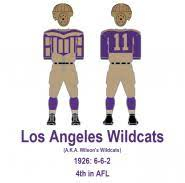
The Los Angeles Wildcats (also reported in various media as Pacific Coast Wildcats, Los Angeles Wilson Wildcats and Wilson's Wildcats) was a traveling team of the first American Football League that was not based in its nominal home city but in Chicago, Illinois (it trained in Rock Island). Coached by Jim Clark, the team was designed to be a showcase for University of Washington star back George “Wildcat” Wilson. Compared to most traveling teams in professional football, the Wildcats were successful, compiling a 6–6–2 record in the only season of the team's – and the league's – existence.

The existence of the Wildcats began with the 1926 formation of the American Football League by C. C. Pyle, a sports agent who represented star back Red Grange. Pyle's application for a National Football League franchise in New York was rejected as Tim Mara, owner of the New York Giants objected to Pyle proposed intrusion into the Giants’ territory. Armed with a five-year lease at Yankee Stadium, Pyle subsequently announced the formation of the American Football League as a showcase for his client.

The league was also a showcase for another Pyle client who was an All-American on the West Coast: Wildcat Wilson. Because of the limitations of train (or bus) travel, the National Football League extended only from the Atlantic coast westward to Kansas City, Missouri, and Pyle wanted to tap the talent of college football players along the Pacific. His solution was novel (and one that the more established NFL would copy quickly): establish a traveling team nominally representing Los Angeles and headed by Wilson. The team would be based in Moline, Illinois (home of the Rock Island Independents, which jumped from the NFL to the AFL) and would have no home stadium. Virtually all of the players of the team attended colleges sited west of the Rocky Mountains.

The team was owned by C. C. Pyle and Red Grange, who also owned another AFL team (the New York Yankees) and had stock in a third (the Chicago Bulls). The three teams and league champion Philadelphia Quakers were the only four teams (of the original nine) still in existence at the end of league play on December 12, 1926. Upon the completion of a barnstorming tour, the Wildcats closed up shop after only one year of existence.

As the team began league play, it became evident that Wilson was not the only weapon that the Wildcats had. Coach Jim Clark had the versatile Mal Bross for either rushing and receiving duties; ends Ray Flaherty and Jim Lawson dutifully caught passes from Wilson, while Duke Morrison ran when Wilson did not take the ball. Furthermore, no fewer than four Wildcats handled the kicking job at one time or another.

Originally scheduled to play only 10 games, the Wildcats played additional contests as last-minute “fill-in” opponents as one team after another in the American Football League folded or otherwise left the league. Immediately after tying the Chicago Bulls in Comiskey Park, the team trekked to Toronto’s Maple Leaf Stadium for a game with the New York Yankees, which also played games on back-to-back days. The Yankees won, 29–0. It was not the first weekend in which the Wildcats played on consecutive days (they actually did so on three other weekends); their Thanksgiving Day contest with the Bulls (a scoreless tie) was their third in a five-day stretch.

By the end of October, the Cleveland Panthers and Newark Bears have closed up shop; the Brooklyn Horsemen merged with their NFL cousins, the Brooklyn Lions in early November, and the Boston Bulldogs, a team that was subsidized by Pyle’s money dropped out. In the four weeks from the departure of Cleveland and the exit of Boston, scheduling “holes” were filled by the two traveling teams of the AFL: the Wildcats and the Rock Island Independents... that is, until November 21, when the Independents – charter members of both the NFL and the AFL – joined the exodus from the younger league by calling it quits after a 3–0 loss to the Bulls. With only two weeks remaining in the season, the Wildcats, Yankees, and Bulls – three teams owned (or co-owned) by Pyle and Grange – and the Philadelphia Quakers were the last teams remaining, with only the Quakers reporting a profit.

Only two official AFL games were left to play in December 1926. On the 5th, the Wildcats shut out the Bulls 5–0 on a frozen field in Comiskey Park, while the Bulls hosted the Yankees the following Sunday as the visiting team wrapped up the 1926 season of the American Football League with a 7–3 victory. At the same time, in a snowstorm at the Polo Grounds, the league champion Quakers were crushed, 31–0, by the New York Giants in a game that marked the end of the American Football League, December 12, 1926.

Two days after the end of the 1926 season (and of the AFL), the Wildcats and the New York Yankees started a series of exhibition games as the two Pyle-owned teams went on a barnstorming tour of the American South and West. The two teams competed in Atlanta (a 7–7 draw), Birmingham, Alabama (a 14–3 Yankees win), Dallas, Texas (a 17-14 Yankees win), Beaumont, Texas (a 34–0 Wildcats win), and San Antonio (a 20–14 Yankees win) before traveling to California for games against the independent Hollywood Generals (whom the Wildcats defeated, 26–7, in Wrigley Field of Los Angeles) and the NFL's traveling team, the Los Angeles Buccaneers (the Wildcats won, 17–0, in a game played in San Francisco).

With the dissolution of the American Football League (Pyle's Yankees were preparing to join the NFL under an arrangement with New York Giants owner Tim Mara, who acquired the assets of the defunct Brooklyn Horsemen), the Wildcats ceased to exist after the game in San Francisco. Wildcat Wilson joined the Providence Steam Roller for the 1927 NFL season. Wilson was not the only 1926 Wildcat to join an NFL roster for the 1927 season. Mal Bross played for the Green Bay Packers. Ted Bucklin played for the Chicago Cardinals. Walden Erickson played for the Pottsville Maroons. Ray Flaherty played for the New York Yankees. Ted Illman played for the Chicago Cardinals. Jim Lawson played for the New York Yankees. Ray Stephens played for the New York Yankees. John Vesser played for the Chicago Cardinals Flaherty continued to play until 1935 (taking 1930 off to teach college football), then became head coach of the Washington Redskins in 1937. He became a member of the Pro Football Hall of Fame in 1976.

Sources
https://www.pro-football-reference.com/
https://www.profootballarchives.com/index.html
https://americanfootballdatabase.fandom.com/wiki/Football_Wiki
https://www.gridiron-uniforms.com/GUD/controller/controller.php?action=main
https://www.profootballhof.com/hall-of-famers/
1926 American Football League from Elias Sports Bureau and Pro Football Research Association Linescore Committee Archived June 5, 2015, at the Wayback Machine
 Schedules and scores of the teams in the 1926 American Football League Archived July 13, 2009, at the Wayback Machine – “Ghosts of the Gridiron”
 "Grangemen and Wildcats Tie, 7-7, in Muddy Contest". The Atlanta Constitution. December 15, 1926. p. 13. Retrieved August 13, 2020 – via Newspapers.com. Open access icon
 "Wildcats Lose To Red Grange Team". Selma Times-Journal. AP. December 17, 1926. p. 6. Retrieved August 13, 2020 – via Newspapers.com. Open access icon
 "Small Dallas Crowd Sees Red Grange's Team Beat Wilson's". The Austin American. AP. December 20, 1926. p. 5. Retrieved August 2, 2020 – via Newspapers.com. Open access icon
 "Wilson Wildcats Defeat Grange". The Austin Statesman. December 23, 1926. p. 8. Retrieved August 13, 2020 – via Newspapers.com. Open access icon
 "Grangemen Win At San Antonio". The Austin Statesman. December 27, 1926. p. 2. Retrieved August 13, 2020 – via Newspapers.com. Open access icon
 "Wilson's Wildcats Win". Pittsburgh Gazette Times. January 10, 1927. p. 10. Retrieved August 13, 2020 – via Newspapers.com. Open access icon
 David S. Neft, Richard M. Cohen, and Rick Korch, The Football Encyclopedia: The Complete History of Professional Football, From 1892 to the Present (St. Martin’s Press 1994), ISBN 0-312-11435-4

Wednesday, June 29, 2022

History Of The American Football League (1926)

The first American Football League, sometimes called AFL I, AFLG, or the Grange League, was a professional American football league that operated in 1926. It was the first major competitor to the National Football League. Founded by Charles "C.C." Pyle, (1882–1939), and General Charles X. Zimmerman, (1865–1926), as vice president and starring Hall of Fame halfback Harold Edward "Red" Grange, (1903–1991), the short-lived league with nine teams competed against the more established – then six-year-old NFL, both for players and for fans. While Pyle's and Grange's New York Yankees team and the already established Philadelphia Quakers became reliable draws, the lack of star power and the uncertain financial conditions of the other seven teams led to the league's dissolution after one season.

The controversial ending of the National Football League's 1925 season led to the founding of the first AFL by Red Grange's agent, C. C. Pyle. In an era in which no professional football team had a prearranged schedule (each team was responsible for booking its own games, with virtually no limitations as to the number of games), the Pottsville Maroons were hailed as the NFL champions by several newspapers after Pottsville defeated the Chicago Cardinals on December 6, even though there were still two weeks left in the season.

Cardinals owner Chris O’Brien hastily arranged for two more games: one against the Milwaukee Badgers the following Thursday, another against the Hammond Pros two days later, even though both teams had already disbanded for the season. Two shutouts (59-0 and 13-0) later, the Cardinals claimed the top spot with an 11-2-1 record. Simultaneous with the Cardinals–Pros game was an exhibition game between Pottsville and an all-star team consisting of former Notre Dame players at Shibe Park, near the home of the Frankford Yellow Jackets, who protested the invasion of territorial rights by the Maroons.

Despite an order from NFL commissioner Joe Carr to cancel the exhibition, the Maroons proceeded to defeat the Notre Dame all-stars 9-7, scoring a field goal in the last minute. Carr immediately canceled the Maroons' scheduled game against the Providence Steam Roller and suspended the franchise. In the league meeting in January 1926, O’Brien refused to accept the championship, but the league record book remained unchanged, showing the Cardinals with an 11-2-1 record to the Maroons’ 10-2-0.

While NFL management was contemplating the penalties for the suspended Pottsville franchise (which was eventually reinstated with the payment of a moderate fine) in December, C. C. “Cash and Carry” Pyle surprised the league by requesting a franchise in New York City for himself and star back Red Grange and secured a five-year lease for baseball's Yankee Stadium, in direct competition to Tim Mara's year-old New York Giants. When Carr announced a ruling in favor of Mara's objection to Pyle's application for NFL membership, Pyle announced the formation of the first American Football League, featuring Grange and the New York Yankees. The NFL charter member Rock Island Independents left the then seven-year-old league to join the new AFL, and the upstart league matched the NFL in having a road team representing Los Angeles.

The new league chose former Princeton athlete, former New York City deputy of street cleaning, and former Newark, New Jersey chief of waste disposal Bill Edwards as its league president and prepared to compete against the older league, (established 1920 and reorganized in 1922), for its talent and spectators. The AFL and NFL went to head-to-head competition in New York (Yankees and Giants), across the East River in Brooklyn (Horsemen and Lions), in Chicago (Bulls vs Bears and Cardinals), and in Philadelphia (Quakers and Yellow Jackets). The AFL's Cleveland Panthers, previously independent, were also preparing to go face-to-face with their hometown counterpart Cleveland Bulldogs, the earlier NFL champions of 1924, when Bulldogs owner Sam Deutsch decided to suspend the operations for 1926.

Boston Bulldogs, coached by Herb Treat, Boston's first professional football team had been in financial difficulty from the beginning, having played only six games before folding in November 1926. Its lack of stars and lack of offense (only three points per game) doomed the franchise as the team failed to score a point in either of its two home games in a nearly empty stadium. Boston would wait until 1932 before it received another professional football franchise, the NFL’s Boston Braves, later briefly renamed the Redskins, and the Washington Redskins since 1937.

Brooklyn Horsemen, coached by Eddie McNeeley, the Horsemen featured Notre Dame Four Horsemen Harry Stuhldreher and Elmer Layden. Unlike the other New York AFL team, Brooklyn suffered at the turnstiles. After only four games, the team was forced to merge with its NFL counterpart (the Lions), played three games in the NFL as the Brooklyn Lions (all shutouts), and winked out of existence at the end of the season.

Chicago Bulls, owned and coached by Joey Sternaman (brother of Chicago Bears owner Dutch Sternaman), the Bulls featured the younger Sternaman as quarterback. While the Bulls' owner created havoc within the Chicago Cardinals by securing a lease for Comiskey Park (forcing the Cardinals into a much smaller Normal Field) and attempting to sign their star halfback Paddy Driscoll (who wound up on the Bears as a result of a trade), the Bulls quarterback provided the bulk of the team's offense, scoring 52 of the Bulls’ 88 points in 14 games. The Bulls were one of only four AFL teams still playing at the end of the season.

Cleveland Panthers, the Panthers had existed as an independent team since 1919, mostly playing teams from upstate New York. Coached by Roy Watts, the Panthers featured six players who played for the NFL’s Cleveland Bulldogs in the 1925 season: Al Michaels, Al Nesser, Dick Wolf, Dave Noble, Ralph Vince and Doc Elliott. Despite having a potent offense and a winning record, the Panthers drew poorly at home aside from the league-opening game. The team left the AFL hours after losing to the Los Angeles Wildcats road team on October 31; they would return to independent status until folding in 1933.

Los Angeles Wildcats (some news sources referred to the team as the "L.A. Wilson Wildcats"). Named after former University of Washington star halfback Wildcat Wilson and owned by C. C. Pyle and Red Grange, the Wildcats were strictly a traveling team based in Rock Island, Illinois. With only one exception, the entire roster consisted of players who competed for colleges located west of the Rockies. One of its 14 games was played in Toronto, Ontario, Canada (December 8: New York won, 28-0). Jim Clark was the head coach.

Newark Bears, owned by the New Jersey Athletic Association (William Coughlin, president) and coached by Hal Hansen, the Bears featured a backfield consisting of players who attended college in Georgia at Georgia Tech and Oglethorpe College. The Bears scored a touchdown in its first game, a 7-7 tie with Chicago, and then did not score again in its remaining four games. Newark was the first AFL to fold, calling it quits after playing Rock Island to a scoreless tie in front of 400 fans on October 24, 1926. For its final game, Newark changed its nickname to the Demons.

New York Yankees, coached by Ralph Scott, the Yankees showcased Red Grange, quarterback George Pease, and wingback Eddie Tryon, a backfield who dominated the league in all offensive categories as the team finished in second place with a 10-5 record. While the rest of the league was starving at the turnstiles, the Yankees were a consistent draw. The Yankees were the only AFL team to outlast the league itself: the league dissolved as the Yankees were on a barnstorming tour of the South and West, and the Yankees entered the NFL as a continuation of the just-defunct Brooklyn franchise for the 1927 season. While New York Giants owner Tim Mara was officially the owner of the “new NFL franchise”, he leased it to C. C. Pyle and Red Grange to compete as the Yankees.

Philadelphia Quakers, the Quakers were a revival of an independent team which played one season in 1921 as an independent, and, before that, as the Union Club of Phoenixville from 1907 to 1920. Owned by Leo Conway and coached by Bob Folwell, the Quakers were the AFL’s only league champion, finishing with an 8-2 record and possessing a formidable line anchored by tackles Bull Boehman and Century Milstead. On December 12, 1926, the Quakers played an exhibition game in a snowstorm against the New York Giants in front of 5000 windblown fans, and lost 31-0. Like Chicago and the traveling Wildcats, the Quakers were still alive at the end of the sole AFL season but folded along with the league at the end of the year.

Rock Island Independents, a charter member of the NFL, the Independents left the established league to make the unique accomplishment of being a charter member of a second professional football league, the AFL. Coached by Johnny Armstrong, the Independents played their first three games at Rock Island and then played the rest of their games as a traveling team before entering oblivion on November 21, 1926.

While the new nine-team AFL was competing against a National Football League that had expanded to 22 teams for the 1926 season, optimism yielded to economic reality for both leagues: most professional football franchises were on financially shaky ground.

The war for talent and audience had a disastrous effect on all but the strongest teams: of the 31 teams that were in existence across both leagues in 1926, only 12 survived to play in 1927, as eight folded, while heavy financial losses left the NFL with no option but to eliminate eleven of their 22 teams.

While the Yankees and the Quakers consistently drew large crowds, the rest of the AFL did not, and one by one AFL franchises went out of business, even with the financial assistance of C. C. Pyle.

The first sign of trouble occurred in mid-October, when Rock Island played its last home game (of three consecutive) and started wandering like the Wildcats. The following week, Brooklyn played its third (and last) home game in the AFL, in front of mainly empty stands. On October 24, 1926, the Newark Bears changed its nickname to the Demons, played a scoreless tie with Rock Island, and disbanded hours after the end of the game. The following week saw the Cleveland franchise collapse.

November 1926 was not much brighter for the house of cards that was the American Football League: the Brooklyn Horsemen played the last three games of its existence (all shutout losses) and left the league when it merged with its NFL counterparts, the Lions. By the middle of the month, the Boston Bulldogs folded, as did Rock Island a week later. By Thanksgiving of 1926, there were only four teams operating in the AFL (New York, Chicago, the Wildcats, and Philadelphia), with only the Quakers making a profit for the year, boosted in part by huge attendances stemming from the United States Sesquicentennial celebration, and the very large stadium capable of hosting them, while Pyle was spending his own money to keep the other three teams afloat.

While the Yankees went on a barnstorming tour and the Quakers attempted to arrange for a challenge game between the Champions of the two leagues, the Wildcats officially became inactive (in reality, they were touring with the Yankees as the "designated opponent").

After the top six NFL teams had all declined the Quakers' challenge due to scheduling and other issues, the NFL's seventh-place finisher New York Giants accepted, with both parties opting for a game at the Polo Grounds on December 12, 1926. The Quakers' hopes for both football credibility and a financial windfall evaporated as the game was played in a blustery snowstorm, and only 5000 fans witnessed the Giants' complete domination of the AFL Champions, with the Giants winning in a 31-0 blowout.

The same day, the Chicago Bulls and the New York Yankees met for the last American Football League game in Comiskey Park: the Yankees won, 7-3, and the league ceased to exist.

While the bulk of the AFL disappeared at the demise of the league, three members had an official existence after the Giants–Quakers game. Although the Brooklyn Horsemen disbanded after its last NFL game, the team's franchise was never withdrawn or cancelled by the league. Tim Mara purchased the franchise and proceeded to lease it to C. C. Pyle for his New York Yankees team. The agreement between the two rivals limited the number of home games that the Yankees were permitted to play in its namesake stadium (four in 1927) and forced Pyle's squad to be primarily a road team displaying the talents of Red Grange. This arrangement lasted for two years: the Yankees were no more after the 1928 season. The Cleveland Panthers, on the other hand, reverted to independent status, and played until 1934.

The AFL name would be used two more times as a professional football league name, one ultimately merged with the NFL in 1970.

Sources
https://www.pro-football-reference.com/
https://www.profootballarchives.com/index.html
https://americanfootballdatabase.fandom.com/wiki/Football_Wiki
https://www.gridiron-uniforms.com/GUD/controller/controller.php?action=main
https://www.profootballhof.com/hall-of-famers/
 1926 AFLG Standings, Stats and Awards. The "G" apparently refers to "Grange"
 David S. Neft, Richard M. Cohen, and Rick Korch, The Football Encyclopedia: The Complete History of Professional Football, From 1899 to the Present (St. Martin’s Press 1994), ISBN 0-312-11435-4
 George Gipe, The Great American Sports Book (Doubleday 1978) ISBN 0-385-13091-0
 The Grange League Archived October 6, 2010, at the Wayback Machine - Pro Football Researchers Association, citing The New York Times, July 17, 1926
 "Bill Edwards Named President of A.F.L." The New York Times, March 8, 1926