Showing posts with label 1919. Show all posts

Wednesday, May 11, 2022

Who Were The Ravenna Sentries?

The Ravenna Sentries were a group of local players who had played in 1916 as the Ravenna Cubs. Most of them signed up for military service in 1917 and serviced together in the 136th Machine Gun Battalion Company C from Massillon, Ohio in the Great War. While at Camp Sheridan they formed a company team that beat all their opponents. When they returned a new team was formed using the name Sentries. The team leader was quarterback Clarence Baxter (blockingback in the singlewing which they played) who called the plays and was the leading receiver. William Trexler, founder of Trexler Rubber Company was one of the halfbacks. The Sentries finished the 1919 season 8-0-3, scored 149 points to 13 and finished with eight straight shutouts. They were a light (average weight of 140 pounds per player) team that used the modern passing game. In a 1920 contest against the Williams Warren Tire squad posted a 133-0 victory. That season they had a 7-2-2 record and out scored opponents 353-25.Their final season appears to have been in 1926.

Sources
https://www.pro-football-reference.com/
https://www.profootballarchives.com/index.html
https://americanfootballdatabase.fandom.com/wiki/Football_Wiki
https://www.gridiron-uniforms.com/GUD/controller/controller.php?action=main
https://www.profootballhof.com/hall-of-famers/

Thursday, April 14, 2022

Who Were The Fort Wayne Pyramids?


The Fort Wayne Pyramids were an independent team based in Fort Wayne, Indiana. The team mostly played games on the road. The team is believed to be founded in 1919. Most of the Pyramids is lost but there 1921 season is the most known from the team's history. The Pyramids played the Kendallville Oaks and were defeated 17-12. They were home for the only time in 1921 and played against the Muncie A.C. and won 21-0. The Pyramids lost 20-0 to the Marion Boosters the following week. They then tied 6-6 against the Garrett Phi Delta Kappa in the fourth game of the season. The Pyramids then won back to back games 6-0 and 7-0 (Wabash A.C. and Fort Wayne Red Devils). The team lost the last two games of the season 12-0 and 22-0 (Bluffton American Legion and Fort Wayne Pros). The team overall was not very successful being the lesser known team in Fort Wayne and folded around 1924.

Sources
https://www.pro-football-reference.com/
https://www.profootballarchives.com/index.html
https://americanfootballdatabase.fandom.com/wiki/Football_Wiki
https://www.gridiron-uniforms.com/GUD/controller/controller.php?action=main
https://www.profootballhof.com/hall-of-famers/

Friday, February 4, 2022

Who Were The Ironton Tanks?

The Ironton Tanks were a semi-professional football team organized in 1919 in Ironton, Ohio.

Their historical marker gives the story of the Tanks origin: "Semi-professional football began in Ironton in 1893 with a team known as the Irontonians. The Ironton Tanks, founded in 1919, was a combination of two Ironton cross-town rival football clubs known as the Irish Town Rags and the Lombards." Their name reflected both the town's deep roots in the iron industry and the desire of returning soldiers from World War I to run over their opponents.

Based on their outstanding record of 85 wins, 19 losses, 14 ties, an undefeated season in 1922, a state championship in 1926 and dual victories in 1930 over National Football League powerhouses the Chicago Bears and New York Giants, the Tanks have a strong claim to being the best team to not play in the NFL. This motto is reinforced on the wall of Tank Stadium, where the story of the stadium opening proclaims "When the Tanks Were Tops". Their unmatched achievements in 1930 are recorded in a Professional Football Researchers Association's report on the 1930 season when talking about non-NFL teams: "None, however, matched the Ironton (Ohio) Tanks' 1930 achievements."

Although the Ironton Tanks ceased operations after the 1930 season, they lived on. Over half of the Tanks moved on to other NFL teams, the most, including Glenn Presnel stayed in Ironton and played for the Portsmouth Spartans (only 30 miles away) until they too folded in 1933. The combined team strength from the Tank infusion and the addition of rookie Dutch Clark, a future Hall of Famer, turned the Spartans into a power to be reckoned with. In 1932 the Spartans were among the best in the league but lost to the Chicago Bears in the first NFL playoff game, but after the next year in the depths of the depression, the Spartans too folded. Their assets were purchased to pay off debt and the team became the Detroit Lions in 1934. Without presence of the Tanks on the roster the Spartan record would have been less successful and likely not worth being bought and moved to become the Detroit Lions. So the forerunners of today's Lions were both the Tanks and Spartans.

As with most football teams of the era, the Tanks regularly played games over Thanksgiving weekend. The Tanks played a game the day after Thanksgiving with the Lombards, a crosstown rival on Friday Nov 26, 1920 winning 26-0 when many people were off due to the holiday. They began the actual string of Thanksgiving Day Games by defeating the Huntington Boosters 12–0 on Thursday Nov 30, 1922. The Tanks continued playing on this national holiday each year through 1930, which was the Tanks final season. Several Tank players (including Glenn Presnell) continued their football careers by joining the nearby Portsmouth Spartans. They did not continue the annual tradition through their demise after the 1933 season. The Spartans assets were acquired and moved to Detroit where they were renamed the Lions. Asked by their new owner (G.A. Richards) about ways to improve ticket sales, the former Tanks players (led by Presnell) indicated that in the past (as Tanks) that they always got a good turnout on Thanksgiving Day. This led him to schedule the first Thanksgiving Day Game in Detroit (actually the 10th game of the series). One thing that made the first game in Detroit so notable was arranging NBC to broadcast the game nationally, reaching a larger audience and developing a national clamor for repeats in following years.

Perhaps more important to Ironton residents at the time were the local rivalries with other cities in the Ohio area, particularly Portsmouth, where the local sentiment was summed up by this quote “ancient and hereditary foes”. Despite being a small town, only about 1/3 the size of Portsmouth, the Tanks are referred to by Carl Becker refers as the dominant team of the era, "In the 1920s, the "famous" Ironton Tanks were the sovereigns of semi-professional football in the upper Ohio Valley, indeed even in the state of Ohio". Other rivals were the Ashland Armcos, from across the river in Kentucky, Dayton Koors, several teams from Cincinnati, Columbus and Akron, but none appeared to have stirred the fans' passion as did the different Portsmouth teams that appeared between 1920 and 1930.

The most colorful figure to be associated with the Ironton Tanks was their legendary coach Earle Louis Neale, known as Greasy Neale. He is the only person to have coached in the Rose Bowl (1922), won the World Series (Reds vs White Sox, 1919) and won an NFL title (Philadelphia Eagles back to back 1948-49). Greasy insisted his Reds won the scandal-plagued 1919 "Black Sox" Series because of better pitching.

The best player for the Tanks was Glenn Presnell. Besides leading the Tanks to victories over the Giants and Bears, guiding the Portsmouth Spartans to third place in the NFL regular season championship in 1932, he helped the Detroit Lions to their first NFL championship in 1935. Not only did he play both sides of the ball, Glenn Presnell held the NFL longest field goal record for 19 years, with a 54 yarder that beat the Green Bay Packers 3–0. He led the NFL in scoring in 1933 with 64 points from TDs, field goals and points after TDs. He graduated from the University of Nebraska as an All-American in 1928 with a bachelor's degree in Education and was honored with an Alumni award in 2003 at the age of 97.
 

Glenn was inducted into the Nebraska High School Hall of Fame, citing his three Letters as a Cornhusker, leading the nation in total yards as a senior, All-Missouri Valley two times, and twice being NFL All-pro. He was inducted into the Nebraska Football Hall of Fame in 1973 and named 34th out of Nebraska's top 100 athletes. Interesting trivia is that his wife helped choose the famous powder blue uniforms for the Detroit Lions when the team moved from Portsmouth, Ohio. However, Glenn's memory is challenged by the Lions official site Outside this minor controversy, Glenn and the Lions seemed to have gotten along well. He posed with a football from "Your Friends at the Detroit Lions" crowning him the "LionKing". Many feel his NFL career itself deserved entry into the Pro Football Hall of Fame, while others have said he was unfairly discriminated against because of his years with the Tanks. An online petition to support his entry to the Football Hall of Fame, in nearby Canton, Ohio, has also attracted attention, Glen has been referenced in several publications as being named an All-American while at Nebraska. In studying the Nebraska football media guide, no individual records other than participantion and team win-loss is recorded for that time frame. The Nebraska media guide does show All-American award winners, and Glenn is not shown as on that list. No effort has been made to confirm directly with any sports officials at the University of Nebraska if this is correct. Also the Wikipedia reference for All-American awards for Glenn's years at Nebraska does not show him being awarded the honor. Again, the total evidence confirming his status in unclear. As evidence of Glenn's outstanding career, it can be shown that his on the field performance both as a Tank, Spartan and Lion were exemplary and several other teams had shown interest in signing him upon the Tanks demise. Indeed, Glenns contributions and performance as a starting halfback and safety in his years with the Detroit Lions were key in their becoming 1935 World Champions. Glenn Presnell was honored by the Lions in 1995 at halftime against the Packers as a member of the 60th anniversary of the 1935 championship by being driven to the 50 yard line in a Ford Model T.

The Ironton Tanks originally played in Beechwood Stadium but following through on local enthusiasm a stadium fund was created and Tank Stadium was built in 1926. This stadium still stands today and is being used by Ironton High School. It is one of the last covered stadiums in use for high school football today. The stadium was later renamed to Tanks Memorial Stadium, the name in use to the present day. In 2009, the field at Tanks Memorial Stadium was given the additional name of Bob Lutz Field in honor of long-time Ironton head coach Bob Lutz. During the summer of 2014, Tank Memorial Stadium's playing surface was upgraded to Field Turf.

Sources
https://www.pro-football-reference.com/
https://www.profootballarchives.com/index.html
https://americanfootballdatabase.fandom.com/wiki/Football_Wiki
https://www.gridiron-uniforms.com/GUD/controller/controller.php?action=main
https://www.profootballhof.com/hall-of-famers/
 "Ohio Historical Society".
 Becker, Carl M. The "Famous" Ironton Tanks The Coffin Corner Volume XIX Professional Football Researchers Association
 "PFRA report on the 1930 season".
 Carrol, Bob. Nagurski's Debut and Rockne's Lesson Pro Football in 1930 The Coffin Corner Volume XX Professional Football Researchers Association
 Becker, Carl M. Ringers Three: The Ironton Tanks versus the Portsmouth Smoke House, 1921 Journal of Sport History Volume 25, Number 3 page 434
 The Ironton Tanks Game Results Archived 2007-09-28 at the Wayback Machine irontonfootball.com Archived 2007-08-15 at the Wayback Machine
 Washington & Jefferson versus the University of California 0-0 tie
 Mann, Alan. The Unique Career of Greasy Neale Archived 2007-09-30 at the Wayback Machine
 Dow, Bill. Presnell's Team Made Holiday Game a Classic Archived 2007-08-18 at the Wayback Machine 1999 Portsmouth Spartan's Historical Society
 Paquette, Marti. University of Nebraska Alumni Awards Program 2003
 Nebraska High School Hall of Fame Newsletter Archived 2003-08-29 at the Wayback Machine 2003
 "Nebraska Football Hall of Fame" (PDF). Archived from the original (PDF) on July 16, 2011. Retrieved August 26, 2007.
 Rodino, John Nebraska's Top 100 Athletes[usurped] Omaha World Herald 8/22/2005
 Green, Jerry Motor City Memories NFL's Oldest Former Player Presnell Recalls Early Days in Detroit Archived 2007-08-21 at the Wayback Machine Gannet News Service July 7, 2003
 Lions official site Archived 2007-09-27 at the Wayback Machine and wiki page, which credit Cy Huston, the first GM and VP with the choice of "Honolulu Blue".
 DatabaseFootball.Com[usurped]
 "Glenn Presnell...Petition for Induction in the Professional Football Hall of Fame, Canton, OH". Angelfire. Archived from the original on August 27, 2001.
 "Ironton Tanks - Ohio History Central". www.ohiohistorycentral.org.
 Payne, Phillip G. Big Time Football in Ironton Ohio, Small Town Boosterism and the Early Days of Professional Football[usurped] Buckeye Hill Country: A Journal of Regional History. II (Spring, 1997): 7-23
 Vaughn, Bob, Ridgeway, Jim Our Interview with Glenn Presnell Archived 2007-09-30 at the Wayback Machine
 Tank Stadium Fund Archived 2007-08-16 at the Wayback Machine
 "Tribute website". Archived from the original on September 28, 2007. Retrieved August 24, 2007.
 "complete schedule and results". Archived from the original on September 28, 2007. Retrieved August 25, 2007.
 "Dave Berry Singer Songwriter Men of Iron and Steel Page". tuhker.tripod.com.
 "Ringers by the Van: The Ironton Tanks vs. the Portsmouth Smoke House, 1923" (PDF).

Tuesday, January 25, 2022

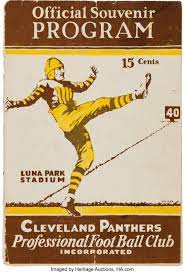
Who Were The Cleveland Panthers?


The Cleveland Panthers were a professional American football team. They were an independent team founded in 1919 from the remains of the Youngstown Patricians. The Panthers played, with various degrees of success, continuously from 1919 and eventually, as fewer opponents played them each year after 1926, sputtered to a quiet folding in 1933.

The Panthers competed in the first American Football League (AFL), founded by Charles "Cash and Carry" Pyle (1882–1939), in 1926. The Panthers, owned by General Charles X. Zimmerman (1865–1926) (the vice president of the AFL), played their home games in old Luna Bowl in Luna Park. Coached by Ray E. Watts, the team drew its players from Ohio colleges and universities and raided the rosters of early National Football League (NFL) teams based in Ohio.

The veteran squad led by tailback Al Michaels was one of only two AFL franchises (the other was the New York Yankees) to average more than 12 points per game. Other former Cleveland Bulldogs Dave Noble and Doc Elliott helped provide offensive firepower, while two-sport star Cookie Cunningham excelled at end, scoring twice on long passes in an October 3, 1926, game against the Los Angeles Wildcats.

In terms of fan support, the Panthers appeared to have had a good start, defeating the Yankees in their first game, at Luna Bowl in front of a reported 22,000 people, but after a second home victory (17-13, against the Wildcats) in which the attendance figures were apparently not reported, and a third straight home win (this time 23-7 against the Rock Island Independents) in front of only 7000 people, it was becoming evident that the Panthers were in trouble despite being in first place with an undefeated record. A 19-12 defeat in front of only 3000 spectators in Chicago's baseball Comiskey Park (the stadium of the Chicago White Sox), foreshadowed the inevitable as the similarly-troubled Newark Bears withdrew from the league on October 24, 1926.

The next week, the Panthers returned home to old Luna Park for a rematch with the Los Angeles Wildcats, a hard-fought game dominated by defense, with Cleveland guard Al Nesser dictating much of the game until a fourth quarter fumble by Al Michaels led to the only score of the game in a 6-0 Wildcats win. While the game was stellar, the attendance was not: only 1000 fans saw it. The following week Stearns Advertising Co. sued the team for $1,000, and the court placed it in receivership. The players were stranded on the road in Philadelphia. The team was disfranchised by the league and disbanded.

Four Panthers subsequently found roster spots on AFL and NFL teams to complete the 1926 season, while six who had played in the NFL had their professional football careers end with the demise of the Cleveland Panthers. The exodus from the AFL continued through November 1926, and after the last official game was played (December 12, 1926), the league itself went out of business.

Immediately after the sudden dissolution of the Panthers, four of the team's members managed to join other rosters in either the NFL or the AFL. Doc Elliot found a spot in the eventual AFL champion Philadelphia Quakers, while Al Nesser returned to the NFL, this time playing for the New York Giants. Guy Roberts and Jack Sack both found a new "home" with the Canton Bulldogs. While Sack finished his career in 1926 and Elliott was out of professional football until 1931, the other two former members continued their careers after the end of the first AFL.

The Panthers returned in 1927 but as an independent semi-professional team managed by George T. Jones, who been the secretary for the team under owner Zimmerman (who died in 1926). The team folded in 1933.

After Cleveland received a franchise to play in the All-America Football Conference (AAFC) in 1944, the team's head coach, Paul Brown (1908-1991), was reluctant to use his own name, while the Panthers name still had popular support in a newspaper contest.

However, Jones still held the rights to the "Panthers" name, and he demanded several thousand dollars from team owner Arthur B. McBride for the use of the name. However, after Brown told McBride "That old Panthers team failed, I want no part of that name", McBride refused to pay. He reopened the contest, and selected the Browns name for his team; Brown ultimately acquiesced, and so the team would be named the Cleveland Browns. The Browns joined the National Football League (NFL) from the AAFC in 1950, and continue to play in the NFL today.

The Panthers nickname would be revived in the NFL in 1993, when an expansion team was awarded to Charlotte, North Carolina: the Carolina Panthers.

Sources
https://www.pro-football-reference.com/
https://www.profootballarchives.com/index.html
https://americanfootballdatabase.fandom.com/wiki/Football_Wiki
https://www.gridiron-uniforms.com/GUD/controller/controller.php?action=main
https://www.profootballhof.com/hall-of-famers/
 "History of Pro Football in Buffalo". Archived from the original on February 14, 2012. Retrieved November 1, 2012.
 Sye, Roy. Cleveland Panthers all known games. Professional Football Researchers Association.
 "A.F.L. Fields Nine Teams", The New York Times, July 17, 1926
 David S. Neft, Richard M. Cohen, and Rick Korch, The Football Encyclopedia: The Complete History of Professional Football, From 1892 to the Present (St. Martin's Press 1994), ISBN 0-312-11435-4
 1926 American Football League from Elias Sports Bureau and Pro Football Research Association Linescore Committee Archived June 5, 2015, at the Wayback Machine
 "CLEVELAND PANTHERS - The Encyclopedia of Cleveland History". Case Western Reserve University and Western Reserve Historical Society. Retrieved May 1, 2017.

Wednesday, January 12, 2022

Who Were The St.Paul Ideals?

The St.Paul Ideals were a professional football team based in  St.Paul, Minnesota. Many of the games and records have been lost in history but it is believed the team played from 1919 to 1923. It is thought the team possibly played in 1910 as well as 1925. The team is mostly known for playing the first APFA/NFL game. On September 6th, 1920 the Rock Island Independents at home played the St. Paul Ideals. The final score was Independents 48 and the Ideas zero. The Independents ended the season with a 2-6 record in 1920. The Ideas were not a professional team making it not the first APFA/NFL to be between two teams in the league. The Ideals would go 2-2-1 in 1921 and follow that up with a 3-1-2 in 1922. They would just play one game in 1923 which was a 0-48 loss to the Hibbing All-Stars.

Sources
https://www.pro-football-reference.com/
https://www.profootballarchives.com/index.html
https://americanfootballdatabase.fandom.com/wiki/Football_Wiki
https://www.gridiron-uniforms.com/GUD/controller/controller.php?action=main
https://www.profootballhof.com/hall-of-famers/

Friday, December 31, 2021

Who Were The Utica K. Of C. Football Team?

The Utica K. of C. or the Utica Knights of Columbus was an independent professional football team from 1919-1921. They played home games in Utica, NY at Knights of Columbus Athletic Field. In 1920, the team went 4-3-1. In week one they faced All-Syracuse on the road and Utica lost 0-7. The following week Utica won 2-0 on the road against the Schenectady Knights of Columbus. Utica then traveled to the Rochester Jeffersons of the APFA (later to be the NFL) where the game ended up in a scoreless tie. Utica then stayed home the following two weeks. They first faced the Endicott Endicott-Johnson A.A. where Utica won 21-14. Utica then played the Amsterdam American Legion, Utica won 68-0. The team went back to Rochester to face the Jeffersons but this time the Jeffersons won 26-7. At home Utica lost 0-7 to the Schenectady Knights of Columbus in the second matchup between them. In the last game for Utica in 1920 the team played at Knights of Columbus Athletic Field to face off against the Watertown Red & Black. Utica would come out with a 20-7 victory.

Sources
https://www.pro-football-reference.com/
https://www.profootballarchives.com/index.html
https://americanfootballdatabase.fandom.com/wiki/Football_Wiki
https://www.gridiron-uniforms.com/GUD/controller/controller.php?action=main
https://www.profootballhof.com/hall-of-famers/

Tuesday, April 10, 2018

History Of The Green Bay Packers

The Green Bay Packers are a member club of the league’s NFC North division . They are also the third-oldest franchise in the NFL which organized and starting play in 1919 in another league before the NFL started in 1920. It is the only non-profit, community-owned major league professional sports team based in the US.aa
The Packers are the last vestige of “small town teams” common in the NFL during the 1920s and ’30s. Founded in 1919 by Curly Lambeau and George Calhoun, the franchise traces its lineage to other semi-professional teams in Green Bay dating back to 1896. Between 1919 and 1920, the Packers competed against other semi-pro clubs from around Wisconsin and the Midwest. They joined the American Professional Football Association (APFA), the forerunner of today’s NFL, in 1921.b
The Packers have won 13 league championships, the most in NFL history, with nine NFL titles before the Super Bowl era and four Super Bowl victories. They won the first two Super Bowls in 1967 and 1968 and were the only NFL team to defeat the AFL prior to the AFL-NFL merger. The Vince Lombardi Trophy is named after their head coach of the time, who guided them to their first two Super Bowls. Their two further Super Bowl wins came in 1997 (1996 season) and 2011 (2010 season).
a
The Packers have had financial troubles from time to time. The most infamous occurred in its early years (1921) where their financial troubles plagued the team but Curly Lambeau found new financial bacckers and regained the franchise. These backers, known as the “Hungry Five”, formed the Green Bay Football Corporation.
The Packers have been World Champions a record 13 times, topping their nearest rival, the Chicago Bears, by four. The first three were decided by league standing, the next six by the NFL Title game, and the final four by Super Bowl victories. The Packers are also the only team to win three consecutive NFL titles, having accomplished this twice, 1929-30-31 under Lambeau, and 1965-66-67 under Lombardi.ccReferences: