Pro Football Historian (PFH) is a blog page written by Flint Given. Pro Football Historian or PFH is a page to inform people on prior NFL events that people might not know about. Learning about teams from the 1920s or even the first few NFL World Championships in the 1930s fascinates me. It's these kinds of events that I want to discuss in this blog. Hopefully you are interested and will continue to check up on my blogs. Check out the website at https://profootballhistorian.lovable.app/
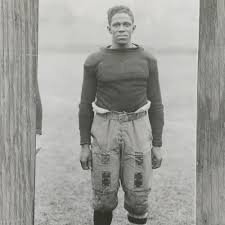
Frederick Douglass "Fritz" Pollard was an American professional football player and coach. In 1921, he became the first African-American head coach in the National Football League. Pollard and Bobby Marshall were the first two African-American players in the NFL in 1920. Football pioneer Walter Camp called Pollard "one of the greatest runners these eyes have ever seen."
Pollard coached Lincoln University's football team in Oxford, Pennsylvania during the 1918 to 1920 seasons and served as athletic director of the school's World War I era Students' Army Training Corps. During 1918–1919, he led the team to a victorious season defeating Howard University's Bisons 13–0 in the annual Thanksgiving classic as well as Hampton University (7–0) on November 9, 1918, and teams of military recruits at Camp Dix (19–0) on November 2, 1918, and Camp Upton (41–0). By the fall of 1920, he had begun to play for Akron, missing key Lincoln losses to Hampton (0–14) and Howard (0–42), much to the consternation of the alumni and administration. Paul Robeson was enlisted by Lincoln's alumni to coach the Thanksgiving 1920 game against Howard.
Pollard criticized Lincoln's administration, saying they had hampered his ability to coach and had refused to provide adequate travel accommodations for the team. "Prior to the Hampton game, the team was compelled to go to Hampton by boat, sleeping on the decks and under portholes," he told a reporter. "No cabins were provided, nor were they given a place to sleep after reaching Hampton. They lost the game through lack of rest." He also blamed the school for not providing the proper equipment. "I, myself, bought and paid $200 out of my pocket for football shoes for the team." He missed the 1920 Howard game, he said, because his Lincoln salary was so low that he was compelled to augment it with pay from Akron.
He played professional football with the Akron Pros, the team he would lead to the APFA championship in 1920. In 1921, he became the co-head coach of the Akron Pros, while still maintaining his roster position as running back. He also played for the Milwaukee Badgers, Hammond Pros, Gilberton Cadamounts, Union Club of Phoenixville and Providence Steam Roller. An article in the October 1, 1921 issue of the Chicago Whip newspaper stated that Pollard served as "assistant coach of the backfield men" of Northwestern University's football team.
Some sources indicate that Pollard also served as co-coach of the Milwaukee Badgers with Budge Garrett for part of the 1922 season.
On November 19, 1922, Pollard and Paul Robeson led the Badgers to victory over the great Jim Thorpe and his Oorang Indians. The final was 13–0 with Robeson scoring both touchdowns in his finest pro football performance.
Fritz also coached the Gilberton Cadamounts, a non-NFL team. In 1923 and 1924, he served as head coach for the Hammond Pros.
Pollard, along with all nine of the African American players in the NFL at the time, were removed from the league at the end of the 1926 season, never to return again. He spent some time organizing all-African American barnstorming teams, including the Chicago Black Hawks in 1928 and the Harlem Brown Bombers in the 1930s.
In the 1930s, Pollard founded his own professional football team, the Brown Bombers. The Depression ended the Brown Bombers' run in 1938, and Pollard went on to other ventures, including a talent agency, tax consulting, and film and music production. He produced Rockin' the Blues in 1956, which included such performers as Connie Carroll, The Harptones, The Five Miller Sisters, Pearl Woods, Linda Hopkins, Elyce Roberts, The Hurricanes, and The Wanderers.
Pollard also published the New York Independent News from 1935 to 1942, purportedly the first African American-owned tabloid in New York City. The war and a rivalry forced it to close. The paper's offices were on 125th Street and at its peak, the paper had a weekly circulation of approximately thirty-five thousand, ranking it among the top most read Black newspapers in the country.
Carroll, John M. (1998). Fritz Pollard: Pioneer in Racial Advancement. Urbana: University of Illinois Press. p. 4. ISBN 0252067991.
Gray, LaVerne (March 1, 2022). "Naomi Willie Pollard Dobson: A Pioneering Black Librarian". Libraries: Culture, History, and Society. 6 (1): 1–20. doi:10.5325/libraries.6.1.0001. ISSN 2473-0343.
Reasons and Patrick, "Pollard Set Records as Black Football Player, Coach", The Plain Dealer, Cleveland, Ohio, 1972, February 27, Section E: 5.
"Crack Lincoln University Team Coached by Fritz Pollard", Philadelphia Tribune, October 19, 1918
"Lincoln University Victor over Howard", Washington Post November 29, 1918.
"Pollard's Orange and Blue Juggernaut Crushes Camp Dix", Philadelphia Tribune, November 9, 1918.
"Lincoln Swamps Camp Upton", Chicago Defender, November 30, 1918.
"Fred Pollard Finishes as Coach for Lincoln", Chicago Defender, December 4, 1920.
"Fritz Pollard Answers Critics", Baltimore Afro-American, December 17, 1920.
"Pollard Made Asst. Coach at Northwestern". The Chicago Whip. October 1, 2021. Retrieved August 9, 2024. Pollard started his duties last Tuesday, appearing on the field in uniform
"Path Lit by Lightning" by David Maraniss
"Rockin' the Blues" – via www.imdb.com.
"Pearl Woods". Discogs.
John M. Carroll (1998). Fritz Pollard: Pioneer in Racial Advancement. University of Illinois Press. ISBN 978-0-252-06799-0.
"Fritz's Fame". Brown University. Brown Alumni News. March 2005. Retrieved February 3, 2016.
"Fritz Pollard: A Forgotten Trailblazer". Retrieved May 26, 2022.
Carroll, John M. (1998). Fritz Pollard: Pioneer in Racial Advancement. University of Illinois Press. pp. 194–196. ISBN 978-0-252-06799-0.
Dunlap, Keith (February 18, 2021). "Fritz was ritz as pioneer for Black football players". Retrieved May 26, 2022.
"03-078 (Fritz Pollard Award)". www.brown.edu.
"Jim Muldoon inducted into Rose Bowl Hall of Fame". Pac-12. Pac-12 Conference. December 30, 2015. Archived from the original on December 30, 2015. Retrieved February 3, 2016. Also inducted (was) ... Brown's Fritz Pollard (1916 Rose Bowl Game)
"Mark Brunell, Fritz Pollard, Tyrone Wheatley and Jim Muldoon to be Inducted into the Rose Bowl Hall of Fame presented by Northwestern Mutual". Tournament of Roses. Pasadena, CA. September 25, 2015. Archived from the original on October 30, 2015. Retrieved February 3, 2016.
"Alpha Athletes at the 1936 Olympic Games in Berlin, Germany". Alpha Phi Alpha fraternity. Retrieved January 10, 2010.
Brown University – Brown University and the Black Coaches Association establish annual Fritz Pollard Award February 18, 2004.
The Pros were established by local businessman Paul Parduhn and Dr. Alva Young. Young, a boxing promoter and owner of a racing stable, also served as doctor/trainer (and part-owner) for a semi-pro football team operated by the Hammond Clabby Athletic Association from 1915–17. In 1918, Young presided over a new team known as the "Hammond All-Stars" and played against many of the teams that would form the backbone of the American Professional Football Association (including the Racine Cardinals, Detroit Heralds, Rock Island Independents, Minneapolis Marines, Cleveland Tigers, Canton Bulldogs, and Toledo Maroons); Young attended the historic meeting in Canton, Ohio at which the APFA was formed in 1920. (It is said that a game between Hammond and Canton, played Thanksgiving Day 1919 and drawing some 12,000 spectators in Chicago, convinced team owners that a league would be viable.)
In 1919, the team starred George Halas at end (wide receiver); Halas left for the Decatur Staleys (the future Chicago Bears) the following year, remaining with that franchise as a player, coach and owner until his death in 1983.
Despite the name, the Pros were little more than a semi-professional outfit; most of the players were locals who had full-time jobs and couldn't practice much, and thus were simply no match for most other NFL squads. Nor did they really represent Hammond, as the town's stadium (A. Murray Turner Field) was built for baseball and seated only a few thousand. The Pros would play only one regular-season NFL game in Hammond, a 7-0 loss to the Dayton Triangles in 1923; instead, Cubs Park in Chicago served as their unofficial "home" stadium. Of the nine African-American players in the league during those years, six played for the Pros, including the first African-American head coach in the NFL, Fritz Pollard, and the successful music producer Mayo Williams.
The 1920 Hammond Pros season was the franchise's inaugural season in the American Professional Football Association (APFA) and second as an American football team. The Pros entered 1920 coming off a 4-win, 2-loss, 3-tie (4–2–3) record in 1919 as an independent team. Several representatives from another professional football league, the Ohio League, wanted to form a new national league, and thus the APFA was created. As for the Hammond Pros, there would be no league titles or anything close in their relatively short NFL history. Competing by and large as a semi-pro team comprised of local players who fit football around other jobs, they compiled just a 5-26-4 record during their seven-year existence (1920-26).
As a franchise without a home, Hammond played virtually all its home games in Chicago at a Wrigley Field known back in the day as Cubs Park. The end for the Pros and Hammond’s NFL affiliation occurred when the rival American Football League folded its operation after the 1926 season. The action prompted an NFL strategic decision of addition by subtraction—eliminating smaller franchises and travel teams to become a leaner, more financially secure organization of 12 members.
One last legacy note of significance regarding the Hammond Pros: six of the nine African-American players who competed in the NFL during the Hammond franchise’s 1920-26 existence played for the Pros.