Showing posts with label HOF 1982. Show all posts

Monday, July 31, 2023

The Story And Significance Of Merlin Olsen - 14 Straight Pro Bowls To Start His Career

Merlin Jay Olsen was an American football player, announcer, and actor. For his entire 15-year professional football career he was a defensive tackle with the Los Angeles Rams in the National Football League. He was selected to play in the Pro Bowl 14 times, every year but his last. The only other football players to have matched or exceeded that number are the former offensive lineman Bruce Matthews, the former tight end Tony Gonzalez, the former quarterback Peyton Manning, and the former quarterback Tom Brady, who is the only NFL player to have played more times in the Pro Bowl, with 15 selections.

In 1961, Olsen received the Outland Trophy, awarded to as the best lineman of the year in college football. He is a member of the Pro Football Hall of Fame and the College Football Hall of Fame. As an actor, he portrayed a farmer, Jonathan Garvey, on Little House on the Prairie. After leaving that series, he starred in his own NBC drama, Father Murphy.
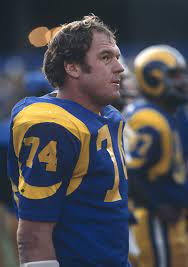
Coming out of college, Olsen had offers from both the Los Angeles Rams of the National Football League and the Denver Broncos of the rival American Football League. He chose the security of the NFL and signed with the Rams. Olsen's first contract was for around $50,000 for two years, plus a signing bonus. It was 1962, and the average football player salary at the time was around $12,000 a year. He was the first USU Aggie to be drafted in the 1st round of the NFL draft.

Olsen played professionally (1962–1976) for the Los Angeles Rams of the National Football League. A leading defensive star of his era, he missed only two games in his 15-season NFL career. He was named the NFL's Rookie of the Year in 1962 and was First-team All-Pro in 1964, and 1966 through 1970. He was voted Second-team All-Pro in 1965, 1973 and 1974.

Olsen almost ended up on offense, but was later moved to the defensive line after a few experiments in practice. Soon he became part of one of the best front fours in NFL history. Deacon Jones, Rosey Grier, and Lamar Lundy joined Olsen on the defensive line in 1963 that was nicknamed "The Fearsome Foursome". He was named the AP NFL Defensive Player of the Week for week 12 in 1965. Olsen scored his first touchdown in that game.

Throughout the 1960s, this quartet terrorized opposing offenses. Olsen's play helped the Rams to the playoffs in 1967 and 1969. He was voted the club's Outstanding Defensive Lineman from 1967 to 1970 by the Los Angeles Rams Alumni. In week 14, 1967, Olsen and the rest of the Fearsome Foursome were named the AP NFL Defensive Players of the Week for their performance against the Baltimore Colts. In the 1970s, Olsen continued his dominant play at defensive tackle and his 11 sacks in 1972 were second on the team. After week 8 in 1972, Olsen was named the Associated Press NFL Defensive Player of the Week for the third time in his career.

The Rams won the NFC West crown in 1973 through 1976 thanks in part to the play of Olsen. They ranked first in the NFL in run defense in 1973 and 1974 and finished second in sacking opposing passers both years. In 1973 Olsen was voted the NFLPA NFC Defensive Lineman of the Year and the next season, 1974, he was the recipient of Bert Bell Award as the NFL MVP as voted by the Maxwell Club. Olsen accepted the award "on behalf of all who toil in the NFL trenches".

Three of the Olsen brothers, Merlin, Phil, and Orrin, played in the NFL, with Merlin and Phil playing together for the Rams from 1971 to 1974. A nephew, Hans, son of his brother, Clark, also played professional football. In 1975 and 1976, the Rams defense finished second in the NFL against the run while ranking in the top five in sacking opposing quarterbacks and compiling a 22-5-1 record over those two seasons.

Olsen's last game was the NFC Championship game in 1976 at Bloomington, Minnesota. The Vikings took advantage on a freak play early in the game. A blocked field goal returned 90 yards for a touchdown shocked the Rams in the first quarter. The defense was later victimized by a couple of big plays by the Vikings. The Rams came up short, losing 24–13, bringing the storied career of the Rams' finest defensive tackle to an end.

Olsen made the Pro Bowl a then-record 14 times, missing it only in his final year. He was inducted into the Pro Football Hall of Fame in 1982 in his first year of eligibility; he selected his college position coach Tony Knap as his presenter. In 1999, Olsen was ranked 25th on The Sporting News' list of the 100 Greatest Football Players.

Olsen enjoyed continued success after the NFL as a broadcaster, actor, and businessman.

Olsen served as a television color commentator, teaming mostly with Dick Enberg on NBC's coverage of the AFC during the late 1970s and almost all of the 1980s. He and Enberg also teamed for four Super Bowls (XV, XVII, XX and XXIII), as well as nine Rose Bowls from 1980 to 1988. Olsen also worked Super Bowl XIII in 1979 with Curt Gowdy and John Brodie (Enberg was then serving as pre-game/halftime/post-game host). In 1989, Olsen was replaced by[16] Bill Walsh as NBC's lead NFL color commentator. For the 1989 season, Olsen worked with Charlie Jones on NBC's broadcasts. In 1990 and 1991, he moved to CBS Sports doing NFL games with Dick Stockton.

Olsen developed a successful career as an actor. He appeared as the character Little George in the John Wayne movie, The Undefeated, with Rams teammate Roman Gabriel, in 1969.

In 1970, he appeared once on Petticoat Junction, in the episode: "With This Ring". He played mountaineer Merlin Fergus.

When Little House on the Prairie actor Victor French left to star in his own comedy Carter Country in 1977, Olsen was tapped to play Michael Landon's new sidekick Jonathan Garvey for several years. One memorable quote from his character's son, Andy Garvey, "My pa doesn't know anything about football!" came when Andy's friends suggested that Jonathan coach their football team.
Olsen played the starring role of John Michael Murphy in the 1981-83 NBC television drama series Father Murphy.

In the Highway to Heaven episode 2.12 ("The Good Doctor"), the main character, Alex, tells Mark Gordon (Victor French) that "All I could see was the flowers and the beard. I thought you were Merlin Olsen." This is an inside joke since all three actors, Merlin Olsen, Michael Landon, and Victor French were in the TV series Little House On the Prairie earlier in their careers.

Olsen's last acting work was in the short-lived 1988 TV series Aaron's Way.

Olsen was also the commercial spokesman for FTD Florists for many years. A part-time resident of the Coachella Valley, Olsen was the longtime radio and television spokesman for Palm Desert-based El Paseo Bank.

Olsen also appeared in many Sigma Chi fraternity promotional campaigns; Merlin, along with his brother Phil, was a Life Loyal Sig, Significant Sig (given to members for distinguishing acts outside the fraternity) and a member of the Order of Constantine (given for service to the Fraternity). Olsen donated one of his cleats, which were bronzed, to be used during the annual football rivalry between two Las Vegas high schools, Eldorado High School and Chaparral High School, which both opened in 1973. Each year, Olsen presented the "trophy" in the ceremony at the rivalry game.[citation needed]
Olsen often co-hosted the Children's Miracle Network telethons, a humanitarian organization founded in 1983 by Marie Osmond and John Schneider.

He was named the Walter Camp Man of the Year in 1982 and Athlete of the Century for the state of Utah. During halftime of a basketball game between Utah State, Olsen's alma mater, and Saint Mary's on December 5, 2009, Utah State University announced that the playing surface inside Romney Stadium, home stadium for the university's football program, would be named Merlin Olsen Field in Olsen's honor. Because of Olsen's illness, Utah State decided not to wait until the 2010 football season to hold the ceremony; he was able to attend the game, but did not speak. A sculpture of Olsen was unveiled in a plaza south of the stadium during an official dedication ceremony in Fall 2010.

In 1979, Olsen was inducted into the Utah Sports Hall of Fame. 
In 1980, Olsen was inducted into the National College Football Hall of Fame. In 1998, Olsen was inducted into the Utah Tourism Hall of Fame. Olsen was voted to the California Sports Hall of Fame Class of 2010, along with Bill Walton, Dwight Stones, and Jim Otto, among others. In 1983, Olsen served as Grand Marshal of the Rose Parade.
Sources
https://www.pro-football-reference.com/
https://www.profootballarchives.com/index.html
https://americanfootballdatabase.fandom.com/wiki/Football_Wiki
https://www.gridiron-uniforms.com/GUD/controller/controller.php?action=main
https://www.profootballhof.com/hall-of-famers/
Florio, Mike (March 11, 2010). "Reports: Merlin Olsen dies at 69". ProFootballTalk. NBC Sports. Retrieved March 11, 2010.
 Cox, Erin (January 13, 2017). "Magic Merilin". The Herald Journal. Retrieved November 18, 2019.
 Honorary Degree Recipients Utah State University.
 "Merlin Olsen College". Lowongankerja2010x.com. Retrieved March 12, 2010.[dead link]
 "Utah State University Media Guide" (PDF). Archived from the original (PDF) on March 4, 2016. Retrieved May 4, 2007.
 "Utah State Championships". College Football Data Warehouse. Archived from the original on February 16, 2010. Retrieved March 13, 2010.
 The East West Shrine Game | Hall of Fame Archived July 21, 2009, at the Wayback Machine
 Hula Bowl | History Archived July 14, 2007, at the Wayback Machine
 NEA All-Time All-America Team – Beckly Post-Herald, August 24, 1969
 "Utah State's Merlin Olsen Named To 75th Anniversary All-Sun Bowl Team" (Press release). Utah State University. July 3, 2008. Archived from the original on November 22, 2008. Retrieved November 16, 2009.
 "Utah State University Will Honor Merlin Olsen on Saturday, Dec. 5 At Aggie Basketball Game" (Press release). Utah State University. November 16, 2009. Retrieved March 11, 2010.
 2008 St. Louis Rams Media Guide
 "Merlin Olsen - enshrinement speech - 1982". profootballhof.com. Retrieved March 25, 2012.
 "NFL News, Scores, Schedule & Standings - Pro Football". Sporting News. Archived from the original on March 9, 2010. Retrieved March 13, 2010.
 "BREAKING NEWS: The Fearsome Foursome now two: NFL Legend Merlin Olsen Dead at 69". The Enterprise Report. March 11, 2010.
 "History of #1 analyst demotions". Classic Sports TV and Media. February 18, 2013. Retrieved April 13, 2013.
 "The Desert Sun - Palm Springs and Coachella Valley news". Desert Sun.
 Ray Brewer (March 11, 2010). ""Merlin Olsen's death felt at Eldorado, Chaparral"". Las Vegas Sun. Retrieved January 8, 2020.
 "Olsen, Hall of Famer and member of 'Fearsome Foursome' dies". NFL News. Associated Press. March 11, 2010. Archived from the original on August 29, 2010. Retrieved March 11, 2010.
 Harrison, Shawn (December 6, 2009). "Field named after Olsen: Utah State honors Aggie legend in halftime ceremony". The Herald Journal. Logan, Utah. Retrieved July 14, 2018.
 "Honorees – Utah Sports Hall of Fame Foundation".
 "Merlin Olsen (1980) - Hall of Fame".
 "Tourism Hall of Fame".
 "2010 Inductees". California Sports Hall of Fame. Retrieved July 14, 2018.
 "Mediterranean Estate, San Marino, California 1984". glen-hampton-gardens-designs.com. Archived from the original on January 26, 2020. Retrieved August 20, 2019.
 "Hans Olsen Stats, Height, Weight, Position, Draft, College". Pro-Football-Reference.com.
 Eborn, Jared (December 6, 2009). "Utah State football names field after Merlin Olsen". Deseret News. Salt Lake City. Archived from the original on December 8, 2009.
 "Merlin Olsen suing NBC". TV Squad. December 31, 2009. Retrieved March 11, 2010.
 "Mesothelioma Takes Life of Merlin Olsen". March 12, 2010. Archived from the original on March 5, 2016. Retrieved March 12, 2010.
 Thursby, Keith (March 12, 2010). "Merlin Olsen dies at 69; Hall of Fame football star later became actor". Los Angeles Times. Retrieved March 12, 2010.
 Goldstein, Richard (March 11, 2010). "Merlin Olsen, 69, Football Star, Commentator and Actor, Dies". The New York Times.

Wednesday, July 26, 2023

The Story And Significance Of George Musso - He Was The First To Win All-NFL At Two Positions

George Francis Musso was an American professional football player who spent his entire 12-year career as a guard and offensive tackle for the Chicago Bears of the National Football League. He was inducted into the Pro Football Hall of Fame in 1982.

Musso attended Millikin University and was a standout in football, basketball, baseball, and track. Millikin was in the "Little 19" conference that included such teams as Eureka, Lombard, and Augustana. In 1929, Musso played against future President Ronald Reagan, who played guard for Eureka College and weighed about 175 pounds; Eureka lost to Musso and Millikin 45–6. Musso was already larger than most linemen of his era, playing college ball at 6' 2", 255 pounds. In 1933, Musso played in the East-West All-Star game, held in Chicago; it was there he first got the attention of George Halas.

Halas, who had doubts the small school Musso could make it in the NFL, offered Musso a $90 a game contract (this was half rate for regular players at that time). Musso agreed and, although he struggled at first, became the centerpiece of the Bears line for 12 years. One reason the Bears of that era were called "Monsters of the Midway" was their imposing size—Musso, who played professionally at 270 pounds, was one of the largest Bears and one of the largest players in the league. His teammates called him "Moose." He played offensive tackle until 1937 when he moved to guard. He was the first to win All-NFL at two positions; tackle (1935), and guard (1937). He played middle guard or nose tackle on defense his entire career. Musso captained the Chicago Bears for nine seasons, playing on the line with other NFL notables as Link Lyman, Joe Kopcha, Walt Kiesling, Bulldog Turner, Joe Stydahar, and Danny Fortmann. He played in seven NFL championship games, with the Bears winning four (1933, 1940, 1941, and 1943). He was inducted to the Pro Football Hall of Fame in 1982. Of note, in 1935 as an NFL lineman, Musso played against Gerald Ford of Michigan in the 1935 College All-Star game. Without a doubt, Musso is the only NFL player, to have played against two U.S. Presidents.

Musso retired to Edwardsville, Illinois, and began a restaurant business. He served as the Madison County, Illinois, sheriff and treasurer from the 1950s through the 1970s. He died in his home in Edwardsville in 2000.
Sources
https://www.pro-football-reference.com/
https://www.profootballarchives.com/index.html
https://americanfootballdatabase.fandom.com/wiki/Football_Wiki
https://www.gridiron-uniforms.com/GUD/controller/controller.php?action=main
https://www.profootballhof.com/hall-of-famers/

Monday, July 24, 2023

The Story And Significance Of Sam Huff - First NFL Player To Be Featured On The Cover Of Time Magazine

Robert Lee "Sam" Huff was an American professional football player who was a linebacker in the National Football League for the New York Giants and the Washington Redskins. He played college football for West Virginia University. He is a member of both the College Football Hall of Fame and the Pro Football Hall of Fame.

Huff was drafted in the third round of the 1956 NFL Draft by the New York Giants. In training camp, head coach Jim Lee Howell was having a hard time coming up with a position for Huff. Discouraged, Huff left camp, but was stopped at the airport by assistant (offensive) coach Vince Lombardi, who coaxed him back to camp.
Then, defensive coordinator Tom Landry came up with the new 4–3 defensive scheme that he thought would fit Huff perfectly. The Giants switched him from the line to middle linebacker behind Ray Beck. Huff liked the position because he could keep his head up and use his superb peripheral vision to see the whole field. On October 7, 1956, in a game against the Chicago Cardinals, Beck was injured and Huff was put into his first professional game. He then helped the Giants win five consecutive games and they finished with an 8–3–1 record, which gave them the Eastern Conference title. New York went on to win the 1956 NFL Championship Game[4] and Huff became the first rookie middle linebacker to start an NFL championship game.

In 1958, the Giants again won the East and Huff played in the 1958 NFL Championship Game. The championship, which became widely known as "The Greatest Game Ever Played", was the first National Football League game to go into sudden death overtime. The final score was Baltimore Colts 23, New York Giants 17.

In 1959, Huff and the Giants again went to the NFL Championship Game, which ended in a 31–16 loss to the Colts. Also that year, Huff became the first NFL player to be featured on the cover of Time magazine on November 30, 1959. He almost passed up the magazine appearance, demanding money to be interviewed, but relented when Time agreed to give him the cover portrait. Huff was also the subject of an October 31, 1960 CBS television special, "The Violent World of Sam Huff", broadcast as an episode of the Walter Cronkite-hosted anthology series The Twentieth Century. The network wired Huff for sound in practice and in an exhibition game.

The Giants then visited the championship under new coach Allie Sherman in 1961, 1962, and 1963, but lost every one of them. To improve what he thought was a defensive problem, Sherman then traded many defensive players, including Cliff Livingston, Rosey Grier, and Dick Modzelewski. After these trades, Huff went to owner Wellington Mara and was assured he would not be traded. But in 1964, Giants head coach Allie Sherman traded Huff to the Washington Redskins for defensive tackle Andy Stynchula and running back Dick James. The trade made front-page news in New York City and was greeted with jeers from Giants fans, who crowded Yankee Stadium yelling "Huff-Huff-Huff-Huff."
Huff played in four consecutive Pro Bowls with the Giants from 1959 through 1963. He was named most valuable player of the 1961 Pro Bowl.

Huff joined the Redskins in 1964 and they agreed to pay him $30,000 in salary and $5,000 for scouting, compared to the $19,000 he would have made another year with New York. The impact Huff had was almost immediate and the Redskins' defense was ranked second in the NFL in 1965.

On November 27, 1966, Huff and the Redskins beat his former Giant teammates 72–41, in the highest-scoring game in league history. After an ankle injury in 1967 ended his streak of 150 straight games played Huff retired in 1968.

Vince Lombardi talked Huff out of retirement in 1969 when he was named Washington's head coach. The Redskins went 7–5–2 and had their best season since 1955 (which kept Lombardi's record of never having coached a losing NFL team intact). Huff then retired for good after 14 seasons and 30 career interceptions. He spent one season coaching the Redskins' linebackers in 1970 following Lombardi's death from colon cancer.

After leaving the NFL, Huff took a position with J. P. Stevens in New York City as a textiles sales representative. He later joined the Marriott Corporation as a salesman in 1971, rising to vice president of sports marketing before retiring in 1998. While with Marriott, Huff was responsible for selling over 600,000 room nights via a partnership between the NFL and Marriott that booked teams into Marriott branded hotels for away games. In the late 1950s and early 1960s he was a spokesman for Marlboro cigarettes.

After retiring from football, Huff spent three seasons as a color commentator for the Giants radio team and then moved on in the same capacity to the Redskins Radio Network, where he remained until his retirement at the end of the 2012 season, calling games alongside former Redskins teammate Sonny Jurgensen and play-by-play announcers Frank Herzog (1979–2004) and Larry Michael (2005–2012). He was also a broadcaster for a regionally syndicated TV package of Mountaineer football games in the mid-1980s.

In 1982, Huff became the second WVU player to be inducted into both the College and Pro football Halls of Fame. In 1988, he was inducted into the WVU School of Physical Education Hall of Fame and, in 1991 he was inducted into the WVU Sports Hall of Fame.

In 1999, Huff was inducted into the National High School Hall of Fame[6] and was ranked number 76 on the Sporting News' list of the 100 Greatest Football Players.

In 2001, Huff was ranked number six on Sports Illustrated's list of West Virginia's 50 Greatest Athletes. In 2005, Huff's uniform number 75 was retired by West Virginia University.

In 1986 Huff began breeding thoroughbred racehorses at Sporting Life Farm in Middleburg, Virginia. His filly, Bursting Forth, won the 1998 Matchmaker Handicap. He also helped establish the West Virginia Breeders' Classic.

In 1970, Huff ran for a seat in the U.S. House of Representatives, but lost in the West Virginia Democratic primary for the 1st district against Bob Mollohan by more than 19,000 votes.[4]
Huff was diagnosed with dementia in 2013. He died at the age of 87 at a hospital in Winchester, Virginia, on November 13, 2021.
Sources
https://www.pro-football-reference.com/
https://www.profootballarchives.com/index.html
https://americanfootballdatabase.fandom.com/wiki/Football_Wiki
https://www.gridiron-uniforms.com/GUD/controller/controller.php?action=main
https://www.profootballhof.com/hall-of-famers/
 "Coal Miners—an essay". Appalachian Blacksmiths Association. Archived from the original on May 17, 2008. Retrieved June 29, 2008.
 "Mountaineer Flashback – Sam Huff". WTRF-TV. Archived from the original on June 3, 2011. Retrieved June 29, 2008.
 "The Violent World". ESPN. Archived from the original on March 16, 2011. Retrieved June 29, 2008.
 "Profile: Sam Huff". WVU Varsity Club. Archived from the original on December 9, 2002. Retrieved June 29, 2008.
 "Farmington's Sam Huff went from zero to hero". Times West Virginian. Archived from the original on February 4, 2013. Retrieved June 28, 2008.
 "National High School Hall of Fame". National Federation of State High School Associations. Archived from the original on June 17, 2008. Retrieved June 29, 2008.
 "A Man's Game". Time Magazine. November 30, 1959. Archived from the original on March 8, 2008. Retrieved June 30, 2008.
 "Robert "Sam" Huff: Academy of Distinguished Alumni". West Virginia University. Archived from the original on May 22, 2008. Retrieved June 28, 2008.
 College Football Hall of Fame profile
 "Sam Huff's Pro Football HOF profile". Pro Football Hall of Fame. Retrieved June 30, 2008.
 "Building America's Team". Dallas Morning News. Archived from the original on August 23, 2004. Retrieved June 30, 2008.
 "Describing 'The Innovator'". The Sporting News. Archived from the original on December 1, 2005. Retrieved June 30, 2008.
 "Greatest game ever played". Pro Football Hall of Fame. Archived from the original on January 10, 2008. Retrieved July 11, 2008.
 "Flashback: Huff Changed the NFL Game". Washington Redskins. Archived from the original on July 10, 2008. Retrieved July 1, 2008.
 "Redskins History: 1960". Washington Redskins. Archived from the original on June 13, 2008. Retrieved July 1, 2008.
 Hose, Dan (January 29, 1982). "Sam Huff, who played for West Virginia University's 1953..." UPI. Retrieved November 19, 2021. Huff is a vice president of marketing for Marriott Hotels for whom he has worked 11 years.
 Stump, Jake (March 2009). "No One More Enthusiastic about Marriott International Coming to the Rescue of The Greenbrier than West Virginia Football Legend Sam Huff, a Longtime Employee of Marriott". Charleston Daily Mail. Archived from the original on November 19, 2021. Retrieved November 19, 2021. Huff was an All-American tackle for WVU in 1955 and then played for the New York Giants and Washington Redskins. He was inducted into the Pro Football Hall of Fame in 1982. He now lives in Virginia and is a radio color commentator for the Redskins. He joined Marriott as a salesman in 1971 after his football career ended and eventually became the chain's vice president of sports marketing. Huff owns 5 percent of the Town Center Marriott.
 Blum, Alan (October 18, 2019). "Museum malignancy: What the Sacklers and Philip Morris have in common". The Cancer Letter. Retrieved November 19, 2021. ...decades of aggressive marketing by Philip Morris aimed at associating its cigarette brands with athletic prowess, notably through Marlboro ads featuring National Football League stars Frank Gifford, Sam Huff, and others. ...
 "Life". December 5, 1960: 151. Retrieved November 19, 2021. {{cite journal}}: Cite journal requires |journal= (help)
 "Football's 100 Greatest Players". Sporting News. Archived from the original on May 16, 2008. Retrieved June 28, 2008.
 "W.Va.'s 50 Greatest Athletes". WVSPN. Retrieved June 29, 2008.
 Furfari, Mickey (November 23, 2005). "Sam Huff's number to be retired today". Beckley Register-Herald. Retrieved November 19, 2021.
 McNamara, Ed (November 17, 2021). "Remembering Giants LB Sam Huff; Lights Out in Oregon". Horse Racing News. Retrieved November 19, 2021. Huff began breeding thoroughbreds in 1986 at Sporting Life Farm in Middleburg, Virginia, and Bursting Forth was a multiple graded-stakes winner for him and trainer Graham Motion. She won 10 of 28 starts and earned $524,474. Among her biggest victories were Monmouth Park's Grade 3 Matchmaker (1998) and Keeneland's Grade 3 Bewitched (1999). In 1987 Huff helped launch the West Virginia Breeders Classic at Charles Town Races. The 35th running of the $300,000 Classic on Oct. 9 topped a nine-stakes, $1 million card for state-breds.
 Schudel, Matt (November 13, 2021). "Sam Huff, NFL Hall of Fame linebacker of 'unmatched ferocity,' dies at 87". Washington Post. Retrieved November 13, 2021.

Monday, July 17, 2023

The Story And Significance Of Doug Atkins - Eight Pro Bowls In His Last Nine Years With The Bears

Douglas Leon Atkins was an American professional football player who was a defensive end for the Cleveland Browns, Chicago Bears, and New Orleans Saints in the National Football League. He played college football for the Tennessee Volunteers under head coach Robert Neyland. He is a member of the College Football Hall of Fame and the Pro Football Hall of Fame.

Atkins was a fierce defender who was known for using his immense size and agility to his advantage. At 6 feet 8 inches, Atkins often batted passes down at the line of scrimmage and used his skills as a high jump champion to leapfrog blockers and get to the quarterback. Atkins was one of the first great exclusively defensive players in professional football and, along with fellow Hall of Famer Gino Marchetti, revolutionized the defensive end position.

The Cleveland Browns selected Atkins with the 11th overall selection in the 1953 NFL draft. He played his first two seasons in the NFL with the Browns, winning the NFL Eastern Conference in 1953, and the NFL Championship in 1954. The Browns traded Atkins and Ken Gorgal to the Chicago Bears for a third-round and a sixth-round pick in the 1956 NFL draft. According to Pat Summerall, Atkins was traded by Paul Brown for burping out loud in a team meeting. In Chicago, Atkins quickly became the leader of a devastating defensive unit. With the Bears, Atkins was a First-team All-Pro selection in 1958, 1960, 1961, and 1963, along with being a starter in the Pro Bowl in eight of his last nine years with Chicago.

At the 1966 Pro Bowl, Atkins announced his retirement from football. He changed his mind and signed with the Bears for the 1966 season. Before the 1967 season, Atkins requested a trade from Chicago and was traded to the New Orleans Saints. He suffered a fractured knee cap during the 1968 season. He retired after the 1969 season. On the final play of his NFL career, Atkins sacked Pittsburgh Steelers quarterback Dick Shiner, preserving the Saints' 27–24 victory in the 1969 season finale.

Atkins was inducted into the Pro Football Hall of Fame in 1982 and the College Football Hall of Fame in 1985. He has also been inducted into the Chicagoland Sports Hall of Fame. His collegiate jersey number, #91, was retired by the University of Tennessee in 2005.

The NFL Network ranked him as the number 9 Pass Rusher of All Time in its Top Ten show. During a 1983 segment about Atkins on the NFL Films show "This Is the NFL", legendary narrator John Facenda described Atkins "like a storm rolling over a Kansas farmhouse. He came from all directions, and all there was to do was to tie down what you could, and hope he didn't take the roof".

Atkins married twice. His first wife was from Humboldt, and he married his second wife, from Milan, Tennessee, after the death of his first wife. He played a minor acting role as "Jebbo" in the 1975 film, Breakheart Pass, starring Charles Bronson. After he retired from the NFL, Atkins worked in various jobs, including as an exterminator, as a pipe system manager, and selling caskets to funeral homes.

Atkins died of natural causes at Fort Sanders Regional Medical Center in Knoxville, Tennessee, on December 30, 2015, at the age of 85. He was survived by his wife, brother, and three sons.
Sources
https://www.pro-football-reference.com/
https://www.profootballarchives.com/index.html
https://americanfootballdatabase.fandom.com/wiki/Football_Wiki
https://www.gridiron-uniforms.com/GUD/controller/controller.php?action=main
https://www.profootballhof.com/hall-of-famers/
"Obituary for Douglas Leon Atkins-Knoxville/Humboldt". Shelton-Hunt Funeral Home. Retrieved March 17, 2024.
 Schudel, Matt (December 30, 2015). "Doug Atkins, intimidating Hall of Fame defensive end, dies at 85". The Washington Post. ISSN 0190-8286. Retrieved January 5, 2016.
 Shields, Andrew (December 30, 2015). "UT, Humboldt football legend Doug Atkins dies". The Jackson Sun. Retrieved December 31, 2015.
 "1949 State Boys' Basketball Tournament Central". TSSAA. Retrieved March 17, 2024.
 "Doug Atkins, intimidating Hall of Fame pass rusher, dies at 85". NBC Sports. December 30, 2015. Retrieved March 17, 2024.
 "Vol legend Doug Atkins dies at 85". WBIR. December 30, 2015. Retrieved March 17, 2024.
 "2012 Tennessee Track & Field Media Guide". ISSUU.com. January 9, 2012.
 "Sidearm Sports Learfield, opens a new window" (PDF). Tennessee Volunteers Athletics. Retrieved August 12, 2022.
 "Southeastern Conference". Track & Field News. June 1952. ISSN 0041-0284.
 West, Marvin (May 28, 2018). "Flowers and No. 7". Knox TN Today. Retrieved March 17, 2024.
 "1953 NFL Draft Listing". Pro-Football-Reference.com. Retrieved March 17, 2024.
 "Hall of Fame defensive end Doug Atkins dies at 85". ESPN.com. Associated Press. December 30, 2015. Retrieved December 30, 2015.
 "UT great, NFL Hall of Famer Doug Atkins dies at 85". The Tennessean. December 30, 2015. Retrieved December 30, 2015.
 Goldstein, Richard (December 30, 2015). "Doug Atkins, Feared Pass-Rusher, Dies at 85". The New York Times. Retrieved December 30, 2015.
 Campbell, David (April 30, 2009). "Ranking the best and worst trades in Cleveland sports history". cleveland.com. Retrieved December 31, 2015.
 Rucker, Wes (December 30, 2015). "Tennessee Vols football legend Doug Atkins passes away". GoVols247. Retrieved December 31, 2015.
 "Doug Atkins Will Return to Bears". Daytona Beach Morning Journal. Associated Press. July 6, 1966. Retrieved December 30, 2015 – via Google News.
 "Doug Atkins Is Disabled". Gettysburg Times. Associated Press. November 29, 1968. Retrieved December 30, 2015 – via Google News.
 Clements, Ron (December 30, 2015). "Pro Football Hall of Famer Doug Atkins dead at 85". Sporting News. Archived from the original on January 4, 2016. Retrieved December 31, 2015.
 "Doug Atkins, Pro Football Hall of Famer and original Saint, dies at 85". NewOrleansSaints.com. December 30, 2015. Retrieved March 17, 2024.
 "NFL 100". NFL.com. Retrieved November 22, 2025.
 Duncan, Jeff (June 16, 2022). "You won't see a Saints player wear jersey Nos. 8 or 9 again. Here's why". The Times-Picayune/The New Orleans Advocate. Retrieved March 17, 2024.
 Kirkham, Nathan (November 17, 2005). "Tennessee Retires Doug Atkins No. 91". National Football Foundation. Retrieved March 17, 2024.
 "Top Ten Pass Rushers: Doug Atkins". NFL.com. Retrieved December 30, 2015.
 Mattingly, Tom. "'A storm blowing over a Kansas farm house'". The Knoxville Focus. Retrieved March 17, 2024.
 "Former UM star Mike Tilleman recalls 12-year career in NFL". The Missoulian (Missoula, Montana). Associated Press. May 2, 1985. p. 23.
 "From Football to Caskets For Former All-Pro Atkins". The Victoria Advocate. Associated Press. April 7, 1975. Retrieved December 31, 2015 – via Google News.
 Rucker, Wes (December 30, 2015). "Tennessee legend Doug Atkins passes away". 247Sports. Retrieved December 30, 2015.