Showing posts with label Art Donavan. Show all posts

Wednesday, September 28, 2022

The Story And Significance Of Art Donovan - Four-time consecutive first-team All-Pro

Arthur James Donovan Jr., nicknamed the Bulldog, was an American football defensive tackle who played for three National Football League teams, most notably the Baltimore Colts. He was inducted into the Pro Football Hall of Fame in 1968.

Art attended Mount Saint Michael Academy in the Bronx. He received a scholarship to the University of Notre Dame in 1942 but left after one semester to join the United States Marine Corps, enlisting in April 1943. He served four years, to include service in the Pacific Theatre during World War II. He took part in some of the conflict's fiercest engagements, such as the Battle of Luzon and the Battle of Iwo Jima. He also served as an ammo-loader on a 40mm gun on the aircraft carrier USS San Jacinto and as a member of 3rd Marine Division. His earned citations, which included the Asiatic-Pacific Campaign Medal and the Philippine Liberation Medal, and would later earn him a place in the U.S. Marine Corps Sports Hall of Fame, the first pro football player so honored. After the war, he completed his college career at Boston College.

In each of his first three seasons, Donovan played for a team that went out of business. He started out with the first Baltimore Colts, which folded after his rookie season in 1950, followed by the New York Yanks in 1951, and their successor, the Dallas Texans, in 1952. After the Texans franchise folded, many of their players moved to Baltimore when the Colts were awarded a new franchise in 1953 and became the second Baltimore Colts, Donovan played with that team. He became one of the stars in an outstanding defense and was selected to five straight Pro Bowls, from 1953 through 1957. The Colts won back-to-back championships in 1958 and 1959. He was selected to the Pro Football Hall of Fame in 1968.
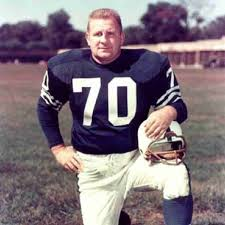
During his career, Donovan played in what many believe was one of the most important games in NFL history, the 1958 NFL Championship Game between the Colts and the New York Giants. The contest between the two teams took place on December 28, 1958, and ended in a 17–17 tie. Being the championship game, it went into overtime, the first NFL game to do so. Witnessed by 40 million viewers on nationwide television, the game came to be known as the "greatest game ever played." Donovan made an important tackle during the overtime, stopping the Giants and allowing Johnny Unitas to lead the Colts on an 80-yard scoring drive to win the game. Donovan was one of 12 Hall of Fame players to take part, six of whom were Colts.

He published an autobiography, Fatso, in 1987. He was noted as a jovial and humorous person during his playing career and capitalized on that with television and speaking appearances after retiring as a player. He owned and managed a country club near Baltimore. Donovan also appeared ten times on Late Night with David Letterman, telling humorous stories about his old playing days and about other footballers he played with and against in his time. He relayed a story that he played without a helmet and in fact is shown on football cards without a helmet. Letterman wore Donovan's No. 70 Colts jersey in the famous Super Bowl XLI commercial with Oprah Winfrey and Jay Leno. Donovan also made several appearances on The Tonight Show Starring Johnny Carson.

Donovan guest-starred in the Nickelodeon show The Adventures of Pete & Pete in the episode "Space, Geeks, and Johnny Unitas". He also appeared as a guest commentator at the WWF King of the Ring tournament in 1994. Donovan's appearance at the event would become infamous among wrestling fans for being seemingly uninformed about the product as well as generally befuddled behavior such as repeatedly asking how much certain wrestlers weighed. He was joined by Gorilla Monsoon on play-by-play, who inadvertently referred to Donovan as "Art O'Donnell", and Randy Savage.

He was co-host of the popular 1990s program Braase, Donovan, Davis and Fans on WJZ-TV in Baltimore with Colt teammate Ordell Braase. The trio talked more about Art Donovan's fabled stories than contemporary NFL football, but the show held high ratings in its time slot. He was also a pitchman for the Maryland State Lottery and ESPN.
Sources
https://www.pro-football-reference.com/
https://www.profootballarchives.com/index.html
https://americanfootballdatabase.fandom.com/wiki/Football_Wiki
https://www.gridiron-uniforms.com/GUD/controller/controller.php?action=main
https://www.profootballhof.com/hall-of-famers/
Martin, Douglas (August 5, 2013). "Art Donovan, a Behemoth of Modesty, Dies at 89". The New York Times. Retrieved March 2, 2020.
 "Averno, Donovan Sent by Browns to Weak Yankees," [Bowling Green, OH] Daily Sentinel-Tribune, Aug. 30, 1951, p. 11.
 "Art Donovan, Pro Football Hall of Famer, dies at 88". NFL.com. Retrieved August 5, 2013.
 "Unitas QBs NFL Team". Tampa Tribune. September 7, 1969. p. 34.
 Schudel, Matt (August 7, 2013) "Colt a Hall of Famer on the field, a card off it" The Washington Post, page B6.[1]
 "HALL OF FAME DT ART DONOVAN DEAD AT 89". AP. Archived from the original on February 22, 2014. Retrieved August 5, 2013.
 "Art Donovan, Uncensored, on Tonight Show, April 12, 1990". YouTube. Archived from the original on January 8, 2019. Retrieved January 14, 2019.
 "Art Donovan on the Tonight Show". YouTube. Archived from the original on December 12, 2021. Retrieved January 14, 2019.
 McNeill, Pat (2002). The Tables All Were Broken: McNeill's Take on the End of Professional Wrestling. iUniverse. p. 278. ISBN 0-595-22404-0.
 Simon, Harry (August 4, 2013). "Classic Induction: Art Donovan – Man of a Thousand Questions. And They Were All "How Much Does This Guy Weigh?"". WrestleCrap. Archived from the original on October 1, 2021. Retrieved November 11, 2018.
 Demme, Ted (September 20, 1996), "Hostage: Part 1", Homicide: Life on the Street, Richard Belzer, Andre Braugher, Reed Diamond, retrieved May 21, 2025
 "Valley Country Club – Weddings In Maryland". www.valleycountryclub.com. Archived from the original on August 8, 2013. Retrieved August 9, 2013.
 "Art Donovan, vocal ex-Colts defensive tackle, dies at 89". The Baltimore Sun. Archived from the original on August 20, 2013. Retrieved August 5, 2013.
 Klingaman, Mike (August 9, 2013) "Hundreds arrive for Art Donovan's Funeral at Cathedral of Mary our Queen" The Baltimore Sun.
 Hamilton, Tracee (August 11, 2013). "Donovan was the real deal, both on the field and off it". The Washington Post. p. D2. Archived from the original on December 12, 2017.
Arthur J. Donovan Jr. and Bob Drury, Fatso: Football When Men Were Really Men. New York: William Morrow & Co., 1987

Tuesday, February 1, 2022

Who Were The Original Baltimore Colts?

The Baltimore Colts were a professional American football team based in Baltimore, Maryland. The first team to bear the name Baltimore Colts, it was a member of the All-America Football Conference (AAFC) from 1947 to 1949 and then joined the National Football League for one season before folding. The Colts were one of the least successful teams in the AAFC and NFL both on and off the field, winning only 11 of their 54 games in their history. In 1953, Baltimore was granted an expansion team that revived the Colts name. Since 1984, this team is now the Indianapolis Colts.

The Colts' origin is with the Miami Seahawks, one of the charter franchises of the AAFC. After playing a single disastrous season, the Seahawks were seized by the league, and were purchased and reorganized by a group of businessmen as the Baltimore Colts. The new team struggled through the next three seasons, but managed to grow a sizable fan base in Baltimore. In 1949, the Colts were one of three AAFC teams, along with the San Francisco 49ers and the Cleveland Browns, to be brought into the NFL following the AAFC-NFL merger. They played only during the 1950 season before financial pressures forced them to fold.

The All-America Football Conference had initially intended to place a team in Baltimore in its opening 1946 season, but this fell through as its prospective owner, retired boxer Gene Tunney, was unable to secure a stadium deal. Needing an eighth team to avoid byes, the AAFC granted a franchise to a group of Miami-based boosters, the Miami Seahawks.

Unfortunately, the Seahawks were beset with problems: they were in the second-smallest market in the NFL or AAFC (ahead of only Green Bay), while Seahawks owner Harvey Hester was the only AAFC owner who was not a millionaire. The season saw them play seven of their first eight games on the road, and combined with a very poor team, the Seahawks drew a paltry total of 49,151 fans to their seven home games.

At the end of the season, the team was $350,000 in debt, including $80,000 in outstanding travel and payroll costs. This was well beyond Hester's ability to pay, and to make matters worse, his boosters walked away upon realizing the extent of the debt. Hester was subsequently declared bankrupt, leaving AAFC Commissioner Jim Crowley with no option but to seize the franchise.

Five businessmen, led by Washington, D.C. attorney Robert D. Rodenburg, made a bid to purchase the Seahawks' assets and use them to start a new team in Baltimore. The AAFC quickly approved the deal, and the team was reorganized as the Baltimore Colts, a name chosen due to the city's long history of horse racing and breeding. Due to the club's inherited talent drought, the Colts were permitted to recruit a player from each of the AAFC's four strongest teams.

Nevertheless, the Colts struggled financially through the 1947 season, leading the owners to walk away after the season. The team was little better on the field, winning only two games to finish in the Eastern Division basement.

Sensing a crisis, the AAFC supplied its three weakest teams (the Colts, the Chicago Rockets and the Brooklyn Dodgers) with superior players. The team found new ownership, but its financial crisis was not resolved.

Even with stronger players, the Colts were barely competitive on the field in 1948. However, the Eastern Division was rather poor that year; none of its four teams tallied a winning record. The Colts tied for first with the Buffalo Bills with a 7–7 record, and lost the division championship playoff to the Bills. The team then regressed in 1949, finishing dead last with a 1–11 record.

In 1948, both the AAFC and the NFL were struggling, and determined that the continued viability of professional football depended on a merger between the leagues. The leagues began negotiating a deal in which three AAFC teams would be brought into the NFL, and the owners of the others would be compensated for their interest. The Cleveland Browns and San Francisco 49ers, clearly the AAFC's strongest teams, were obvious choices.

It initially appeared that the Bills would be the third team in the merger. However, the Colts' owners pressed to be included in the Bills' place, even though they were one of the weakest teams in the league, but George Preston Marshall, owner of the Washington Redskins, initially refused to cooperate. He considered Baltimore to be part of his home territory, and believed the Colts would infringe on his rights.

Marshall finally relented in exchange for the Colts paying him $150,000 for the infringement. With this obstacle overcome, the merger was finalized, and the Colts were brought into the NFL.

The Bills were arguably a better choice for entry into the NFL; they were in a more isolated market, had stronger attendance and performed better on the field. The newly merged league's owners scheduled a second vote to add the Bills in order to balance the schedule. However, in those days, adding a new team required a unanimous vote, and the Chicago Bears's George Halas and the Los Angeles Rams' Dan Reeves persuaded two other clubs to vote with them in blocking the merger. (The Bills were not the same as the modern Buffalo Bills franchise, which joined the NFL in 1970.)

The Colts were nominally part of the "National Conference" along with the other eastern teams in the merged league, but unlike the other twelve teams, Baltimore was scheduled as a "swing team" and played every team in the NFL over the course of the 1950 season; the other twelve teams played a double round robin schedule in their conference, plus one crossover game with the opposing conference and a game with Baltimore.

Despite the addition of the Bills players, the Colts struggled through the 1950 season, ending with a record of 1–11–0.

Facing a financial crisis, Colts owner Abraham Watner sold the team and its player contracts back to the NFL for $50,000, and the team officially folded.

Interestingly enough, the Baltimore Colts in 1950 had two future Hall of Fame quarterbacks in Y.A. Tittle and George Blanda (only one game) on their roster. Tittle was the Colts starter for most of his time with Colts but after three disappointing seasons went on to be one of the best quarterbacks of his generation. They also had another future Hall of Famer in Art Donavan. The team even drafted Bobby Layne second overall in the 1948 draft but he ended up playing in the NFL and eventually went on to have a Hall of Fame career. In 1950, just like Blanda, they also had Frank Filchock for one game, a player who was banned from the NFL. Another quarterback the Colts had was Adrian Burk. Burk in his rookie season would not win a game in his five starts but had a solid career with the Philadelphia Eagles including a seven touchdown pass game in 1954. Burk who was a first round pick by the Colts only played one year for them since the team folded and he went on to the Eagles then later became an official in the NFL after his playing career.

Despite this, fan support continued in many quarters: notably, the team's marching band and fan club remained intact. Three years later, another franchise, also named the Colts, came to Baltimore.

Sources
https://www.pro-football-reference.com/
https://www.profootballarchives.com/index.html
https://americanfootballdatabase.fandom.com/wiki/Football_Wiki
https://www.gridiron-uniforms.com/GUD/controller/controller.php?action=main
https://www.profootballhof.com/hall-of-famers/
Coenen, p. 118.
 Coenen, p. 113; 136.
 Coenen, p. 126.
 Coenen, p. 131.
 "Colt Prexy Boils Over At 'Weak Sister' Talk, Cites Season Figures". Evening Star. December 29, 1948. Retrieved May 16, 2023.
 "Driskill Takes Over as Colts' New Chief". Evening Star. March 2, 1949. Retrieved May 16, 2023.
 Coenen, pp. 131–132
 Coenen, pp. 133–135.
 "Watner to Head Colts". The New York Times. December 18, 1949.
 Baltimore Colts 1950 Press-Radio-Television Guide (information on page 3). Retrieved September 22, 2020
 Baltimore Colts 1949 Press, Radio and Television Guide (information on page 4). Retrieved September 22, 2020
 Baltimore Colts 1948 Press and Radio Guide (information on page 4). Retrieved September 22, 2020
Coenen, Craig R. (2005). From Sandlots to the Super Bowl: the National Football League, 1920–1967. University of Tennessee Press. ISBN 1-57233-447-9. Retrieved October 1, 2010.