Wednesday, May 29, 2024

The Story And Significance Of Charlie Joiner - Retired As The NFL Career Leader In Receptions, Receiving Yards, Games Played At Wide Receiver, And Seasons Played At Wide Receiver

Charles B. Joiner Jr. is an American former professional football wide receiver who played in the American Football League (AFL) and the National Football League for 18 seasons. He played 11 seasons with the San Diego Chargers, with whom he earned all three of his Pro Bowl selections, and was named first-team All-Pro by the Associated Press in 1980. He was inducted into the Pro Football Hall of Fame in 1996.

Joiner played college football with the Grambling State Tigers and was a three-time, first-team all-conference selection in the Southwestern Athletic Conference (SWAC). He was selected as a defensive back in the fourth round of the 1969 NFL/AFL draft by the AFL's Houston Oilers, who soon returned him to the wide receiver position. Joiner played three and a half seasons each for the Oilers (1969–1972) and Cincinnati Bengals (1972–1975), missing substantial time through injuries with both teams.

Cincinnati traded Joiner to the Chargers, with whom he played for eleven seasons (1976–1986). He made the Pro Bowl in his first year with the team, but his role was reduced in the following two seasons, nearly leading him to retire as early as 1978. Joiner's career was revitalised once head coach Don Coryell installed his Air Coryell passing offense. He had three consecutive 1,000-yard receiving seasons from 1979–1981, making two further Pro Bowls (1979–1980) and the 1980 All-Pro team.

He retired with the most career receptions, receiving yards, and games played of any wide receiver in NFL history. He was noted for his precise route running, as well as his longevity and late-career success, with over half his catches coming after his 32nd birthday. Joiner went on to serve as a wide receivers coach for twenty-six years before retiring completely after the 2012 season.

Joiner graduated from Grambling in 1969 and was selected in the fourth round of the 1969 NFL/AFL draft with the 93rd overall pick by the AFL's Houston Oilers. A Corpus Christi Times draft review described him as a having "great speed (4.5 in the 40) and excellent hands." The Oilers drafted Joiner with intent to use him at defensive back; this upset Robinson, who stated his former player could "beat any defensive back one-on-one" in a press release urging Houston to keep him on offense. Joiner's own expectation was that he would "play a few years," qualify for an NFL pension and then move on to another career.

The Oilers eventually chose to play Joiner both ways as a rookie, installing him as their fourth wide receiver for the 1969 season. He was playing on offense when his rookie season was brought to an end by injury—he was tackled after making a catch in a week 7 victory over the Denver Broncos and suffered a compound fracture of the right arm. Head coach Wally Lemm described Joiner as a "fine young prospect" after the injury.

Joiner had another injury setback in 1970 when he broke an arm in the first preseason game. He missed the first five regular season games before returning to face the San Diego Chargers, producing 5 catches for 100 yards and scoring his first professional touchdown on a 46-yard pass from Jerry Rhome. He scored twice in a game against the Cincinnati Bengals later in the season, one of those on a career-long 87-yard touchdown catch.

Houston moved Joiner up in their depth chart by trading starting wide receiver Jerry LeVias before the 1971 season; general manager John W. Breen gave Joiner's performance in a preseason scrimmage as a reason for the trade. While the Oilers struggled for much of the season, they had one of the highest ranked passing attacks in the American Football Conference (AFC) and Joiner led the team in both receiving yardage and touchdowns.

Houston traded Joiner to Cincinnati six games into the 1972 season, on October 24; he and linebacker Ron Pritchard were sent to the Bengals in exchange for running backs Paul Robinson and Fred Willis. Joiner had been leading the Oilers in receiving with 16 receptions for 307 yards and 2 touchdowns, and had scored in his final game the day before the trade. He said, "I really didn't think it was me they were talking about. I was their leading pass receiver for two years and it really hurt me."

Houston traded Joiner to Cincinnati six games into the 1972 season, on October 24; he and linebacker Ron Pritchard were sent to the Bengals in exchange for running backs Paul Robinson and Fred Willis. Joiner had been leading the Oilers in receiving with 16 receptions for 307 yards and 2 touchdowns, and had scored in his final game the day before the trade. He said, "I really didn't think it was me they were talking about. I was their leading pass receiver for two years and it really hurt me."

Joiner said of his new team, "You come to a new situation and you may be a little scared, but everyone here has been friendly and it's been real good," adding that he found passes from the Bengals' quarterbacks to be thrown softer and to be easier to catch.

Cincinnati and Houston were scheduled to meet the Sunday after the trade. Joiner saw limited action with a single catch for 19 yards in a 30–7 win. Overall, he struggled to make an impact with his new team in 1972, catching only eight passes in eight games—he remained on the bench for the entirety of two of these. The Cincinnati Enquirer described him as a "disappointment" who "never quite measured up."

Joiner's progress was praised by offensive assistant coach Bill Walsh in the build-up to the 1973 season, with Walsh noting a particular improvement in accurate route running. Nonetheless, he entered the 1973 season with his position in the team under threat after the Bengals selected another wide receiver, Isaac Curtis, in the first round of the NFL draft; Curtis was expected to start as a rookie. Joiner suffered another injury setback in preseason, this time to his knee, and began the regular season on the inactive list. Head coach Paul Brown was impressed by his attitude as he fought to regain fitness after the injury, saying "No man ever worked harder or gave it more to get himself back in shape." Joiner returned to face the Cleveland Browns after missing three games but was immediately injured again; he caught a 26-yard pass on the Bengals' first play from scrimmage but suffered a fractured collar bone while being tackled and was believed to be out for the year.

Joiner returned sooner than expected, missing six further games before beginning a consecutive appearance streak that would last for over 13 years. Quarterback Ken Anderson praised Joiner's impact, saying that having both he and Curtis on the field stretched the opposing defense, who could not double cover both of them. Joiner finished the season with 13 catches for 134 yards from his five appearances. The Bengals were successful as a team, winning the AFC Central division with a 10–4 record. Joiner's first playoff game ended in a 34–16 defeat to the Miami Dolphins. The Bengals' passing attack was largely shut down, and he caught only two passes for 33 yards.

Cincinnati gave Joiner a new multi-year contract in the run-up to the 1974 season. He scored his first Bengals touchdown in week 5, a 65-yarder against Cleveland. He shared time with Chip Myers as Curtis' partner during the year.

Brown planned to use Joiner together with Myers and second-year receiver John McDaniel as a trio of partners for Curtis in 1975. He was the most successful of the three as the season progressed, posting new career bests of 37 receptions for 726 yards, an average of 19.6 yards per catch. On November 23, 1975, he set a Bengals then-single-game record with 200 receiving yards in a 35–23 loss to Cleveland; it would remain his personal career high.

Cincinnati won a wild card spot in the playoffs with an 11–3 record. They again lost in the first round, this time 31–28 to the Oakland Raiders. Joiner scored his first postseason touchdown as the Bengals came close to rallying from seventeen points behind in the final quarter—he said, "We should have won the ball game, we just ran out of time." It was his final game as a Bengal.

On April 1, Cincinnati traded Joiner to the San Diego Chargers for defensive end Coy Bacon. Brown acknowledged that Joiner was coming off a good year, but identified the defensive line as a stronger area of need for his team. Joiner was happy to reunite with Walsh, who had just joined the Chargers as their offensive coordinator. Chargers quarterback Dan Fouts was impressed by his new receiver in preseason: "I love Charlie Joiner. He has a knack for finding the open spot."

Joiner became the Chargers' leading receiver during a successful 1976 season with the team. He had a run of four consecutive 100-yard games early in the year, and secured his first 1,000-yard receiving season with two games to spare. He finished the year with 50 receptions for 1,056 yards (the third most in the league, and 285 more than Curtis had in Cincinnati) while averaging 21.1 yards per catch, and was named second-team All-Pro by the Newspaper Enterprise Association (NEA) at season's end.

The trade for Joiner benefited both teams in the short term, as both he and Bacon were named to the Pro Bowl and voted MVP by their respective teams that year. Beyond 1976, Bacon only played one more year in Cincinnati, while Joiner's career with the Chargers covered a further decade.
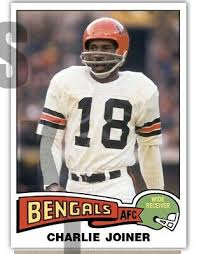
Joiner gave some thought to retirement before committing to play the 1977 season. He was reunited with his Grambling quarterback James Harris on the field, as Fouts was holding out through much of the season. Joiner was often double covered as newly acquired receiver Johnny Rodgers was injured, and their No. 1 draft pick from the year before, running back Joe Washington, was recovering from knee issues. Joiner finished with 35 catches, 542 yards and 6 touchdowns, short of his 1976 performance in all three statistics but still enough to led all Chargers wide receivers.

Ray Perkins became the Chargers' offensive coordinator in 1978, their third offensive coordinator in three years. He emphasized using running backs as possession receivers and rookie No. 1 pick John Jefferson as the deep threat while phasing out Joiner, who had undergone offseason knee surgery. He informed head coach Tommy Prothro before the season that he was considering retirement, but Prothro was able to persuade him to continue. Don Coryell became San Diego's head coach in 1978, replacing Prothro midseason; Coryell had a reputation as an offensive strategist, but largely stuck with Perkins' system in 1978. Joiner struggled with post-surgery knee problems during the year and finished with 33 receptions, two fewer than in 1976 despite the regular season increasing from fourteen games to sixteen.

In the 1979 season, Joiner featured heavily in the pass-based offense known as Air Coryell. The Chargers bolstered their receiving corps entering the season by using their first-round draft pick to select tight end Kellen Winslow. Coryell also hired Joe Gibbs as the new offensive coordinator that season after Perkins left for the New York Giants. They noticed that Joiner had been getting open the year before, and envisioned him as a key to their offense.

It was a successful regular season for the Chargers, as they posted a 12–4 record and earned their first divisional title in 14 years. Joiner played a key role in the division-deciding game, a 17–7 win over the Denver Broncos in the regular-season finale. He was forced back to the locker room twice during the game with injuries, but returned to the field bandaged both times. He sustained a concussion during the game and finished it with stitches over one eye, as well as hip and thigh injuries. Joiner finished the game with 3 catches for 58 yards and the game-winning touchdown. It was an inspirational performance with Jefferson unable to play and John Floyd, the Chargers only other receiver, being just a rookie; Coryell later remembered it as "The Charlie Joiner Game."

Joiner finished second in the AFC in receptions to Baltimore's Joe Washington, his former Chargers teammate, with a career-high 72 catches covering 1,008 yards and four touchdowns. His reception total was the most by a Charger since Lance Alworth's 73 in 1966, and the most by a player Joiner's age (32) in NFL history at that time. Joiner was the third player in league history to catch 70 or more passes after age 30, joining Don Maynard and Ahmad Rashad, who were each 30. He was named to the Pro Bowl, replacing an injured Lynn Swann, who himself was a replacement for Steve Largent. Joiner was the oldest player in the all-star game.

Joiner's third playoff game ended in another defeat; his former team the Oilers overcame key injuries to surprise San Diego 17–14 in their own stadium. A disappointed Joiner commented: "I think we took it for granted... You got to fight in this game. We let them take it away from us. They wanted it more than we did."

Joiner had again expected to retire after the previous season, but returned in 1980 saying he wanted "one more shot at the Super Bowl." He had a career-high 10 catches in one game in a 44–7 win over the New York Giants, accounting for 171 yards and a touchdown. Joiner finished the year with 71 receptions for 1,132 yards, and teamed with Jefferson and Winslow to become the first trio of receivers on a team to reach 1,000 yards in the same season. The three were all named first-team All-Pro by the Associated Press.

The Chargers won their division again, this time with an 11–5 record. In the divisional playoffs, Joiner's 9-yard touchdown catch from Fouts began a comeback that saw the Chargers turn a 14–3 halftime deficit into a 20–14 victory, Joiner's first in the playoffs. San Diego progressed to the AFC championship game, where Joiner led the team with 6 catches for 130 yards and two touchdowns, but could not prevent a 34–27 home defeat to the Raiders. Reflecting on a second consecutive season of being eliminated at home, Joiner said, "We have to think about opportunities. We really missed the last two years."

Joiner once again considered retirement before the 1981 season, saying "Frankly, I don't know how much longer I can play. I feel my skills have diminished." Nonetheless, he continued his career, beginning the season as the Chargers' top wide receiver due to Jefferson holding out and eventually being traded. In San Diego's opening game at Cleveland, Joiner caught 6 passes for 191 yards, which would be his best total with the Chargers. This prompted Fouts to say, "I don't why he's so much better than he was when I first saw him, but he is. I've never seen him better." After another strong performance in week 2, Joiner already had 13 catches for 357 yards on the season, and felt his knees to be in better condition than past seasons. His production decreased in the following weeks as opposing defenses double covered him, but the addition of Wes Chandler to replace Jefferson relieved that pressure. Joiner finished with 70 catches, making him the first receiver with at least 70 catches in three consecutive NFL seasons. He also had a team-leading and career-high 1,188 yards receiving, and the Chargers won their third consecutive AFC West title with a 10–6 record.

In the divisional playoffs, Joiner played a key role in San Diego's 41–38 overtime win over the Miami Dolphins, a game that became known as The Epic In Miami. He caught 7 passes for 108 yards, including a 39-yard reception on the penultimate play of the game set up Rolf Benirschke's game-winning 29-yard field goal. The Chargers advanced again to the conference championship, but lost 27–7 to Joiner's former team Cincinnati in a game later known as the Freezer Bowl due to frigid gameday conditions.

Joiner committed to another season in July, signing a new contract. The 1982 season was reduced to nine games by a players' strike. Joiner had no touchdowns in the regular season, though he did produce three 100-yard games.

San Diego finished 6–3, making the playoffs for the last time in Joiner's career. They won their first game 31–28 at the Pittsburgh Steelers, but lost the next 34–13 in Miami, with their powerful offense largely shut down. Joiner scored his only touchdown of the season during the Miami defeat. He said, "The Chargers are human. You can't ask everything of us, every game."

During the offseason Joiner intimated that his decision on whether to continue his career might rest on whether Fouts, a free agent, negotiated a new contract with the Chargers. Fouts did eventually sign, and Joiner was back for another season.

The Chargers had a disappointing 1983 campaign; Fouts missed time through injuries, and they finished 6–10. Joiner played the full season despite cracked ribs, he caught 65 passes for 960 yards and 3 touchdowns, and was voted both the most valuable and most inspirational Charger by his teammates. His late-career surge had seen Joiner catch 314 passes in the past five seasons after only catching 282 in his first ten.

Joiner quickly expressed an interest in returning for the 1984 season, and said that he was "kind of looking forward to camp." He nonetheless did not attend his first mandatory practice, as he was holding out for a two-year contract and the Chargers were only offering him one year. Winslow said of his absence, "It's like there's a missing link, the chemistry isn't there. It's as if you're missing an ingredient." The holdout lasted only six days before Joiner agreed to a one-year contract. He entered the season needing 52 receptions to break Charley Taylor's NFL record of 649 for a career.

Joiner made little impact during the early part of the season, with only eight catches during the first four games; in week 4 against the Raiders he had no catches at all, ending a streak of 85 consecutive games with a catch (78 regular season, 7 postseason). He improved enough to finish with 61 catches on the year.

Joiner passed Taylor as the career leader in receptions on November 25, 1984, breaking the mark with 6 catches for 70 yards and a touchdown in a 52–24 loss against the Steelers. The record-breaking 650th catch was a 3-yarder from backup quarterback Ed Luther late in the game. Joiner expressed disappointment that the landmark had come in an away game, in a loss, and that Fouts hadn't thrown the record-breaking pass.

During the offseason Joiner signed another one-year contract, committing to a tenth year with the Chargers. He stated in training camp that he considered himself "on the bubble" as a player who might struggle to maintain a place in the team at the expense of younger receivers. Joiner continued to play in every game, and passed Jackie Smith's record of 210 appearances at a receiving position early in the season. He finished the 1985 season with 59 catches for 932 yards, and tied his career high by scoring 7 touchdowns.

Joiner signed another one-year contract, and entered the 1986 season only 128 receiving yards behind Don Maynard's NFL record of 11,834 for a career. He would turn 39 during the course of the season and was the second-oldest active player behind Jeff Van Note of the Atlanta Falcons, as well as the oldest wide receiver in league history.

He surpassed Maynard's record of receiving yards in a week 5 away game against the Seattle Seahawks. The record-breaking catch was a 20-yarder from Fouts during the 3rd quarter of a 33–7 defeat; the game was halted briefly and Joiner got a standing ovation from the Seattle crowd. Joiner broke his right hand late in the season. In week 15, he was available to play in what would have been his final home game, but was kept on the sidelines by new head coach Al Saunders due to his injury. It was the first game he had missed since 1973 with the Bengals, and broke a 194-game regular season appearance streak. Joiner was disappointed, but said that the younger receivers had practiced all week for the game and it would have been unfair to them if he had played. Saunders expressed regret for not using him, saying that the Joiner's streak and potential last home game didn't cross his mind. Joiner did play the following week, ending his career with 3 catches for 25 yards in a 47–17 defeat at Cleveland.

Joiner finished the year with 34 catches, his least productive season since 1978, and retired from playing after the season. He said, "I'd thought about it for about eight or nine years and I finally did it. I'm 39 and that's too old to be playing football for a wide receiver. I've had a great career, I think, and I'm just proud of the fact that I finished No. 1, even though it probably won't last that long."

Joiner was the last active player from the AFL. He finished his 18 AFL/NFL seasons with 750 receptions for 12,146 yards, averaging 16.2 average per catch, and 65 touchdowns. He caught 586 passes in 11 seasons with San Diego after totaling 164 in seven seasons with Houston and Cincinnati. Joiner had 50 or more catches in seven seasons, five with 60 or more, and three with at least 70 with the Chargers. He retired as the then-NFL leader in career receptions and receiving yards. At the time, he also played the most seasons (18) and games by a wide receiver (239). At age 39, Joiner also retired as the oldest wide receiver in NFL history, Joiner had 530 receptions after he was 30 years old, including 396 starting from the 1980 season, during which he turned 33. He credited his success and longevity to Coryell: "Thanks to Coach Coryell’s offense and his revolutionary passing game, he prolonged my career, from the day I got to the Chargers until the day I retired. I will forever be grateful to him and what he did for the game of football."

Joiner excelled despite neither being among the quickest nor most talented receivers in the NFL. Throughout his career, he was overshadowed by more glamorous receiving mates, including LeVias and Ken Burrough in Houston, Curtis in Cincinnati, and Jefferson, Chandler, and Winslow with San Diego. In addition to good health and longevity, Joiner was an intelligent player and precise pass route runner, capable of changing direction without sacrificing speed due to a short stride and low centre of gravity. He had a tendency to fumble while with the Bengals, but fixed the problem and seldom fumbled while in San Diego. Joiner rarely ran deep routes, specialising in running inside patterns and making tough catches in traffic. He became aware early in his time in San Diego that he no longer had the sprinting speed of his youth, and compensated with an improved knowledge of defenses brought on by experience. Quiet and modest as an individual, Joiner was voted the Chargers' most inspirational player seven times by his teammates.

Hall of Fame coach Walsh called Joiner "the most intelligent, the smartest, the most calculating receiver the game has ever known." Gibbs, his offensive coordinator in San Diego, praised Joiner as "a totally dedicated guy who was just a great producer." "Without question, he is the finest technician—running routes and reading coverages—in the National Football League", said Ernie Zampese, the Chargers' receiving coach. Bengals teammate Bob Trumpy praised Joiner's work ethic, saying, "You know why he's caught all those balls? Because he's busted his tail in every practice, on every play in practice. Whatever quarterback he's been with has known that Charlie will be there, every time. He trusts Charlie." Joiner was Fouts' favorite receiver on third down. "All I’m trying to do out there is look for a port in a storm. He’s the port. Having Charlie is like having a fail-safe button," said Fouts.

Joiner was inducted into the Louisiana Sports Hall of Fame in 1990. He was voted into the Pro Football Hall of Fame in 1996, becoming the third Grambling player to be selected. In 1999, he was ranked No. 100 on The Sporting News's list of the 100 greatest football players, while a 2019 USA Today article ranked him as the ninth-best player in Chargers history. He was inducted into the Black College Football Hall of Fame in 2013. The Chargers inducted Joiner into their hall of fame in 1993 and retired his No. 18 in 2023.

In 1987, Saunders hired Joiner as an assistant coach working with wide receivers. He was retained by the following head coach, Dan Henning, but Henning's entire coaching staff were dismissed following the 1991 season, ending Joiner's sixteen-year run with the team as a player and coach. He joined the Marv Levy's Buffalo Bills shortly afterwards, again serving as a wide receiver coach, then moved on to take the same role with the Kansas City Chiefs in 2001. Joiner stayed with the Chiefs for seven seasons before losing his job with them in 2008; he re-joined the Chargers three weeks later for final stint working with their receivers. Joiner spent five more years in San Diego, then announced his retirement at the age of 65, saying football was "definitely a young man's game."

Joiner's retirement ended a 44-year professional career, eighteen as a player and twenty-six as a position coach. Twenty-one of those years were spent with the Chargers.

After leaving the Oilers, Joiner continued to live in Houston throughout the rest of his playing career, only moving to Rancho Bernardo in San Diego when he joined the Chargers' coaching staff. He has an accountancy degree from his time in college, and worked part time for Gulf Oil during the offseason for ten years. Joiner was unusual in not employing a sports agent, as his knowledge of finance allowed him to manage his own contract negotiations.

Joiner is married and has two daughters.

Sources
https://www.pro-football-reference.com/
https://www.profootballarchives.com/index.html
https://americanfootballdatabase.fandom.com/wiki/Football_Wiki
https://www.gridiron-uniforms.com/GUD/controller/controller.php?action=main
https://www.profootballhof.com/hall-of-famers/
 "Charlie Joiner statistics". Pro Football Reference. Retrieved March 20, 2024.
 Smith, Don (1996). "Charlie Joiner" (PDF). The Coffin Corner. Vol. 18, no. 2. Professional Football Researchers Association. Retrieved March 19, 2024.
 Gaines, Bob (August 31, 1985). "When they were young". Daily Times-Advocate. p. 19 – via newspapers.com.
 Harrison, Cal (September 28, 1963). "Boston knocks Wallace 52–6". Lake Charles American-Press. p. 12 – via newspapers.com.
 "Panthers wallop J.S. Clark 91–6". Lake Charles American-Press. November 15, 1964. p. 36 – via newspapers.com.
 "2 win in tipoff; pairings are set". Lake Charles American-Press. December 19, 1964. p. 6 – via newspapers.com.
 "Clark is champion in district 7–AAA". Lake Charles American-Press. April 23, 1965. p. 12 – via newspapers.com.
 Football Media Guide (PDF). Grambling State University Athletics. 2018. p. 156.
 "Inductees of the Black College Football Hall Of Fame". blackcollegefootballhof.org. Retrieved March 10, 2024.
 "Grambling might puts crusher on P.V. Panthers". New Pittsburgh Courier. October 9, 1965. p. 14 – via newspapers.com.
 "4. Charlie Joiner". Corpus Christi Times. February 11, 1969. p. 3-B – via newspapers.com.
 "Brief summary of cumulative football statistics, Grambling 1966". stats.ncaa.org. Retrieved November 17, 2024.
 "All-SWAC team names six Tigers". Shreveport Times. December 18, 1966. p. 6-D – via newspapers.com.
 "Grid awards". Louisiana Weekly. June 3, 1967. p. 11 – via newspapers.com.
 Young, Rick (December 28, 1994). "Grambling star end Moore a traveler". Alabama Journal. p. 12 – via newspapers.com.
 "Brief summary of cumulative football statistics, Grambling 1968". stats.ncaa.org. Retrieved November 17, 2024.
 "Grambling bowl victor". Lancaster Sunday News. AP. December 8, 1968. p. 46 – via newspapers.com.
 Howard, Brian (ed.). "2022 Grambling Football Fact Book" (PDF). Grambling Athletics Communications Office. p. 65. Retrieved January 20, 2023.
 Gaines, Bob (December 14, 1985). "That ol' man Joiner keeps rollin' along". Escondido Times-Advocate. p. B1 – via newspapers.com.
 "Charlie Joiner". Pro Football Hall of Fame. Retrieved January 22, 2022.
 Harris, Andrew (February 9, 1969). "Speaking of sports". Baton Rouge News Leader. p. 1-D – via newspapers.com.
 Distel, Dave (December 13, 1986). "Don't strike up band, just give Charlie Joiner a hand". Los Angeles Times. pp. III-1, III-24 – via newspapers.com.
 Magee, Jerry (December 29, 1979). "Aging Charlie Joiner now a thinking man's receiver". Shreveport Times. Gannett News Service. p. 2-C – via newspapers.com.
 "Fractured arm sidelines Joiner". Tampa Tribune. UPI. October 27, 1969. p. 4-C – via newspapers.com.
 McDonough, Will (November 1, 1969). "Oilers pick over Pats despite injury jinx". Boston Globe. p. 22 – via newspapers.com.
 "Team history". Pro Football Hall of Fame. Retrieved November 16, 2024.
 "Oilers elect five captains for game". McAllen Monitor. UPI. September 17, 1970. p. 17 – via newspapers.com.
 "Oilers activate Charlie Joiner". Brownsville Herald. UPI. October 23, 1970. p. 10 – via newspapers.com.
 "Oilers, Chargers tie". Quad-City Times. October 26, 1970. p. 7.
 "Surprising Bengals clinch tie by 30–20". Fort Worth Star-Telegram. AP. December 14, 1970. p. 5C – via newspapers.com.
 "Charlie Joiner touchdowns". Pro Football Reference. Retrieved March 11, 2024.
 "Football's lopsided deal". Pomona Progress-Bulletin. United Press International. July 27, 1971. p. C-1 – via newspapers.com.
 "Oilers go out to salvage some pride". Corpus Christi Caller-Times. December 3, 1971. p. 6 – via newspapers.com.
 "1971 Houston Oilers summary". Pro Football Reference. Retrieved March 11, 2024.
 "Oilers land two rushers". Kansas City Star. AP. October 24, 1972. p. 13 – via newspapers.com.
 "Phipps late score saves Browns, 23-17". Daily Oklahoman. AP. October 23, 1972. p. 25 – via newspapers.com.
 Forbes, Dick (October 26, 1972). "Bengal newcomers, some new, some 'old', at Spinney Field". Cincinnati Enquirer. p. 73 – via newspapers.com.
 Callahan, Tom (November 10, 1972). "Strike up the band". Cincinnati Enquirer. p. 55 – via newspapers.com.
 Forbes, Dick (October 27, 1972). "Newcomers to see action—P.B." Cincinnati Enquirer. p. 30 – via newspapers.com.
 "An easy one for 'the old coach'". Cincinnati Enquirer. October 30, 1972. p. 50 – via newspapers.com.
 Stewart, D.L. (July 19, 1973). "Bengals trade may prove OK". Dayton Journal Herald. p. 18 – via newspapers.com.
 Forbes, Dick (June 10, 1973). "Bengals sign Chandler, like Spinney, preview". Cincinnati Enquirer. p. 8-C – via newspapers.com.
 Cobb, Barry (January 31, 1973). "Curtis, Chandler could be starters". Cincinnati Post. p. 9 – via newspapers.com.
 Cobb, Barry (February 1, 1973). "245-pound back taken by Bengals". Cincinnati Post. p. 25 – via newspapers.com.
 Cobb, Barry (September 19, 1973). "Dressler, Joiner doubtful". Cincinnati Post. p. 19 – via newspapers.com.
 "Carter injured, lost for season". Beckley Post-Herald. AP. September 11, 1973. p. 3 – via newspapers.com.
 Forbes, Dick (October 6, 1973). "Joiner has some lost time to redeem Sunday". Cincinnati Enquirer. p. 23 – via newspapers.com.
 Kozloski, Hank (October 8, 1973). "Cleveland gets by Bengals, 17-10". Mansfield News-Journal. p. 19 – via newspapers.com.
 "Crippled Bengals can expect no mercy from Steelers". Racine Journal Times. Associated Press. October 14, 1973. p. 5C – via newspapers.com.
 Appleman, Marc (December 16, 1986). "Joiner stood idle as streak came to end". Los Angeles Times. pp. III-1, III-9 – via newspapers.com.
 Stewart, D. L. (November 26, 1973). "Bengals say Cards 'dirty'". Dayton Journal Herald. p. 11 – via newspapers.com.
 Gray, Frank (December 10, 1973). "Bengals 'shoot the works'". Troy Daily News. p. 14 – via newspapers.com.
 Rorrer, George (September 21, 1974). "Charlie Joiner". Louisville Courier-Journal. p. 12 – via newspapers.com.
 Lutz, Michael A. (December 17, 1973). "Champ Bengals subdued". Brownwood Bulletin. Associated Press. p. 7-A – via newspapers.com.
 Williams, Marty (December 24, 1973). "Miami's near-perfection shocks Bengals, 34–16". Dayton Daily News. p. 6 – via newspapers.com.
 "Bengals ink pair". Paterson News. UPI. May 25, 1974. p. 17 – via newspapers.com.
 Kozloski, Hank (October 14, 1974). "Bengals blast Browns, 34 to 24". Mansfield News-Journal. p. 9 – via newspapers.com.
 Fink, David (December 14, 1974). "Those Bengals: cats of a different color". Pittsburgh Post-Gazette. p. 10 – via newspapers.com.
 Queenan, Bob (November 27, 1975). "Charlie Joiner is the Bengals Mr. Modest". Cincinnati Post. p. 44 – via newspapers.com.
 "Bengals Deal Joiner For Chargers' Bacon". Coshocton Tribune. UPI. April 2, 1976. p. 8. Retrieved January 27, 2022 – via Newspapers.com.
 "Chargers Get Joiner". Times-Advocate. Escondido, California. AP. April 2, 1976. pp. A-11, A-12. Retrieved January 27, 2022 – via Newspapers.com.
 Williams, Marty (November 24, 1975). "Browns Spot Flaw, Then Belt Bengals". Dayton Daily News. p. 16. Retrieved January 27, 2022 – via Newspapers.com.
 "Regular Season Individual Records - Cincinnati Bengals". Archived from the original on October 14, 2006. Retrieved November 15, 2006.
 "Career highlights". Lafayette Daily Advertiser. January 14, 1987. p. 28 – via newspapers.com.
 "Raiders face gamble against playoff odds". Roanoke World-News. AP. December 29, 1975. p. 15 – via newspapers.com.
 "Bengals: we should have won". Tallahassee Democrat. AP. December 29, 1975. p. 20 – via newspapers.com.
 "Charlie Joiner traded". Belleville News-Democrat. April 2, 1976. p. 15 – via newspapers.com.
 "Bengals Deal Joiner for Charger's Bacon". The Coshocton Tribune. UPI. April 2, 1976. p. 8. Retrieved March 5, 2022 – via Newspapers.com.
 Hoff, Dave (August 4, 1976). "New look spawns Charger hopes". Escondido Times-Advocate. p. A-17. Retrieved March 5, 2022 – via Newspapers.com.
 Hoff, Dave (August 2, 1976). "Chargers' first step pointing right direction". Escondido Times-Advocate. p. A-9 – via newspapers.com.
 "Frustrated Chargers are dangerous". Palm Springs Desert Sun. UPI. November 13, 1976. p. A14 – via newspapers.com.
 Felser, Larry (November 20, 1976). "Scoring amnesia hurts last chance to win at home". The Buffalo News. p. B-3 – via newspapers.com.
 Gosselin, Rick (November 28, 1976). "Zones, blitzes aid NFL pass rebirth". Miami Herald. United Press International. p. 2-C – via newspapers.com.
 "Podolak pops Chargers". Escondido Times-Advocate. UPI. November 29, 1976. p. A-9 – via newspapers.com.
 "Stabler is No. 1 passer". Tucson Daily Citizen. Associated Press. December 16, 1976. p. 54 – via newspapers.com.
 Hoff, Rick (July 24, 1977). "Rodgers high on Chargers' hopes for '77". Times-Advocate. Escondido, California. p. B-1. Retrieved January 17, 2022 – via Newspapers.com.
 Olderman, Murray (January 11, 1977). "O.J., Ham, Guy Top All-NFL". The Register. Orange County, California. Newspaper Enterprise Association. p. C-3. Retrieved January 17, 2022 – via Newspapers.com.
 Michaels, Matt (October 2, 1977). "Look-a-like coaches facing each other". Times-Advocate. Escondido, California. p. B-6. Retrieved March 6, 2022 – via Newspapers.com.
 Albers, Bucky (September 28, 1977). "Joiner bit wistful about Bengal era". Dayton Journal Herald. p. 15 – via newspapers.com.
 Whicker, Mark (September 26, 1984). "Joiner's efficiency yields high mileage". Philadelphia Daily News. p. 87 – via newspapers.com.
 Distel, Dave (September 11, 1981). "Cornerbacks just don't buy Charlie Joiner's deterioration". Los Angeles Times. pp. III-1, III-18 – via newspapers.com.
 Braucher, Bill (October 2, 1977). "SD's Harris still seeking an NFL home". Cincinnati Enquirer. p. C1.
 "Chargers 30, Seahawks 28". San Francisco Examiner. November 28, 1977. p. 46.
 Frauenheim, Norm (May 27, 1978). "Jefferson set to sign soon". Arizona Republic. p. D-11 – via newspapers.com.
 Zimmerman, Paul (October 8, 1984). "HE'S CATCHING UP TO THE CATCHING RECORD". Sports Illustrated. Retrieved January 19, 2023.
 "Joiner hints at retirement". Cincinnati Enquirer. February 10, 1980. p. C-16 – via newspapers.com.
 Oates, Bob (October 1, 1978). "Pro football". Los Angeles Times. p. III-2.
 Pierson, Don (October 23, 1981). "Air Coryell flying high". Chicago Tribune. pp. VI-1, VI-4.
 Distel, Dave (October 24, 1979). "A patient man calls the shots for Chargers". Los Angeles Times. pp. III-1, III-6.
 "Joiner bounces off mat to spur Charger victory". Columbus Ledger. AP. December 18, 1979. p. C-1 – via newspapers.com.
 Dolan, Steve (January 13, 1987). "For Joiner, Career Had Thrills and a Regret : He Recalls Records, but Missed Super Bowl". Los Angeles Times. Retrieved March 19, 2024.
 Mayer, Ron (January 24, 1980). "Joiner: A Sub's Still an Honor". Honolulu Star-Bulletin. p. D-1. Retrieved January 18, 2022 – via Newspapers.com.
 Maffei, John (August 28, 1980). "Chargers must pass the test in '80". Escondido Times-Advocate. Football Supplement, p. 3. Retrieved January 6, 2024 – via Newspapers.com.
 "Phillips: 'character exhibited'". Lancaster Sunday News. AP. December 30, 1979. p. C-3.
 "Steelers next for reborn Oilers". Tampa Tribune. UPI. December 31, 1979. p. 8-C – via Newspapers.com.
 "Chargers dominate All-Pro squad..." Times-Advocate. Escondido, California. AP. January 7, 1981. p. D-1. Retrieved January 17, 2022 – via Newspapers.com.
 "Benirschke, Fouts pace Chargers to 26–17 win". Sacramento Bee. AP. December 23, 1980. pp. C1, C4 – via Newspapers.com.
 "'Electric' Chargers shock Bills, 20–14". Santa Cruz Sentinel. AP. January 4, 1981. pp. 47, 50 – via Newspapers.com.
 Maffei, John (January 12, 1981). "Chargers' story ends on super sour note". Escondido Times-Advocate. pp. D-1, D-2 – via Newspapers.com.
 Valli, Bob (January 13, 1981). "Silent grief replaces Chargers' spark". Oakland Tribune. p. D-3.
 "Jefferson puts trust in Slusher". Zanesville Times Recorder. AP. July 30, 1981. p. 5-B – via newspapers.com.
 Pulliam, Kent (September 20, 1981). "Fouts and Joiner on same wavelength". Kansas City Star. p. 15 – via newspapers.com.
 "Seattle Seahawks vs. San Diego Chargers". Escondido Times-Advocate. October 2, 1981. p. C-4 – via newspapers.com.
 Byrd, Jerry (November 14, 1981). "Still going up hill at 34". Shreveport Journal. p. 1-B – via newspapers.com.
 Magee, Jerry (December 25, 1981). "Dan Fouts". Miami News. p. 1C – via newspapers.com.
 Moran, Malcolm (January 3, 1982). "CHARGERS WIN IN OVERTIME; COWBOYS ROMP; BENIRSCHKE KICK GIVES SAN DIEGO 41-38 DECISION". The New York Times. Section 5, page 1. Retrieved December 17, 2019.
 "Bengals say cold beat the Chargers". Lafayette Journal and Courier. AP. January 11, 1982. p. C-1 – via Newspapers.com.
 "Sports in brief". Asbury Park Press. Associated Press. July 10, 1982. p. B4 – via newspapers.com.
 "Tentative agreement reached; NFL to resume play Sunday with nine-week abbreviated season". Eau Claire Leader-Telegram. AP. February 5, 1982. p. 1B – via Newspapers.com.
 Maffei, John (January 10, 1983). "For the Chargers, weather was NF—no factor". Escondido Times-Advocate. p. D4 – via newspapers.com.
 "NFL playoffs are emotional for winners and losers". Modesto Bee. January 17, 1983. p. C-3 – via newspapers.com.
 Greene, Jerry (January 17, 1983). "Charger circus performance: Clowns under the 'big flop'". Orlando Sentinel. p. C-4 – via newspapers.com.
 Distel, Dave (April 14, 1983). "Their future lies in Fouts' hands". Los Angeles Times. p. III-1 – via newspapers.com.
 "Chargers give Fouts big bucks to sign 6-year pact". Tampa Tribune. AP. June 30, 1983. p. 1C – via Newspapers.com.
 Cobbs, Chris (December 20, 1983). "Chargers' season ends on a high note for Charlie Joiner". Los Angeles Times. pp. III-1, III-9 – via newspapers.com.
 Norcross, Don (July 27, 1984). "Chargers welcome back 'the pro'". Escondido Times-Advocate. pp. C1, C6 – via newspapers.com.
 Magill, Eric (June 20, 1984). "Joiner adds specialty to 'contact'". Salisbury Daily Times. p. 29 – via newspapers.com.
 "Chargers notes". Escondido Times-Advocate. July 22, 1984. p. D3 – via newspapers.com.
 Norcross, Don (September 28, 1984). "Should the Chargers worry about Joiner". Escondido Times-Advocate. pp. C1, C7 – via newspapers.com.
 "Joiner signs for 17th year". Abilene Reporter-News. April 24, 1985. p. 2-C – via newspapers.com.
 Pulliam, Kent (December 15, 1984). "The game always comes first for Chargers' Joiner". Kansas City Times. p. E-4 – via newspapers.com.
 "Chargers' Joiner snaps NFL receiving mark". Twin Falls Times-News. AP. November 26, 1984. p. B-3 – via newspapers.com.
 Distel, Dave (July 31, 1985). "On the bubble". Los Angeles Times. pp. III-1, III-8 – via newspapers.com.
 "Fouts, Joiner still thanking Bengals". Hanford Sentinel. United Press International. September 20, 1985. p. 11 – via newspapers.com.
 Posner, Jay (February 27, 1986). "Joiner signs contract for 18th pro season". Escondido Times-Advocate. p. D1 – via newspapers.com.
 "Rice set record in years". Tampa Bay Times. October 12, 2002. p. 10C – via newspapers.com.
 Garber, Greg (August 10, 1986). "Game has changed, Falcon in middle hasn't". Hartford Courant. p. E12 – via newspapers.com.
 Gaines, Bob (August 30, 1986). "Joiner keeps bagging those milestones". Escondido Times-Advocate. pp. 12, 24 – via newspapers.com.
 "Largent, Joiner Set Reception Records". The New York Times. AP. October 7, 1986. p. D28. Retrieved January 13, 2022.
 "Joiner misses what may be last home game". Meriden Record-Journal. UPI. December 16, 1986. p. 14 – via newspapers.com.
 Posner, Jay (December 22, 1986). "Chargers notes". Escondido Times-Advocate. p. D2 – via newspapers.com.
 Judge, Clark (January 12, 1987). "Joiner retires to coach WRs - Chargers release Durden, Bauer". Evening Tribune. p. C-1. Retrieved January 19, 2023. At 39, Joiner was coming off his least productive season (34 catches) since 1978 and made it known he would like to enter coaching.
 "Largent in daze after record-setting catch". Spokane Spokesman-Review. December 28, 1987. p. C1 – via newspapers.com.
 "Sunday's stars". San Bernardino County Sun. September 19, 1988. p. C6 – via newspapers.com.
 "NFL receiving whiz Charlie Joiner exits". Shreveport Times. Associated Press. January 13, 1987. p. 15 – via newspapers.com.
 "Joiner retires". Merced Sun-Star. Associated Press. January 13, 1987. p. 10. Retrieved January 15, 2022 – via Newspapers.com.
 "Hall of Fame Thumbnails". Los Angeles Times. Associated Press. January 16, 1994. Retrieved January 15, 2022.
 Cobbs, Chris (January 12, 1987). "Joiner May Retire Today, Source Says". Los Angeles Times. Retrieved January 19, 2023.
 "Charlie Joiner highlights". The Oregonian. January 14, 1987. p. D5 (61).
 Center, Bill (July 10, 2010). "Don Coryell, ex-Chargers, Aztecs coach dies at 85". San Diego Union-Tribune. Retrieved January 9, 2023.
 "Chargers-Bears". Escondido Times-Advocate. November 30, 1978. p. D-4 – via newspapers.com.
 "Walsh looks to O.J. and J.O. in his initial season". Los Angeles Times. June 4, 1979. pp. III-7, III-7 – via newspapers.com.
 "Joiner". Los Angeles Times. November 14, 1984. p. III-8 – via newspapers.com.
 "Joiner". Los Angeles Times. November 14, 1984. p. III-8 – via newspapers.com.
 "Monday scouting report". Miami News. October 27, 1984. p. 59 – via newspapers.com.
 Wolf, Bob (September 11, 1987). "The man who can't miss can quit". Los Angeles Times. p. III-2C – via newspapers.com.
 Burick, Si (June 30, 1974). "When speaking of big backs, can Jim Brown be forgotten?". Dayton Daily News. p. 1-D – via newspapers.com.
 Olderman, Murray (December 27, 1984). "Record holder is quiet". Sapulpa Daily Herald. NEA. p. 9 – via newspapers.com.
 "Coaches". Escondido Times-Advocate. September 12, 1987. p. 39 – via newspapers.com.
 Trey Iles (July 23, 2014). "NFL Hall of Famer Grambling's Charlie Joiner is No. 28 on Louisiana's list of all-time top 51 athletes | Sports". The Times-Picayune. nola.com. Retrieved October 26, 2019.
 Friend, Tom (January 28, 1996). "Dierdorf And Gibbs Lead Five Into Hall". The New York Times. Retrieved January 9, 2023.
 Matthews, Bob (August 15, 1999). "Wings' streak was Rochester's best". Rochester Democrat and Chronicle. p. 3D. Retrieved December 17, 2019 – via Newspapers.com.
 Borquez, Gavino; Neumann, Thomas (August 29, 2019). "NFL 100: Best players in Chargers history". USA Today. Retrieved August 29, 2019.
 "All Inductees". BlackCollegeFootballHOF.org. Archived from the original on February 2, 2020. Retrieved February 25, 2021.
 Roth, Leo (September 15, 1993). "Chargers to honor ex-great Joiner". Rochester Democrat and Chronicle. p. 6D.
 "Chargers to Retire Numbers of Pro Football Hall of Fame Receiver Charlie Joiner and Pro Football Hall of Fame Tight End Kellen Winslow at Season Opener". Chargers.com. August 24, 2023.
 Canepa, Nick (November 16, 2009). "Greatest Chargers list rings true". The San Diego Union-Tribune. Archived from the original on January 14, 2010.
 "Chargers to Relocate to Los Angeles". Los Angeles Chargers. January 12, 2017. Archived from the original on January 12, 2017. Retrieved February 22, 2017.
 "Los Angeles Chargers 2023 Media Guide". NFL.com. Los Angeles Chargers. pp. 327–328. Retrieved March 20, 2024.
 Distel, Dave (February 20, 1992). "Fame has yet to catch up with Joiner". Los Angeles Times. pp. C1, C9A – via newspapers.com.
 "Posnanski: Receivers aren't speedy". Kansas City Star. August 7, 2001. p. C7 – via newspapers.com.
 "Joiner replaces Lofton as Chargers receivers coach". NFL.com. Retrieved January 23, 2008.
 "Charlie Joiner retires from San Diego Chargers". NFL.com. January 22, 2013. Retrieved October 26, 2019.
 Brown, Bruce (June 23, 1985). "Hall of Fame threesome joined by common thread". Lafayette Daily Advertiser. p. 33 – via newspapers.com.
 Distel, Dave (July 28, 1984). "Chargers' Joiner showed class even while holding out". Los Angeles Times. p. III-1 – via newspapers.com.

Wednesday, May 22, 2024

The Story And Significance Of Joe Gibbs - Head Coach Of Three Super Bowl Teams With Three Different Starting Quarterbacks

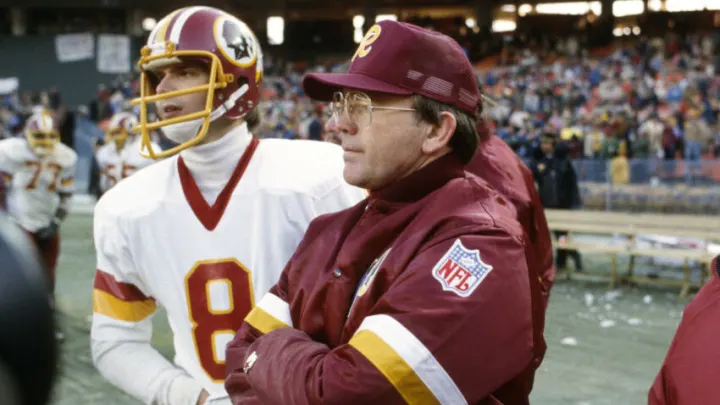
Joe Jackson Gibbs is an American auto racing team owner and former football coach. He served two stints as the head coach of the Washington Redskins of the National Football League, from 1981 to 1992 and then 2004 to 2007. Gibbs led them to nine playoff appearances, four NFC Championship titles, and three Super Bowl wins over 16 total seasons.

Gibbs was named NFL Coach of the Year in 1982 and 1983 and is the only head coach to have won Super Bowls with three different starting quarterbacks. He and his family founded the NASCAR team Joe Gibbs Racing in 1992, which has since won five NASCAR championships. Gibbs was inducted into the Pro Football Hall of Fame in 1996 and the NASCAR Hall of Fame in 2020, the only member of both, and was voted onto the NFL 100th Anniversary All-Time Team.

Gibbs began his career in 1964 coaching offensive linemen under Don Coryell for the San Diego State Aztecs football team. He served two years each at Florida State, USC, and Arkansas. Gibbs then advanced to the National Football League, hired as the offensive backfield coach for the St. Louis Cardinals (1973–1977) by Coryell, who had been named head coach. After a season as offensive coordinator for the Tampa Bay Buccaneers (1978) under McKay, Gibbs rejoined Coryell with the San Diego Chargers in 1979.

While in Tampa, Gibbs developed the reputation as a leading pioneer for championing black quarterbacks in the NFL, which was considered extremely controversial at the time. After thoroughly studying Matt Cavanaugh, who led Pitt to a national championship, Guy Benjamin, an All-American from Stanford University, and Doug Williams from Grambling State University, Gibbs rated Williams as the best professional prospect, and informed head coach McKay that Williams would be "hands down and without question" the best quarterback in the 1978 NFL draft. According to Tony Dungy, "People don't realize that Joe Gibbs changed the face of the NFL by having the courage to say, in a Southern town at that time, that Doug Williams is the guy we should take. When Tampa drafted Doug, it shocked the whole country to take this unknown from Grambling over those star players from Pitt and Stanford. But that was Joe Gibbs. He was looking for the best player possible." With the recommendation of Gibbs, Tampa Bay selected Williams, and became the first African-American drafted in the first round to play quarterback.

In his book Rise of the Black QB, author Jason Reid cited an incident in the 1978 Tampa Bay training camp, in which quarterbacks coach Bill Nelsen began berating Williams in what was described as going beyond coaching and becoming a personal attack. Just a position coach at the time, Gibbs, who was at the opposite end of the field, sprinted over to Nelsen and confronted him. "I think Coach Gibbs knew that it wasn't a matter of being coached hard," recalled Williams. "I mean, I played for Eddie Robinson at Grambling, so he knew I could handle that. But he (Gibbs) immediately sensed that something else was going on."[3] Gibbs threw his clipboard down, pointed his finger in Nelsen's face and said, "Don't you ever talk to him like that again! Is that clear?" According to Williams, Nelsen never confronted Williams in that manner again.

As the offensive coordinator for San Diego, Gibbs spearheaded the highly successful "Air Coryell" offense. Using a sophisticated passing attack, the Chargers and quarterback Dan Fouts set multiple offensive records during Gibbs' two seasons there. Remarkably, the Chargers averaged more than 400 yards of offense per game during their 1980 season. After 17 years of coaching as an assistant, the Washington Redskins offered Gibbs their head coaching position.

After firing then-head coach Jack Pardee, Redskins owner Jack Kent Cooke was on the lookout for candidates. When general manager Bobby Beathard pointed out the 40-year-old San Diego assistant coach, Cooke, who had a keen eye for spotting leadership and an ability to teach (he also hired Jerry West and Sparky Anderson to their first managerial/executive jobs), saw Gibbs' potential during an interview and hired him.

Gibbs' first season with the Redskins started inauspiciously when the team lost their first five games. Cooke famously expressed confidence in Gibbs, declaring that the team would finish 8–8. The losses and Cooke's confidence served as a catalyst, and the newly motivated team improved and reached an even 8–8 record in 1981.

Gibbs' second season with the Redskins, which was shortened by a players strike, saw them defeat the Miami Dolphins 27–17 in Super Bowl XVII. In 1983, Gibbs' success continued with a 14–2 regular-season record and a win against the Los Angeles Rams 51–7 at home, in the divisional round of the playoffs. The Redskins once again won an NFC Championship, defeating the San Francisco 49ers 24–21 on a last-second field goal, advancing to Super Bowl XVIII. The Redskins were installed as a 2-point favorite by Nevada books going into the game, but were soundly defeated by the Los Angeles Raiders 38–9.

The 1984 Redskins won the NFC East with an 11–5 record and hosted a home playoff game against the Chicago Bears but lost 23–19.

Gibbs coached the 1985 Redskins to a 10–6 regular-season record and barely missed the playoffs. During the season Joe Theismann broke his leg during a Monday Night Football game against the New York Giants, but the Redskins still won the game with Jay Schroeder at quarterback.

In 1986, Gibbs coached the team to a 12–4 regular-season record and defeated the Los Angeles Rams 19–7 in the wild card playoffs, then upset the defending champion Chicago Bears 27–13 in the divisional round, on the road, to get back to the NFC Championship game against the New York Giants. The Giants would win 17–0. It was to be Gibbs' only NFC championship game loss.

The 1987 Redskins made the playoffs and again defeated the Chicago Bears 21–17 on the road in the divisional round, then beat the Minnesota Vikings 17–10 at home in the NFC Championship Game, then at Super Bowl XXII, they rode the arm of quarterback Doug Williams to blow out the Denver Broncos 42–10.

Four years later, the Redskins won their first 11 games before finishing the season 14–2, and cruised through the playoffs with home victories over the Atlanta Falcons (24–7) and Detroit Lions (41–10). In Super Bowl XXVI, the Redskins were up 24–0 on the Buffalo Bills just 16 seconds into the third quarter, and 37–10 with over 11 minutes to go when Gibbs pulled most of his starters. The Bills would score two cosmetic touchdowns for a final score of 37–24. The victory gave Gibbs and the team their third Super Bowl title.

Gibbs returned for the 1992 regular season to defend the Redskins' Super Bowl crown from the previous year. The Redskins finished with a lesser record at 9–7 and third place in the NFC East. They needed a bit of help to make the playoffs and they got it after a loss by the Green Bay Packers got them in as the last Wild Card entry. In the wild-card round, the Redskins defeated the Minnesota Vikings on the road, by the score of 24–7, however they would fall in the divisional round to the San Francisco 49ers in a road game by the score of 20–13, ending the Redskins' hopes of retaining their Super Bowl crown. Two months after Super Bowl XXVII, Gibbs retired on March 5, 1993, surprising many in the organization and around the league. Center Jeff Bostic called it "probably the biggest shock I've gotten in my life." A notorious workaholic, he had begun to suffer health problems, and he cited a desire to spend more time with his family.

From 1994 to 1997, Gibbs served as a color analyst on NBC Sports' NFL pregame show.

In 1996, Gibbs was enshrined in the Pro Football Hall of Fame. He was one of the winningest coaches in the NFL, with a record of 124–60, and a post-season record of 16–5. His combined winning percentage of .683 was third all-time (behind Vince Lombardi and John Madden). In his 12 seasons so far, the Redskins won 4 NFC East titles, reached the playoffs 8 times, and finished with a losing record only one season (7–9 in 1988). Gibbs is the only NFL coach to win three Super Bowls with three different starting quarterbacks and three different starting running backs.

Although Gibbs helped craft a passing-oriented attack during his time in San Diego, his Redskins teams incorporated a smash-mouth, rushing-oriented attack oriented around such plays as the iconic counter trey. By building a strong offensive line (known as "The Hogs") Gibbs was able to control the line of scrimmage, allowing workhorse running backs John Riggins, George Rogers, and Earnest Byner to power the ground game. Gibbs added a deep passing attack which complemented the ground game, utilizing agile receivers such as Art Monk, Gary Clark, and Ricky Sanders. Gibbs' offense was aided by aggressive defensive units under the direction of defensive coordinator Richie Petitbon.

Gibbs' system was robust enough to be successful without a Hall-of-Fame-caliber quarterback at the helm. The Redskins' Super Bowl victories were won featuring Joe Theismann, Doug Williams, and Mark Rypien. Gibbs is credited with inventing the H-back set, typically by use of a smaller tight end in the backfield. Gibbs was also credited for creating the Trips formation: stacking three wide receivers to one side. He is one of few coaches that utilized the H-back position prominently in his offense. Gibbs' offenses were known for their extensive number of formations, as well as shifts and motions.

Gibbs created his NASCAR team, Joe Gibbs Racing in 1992, a year before he first retired from the NFL. The first driver for his team was Dale Jarrett (1992–1994), with the sponsor Interstate Batteries, and the number 18. His son, J. D. Gibbs, was the president of Joe Gibbs Racing and oversaw daily operations of each of the teams since his father's return to the NFL. J. D. Gibbs passed away on January 11, 2019. Driver Denny Hamlin won the Daytona 500 on February 17 and dedicated the win to J. D. in his post-race celebration.

The team currently fields four full-time entries in the NASCAR Cup Series and three full-time entries in the NASCAR Xfinity Series.

In 2008, Gibbs branched out into motorcycle racing, forming the JGRMX team competing in the AMA motocross and supercross championships. The team is based in Huntersville, North Carolina. The team was managed by Gibbs' son Coy Gibbs until his untimely death in November 2022.

Throughout his retirement, many NFL owners approached Gibbs hoping to lure him out of retirement, but to no avail. Some owners even offered to move his entire NASCAR racing team to their team's city if he came back. The only team he seriously considered coming back for was the Carolina Panthers when they first joined the NFL as an expansion in 1995. However, he did not believe he would be able to manage his time between his race team and coaching. In 1999, he was part of a group that was trying to buy the Redskins but ultimately failed. In 2002, Gibbs and a small group of investors bought five percent of the Atlanta Falcons from owner Arthur Blank for $27 million. It wasn't until late 2003 when Gibbs really started to catch the football fever again. Blank and his general manager, Rich McKay moved quickly to interview him for the Falcons' vacant head coaching position due to the firing of Dan Reeves.

In January 2004, Gibbs accepted an offer from Redskins owner Daniel Snyder to return as the team's head coach. At his press conference, Gibbs stated that even though he enjoyed NASCAR, he had also missed coaching in the NFL. Gibbs left his racing team in the hands of his eldest son, J. D., while his other son, Coy, joined him as an assistant with the Redskins. Many coaches from his previous tenure with the team returned with Gibbs as well, including offensive line coach/assistant head coach Joe Bugel, offensive coordinator Don Breaux, quarterbacks coach Jack Burns, and tight ends coach Rennie Simmons. Gibbs also hired former Buffalo Bills head coach Gregg Williams to join the team to run the defense and hired one of his former running backs, Earnest Byner, to serve as running backs coach.

In 2004, Gibbs had what was, up to that point, the worst season of his career with a 6–10 finish. However, the team did finish the season on a high note with a 21–18 victory over playoff-bound Minnesota. The defense also finished the season ranked third in yards allowed. Hoping to improve on the previous season's dismal passing attack, Gibbs added former Jacksonville Jaguars offensive coordinator Bill Musgrave as his quarterbacks coach. Having coached new Redskins quarterback Mark Brunell when they both were in Jacksonville, they easily formed a rapport. Musgrave's input allowed the Redskins to add a few new wrinkles to their playbook. For the first time under Gibbs, the Redskins offense utilized the shotgun formation. In the Wild Card playoff game, Gibbs led his team to a 17–10 victory over the Tampa Bay Buccaneers, to whom the Redskins suffered a 36–35 defeat earlier in the year. In the next round of the playoffs, however, the Redskins could not replicate their early-season victory over the Super Bowl-bound Seattle Seahawks, and lost to the eventual NFC Champion by the score of 20–10.

During the 2006 offseason, Gibbs hired Kansas City Chiefs' offensive coordinator Al Saunders to be associate head coach. Saunders came from a similar background as Gibbs, as both learned under Don Coryell. He took over for Gibbs as the team's primary play-caller upon joining the Redskins. This allowed Gibbs to focus more on his role as head coach and CEO and devote more time to personnel matters, defense, and special teams. Gibbs also added former Buffalo Bills defensive coordinator Jerry Gray to his staff as secondary/cornerbacks coach.

The Redskins finished 5–11 in 2006, the team's worst regular-season record under him. The following season the team suffered a tragedy when free safety Sean Taylor was shot in his home during a home robbery in November 2007 and died in the hospital a day later. However, the Redskins still qualified for the playoffs following the completion of a 9–7 regular season before being defeated by the NFC West division champions Seattle Seahawks in the first round. Gibbs retired as head coach and president in January 2008, citing family obligations. During Gibbs' four-year return to the Redskins, the team qualified for the playoffs twice, once more than it qualified for the playoffs during his 11-year absence. He was succeeded as head coach by Jim Zorn.

He founded Game Plan for Life in 2009, an evangelical Christian witnessing organization. In 2017, the organization funded the establishment of a Southeastern Baptist Theological Seminary campus in the Nash Correctional Institution prison in Nashville, North Carolina.

Gibbs became a Baptist at the age of nine. He currently resides in Charlotte, North Carolina, with his wife Patricia, who is of Mexican descent. They had two sons, J. D. Gibbs and Coy Gibbs, and eight grandchildren, including Ty Gibbs. His son J. D. died on January 11, 2019, after a long battle with neurological brain disease diagnosed in 2015, while his other son, Coy, died in his sleep on November 6, 2022. His grandsons Jackson and Ty both work for his team. Jackson played college football at UCLA and Appalachian State, and Miller also played football at Appalachian State. Jackson is currently a pit crew member for Christopher Bell in the NASCAR Cup Series. Ty drives the No. 54 in the NASCAR Cup Series for JGR. Ty won the 2021 ARCA Menards Series championship and the 2022 NASCAR Xfinity Series championship. Gibbs became a limited partner of Harris Blitzer Sports & Entertainment (HBSE) upon their investment in Joe Gibbs Racing in 2023.

On September 5, 2008, Gibbs addressed the 2008 Republican National Convention, during which he offered his support for John McCain and his hope that the McCain-Palin ticket would lead to a 'spiritual awakening' in the United States. Gibbs has long been open about his Christian faith, but notoriously reserved about articulating his political positions, because, as the old Washington joke goes, "The Redskins are the only thing that unites the town." As one of the most sought after A-List figures in Washington social circles for over a quarter-century (and even being referred to as "the most popular man in Washington" by the Washington Post), Gibbs admitted being uneasy addressing the convention, stating that it was "a little awkward to put on a partisan hat."

In 1992, Gibbs co-authored Joe Gibbs: Fourth and One, and in 2003, he co-authored Racing to Win. The books resemble a business and life how-to book and motivational guide as he discusses his successes and mistakes in his career, offering the lessons he learned as tips to the readers. In 2009, Gibbs wrote the book Game Plan for Life which discusses his life in football; how his religious faith can help others and outside of sports, as well as key topics that are important to people trying to lead a contemporary Christian lifestyle.

Sources
https://www.pro-football-reference.com/
https://www.profootballarchives.com/index.html
https://americanfootballdatabase.fandom.com/wiki/Football_Wiki
https://www.gridiron-uniforms.com/GUD/controller/controller.php?action=main
https://www.profootballhof.com/hall-of-famers/
David Blevins, The Sports Hall of Fame Encyclopedia: Baseball, Basketball, Football, Hockey, Soccer, Volume 1, Rowman & Littlefield, USA, 2012, p. 351
 "Joe Gibbs opened the door for African-American QBS in the NFL as both an assistant and as a head coach".
 Rise Of The Black QB Kevin Sheehan Show. August 4, 2022
 Mike Piellucci. (August 17, 2022).'The Rise of the Black Quarterback' and the Men Who Forced a Signal Change in the NFL D Magazine
 "Gibbs Hired as Redskins Coach After Meeting With Cooke". Washington Post. January 13, 1981.
 "Super Bowl XXV". Baltimore Sun. Retrieved September 15, 2010.
 "Some players saw hints that coach might quit JOE GIBBS RETIRES". Baltimore Sun. Retrieved May 3, 2017.
 Friend, Tom (January 28, 1996). "Dierdorf And Gibbs Lead Five Into Hall". New York Times.
 "Gibbs' deal more lucrative than Spurrier's". ESPN.com. January 7, 2004.
 "NFL football news, rumors, analysis". Pro Football Weekly. Archived from the original on March 6, 2005.
 "2005 Washington Redskins Rosters, Stats, Schedule, Team Draftees". Pro-Football-Reference.com. Retrieved May 11, 2025.
 Battista, Judy (January 9, 2008). "Redskins' Gibbs Retires After a Trying Season". The New York Times. Retrieved April 2, 2010.
 "Gibbs cites pull of family obligations for retiring from Redskins". ESPN.com. January 8, 2008.
 "NASCAR drivers, Joe Gibbs get behind Supercross". USA Today. Retrieved June 28, 2016.
 "JGRMX Team". jgrmx.com. Archived from the original on July 24, 2008. Retrieved June 28, 2016.
 Clare Morris, Former Redskins Coach Joe Gibbs Shares the Gospel Through 'Game Plan for Life', christianpost.com, USA, March 22, 2012
 Jordan Bianchi, At a North Carolina prison, Joe Gibbs’ ministry program is giving inmates a new purpose, theathletic.com, USA, January 10, 2022
 Tom Foreman, Eric Marrapodi, Winning, by God. Joe Gibbs' third act: Evangelist Archived March 20, 2023, at the Wayback Machine, cnn.com, USA, December 8, 2012
 "Gibbs's Grandson Has Leukemia". The Washington Post. January 24, 2007. Retrieved April 2, 2010.
 "J. D. Gibbs, co-founder of Joe Gibbs Racing, dies at 49". Official Site Of NASCAR. January 12, 2019. Retrieved April 15, 2019.
 Jhabvala, Nicki. "Josh Harris's sports ownership group invests in Joe Gibbs Racing". The Washington Post. Retrieved June 20, 2023.
 "Joe Gibbs: Redskins on the right path under Mike Shanahan". USA Today. March 18, 2010. Retrieved May 6, 2010.
 Carpenter, Les (January 9, 2008). "Redskins' Gibbs Resigns As Coach". The Washington Post. Retrieved April 2, 2010.
 Text and video: Joe Gibbs' speech at Republican convention, HamptonRoads.com
 "NFL 100". NFL.com. Retrieved January 25, 2021.
 Coach Gibbs Drive officially unveiled - SI.com (Sports Illustrated)
 "Library of Congress Online Catalog". Retrieved February 12, 2008.
 Jayski.com Article Gibbs to write book Game of Life

Monday, May 20, 2024

The Story And Significance Of Dan Dierdorf - Six Time All-Pro At Offensive Tackle

Daniel Lee Dierdorf is an American sportscaster and former football player. He played 13 seasons (1971–1983) as an offensive tackle for the St. Louis Cardinals of the National Football League.

Dierdorf played college football for the Michigan Wolverines from 1968 to 1970 and was selected as a consensus All-American in 1970 and a first-team All-Big Ten Conference player in 1969 and 1970. He was inducted into the University of Michigan Athletic Hall of Honor in 1996 and the College Football Hall of Fame in 2000.

Playing in the NFL for St. Louis, he was selected by the National Football League Players Association as the Offensive Lineman of the Year for three consecutive years from 1976 to 1978. Between 1974 and 1980, he played in the Pro Bowl six times and was chosen as a first-team All-Pro five times. He was named to the NFL 1970s All-Decade Team and was inducted into the Pro Football Hall of Fame in 1996.

Since his playing career ended, Dierdorf has worked as a broadcaster. He worked for the American Broadcasting Company (ABC) from 1987 to 1999, including 12 seasons as color analyst on Monday Night Football. He was then part of the NFL on CBS team as an announcer for 15 years from 1999 to 2013. Since 2014, he has been the color analyst for Michigan Wolverines football radio broadcasts. In 2008, Dierdorf received the Pete Rozelle Radio-Television Award from the Pro Football Hall of Fame.

Dierfdorf was selected by the St. Louis Cardinals in the second round (43rd overall pick) of the 1971 NFL draft. As a rookie in 1971, he appeared in 12 games, six as a starter. During the 1972 and 1973 seasons, Dierdorf became a fixture in the Cardinals' offensive line, starting all 14 games both years. However, the Cardinals continued to struggle, compiling identical 4–9–1 records all three years. Dierdorf played at the offensive guard and offensive tackle positions in 1971 and 1972 before settling in at the offensive tackle in 1973.

From 1974 to 1976, Dierdorf started every game at right tackle for the Cardinals during a three-year span in which the team compiled records of 10–4, 11–3, and 10–4 under head coach Don Coryell. In 1977, Dierdorf sustained a broken jaw and missed two games to injury as the Cardinals fell to 7–7. In 1978, Dierdorf started all 16 games at right tackle for the Cardinals.

During his peak years from 1974 to 1978, Dierdorf was regarded as one of the best offensive linemen in the NFL. He was selected by the National Football League Players Association as the Offensive Lineman of the Year for three consecutive years from 1976 to 1978. The Cardinals' offensive line, led by Dierdorf, Conrad Dobler, and Tom Banks, led the NFL with the fewest sacks allowed for three years (and the National Football Conference for five years) in the mid-1970s. In 1975, the group set an NFL record, allowing only eight sacks in 14 games.

Dierdorf did not allow a sack during the entire 1976 and 1977 seasons. His streak ended in the first game of the 1978 season when Chicago Bears defensive end Tommy Hart tallied two sacks against Dierdorf. Dierdorf had not given up a sack since the 1975 NFC Divisional playoff game when Jack Youngblood sacked Jim Hart.

Dierdorf was selected to play in the Pro Bowl for five consecutive years from 1974 to 1978. Dierdorf also received first-team All-NFL honors as follows: in 1975 from the Pro Football Writers Association (PFWA); in 1976 from the Associated Press (AP), PFWA, Newspaper Enterprise Association (NEA), and Pro Football Weekly (PFW); in 1977 from AP, PFWA, NEA, and PFW; and in 1978 from AP, PFWA, NEA, PFW. He was named as the NFC choice for the NFLPA/Coca-Cola Offensive Lineman of the Year Award three straight years (1976–78) and was the Seagram's Seven Crowns of Sports Offensive Lineman of the Year in 1975. He also won the Forrest Gregg Award for NFL Offensive Lineman of the Year in 1975.

On September 9, 1979, Dierdorf sustained torn ligaments in his left knee during an extra point attempt in the second quarter of the second game of the season against the New York Giants. After the game, Dierdorf said, "The knee was completely out of the socket. It moved a couple of inches off to the side. My leg was all twisted around and my foot was pointing in the wrong direction. It was painful. Very painful." Dierdorf was carried off the field on a stretcher, underwent knee surgery, and missed the remainder of the 1979 season.

Dierdorf returned to the Cardinals in 1980, starting all 16 games for the team at right tackle in both the 1980 and 1981 seasons. In 1980, he was selected to play in the Pro Bowl and was selected as a first-team All-NFL player by the NEA. In 1982, Dierdorf moved to center and was the starter at that position for all nine games in a strike-shortened season.

In 1983, Dierdorf returned to his right tackle position and appeared in seven games, only four as a starter. On October 11, 1983, after the Cardinals began the season with a 1–5 record, Dierdorf announced that he would retire at the end of the 1983 season. At the press conference announcing his retirement, Dierdorf said, "This was an easy decision for me to make. . . . Physically, I just can't play the type of game I want to." He added: "Ninety-five percent of me is sad that I'm retiring, but my knees are very, very happy."

In January 1984, after retiring as a player, Dierdorf was hired as an afternoon talk show host by KMOX radio in St. Louis. In the fall of 1984, he also worked as a color analyst on radio broadcasts of Missouri Tigers football and St. Louis Cardinals football games. In late 1984, he also added St. Louis Blues hockey broadcasts to his repertoire. In the fall of 1985, Dierdorf was hired by CBS as part of its broadcast team for NFL games. He worked on CBS broadcasts of NFL games in 1985 and 1986.

In April 1987, Dierdorf was hired by ABC to join Al Michaels and Frank Gifford on Monday Night Football broadcasts. He spent 12 seasons on Monday Night Football before resigning the post in early 1999.

During his affiliation with ABC, Dierdorf also served as a blow-by-blow boxing commentator in 1989, beginning with Meldrick Taylor's first defense of his championship, served as a correspondent for the network's coverage of the 1988 Winter Olympics in Calgary, and called play-by-play of some College Football on ABC games in the early 1990s.

In April 1999, Dierdorf signed with CBS and was paired with Verne Lundquist as the network's No. 2 NFL broadcasting team. After week 2 of the 2000 season, Lundquist was moved to CBS' lead college football team, and Dierdorf served as commentator for Dick Enberg from 2000 to 2005. Lundquist would partner up with Dierdorf in week 1 in 2003 and 2005. He also partnered up with Kevin Harlan in week 1 of 2001, Ian Eagle in week 1 of 2002, and Todd Blackledge in week 1 of 2004 while Enberg was covering the US Open tennis on CBS. During the 2006 NFL season, Dierdorf was paired with Greg Gumbel as CBS' No. 2 NFL pairing behind Jim Nantz and Phil Simms. He remained paired with Gumbel for eight seasons from 2006 to 2013.

On November 20, 2013, Dierdorf announced that the 2013 NFL season would be his last as an analyst. "It has become a challenge for me to travel to a different NFL city every week, so it's time to step aside." Dierdorf's final broadcast for CBS was an AFC divisional playoff game on January 11, 2014, between the Indianapolis Colts and New England Patriots.

On April 17, 2014, Dierdorf was introduced as the new color analyst for Michigan Wolverines football radio broadcasts. He was paired with former college teammate Jim Brandstatter, who did play-by-play, on Michigan games. Brandstatter was Dierdorf's backup on the offensive line, at strong tackle. Dierdorf and Brandstatter both retired from broadcasting after the 2021 season.

In 1994 and 1995, Dierdorf was a finalist for election to the Pro Football Hall of Fame, but he narrowly missed the required 29 votes on both occasions. In January 1996, he received the required vote count and was elected to the Pro Football Hall of Fame.

In addition to his election into the Pro Football Hall of Fame in 1996. Dierdorf was named to the University of Michigan Athletic Hall of Honor in October 1996. He was inducted into the College Football Hall of Fame in 2000. In 2001, Dierdorf was named to the Michigan Sports Hall of Fame. In 2002, Dierdorf received a star on the St. Louis Walk of Fame. In August 2006, Dierdorf became one of eight charter inductees into the Arizona Cardinals Ring of Honor.

In 2008, Dierdorf received the Pete Rozelle Radio-Television Award from the Pro Football Hall of Fame. The award was presented to Dierdorf for "longtime exceptional contributions to radio and television in professional football."

Dierdorf and his wife, Debbie, continue to live in St. Louis. They have two adult children.

Dierdorf was the co-proprietor, along with former Cardinals quarterback Jim Hart, of Dierdorf and Hart's, a St. Louis steakhouse which closed in 2013 after almost 30 years in business. Dierdorf also is one of the investors of KTRS radio in St. Louis.

Sources
https://www.pro-football-reference.com/
https://www.profootballarchives.com/index.html
https://americanfootballdatabase.fandom.com/wiki/Football_Wiki
https://www.gridiron-uniforms.com/GUD/controller/controller.php?action=main
https://www.profootballhof.com/hall-of-famers/
Pro-Football-Reference.com. Sports Reference LLC. Retrieved October 8, 2016.
 Larry Stewart (July 26, 1996). "Dierdorf's One-Mile Trip Takes Him to Hall of Fame". Los Angeles Times.
 Scheiderer, Dave (May 13, 1967). "East Cinder Victory 'Taylor' Made". Akron Beacon Journal. p. B5 – via Newspapers.com. Open access icon
 Baumgardner, Nick (December 8, 2019). "Bump's boys: Bump Elliott's Michigan legacy will be cherished forever". The New York Times.
 "Beware! Dierdorf Is Coming". St. Louis Post-Dispatch. August 4, 1971. p. 18A – via Newspapers.com. Open access icon
 "University of Michigan Football Rosters". Bentley Historical Library. Retrieved October 5, 2016.
 "1968 Football Team". Bentley Historical Library, University of Michigan. Retrieved October 8, 2016.
 Jack Patterson (November 20, 1968). "Dierdorf: Michigan Monster Man". The Akron Beacon Journal. p. G3 – via Newspapers.com. Open access icon
 George Langford (November 17, 1968). "Ohio, Michigan Win; Meet on Saturday; Johnson Gets 347 Yards, Scores Five Times To Help Michigan Beat Wisconsin 34 to 9". Chicago Tribune.
 Oliver E. Kuechle (November 18, 1968). "Wisconsin Defeat Summed Up in but 2 Words -- Ron Johnson". The Milwaukee Journal. pp. 2–12. Archived from the original on May 2, 2016. Retrieved October 8, 2016.
 "Podolak, Meskimen Make All-Big 10: 4 Ohio State, 6 Michigan Men Picked". Cedar Rapids Gazette. November 26, 1968.
 "Mandich, Dierdorf Key U-M Charge". Lansing State Journal. October 16, 1969. p. G1 – via Newspapers.com. Open access icon
 "1969 Football Team". Bentley Historical Library, University of Michigan. Retrieved October 8, 2016.
 "Dierdorf Surprised To Be Named Top Lineman". The Holland, Michigan Evening Sentinel. November 26, 1969. p. 21 – via Newspapers.com. Open access icon
 "No Hawks Named All-Big Ten" (PDF). The Daily Iowan. November 26, 1969. p. 6.
 "Bucks Head All-Big Ten". Oshkosh Daily Northwestern. November 28, 1969. p. 16 – via Newspapers.com.
 Central Press, pt. 2
 "1970 Football Team". Bentley Historical Library, University of Michigan. Retrieved October 8, 2016.
 "Bo Presents Rare Orchid: Dan Dierdorf Recipient of Verbal Praise". The News-Palladium (AP story). October 14, 1970. p. 36 – via Newspapers.com. Open access icon
 "2014 NCAA Football Records: Consensus All-America Selections" (PDF). National Collegiate Athletic Association (NCAA). 2014. p. 7. Archived from the original (PDF) on November 26, 2018. Retrieved February 10, 2015.
 "Theisman Edges Heisman Winner". Gazette Telegraph. December 10, 1970 – via Newspapers.com. Open access icon
 "FWAA All-America Since 1944" (PDF). Football Writers Association of America. Archived from the original (PDF) on March 4, 2019. Retrieved October 8, 2016.
 "3 Buckeyes on NEA All-American". The Times-Recorder. November 29, 1970 – via Newspapers.com. Open access icon
 "All-American UPI Football Selections". Daily Independent Journal. December 1, 1970 – via Newspapers.com. Open access icon
 "Bucks, Michigan Top All-Big Ten Team". Jacksonville (Ill.) Journal. December 1, 1970. p. 10 – via Newspapers.com.
 "Buckeyes place 6 on all-Big Ten team". The Bryan Times (AP story). November 27, 1970. p. 10.
 "Shrine Game: East Club Is Selected". Statesman (Salem, OR). December 1, 1970. p. 15 – via Newspapers.com. Open access icon
 "Player Selected for Annual Hula Bowl". Ogden Standard-Examiner. December 20, 1970. p. 4C – via Newspapers.com. Open access icon
 Jeff Meyers (October 2, 1974). "Dierdorf's 'Market Value] At An Ebb". St. Louis Post-Dispatch. p. 2E – via Newspapers.com. Open access icon
 "Chicago/St. Louis/Phoenix/Arizona Cardinals Franchise Encyclopedia". Pro-Football-Reference.com. Sports Reference LLC. Retrieved October 11, 2016.
 "Dan Dierdorf Bio". Pro Football Hall of Fame. Retrieved October 11, 2016.
 "Dan Dierdorf Highlights". Pro Football Hall of Fame. Retrieved October 11, 2016.
 John Sonderegger (July 31, 1983). "Veteran of Trenches Dierdorf Enjoys Training Camp Rigors". St. Louis Post-Dispatch. p. B1 – via Newspapers.com. Open access icon
 "Dierdorf Will Be Out For Season". St. Louis Post-Dispatch. September 10, 1979. p. 1C – via Newspapers.com. Open access icon
 Tom Barnidge (September 30, 1979). "Dierdorf Finds Crutches Tougher Than Joe Greene". St. Louis Post-Dispatch. p. 2E – via Newspapers.com. Open access icon
 John Sonderegger (July 24, 1980). "Dierdorf Anxious To Test Knee". St. Louis Post-Dispatch. p. 2B – via Newspapers.com. Open access icon
 John Sonderegger (October 11, 1983). "Dierdorf Will Retire After Season". St. Louis Post-Dispatch. pp. C1, C6 – via Newspapers.com. Open access icon
 Eric Mink (January 26, 1984). "Status Report At KMOX Radio". St. Louis Post-Dispatch. p. 6D – via Newspapers.com. Open access icon
 Eric Mink (February 6, 1984). "Dierdorf Reverses Field". St. Louis Post-Dispatch. p. 6D – via Newspapers.com. Open access icon
 "Dierdorf Keeps His Sports Lines Open". St. Louis Sports-Dispatch. June 10, 1985. p. 3C – via Newspapers.com. Open access icon
 "Dierdorf Blazes New Trail For Jocks-Turned-Broadcasters". St. Louis Post-Dispatch. September 29, 1985. p. 10D – via Newspapers.com. Open access icon
 "Dierdorf Has Dream Come True". St. Louis Post-Dispatch. April 14, 1987. p. 5B – via Newspapers.com. Open access icon
 Dan Caesar (February 5, 1999). "Dierdorf leaves "Monday Night Football" team: Lack of progress on contract prompts St. Louisan to step down". St. Louis Post-Dispatch. pp. D1, D7 – via Newspapers.com. Open access icon
 "Dierdorf hired by CBS". Journal Gazette (Mattoon, IL). April 15, 1999. p. B2 – via Newspapers.com. Open access icon
 "Bettis Makes a Smooth Transition From Football". Los Angeles Times. September 7, 2006. p. D8 – via Newspapers.com. Open access icon
 Brinson, Will. "CBS Sports' Dan Dierdorf to retire after 2013 NFL season". CBS Sports. Retrieved November 20, 2013.
 "Sportline". USA Today. January 11, 2014. p. C8 – via Newspapers.com. Open access icon
 Dan Caesar (April 18, 2014). "Media Views: Alum Dierdorf to broadcast Michigan games". St. Louis Post-Dispatch.
 Zach Shaw (October 16, 2015). "Best seats in the house: Brandstatter and Dierdorf carry on Michigan broadcasting tradition". The Michigan Daily.
 Jim Thomas (January 28, 1996). "He's In: Dierdorf Makes Hall of Fame; Cardinals' No. 72 Elected After 2 Disappointments". St. Louis Post-Dispatch. pp. 1, 4 – via Newspapers.com. Open access icon
 "Hall of Honor will induct 9 from U-M". Detroit Free Press. October 17, 1996. p. 2C – via Newspapers.com. Open access icon
 "Dierdorf among picks for College Hall of Fame". St. Louis Post-Dispatch. April 26, 2000. p. D6 – via Newspapers.com. Open access icon
 "Daniel Lee (Dan) Dierdorf". michigansportshof.org. Michigan Sports Hall of Fame. Retrieved December 18, 2019.
 "Five new inductees make 100 stars on the sidewalk". St. Louis Post-Dispatch. May 13, 2002. pp. D1, D2 – via Newspapers.com. Open access icon
 St. Louis Walk of Fame. "St. Louis Walk of Fame Inductees". stlouiswalkoffame.org. Archived from the original on October 31, 2012. Retrieved April 25, 2013.
 "Honors scheduled". The Arizona Republic. July 31, 2006. p. C5 – via Newspapers.com. Open access icon
 "Dierdorf wins HOF's Rozelle Awards". The Southern Illinoisan. July 9, 2008. p. 2C – via Newspapers.com. Open access icon
 Joe Holleman (April 25, 2013). "Dierdorf & Hart's to close May 18". St. Louis Post-Dispatch.