Pro Football Historian (PFH) is a blog page written by Flint Given. Pro Football Historian or PFH is a page to inform people on prior NFL events that people might not know about. Learning about teams from the 1920s or even the first few NFL World Championships in the 1930s fascinates me. It's these kinds of events that I want to discuss in this blog. Hopefully you are interested and will continue to check up on my blogs.
Robert Bruce St. Clair was an American professional football player who was a tackle for 11 seasons with the San Francisco 49ers of the National Football League. He played college football for the Tulsa Golden Hurricane.
St. Clair was drafted by the 49ers in the third round of the 1953 NFL Draft. He played his entire 11-year professional career in San Francisco, making his year with the University of Tulsa the only season he did not play home games in Kezar Stadium.
He began his career by successfully holding out for a $6,000 rookie salary. In his first preseason, he earned his spot on the 1953 team by holding his own against defensive tackle Leo Nomellini in practice. Primarily an offensive tackle, he played alongside the Million Dollar Backfield, whose halfback Hugh McElhenny considered him a dominant blocker. He started every game for the 49ers from 1954 to 1956, when he also received his first Pro Bowl selection.
Due to his size, St. Clair was also an effective special teams player. He blocked 19 field goals over the course of his career, ten of which came in 1956, and was instrumental in Abe Woodson's 105-yard kick return touchdown in 1959.
His only postseason game came in 1957. After missing eight weeks with a shoulder injury early in the season, St. Clair returned as the 49ers ended the season with an 8–4 record, tying the Detroit Lions to force a one-game playoff, which Detroit won in a 31–27 comeback victory.
St. Clair once again started at least ten games in each of the 1958–1961 seasons, receiving Pro Bowl honors each year. He missed time due to an Achilles injury in 1962, but returned to play the entire 1963 season, for which he received the 49ers' Len Eshmont Award. During the 1964 preseason, he injured his other Achilles tendon during punt return practice, requiring career-ending surgery.
A perennial team captain, St. Clair was nicknamed "The Geek" by his teammates due to his eccentric off-the-field behavior, including a habit of eating raw meat, which he frequently used to intimidate 49ers rookies.
St. Clair was elected to the Pro Football Hall of Fame in 1990. On January 19, 2001, the city of San Francisco renamed the field at Kezar Stadium in his honor in recognition of the 189 home games he played there, and his number was retired by the 49ers later that year.
While still an active player, St. Clair was elected to Daly City's city council in 1958, which included a term as mayor from 1961 to 1962; one of his mayoral and council colleagues was his high school coach Joe Verducci. The 49ers made arrangements for him to fly back to Daly City for council business during road trips. He was the county supervisor for San Mateo County from 1966 to 1974. For many years he owned a liquor store at 24th and Sanchez in Noe Valley, which still bears his name.
St. Clair broke his hip in February 2015; complications led to his death in Santa Rosa, California, on April 20, 2015, at the age of 84.
"1951 USF Dons: The team that stood tall". NFL.com. Retrieved October 9, 2024.
Graham Kislingbury, "Bob St. Clair: The King of Kezar," Corvallis Gazette-Times, Feb. 6, 2010.
Travers, Steven (2009). The Good, the Bad, and the Ugly: San Francisco - Heart-Pounding, Jaw-Dropping, and Gut-Wrenching Moments from San Francisco 49ers History. Triumph. p. ix. ISBN 978-1600782794.
Smith, Don (May 2, 1990). "Pro Football Hall of Fame to induct 49ers' St. Clair". The Press-Courier. pp. 15, 17.
Branch, Eric (April 20, 2015). "Bob St. Clair, Hall of Fame 49ers lineman, dies at 84". SFGate.
Steve Chawkins, "Bob St. Clair dies at 84, Hall of Fame offensive lineman for 49ers", Los Angeles Times, September 21, 2015.
"Bob St. Clair Height, Weight, Position, Draft, College". Pro-Football-Reference.com. Retrieved September 21, 2023.
Jacobs, Martin S. (2005). San Francisco 49ers. Arcadia. p. 55. ISBN 0738529664.
Chandler, John (December 1, 1967). "Browns Meet Chicago Cards At Cleveland". St. Petersburg Times. Associated Press. p. 6-C.
"Lions' Thrilling Rally Wins Playoff, 31–27". Pittsburgh Post-Gazette. Associated Press. December 22, 1957. p. 20.[permanent dead link]
"49ers Team Awards". Retrieved September 21, 2023.
"Freak Injury Threatens Pro Career Of St. Clair". St. Petersburg Times. San Francisco. Associated Press. September 15, 1964. p. 3-C.
Graham, Ricci (December 3, 2001). "Flooded Parking Lots Keep Fans Out of 3Com Park". The San Francisco Examiner. San Francisco, California. p. B8 – via Newspapers.com.
"For 49ers' St. Clair, Football And Politics Add Up to Success". The Miami Herald. AP. August 7, 1958. Retrieved March 24, 2021 – via Newspapers.com.
"St. Clair Elected Daly City Official". Oakland Tribune. AP. April 10, 1958. Retrieved March 24, 2021 – via Newspapers.com.
"Daly City Elects Bob St. Clair Mayor". The Dispatch / The Rock Island Argus. AP. April 22, 1961. Retrieved March 24, 2021 – via Newspapers.com.
"49er Tackle St. Clair Seeks Council Post". The Sacramento Bee. AP. February 11, 1958. Retrieved March 24, 2021 – via Newspapers.com.
"St. Clair's Success Formula; Pro Football, Politics, Beer". St. Joseph News-Press. Daly City, California. Associated Press. August 6, 1958. p. 14.
Thomas Wade Landry was an American professional football coach, player, and World War II veteran. Regarded as one of the greatest head coaches of all time, he was the first head coach of the Dallas Cowboys in the National Football League, a position he held for 29 seasons. During his coaching career, he created many new formations and methods, such as the now default defense the 4–3 defense that is used by a majority of teams in the NFL, and the "flex defense" system made famous by the "Doomsday Defense" squads he built during his tenure with the Cowboys. His 29 consecutive years from 1960 to 1988 as the coach of one team is an NFL record, along with his 20 consecutive winning seasons, which is considered to be his most impressive professional accomplishment.
In addition to his record 20 consecutive winning seasons from 1966 to 1985, Landry won two Super Bowl titles in Super Bowl VI and XII, five NFC titles, and 13 divisional titles. He compiled a 270–178–6 record, the fourth-most wins all-time for an NFL coach, and his 20 career playoff victories are the third-most of any coach in NFL history. Landry was also named the NFL Coach of the Year in 1966 and the NFC Coach of the Year in 1975.
From 1966 to 1982, a span of 17 years, Dallas played in 12 NFL or NFC Championship games. Furthermore, the Cowboys appeared in 10 NFC Championship games in the 13-year span from 1970 to 1982. Leading the Cowboys to three Super Bowl appearances in four years between 1975 and 1978, and five in nine years between 1970 and 1978, along with being on television more than any other NFL team, resulted in the Cowboys receiving the label of "America's Team", a title Landry did not appreciate because he felt it would bring on extra motivation from the rest of the league to compete with the Cowboys. He was inducted into the Pro Football Hall of Fame in 1990 as a head coach.
He interrupted his education after a semester to serve in the United States Army Air Corps during World War II. Landry was inspired to join the armed forces in honor of his brother Robert Landry, who had enlisted in the Army Air Corps after the attack on Pearl Harbor. While ferrying a B-17 over to England, Robert Landry's plane had gone down over the North Atlantic, close to Iceland. Several weeks passed before the Army was able to officially declare Robert Landry dead. Landry began his basic training at Sheppard Field near Wichita Falls, Texas (now Sheppard AFB), and his preflight training at Kelly Field (now Kelly Field), located near San Antonio, Texas. Landry's first experience as a bomber was a tough one. A few minutes after takeoff, Landry noticed that the pilot seemed to be working furiously, causing him to realize that the plane's engine had died. Despite this experience, Landry was committed to flying. At the age of 19, Landry was transferred to Sioux City, Iowa, where he trained as a copilot for flying a B-17. In 1944, Landry got his orders, and from Sioux City he went to Liverpool, England, where he was assigned to the Eighth Air Force, 493rd Squadron in Ipswich. Landry earned his wings and a commission as a Second Lieutenant at Lubbock Army Air Field, and was assigned to the 493d Bombardment Group at RAF Debach, England, as a B-17 Flying Fortress bomber copilot in the 860th Bombardment Squadron. From November 1944 to April 1945, he completed a combat tour of 30 missions, and survived a crash landing in Belgium after his bomber ran out of fuel.
He returned to his studies at the University of Texas in the fall of 1946. On the football team, he played fullback and defensive back on the Texas Longhorns' bowl game winners on New Year's Day of 1948 and 1949. At UT, he was a member of the Texas Cowboys and Delta Kappa Epsilon fraternity (Omega Chi chapter). He received his bachelor's degree from UT in 1949. In 1952, he earned a master's degree in industrial engineering from the University of Houston.
Landry was selected in the 19th round (128th overall) of the 1948 AAFC Draft. He played one season in the All-America Football Conference for the New York Yankees, then moved in 1950 across town to the New York Giants.
Landry was also selected by the New York Giants in the 20th round (184th overall) of the 1947 NFL Draft.
After the 1949 season, the AAFC folded, and the Yankees were not among the teams absorbed by the NFL. The New York Giants exercised their territorial rights and selected Landry in a dispersal draft. Under the guidance of Giants head coach Steve Owen, Landry got his first taste of coaching. Instead of explaining the 6–1–4 defense to the players, Owen called Landry up to the front, and asked him to explain the defense to his teammates. Landry got up, and explained what the defense would do to counter the offense, and this became Landry's first coaching experience. The 1953 season would be a season to forget, with the lowest point coming in a 62–10 loss at the hands of the Cleveland Browns. This loss would ultimately cost Coach Owen his job, and would again have Landry pondering his future. In 1954, he was selected as an All-Pro. He played through the 1955 season, and acted as a player-assistant coach the last two years, 1954 through 1955, under the guidance of new Giants head coach Jim Lee Howell. Landry ended his playing career with 32 interceptions in only 80 games, which he returned for 404 yards and three touchdowns. He also recovered 10 fumbles (seven defensive), returning them for 67 yards and two touchdowns.
For the 1954 football season, Landry became the defensive coordinator for the Giants, opposite Vince Lombardi, who was the offensive coordinator. Landry stayed on as a full-time defensive coordinator after his retirement, and led one of the best defensive units in the league from 1956 to 1959. The two coaches created a fanatical loyalty on a team that they coached to three appearances in the NFL championship game in four years. The Giants beat the Paddy Driscoll-led Chicago Bears 47–7 in 1956, but lost to the Baltimore Colts in 1958 and 1959.
In 1960, he became the first head coach of the Dallas Cowboys, a position he held for 29 seasons (1960–88). The Cowboys started with difficulties, recording an 0–11–1 record during their first season, with five or fewer wins in each of their next four. Despite this early futility, in 1964, Landry was given a 10-year extension by owner Clint Murchison Jr. It would prove to be a wise move, as Landry's hard work and determination paid off, and the Cowboys improved to a 7–7 record in 1965. In 1966, they surprised the NFL by posting 10 wins and making it all the way to the NFL Championship game. Dallas lost the game to Lombardi's Green Bay Packers, but this season was but a modest display of what lay ahead.
Landry developed the now-popular "4–3 defense" while serving as Giants defensive coordinator. It was called "4–3" because it featured four down lineman (two ends and two defensive tackles on either side of the offensive center) and three linebackers – middle, left, and right. The innovation was the middle linebacker. Previously, a lineman was placed over the center. But Landry had this person stand up and move back two yards. The Giants' middle linebacker was the legendary Sam Huff.
"Landry built the 4–3 defense around me. It revolutionized defense and opened the door for all the variations of zones and man-to-man coverage, which are used in conjunction with it today" which Sam Huff said.
When he came to Dallas, Landry refined the 4–3 even further, specifically to counter Lombardi's "run to daylight" strategy. Lombardi's offense was built around sending the running back through any open space, rather than a specific assigned hole. Landry reasoned that the best counter was a defense that blotted out the daylight. The result was the "Flex Defense," which assigned the defenders specific areas of the field to cover. When Landry first implemented it in 1964, fans were initially mystified when they saw the Cowboys defense not swarming to the ball. However, the skeptics were won over when ball carriers invariably ran right into the arms of one of Landry's defenders. The Flex Defense worked so well that Landry had to create an offense to score on it, one which disguised an otherwise simple play with multiple formations.
Landry did not always search inside the traditional college football pipeline for talent. For example, he recruited several soccer players from Latin America, such as Efren Herrera and Rafael Septién, to compete for the job of placekicker for the Cowboys. Landry looked to the world of track and field for speedy skill-position players. For example, Bob Hayes, once considered the fastest man in the world, was drafted by and played wide receiver for the Cowboys under Landry.
Landry produced a very large coaching tree. In 1986, five NFL head coaches were former Landry assistants: Mike Ditka, Dan Reeves, John Mackovic, Gene Stallings, and Raymond Berry.
While Tom Landry's Cowboys are known for their two Super Bowls against Chuck Noll and the Pittsburgh Steelers, Landry also led Dallas to three other Super Bowls, and they were a Bart Starr quarterback sneak away from representing the NFL in the second Super Bowl. Tom Landry was 2–3 in Super Bowls, winning both in New Orleans and losing all three at the Miami Orange Bowl.
Landry coached the Cowboys to their first Super Bowl win, defeating the Miami Dolphins 24–3, holding the Dolphins to a single field goal. The Cowboys won their first Super Bowl a year after losing to the Baltimore Colts. The Cowboys lost the first battle with the Steelers, in a game that is heralded as a classic. The rematch would be just as good, with the Cowboys being a Jackie Smith catch away from tying the Steelers and keeping pace early in the third quarter; instead, Pittsburgh scored twice in succession and put the game away. Before the Super Bowl XIII rematch, Cowboys linebacker Thomas "Hollywood" Henderson famously stated, "Terry Bradshaw couldn't spell c-a-t if you spotted him the C and the T." Landry recalled in his autobiography how he cringed when he heard that, because he did not feel that Bradshaw needed additional motivation in a big game like the Super Bowl.
During the 1980s, the Cowboys won two division championships, made five playoff appearances, and reached the NFC Championship Game in three consecutive seasons (1980–1982). However, they failed to reach the Super Bowl during the decade. The team's 1982 NFC Championship Game loss was Landry's final conference championship game appearance; the preceding week's win was his final playoff victory.
In 1984, Dallas businessman Bum Bright bought the team from Murchison. As the Cowboys suffered through progressively poorer seasons (their record falling from 10–6 in 1985 to 7–9 in 1986, 7–8 in 1987, and 3–13 in 1988), Bright became disenchanted with the team. Landry's game strategies and single-mindedness during these seasons left him open to public criticism.
Landry signed a three-year contract in the summer of 1987. However, general manager Tex Schramm brought in Paul Hackett as a new offensive coach in 1986, and in 1987, he hired offensive line coach Jim Erkenbeck and special-teams coach Mike Solari. Some suggested that Schramm's moves divided the coaching staff, a plan to first undermine and then dismiss Landry. Bright, who usually stayed behind the scenes, publicly criticized Landry after a home loss to the Atlanta Falcons in 1987, saying that he was "horrified" at the play-calling and complaining, "It doesn't seem like we've got anybody in charge who knows what he's doing, other than Tex." Bright's belief that former first-round draft picks Danny Noonan and Herschel Walker were not being used enough further put him at odds with the coaching staff. On the day after the Cowboys lost to the Detroit Lions, a team that had entered the game tied for the worst record in the NFL, Schramm said on his radio show, "There's an old saying, 'If the teacher doesn't teach, the student doesn't learn.'" Nonetheless, Bright maintained his hands-off approach on the team while Schramm retained his confidence in Landry.
Landry's Cowboys finished the 1988 season 3–13, the worst record in the league. His record as head coach fell to 270–178–6. It was the Cowboys' third consecutive losing season and the fourth time in five years that they had missed the playoffs. Nonetheless, Landry felt confident he could correct the mistakes he had been making in recent years. In February 1989, before the start of the 1989 season, as he dismissed or reassigned his assistants, he remained determined to coach into the 1990s "unless I get fired." Landry had one year left on his contract, which paid $1 million per season.
Meanwhile, Bright had suffered major losses in his banking, real estate, and oil businesses; during the savings and loan crisis, Bright's Savings and Loan was taken over by the FSLIC. With most of the rest of his fortune tied up in the Cowboys, Bright was forced to put the team up for sale. Bright ultimately sold the team to Jerry Jones, who fired Landry on February 25, 1989, one day after closing on the purchase. Jones hired Jimmy Johnson, his former teammate at the University of Arkansas, who had been serving as head coach at the University of Miami. Schramm was in tears at the press conference that announced the coaching change; he was forced out as general manager shortly afterwards. Schramm and Landry had been together for 29 years, each being the only person to serve in their respective position since the Cowboys' inception in 1960. When Landry met with his players two days later to tell them how much he would miss them, he began to cry, and the players responded with a standing ovation. He had spent 40 consecutive years at field level in the AAFC and NFL: five as a player (1949–53), two as a player-assistant coach (1954–55), four as an assistant coach (1956–59), and 29 as a head coach.
Jones received immediate backlash for his decision to fire Landry, while the former coach received an outpouring of public support. Despite Landry's recent poor performance, Cowboys fans felt disillusioned that the only coach in the team's history had been removed so unceremoniously. NFL commissioner Pete Rozelle compared the firing to the death of former Green Bay Packers coach Vince Lombardi. President George H.W. Bush, who had previously represented Texas in the House of Representatives, called Landry "an inspiration to all who ever watched or played the game of football."
Jones stated he never considered retaining Landry and that he would not have purchased the team unless he could hire Johnson as coach. In 1990, Bright said that he regretted the backlash that Jones had faced for firing Landry. Bright recounted that he had been willing to fire Landry himself as early as 1987, but that Schramm had told him that there was no suitable replacement who was ready to assume the job. By 1993, relations between Jones and Landry had improved, and Landry was inducted into the Ring of Honor at Texas Stadium.
Landry's last work in professional football was as a limited partner of the San Antonio Riders of the World League of American Football in 1992.
Landry died on February 12, 2000, after battling leukemia. Landry's funeral service was held at Highland Park United Methodist Church, where he was an active and committed member for 43 years. He was interred in the Sparkman-Hillcrest Memorial Park Cemetery in Dallas. A cenotaph dedicated to Landry, complete with a depiction of his fedora, was placed in the official Texas State Cemetery in Austin at the family's request.
The Cowboys wore a patch on their uniforms during the 2000 season depicting Landry's trademark fedora. A bronze statue of Landry stood outside of Texas Stadium, and now stands in front of AT&T Stadium since the Cowboys relocated in 2009. The section of Interstate 30 between Dallas and Fort Worth was named the Tom Landry Highway by the Texas Legislature in 2001. The football stadium in Landry's hometown of Mission, Texas, was named Tom Landry Stadium to honor one of the city's most famous former residents. Similarly, Trinity Christian Academy's stadium in Addison, Texas, is named Tom Landry Stadium in honor of Landry's extensive involvement and support of the school. An elementary school in the Carrollton-Farmers Branch Independent School district, very near the Cowboys former training facility in Valley Ranch, is also named in honor of Landry. The Tom Landry Welcome Center at Dallas Baptist University, where he was a frequent chapel speaker and award recipient, was posthumously dedicated to him in 2002.
In 2013, a major new biography of Landry was published, entitled The Last Cowboy.
"Bill Belichick vs Tom Landry: Sideline Comparison". NFL.com. Retrieved February 20, 2023.
Barron, David (January 31, 2017). "Super coaches: Title winners Landry, Johnson, Kubiak share Texas ties". Houston Chronicle.
St. John, Bob (September 20, 2000). "At Mission High, A Star is Unleashed". The Dallas Morning News.
"Mission, Texas, remembers Tom Landry". ESPN.com. Associated Press. February 13, 2000. Retrieved December 26, 2019.
Tom Landry: An Autobiography ISBN 0-310-52910-7
"Tom Landry, Saint, 'Plastic Man' or Neither – Memories Incorporated, a Texas 501c3". June 30, 2024.
Cavanaugh, 2008 pg. 27
Cavanaugh, 2008 pg. 26
Tom Landry: an Autobiography ISBN 0-310-52910-7
"Building America's Team". The Dallas Morning News. Archived from the original on August 23, 2004. Retrieved January 29, 2007.
"Describing 'The Innovator'". The Sporting News. Archived from the original on December 1, 2005. Retrieved January 29, 2007.
Randy Harvey (February 15, 2000). "Landry Definitely Marched to Beat of His Own Drum". Los Angeles Times.
Skip Hollandsworth (August 1987). "Is There Any WayTo Explain Football's Most Confusing, Convoluted, Intellectually Taxing, Perhaps-No-Longer-So-Great Defense?". D Magazine.
"Tom Landry: Producer's Notes Part 2". NFL Films. November 2, 2011. Archived from the original on January 16, 2020. Retrieved January 16, 2020.
"Bob Hayes bio". Dallas Cowboys Fan Club.com. Archived from the original on October 19, 2010. Retrieved January 4, 2011.
"1989 Review: Jerry Jones Fires Tom Landry – Know Your Dallas Cowboys – Know Your Dallas Cowboys". Archived from the original on June 17, 2013. Retrieved July 9, 2016.
Zimmerman, Paul (December 21, 1987). "Assault On Mount Landry". Sports Illustrated.
"Landry feeling the heat in Dallas". The Spokesman-Review. Retrieved July 9, 2016 – via Google News Archive Search.
Myers, Gary. "Jones buys Cowboys, fires Landry". The Dallas Morning News. Archived from the original on March 4, 2016. Retrieved July 30, 2023.
"Ex-Cowboys Owner Bright Almost Fired Landry in '87". Los Angeles Times. Associated Press. February 26, 1990. Retrieved July 14, 2011.
Weingarten, Paul (March 1, 1989). "Landry Firing Represents Final Blow to 'Old Dallas'". Chicago Tribune. Retrieved August 13, 2023.
"Tom Landry has lost his job but not the respect of fans". UPI. March 3, 1989. Retrieved August 13, 2023.
Weingarten, Paul (April 23, 1989). "Landry 'Choked Up' By Massive Dallas Tribute". Chicago Tribune. Retrieved August 13, 2023.
Richardson, Steve (July 21, 1993). "Landry to Join Cowboys Ring of Honor - Jones, Ex-Coach Put an End to Reports of Feud". The Dallas Morning News. Retrieved August 13, 2023.
"To Tell the Truth Primetime Episode Guide 1956–67". "To Tell the Truth" on the Web. Retrieved June 16, 2016.
"Local Football Star Demarcus Ware to be 'Mama's Boy' in Campbell's Soup Ad" Archived July 18, 2011, at the Wayback Machine, WSFA.
"Golden Plate Awardees of the American Academy of Achievement". achievement.org. American Academy of Achievement.
"Our History Photo: Academy guests of honor: Legends of Sport: Tom Landry, Dallas Cowboys head coach and member of the Pro Football Hall of Fame, presents the American Academy of Achievement's Golden Plate Award to Mother Antonia Brenner, the "Prison Angel," at the 1983 Summit in San Diego". American Academy of Achievement.
"Flashback: Tom Landry, Dallas part ways with parade, adulation". The Dallas Morning News. April 23, 1989.
"Pro Football Hall of Fame "God's Coach" Tom Landry". Pro Football Hall of Fame.
"Ring of Honor: Tom Landry". Dallas Cowboys.
"Tom Landry Dallas Cowboys Head Coach 1960-1988". dallascowboysfanclub.com. Archived from the original on February 11, 2010.
Kinsolving, Carey (May 9, 1992). "Faith on the Field". Houston Chronicle. Retrieved November 23, 2021.
Janofsky, Michael (September 18, 1983). "THE PRIVATE SIDE OF LANDRY BELIES HIS PUBLIC IMAGE". The New York Times. Retrieved August 29, 2025.
"'They were a perfect match': Alicia Landry, the woman behind Tom's fedora, dies at 91". Dallas News. January 23, 2021. Retrieved January 23, 2021.
"Tom Landry's Fedora". June 10, 2014.
"Ex-Coach Landry Has Cancer". CBS News. May 8, 1999. Retrieved July 2, 2025.
"Legendary Landry succumbs to leukemia". ESPN. February 15, 2000. Retrieved July 2, 2025.
Texas State Cemetery page Archived November 20, 2007, at the Wayback Machine
Tom Landry Stadium at TexasBob.com
Addison's Tom Landry Stadium at TexasBob.com
"Texas High School Helmet Project". Archived from the original on July 29, 2016. Retrieved July 9, 2016.
"Tom Landry Elementary School". Archived from the original on October 9, 2014. Retrieved July 9, 2016.
"Tom and Alicia Landry Welcome Report" (PDF). Dallas Baptist University Report. Dallas, TX: Dallas University. 2002. Archived (PDF) from the original on October 30, 2020. Retrieved January 13, 2021.
The Last Cowboy: A Life of Tom Landry in Publishers Weekly
John Harold Lambert is an American former football linebacker who played his entire 11-year career for Pittsburgh Steelers of the National Football League . Recognized by the Pro Football Hall of Fame in 1990 as "the greatest linebacker of his era," Lambert was the starting middle linebacker on four Super Bowl-winning teams with the Steelers. He played college football for the Kent State Golden Flashes.
Lambert was selected by the Steelers in the second round of the 1974 NFL Draft, though many pro football coaches and scouts thought he was too small to play linebacker in the NFL. (Lambert played quarterback at Crestwood HS before switching to defensive end at Kent State.) While most of his pro career he was reported to be 6 feet 4 inches and 220 pounds in the program, he measured 6 feet 3+1⁄2 inches and 204 pounds as a rookie.
Lambert was the prototypical middle linebacker for what became the Tampa Two defense. Bud Carson, in his "Double-Rotating Zone" defense where safeties played back in a two-deep zone and the corner-backs played in two shallow zones or in bump-and-run coverage, instead of having the middle linebacker close to the line in run support, had the middle linebacker drop back into a middle zone to cover the seam between the safeties. Middle linebackers had not been tasked in such a way previously (Dick Butkus and Ray Nitschke being the epitomes of the run-support middle linebacker), but Lambert's size, speed, and talents facilitated the new role.
The Steelers took a chance on Lambert when he replaced injured middle linebacker Henry Davis. Lambert went on to earn the NFL Defensive Rookie of the Year Award as a central figure on a great Steeler defense that went on to win their first Super Bowl by beating the Minnesota Vikings 16–6 in Super Bowl IX.
Lambert prided himself on his ability to hit hard and intimidate the opposition. He was the Steelers starting middle linebacker for eight seasons when the team primarily used the 4–3 defense & right inside linebacker for three seasons after the Steelers switched to the 3–4 defense, with Loren Toews being the regular starter at the other inside linebacker position late in Lambert's career though Lambert retained the "Mike" role as the team's signal-caller on defense. According to Steelers media guides, Lambert averaged 146 tackles per season through his 10th year. He recorded only 19 in his 11th and final season because of an injury.
Lambert amassed 28 career interceptions, 1,479 career tackles (1,045 solo), and (officially) 231⁄2 sacks. In a nine-year span, Jack Lambert was named to nine straight Pro Bowls and was NFL Defensive Player of the Year once.
Lambert's four upper front teeth were missing as a result of taking an elbow in basketball during high school. Although he had a removable partial denture he wore in public, he didn't wear it during games, and pictures of Lambert's toothless snarl became an iconic image of the famous Steeler defense.
In 1976, Lambert assumed the role as leader of the Steelers after star defensive tackle "Mean Joe" Greene missed several games due to a chronic back injury. After quarterback Terry Bradshaw, receiver Lynn Swann and several other starters went down with injuries, the Steelers struggled to a 1–4 record. At a "players only" meeting, Lambert made it clear that "the only way we are going to the playoffs to defend our title is to win them all from here out."[This quote needs a citation] In a remarkable nine-game span, the Steelers defense allowed only two touchdowns and a total of 28 points, including five shutouts. The Steelers won all of these games and finished at 10–4. The defense gave up only a record low 138 points for the entire season. Eight of the eleven defensive starters on the Steelers made the Pro Bowl that year. Jack Lambert was named NFL Defensive Player of the Year in 1976.
During the 1984 season, a severe and recurring case of turf toe sidelined him, after which he retired. A bachelor throughout his NFL career, Lambert married after retirement.
He has been a long-time volunteer deputy wildlife officer and he now focuses on coaching youth baseball and basketball, tending to his land and maintaining his town's ball fields. He also played on a men's ice hockey team in nearby Harmarville, Pennsylvania.
Lambert was a member of the NFL on Westwood One as an analyst.
In 2004, the Fox Sports Net series The Sports List named Lambert as the toughest football player of all time.
While Lambert's number, 58, is one of many jersey numbers "unofficially retired" by the team (the Steelers have retired three jersey numbers-number 70, 75 and 32, worn by Ernie Stautner, Joe Greene and Franco Harris respectively), his jersey number has perhaps gotten the most attention out of all such jersey numbers. When Lambert retired, he reportedly told the equipment manager that he was not to issue number 58 again. Lambert later fought with the equipment manager outside of the facility because of a misunderstanding about his number.
Lambert was inducted into the Pro Football Hall of Fame in 1990. Lambert was voted to the Pittsburgh Steelers 75th Anniversary team. NFL Network's countdown show, NFL Top 10, named Lambert the number 8 "Most Feared Tackler" and the number 5 "Pittsburgh Steeler" of all time.
Lambert remains popular among Steeler fans and was arguably the most feared defender on the team despite the fact that some have regarded Jack Ham as a better outside linebacker than Lambert as a middle linebacker during the Steelers dominance of the 1970s. This has been attributed to Lambert looking directly at the quarterback and vice versa before the start of plays. Adding to his mystique has been Lambert's reclusiveness in retirement; aside from his Hall of Fame induction and the Steelers last game at Three Rivers Stadium, Lambert has rarely made any public appearances related to football, preferring to live a private life.
Staff Writer. "NFL Hall of Famer Jack Lambert sent special letter to Crestwood football team". Record-Courier. Retrieved January 5, 2025.
"Time running out for bidding on auction of Jack Lambert's false teeth container". Yahoo News. April 1, 2021. Retrieved January 6, 2025.
Staff, The Athletic NFL (August 17, 2023). "The NFL 100: From Derrick Brooks to Tom Brady, The Athletic finds the best players in football history". The New York Times. ISSN 0362-4331. Retrieved January 5, 2025.
"Jack Lambert auctioning off personal items, including his teeth holder". NBC Sports. March 1, 2021. Retrieved January 6, 2025.
"Citrus Bowl History". Cheez-It Citrus Bowl. November 30, 2021. Retrieved January 5, 2025.
"Kent State Football to Square off Against Alabama in 2011: Kent State University Athletics". Archived from the original on November 28, 2010. Retrieved November 17, 2010.
"Football Hands Out Spring Awards; Names Captains". Kent State Golden Flashes. May 1, 2010. Retrieved January 5, 2025.
"Bud Carson Record, Statistics, and Category Ranks". Pro-Football-Reference.com. Retrieved January 6, 2025.
"Steelers Dream Team". Pittsburgh Post-Gazette. October 25, 2007. Retrieved January 6, 2025.
"Founders? Steelers Get Dragged Into Wild NFL Rant". Pittsburgh Steelers On SI. September 20, 2024. Retrieved January 6, 2025.
Schalter, Ty. "Football 101: Breaking Down the Cover 2 Defense". Bleacher Report. Retrieved January 6, 2025.
"Super Bowl IX - Pittsburgh Steelers vs. Minnesota Vikings - January 12th, 1975". Pro-Football-Reference.com. Retrieved January 6, 2025.
"Dave Anderson". The New York Times. January 20, 1976. ISSN 0362-4331. Retrieved January 6, 2025.
"Steelers celebrate 50th anniversary of first Super Bowl: 50 facts about Pittsburgh's 1974 championship team". CBSSports.com. October 18, 2024. Retrieved January 6, 2025.
"1975 Pittsburgh Steelers season part III". www.steelersuk.com. Retrieved January 6, 2025.
"Blowout win comes at a cost". www.steelers.com. May 16, 2011. Retrieved January 6, 2025.
"1975 NFL All-Pros". Pro-Football-Reference.com. Retrieved January 6, 2025.
"Steelers 'ice' Raiders for AFC title". www.steelers.com. Retrieved January 6, 2025.
"AFC Championship - Oakland Raiders at Pittsburgh Steelers - January 4th, 1976". Pro-Football-Reference.com. Retrieved January 6, 2025.
"The scariest Steelers players of all-time". 247sports.com. Retrieved January 6, 2025.
Calderone, Tony (September 2, 2023). "Cris Collinsworth Recalls Why He Had A 'Big Smile' After Being Hit By Jack Lambert". Steelers Depot. Retrieved January 6, 2025.
Flaherty, Dan (November 4, 2021). "1976 Pittsburgh Steelers: A Three-Peat Bid Derailed By Injuries". OUAT Sports. Retrieved January 6, 2025.
Rich Exner, cleveland com (November 26, 2019). "The day Joe "Turkey" Jones upended Steelers QB Terry Bradshaw and what else happened in the game: Browns Flashback". cleveland. Retrieved January 6, 2025.
Flaherty, Dan (November 4, 2021). "1976 Pittsburgh Steelers: A Three-Peat Bid Derailed By Injuries". OUAT Sports. Retrieved January 6, 2025.
"ESPN.com - Page2 - The List: Best NFL defense of all-time". www.espn.com. Retrieved January 6, 2025.
"1976 Pittsburgh Steelers Rosters, Stats, Schedule, Team Draftees". Pro-Football-Reference.com. Retrieved January 6, 2025.
"mcubed.net : NFL : Fewest points allowed all time". mcubed.net. Retrieved January 6, 2025.
"1969 Minnesota Vikings Rosters, Stats, Schedule, Team Draftees". Pro-Football-Reference.com. Retrieved January 6, 2025.
"1975 Los Angeles Rams Rosters, Stats, Schedule, Team Draftees". Pro-Football-Reference.com. Retrieved January 6, 2025.
"1976 NFL Pro Bowlers". Pro-Football-Reference.com. Retrieved January 6, 2025.
"AP Defensive Player of the Year Winners". Pro-Football-Reference.com. Retrieved January 6, 2025.
"AFC Championship - Pittsburgh Steelers at Oakland Raiders - December 26th, 1976". Pro-Football-Reference.com. Retrieved January 6, 2025.
"Divisional Round - Pittsburgh Steelers at Denver Broncos - December 24th, 1977". Pro-Football-Reference.com. Retrieved January 6, 2025.
"Pittsburgh Steelers Team Records, Leaders, and League Ranks". Pro-Football-Reference.com. Retrieved January 6, 2025.
"Jack Lambert nearly ejected from game vs. Browns in 1978". 247Sports. Retrieved January 6, 2025.
"Jack Lambert NFL Player: A Living Football Legend". December 7, 2023.
"Jack Lambert Stadium - Mantua, Ohio".
Crestwood High School yearbook, 1981
Starkey, Joe (April 3, 2005). "Jack Lambert's children live the sporting life in Worthington". www.tribliveoffers.com. Retrieved January 6, 2025.
Melody, Tom (July 26, 1999). "Former Steelers linebacker Jack Lambert loving life". Akron Beacon Journal. Retrieved October 31, 2024.
Simers, T. J. (January 22, 1996). "Curtain Calls? : Well, No, Lambert Prefers a Small-Town Life Devoid of Talk of Steeler Past". Los Angeles Times. Retrieved March 11, 2023.
"NFL 100". NFL.com. Retrieved January 5, 2025.
"The Sporting News 100 Greatest Players of All-Time". Future Football Legends. Retrieved January 5, 2025.
"NFL's All-Decade Teams | Pro Football Hall of Fame | Pro Football Hall of Fame". pfhof. Retrieved January 6, 2025.
"Jewell wins Jack Lambert Award". iowa.rivals.com. November 27, 2017. Retrieved January 6, 2025.
"Kentucky's Allen wins Jack Lambert Award". NFL Draft On SI. December 18, 2018. Retrieved January 6, 2025.
Brown, Scott (July 30, 2014). "Greene's No. 75 to be retired by Steelers". ESPN. Archived from the original on August 4, 2014. Retrieved July 30, 2014.
Starkey, Joe (May 20, 2022). "Would Hall of Famer Jack Ham really be a backup in today's NFL?". York Dispatch. Retrieved January 6, 2025.
Theodore Paul Hendricks, nicknamed "the Mad Stork", is a Guatemalan-born former professional American football linebacker who played for 15 seasons with the Baltimore Colts, the Green Bay Packers, and the Oakland / Los Angeles Raiders in the National Football League. He was a member of four Super Bowl-winning teams, and was elected to the Pro Football Hall of Fame in 1990 after being elected to the College Football Hall of Fame in 1987. He is the first Guatemalan-born player in the NFL. He played college football for the Miami Hurricanes.
Hendricks began his pro football career as a second-round pick of the Baltimore Colts in the 1969 AFL-NFL Draft. He was initially listed as a defensive end, which is why he had the unusual number (for a linebacker) of 83. After coach Don Shula converted him to linebacker, he entered the starting lineup in the sixth game of his rookie 1969 season, the beginning of 69 consecutive starts with the Colts.[8] He made 32 tackles and 2 sacks on the quarterback and knocked down 2 passes and blocked a field goal (the first of 25 blocked kicks in his career).
He played a key role in the Colts' 1970 Super Bowl V-winning season. He was the starting strong-side linebacker and recorded 67 tackles and 1-1/2 sacks while intercepting a pass. He also recorded 2 blocked kicks and knocked down 5 passes. He and fellow linebackers Mike Curtis and Ray May anchored a unit that was one of the NFL's best in defending against the run; which was 102.8 yards per game – 6th in the NFL, and allowing only 2 rushing touchdowns all season (tied with the Los Angeles Rams for first in the NFL). They allowed only 234 points, 7th in the NFL.
He was chosen to the first of four All-Pro selections in 1971. He had 63 tackles and picked off 5 passes while batting away 7 passes. He also recorded 5 sacks and blocked 2 more kicks. The Colts defense was ranked #1 in the NFL in fewest rushing yards allowed and lowest rushing attempt. The Colts made the playoffs but did not advance to the Super Bowl, losing to the Miami Dolphins.
In 1972 Hendricks recorded 99 tackles, 6 sacks, knocked down 7 passes, intercepted two passes and blocked 2 field goals. The following season Hendricks made 86 tackles and 4 sacks (bringing his Colt total to 18-1/2) and picked off 3 passes (making his Colt total 11) for 33 yards, while batting away 7 passes for the third consecutive season and blocking a punt. He was second-team All-Pro in both 1972 and 1973. He played the last of five seasons with the Colts without signing a contract.
One week after signing to begin play in 1975 with the World Football League's Jacksonville Sharks, Hendricks was traded along with a 1975 second-round pick (28th overall–traded to Los Angeles Rams for John Hadl) from the Colts to the Green Bay Packers for Tom MacLeod and a 1975 eighth-round selection (192nd overall–Northwestern State running back Mario Cage) on August 13, 1974.
He was assigned jersey no. 56. Hendricks was then in the second straight option year of his NFL contract, and had one of his best seasons: five interceptions, seven blocked kicks (3 field goals, 3 punts and 1 extra point) and a safety, two sacks, 75 tackles, and two knocked down passes while again earning consensus All-Pro honors for the second time.
With the World Football League bankrupt, owner Al Davis of the Raiders sent two first round draft choices to the Packers for the rights to Hendricks, signing him as a limited free agent.
After the trade, Hendricks went on to nine seasons with the Raiders before retiring after the 1983 season. In his first year on the Raider team, coach John Madden used him sparingly, partly as a result of a feud Madden had with Al Davis. However, Madden eventually had him starting by the end of the 1975 season. Hendricks recorded only 27 tackles and 3 passes batted and 2 interceptions. He was used in the Raiders nickel defense and recorded 5 sacks in that role. He also recorded 4 sacks in a playoff win against the Cincinnati Bengals. Injuries limited the number of defensive lineman Madden had available so he used Hendricks as a stand-up defensive end, the position Hendricks played in college. At season's end the Raiders defense was among the NFL's top units, despite injuries to a few key defensive linemen. The Raiders led the NFL in interceptions and they ranked 2nd in the NFL in sacks, 7th in fewest points allowed, and were 3rd in total defense.
The next year Hendricks became a full-time player with the Raiders, and the Raiders switched to a 3–4 defense early in the season. Hendricks played the weakside linebacker, since All-Pro Phil Villapiano played Hendricks' strong-side; he made 57 tackles, 6 sacks, knocked down 5 passes while picking off one and blocking 2 punts. The Raiders defense was 6th in the NFL in sacks but did not finish in the top ten in points allowed or total defense. The Raiders won Super Bowl XI, the first in franchise history, and the first of three Super Bowl titles in seven seasons. Hendricks was second-team All-Pro for the first of three consecutive years.
In 1977, Hendricks moved back to the strong-side linebacker position due to Villapiano's injury and made 56 tackles, 2 sacks and knocked down 4 passes. The Raider defense was 7th in the NFL against the run and tied for 3rd in allowing the fewest rushing touchdowns. They also tied for third in the NFL with 26 interceptions.
In the 1978 season Hendricks recorded a stellar season with 78 tackles, 6 sacks, 3 interceptions, 8 passes defensed and 2 fumble recoveries. The defense tied for 4th in most interceptions in the NFL and scored 4 defensive touchdowns which tied them for 2nd most in the NFL. They were tied for 10th in fewest points allowed as well.
A vote among Raider coaches showed that all of them had voted to release Hendricks at season's end. However, owner Al Davis insisted on keeping Hendricks. Hendricks ended up making 76 tackles with a career-high 8-1/2 sacks, 3 interceptions (bringing his career total to 26) while batting 16 passes and blocking 3 kicks. The defense rebounded to #5 against the run in the NFL, #1 in intercepting passes, and were 3rd in sacking opponents quarterbacks, and 11th in the NFL in total defense and 10th in fewest points allowed. In 1980 he was a consensus first-team All-Pro for the first time since 1974 and he helped the Raiders to their win in Super Bowl XV while going to another Pro Bowl.
Hendricks was All-Pro and All-AFC in the strike-shortened 1982 season as Hendricks made 28 tackles and seven sacks in just nine games while he deflected 2 passes. The Raiders were 8–1 but were stunned in a playoff loss to the New York Jets. The Raider defense was as good as there was in the NFL for the 1982 season. They were 2nd in fewest rushing yards allowed and 2nd in sacking the opposing quarterback.
In his final campaign, 1983, Hendricks played less than at any point since 1975 but still made his eighth Pro Bowl and was second team All-AFC while recording 41 tackles, two sacks and deflecting four passes. He also blocked the 25th kick of his career and was a part of the Raiders Super Bowl XVIII victory. The defense was 4th in the NFL against the run, again tied for 2nd in sacking the quarterback, and fifth in total defense and 13th in allowing the fewest points allowed while being eighth in allowing the fewest touchdowns from scrimmage.
Hendricks was a member of four Super Bowl-winning teams (three with the Raiders and one with the Colts) and was a Pro Bowl selection eight times, at least once with each of his three NFL teams.
Hendricks played in 215 consecutive regular-season games. He also participated in eight Pro Bowl games, seven AFC championships, and four Super Bowls (V with the Colts, XI, XV and XVIII with the Raiders). Hendricks was named All-Pro as a Colt in 1971, as a Packer in 1974, and twice as a Raider in 1980 and 1982. He also earned second-team All-Pro honors five other times (1972, '73, '76, '77, '78). He also earned All-conference honors in 1971, '72, '74, '76, '80, '81 and '82, while being named 2nd-team All-AFC in 1973, '78 and '83.
Hendricks was elected to the Pro Football Hall of Fame in 1990, his second year of eligibility. In 1999, he was ranked number 64 on The Sporting News' list of the 100 Greatest Football Players.
He currently works on behalf of ex-players as part of the Hall of Fame Players Group. His Ted Hendricks Foundation supports health, education and research programs. The Annual Ted Hendricks Defensive End of the Year Award is presented to the most outstanding collegiate player each year. He has been named as one of the members of the NFL's all time 75th anniversary team in 1994. During the commemoration of the 100th Anniversary of the NFL, Ted Hendricks was named 82nd in "Top 100: NFL's Greatest Players" of all time.
He has been awarded the Order of the Quetzal, the highest award for civilians, by his native Guatemala.
Ted Hendricks Stadium in Hialeah, Florida is named in his honor.
Salvadore, Damon (January 28, 2015). "Super Bowl 2015 News: Who Were the Greatest Latin American Born Players in NFL History?". Latin Post. Retrieved August 10, 2025.
"Florida Sports Hall of Fame | Ted Hendricks". Retrieved November 3, 2024.
"NFL U 1950-1969 – Hurricane Warriors". Retrieved November 3, 2024.
Rollow, Cooper (August 4, 1990). "HENDRICKS SKINNY, BRASH AND A HALL-OF-FAME TALENT". Chicago Tribune. Retrieved July 28, 2022.
"Ted Hendricks (1987) - Hall of Fame". National Football Foundation. Retrieved November 3, 2024.
"Hispanic Heritage Month: Honoring Hall of Famer Ted Hendricks". www.cfbhall.com. Retrieved November 3, 2024.
Williams, Randall (September 29, 2021). "Celebrating the NFL's Greatest Hispanic Players and Coaches". Boardroom. Retrieved November 3, 2024.
"NFL 100". NFL.com. Retrieved November 3, 2024.
"Consensus All-America Teams (1960-1969)". College Football at Sports-Reference.com. Retrieved April 14, 2025.
LaMarre, Tom (April 22, 2023). "LB Hendricks Legacy is One of the All-Time Best". Las Vegas Raiders On SI. Retrieved November 3, 2024.
"Prominent Alumni". kappasigma.org. Kappa Sigma Fraternity. Retrieved September 11, 2021.
"THEODORE PAUL HENDRICKS". cfbhall.com. College Football Hall of Fame. Retrieved September 11, 2021.
Pompei, Dan (July 18, 2023). "NFL 100: At No. 77, Ted Hendricks perfectly combined athleticism, length, brains and personality". The New York Times. ISSN 0362-4331. Retrieved November 3, 2024.
"Question & Answer Ted Hendricks | Pro Football Hall of Fame". pfhof. Retrieved November 3, 2024.
Mike Curtis with Bill Gilbert, Keep Off My Turf. Philadelphia: J.P. Lippincott & Co., 1972; p. 17.
Preston, Mike (October 25, 2019). "Former Baltimore Colts great Mike Curtis might finally get his much-deserved Hall of Fame nod". Baltimore Sun.
Underwood, Cameron J. (June 5, 2017). "89 days to Miami Hurricanes Football: A tribute to Ted Hendricks". stateoftheu.com. Vox Media, LLC. Retrieved September 11, 2021.
"The 150 greatest players in college football history: Jim Brown is No. 1". ESPN.com. January 14, 2020. Retrieved November 3, 2024.
"Ted Hendricks". umsportshalloffame.com. University of Miami Sports Hall of Fame. Retrieved September 11, 2021.
"List of Ted Hendricks Award Winners by Year". collegefootballnetwork.com. December 7, 2023. Retrieved November 3, 2024.
"Ted Hendricks Official Site". tedhendricks.com. Retrieved November 3, 2024.
"Colts' Hendricks Sent to Packers," The Associated Press (AP), Tuesday, August 13, 1974. Retrieved October 27, 2020
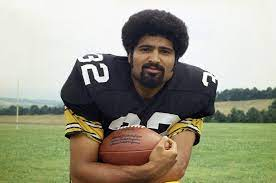
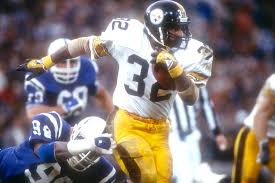
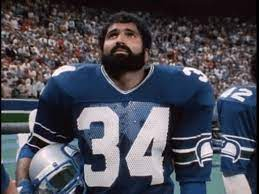
Franco Harris was an American football running back who played in the National Football League for 13 seasons, primarily with the Pittsburgh Steelers. He played college football for the Penn State Nittany Lions and was selected by the Steelers in the first round of the 1972 NFL Draft. Harris spent his first 12 seasons with Pittsburgh, earning nine Pro Bowl selections, and was a member of the Seattle Seahawks in his last.
A four-time Super Bowl winner with the Steelers, Harris was the Most Valuable Player (MVP) of Super Bowl IX. He also scored the "Immaculate Reception" touchdown, one of professional football's most famous plays, which gave the Steelers their first playoff win. Harris was inducted into the Pro Football Hall of Fame in 1990.
Harris was selected 13th overall in the first round of the 1972 NFL Draft by the Pittsburgh Steelers despite assistant personnel director Bill Nunn and head coach Chuck Noll preferring Robert Newhouse. In his first season with the Steelers (1972), Harris was named the NFL Rookie of the Year by The Sporting News and NFL Offensive Rookie of the Year by the Associated Press. In that season he gained 1,055 yards on 188 carries, with a 5.6 yards per carry average. He also rushed for 10 touchdowns and caught one touchdown pass. He was popular with Pittsburgh's large Italian-American population: his fans, including "Brigadier General" Frank Sinatra, dubbed themselves "Franco's Italian Army" and wore army helmets with his number on them.
During his rookie season, Harris was a key player in one of professional football's most famous plays, dubbed the "Immaculate Reception" by Pittsburgh sportscaster Myron Cope. In the first round of the playoffs, the Oakland Raiders were leading the Steelers 7–6 with 22 seconds to play when a Terry Bradshaw pass was deflected away from intended receiver John "Frenchy" Fuqua as defender Jack Tatum arrived to tackle him. Harris snatched the ball just before it hit the ground and ran it into the endzone, resulting in the Steelers' first playoff win.
Harris was chosen for nine consecutive Pro Bowls (1972–1980), and was All-Pro in 1977. Harris rushed for more than 1,000 yards in eight seasons, breaking a record set by Jim Brown. The running back tandem of Harris and Rocky Bleier combined with a strong defense to win four Super Bowls following the 1974, 1975, 1978, and 1979 seasons. On January 12, 1975, he was the Most Valuable Player of Super Bowl IX; in that game he rushed for 158 yards and a touchdown on 34 carries for a 16–6 win over the Minnesota Vikings. Harris was the first African American as well as the first Italian-American to be named Super Bowl MVP. Harris was a major contributor for the Steelers in all of their first four Super Bowl wins. His Super Bowl career totals of 101 carries for 354 yards are records and his four career rushing touchdowns are tied for the second-most in Super Bowl history.
Harris claimed that he extended his career and thus his contribution to the team's objectives (including four Super Bowl victories) by avoiding unnecessary contact.
With the retirement of O. J. Simpson after the 1979 season, Harris became the career rushing leader among active players. Following the 1983 season, Harris and Walter Payton were both closing in on Jim Brown's NFL rushing record, and Harris asked the Rooney family for a pay raise. Believing that Harris was on the downside of his career, they refused and Harris threatened to hold out. The Steelers released him during training camp in 1984 and he then signed with the Seattle Seahawks during the 1984 season. He played just eight games with the team, gaining only 170 yards before retiring (192 yards short of Jim Brown's record).
In his 13 professional seasons, Harris gained 12,120 yards (then 3rd all-time) on 2,949 carries, a 4.1 yards per carry average, and scored 91 rushing touchdowns (then also 3rd). He caught 307 passes for 2,287 yards, a 7.4 yards per reception average, and nine receiving touchdowns. Harris's 12,120 career rushing yards rank him 12th all time in the NFL, while his 91 career rushing touchdowns rank him 10th all time tied with Jerome Bettis.
In 1990, Harris and his former Penn State teammate Lydell Mitchell founded Super Bakery (renamed RSuper Foods in 2006), which produced nutrition-oriented food for schoolchildren. Harris and Mitchell also partnered in 1996 to rescue the Parks Sausage Company in Baltimore, the first African-American–owned business to go public in the U.S.
In 2007, Harris was chosen by Forest City Enterprises to lead a charitable foundation they created, related to the development of a casino for downtown Pittsburgh that would be managed by Harrah's.
In August 2008, Harris attended the 2008 Democratic National Convention, in Denver, Colorado, as part of the Pennsylvania delegation. Harris voted for Barack Obama on December 15, 2008, as one of Pennsylvania's 21 Democratic presidential electors.
In January 2011, Harris became co-owner of the Pittsburgh Passion. Also in 2011, Harris briefly worked with The Meadows Racetrack and Casino, before the casino suspended the relationship after his comments in support of Joe Paterno, his coach while at Penn State, during the Penn State child sex abuse scandal.
In 2019, Harris starred in the NFL's 100th Anniversary commercial recreating the Immaculate Reception with Terry Bradshaw.
Harris was married to Dana Dokmanovich. They had one son together: Franco "Dok" Harris, who ran as a third-party candidate in the 2009 Pittsburgh mayoral election and finished in second place with 25% of the vote. Franco’s brother, Pete Harris, played football for Penn State and died of a heart attack on August 15, 2006, at age 49.
Harris served as part of the advisory board of Penn State's Center for Food Innovation, and in the fall of 2009 was named a Conti Professor by Penn State's School of Hospitality Management. He was involved in, and provided funding to, Penn Staters for Responsible Stewardship, a group aimed at ousting the members of Penn State's board of trustees.
Harris died in his sleep at his home in Sewickley, Pennsylvania, on December 20, 2022, at age 72, three days before the 50th anniversary of the "Immaculate Reception". Harris's death was considered sudden, as he had been active on social media just days before his death and had spoken to visitors at the Heinz History Center the day before his death including a live interview with KDKA-TV from the Heinz History Center. He was set to attend a ceremony at halftime during a Steelers game against the Las Vegas Raiders on December 24, 2022, to retire his jersey number. Hours before his death, Harris recorded an interview with Steelers defensive end Cameron Heyward for his podcast in what would be his last public interview, during which he ironically commented about how he was "feeling good" and happy to have made it to the 50th anniversary of the "Immaculate Reception". His cause of death was later ruled as natural causes.
Immediately after his death, many gave public tributes. Terry Bradshaw, who had found out about Harris's death from his wife after seeing a text message from Mel Blount, had just seen Harris two weeks prior, filming material related to the Immaculate Reception's anniversary and was in a "state of shock". Bradshaw praised Harris, saying that "as a teammate, he was just the best." Steelers president Art Rooney II, who like the rest of the Rooney family was close to Harris, said through a statement by the team that "From his rookie season, which included the Immaculate Reception, through the next 50 years, Franco brought joy to people on and off the field. He never stopped giving back in so many ways. He touched so many, and he was loved by so many." In addition to Penn State itself, two Penn State alumni with connections to the Steelers—Harris's former teammate Jack Ham and current Steelers tight end Pat Freiermuth—also paid their respects to Harris. Other tributes would later come out by current and former Steelers as well as other Pittsburgh celebrities such as Joe Greene, Jerome Bettis, Najee Harris, Ben Roethlisberger, Hines Ward, Tony Dungy, T. J. Watt, Trai Essex, Arthur Moats, James Conner, current Steelers head coach Mike Tomlin, Charlie Batch, Kurt Angle, Mark Madden, Tony Dorsett, Darrelle Revis, Billy Gardell, and Joe Manganiello; the Penguins and Pirates also paid tribute. The December 27, 2022, episode of Pittsburgh Dad covering the aforementioned Steelers-Raiders game (a 13-10 Steelers win) featured a tribute to Harris from the titular character.
Despite only playing briefly with the Seahawks, the team also acknowledged Harris's passing; other tributes from the NFL came from the Raiders, Baltimore Ravens, Emmitt Smith, Michael Irvin, Shannon Sharpe, Eric Dickerson, O. J. Simpson, Barry Sanders, Larry Csonka, Jack Youngblood, and NFL commissioner Roger Goodell. Longtime ESPN personality Chris Berman paid tribute to Harris. Presidents Joe Biden and Barack Obama also paid tribute to Harris. U.S. Senator-elect John Fetterman released a statement mourning Harris, who supported his 2022 candidacy.
The Steelers held a public viewing for Harris at Acrisure Stadium on December 27, 2022, prior to the family holding a private funeral service.
In 1984, Harris received the Golden Plate Award of the American Academy of Achievement. In 1999, he was ranked number 83 on The Sporting News list of the 100 Greatest Football Players. In 2006, The Heinz History Center, home of the Western Pennsylvania Sports Museum, installed a life-size figure of Harris in the grand concourse of Pittsburgh International Airport, which recreates the "Immaculate Reception". He was inducted into the New Jersey Hall of Fame in 2011. On December 24, 2022, the 50th anniversary of the "Immaculate Reception", Harris became the third Steeler to have his number (32) retired; the first two were Ernie Stautner (70) and Joe Greene (75).
"The 10 Greatest NFL Fullbacks in History", Sports Cheat Sheet, December 20, 2015, archived from the original on September 27, 2018, retrieved September 27, 2018
"Franco Harris: still goal-bound 'He has always known where he wanted to go'" Archived April 23, 2021, at the Wayback Machine, by Sean Somerville, Baltimore Sun, September 22, 1996
"Black and Gold Soul with Italian Legs" Archived October 19, 2020, at the Wayback Machine, Sports Illustrated, December 11, 1972.
Beckner, Jr., Bill (December 21, 2022). "'He was super:' Franco Harris was 3-sport star in New Jersey before NFL fame". Pittsburgh Tribune.
The Ultimate New Jersey High School Yearbook. 1998.
DiSanto, Matt (February 2, 2020). "Franco Harris' 'Immaculate Reception' Voted Greatest Moment in NFL History". Onward State.
"Franco Harris College Stats". College Football @ Sports-Reference.com. Archived from the original on January 6, 2015. Retrieved May 16, 2015.
Franco Harris, Class of 1990 – Pro Football Hall of Fame. Retrieved December 22, 2022.
Denlinger, Ken. "Steelers Forged By Draft Masters," The Washington Post, Friday, January 18, 1980. Retrieved December 22, 2022.
"Franco Harris Stats". Pro Football Reference. Retrieved December 22, 2022.
Gayla, Marella (June 27, 2018). "Remembering Al Vento and Franco's Italian Army". Pittsburgh Post-Gazette. Archived from the original on January 9, 2019. Retrieved November 1, 2018.
Cope, Myron (December 21, 1997). "Backtalk; An Immaculate Explanation of the Truth". The New York Times. Retrieved December 22, 2022.
"Football History – Pro Football Hall of Fame Official Site". profootballhof.com. Archived from the original on December 27, 2008. Retrieved March 25, 2018.
"'Immaculate Reception' Still Lifts a Region's Spirits 50 Years Later". NECN. Associated Press. December 19, 2022. Retrieved December 22, 2022.
Robinson, Sam (December 21, 2022). "Hall Of Fame RB Franco Harris Dies at 72". Pro Football Rumors.
"Harris gets his 1,000 years as Cleveland thousands boo". Pittsburgh Post-Gazette. December 19, 1983. p. 15. Retrieved December 22, 2022 – via Newspapers.com.
De La Fuente, Homero (December 21, 2022). "Pittsburgh Steelers legend Franco Harris, known for 'Immaculate Reception,' dead at age 72". CNN.
"Super Bowl, NFL Black History Firsts". ABC News.
"Super Bowl Week Conjures Up Bright Moments". WGBO. February 1, 2017.
"TSN Presents – Football's 100 Greatest Players". June 27, 2008. Archived from the original on June 27, 2008. Retrieved March 25, 2018.
Goodman, Mark (January 13, 1980). "A Class Act from the Start, O.J. Simpson Retires in Style". The Central New Jersey Home News. p. 173 – via Newspapers.com. Open access icon
Stoneking, Dan (October 3, 1980). "Here comes Franco!". The Minneapolis Star. p. 14 – via Newspapers.com. Open access icon
"Franco Harris ended career with Seahawks". The Boston Globe. Archived from the original on September 24, 2015. Retrieved March 25, 2018.
Smith, Yaneek (January 24, 2011). "10 NFL Greats We Wish Had Played for Just One Team". Bleacher Report.
"NFL Career Rushing Yards Leaders Through 1984 - Pro-Football-Reference.com". Pro-Football-Reference.com. Archived from the original on November 13, 2017. Retrieved March 25, 2018.
"NFL Career Rushing Touchdowns Leaders Through 1984 - Pro-Football-Reference.com". Pro-Football-Reference.com. Archived from the original on November 13, 2017. Retrieved March 25, 2018.
NFL Rushing Leaders, retrieved October 12, 2009 {{citation}}: |archive-url= is malformed: timestamp (help)
"The Super Bakery Story" (PDF). Archived from the original (PDF) on July 28, 2011. Retrieved October 26, 2009.
"Philadelphia company buys Parks Sausage Co". Observer-Reporter. February 4, 1999. Archived from the original on April 23, 2021. Retrieved March 25, 2018 – via Google News.
"CEO welcomes a challenge". Reading Eagle. June 14, 1992. Archived from the original on April 23, 2021. Retrieved March 25, 2018 – via Google News.
"Forest City Enterprises : Press Releases". November 1, 2007. Archived from the original on November 1, 2007.
"AP News Wire, Associated Press News". Retrieved March 6, 2023.[permanent dead link]
"The Associated Press: It's official: Barack Obama elected 44th president". Archived from the original on December 18, 2008. Retrieved November 11, 2016.
"AP/Inquirer: Obama wins ... in a formality". Philadelphia Daily News. Archived from the original on December 17, 2008. Retrieved March 25, 2018.
"OWNERSHIP – Official Website of the Pittsburgh Passion Women's Football Team". March 29, 2013. Archived from the original on March 29, 2013. Retrieved March 25, 2018.
Schilken, Chuck, "Franco Harris loses job for comments supporting Joe Paterno", Los Angeles Times, November 16, 2011, 9:32 am. Retrieved November 22, 2011.
Carroll, Charlotte. "Watch: NFL's 100th anniversary Super Bowl ad". Sports Illustrated. Retrieved December 22, 2022.
Sandomir, Richard; Victor, Daniel (December 21, 2022). "Franco Harris, Steeler Who Caught 'Immaculate Reception,' Dies at 72". The New York Times. Retrieved December 21, 2022.
SUMMARY REPORT – Allegheny County – 2009 General Election, Allegheny County Board of Elections, November 3, 2009, archived from the original on November 8, 2009, retrieved November 4, 2009
"Kdka.com – Brother of Former Steeler Passes Away". Archived from the original on September 27, 2007. Retrieved February 13, 2007.
"Conti Symposium to Focus on Healthy, Cost-Effective Food". hhdev.psu.edu. October 7, 2009. Archived from the original on August 14, 2014. Retrieved August 13, 2014.
200 flock to King of Prussia in support of Paterno, Philadelphia Daily News
Damp, Patrick (December 25, 2022). "Pittsburgh Sports Year In Review: Looking back on the biggest sports stories of 2022". CBS Pittsburgh. Retrieved December 30, 2022.
"Steelers Hall-of-Famer Franco Harris dead at 72". WTAE. December 21, 2022. Retrieved December 21, 2022.
Graves, Will (December 21, 2022). "Steelers Hall of Fame running back Franco Harris dies at 72". Associated Press News. Retrieved December 21, 2022.
Rutter, Joe (December 21, 2022). "Steelers great Franco Harris dies at age 72". Pittsburgh Tribune-Review. Retrieved December 21, 2022.
Koroza, Alex (December 22, 2022). "In One of His Final Interviews, Franco Harris Discussed His Excitement for Saturday's Ceremony". Steelers Depot. Retrieved December 30, 2022.
"Pittsburgh Steelers Hall-of-Famer Franco Harris passes away at 72". The Economic Times. December 21, 2022.
Guggenheimer, Paul (December 21, 2022). "Terry Bradshaw in 'state of shock' over Franco Harris' death". Trib Live. Retrieved December 30, 2022.
Labrlola, Bob (December 23, 2022). "Hall of Fame RB Franco Harris, 72". Pittsburgh Steelers. Retrieved December 30, 2022 – via steelers.com.
Varley, Teresa (December 23, 2022). "Reacting to the loss of a Steelers icon". Pittsburgh Steelers. Retrieved December 30, 2022 – via steelers.com.
YouTube [dead link]
"Berman: Can't think of Steelers without thinking of Franco Harris – ESPN Video". December 21, 2022.
"Statement from President Joe Biden on the Passing of Franco Harris" (Press release). The White House. December 21, 2022. Retrieved December 30, 2022.
"Joe Biden, Barack Obama Mourn Franco Harris' Death, 'An Extraordinary Man'". TMZ. December 21, 2022. Retrieved December 30, 2022.
"Pittsburghers mourn the loss of Franco Harris, as stories of his legend pour in". 90.5 WESA. December 21, 2022. Retrieved December 23, 2022.
"Franco", John Fetterman on YouTube, October 28, 2022, retrieved December 23, 2022
"Public viewing for Franco Harris held at Acrisure Stadium". December 28, 2022.
"Golden Plate Awardees of the American Academy of Achievement". achievement.org. American Academy of Achievement. Archived from the original on December 15, 2016. Retrieved November 27, 2020.
"Franco Harris to be inducted into NJ Hall of Fame – Philly". Philadelphia Daily News. May 26, 2011. Archived from the original on September 22, 2017. Retrieved March 25, 2018.
"Steelers retire Franco Harris' No. 32 during emotional halftime ceremony days after Hall of Famer's death". NFL.com. December 24, 2022.
Robinson, Alan. "Joe Greene only 2nd player in Steelers history to get number retired". TribLIVE.com. Archived from the original on November 13, 2017. Retrieved March 25, 2018.
"Bio – Franco Harris". onlc.com.
Keegan, Kayla (September 26, 2018). "Here's What Franco Harris Might Have to Do With 'This Is Us'". Good Housekeeping. Retrieved December 21, 2022.
Robert Allen Griese is an American former professional football player who was a quarterback for the Miami Dolphins of the American Football League (AFL) and National Football League. He earned All-American honors playing college football with the Purdue Boilermakers before being drafted in 1967 by the Dolphins of the AFL. Widely regarded as one of the greatest quarterbacks of the 1970s, Griese led the Dolphins to a then record three consecutive Super Bowl appearances, including two Super Bowl victories in VII and VIII, the first of which capped off Miami's undefeated and untied 1972 season, the only such season in NFL history. Griese was inducted into the College Football Hall of Fame and the Indiana Football Hall of Fame in 1984 and the Pro Football Hall of Fame in 1990. He later worked as a television commentator, calling NFL games for NBC Sports and college football for ESPN and ABC Sports. Griese is one of three quarterbacks from Purdue to win the Super Bowl (along with Len Dawson and Drew Brees).
Griese was selected by the AFL's Miami Dolphins as the fourth player in the 1967 Common Draft.[20] Griese threw for 2,005 yards and 15 touchdowns his rookie year.
Griese was an AFL All-Star his first two years with the Dolphins, and earned AFL All-Star or AFC-NFC Pro Bowl honors in six additional seasons. While he never put up huge numbers, his leadership played an important role in helping the Dolphins compete in three consecutive Super Bowls, winning the latter two contests.
Griese started the season as the team's second-string quarterback behind John Stofa. When Stofa broke his ankle in the first quarter of the first game of the 1967 season, Griese stepped in and led the Dolphins to a 35–21 victory against the Denver Broncos. The 1967, 1968, and 1969 seasons were tough for the expansion Dolphins. After a difficult 1969 season that was worse than the 1968 season, coach George Wilson was fired.
Dolphin owner Joe Robbie brought in Don Shula from the Baltimore Colts in 1970, and the team's personality and fortunes turned quickly. The Dolphins found a new discipline, and learned what it took to become a winning team. They went from a 3–10–1 record in 1969 to 10–4 in 1970, making the playoffs.
In 1971 the Dolphins made it to the Super Bowl, losing 24–3 to the Dallas Cowboys. Griese was named the 1971 Newspaper Enterprise Association NFL Most Valuable Player award, and was awarded the Jim Thorpe Trophy.
The 1972 season began with the Dolphins winning their first four games. In the fifth game of the season, Bob Griese was tackled hard by Deacon Jones and Ron East of the San Diego Chargers, and went down with a broken leg and dislocated ankle. Earl Morrall, fresh off the waiver wire from Shula's former team, the Baltimore Colts, guided the Dolphins through the rest of the regular season, and maintained an unbeaten record in the process. Morrall also led the NFL in five passing categories during this time, including passer rating. As the playoffs began, the Dolphins were not as strong as they needed to be to go deep into the postseason, barely winning against the Cleveland Browns, a team that they should have beaten easily. The second game of the playoffs the team got off to a slow start against the Pittsburgh Steelers. Shula asked Griese to relieve the ailing Morrall, simply asking Griese at halftime, “Are you ready?” Griese replied with, “Yes, I'm ready.” Griese took the field and completed 3 of 5 passes for 70 yards as the Dolphins beat the Steelers by a score of 21–17 to clinch their second straight Super Bowl appearance.
Despite their unbeaten season, the Dolphins were listed as two point underdogs to the Washington Redskins in Super Bowl VII. Staying with the system that got them there, the Dolphins offense played a perfect ball control game. Griese connected on 8 of 11 passes for 88 yards and a touchdown, and Larry Csonka rushed for over 120 yards. Washington's only score was on a returned blocked field goal, and Miami won the game 14–7.
In 1973 Griese led another strong Dolphins team, but they did not make it through the season undefeated. They reached the Super Bowl for the third consecutive season and defeated the Minnesota Vikings 24–7.
In 1974, Griese and the Dolphins had an 11–3 regular-season record, but lost to the Oakland Raiders in the divisional round of the playoffs.
In 1975, Griese and the Dolphins started strong, but late in the season in a game against the Baltimore Colts, Griese suffered a broken toe and was out for the rest of the season. The Dolphins finished a respectable 10–4, but missed out on the playoffs for the first time in the Shula era.
In 1976, the Dolphins had many injuries, and the team finished the season at 6–8, the first time Don Shula ever suffered a losing season in his career.
1977 was a rebound year for both Griese and the Dolphins; he began to wear eyeglasses on the field.[38] On Thanksgiving, 1977, Griese threw six touchdown passes in three quarters to defeat the St. Louis Cardinals 55–14. The Dolphins would set a franchise record for most points scored in one game with 55. Of note, the Dolphins would score eight touchdowns and accumulate 34 first downs. He again led the AFC in touchdown passes thrown but the Dolphins rebound to a 10–4 record was again not enough to get the team into the playoffs.
The following year, Griese tore ligaments in his knee in a preseason game. However, when he came back, he was just as strong a passer as he had been the previous year. In one game against the Houston Oilers (nationally telecast as a marquee matchup on ABC's Monday Night Football), Griese dueled with Oiler running back Earl Campbell in an offensive slugfest. Griese threw for over 300 yards and Campbell rushed for nearly 200. The Oilers won the game 35–30. For the year, Griese completed a league-leading 63% of his passes, as the Dolphins went 11–5, losing again to the Oilers in the playoffs.
In 1979, he suffered from some nagging leg injuries that affected his throwing ability. He was not as effective, and he began to hear some criticism. However, he was able to lead the Dolphins to a 10–6 record. The Dolphins then found themselves dominated by the Pittsburgh Steelers in the Divisional round of the playoffs.
In 1980, Griese found himself on the bench due to the emergence of Don Strock and rookie David Woodley. However, Griese came off the bench for several games in a row to lead comeback wins. Griese won back the starting spot in the fifth game of the season, but was tackled hard by Mike Ozdowski of the Baltimore Colts. The tackle tore up his shoulder, and he was out for the rest of the year. The injury eventually led to Griese's decision to retire from the game at the age of 35. Griese was eventually elected to the Pro Football Hall of Fame in 1990.
He had established his reputation as the “Thinking Man's Quarterback,” as he brilliantly called his own plays throughout his career. Dolphin owner Joe Robbie called him “the cornerstone of the franchise,” around whom the Miami Dolphins were built. Robbie elected to ask Griese to stay on for another year as assistant coach, which he did for the 1981 season, helping Strock and the young Woodley as they teamed to become the famous “Woodstrock.” After the year ended, he decided that he did not like the hours required to be an assistant coach, hoping to devote more time to his family, yet he still enjoyed being part of the game. (Sources for Pro Football Career found in Undefeated, by Bob Griese, 2000, and The Winning Edge by Don Shula, 1974.)
The Miami Dolphins had the highest winning percentage in all professional sports in the 1970s, and Bob Griese was its starting quarterback throughout the decade, except when he was injured for several games in 1972, 1975, and 1978.
In Griese's 14 pro seasons, he threw for 25,092 yards and 192 touchdowns. Griese also rushed for 994 yards and seven scores. Griese was a six-time Dolphins' MVP and was All-Pro in 1971 and 1977. He played in two AFL All-Star games and six Pro Bowls.
The Dolphins retired his number 12 during a Monday Night Football game in 1985, telecast on ABC, the network which would prominently be featured in his post-football career.
To stay in touch with the game, in 1982 Griese decided to take a job as an announcer for NBC Sports, teaming with Charlie Jones for NFL games. While there, he called Super Bowl XX.
In 1987, Griese was hired by ABC Sports, where he began to provide color commentary for college football games.
While at ABC, Griese called the 1999, 2001 and 2005 BCS National Championship games.
At ABC Griese had many opportunities to watch his son Brian Griese play for the Michigan Wolverines. ABC was at first reluctant to let Griese broadcast Michigan games, fearing a conflict of interest. But when they decided to give it a try, Bob remained as impartial and professional as he could be, even referring to his son as “Griese,” rather than Brian, and pointing out errors when he felt necessary.
On January 1, 1998, Bob got to broadcast the Rose Bowl game, the last college game of his son's career. Brian was named MVP of the game, leading his Wolverines to an undefeated season and the national championship title with their Rose Bowl victory. Bob and Brian were emotional at that moment, as they thought of Bob's wife Judi, who had died from breast cancer in 1988 but whom they both felt was there at that special moment. Bob and Brian later wrote a book, entitled Undefeated (ISBN 0-7852-7021-3), which discussed not only their football connection, but also their love for Judi.
Brian became a professional quarterback and broadcaster himself, playing for the Denver Broncos and Tampa Bay Buccaneers, and later commentating games for ESPN and ABC.
During the 2009 and 2010 seasons, Griese served as the lead commentator for ESPN's noon college football broadcasts. He retired from ESPN on February 3, 2011.
Griese married Purdue classmate Judi Lassus in June 1967,[43] following their graduation, and they had three sons. A nurse, Judi lost a six-year battle with breast cancer at age 44 in early 1988. He now resides with his second wife, Shay, in Jupiter, Florida, and Banner Elk, North Carolina. His youngest son is Brian Griese (b. 1975), who also played quarterback in the NFL. His grandson, Jack Griese, is a running back for the University of Virginia.
In 2006, Griese made an appearance on the game show, Wheel of Fortune: he won the $100,000 grand prize and donated his $114,310 total winnings to Judi's House.
In 1975, Griese received the Golden Plate Award of the American Academy of Achievement.
"Miami Dolphins Team History". profootballhof.com. Archived from the original on June 10, 2020. Retrieved March 17, 2020.
Frank, Vincent (February 23, 2021). "Ranking the best NFL quarterbacks of the 1970s". Sportsnaut. Retrieved May 18, 2025.
"The top 10 NFL quarterbacks of the 1970s | Fox Sports".
"College Football Hall of Fame Inductees". Archived from the original on August 7, 2016. Retrieved March 10, 2020.
"Indiana Football Hall of Fame". Archived from the original on August 21, 2018. Retrieved March 10, 2020.
"Bob Griese". profootballhof.com. Archived from the original on March 29, 2020. Retrieved March 10, 2020.
"Super Bowl champion QBs by alma mater". newsday.com. February 2, 2020. Archived from the original on February 4, 2020. Retrieved March 10, 2020.
"American Legion Baseball National Champions – 1926 to 2014" (PDF). legion.org. Archived (PDF) from the original on May 16, 2019. Retrieved January 7, 2020.
Tom Tuley (April 27, 1963). "Coaching Doesn't Intrigue Bob Griese". The Evansville Press. Archived from the original on December 14, 2013. Retrieved March 10, 2020.
(cited from Undefeated, by Bob Griese, copyright 2000)
"Significant Sig Recipients". sigmachi.org. Sigma Chi. Archived from the original on May 2, 2021. Retrieved January 8, 2020.
Engelhardt, Gordon (January 21, 2019). "Griese, Mattingly set standard among Evansville male athletes". Evansville Courier & Press. Archived from the original on August 11, 2020. Retrieved April 1, 2020.
"Purdue Blanks Out-Manned Ohio U., 17–0". The Terre Haute Tribune. September 27, 1964. p. 50. Archived from the original on October 29, 2019. Retrieved March 10, 2020 – via Newspapers.com.
Jack Saylor (October 17, 1965). "Griese Lifts Purdue Past Michigan, 17–15". Detroit Free Press. pp. 1C, 3C. Archived from the original on November 11, 2019. Retrieved March 10, 2020 – via Newspapers.com.
"Legends of Purdue Football: Bob Griese". purduesports.com. Archived from the original on May 2, 2021. Retrieved January 7, 2020.
College Football Hall of Fame profile
"The Rose Bowl Game® presented by VIZIO". Archived from the original on December 8, 2010. Retrieved December 10, 2010.
"Bob Griese Earns Final Honor for Football, Scholastic Abilities". June 5, 1967. Archived from the original on March 4, 2016. Retrieved March 10, 2020.
"Purdue Intercollegiate Athletics Hall of Fame". Archived from the original on November 7, 2019. Retrieved March 10, 2020.
"1967 NFL Draft". Pro Football Reference. Archived from the original on October 23, 2018. Retrieved March 17, 2020.
"Bob Griese". Pro Football Reference. Archived from the original on May 2, 2021. Retrieved March 17, 2020.
"1967 AFL Weekly League Schedule". pro-football-reference.com. Archived from the original on November 8, 2020. Retrieved March 17, 2020.
Don Shula (February 18, 2020). "In My Own Words 50 Years Later: Dolphins Hire Don Shula". Archived from the original on February 19, 2020. Retrieved March 11, 2020.
Jack Olsen (November 9, 1970). "The Rosenbloom-Robbie Bowl". Sports Illustrated. Archived from the original on July 25, 2008. Retrieved March 11, 2020.
"Lamonica's 'bomb' wins for Raiders". Milwaukee Sentinel. UPI. December 28, 1970. p. 1, part 2.[permanent dead link]
"Oakland slips, slides past Dolphin defense". Lodi News-Sentinel. California. UPI. December 28, 1970. p. 22. Archived from the original on May 2, 2021. Retrieved October 6, 2020.
Maule, Tex (January 4, 1971). "Rushing to stake a claim". Sports Illustrated. p. 10. Archived from the original on November 6, 2019. Retrieved March 17, 2020.
"Super Bowl VI – Miami Dolphins vs. Dallas Cowboys – January 16th, 1972". Pro Football Reference. Archived from the original on August 7, 2019. Retrieved March 17, 2020.
"The Newspaper Enterprise Association NFL Most Valuable Player Winners". Pro-Football-Reference.com. Archived from the original on June 10, 2016. Retrieved March 11, 2020.
"Bob Griese Gets Thorpe Trophy As Top Player". Gettysburg Times. Associated Press. January 5, 1972. p. 4. Archived from the original on May 2, 2021. Retrieved March 11, 2020.
Karen Crouse (December 16, 2007). "An Understudy Helped Make the Dolphins 17–0". The New York Times. Archived from the original on January 16, 2018. Retrieved March 11, 2020.
"1972 NFL Leaders and Leaderboards". Pro Football Reference. Archived from the original on April 1, 2020. Retrieved March 11, 2020.
DiNitto, Marcus (January 25, 2015). "Super Bowl Betting History – Underdogs on Recent Roll". The Sporting News. The Linemakers. Archived from the original on January 27, 2020. Retrieved April 10, 2020.
"Greatest NFL teams of all time". ESPN. Archived from the original on August 19, 2012. Retrieved April 10, 2020. …the Dolphins played one of the easiest schedules in modern NFL history – the opposition had a combined winning percentage under .400.
Eskenazi, Gerald (January 27, 1991). "SUPER BOWL XXV; Garo's Gaffe, McGee's Hangover And More: The First 24 Years". The New York Times. Archived from the original on October 13, 2018. Retrieved April 10, 2020.
mouthpiecesports1 (July 31, 2008). "Preparation is Key with 1972 Miami Dolphins' Coach Don Shula". Archived from the original on March 25, 2016. Retrieved April 10, 2020 – via YouTube.
"Don Shula Coaching Results". Pro Football Reference. Archived from the original on March 21, 2021. Retrieved April 1, 2020.
Jenkins, Dan. "Spectacles make him spectacular," Sports Illustrated, October 10, 1977. Retrieved December 20, 2020
"Rome News-Tribune – Google News Archive Search". news.google.com. Archived from the original on November 17, 2015. Retrieved November 15, 2015.
100 Things Dolphins Fans Should Know and Do Before They Die, Armando Salguero, Triumph Books, Chicago, 2020, ISBN 978-1-62937-722-3, p.176
"Bob Griese retires from broadcasting". ESPN. February 3, 2011. Archived from the original on April 14, 2019. Retrieved March 11, 2020.
"Bob Griese will replace Jim Mandich on Dolphins' broadcasts". South Florida Sun Sentinel. August 19, 2011. Retrieved March 11, 2020.
"Griese married". Tuscaloosa News. Alabama. Associated Press. June 11, 1967. p. 17.
"Judi Griese, wife of ex-Miami Dolphin Bob Griese, dies at age 44". Boca Raton News. Florida. Associated Press. February 15, 1988. p. 5B.
"Griese finally gets Hall votes". Boca Raton News. Florida. Associated Press. August 3, 1990. p. 4C.
"Jack Griese". Virginia Cavaliers Official Athletic Site. June 22, 2022. Retrieved September 2, 2023.
Wheel of Fortune. Season 23. Episode 4387. January 24, 2006. Syndication.
"#TBT former ABC/@ESPNCFB analyst Bob Griese competed on @WheelofFortune for @JudisHouse – & son @briangriese , current ESPN #MNF analyst, was in attendance". Twitter. Archived from the original on January 28, 2021. Retrieved February 2, 2021.
"Golden Plate Awardees of the American Academy of Achievement". www.achievement.org. American Academy of Achievement. Archived from the original on December 15, 2016. Retrieved November 8, 2020.
"800 Feted at Glittering Banquet" (PDF). American Academy of Achievement. June 29, 1975. Archived (PDF) from the original on May 2, 2021. Retrieved November 8, 2020.