Showing posts with label Ohio League. Show all posts

Monday, February 27, 2023

Who Were The Dayton Merchants?

The Dayton Merchants were one of five professional football teams to play in the Ohio Professional Football League in 1941. On Sunday October 5, 1941 The Dayton Merchants faced off against the Middletown Merchants which resulted in a 6-0 defeat. The following Sunday the Dayton Merchants were defeated by the Dayton Dakotas 25 to nothing. The following week the Dayton Merchants were defeated against the Cincinnati Pepsi-Colas 26-0. On Sunday October 26, 1941 in a rematch of the prior week in Cincinnati, Ohio the Dayton Merchants faced off against the Cincinnati Pepsi-Colas, the Dayton Merchants would lose 38 to nothing. On Sunday November 2, 1941 the Dayton Merchants would face off against the Columbus Avondales in a 13-0 defeat. On Sunday November 9, 1941 the Dayton Merchants would face off against the Middletown Merchants in a scoreless tie. On Sunday November 16, 1941 the Dayton Merchants would face off against the Dayton Dakotas in a 12-0 defeat. In the last week of the season and ultimately last week of games for the league, the Dayton Merchants played against the Cincinnati Pepsi-Colas in which the Merchants would lose 33-0. The Merchants went 0-7-1 which resulted in fifth and last place in the league. The team never scored a single point in all games.

Sources
https://www.pro-football-reference.com/
https://www.profootballarchives.com/index.html
https://americanfootballdatabase.fandom.com/wiki/Football_Wiki
https://www.gridiron-uniforms.com/GUD/controller/controller.php?action=main
https://www.profootballhof.com/hall-of-famers/

Wednesday, February 8, 2023

Who Were The Columbus Avondales?

The Columbus Avondales were one of five professional football teams to play in the Ohio Professional Football League in 1941. On Sunday October 5, 1941 The Columbus Avondales faced off against the Dayton Dakotas which resulted in a 12-6 defeat. The following Sunday the Columbus Avondales were defeated by the Middletown Mercahnts 7 to nothing. The following week the Columbus Avondales were victorious against the Dayton Merchants 13-0. On Sunday November 9, 1941 in Columbus, Ohio the Columbus Avondales faced off against the Cincinnati Pepsi-Colas, the Columbus Avondales would lose 25 to nothing. On Sunday November 23, 1941 the Columbus Avondales would face off against the Cincinnati Pepsi-Colas again in a 32-0 defeat. In the last week of the season and ultimately last week of games for the league, the Columbus Avondales played against the Dayton Dakotas in which the Dakotas would win 37-6. The Avondales went 1-5 which resulted in fourth place in the league.

Sources
https://www.pro-football-reference.com/
https://www.profootballarchives.com/index.html
https://americanfootballdatabase.fandom.com/wiki/Football_Wiki
https://www.gridiron-uniforms.com/GUD/controller/controller.php?action=main
https://www.profootballhof.com/hall-of-famers/

Monday, January 23, 2023

Who Were The Middletown Merchants?

The Middletown Merchants were one of five professional football teams to play in the Ohio Professional Football League in 1941. On Sunday October 5, 1941 The Middletown Merchants faced off against the Dayton Merchants which resulted in a 6-0 win. The following Sunday the Middletown Merchants were defeated by the Cincinnati Pepsi-Colas 13 to nothing. The following week the Middletown Merchants were defeated 0-6 by the Dayton Dakotas. On Sunday October 26, 1941 in Middletown, Ohio the Middletown Merchants faced off against the Columbus Avondales, the Middletown Merchants would win 7 to nothing. On Sunday November 9, 1941 the Middletown Merchants would face off against the Dayton Merchants in a 0-0 tie. The following week the Middletown Merchants traveled to Cincinnati in which the Merchants would be defeated 8-0 at Carthage Fairgrounds. In the last week of the season and ultimately last week of games for the league the Middletown Merchants would be defeated 13-0 by the Dayton Dakotas at Sucher's Park. The Merchants went 3-3-1 which resulted in third place in the league.

Sources
https://www.pro-football-reference.com/
https://www.profootballarchives.com/index.html
https://americanfootballdatabase.fandom.com/wiki/Football_Wiki
https://www.gridiron-uniforms.com/GUD/controller/controller.php?action=main
https://www.profootballhof.com/hall-of-famers/

Wednesday, January 4, 2023

Who Were The Dayton Dakotas?

The Dayton Dakotas were one of five professional football teams to play in the Ohio Professional Football League in 1941. On Sunday October 5, 1941 The Dakotas faced off against the Columbus Avondales which resulted in a 12-6 win. The following Sunday the Dakotas defeated the Dayton Merchants 25 to nothing. The following week the Dakotas were defeated 0-6 to the Middletown Merchants. On Thursday October 23, 1941 at a neutral site against the Columbus Bulls, the Dakotas would lose in a shutout defeat 0-42 in Zanesville, Ohio at Municipal Stadium with 1800 in attendance. On Sunday November 16, 1941 the Dakotas would defeat the Dayton Merchants 12-0 for the second time during the 1941 season. The following week the Middletown Merchants traveled to Dayton in which the Dayton Dakotas would win 13-0 at Sucher's Park. In the last week of the season and ultimately last week of games for the league the Dayton Dakotas would defeat the Columbus Avondales 37-6. The Dakotas went 5-2 which resulted in second place in the league.

Sources
https://www.pro-football-reference.com/
https://www.profootballarchives.com/index.html
https://americanfootballdatabase.fandom.com/wiki/Football_Wiki
https://www.gridiron-uniforms.com/GUD/controller/controller.php?action=main
https://www.profootballhof.com/hall-of-famers/

Monday, December 12, 2022

Who Were The Cincinnati Pepsi-Colas?

The Cincinnati Pepsi-Colas were a professional football team that played in the Ohio Professional Football League. The league and team lasted just one season. The team played seven games and won every single one of them. The first game was played October 12, 1941 against the Middletown Merchants in a 13-0 victory. The following week on October 19, 1941 against the Dayton Merchants in a 26-0 victory. A week later Cincinnati played a home game against the Merchants in a rematch of the previous week in 38-0 victory at the Carthage Fairgrounds. The next game for the Pepsi-Colas was against the Columbus Avondales in 25-0 victory at Red Bird Stadium in Columbus, Ohio. Cincinnati then played two home games against the Middletown Merchants (8-0) and the Columbus Avondlaes (32-0) in shutout victories. The last game was a 33-0 victory over the Dayton Merchants on November 30, 1941. They ultimately were the champions of the league and the league and team did not return the following season.

Sources
https://www.pro-football-reference.com/
https://www.profootballarchives.com/index.html
https://americanfootballdatabase.fandom.com/wiki/Football_Wiki
https://www.gridiron-uniforms.com/GUD/controller/controller.php?action=main
https://www.profootballhof.com/hall-of-famers/

Monday, November 14, 2022

Who Were The Franklin Athletic Club Of Cleveland?

The Franklin Athletic Club of Cleveland was a short-lived professional football team based in Cleveland, Ohio from 1903 until around 1909. Franklin played against "Ohio League" teams such as the early Canton Bulldogs, Shelby Blues and Massillon Tigers. In 1904 the Tigers defeated Franklin 56-6.

The team's most notable player was Peggy Parratt, one of the pioneers of the forward pass, who played with Franklin briefly in 1907.The team stopped playing games after 1909.

Sources
https://www.pro-football-reference.com/
https://www.profootballarchives.com/index.html
https://americanfootballdatabase.fandom.com/wiki/Football_Wiki
https://www.gridiron-uniforms.com/GUD/controller/controller.php?action=main
https://www.profootballhof.com/hall-of-famers/
Roberts, Milt (1979). "Peggy Parratt MVP" (PDF). Coffin Corner. 1 (6). Professional Football Researchers Association: 1–5. Archived from the original (PDF) on October 22, 2012.
PFRA Research. "Glamourless Gridirons: 1907-1909" (PDF) (6). Professional Football Researchers Association: 1–4. Archived from the original (PDF) on March 26, 2012. {{cite journal}}: Cite journal requires |journal= (help)
Carroll, Bob; Bob Braunwart (1981). "Ohio League" (PDF). Coffin Corner. 3 (6). Professional Football Researchers Association: 1–4. Archived from the original (PDF) on August 22, 2014.

Wednesday, October 26, 2022

History Of The Ohio Leagues

The Ohio League was an informal and loose association of American football clubs active between 1902 and 1919 that competed for the Ohio Independent Championship (OIC). As the name implied, its teams were mostly based in Ohio. It is the direct predecessor to the modern National Football League.

A proposal to add teams from outside Ohio, such as the Latrobe Athletic Association, to form a formal league known as the "Football Association" fell through prior to the 1904 season.

Though a champion was declared by the group throughout its existence, a formal league was not founded until 1920, when several Ohio League teams added clubs from other states to form the American Professional Football Association. In 1922, the APFA became the National Football League.

All but one of the remaining Ohio League teams left the NFL after the 1926 season, with the sole remaining team, the Dayton Triangles, surviving until 1929, before moving several times and eventually ending up in Dallas, after which they were officially cancelled by the NFL, who sold the players and assets to Carroll Rosenbloom in Baltimore, where they were re-named the Colts. The team moved again in 1984 and the descendant of the Triangles franchise is ostensibly now in Indianapolis, just 117 miles to the west of their origin.

The league champions for each season were the 1902 Akron East Ends, 1903 Massillon Tigers who went 8-1-0, 1904 Massillon Tigers who went 7-0-0, 1905 Massillon Tigers who went 10-0-0, 1906 Massillon Tigers who went 10-1-0,1907 Massillon Tigers who went 7-0-1, 1908 Akron Indians who went 8-0-1, 1909 Akron Indians who went 9-0-0, 1910 Shelby Blues and Shelby Tigers who went 14-0-1, 1911 Shelby Blues who went 10-0-0, 1912 Elyria Athletics who went 8-0-0, 1913 Akron Indians who went 8-1-2, 1914 Akron Parratt's Indians who went 8-2-1. The 1915 champions has been disputed with no clear winner to this date. In 1916, the Canton Bulldogs went 9-0-1. In 1917, the Canton Bulldogs went 9-1-0.  In 1918, the Dayton Triangles went 8-0-0. In 1919, the Canton Bulldogs 9-0-1.

Some of the better teams of the 1920s, who did not join the NFL existed in the Ohio Valley, and would form an unofficial but recognized circuit - The Ohio Valley League - which resembled the old Ohio League. The "league" collapsed at the beginning of the Great Depression.

The two stronger teams in the league were the Portsmouth Spartans and the Ironton Tanks, that in the year after the circuit died (1930) beat the New York Giants and Chicago Bears, while the Spartans would join the NFL and would later become the Detroit Lions. Two other noteworthy teams were the Armco Corporation employees teams - Ashland Armco Yellowjackets (Kentucky) and Middletown Armco Blues (Ohio), who featured many former college All-Americans, including Red Roberts.

The champions for the Ohio Valley League were the1925 Ironton Tanks (9-1-2), the 1926 Ironton Tanks (11-1-1), the 1927 Ashland Armco Yellowjackets (7-1-3), 1928 Ironton Tanks (7-1-3), 1929 Portsmouth Spartans (12-2-1).

In 1941, there was a resurgence in pro football in Ohio, as local teams tried to form a new professional league called The Ohio Professional Football League (also known as Ohio Valley League). Six teams came together in an attempt to restore the region's former old glory: The Dayton Dakotas, Dayton Merchants, Cincinnati Pepsi-Colas, Columbus Avondales, Middletown Merchants, and another Canadian team the Thomas Athletic Club from Windsor, Ontario,[18] but they withdrew from the league before the season started.

The circuit operated on a much smaller scale from previous leagues, and did not return for a second season. The Cincinnati Pepsi-Colas were league champions with a 7-0 record. This was the last Ohio based professional football league to date.

Sources
https://www.pro-football-reference.com/
https://www.profootballarchives.com/index.html
https://americanfootballdatabase.fandom.com/wiki/Football_Wiki
https://www.gridiron-uniforms.com/GUD/controller/controller.php?action=main
https://www.profootballhof.com/hall-of-famers/
Massillon won by tiebreaker of common opponents. While both Massillon and the Shelby Blues went undefeated and played each other once to a scoreless tie, Shelby tied the Columbus Panhandles, while Massillon had defeated Columbus twice.
 Both teams finished undefeated, but shared so many players that it was impossible to stage a true championship game. Their records were added together and the two organizations shared the title and officially merged in 1911. The Tigers name was spun off to another team.
 While Akron is traditionally listed as champions, the Dayton Cadets won the Southern Division title with an undefeated record. Akron and Dayton never faced each other.
 The Professional Football Researchers Association lists 1915 as "no clear champion" and discounts the Youngstown Patricians, the only undefeated team that year, as having a subpar schedule. Canton and Massillon, the next two contenders, tied at 5-2-2.
 "the Ohio Valley in 1924" (PDF). Archived (PDF) from the original on September 15, 2015.
 "Thorpe's Farewell Season" (PDF). Archived (PDF) from the original on September 7, 2015.
 Bob Gill, with Tod Maher. Outsiders II: Minor League And Independent Football, 1951-1985, St. Johann Press, 2010. ISBN 1878282654
 "The "Famous" Ironton Tanks" (PDF). Archived (PDF) from the original on September 7, 2015.
 "1930 Ironton Tanks".
 "Armco Semi-Pro Football Teams 1924-1929". 2 September 2019.
 "Armco's Semi-Pro Football Teams" (PDF). Archived (PDF) from the original on June 10, 2021.
 "1925 Ironton Tanks".
 "1926 Ironton Tanks".
 "1927 Ashland Armcos".
 "1928 Ironton Tanks".
 "1929 Portsmouth Spartans".
 "Dakotas to Stand Pat On Lineup". The Journal Herald. October 10, 1941. Retrieved May 5, 2021 – via Newspapers.com.
 "2 Dayton Teams In New Pro Football Circuit". Dayton Daily News. September 21, 1941. Retrieved May 5, 2021 – via Newspapers.com.
 "1941 Cincinnati Pepsi-Colas (OVFL)".
 "1941 Dayton Dakotas (OVFL)".
 "1941 Middletown Merchants (OVFL)".
 "1941 Columbus Avondales (OVFL)".
 "1941 Dayton Merchants (OVFL)".

Friday, May 13, 2022

Who Were The Shelby Blues?

The Shelby Blues were an American football team based in Shelby, Ohio. The team played in the Ohio League from 1900 to 1919. In 1920, when the Ohio League became the APFA (now known as the National Football League), the Blues did not join but continued to play against APFA teams, only to later suspend operations. The Blues returned to play as an independent between 1926 and 1928.

The team was named for their blue uniforms, that were worn in their first year. In 1905, the Blues replaced the Shelby Athletic Club as the top football team in town. A year later the team was the runner-up for the Ohio League title, behind only the Akron Indians. The Blues won Ohio League championships in 1910 and 1911, with Peggy Parratt, an early pioneer and master of the forward pass, at quarterback. In 1904, the Blues are credited with signing the first black players in American professional football, halfback Charles Follis.

Sources
https://www.pro-football-reference.com/
https://www.profootballarchives.com/index.html
https://americanfootballdatabase.fandom.com/wiki/Football_Wiki
https://www.gridiron-uniforms.com/GUD/controller/controller.php?action=main
https://www.profootballhof.com/hall-of-famers/
"Breaking Pro Football's Color Line: The Story of Charles W. Follis". Bleacher Report. Retrieved September 22, 2023.
Carroll, Bob (1991). "Shelby Who? Ohio Pro Football in 1910" (PDF). Coffin Corner. Vol. 13, no. 4. Professional Football Researchers Association. Archived from the original (PDF) on October 6, 2010.
Johnson, Pearce (1987). "When Did They Start?" (PDF). Coffin Corner. Vol. 9, no. 6. Professional Football Researchers Association. Archived from the original (PDF) on November 27, 2010.

Wednesday, May 4, 2022

Who Were The Masillon Tigers?

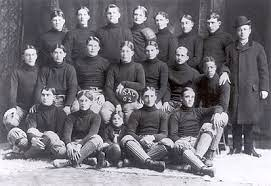
The Massillon Tigers were an early professional football team from Massillon, Ohio. Playing in the "Ohio League", the team was a rival to the pre-National Football League version of the Canton Bulldogs. The Tigers won Ohio League championships in 1903, 1904, 1905, and 1906, then merged to become "All-Massillons" to win another title in 1907. The team returned as the Tigers in 1915 but, with the reemergence of the Bulldogs, only won one more Ohio League title. Pro football was popularized in Ohio when the amateur Massillon Tigers, hired four Pittsburgh pros to play in the season-ending game against Akron. At the same time, pro football declined in the Pittsburgh area, and the emphasis on the pro game moved west from Pennsylvania to Ohio.

The team opted not to join the APFA (later renamed the NFL) in 1920; it remained an independent club through 1923, when the Tigers folded. During their time as an independent, the Tigers never played against any team in the NFL, even though several other independent teams did. The Massillon Tigers team name was transferred to Massillon Washington High School, who still uses it today.

The Massillon area had fielded several amateur football teams featuring only local players since the early 1890s. However while some had performed well, the others were more likely to be defeated when they played their cross-county arch-rival, Canton. Therefore a group of 35 area businessmen meet on September 3, 1903, at the Hotel Sailor in Massillon to form the area's first professional football team. Jack Goodrich, who expected to play halfback for the new team, was named manager. Meanwhile Ed J. Stewart, a young and ambitious editor of the city newspaper The Evening Independent, was named as the team's first coach. Stewart had playing experience while attending Western Reserve College and Mount Union College. Apart from being the team's coach, he later appointed himself as the team's quarterback.

J.J. Wise, who was the Massillon Clerk of Courts, led a committee to secure the necessary funds for a new football and jerseys that were nearly the same color. The local venders only had a sufficient quantity of one jersey style to outfit an entire team. Those jerseys imitated the orange and black striped attire of the Princeton Tigers. So the new Massillon team was christened the "Tigers."

When the Tigers began play in 1903, several of the expected starters hadn't touched a football in eight or more years. According to locals belief, Baldy Wittman, 32-year-old proprietor of a local cigar store and a spare-time police officer, had never played the game at all. Charles "Cy" Rigler, who later became a famous major league baseball umpire started at tackle. Wittman opened at an end and was elected the team captain. Meanwhile Stewart lined himself up at quarterback. The Tigers first game against Wooster College ended in a 6-0 defeat. A biased official was the excuse for the loss. The Tigers followed their first ever game with a 16-0 victory over Stewart's alma mater, Mount Union College, a 6-0 victory over the Akron Imperials, and a 38-0 over the Akron Blues. After a 34-0 victory over the Dennison Panhandles, the Tigers prepared for their cross-county rivals, a sandlot team from Canton. Betting on the games, during the early 1900s was common. It is believed that over $1000 was risked on the game's outcome. The Tigers held on to a 16-0 score to win the first game between the two clubs.

After the Canton-Massillon game, the Tigers began to look at winning the mythical "Ohio League" championship. On Thanksgiving Day 1903, the Tigers avenged their only loss of the season against Wooster College with a 34-0 score. This outcome gave legitimacy to the belief that the Tigers were robbed by a corrupt official in their inaugural game. On December 5, an agreement was signed by Massillon and the Akron East Ends to play. The contract called for a 75-25 split of the gate, with the winner taking the 75% of the gate. However Massillon soon found itself in a troubling situation due to injuries to several of their star players. The team's management decided to replace the injured players with "ringers". Several pro football players from the Pittsburgh area soon traveled to Ohio to play for Massillon. Among them was Bob Shiring and Harry McChesney, who played in 1902 with the Pittsburgh Stars of the first National Football League. These player developments did not sit well with the Akron media, most notably the Akron Beacon-Journal. Massillon would go on to the win the championship game 12-0, however the Akron Beacon-Journal later stated that most of Massillon's 75% gate money went to the Pittsburgh ringers. Plans were soon in the mix for spending $1,000 on a 1904 Tigers team.

In 1904 the Tigers repeated as Ohio League champions. It was during this time that a least seven teams in Ohio began hiring players for games. Most of these "ringers" were from Pittsburgh. Many players were hired on a per game basis and were never signed to any written contract. Ted Nesser, of the infamous Nesser Brothers, played for the Shelby Blues until he was hired to play one game for the Tigers. For the next two season he remained in the Tigers lineup. However after the Tigers began the 1904 season, many Massillonians were bored with the ease of the Tigers' wins, even at this early stage. That season the Tigers defeated a club from Marion 148-0. Also keep in mind that a touchdown counted only five points until 1912. However under the rules of the time, the team that scored turned around and received the next kickoff (traditionally, onside kicks were far more commonplace—and easier—at this time, but Marion chose not to use them for reasons unexplained). During the game a Massillon end named Walt Roepke ran a punt back for a touchdown. Marion never got another chance to handle the ball, as Massillon took kickoff after kickoff and moved down the field to touchdown after touchdown.

The Tigers defeated the Akron East Ends again (now renamed the Akron Athletic Club) 6-5 after Akron's Joe Fogg missed an extra point kick on the last play of the game.

By 1905 the Tigers were considered one of the top three teams in the country, along with the Latrobe Athletic Association and the Canton Bulldogs. Both teams were constantly fighting for the best players in football. In fact the Bulldogs, or Canton Athletic Club as it was called at the time, formed their football team in 1905 with sole objective of beating the Tigers, who had won every Ohio League championship since 1903.

Both teams spent lavish amounts of money to bring in ringers from out of town. The teams first played each other twice in 1905, with Massillon winning the first game 14-4. The second game saw a 10-0 Massillon win, however the win drew protests from Canton coach Blondy Wallace, who argued against a 10-ounce ball used by Massillon during the game, instead of the regular 16-ounce ball. The 10-ounce ball was provided to the Tigers by their owner, a Massillon newspaper editor. The protest fell on deaf ears, and Massillon was named the 1905 Ohio League champions.

In the off-season prior to the 1906 season, a news story in the Cleveland Plain Dealer alleged that the Canton Athletic Club was financially broke and could not pay its players for that final game. The club denied the allegation and insisted that every dollar promised had indeed been delivered. Many Canton followers believed the story had originated in Massillon as a trick to discredit their team and make it tougher for Canton to recruit players for 1906. Massillon coach, Ed Stewart, who had newspaper connections was believed by Canton to have planted the story. However, while Canton was in fact losing money in 1905, a group of area businessmen shouldered the losses.

In a counter-charge, Canton insisted that the Tigers were also deeply in debt. However, a statement by the Tigers showed $16,037.90 in receipts and only $16,015.65 in expenditures. The only problem with Massillon's figures was that they only listed salaries, including railroad fare, at $6,740.95, which means the players were getting only about $50 per game. However, it is believed, like with Canton, that Massillon's area boosters picked up whatever losses the Tigers accured during 1905.

For the 1906 season, Canton coach Wallace signed the entire backfield of the Tigers to the Canton team. While in Massillion, Ed Stewart was promoted from head coach to manager. Sherburn Wightman, who played under Amos Alonzo Stagg at the University of Chicago, was named the team's new coach.

However, by 1906, the Bulldogs and Tigers were involved in a game-rigging scandal that effectively killed both teams. was the first major scandal in professional football. It was more notably the first known case of professional gamblers' attempting to fix a professional sport. It refers to an allegation made by the Massillon Independent newspaper charging the Bulldogs coach, Blondy Wallace, and Tigers end, Walter East, of conspiring to fix a two game series between the two clubs. The scandal called for Canton to win the first game and Massillon was to win the second, forcing a third game-with the biggest gate-to be played legitimately, with the 1906 Ohio League championship at stake. Canton denied the charges, maintaining that Massillon only wanted to damage the club's reputation. Although Massillon could not prove that Canton had indeed thrown the second game, the scandal tarnished the Bulldogs and Tigers names and reportedly helped ruin professional football in Ohio until the mid 1910s. To this day the details of the scandal consist of charges and counter-charges.

A reorganized "All-Massillons" played in 1907, after which professional football in Massillon effectively stopped. The team was made up of many of the former Tigers players and was managed by Sherburn Wightman. The team defeated the Columbus Panhandles, with the Nesser Brothers in the line-up, 13-4, and celebrated its fifth consecutive state championship. Because of the game's importance, Massillon brought in two ringers, Peggy Parratt and Bob Shiring.

In 1911 a Canton-Massillon game was hyped beforehand as a return of the 1905-06. However after seeing the 57-0 Canton victory, it became apparent that this Massillon team bore little resemblance to the Tigers' teams of the past. However the Massillon lineup did consist of Tigers greats Baldy Wittmann and Frank Bast.

During the summer of 1914, members of the Massillon Chamber of Commerce asked Jack Cusack, the manager of the re-organized Canton Bulldogs, to attend a secret meeting to discuss a proposed new Massillon Tigers football team. Cusack believed that a game against a strong Massillon team and a restart of the historic Canton-Massillon rivalry was bound to bring in fans to Canton. However in order to get the team fielded, Massillon planned to raid the Akron Indians roster of its key players. Because of this, Cusack refused to help Massillon restart their club. In 1914, an unwritten agreement existed among Ohio League managers that refrained them from raiding other teams. Also a raid of players would start a bidding war, raise players' salaries for all teams, and destroy the fragile profit margin already established. Cusack refused to provide a Canton-Massillon game if players from the Indians were raided. Plans for a new "Tigers" were put on hold until 1915.

The Tigers returned to the Ohio League in 1915. They were backed by local businessmen, Jack Donahue and Jack Whalen. Massillon did end up raiding the Indians team of their top players. In turn Cusack took in the Akron players, and raided the Youngstown Patricians, hoping to improve his team. Massillon hired new ringers for a new bidding war with Canton, however Cusack signed the legendary Jim Thorpe to his squad. The Tigers ended their 1915 season with a share of the 1915 championship with Canton. Both teams finished the season 5-2-0. One anonymous Massillon official revealed it had taken between $1,500 and $2,000 to bring in the Tigers lineup that opposed Canton in the final game. This would be Massillon's last "Ohio League" title, and a disputed one at that—the very Patricians squad that the Tigers had raided earlier in the season had racked up an even more impressive 9-0-1 record against lesser talent, including a win against the Washington Vigilants, one of the East Coast's top professional teams, leading many observers to give Youngstown the title instead.

The Tigers rebirth, saw the team incorporate many of the top players of the era. For example Knute Rockne, Charles Brickley, Gus Dorais, Bob Nash, Stan Cofall, and, future Hall of Famer, Greasy Neale. The 1916 season saw the Tigers end up in second place of the "Ohio League" standings behind the Canton Bulldogs. However despite record crowds for two Bulldog-Tigers match-ups, Massillon lost money on the season, while Canton barely made a profit. Most of the Midwestern major teams were running into debt. Since every player knew Jim Thorpe was being paid $250 a game, many players of considerably less talent were holding out for $100 or $125 a game. Team managers had to produce stars to draw crowds, but the crowds could never be big enough to pay for the stars. Teams desperately needed something like the old "Ohio League" sub-rosa agreement where the managers agreed to not raid other team rosters. Only that sort of agreement could hold salaries at a responsible level.

In 1917, Bob Nash promised an "Ohio League" championship to the fans in Massillon. In doing so he put together an offensive line that included Charlie Copley at tackle and Al Wesbecher at center. However after storming out to a 4-0 start, the Tigers were defeated by Stan Cofall and the Youngstown Patricians 14-6. However later that season Cofall and Bob Peck decided to play for Massillon which prematurely ended the Pats 1917 campaign. However despite their winning seasons and star talent, Massillon was still losing money. One reason for the disparity is that Massillon was smaller than Canton, meaning it had a smaller fan base to support its football team. The Tigers had highly devoted following, however they weren't enough of them. Also the city lacked a decent ballpark. as a result many of the Tigers' biggest home games were undersold. The only way to make the Tigers profitable was to use Peggy Parratt's old Akron scheme of bringing in just enough high-priced stars to win. Even then, the Tigers would have probably operated at a loss, but one small enough that it could be made up for by the team's backers. However Massillon did upset the Bulldogs in their second game of the season series 6-0, behind two field goals kicked by Cofall. But despite the upset, Canton was regarded as the U.S. champion; Massillon couldn't make a serious claim. The Tigers had lost their first game with the Bulldogs by a larger margin and dropped two other games to lesser opponents. It had not been a good season for Massillon. They lost three games on the field, and their backers dropped $4,700 at the gate. After the season, a "Cleveland critic" chose an all-pro team from among the four major northeastern Ohio teams. The Massillon players listed on the all-pr listing were Bob Nash, Bob Peck, Pike Johnson, Charley Copley, and Stan Cofall. One of the teams Massillon would play (and defeat soundly) in 1917 was the Buffalo All-Stars, who would later join the NFL as the Buffalo All-Americans in 1917.

The team suspended operations in 1918 due to a flu pandemic and the Great War, but returned in 1919.

Many of the top teams of the "Ohio League" returned to action in 1919. At a meeting on July 14, 1919, the managers held a "get-together" at Canton's Courtland Hotel. The managers decided on a pay scale for officials and agreed to refrain from stealing each others players for the upcoming season. However the big surprise came when Massillon backer Jack Donahue refused to go along with a proposal to limit salaries. Massillon had trouble with the increasing cost of players and would profit more by a salary cap than anyone else. Donahue insisted, "If a manager wants to pay $10,000 for a player, that's his business."

The Tigers were set to begin their 1919 season in New York City against the New York Brickley Giants, organized by the same Charles Brickley that had played for Massillon in 1917. However due to a dispute over the application of New York's blue laws, that prohibited playing football on Sundays, Brickley's Giants were forced to fold. (The Giants team would however regroup and play in the National Football League in 1921 and as an independent until 1923; a second, unrelated New York Giants would join the league for 1925 and this is the New York Giants team that is in the NFL today.) The Tigers did play well in 1919, however once again the came in second to Canton in the "Ohio League" standings. The team's backers then decided to fold the team after losing over $5,000 during the season. Stan Cofall also abandoned the Tigers after the season. He and many of the now former-Tigers players left to play for the Cleveland Tigers.

During the August 20, 1920 the first meeting aimed at establishing the American Professional Football Association (renamed the National Football League in 1922), there was hope that F.J. Griffiths, of the Massillon steel industry, would resurrect the franchise, but the meeting passed with no word from Griffiths. During late August and early September of that same year, Ralph Hay and Jim Thorpe tried without success to find a backer for a new Massillon team. While the Tigers consistently lost money for themselves, they were always a good draw for others. In fact it was a strong rivalry with Massillion that helped lead Jim Thorpe to Canton. Cupid Black, an All-America guard from Yale, was also rumored to restart the Tigers franchise, however he later turned down the offer.

On September 17, 1920 at Ralph Hay's Hupmobile dealership in Canton, the charter members of the future NFL formally established the new league. During that meeting, the first order of business was to decided the future of the Massillon franchise. It was then that the managers were confronted by Vernon Maginnis, the manager of the unsuccessful Akron Indians in 1919, who wanted to field a traveling team and call it the "Massillon Tigers". Hay and the other managers turned down the offer because they didn't feel the franchise would pan out and because nobody wanted to see the proud Massillon Tigers name taken in vain and made a road attraction. The current Akron owners, now renamed the Pros, Art Ranney and Frank Nied were also associated with Maginnis during his ownership of the team in 1919, and had many problems with him during that season.

Maginnis' representative was not admitted to the meeting, however the Massillon Tigers were counted as present at the charter meeting of the NFL. Hay, who'd tried to get a real Massillon team restarted, considered himself as their spokesman. Once the meeting started, he stood up and announced that Massillon was withdrawing from professional football for the season of 1920. And to resure that Maginnis wouldn't try to reestablish a Massillon "franchise", Hay told the American Professional Football Association managers: "Do not schedule any `other' Massillon team".

The 10 teams represented at the September 17 meeting are considered charter members of the AFPA, and, by extension, of the National Football league. Massillon is usually counted on a technicality. The team, under Hay, were there, they just never played in the new league.

Sources
https://www.pro-football-reference.com/
https://www.profootballarchives.com/index.html
https://americanfootballdatabase.fandom.com/wiki/Football_Wiki
https://www.gridiron-uniforms.com/GUD/controller/controller.php?action=main
https://www.profootballhof.com/hall-of-famers/
Carroll, Bob. "Ohio Tiger Trap" (PDF). Coffin Corner. Professional Football Researchers Association: 1–4. Archived from the original (PDF) on February 26, 2012.
 PFRA Research. "Ohio Pounce Again" (PDF). Coffin Corner. Professional Football Researchers Association: 1–5. Archived from the original (PDF) on November 26, 2010.
 *Peterson, Robert W. (1997). Pigskin: The Early Years of Pro Football. Oxford University Press. ISBN 0-19-511913-4.
 Lahmen, Sean (October 10, 2008). "Canton vs. Masillon, 1906". In Lahmen's Terms. Retrieved February 27, 2012.
 "Blondy Wallace and the Biggest Football Scandal Ever" (PDF). PFRA Annual. 5. Professional Football Researchers Association: 1–16. 1984. Archived from the original (PDF) on December 18, 2010.
 Ross, Charles K. (1999). Outside the Lines: African Americans and the Integration of the National Football League. NYU Press. ISBN 0-8147-7496-2.
 "Blondy Wallace and the Biggest Football Scandal Ever" (PDF). PFRA Annual. 5. Professional Football Researchers Association: 1–16. 1984. Archived from the original (PDF) on December 18, 2010.
 PFRA Research. "Glamourless Gridirons: 1907-09" (PDF). Coffin Corner. Professional Football Researchers Association: 1–5. Archived from the original (PDF) on March 26, 2012.
 PFRA Research. "Parratt Wins Again" (PDF). Coffin Corner. Professional Football Researchers Association: 1–5. Archived from the original (PDF) on March 26, 2012.
 "College Gridders Are Declared Ineligible". The Mansfield Shield. November 18, 1915.
 PFRA Research. "Thrope Arrives" (PDF). Coffin Corner. Professional Football Researchers Association: 1–5. Archived from the original (PDF) on March 11, 2012.
 PFRA Research. "The Super Bulldogs 1916" (PDF). Coffin Corner. Professional Football Researchers Association: 1–5. Archived from the original (PDF) on September 6, 2015.
 PFRA Research. "Canton Wins Again 1917" (PDF). Coffin Corner. Professional Football Researchers Association: 1–5. Archived from the original (PDF) on June 17, 2013.
 PFRA Research. "Associating in Obscurity 1920" (PDF). Coffin Corner. Professional Football Researchers Association: 1–6. Archived from the original (PDF) on December 18, 2010.
 PFRA Research. "Forward into Invisibility 1920" (PDF). Coffin Corner. Professional Football Researchers Association: 1–6. Archived from the original (PDF) on December 18, 2010.

Monday, January 10, 2022

Who Were The Toledo Maroons?


The Toledo Maroons were a professional American football team based in Toledo, Ohio in the National Football League in 1922 and 1923. Prior to joining the NFL, the Maroons played in the unofficial "Ohio League" from 1902 until 1921. The team later moved to Kenosha, Wisconsin to play as the Kenosha Maroons in 1924, before disbanding.

The Maroons originated as a semi-pro football team known as the Toledo Athletic Association, in 1902. The Association formed the Toledo Maroons in 1906 as a farm team for teenagers who could later move up to playing for the Association's senior team. However in 1908, the Association was forced to disband the owners of Armory Park, where the team played, no longer wanted the field torn up by cleats. Despite the setback, the Maroons kept playing on other fields. By 1909, the former teenagers were adults, still playing organized football, and they began to play against numerous amateur and semi-pro opponents from outside the area.

Beginning in 1915, the Maroons were playing some very strong opposition, including such future NFL teams as the Columbus Panhandles, the Dayton Gym Cadets (later known as the Dayton Triangles), and the Cincinnati Celts.

When the American Professional Football Association was organized in 1920, Toledo chose to remain an independent team. However in 1922, the Maroons joined the league, now renamed the National Football League.

The Maroons finished fourth with a 5-2-2 record that season, then dropped to 3-3-2 in 1923. Attendance was poor in Toledo, so the franchise moved to Kenosha, Wisconsin, and dropped out of the league after an 0-4-1 record in 1924. The Maroons ran up a 5-2-2 record in their initial 1922 season. However the level of competition was suspect. Their opponents' combined mark was only 7-23-2. The Maroons scheduled easy opponents again in 1923 and finished this season at 3-3-2. However, when they were blasted 28-0 in the last game of the season by the Canton Bulldogs, the Toledo squad played its last game. The team later relocated to Kenosha, Wisconsin to become the Kenosha Maroons for the 1924 season, before disbanding.

Sources
https://www.pro-football-reference.com/
https://www.profootballarchives.com/index.html
https://americanfootballdatabase.fandom.com/wiki/Football_Wiki
https://www.gridiron-uniforms.com/GUD/controller/controller.php?action=main
https://www.profootballhof.com/hall-of-famers/
Carroll, Bob; Gershman, Michael; Neft, David; et al., eds. (1997). Total Football: The Official Encyclopedia of the National Football League. Harper Collins. p. 96. It appears, though no conclusive evidence exists, that the Toledo Franchise was transferred to Kenosha
 "The Gridiron Uniform Database". Archived from the original on October 17, 2013. Retrieved October 17, 2013.

Thursday, January 6, 2022

Who Were The Cincinnati Celts?

The Cincinnati Celts was the first professional football team to play in Cincinnati, Ohio. The team played in the unofficial "Ohio League" and the American Professional Football Association (renamed the National Football League in 1922). The Celts were a traveling team, playing all of their APFA games in other cities' stadiums. In its only season in the APFA, 1921, the team had a record of 1-3. For the entire span of the team's existence, the Celts were coached by Mel Doherty, who was also the team's center.
 
The Celts were established in 1910 as a semi-pro team made up primarily of players from Miami University in nearby Oxford, Ohio. During the first 10 years of their existence, the team flourished playing numerous semi-pro teams from Ohio. An early member of squad, George Roudebush, referred to the team as being ran “by a bunch of wild Irishmen.” In 1914 Lou Partlow played for the Celts. Louis Partlow was a running back who played ten seasons with the Dayton Triangles in the National Football League. He is remembered for being the first professional footballer to score an official touchdown in NFL history. 

Probably the greatest moment in the team's early existence came against a team from Pine Village, Indiana, in 1916. While Pine Village consisted of only 300 residents, it was the top team in Indiana before World War I, compiling a record of undefeated for 13 seasons. In 117 games, they’d only once been tied. Pine Village faced the Celts before a crowd of 2,500 people in nearby Lafayette. With Pine Village leading the  Cincinnati Celts 6-2, the Celts were forced to punt. George Roudebush then lined up behind the punter. Under the rules of the time, anyone lining up behind the punter was eligible to recover the kick as a free ball. After the ball was kicked, Roudebush, ran down the field. Pine Village not wanting to touch the ball, was unaware that Roudebush was eligible to recover it. Roudebush recovered the ball in the Pine Village endzone, giving the Celts a 9-6 victory.

When the APFA was formed in 1920, the Celts were at first not invited to join the new league. A year later, though, the team finally joined the AFPA. However the Celts could not keep up with the competition on the field. During their only four league games, the Celts were outscored 117 to 14. The team's only two touchdowns, and victory, came during a 14-0 shutout of the Muncie Flyers. The Celts also faced the 1920 APFA champion Akron Pros, Cleveland Tigers and the Evansville Crimson Giants losing handily in each contest. They finally withdrew from the league just before it was renamed as the NFL in 1922. For many years the NFL record book listed the Celts as having an APFA record of 0-8-0. After reviewing records from the era, the NFL corrected the standings.

The team's finances were also troubling. Attendance at their games never peaked above 2,500 spectators. the Celts were also unable to pay even the nominal league fees. The Celts continued as an amateur team until 1923.

Sources
https://www.pro-football-reference.com/
https://www.profootballarchives.com/index.html
https://americanfootballdatabase.fandom.com/wiki/Football_Wiki
https://www.gridiron-uniforms.com/GUD/controller/controller.php?action=main
https://www.profootballhof.com/hall-of-famers/
Cincinnati Celts profile at Ohio History Central
Cincinnati Celts 1921 overview at databaseFootball.com[usurped]
Carroll, Bob (1988). "Roudebush Knew The Rules" (PDF). Coffin Corner. 10 (4). Professional Football Researchers Association: 1–3. Archived from the original (PDF) on November 27, 2010.