Showing posts with label HOF 2003. Show all posts

Monday, October 28, 2024

The Story And Significance Of Hank Stram - Only Coach To Last The Entire AFL's History

Henry Louis Stram was an American football coach. He is best known for his 15-year tenure with the Dallas Texans / Kansas City Chiefs of the American Football League (AFL) and National Football League.

Stram won three AFL championships, more than any other coach in the league's history. He then won Super Bowl IV with the Chiefs. He also coached the most victories (87), had the most post-season games (7) and the best post-season record in the AFL (5–2). Stram is largely responsible for the introduction of Gatorade to the NFL due to his close association with Ray Graves, coach at the University of Florida during Gatorade's development and infancy. Stram never had an offensive coordinator, defensive coordinator, or special teams coach during his career with the Chiefs.

He was an assistant football coach for the Boilermakers from 1948 to 1955 and the head baseball coach from 1951 to 1955. In 1996, Stram and Len Dawson were inducted into the Purdue Athletic Hall of Fame. After coaching at Purdue, Stram was an assistant at Notre Dame, Southern Methodist University, and Miami. Stram was Miami's backfield coach and credited with installing the multiple offense that helped lead the team to a 6–4 record in 1959.

In 1959, Lamar Hunt recruited Stram to coach his Dallas Texans in the new AFL, which commenced play in 1960. Hunt had previously been a bench player at SMU when Stram had been coaching there and the Texans' position had been turned down by Bud Wilkinson and Tom Landry, then an assistant at the New York Giants. The Texans played their first game in the new AFL in September 1960 and proved to be successful from the beginning.

In 1962, the Texans won the AFL Western Division and the AFL championship. The Texans won the championship against the Houston Oilers 20–17 in what was the longest professional football championship game ever played. Tommy Brooker kicked a field goal at 17:54 of overtime to win the game for the Texans and stop the Oilers from winning their third straight title.

The Dallas Texans became the Kansas City Chiefs in 1963 and continued their success. In 1966, they won the AFL title again on the back of one of the best defensive teams in the history of professional football featuring three hall of famers and eight all star players. The Chiefs defeated the Buffalo Bills 31–7 in Buffalo. The Chiefs played the Green Bay Packers in Super Bowl I with the Packers winning 35–10. To overcome the Chiefs' defense, Packers' coach Vince Lombardi used a short passing game which proved successful, with quarterback Bart Starr becoming the first Super Bowl MVP.

In a 1968 game against the Oakland Raiders in Kansas City, the Chiefs entered the game without a healthy wide receiver ready to play. Stram went in to pro football's past and resurrected the T formation. The Chiefs won the game 24–10 running the ball 60 times for over 300 yards while passing only three times for 16 yards.

The Kansas City Chiefs won the AFL championship again in 1969. In Super Bowl IV, his ingenious innovations, the "moving pocket" and the "triple-stack defense", dominated the Minnesota Vikings on both sides of the ball. In the Super Bowl, Stram became the first professional football coach to wear a microphone. Stram's recorded comments from that game have become classics: "Just keep matriculatin' the ball down the field, boys.", "How could all six of you miss that play?" "65 Toss Power Trap", "Kassulke was running around there like it was a Chinese fire drill", and his assessment of the Vikings' ineffectual play: "You can't do that in OUR league!". In the clip where he asks a referee "How could all six of you miss that play?" the referee's response leads the confused Stram to mutter, "No. What?" The Super Bowl victory was the second straight by a team from the AFL and added credibility to the newer league, which would complete a planned merger with the NFL the following season.

In 1971, the Chiefs won the AFC Western Division championship. The Miami Dolphins defeated the Chiefs on Christmas Day 1971. The teams played the longest game in the history of professional football. After that, the Chiefs did not enjoy the same success, resulting in Stram leaving the franchise. Stram's tenure in Kansas City ended with a 35–15 loss at home to the same Viking team the Chiefs defeated in Super Bowl IV.

Following a 5–9 finish in the 1974 season, which was at the time the worst record in franchise history, Stram was fired.

Stram's 129 victories were the most in Chiefs history until 2023 when Andy Reid surpassed him with his 130th win.

Stram became the head coach of the New Orleans Saints in 1976, but posted losing records in his two seasons, 4–10 and 3–11. Hampering Stram's efforts to rebuild the typically struggling Saints was a severe elbow injury to quarterback Archie Manning, who missed the entire 1976 season and parts of the 1977 campaign. Stram also had to deal with continuous discipline problems caused by his leading rusher, Chuck Muncie, who was in the early stages of a cocaine addiction which would lead to his trade in 1980 from New Orleans to the San Diego Chargers.
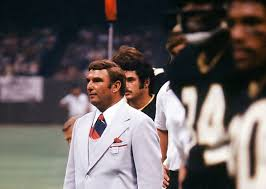
Perhaps the biggest highlight of his New Orleans tenure was a 27–17 win over his former team, the Kansas City Chiefs, at Arrowhead Stadium in 1976, Stram's first victory with the Saints. The 1977 campaign culminated in an historic home loss to the previously winless Tampa Bay Buccaneers who were riding a 26-game losing streak over two seasons. Stram took the loss hard, burning the game film. He was fired after the final game of the season.

Stram was an innovator, a shrewd judge of talent, and an excellent teacher. He helped develop Hall of Famers Len Dawson, Bobby Bell, Buck Buchanan, Curley Culp, Willie Lanier, Jan Stenerud, Emmitt Thomas, and Johnny Robinson, and others like Ed Budde and Otis Taylor. He would take players that had been unsuccessful on other teams, such as Len Dawson, who had failed to catch on with both the Steelers and the Browns, and help them develop their potential. Stram recruited heavily from historically black colleges, so his teams were always diverse, and he also instituted weight-training and off-season mini-camps. He was also the first coach in professional football to use Gatorade on his sidelines and run both the I formation and two-tight end offense, still used in professional football today. On defense, the Chiefs employed a triple-stack defense, hiding the three linebackers behind defensive linemen.

He was considered a motivational genius, and his emphasis on the Chiefs' wearing of a patch commemorating the AFL in Super Bowl IV was one of his typical ploys, extracting maximum effort from players who had been derided by proponents of the NFL. Stram was inducted into the Pro Football Hall of Fame in 2003, nine years after Bud Grant, the man whose team he had convincingly defeated in Super Bowl IV, had been enshrined. At the Hall of Fame ceremonies, Stram was so weakened by the effects of diabetes that Len Dawson pushed his former coach onto the stage in a wheelchair. Stram's induction speech was then played from a previously recorded videotape.

Stram was the only head coach who lasted the entire history of the AFL (1960 – 1969).

Following his retirement from coaching, Stram enjoyed a long and successful career as a color commentator on CBS' television and radio broadcasts of NFL games. Stram began broadcasting games for CBS in 1975, originally calling games with Frank Glieber. After a brief hiatus so he could return to coaching, Stram returned to call games with Gary Bender in 1978. His other broadcast partners were Jack Buck, Vin Scully, Curt Gowdy, Dick Stockton, Tim Brant, Steve Zabriskie, Jim Henderson, Sean McDonough, and Jim Nantz, along with various others. From 1979 through 1989 he also called the Tampa Bay Buccaneers' preseason football games for WTOG-TV in Tampa, Florida.

As a broadcaster, Stram is best remembered for his near-20-year stint (beginning in 1978 and lasting through the 1995 season) with Jack Buck on CBS Radio broadcasts of Monday Night Football games. Stram's key broadcasting trademark was his habit of predicting the next play before it happened.

On January 10, 1982, Stram, along with Vin Scully, called the famous NFC Championship Game between the San Francisco 49ers and the Dallas Cowboys. The game in question was immortalized by Dwight Clark's touchdown catch which elevated the 49ers into their first Super Bowl appearance (the first of four during the 1980s).

During a 1988 broadcasting trip to Indianapolis for a Chicago Bears–Colts game, Stram collapsed with a severely blocked aortic valve and underwent open heart surgery. He was hospitalized in Indianapolis for a week and later resumed his career with CBS.

He remained a part of CBS' television broadcast team until 1993. His last game as a broadcaster was Super Bowl XXX for CBS Radio in 1996.

Stram married Phyllis Marie Pesha in 1953 and they stayed together as husband and wife until his death due to complications from diabetes in 2005. They had six children, four sons and two daughters, including actor Henry Stram.

Stram made a guest appearance as himself on the TV show Coach. In the episode, Stram was attending a coaching convention with fellow coaches Barry Switzer and George Allen. Hayden Fox, the fictional protagonist of the show, also attended the conference.

Hank Stram retired to New Orleans, Louisiana, where he built a home in the town of Covington. He died at St. Tammany Parish hospital in Covington, from complications due to diabetes, on July 4, 2005.

Sources
https://www.pro-football-reference.com/
https://www.profootballarchives.com/index.html
https://americanfootballdatabase.fandom.com/wiki/Football_Wiki
https://www.gridiron-uniforms.com/GUD/controller/controller.php?action=main
https://www.profootballhof.com/hall-of-famers/
Drobnicki, John. (2011). "Stram, Hank," in The Polish American Encyclopedia. Ed. James S. Pula. Jefferson, NC: McFarland & Co., 506.
 "UPI Almanac for Thursday, Jan. 3, 2019". United Press International. January 3, 2019. Archived from the original on January 3, 2019. Retrieved September 3, 2019. football Hall of Fame Coach Hank Stram in 1923
 Farmer, Sam (July 5, 2005). "Hank Stram, 82; Won More Games Than Any Other Coach in the AFL". Los Angeles Times. Retrieved February 2, 2020.
 "Coach Stram Moves On". The Miami Hurricane. January 5, 1960. Retrieved January 30, 2022.
 Grathoff, Pete (November 27, 2023). "Andy Reid passes Hank Stram for most wins as Chiefs coach, makes NFL history". Yahoo! News. Retrieved February 17, 2025.
 "Buccaneers vs. New Orleans Saints Sunday December 11, 1977 - Away Game". BuccaneersFan.com©. Retrieved June 12, 2024.
 "Hall of Fame Coach Hank Stram Dies at 82". FOX News. Associated Press. July 4, 2005. Retrieved January 27, 2019.
 "Hank Stram Record, Statistics, and Category Ranks". Pro-Football-Reference.com.
Hank Stram with Lou Sahadi, They're Playing My Game, Morrow, New York 1986 ISBN 0-688-06080-3
Edward Gruver, The American Football League: A Year-by-Year History 1960–1969 McFarland & Company 1997 ISBN 0-7864-0399-3
Brad Adler, Coaching Matters: Leadership & Tactics of the NFL's Ten Greatest Coaches Brassey's Inc 2003 pages 56–57 ISBN 1-57488-613-4
"Stram gets Texan post", Dallas Morning News December 21, 1959
"Texans now rule AFL kingdom", Dallas Morning News December 24, 1962
MacCambridge, Michael (2005), America's Game. New York:Anchor Books. ISBN 978-0-307-48143-6

Wednesday, October 23, 2024

The Story And Significance Of James Lofton - Became The Oldest Player In League History To Record 1,000 Receiving Yards In A Season

James David Lofton is an American former professional football player and coach. He played in the National Football League (NFL) as a wide receiver for the Green Bay Packers (1978–1986), Los Angeles Raiders (1987–1988), the Buffalo Bills (1989–1992), Los Angeles Rams (1993) and Philadelphia Eagles (1993). He was also the NCAA champion in the long jump in 1978 while attending Stanford University.

Widely regarded as one of the greatest wide receivers of all time, Lofton was inducted into the Pro Football Hall of Fame in 2003. After his playing career ended, he became a wide receivers coach for the San Diego Chargers and Oakland Raiders.

Lofton was drafted in the first round (sixth overall) of the 1978 NFL draft by the Green Bay Packers. He was named to the NFL Pro Bowl eight times (seven with the Packers, one with the Bills). He was also named to four All-Pro teams. He also played in three Super Bowls during his career with the Bills.Lofton was inducted into the Pro Football Hall of Fame in 2003.

In his 16 NFL seasons, Lofton caught 764 passes for 14,004 yards and 75 touchdowns. He averaged 20 yards per catch or more in five seasons, leading the league in 1983 and 1984 with an average of 22.4 and 22 yards respectively. He also rushed 32 times for 246 yards and one touchdown.

Lofton is the first NFL player to record 14,000 yards receiving and was the second (one game after Drew Hill) to score a touchdown in the 1970s, 1980s, and 1990s. During his nine seasons in Green Bay, Lofton played in seven Pro Bowls and left as the team's all-time leading receiver with 9,656 yards (since broken by Donald Driver). On April 13, 1987, he was traded for two draft picks to the Raiders in the wake of his charge for second degree sexual assault. A month later, he was found not guilty by Brown County Circuit Court jury. Two mediocre seasons (a combined 69 catches in 28 games) with the Raiders followed before he was signed as a free agent by Buffalo in 1989. He was to sign a two-year deal with Oakland in 1993 but instead joined the Los Angeles Rams, where he played just one game before finishing the season with Philadelphia.

On the retirement of Steve Largent, Lofton became the NFL's active leader in receiving yards at the start of 1990, through to his retirement in 1993. In 1991, Lofton became the oldest player to record 1,000 receiving yards in a season (since broken by Jerry Rice). On October 21, of that same year, Lofton became the oldest player to record 200 yards receiving as well as 200 yards from scrimmage in a game (35 years, 108 days). He is also the 2nd oldest player to have 200+ all-purpose yards in a game behind Mel Gray, (35 years, 204 days). He was inducted into the Green Bay Packers Hall of Fame in 1999.

Lofton became the wide receiver coach for the San Diego Chargers in 2002 and continued that role until he was fired on January 22, 2008. Early in his coaching career, Lofton watched Robert Woods in a high school track meet, he noted that he would be an incredible NFL prospect. In 2005 at the NFL draft, Lofton played catch with Desean Jackson, noting he was going to be an excellent deep ball threat. Lofton was later announced as a candidate to become head coach for Oakland Raiders in 2007 but the job would later go to Lane Kiffin. In 2008, the Raiders hired him as their wide receivers coach. On January 13, 2009, Lofton was let go by the Oakland Raiders and replaced by Sanjay Lal.

Lofton served as a color analyst and sideline reporter for NFL coverage on Westwood One radio from 1999 to 2001. In 2009, he re-joined the network to team with Dave Sims and later Kevin Kugler on Sunday Night Football broadcasts. He moved to a television position on the NFL on CBS in 2017, replacing the departing Solomon Wilcots. He has been the game analyst paired with Andrew Catalon since then. In 2023, Lofton was considered by many to be in the running for a promotion to higher tiers of the announcing ranks on CBS.

Lofton and his wife Beverly have three children including David who also played college football at Stanford. Lofton's cousin, Kevin Bass, was a Major League Baseball player.

In October 1984, a dancer at the Marquee Club in Milwaukee accused James Lofton and his Packers teammate Eddie Lee Ivery of sexual assault. Lofton and Ivery asserted that the acts were consensual. Neither player ended up being charged in the incident due to a lack of evidence. Two years later, Lofton was charged with second-degree sexual assault following an incident in the stairwell of a Green Bay nightclub. He was found not guilty of that charge.

Sources
https://www.pro-football-reference.com/
https://www.profootballarchives.com/index.html
https://americanfootballdatabase.fandom.com/wiki/Football_Wiki
https://www.gridiron-uniforms.com/GUD/controller/controller.php?action=main
https://www.profootballhof.com/hall-of-famers/
 "The Life And Career Of James Lofton (Complete Story)". Pro Football History. February 18, 2022. Retrieved March 7, 2022.
 Kenyon, David (October 3, 2018). "The Top 10 NFL Wide Receivers of All Time". Bleacher Report. Archived from the original on April 5, 2022. Retrieved August 16, 2022.
 Tallent, Aaron (February 18, 2022). "25 Greatest Wide Receivers in NFL History". AthlonSports.com. Archived from the original on April 5, 2022. Retrieved August 16, 2022.
 Patuto, Greg (May 15, 2020). "Ranking The 20 Greatest NFL Wide Receivers Of All Time". ClutchPoints. Archived from the original on February 7, 2022. Retrieved August 16, 2022.
 "Hall of Famers » JAMES LOFTON". Profootballhof.com. Retrieved May 15, 2013.
 "Las Vegas Raiders". Las Vegas Raiders. Retrieved March 7, 2022.
 "HOFer James Lofton Inspires". Calhisports.com. November 15, 2012. Retrieved May 15, 2013.
 "James Lofton". Retrieved December 16, 2018.
 "California State Meet Results - 1915 to present". Hank Lawson. Archived from the original on October 6, 2014. Retrieved December 25, 2012.
 @jfritz20 (June 2, 2009). "Top 50 All-Time Bills, No. 47: WR James Lofton". Buffalo Rumblings. Retrieved May 15, 2013.
 Heisler, Mark (April 14, 1987). "Raiders Acquire Lofton From Green Bay : L.A. Disregards Fact the All-Pro Wide Receiver Is Awaiting Trial". Los Angeles Times. Retrieved May 13, 2024.
 Heisler, Mark (May 23, 1987). "Lofton Is Acquitted of Sexual Assault by Green Bay Jury". Los Angeles Times. Retrieved May 13, 2024.
 Smith, Timothy W. (January 19, 1992). "PRO FOOTBALL; The Decline and Return of James Lofton". The New York Times. ISSN 0362-4331. Retrieved May 13, 2024.
 Springer, Steve (May 8, 1993). "Lofton to Become a Raider--Again : Pro football: He agrees to two-year, $1.8-million deal to rejoin team. Rams also were interested in receiver". Los Angeles Times. Retrieved May 13, 2024.
 Christl, Cliff. "James Lofton". Packers.com. Archived from the original on May 25, 2023. Retrieved September 20, 2023.
 Williamson, Bill (January 13, 2009). "James Lofton - AFC West Blog - ESPN". Espn.go.com. Retrieved May 15, 2013.
 "James Lofton". FOX 5 San Diego. January 4, 2021. Retrieved March 7, 2022.
 Putterman, Alex (May 10, 2017). "James Lofton joins CBS as an NFL game analyst, while Tony Gonzalez jumps to Fox". Awful Announcing.
 Connors, Greg. "Former Bill James Lofton joins CBS's NFL lineup as networks announce broadcast teams," The Buffalo (NY) News, Tuesday, August 15, 2017. Retrieved February 5, 2022.
 "A Tale of Two Teams," Stanford Magazine (Stanford University), November/December 2006. Retrieved February 5, 2022.
 "Milwaukee Buzz: Milwaukees most notorious sex scandals". Onmilwaukee.com. March 14, 2009. Retrieved May 15, 2013.

Monday, October 21, 2024

The Story And Significance Of Joe DeLamielleure - All-Pro At Offensive Guard Seven Times

Joseph Michael DeLamielleure is an American former professional football player who was a guard in the National Football League. He was an All-American playing college football for the Michigan State Spartans. He was selected by the Buffalo Bills in the first round of the 1973 NFL draft. He won All-Rookie Honors, after finding out a physical condition with his irregular heartbeat was not serious. In 1973 the Buffalo Bills rushing offense led the NFL in yards, yards per carry, as well as rushing touchdowns. He is also one of the first living NFL players to be tested and diagnosed with CTE (Chronic Traumatic Encephalopathy).

DeLamielleure was perhaps the central figure in the "Electric Company," the Bills' offensive line that paved the way for O. J. Simpson to rush for 2,003 yards in 1973, the first player ever to break that barrier, and the only player ever to do so in a 14-game schedule.

The league-leading rushing yardage mark of 3,088 yards is still the 14-game record. Only the 1978 New England Patriots have bettered that mark and did it in 16 games. Individually, Simpson led the NFL in all four major rushing categories. Joe also had the longest run in the NFL. The 2,003 yards Simpson rushed for is still the 14 game record (Eric Dickerson, Barry Sanders, Terrell Davis, Jamal Lewis, Chris Johnson, Adrian Peterson and Derrick Henry achieved their marks in 16 games). DeLamielleure was also on the kickoff return team that blocked for Wallace Francis, who led NFL with two return touchdowns. DeLamielleure played on the wedge of the kickoff return team his entire career in Buffalo.

The following year, 1974, the Bills improved to 9–5 and made the playoffs. DeLamielleure was voted second-team All-Pro. In 1975 the Bills displayed one of the most potent offenses of the decade. They led the NFL in eleven categories, including total offense, rushing, rushing average, points, touchdowns and touchdown passes en route to an 8–6 record. The offensive line also allowed the fewest sacks in AFC. Simpson, behind the "Electric Company" achieved his second "quadruple crown" in three years and also had the longest run in NFL. Individually, DeLamielleure was named First-team All-Pro.

O.J. Simpson again lead the NFL in rushing in 1976 and DeLamielleure is named a First-team All-Pro.

In 1977, with Simpson injured at mid-season, the Bills pass more often, leading the NFL in passing yards and total passing attempts.

In 1978, with Simpson traded, Bills running back Terry Miller takes over and is 9th in the NFL in rushing.

DeLamielleure was named first team All-Pro four times, second team all-pro three times and was named to the Pro Bowl six times. In 1975, DeLamielleure was named by the NFLPA as Offensive Lineman of the Year. In 1973, DeLamielleure was Co-Offensive Linemen of the Year as awarded by the 1000 Yard Rusher Club, Columbus, Ohio. In 1977, DeLamielleure received the Forrest Gregg Award as the NFL's Top Offensive Lineman for that season.

In 1980, DeLamielleure was traded to the Cleveland Browns where he blocked for his 2nd NFL MVP, Brian Sipe. DeLamielleure became the first player ever to block for a 2,000-yard rusher and a 4,000-yard passer. Of those who have done it since, (Jackie Slater, Doug Smith, Irv Pankey, Kevin Glover, and Tom Nalen) only DeLamielleure's duo were NFL MVPs and the passer (Sipe) also won the NFL passing crown. Also, the 1980 Browns offensive line led NFL in allowing the lowest sacks percentage and blocked for a 1,000-yard runner (Mike Pruitt). During his five years with Cleveland, he played every game. In 1979, DeLamielleure was named to the NFL's All-Decade Team. He played his final year in the NFL, 1985, back with the Buffalo Bills.

In 1992, DeLamielleure had a short stint with the Charlotte Rage of the Arena Football League.

DeLamielleure was named to the Pro Football Hall of Fame in 2003 and was inducted to the East-West Shrine Game Hall of Fame in 2007.

DeLamielleure was a key advocate for retired players of the league in need of financial assistance. As such, he was often a critic of Gene Upshaw, the head of the Players Union when it came to attending to the needs of older players in terms of medical and financial help in favor of current players. DeLamielleure, along with other former greats such as Mike Ditka announced the first Gridiron Greats Assistance Fund auction in 2007, and he stated that both Upshaw and former NFL commissioner Paul Tagliabue had "done nothing" when it comes to older players.

DeLamielleure was a promoter of the All-American Football League, a spring league that hoped to fill a void of the now-defunct NFL Europe. The AAFL planned to take collegiate players provided they've earned a four-year college degree. However, the league did not play a game.

In 2009, DeLamielleure and his two former college teammates at Michigan State University embarked on a bicycle ride from East Lansing, Michigan to the site of "The City of the Children" orphanage in Mexico. The bike tour was to raise funds needed to complete construction and provide the necessary resources to support the abandoned, abused and neglected children of that region.

In 2013, DeLamielleure was diagnosed with early signs of chronic traumatic encephalopathy (CTE).

In 2016, DeLamielleure appeared in the Academy Award-winning documentary O.J.: Made in America, discussing Simpson's time in Buffalo and his demeanor as a teammate.

DeLamielleure served as an offensive line coach under Sam Rutigliano for two seasons at Liberty University, before going on to coach at Duke University in the same role from 1996 to 2000. He later coached in the Charlotte area with the Private Coaching Service CoachUp.

Sources
https://www.pro-football-reference.com/
https://www.profootballarchives.com/index.html
https://americanfootballdatabase.fandom.com/wiki/Football_Wiki
https://www.gridiron-uniforms.com/GUD/controller/controller.php?action=main
https://www.profootballhof.com/hall-of-famers/
Weinbaum, William; Delsohn, Steve (April 17, 2017). "OTL: Ex-NFL stars show CTE signs". ESPN.com. Retrieved July 11, 2019.
 Member profile
 ArenaFan Online Page
 "Archived copy". Archived from the original on July 21, 2009. Retrieved July 21, 2009.
 "Report: Upshaw critic thinks threat real". ESPN.com. Associated Press. June 5, 2007. Retrieved July 27, 2025.
 "Bitter rival mourns Upshaw's passing". August 21, 2008.
 "Buffalo Bills.com". Archived from the original on March 30, 2009. Retrieved April 2, 2009.
 "Three Former NFL Stars Diagnosed with Telltale Signs of CTE". PBS.
 "The Craziest Moments and Quotes from 'O.J.: Made in America'". Newsweek. June 24, 2016.
 ESPN.com
 www.coachup.com/coaches/joed-11
 Springer, Steve (July 27, 1995). "He Gave His All : For Ex-Raider Marsh, That Meant His Right Leg, Which Was Amputated After Years of Pain". Los Angeles Times. Retrieved March 13, 2020.
 DeLamielleure inducted into Michigan Sports Hall of Fame, mshof.org; accessed June 28, 2015.

Wednesday, October 16, 2024

The Story And Significance Of Elvin Bethea - Played 210 Games As A Houston Oilers And Made Eight Pro Bowls At Defensive End

Elvin Lamont Bethea is an American former professional football player who spent his entire career as a defensive end with the Houston Oilers of the American Football League (AFL) and National Football League. He played college football for the North Carolina A&T Aggies and was the first player from the school to be elected to the Pro Football Hall of Fame, having been inducted in 2003.

During his career in Houston, Bethea played in 210 games, including a stretch of 135 consecutive. He played at defensive end and guard in the 1968 season and didn't miss a game until breaking his arm in a game against the Oakland Raiders in 1977. He led the team in sacks six times, finishing his career with 105 unofficial sacks.

Elvin Bethea, an outstanding prospect from North Carolina A&T, was the Houston Oilers third-round pick in the 1968 AFL/NFL Draft. Most observers agree that for a third-rounder, he was a steal. In hindsight, and after 16 seasons of outstanding play with the Oilers, it’s safe to say he was more than a “steal,” he was clearly one of the best players selected, and that in a draft that produced three future Hall of Fame players, Larry Csonka, Art Shell, and Ron Yary.

An eight-time Pro Bowl selection, Bethea played in 210 games during his long career in Houston. He was named first- or second-team All-AFL/AFC six times and second-team All-Pro four times. Considered a leader both on and off the field, Bethea was durable and dependable. He started at defensive end in the 1968 season opener and didn’t miss a game until breaking his arm in a game against the Oakland Raiders on November 13, 1977.

When he retired – which was put off by a year per the Oilers’ request – he held three team records relating to career service: most seasons (16), most career regular season games played (210), and most consecutive regular season games played (135). He also saw action in eight Oilers playoff games.

Although sacks were not an official National Football League statistic until 1982, Elvin’s unofficial 105-career quarterback sack total still ranks as the best in Oilers/Tennessee Titans history. Six times he led his team in that department. His best single game performance as a pass rusher came in a game against the San Diego Chargers in 1976 in which he recorded 4 sacks and one fumble recovery.

More than just a pass rusher, Bethea was also effective against the run. Even though 1974 was the first year such statistics were compiled by the Oilers, his 691-career tackles, are still among the best in franchise history, even excluding the first six years of his career.

His career high was in 1973 with 16 sacks, which still ranks as the best in Oilers/Tennessee Titans history, a feat made more remarkable by the Oilers' 1–13 record. In 1976 Bethea recorded 14.5 sacks, yet was not voted to the Pro Bowl. In a game against the San Diego Chargers in 1976, he recorded four sacks (his career high) and had one fumble recovery.

He also had 14.5 sacks in 1969. Other notable seasons in terms of sacks were: 1970 and 1971 with 10.5 sacks in each, 1975 with 10 and 1978 with 8. He played in the AFC Championship game in 1978 and 1979.

Bethea was Second-team All-Pro in 1969, 1973, 1978 and 1979 to go with his 8 Pro Bowl selections.

Bethea was elected to the Pro Football Hall of Fame in 2003. He was officially inducted during the Enshrinement Ceremony on August 3, 2003, where his college coach and presenter, Hornsby Howell, unveiled the bust of Bethea, which was sculpted by Scott Myers.

In 2005, Bethea was inducted to the North Carolina Sports Hall of Fame.

Sources
https://www.pro-football-reference.com/
https://www.profootballarchives.com/index.html
https://americanfootballdatabase.fandom.com/wiki/Football_Wiki
https://www.gridiron-uniforms.com/GUD/controller/controller.php?action=main
https://www.profootballhof.com/hall-of-famers/
 Elvin Bethea, database Football. Accessed November 26, 2007.
 http://www.chron.com/CDA/archives/archive.mpl/2003_3677140/pro-football-hall-of-fame-star-track-shot-put-cham.html [dead link]
 "2000 GWI Results". Archived from the original on May 5, 2013. Retrieved December 10, 2012.
 profootballhof.com
 Member – Pro Football Hall of Fame
 "Years - Hall of Famers | Pro Football Hall of Fame Official Site".
 "Photo Gallery » Class of 2003. Enshrinement Day » Class of 2003. Enshrinement Day". Retrieved December 10, 2010.
 "Tar Heel Blue CSTV.com". Archived from the original on January 6, 2009. Retrieved March 27, 2009.
 Bethea, Elvin (2005). Smash Mouth: My Football Journey from Trenton to Canton. Sports Publishing LLC. ISBN 158261881X. Retrieved February 19, 2016.

Monday, October 14, 2024

The Story And Significance Of Marcus Allen - Most Consecutive Seasons With Multiple Rushing Touchdowns

Marcus LeMarr Allen is an American former professional football running back who played in the National Football League for 16 seasons, primarily with the Los Angeles Raiders. Considered one of the greatest goal line and short-yard runners in NFL history, he was selected 10th overall by the Raiders in the 1982 NFL draft, following a successful college football career with the USC Trojans. He was a member of the Raiders for 11 seasons and spent his last five seasons with the Kansas City Chiefs.

During his professional career, Allen ran for 12,243 yards and caught 587 passes for 5,412 yards. He also scored 145 touchdowns, including a then-league-record 123 rushing touchdowns, and was elected to six Pro Bowls. While with the Raiders, he helped the team win Super Bowl XVIII. He was the first NFL player to gain more than 10,000 rushing yards and 5,000 receiving yards during his career. Allen has the distinction of being the only player to have won the Heisman Trophy, named Unanimous All-American, won an AFCA National Championship Trophy, the Super Bowl, and be named NFL MVP and Super Bowl MVP. He was inducted to the College Football Hall of Fame in 2000, the Pro Football Hall of Fame in 2003, and the International Sports Hall of Fame in 2021.

Allen was drafted as the 10th overall pick in the 1982 NFL draft by the Los Angeles Raiders. Allen was pleased that he didn't have to travel as the team had just relocated from Oakland. Allen has recalled that shortly before being drafted the Raiders asked him his weight (he answered 200 or 212) and then drafted him soon after. Though his rookie season was shortened by a league strike, Allen rushed for 697 yards and led the Raiders to the best record in the AFC at 8–1. He was voted the NFL Offensive Rookie of the Year. The Raiders lost to the New York Jets in the AFC Divisional Playoffs.

The next season, Allen broke the 1,000-yard mark for the first time, an accomplishment he would repeat the two following years. During the 1985 season, he rushed for 1,759 yards and scored 11 touchdowns on 380 carries, leading the Raiders to a 12–4 record and the AFC West Division Championship. In addition, Allen was named the NFL MVP.

In Super Bowl XVIII on January 22, 1984, Allen ran for 191 yards, caught two passes for 18 yards, and scored two touchdowns in the Raiders' 38–9 victory over the Washington Redskins. Included in his stats was a 74-yard touchdown run, a feat that remained the longest run in Super Bowl history until Willie Parker's 75-yard run in Super Bowl XL. Allen's 191 rushing yards were also a Super Bowl record, which stood until Timmy Smith of the Redskins topped it with 204 yards in Super Bowl XXII. Upon winning the game, Allen joined a small group of players to win both the Heisman Trophy and Super Bowl MVP (Roger Staubach, Jim Plunkett, and later Desmond Howard). In total, Allen rushed 58 times for 466 yards and four touchdowns during the playoffs. He also added 118 yards and one touchdown on 14 receptions.

Allen ended the 1985 season on a strong note, finishing the year as the NFL rushing leader with 9 consecutive 100-yard games.

From 1987 through 1990, Allen shared the backfield with Bo Jackson. Initially, Allen was commended for his gracious nature and team spirit for sharing the spotlight during the prime of his career. In later seasons with the Raiders, Allen had a stormy relationship with owner Al Davis stemming from a contract dispute; Davis referred to Allen as a "cancer to the team." He also missed most of the 1989 season with a knee injury. Allen was relegated to back-up duty in his final three seasons with the Raiders and, at one time, fell to fourth on the depth chart. Allen's strained relationship with Davis reached an all-time low in December 1992. During halftime of the Raiders-Dolphins game on Monday Night Football, a taped interview between Al Michaels and Allen was broadcast in which Allen said that Davis "told me he was going to get me", adding, "I think he [Davis] tried to ruin the latter part of my career, tried to devalue me. He's trying to stop me from going to the Hall of Fame. They don't want me to play."

Allen eventually left Los Angeles and joined the Kansas City Chiefs in 1993. Although he only rushed for 764 yards that year, he scored 12 touchdowns, leading the AFC, as he and Joe Montana led the Chiefs to the AFC Championship Game. Allen scored touchdowns in all three Chiefs playoff games that year, and was named the NFL Comeback Player of the Year by the Pro Football Writers Association. With the retirement of Eric Dickerson in 1993, Allen became the active leader in career rushing yards, a position he maintained until being passed by Barry Sanders in Game 1 of 1997. Allen went on to play for the Chiefs for four more seasons, leading the team in rushing every year but his last.

Allen retired after the 1997 season. In 1999, he was ranked 72nd on The Sporting News' list of the 100 Greatest Football Players. Allen was inducted into the Pro Football Hall of Fame in 2003. Allen was also inducted into the California Sports Hall of Fame in 2007.

In 1999, Allen was also inducted into the San Diego Hall of Champions Breitbard Hall of Fame.

In 2008, Allen joined as a spokesman for the sports website OPENSports.com, the brainchild of Mike Levy, founder and former CEO of CBS Sportsline.com. Allen wrote a blog and occasionally answered member questions for the company during this time.

In 1986, Allen met Kathryn Eickstaedt and the two later got engaged. They married in 1993 at O.J. Simpson's Rockingham estate, since Allen was friends with Simpson. Allen played the role of Rick Lambert in the sitcom 1st & Ten with Simpson in the mid-80's. Allen and Eickstaedt's engagement was mentioned in Faye Resnick's book, Nicole Brown Simpson: The Private Diary of a Life Interrupted, which was published during Simpson's murder trial. Resnick claimed Nicole Brown Simpson was having an affair with Allen, and Eickstaedt was aware of Allen's womanizing ways, and if she knew of the affair, she would have to call off the wedding. Sports agent Mike Gilbert (who had represented both Allen and Simpson) and actress Robin Greer both also claimed in O.J.: Made in America that Simpson and Allen had had a romantic relationship. Allen and Eickstaedt were summoned to testify in the trial but fought the subpoena as they wanted to stay out of it. The couple divorced in 2001.

Allen is the older brother of Canadian Football Hall of Fame quarterback Damon Allen.

Sources
https://www.pro-football-reference.com/
https://www.profootballarchives.com/index.html
https://americanfootballdatabase.fandom.com/wiki/Football_Wiki
https://www.gridiron-uniforms.com/GUD/controller/controller.php?action=main
https://www.profootballhof.com/hall-of-famers/
 "Marcus Allen". Pro Football Hall of Fame. Retrieved May 11, 2009.
 Turner, Josiah (February 3, 2016). "Cam could become 2nd to win Heisman/national title/MVP/Super Bowl". ESPN.com. Retrieved June 17, 2024.
 Dr. Robert Goldman (March 13, 2021). "2021 International Sports Hall of Fame Inductees". www.sportshof.org. Retrieved July 14, 2023.
 "Marcus Allen, Terrell Davis deliver Golden Footballs to SD". NFL.com. October 20, 2015. Retrieved November 15, 2024.
 Kenney, Kirk (February 26, 2021). "San Diego Stadium farewell: Lincoln's Marcus Allen had game for the ages in 1977 finals". San Diego Union-Tribune. Retrieved November 15, 2024.
 San Diego Union-Tribune, February 3, 2014.
 [1], January 11, 2024.
 Jensen, Jeffry (2002) [1992]. Dawson, Dawn P (ed.). Great Athletes. Vol. 1 (Revised ed.). Salem Press. pp. 42–45. ISBN 1-58765-008-8.
 "1981 College Football Leaders". College Football at Sports-Reference.com. Retrieved November 20, 2025.
 "Marcus Allen". Sports Reference. Retrieved October 11, 2025.
 Harvey, Harvey (2002). The Super Bowl's Most Wanted: The Top 10 Book of Big-Game Heroes, Pigskin Zeroes, and Championship Oddities (1st ed.). Brassey's, Inc. p. 123. ISBN 9781612340289.
 "Marcus Allen Game Logs". Pro-Football-Reference.com. Sports Reference. Archived from the original on July 25, 2008. Retrieved May 11, 2009.
 "Archives". Los Angeles Times. December 4, 1987.
 Gay, Nancy (August 4, 2003). "Raiders Notebook: Classy Allen has the last word on his day". SFGate. Hearst Communications. Retrieved May 11, 2009.
 "Allen relegated to back up duty". Football.com. Archived from the original on September 5, 2008. Retrieved August 19, 2008.
 "Pro Football: Raiders' Allen Irked at Davis". The New York Times. December 15, 1992. Retrieved May 11, 2009.
 "Marcus Allen". HickokSports.com. Ralph Hickok. February 18, 2009. Retrieved May 11, 2009.
 "Marcus Allen legendary in '77 CIF title game". San Diego Union-Tribune. February 3, 2014. Retrieved June 6, 2024.
 "LT TOPS BREITBARD HALL OF FAME CLASS OF 2015". San Diego Hall of Champions. 2015.
 "We Are the Champions, of San Diego". San Diego Hal of Champions. September 18, 2014.
 "Marcus Allen". OPEN Sports. OPEN Sports Network. Retrieved May 11, 2009.
 "Erika Girardi and Kathryn Edwards Join The Real Housewives Of Beverly Hills". Broadway World. November 5, 2016. Retrieved September 9, 2016.
 Ezra Edelman (June 14, 2016). "Part 2". O.J.: Made in America. 1:27:28 minutes in. ESPN Films. ESPN.
 Segura, Megan (January 26, 2016). "A Deep Dive into the Kathryn vs. Faye Feud". Bravo. Retrieved September 10, 2016.
 Ezra Edelman (June 14, 2016). "Part 2". O.J.: Made in America. 1:26:55 minutes in. ESPN Films. ESPN.
 Rosenfeld, Laura (February 24, 2016). "Does Kathryn Edwards Think O.J. Simpson Did It?". Bravo. The Daily Dish. Retrieved September 10, 2016.
 "Bravo Media Blings Back an All New Season of "The Real Housewives of Beverly Hills" Premiering Tuesday, December 1 at 9PM ET/PT". The Futon Critic. November 5, 2015. Retrieved September 9, 2016.
 Weigle, Lauren (January 19, 2016). "Kathryn 'Kate' Edwards on 'Real Housewives of Beverly Hills'". Heavy. Retrieved September 10, 2016.
 Diamos, Jason (August 31, 2006). "Undiscovered Quarterback Is a Star Up North". The New York Times. Retrieved December 12, 2021.