Pro Football Historian (PFH) is a blog page written by Flint Given. Pro Football Historian or PFH is a page to inform people on prior NFL events that people might not know about. Learning about teams from the 1920s or even the first few NFL World Championships in the 1930s fascinates me. It's these kinds of events that I want to discuss in this blog. Hopefully you are interested and will continue to check up on my blogs. Check out the website at https://profootballhistorian.lovable.app/
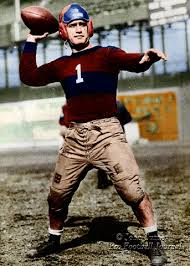
Benjamin Friedman was an American football player and coach, and athletic administrator.
A native of Cleveland, Ohio, Friedman played college football as a halfback and quarterback for the University of Michigan Wolverines from 1924 to 1926. Friedman played in the backfield on both offense and defense, handled kicking and return duties, and was known for his passing game. He was a consensus first-team All-American in both 1925 and 1926, and won the Chicago Tribune Silver Football trophy as the most valuable player in the Big Ten Conference in 1926.
Friedman also played eight seasons in the National Football League for the Cleveland Bulldogs (1927), Detroit Wolverines (1928), New York Giants (1929–1931), and Brooklyn Dodgers (1932–1934). He was the leading passer of his era in the NFL and is credited with revolutionizing the game with his passing prowess. He led the league in passing for four consecutive years from 1927 to 1930, and was selected as the first-team All-NFL quarterback in each of those years. He also served as the head coach of the Giants for the last 2 games of the 1930 season, both were victories. Then he was the head coach of the Dodgers during the 1932 season.
Friedman later served as the head football coach at City College of New York from 1934 to 1941, and at Brandeis University from 1950 to 1959. He was also the first athletic director at Brandeis, holding the position from 1949 to 1963. During World War II, he was a lieutenant in the United States Navy, serving as the deck officer aboard the aircraft carrier USS Shangri-La in the Pacific theater. He was part of the inaugural class of inductees into the College Football Hall of Fame in 1951, and was posthumously inducted into the Pro Football Hall of Fame in 2005.
In August 1927, Friedman announced that he would play professional football for the Cleveland Bulldogs in the National Football League. During the 1927 season, Friedman started all 13 games at quarterback and led Cleveland to an 8–4–1 record. Cleveland had the top scoring offense in the league with an average of 16.1 points per game. In his first NFL game, he threw a 50-yard touchdown pass to Al Bloodgood. He led the NFL during the 1927 with 12 passing touchdowns and 1,721 passing yards; his closest competitors totaled seven passing touchdowns and 1,362 passing yards. He was selected as a first-team All-NFL player by both the Chicago Tribune and the Green Bay Press Gazette.
In 1928, the Cleveland NFL franchise moved to Detroit and became known as the Detroit Wolverines. Friedman started all 10 games for the Wolverines and led the club to a 7–2–1 record. With Friedman at the helm, Detroit also had the top-scoring offense in the league with an average of 18.9 points scored per game. For the second straight season, he led the NFL with 10 passing touchdowns (double the next highest total) and 1,120 yards, and was again selected as a first-team All-NFL player by both the Chicago Tribune and the Green Bay Press Gazette. Friedman also led the NFL in rushing touchdowns in 1928, making him the only player in NFL history to lead the league in both passing and rushing touchdowns in the same season.
In July 1929, Friedman signed with the New York Giants. In his first year in New York, Friedman appeared in all 15 games and led the 1929 Giants to a 13–1–1 record, second best in the NFL. The Giants also had the top scoring offense in the league with an average of 20.8 points per game. Friedman led the NFL with 985 passing yards, and his 20 touchdown passes set an NFL single season record that stood until 1942. After the final game of the 1929 season, one sports writer noted: "The uncanny field generalship of Friedman, combined with his bullet passes, was a big factor in the Giants' thirteenth and last victory of the season."
In 1930, Friedman had another strong season, appearing in 15 games for the Giants and helping the team to a 13–4 record. The Giants again finished in second place in the NFL and had the top scoring offense in the league with 18.1 points scored per game. Friedman led the NFL with 922 passing yards and 10 touchdown passes in 1930. For the fourth consecutive season, Friedman was selected as a first-team All-NFL player.
Friedman's passing proficiency was especially noteworthy considering that the football used at the time was rounder and more difficult to throw. Friedman called plays at the line of scrimmage and threw on first and second down, when most teams waited until third down. "Benny revolutionized football. He forced the defenses out of the dark ages." George Halas later said.
In February 1931, Friedman announced that he intended to retire from professional football. He was hired as an assistant coach for the Yale Bulldogs football team. On October 26, 1931, Friedman signed a contract to return to the Giants for the remainder of the season. Since the Giants' practices were held in the morning, Friedman indicated that his duties with the Giants would not conflict with his coaching duties at Yale. Friedman appeared in nine games for the 1931 Giants.
In March 1932, Friedman signed as player, manager, and coach for the Brooklyn Dodgers. The Dodgers compiled a 3–9 record in 1932.
Friedman signed to return to the Dodgers in September 1933, though he did not serve as the head coach in 1933. He started five of ten games for the 1933 Dodgers. His average of 84.9 passing yards per game led the NFL for the 1933 season.
In 1934, Friedman appeared in only one NFL game.
In his eight seasons in the NFL, statistics are incomplete, but he appeared in 81 games, compiled at least 5,326 passing yards, and had 66 touchdown passes and 51 passes intercepted. He was the NFL's career leader in passing yardage until Sammy Baugh's seventh NFL season in 1947. Friedman also totaled over 1,000 yards rushing and over 400 yards on punt returns. At the time of his retirement, Friedman also held the NFL record with 66 career touchdown passes.
In February 1934, Friedman was hired as the football coach at City College of New York. He remained the coach at City College through the 1941 season, stepping down in 1942 for military service. Friedman's City College teams compiled a composite record of 27–31–4.
In the summer of 1942, Friedman enlisted in the United States Navy with the rank of lieutenant. He was named an assistant football coach at the Great Lakes Naval Training Station in North Chicago, Illinois. He later served as the deck officer aboard the aircraft carrier USS Shangri-La in the Pacific Ocean theater of World War II.
After being discharged, he went into the automobile sales business. He operated a Jeep dealership in Detroit.
In June 1949, Friedman was hired as the athletic director at Brandeis University, a university founded in 1948 at Waltham, Massachusetts. He was also the school's first coach of the Brandeis football team when it began play in 1950. He remained the head football coach at Brandeis through the 1959 season. Despite the limited enrollment, the first years of the football program were incredibly successful winning their first game against the prestigious Harvard freshman team. In the following years Friedman's Judges posted a winning record in their first varsity season as well as going 6–1 in 1957, the team's best record. Friedman's run as head coach of the Judges was filled with years of struggles to attract high end talent. Additionally, players at Brandeis were required to maintain certain academic standards that made it challenging for Friedman to recruit. Despite this, in 10 years as head coach, Friedman's Brandeis football teams compiled a winning record of 38–35–4.
In 1960, Brandeis discontinued its football program, noting that "the per capita cost of fielding a varsity football team is inordinately high in relation to other varsity and intramural sports." Despite the end of the football program, Friedman remained as the athletic director at Brandeis until April 1963 when he resigned his post.
When the College Football Hall of Fame was established in 1951, Friedman was part of the inaugural group of 32 players and 21 coaches to be inducted.
Friedman also received acclaim for his professional football career. Sports writer Paul Gallico called Friedman "the greatest football player in the world." Wellington Mara, the owner of the New York Giants, said of Friedman, "He was the Johnny Unitas of his day. He was the best of his time." George Halas gave Friedman credit for revolutionizing the game with his passing and wrote an article in 1967 titled "Halas Calls Friedman Pioneer Passer – Rest Came By Design."
However, when the Pro Football Hall of Fame was established in 1963, Friedman was overlooked. As years passed, numerous quarterbacks were inducted, including Sammy Baugh (1963), Dutch Clark (1963), Jimmy Conzelman (1964), Paddy Driscoll (1965), Otto Graham (1965), Sid Luckman (1965), Bob Waterfield (1965), Arnie Herber (1966), Bobby Layne (1967), Y. A. Tittle (1971), Norm Van Brocklin (1971), and Ace Parker (1972). Friedman's frustration grew as he continued to be overlooked. In February 1976, more than 40 years after his NFL career had ended, he wrote a letter to The New York Times pleading his case. It was not until 2005, 23 years after his death, that Friedman was finally inducted into the Pro Football Hall of Fame. A group of 40 to 50 players who played for him at Brandeis printed brochures and lobbied for his induction. He was then nominated by the Hall's veterans committee and received the requisite votes by a 39-member panel of selectors.
Friedman was married in February 1931 to Shirley Immerman, a resident of Brooklyn. The wedding was held at a Long Island country club with Guy Lombardo and his orchestra providing the entertainment. They were married for more than 50 years.
In 1949, Friedman became Brandeis University's first athletic director. He also served as head football coach until the school dropped the program. He went on sabbatical in September 1962 and resigned the following April, citing business pressures and the growth of his boys' quarterback school at Camp Kohut in Oxford, Maine. He sold the camp in 1969.
In his later years, Friedman suffered from multiple health problems. He battled and beat cancer, underwent back surgery, and suffered from heart disease and diabetes. In April 1979, Friedman developed a diffused clot of arteries in his left leg that resulted in gangrene. He underwent a partial amputation of his left leg below the knee.
In November 1982, he was found dead in his apartment in New York City as the result of a self-inflicted gunshot wound. He left a note indicating that he was "severely depressed." Friedman was survived by his wife, Shirley, a brother, and a sister.
Professional wrestler Maxwell Jacob Friedman claims to be a relative of Friedman.
"Benny Friedman". Pro-Football-Reference.com. Sports Reference LLC. Retrieved October 5, 2016.
Jewish Sports Stars: Athletic Heroes Past and Present - David J. Goldman - Google Books
Murray Greenberg, Passing Game: Benny Friedman and the Transformation of Football. New York: Public Affairs, 2008; p. 6.
Friedman's mother was referred to as Mayme in the 1910 US Census and as Mamy in the 1930 US Census.
The Scribner Encyclopedia of American Lives: 1981–1985 - Kenneth T. Jackson - Google Books
Whalen, Jim; Staph, C.C. (1986). "The Facts About Friedman" (PDF). The Coffin Corner. Pro Football Researchers.
1910 US Census entry for Louis Friedman and family. Census Place: Cleveland Ward 20, Cuyahoga, Ohio; Roll: T624_1171; Page: 8A; Enumeration District: 0302; FHL microfilm: 1375184. Ancestry.com. 1910 United States Federal Census [database on-line].
Grayson, Harry (December 11, 1943). "Friedman Overcame Discouragement To Be Greatest Player of His Period". The News-Herald (NEA wire story). p. 7 – via Newspapers.com. Open access icon
Greenberg, Passing Game, p. 11.
John J. Grabowski (1992). Sports in Cleveland: An Illustrated History. Indiana University Press. p. 55. ISBN 0253207479.
"University of Michigan Football Rosters". Bentley Historical Library. Retrieved October 5, 2016.
"100–to–1 Shot a Derby Favorite". The News-Herald. December 29, 1924. p. 8 – via Newspapers.com. Open access icon
"Michigan Defeats Wisconsin, 21 to 0: Friedman's Passing and Running Lead to Three Touchdowns by Wolverines; 45,000 Witness Contest". The New York Times. October 26, 1924.
"Michigan Crew Has Easy Time in Home Battle: Northwestern Falls to 27–0 Score – Rockwell Scores Three Touchdowns". Youngstown Vindicator (AP story). November 9, 1924. p. 4C.
Evans, Billy (November 25, 1924). "Friedman Is Michigan's Big Find". The News-Palladium (Benton Harbor, Mich.). p. 5 – via Newspapers.com. Open access icon
"Yost Calls 1925 Eleven Greatest: Does Not Even Except Wonderful Teams of 1901 and 1902; Rolled Up Grand 227 Point Total; Wolverine Mentor Says He's Proud to Have Coached Boys". The Hartford Courant. November 29, 1925. p. B2.
"30,000 See Michigan Take Opener, 39–0: Friedman Stars as Wolverines Beat Michigan State Before Record Crowd". The New York Times. October 4, 1925.
"YOSTMEN STRIKE THROUGH AIR TO NIP STATE, 39–0: EASY FOR MICHIGAN". Chicago Daily Tribune. October 4, 1925. p. A3.
"Michigan Crushes Indiana by 63–0: Wins Easily Behind Brilliant Work of Friedman, Who Is Star of Game". The New York Times. October 11, 1925.
"Michigan Eleven Leads in Big Ten: Decisive Victory Over Wisconsin Puts Yost's Team in Van – Chicago Has Great Defense". The New York Times (AP story). October 19, 1925.
Vidmer, Richards (November 1, 1925). "Michigan Crushes Navy Eleven, 54–0: Yost's Great Wolverine Machine Rolls Relentlessly Over the Middies Eight Times; Excels in Every Phase; Powerful Line Blocks Navy While Friedman and Other Backs Execute Plays at Will". The New York Times.
Hackleman, Jack (December 5, 1956). "1925 Version of Michigan Eleven Called Greatest Work of Pigskin Artist Yost". The Commerce Daily Journal.
Crusinberry, James (November 1, 1925). "Michigan Sinks Navy Gridiron Craft, 54 to 0: Baffling Passes Rout Midshipmen; Near Point a Minute". Chicago Daily Tribune. p. A1.
Crusinberry, James (November 3, 1925). "Brains Replace Beef on Winning Football Teams: Michigan Victory Proves Value of Wits". Chicago Daily Tribune. p. 25. Retrieved July 5, 2017.
Crusinberry, James (November 22, 1925). "Michigan Ruins Gophers' Title Hopes, 35 to 0: Victory Gives Them Claim on Title". Chicago Daily Tribune. p. A1.
"NCAA Football's Finest" (PDF). NCAA. 2002. Retrieved October 5, 2016.
"All-America Roster" (PDF). NCAA. Archived from the original (PDF) on December 1, 2007. Retrieved January 14, 2008.
Will Perry, The Wolverines, pp. 109–112 (Chapter 18 concerning the 1925 and 1926 seasons is titled "The Benny-To-Bennie Show.")
"What's a Michigan Man?". Maize and Blue Football Fans. January 5, 2011.
Parker, Dick. "Friedman to Oosterbaan" (PDF). LA84 Foundation. Archived from the original (PDF) on June 13, 2010. Retrieved October 6, 2016.
Jordan Krumey (March 22, 2009). "Benny To Bennie: The Connection That Changed College Football". Bleacher Report.
Greenberg, Murray (2008). Passing Game: Benny Friedman and the Transformation of Football. Public Affairs. ISBN 9781586484774.
"Benni Oosterbaan: Class of 1987". Muskegon Ara Sports Hall of Fame. Archived from the original on August 28, 2008. Retrieved August 18, 2016.
"Benny Friedman Selected as Captain of Michigan's 1926 Football Squad". The Detroit Free Press. November 24, 1925. p. 22 – via Newspapers.com. Open access icon
"1926 Football Team". University of Michigan, Bentley Historical Library. Retrieved October 6, 2016.
"Benny Friedman, Jewish Football Star, Honored". Jewish Daily Bulletin. November 3, 1926.
"2014 NCAA Football Records: Consensus All-America Selections" (PDF). National Collegiate Athletic Association (NCAA). 2014. p. 5. Archived from the original (PDF) on November 26, 2018. Retrieved October 6, 2016.
"Middle West Given The Lion's Share in All-American Selections". The Huntington Press. Indiana. December 5, 1926 – via Newspapers.com. Open access icon
"Seven Western Players Named On Collier's All-American; Big Three Teams Are Slighted". Charleston Daily Mail. December 6, 1926.
Brown, Norman (December 13, 1926). "Six Mid-West Stars Are On Nation's All-American Football Selection: Mythical Team of Million Grid Fans Released; 500 Newspapers Conduct Poll to Get Genuine Football Eleven". The Davenport Democrat And Leader.
"Fans Select First All-American Grid Team". Billings Gazette. December 13, 1926.
"All-American Is Chosen By New York Sun". Athens Messenger. November 28, 1926.
"These Players Honored by Eckersall with Places on All-America Team". Detroit Free Press. December 12, 1926. p. 29.
""Big Ten" Trophy Goes To Friedman". The Lincoln Star. December 19, 1926. p. 10 – via Newspapers.com. Open access icon
"Benny Joins Cleveland Pros". The Des Moines Register. August 7, 1927. p. 19 – via Newspapers.com. Open access icon
"NFL Career Passing Touchdowns Leaders". Pro-Football-Reference.com. Sports Reference LLC. Retrieved October 5, 2016.
"The Little Giant: Former Michigan star called 'best I ever played against' by Red Grange". Lansing (MI) State Journal (AP story). August 5, 2005. p. 19 – via Newspapers.com. Open access icon
"Ben Friedman Signs To Coach City College". Plainfield, N.J., Courier News. February 5, 1934. p. 16.
"Friedman Named Navy Coach". Montana Standard. August 30, 1942. p. 21 – via Newspapers.com. Open access icon
"Benny Friedman Has Hands Busy In Navy Instead of Football". The Fresno Bee. July 28, 1945. p. 6 – via Newspapers.com. Open access icon
"Friedman Set to Tackle Auto Business". Detroit Free Press. November 28, 1945. p. 14 – via Newspapers.com. Open access icon
"Benny Friedman Named Brandeis Athletic Head". The News Journal. June 16, 1949. p. 42 – via Newspapers.com. Open access icon
"Building Sports at Brandeis U.: Friedman Turns Trailblazer". Detroit Free Press. October 31, 1950. p. 16 – via Newspapers.com. Open access icon
[1]
"Benny Friedman Records by Year". College Football Data Warehouse. David DeLassus. Archived from the original on August 5, 2016. Retrieved October 5, 2016.
"Friedman Left Without Football". Pittsburgh Post-Gazette. May 22, 1960. p. 31 – via Newspapers.com. Open access icon
"Friedman Quits Brandeis Post". The Des Moines Register. April 29, 1963. p. 19 – via Newspapers.com. Open access icon
"Name 32 Players, 21 Coaches To Football's Hall of Fame". Ironwood Daily Globe. November 5, 1951. p. 8 – via Newspapers.com. Open access icon
"The man that fame forgot". The Boston Globe. January 30, 2005.
"Class of 2005 Clippings". Pro Football Hall of Fame. Retrieved October 6, 2016.
"Sports Editor's Mailbox: Football Hall of Fame/N.F.L. Essay/Hockey Soreheads". The New York Times. February 8, 1976.
"Friedman to be inducted to Football Hall of Fame". Jewish Post. April 6, 2005. p. 16.
Wilner, Barry (August 5, 2005). "NFL pioneer Friedman headed to Hall posthumously". The Anniston Star (AP story). p. 24 – via Newspapers.com. Open access icon
"Six Named To Michigan Fame Hall". The News-Palladium (Benton Harbor, Mich.). May 15, 1961. p. 12 – via Newspapers.com. Open access icon
"1976 Inductees". Greater Cleveland Sports Hall of Fame. Retrieved October 5, 2016.
"Benny Friedman profile". International Jewish Sports Hall of Fame. Retrieved October 5, 2016.
"Friedman heads Hall of Honor". Detroit Free Press. July 11, 1980. p. 6D – via Newspapers.com. Open access icon
"Michigan Athletic Hall of Honor". Bentley Historical Library. Retrieved October 5, 2016.
"Inductees". jewishsports.org. Archived from the original on February 13, 2007.
Greenberg, Passing Game, p. 236.
"Cupid Wins This Game". The Eugene Guard. February 12, 1931. p. 5C – via Newspapers.com. Open access icon
"Friedman Resigns Post In Athletics at Brandeis". The New York Times. April 29, 1963.
"Benny Friedman Holds Quarterback 'School'". The Portsmouth (NH) Herald. August 13, 1963. p. 9 – via Newspapers.com. Open access icon
"Friedman Sells Maine Grid Camp; Planning to Open Seven More". Fitchburg Sentinel. July 8, 1969. p. 7 – via Newspapers.com. Open access icon
"More Injuries Now Than '27 For Quarterbacks – Friedman". Florence Morning News. October 14, 1977. p. 21 – via Newspapers.com. Open access icon
Kirshner, Sheldon (December 2, 2009). "American Jewish Football Player Revolutionized the Game". The Canadian Jewish News.
"Wolverine great Friedman has his left leg amputated". Detroit Free Press. April 28, 1979. p. 1C – via Newspapers.com. Open access icon
"Ex-Wolverine QB Friedman found dead". Detroit Free Press. November 24, 1982. p. 1D – via Newspapers.com. Open access icon
Tuite, James (November 24, 1982). "Benny Friedman, Star Passer At Michigan And With Pros". The New York Times.
"Bennie Friedman NFL Record, Statistics, and Category Ranks". Pro-football-reference.com. Retrieved January 7, 2025.
Bob Curran, Pro Football's Rag Days. Englewood Cliffs, NJ: Prentice-Hall, 1969.
Barry Gottehrer, The Giants of New York: The History of Professional Football's Most Fabulous Dynasty. New York, G.P. Putnam's Sons, 1963.
Murray Greenberg, Passing Game: Benny Friedman and the Transformation of Football. New York: Public Affairs, 2008.
Francis J. Powers, "Friedman of Michigan Team is One of Big Ten Stars: Splendid Showing of Wolverines is Credited to Him," Springfield [OH] News-Sun, Nov. 10, 1924, pp. 12–13.
The Cleveland Bulldogs were a team that played in Cleveland, Ohio in the National Football League. They were originally called the Indians in 1923, not to be confused with the Cleveland Indians NFL franchise in 1922. However, after team owner Samuel Deutsch purchased the Canton Bulldogs in 1924, he merged the Canton team with his Indians and renamed his franchise the Cleveland Bulldogs. The Canton Bulldogs remained a part of the team until 1925, when they were sold back to Canton. The Cleveland Bulldogs played in the NFL until 1928 when they were relocated to Detroit and became the Detroit Wolverines. The team was later incorporated into the New York Giants in 1929. The Cleveland Bulldogs won the 1924 NFL championship.
Sam Deutsch, a Cleveland jeweler and boxing promoter who also owned a minor-league baseball team, bought an NFL franchise in 1923 and named the team the Indians. They played only seven games in that first season, but they had a shot at the championship, with a 3–0–3 record going into their final game against the Canton Bulldogs, who were also undefeated. The Indians were defeated 46–0 and posted a 3–1–3 league record, finishing fifth in the league, which comprised twenty teams at the time.
However, in August 1924, Deutsch, bought the defending NFL champions Canton Bulldogs for $2,500. The Bulldogs were experiencing heavy financial troubles at time and were sold to Deutsch without much of a struggle. Deutsch combined the Cleveland Indians with the Canton Bulldogs, creating a new team, the Cleveland Bulldogs. Only seven of the Canton players actually joined the new Bulldogs; among them was player-coach Guy Chamberlin. The team played all of its home games at Dunn Field although Deutsch returned the team to Canton for the Thanksgiving game that season.
The Cleveland Bulldogs won the NFL championship that year with a 7–1–1 record. After winning their first six games, the Bulldogs lost to the Frankford Yellow Jackets and entered a virtual tie with the Chicago Bears for first place in the standings. The Bears played more games, but also had more ties, and their one loss had come in the season opener against the Bulldogs. The Bears attempted to have an after-season exhibition game counted toward the standings, however in 1924 this was against the NFL's rules. In July 1924, NFL owners had agreed on a proposal that the 1924 NFL season would begin on September 27 and end on November 30. Ironically, as it turned out, the proposal was made by Dutch Sternaman, co-owner of the Bears. On the official end date, Cleveland had a 7–1–1 record to Bears' 6–1–4. Ties didn't count at all in those days, so the Bulldogs were in first place with an .875 winning percentage to Chicago's .857. However, on December 7, 1924 the Bulldogs went to Chicago for a challenge match. The Bears won the game, 23–0, and claimed that they deserved the NFL championship; they cited as precedent the 1921 championship decision (which the Bears had won over the Buffalo All-Americans) that declared there was no such thing as an exhibition game. However, the issue wasn't settled until the owners' meeting in January, when the owners voted for Cleveland to take the title. The owners also decided at that meeting that the 1925 season would run through December 20.
In 1925, several Canton businessmen purchased the rights to the old Canton Bulldogs team from Deutsch for $3,000. The Bulldogs, now known as the Canton Bulldogs, played in Canton during the 1925 and 1926 seasons. However Deutsch continued to call his Cleveland franchise the Bulldogs. He also sold his Cleveland Indians half of the club to Herb Brandt in August 1925. That season the Cleveland Bulldogs fell to a dismal 5–8–1 record. The team performed poorly on the field and at the bank. By mid-November the organization was nearly bankrupt.
In 1926 Brandt received authority from the league to suspend operations for a year. The Bulldogs then returned in 1927, bolstered by players from the folded Kansas City Cowboys franchise. Deutsch returned as the principal owner of this new Cleveland Bulldogs club. He, along with fellow investors Max Rosenblum, Brandt, Harold Gould, and Clinton Winfrey, built the new Bulldogs around native Clevelander Benny Friedman, a star quarterback at the University of Michigan. The team finished fourth in the National Football League this season, with an 8–4–1 record.
At the end of the season, Elliott Fisher purchased the Bulldogs and moved the team to Detroit, renaming them the Detroit Wolverines. The 1928 Wolverines team consisted of 12 former Bulldogs players. Before the 1929 season, Tim Mara, owner of the New York Giants, purchased the entire Wolverines squad, including Benny Friedman, and absorbed the team into his New York Giants franchise. Eight former Bulldogs players ended up playing for the Giants that season.
In 1905, several University of Detroit football players, led by Bill Marshall, organized the Heralds as an amateur team after the university did not field a squad. While the university's football team resumed play in 1906, the Heralds continued to play as an amateur team. In 1911, the team dropped its amateur status and became semi-professional. In 1916, several out-of-town players were brought in to replace some of the older players, several of whom had been with the Heralds since 1905.
Despite not being based in Ohio, the Heralds played many of their games against teams in the Ohio League. In 1917, the team recorded an 8–2 record, their only losses coming at the hands of the Ohio League champion Canton Bulldogs and a military team from Battle Creek. The Heralds were a rarity in 1918; while most teams either stopped play or reduced their schedules to only local teams because of World War I and the flu pandemic, the Heralds continued to play a full schedule and even travel to other cities, accruing a 6–2 record with both losses coming to the Ohio League champion Dayton Triangles. In 1919, as the suspended teams resumed play and travel restrictions eased significantly, the Heralds went 1–4–2, including losses to Bulldogs and the Massillon Tigers.
In 1920, the American Professional Football Association, predecessor to the National Football League, was established. While the Heralds did not officially join the association, they are listed in league standings for the season. Overall, the Heralds went 2–3–3. The Heralds were reorganized into the Detroit Tigers, after the city's major league baseball team, for the 1921 season. However, after a tie and a win in their first two games, the Tigers lost the next five. Several players complained about not getting paid and left the team during the season. The team officially folded at the end of the season in mid-November. Its remaining players were given to the Buffalo All-Americans.
In 1925, Detroit fielded its second NFL franchise, the Detroit Panthers. The team was organized by future Hall of Famer, Jimmy Conzelman. Conzelman was a quarterback who had recently played with the Decatur Staleys, Rock Island Independents and the Milwaukee Badgers. Conzelman served as the team's owner, coach, and starting quarterback. The Panthers started the season 8–1. However, a 6–3 upset loss to the Independents on Thanksgiving Day knocked them out of first place and they ended the season in third.
The Panthers hoped to build on their 1925 season, but they opened the 1926 season with an 0–3 record. After rallying to a 4–0–2 record in their next six games, they lost their last three. Conzelman gave up the franchise and joined the Providence Steam Roller as player-coach.
Following the 1927 season, the Cleveland Bulldogs were sold to a group of investors, who moved the team to Detroit. Coached by LeRoy Andrews, the team was renamed the Detroit Wolverines. They were named after quarterback Benny Friedman's alma mater, the Michigan Wolverines. The Wolverines finished their 1928 season in third place with a 7–2-1 record, losing only to the Providence Steam Roller and the Frankford Yellow Jackets, the NFL's first and second place teams.
During the offseason, Tim Mara, the owner of the New York Giants, was interested in acquiring Friedman. Rather than simply trade for Friedman, Mara bought the entire Wolverines franchise and promptly deactivated it, delivering Friedman and other star Wolverines players to New York. The NFL would not return to the Motor City for six years, until the Portsmouth Spartans became the Detroit Lions in 1934.
While the Lions are well known for playing on Thanksgiving Day, the other Detroit teams had a history of playing on Thanksgiving Day as well. Here is a list of the games.
1917 Heralds vs. Canton Bulldogs (lost 7–0)
1920 Heralds at Dayton Triangles (lost 28–0)
1921 Tigers, merged with the Buffalo All-Americans, at Chicago Staleys (won 7–6)
1925 Panthers vs. Rock Island Independents (lost 6–3)
1926 Panthers vs. Los Angeles Buccaneers (lost 9–6)
Joseph T. Labrum, "Chronology," in Joseph T. Labrum (ed.), The National Football League Record and Rules Manual: 1958, 39th Season. Bala-Cynwyd, PA, 1958; p. 66–68.
This contest (as of 2024) is the only game in NFL history to end with this score, thus creating a scorigami.
C.A. Lovett, "Detroit Smears Pylemen: Friedman Passes Wolverines to 35–12 Win Over Yankees," New York Daily News, Oct. 15, 1928, p. 36.
"Football Yanks Bow to Detroit: Friedman's Forward Passes Result in 4 Touchdowns as Wolverines Win, 35 to 12," Brooklyn Daily Times, Oct. 15, 1928, p. 15.
"Friedman Pros Defeat Giants: Bennie is Almost Whole Show as Wolverines Win, 28 to 0," Detroit Free Press, Oct. 22, 1928, pp. 18, 20.
United Press, "Detroit Wolverines Trim New York Giant Gridders," St. Joseph Herald-Press, Oct. 22, 1928, p. 7.
Wilfrid Smith, "Detroit Line Attack Beats Bears, 6–0: Friedman the Passer Shines in a New Role," Chicago Tribune, Oct. 29, 1928, pp. 23-24.
Associated Press, "Benny's Team Defeats Bears: Wolverines Cling to Professional League Lead by 6–0 Victory," Detroit Free Press, Oct. 29, 1928, p. 16.
"Frankford Yellow Jackets Jolt Wolverines, 25 to 7," Atlantic City Sunday Press, Nov. 4, 1928, p. 28.
Greg D. Tranter, The Providence Steam Roller: New England's First NFL Team. Jefferson, NC: McFarland & Co., 2024; pp. 236-237.
C.A. Lovett, "Wolverines Tie Giants in 4th Period Surge," New York Daily News, Nov. 12, 1928, p. 29.
Harold C. Burr, "Giants Fooled by Wolverines Who Play Dead: Benny Friedman Engineers Star Play to Tie Pro Football Champs," Brooklyn Eagle, Nov. 12, 1928, p. 30.
" Bennie's Arm Beats Yankees: Friedman Wolverines Defeat Eastern Eleven, 13 to 0, by Aerial Attack," Detroit Free Press, Nov. 19, 1928, pp. 15-16.
Associated Press, "Detroit Wolverines Score 18–0 Victory Over New York Yankees," Rochester Democrat and Chronicle, Nov. 19, 1928, p. 19.
United Press, "Friedman's Eleven Beats New Yorkers," Traverse City Record-Eagle, Nov. 19, 1928, p. 6.
"Detroit Pros Rally to Beat Bears," Rock Island Argus, Nov. 26, 1928, p. 16.
Associated Press, "Wolverines Trounce Chicago Bears," Decatur Herald and Review, Nov. 26, 1928, p. 4.
"Benny Defeats Chicago Bears Single-Handed," Decatur Evening Herald, Nov. 26, 1928, p. 13.
"'Tiny' Feather Back at Full for Friedman: Big Fullback's Injury Mends for Game Tomorrow with Dayton Triangles," Detroit Free Press, Nov. 28, 1928, p. 19.
"Friedman's Wolverines Crush Dayton Triangles, 33 to 0: Great Passing Routs Ohioans," Detroit Free Press, Nov. 30, 1928, p. 20.
"Triangles are Defeated, 33–0: Benny Friedman Leads Wolverines to Victory in National League," Dayton Daily News, Nov. 30, 1928, p. 38.
"Triangles are on Short End: Local Eleven Goes Down to Defeat at Detroit by Score of 33 to 0," Dayton Herald, Nov. 30, 1928, p. 32.
The reporter for the United Press had the crowd at 3,500.
C.A. Lovett, "Wolverines Sock Grid Yanks, 34–6: New York Gets First Touchdown, Then Fades Out," New York Daily News, Dec. 10, 1928, p. 38.
"Wolverines Beat Football Yankees," Brooklyn Daily Times, Dec. 10, 1928, p. 12.
United Press, "Friedman's Wolverines Humbles Yankees, 34–6," Minneapolis Star, Dec. 10, 1928, p. 14.
"On the Air Today: Professional Football Game," Hartford Courant, Oct. 14, 1928, p. 12E.
Bak, Richard (January 6, 2012). "Pro football struggled in Detroit during the Roaring '20s". Vintage Detroit. Archived from the original on April 6, 2022. Retrieved May 2, 2020.
"Detroit Titans Year by Year Football History" (PDF). Detroit Titans. Archived (PDF) from the original on May 6, 2019. Retrieved May 6, 2019.
Griffith, R. D. (2012). To the NFL: You Sure Started Somethin' A Historical Guide of All 32 NFL Teams and the Cities They've Played In. Dorrance Publishing Company, Inc. p. 138. ISBN 978-1434916815.
Maxymuk, John (2012). NFL Head Coaches: A Biographical Dictionary, 1920-2011. McFarland & Company, Inc. p. 383. ISBN 978-0786465576.
"'Pro' Champs Are Beaten by Officers". Detroit Free Press. November 12, 1917. Archived from the original on June 7, 2019. Retrieved May 6, 2019.
"1919 Detroit Heralds". The Pro Football Archives. Archived from the original on April 24, 2022. Retrieved May 6, 2019.
"Detroit Heralds 1920 Game Log". Pro-Football-Reference.com. Archived from the original on May 8, 2019. Retrieved May 8, 2019.
"Detroit Tigers 1921 Game Log". Pro-Football-Reference.com. Archived from the original on May 6, 2019. Retrieved May 6, 2019.
Bak, Richard (January 7, 2012). "Pro football struggled in Detroit during the Roaring 20s (Part II)". Vintage Detroit. Archived from the original on October 19, 2021. Retrieved May 2, 2020.
Schubert, Bill (1997). "JIMMY CONZELMAN" (PDF). Professional Football Researchers Association. Archived (PDF) from the original on September 7, 2015. Retrieved May 7, 2019.
Rozendaal, Neal (2012). Duke Slater: Pioneering Black NFL Player and Judge. McFarland & Company, Inc. p. 100. ISBN 978-0786469574.
"Detroit Panthers 1925 Game Log". Pro-Football-Reference.com. Archived from the original on May 7, 2019. Retrieved May 7, 2019.
"1925 NFL Standings & Team Stats". Pro-Football-Reference.com. Archived from the original on April 18, 2019. Retrieved May 7, 2019.
"Detroit Panthers 1926 Game Log". Pro-Football-Reference.com. Archived from the original on May 7, 2019. Retrieved May 7, 2019.
"Detroit Wolverines 1928 Game Log". Pro-Football-Reference.com. Archived from the original on May 8, 2019. Retrieved May 8, 2019.
"1928 NFL Standings & Team Stats". Pro-Football-Reference.com. Archived from the original on April 21, 2019. Retrieved May 8, 2019.
"Benny Friedman To Lead Giants". Detroit Free Press. July 18, 1929. Archived from the original on June 7, 2019. Retrieved May 7, 2019.
Barnett, C. Robert (1980). "THE PORTSMOUTH SPARTANS" (PDF). Professional Football Researchers Association. Archived (PDF) from the original on September 21, 2020. Retrieved May 8, 2019.
Cook, William A. (2011). Jim Thorpe: A Biography. McFarland & Company Inc. pp. 134–135. ISBN 978-0786463558.
"Thanksgiving Day Games". Pro Football Hall of Fame. Archived from the original on May 8, 2019. Retrieved May 8, 2019.
"Jimmy Conzelman". Pro Football Hall of Fame. Archived from the original on May 8, 2019. Retrieved May 8, 2019.
"Benny Friedman". Pro Football Hall of Fame. Archived from the original on May 23, 2020. Retrieved May 2, 2020.