Pro Football Historian (PFH) is a blog page written by Flint Given. Pro Football Historian or PFH is a page to inform people on prior NFL events that people might not know about. Learning about teams from the 1920s or even the first few NFL World Championships in the 1930s fascinates me. It's these kinds of events that I want to discuss in this blog. Hopefully you are interested and will continue to check up on my blogs. Check out the website at https://profootballhistorian.lovable.app/
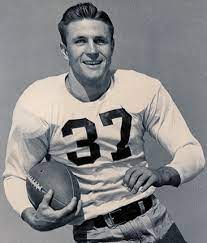
Ewell Doak Walker II was an American professional football player for the Detroit Lions of the National Football League. He played college football as a halfback at Southern Methodist University (SMU), where he won the Heisman Trophy in 1948. Walker then played professionally in the NFL with the Lions for six seasons, from 1950 to 1955.
Walker was inducted into the College Football Hall of Fame in 1959 and the Pro Football Hall of Fame in 1986. The Doak Walker Award, awarded annually since 1990 to the top running back in college football, is named after him.
Following his junior year at SMU, Walker was selected by the Boston Yanks with the third pick of in the 1949 NFL Draft, held in December 1948. The Detroit Lions acquired Walker's rights from Boston in exchange for John Rauch, whom the Lions had selected with the second pick of the 1949 NFL Draft. The Cleveland Browns held the AAFC to arbitrate their conflicting claims or flip a coin. Instead, the Browns agreed in January 1950 to forego their claim to Walker in exchange for the Lions' second pick in the 1950 NFL Draft.
In Detroit, Walker was reunited with former high school teammate Bobby Layne who the Lions acquired by trade in April 1950. The two Texans led the Lions to one of the top scoring offenses during the 1950 NFL season, as Layne led the NFL with 2,323 passing yards and Walker led the league with 128 points on five rushing touchdowns, six receiving touchdowns, 38 extra points, and eight field goals. Walker appeared in all 12 games for the 1950 Lions at the left halfback position; he rushed for 386 yards on 83 carries (4.7 yards per carry), caught 34 passes for 534 yards, and totaled 1,262 all-purpose yards. He was selected by both the Associated Press (AP) and United Press (UP) as a first-team player on the 1950 All-Pro Team. His 128 points in 1950 was the second highest single-season total in NFL history to that time.Walker had another strong season in 1951, appearing in all 12 games at left halfback for the Lions, totaling 1,270 all-purpose yards (fourth best in the NFL), scoring 97 points (third best in the NFL), and leading the NFL with 43 extra points. He was again selected by the AP and UP as a first-team All-Pro.
Walker suffered leg injuries that limited him to seven games during the 1952 season. He was fully recovered in time for the post-season and rushed for 97 yards and caught two passes against the Browns in the 1952 NFL Championship Game.
Healthy for the full 1953 season, Walker helped lead the Lions to their second consecutive NFL championship. He ranked third in the NFL with 93 points scored and totaled 978 all-purpose yards, including 502 receiving yards and 337 rushing yards. In the 1953 NFL Championship Game, he scored a touchdown and kicked a field goal and an extra point to account for 10 of the Lions' 17 points. At the end of the 1953 season, Walker was selected by the AP as a first-team All-Pro and by the UP as a second-team All-Pro.
In 1954, Walker helped lead the Lions to their third consecutive NFL Western Division championship. He led the NFL with 43 extra points (out of 43 attempted) and an average of 14.4 yards per touch. He ranked second in the NFL with 106 points scored and third with 11 field goals. He also kicked a field goal and an extra point in the 1954 NFL Championship Game and was selected by the AP, UP, and The Sporting News as a first-team back on the 1954 All-Pro Team.
In July 1955, Walker signed a contract worth $27,500 to play a final season for the Lions and to serve as a special scout for the Lions in Texas in 1956 and 1957. At age 28, Walker retired not because his abilities had diminished but because of the need to attend to multiple business interests in Texas. In his final season, he appeared in all 12 games for the Lions and led the NFL in scoring with 96 points. Walker scored 11 points in the final game of the season to secure the league's scoring title. His 1955 scoring title was remarkable given the fact that it was achieved while playing for a team that won only three games and compiled the worst record in the NFL.
On December 11, 1955, the day of Walker's final regular season game, the Lions held a "Doak Walker Day" at Briggs Stadium at which he was presented with a silver football engraved with the names of his teammates and coaches. Walker's jersey (No. 37) was also retired as part of the ceremony.
Walker's final NFL appearance was in the 1956 Pro Bowl at the Los Angeles Memorial Coliseum on January 15, 1956.
At the time of his retirement, Walker ranked third in NFL history with 534 points scored (not including 21 post-season points) in six NFL seasons. Only Don Hutson (825 points in 11 seasons) and Bob Waterfield (573 points in eight seasons) had scored more points. Walker also totaled 1,520 rushing yards on 309 carries (4.9 yards per carry) and 152 receptions for 2,539 yards (16.7 yards per reception).
In March 1950, Walker married his college sweetheart, Norma Jane Peterson, at the Highland Park Presbyterian Church in Dallas. His groomsmen included Bobby Layne and Kyle Rote. They had four children: Laurie ('52), Kris ('56), Russ ('60), and Scott ('63), but divorced in 1965. Walker married Olympic ski racer Skeeter Werner in 1969, and they lived in her hometown of Steamboat Springs, Colorado.
Walker left pro football in 1955 to concentrate on his private business interests in sporting goods and as a sales executive with an electrical contracting company. Walker took a position as a coach with the Akron Vulcans of the Continental Football League. When the Vulcans owner was exposed as a con-artist and stopped paying his bills, Walker and his assistant coaches (Tobin Rote and Lou Rymkus being among them) kept the team alive as long as they could with funds out of their own pockets; Walker eventually quit before the team folded. He later founded Walker Chemicals in Denver, a company he sold upon retirement.
In January 1998, at age 71, Walker was paralyzed from the neck down in a skiing accident at Steamboat Springs, Colorado. After hitting a change in terrain, he flew 20 to 30 feet in the air and tumbled 75 feet. He died in September from injuries sustained in the accident.
Wallace, William N. (September 28, 1998). "Doak Walker, 71, standout in college and pro football". New York Times. Retrieved December 24, 2015.
Weller, Robert (September 28, 1998). "His college's only Heisman winner; played for Detroit Lions". Pittsburgh Post-Gazette. Associated Press. p. A14.
"Doak Walker". Pro-Football-Reference.com. Sports Reference LLC. Retrieved November 8, 2017.
"In the Air or On the Ground, Doak's Game is Close to Perfect", Stanley Woodward's Football – 1949. New York: Dell Publishing, 1949; pg. 11.
1930 U.S. Census entry for Ewell D. Walker and family. Son Ewell age 3. Census Place: Dallas, Dallas, Texas; Roll: 2313; Page: 88A; Enumeration District: 0017; FHL microfilm: 2342047. Ancestry.com. 1930 United States Federal Census [database on-line].
1940 U.S. Census entry for Ewell D. Walker and family. Son Ewell age 13. Census Place: University Park, Dallas, Texas; Roll: T627_4015; Page: 62A; Enumeration District: 57-7A. Ancestry.com. 1940 United States Federal Census [database on-line].
"Walker To Play In Frisco Game". Big Spring (TX) Herald. December 20, 1945. p. 11 – via Newspapers.com.
SMU 1946 Online yearbook http://memories.smu.edu/launch.aspx?eid=b263c230-c3c4-4f8e-aefa-d3aa10e6fadb&pnum=221&skip=true&keywords=doak%20walker%20cycen%20fjodr Archived July 25, 2013, at the Wayback Machine
Maisel, Ivan (August 16, 1999). "Team of the Century". Sports Illustrated. Vol. 91, no. 6.
"Detroit obtains draft rights to Doak Walker". St. Petersburg Times. Florida. Associated Press. January 22, 1950. p. 33.
"Lions Swap Wilson for Layne". Detroit Free Press. April 9, 1950. p. 51 – via Newspapers.com.
"Lions Honor Doak: Walker Hangs Up NFL Cleats, Scoring Title". Brownwood (TX) Bulletin. December 12, 1955. p. 4 – via Newspapers.com.
"Injured Leg Finally Hospitalizes Doak". Detroit Free Press. October 25, 1952. p. 15 – via Newspapers.com.
"Championship – Detroit Lions at Cleveland Browns – December 28th, 1952". Pro-Football-Reference.com. Sports Reference LLC. Retrieved November 8, 2017.
"Championship – Cleveland Browns at Detroit Lions – December 27th, 1953". Pro-Football-Reference.com. Sports Reference LLC. Retrieved November 8, 2017.
"Doak Signs . . . for $27,500". Detroit Free Press. July 30, 1955. p. 11 – via Newspapers.com.
"Lions Are Beaten By Giants, 24–19". Detroit Free Press. December 12, 1955. p. 1 – via Newspapers.com.
"1955 NFL Standings & Team Stats". Pro-Football-Reference.com. Sports Reference LLC. Retrieved November 9, 2017.
"Lions Hold 'Day' For Walker Sunday". Detroit Free Press. December 7, 1955. p. 7 – via Newspapers.com.
"East Defeats West In Pro Bowl". Los Angeles Times. January 16, 1956. pp. 4–1, 4–2.
"Lions to retire Doak Walker's jersey number". Victoria Advocate. Texas. United Press. December 4, 1955. p. 14A.
"Doak "The Doaker" Walker". National Football Foundation. Retrieved November 8, 2017.
"Golden Plate Awardees of the American Academy of Achievement". www.achievement.org. American Academy of Achievement.
"Walker was the ultimate Lion". Detroit Free Press. August 2, 1986. pp. 1D, 2D – via Newspapers.com.
"Washington running back wins first Doak Walker award". The Jackson Sun. December 8, 1990. p. 16 – via Newspapers.com.
"1998 Year in Review – Saying Goodbye – Saying goodbye to Doak Walker". CNN/SI. December 16, 1998. Archived from the original on August 24, 2000. Retrieved August 26, 2007.
"Doak Walker Takes Bride". The Arizona Republic. March 18, 1950. p. 9 – via Newspapers.com.
Werner, Skeeter; Walker, Doak (January 3, 1967). "First suggestion: get an instructor". Pittsburgh Press. p. 40.
Association, International Skiing History (September 2000). "Remembering: Skeeter Werner". Skiing Heritage: 36.
"Doak Walker dies of paralysis injuries". Reading Eagle. Pennsylvania. Associated Press. September 28, 1998. p. D9.
"Friends, family honor Walker". Victoria Advocate. Texas. Associated Press. October 1, 1998. p. 2B.
"Lion star ponders big offer by team". Spokane Daily Chronicle. Washington. Associated Press. April 6, 1955. p. 25.
"A false start – News – Ohio". Archived from the original on August 8, 2014.
"Football Hall of Famer Doak Walker paralyzed". Democrat & Chronicle. February 1, 1998. p. 5D – via Newspapers.com.
William N. Wallace (September 28, 1998). "Doak Walker, 71, Standout In College and Pro Football". The New York Times.
"Former Lion, college star Doak Walker dies at 71". Detroit Free Press. September 28, 1998. p. 2D – via Newspapers.com.
Clarence McKay "Ace" Parker was an American football and baseball player and coach. He played professional football as a quarterback in the National Football League for the Brooklyn Dodgers (1937–1941) and Boston Yanks (1945) and in the All-America Football Conference (AAFC) for the New York Yankees. He was an All-American halfback at Duke University in 1936. Parker also played Major League Baseball during 1936 and 1937 with the Philadelphia Athletics. He served as the head baseball coach at Duke from 1953 to 1966. Parker was inducted into the College Football Hall of Fame in 1955 and the Pro Football Hall of Fame in 1972.
Parker was drafted by the Brooklyn Dodgers as the third pick of the second round in the 1937 NFL draft. Sammy Baugh was the only passer drafted ahead of Parker. Parker, who played for the Philadelphia Athletics of Major League Baseball beginning in 1937, originally had no intention of playing in the NFL. Baseball was the glamour pro sport at the time and the NFL had a rough, vulgar reputation. But perhaps because of his .117 batting average that year, he asked for and received permission from the A's to play football. Parker thus became a true two-sport phenomenon, playing both Major League Baseball and NFL football in both 1937 and 1938. Parker, playing various infield positions, batted .179 over two seasons with the A's, scoring 20 runs with 25 RBI over 94 games. Parker was the first American League player (and second player overall, behind National Leaguer Eddie Morgan) of only a handful of Major League Baseball players to hit a home run as a pinch-hitter in their first at bat.
When Parker joined the Dodgers in 1937, Brooklyn had been a perennial NFL cellar-dweller in the East Conference since 1930. With his running, passing, and punting ability, he brought them instant credibility. He led the team in passing in 1937 and every year he played. In 1938, he led Brooklyn to a .500 record and led the NFL in passing yards with 865. When legendary coach Jock Sutherland joined the Dodgers in 1940, Parker's career took off. In 1940, he threw for 817 yards and 10 touchdowns, rushed for 306 yards, caught 3 passes, including 2 for touchdowns, and led the league in points after touchdowns. The Dodgers finished only one game out of first, with an 8–3 record, and Parker was named the NFL MVP. In 1941, Parker continued to shine, but the Dodgers again finished second to the New York Giants, despite beating their New York rivals twice during the season. Parker's NFL career went on hold in 1942, as he, like many NFL players, left football to enlist in the Armed Services. After serving for over two years, Parker returned to the NFL, this time with the short-lived Boston Yanks, but at age 33, he took on a minor role.
He rejoined the former owner of the Dodgers, Dan Topping, in 1946 as part of the New York Yankees of the new All-America Football Conference (AAFC). Coached by former Washington Redskins coach Ray Flaherty and led by Parker, the Yankees won the AAFC East, giving Parker his only division title in pro football. The Yankees met the powerful Cleveland Browns in the championship game. The Yankees played well, but eventually succumbed to the Browns. Parker was 8 of 18 passing, for only 81 yards and an interception. Parker retired after the game, completing a fine career at age 34. He was inducted into the Pro Football Hall of Fame and the Virginia Sports Hall of Fame in 1972.
After his playing days, Parker became the head baseball coach (1953–1966) and assistant football coach (1947–1965) at Duke University. He was manager of the Durham Bulls from 1949 to 1952, serving as player-manager for the first three seasons and finishing with a record of 303–266 (.533). He was Piedmont League manager of the year in 1949 and 1951. He was also a founding member of the Elizabeth Manor Golf and Country Club in Portsmouth, Virginia.
On August 13, 2008, Parker was part of the inaugural class inducted into the Hampton Roads Sports Hall of Fame, honoring athletes, coaches and administrators who made contributions to sports in Southeastern Virginia.
At the time of his death, Parker was the oldest living member of the Pro Football Hall of Fame, the oldest living former professional football player and the last living person to play on the same major league baseball field as Baseball Hall of Fame member Rogers Hornsby. On May 7, 1937, Parker appeared for the Philadelphia Athletics while Hornsby played one of his last games for the St. Louis Browns.[4] Before his death, Parker and Hall of Famer Bobby Doerr were the last men to play on the same field as baseball immortal Lou Gehrig.
Parker died the morning of November 6, 2013 at the age of 101. He is the first member of the Pro Football Hall of Fame to have lived past their 100th birthday.
Bowling, Lewis (November 2013). "The Ace of them all: Duke legend Ace Parker passes away at age 101; was the oldest living Pro Football Hall of Famer". GoDuke the Magazine. 5 (3). Winston-Salem, North Carolina: Blue Devil IMG Sports Network: 14–16.
"Ace Parker Celebrates 100th Birthday Today – Duke University Blue Devils | Official Athletics Site". GoDuke.com. Retrieved August 12, 2012.
"1937 NFL Draft Listing". Pro-Football-Reference.com. Retrieved March 21, 2023.
"Pinch Hitting Records". baseball-almanac.com. Retrieved April 4, 2012.
"Ace Parker dead at 101 - Pro Football Hall of Fame Official Site". www.profootballhof.com. Retrieved November 9, 2018.
"May 7, 1937 Philadelphia Athletics at St. Louis Browns Box Score and Play by Play". Baseball-Reference.com. May 7, 1937. Retrieved August 12, 2012.
"April 26, 1938 New York Yankees at Philadelphia Athletics Play by Play and Box Score". Baseball-Reference.com. April 26, 1938. Retrieved August 12, 2012.
The Boston Yanks were a National Football League team based in Boston, Massachusetts, that played from 1944 to 1948. The team played its home games at Fenway Park. Any games that conflicted with the Boston Red Sox baseball schedule in the American League were held at Braves Field of the cross-town National League team, the Boston Braves. Team owner Ted Collins, who managed singer and TV show host Kate Smith for thirty years, picked the name "Yanks" because he originally wanted to run a team that played at New York City's old Yankee Stadium. The Yanks could manage only a losing 2–8 record during their first regular season.
Because of a shortage of players caused by World War II, the Yanks were temporarily merged with the erratic founding APFA member Dayton Triangles' franchise, then known as the Brooklyn Tigers, for the 1945 season, and styled as just the Yanks with no home city named. The merged team played four home games in Boston and one in New York and finished with a losing 3–6–1 record.
When Brooklyn Tigers owner Dan Topping announced his intentions to join the newly established rival professional football league, the All-America Football Conference (AAFC) in 1946, his NFL franchise, which was a founding APFA member that he had moved from Dayton, Ohio in 1929, was revoked and all of its players were assigned to the Yanks, with the original Triangles legacy being carried on by this group. After three continuous losing seasons, Collins finally was allowed to move to New York City. But instead of an official relocation, he asked the league to officially fold his Boston franchise and give him a new franchise, for a Federal tax write off. The League granted his request, and Collins named his new team the New York Bulldogs. However, like many of this franchise's moves, the NFL considers them to have folded, while the players and assets simply moved, ultimately keeping the Dayton Triangles' legacy alive as the last remaining Ohio League member. Despite the franchise's assets moving to a new city and carrying on the team's legacy, The Boston Yanks are the only officially defunct NFL team ever to have the first overall NFL draft pick. They had it twice, in 1944 and 1946, selecting a quarterback from Notre Dame: Angelo Bertelli and Frank Dancewicz, both Massachusetts natives. The team compiled a 14-38-3 record over its lifespan.
HOW TO GET FROM DAYTON TO INDIANAPOLIS BY WAY OF BROOKLYN, BOSTON, NEW YORK, DALLAS, HERSHEY AND BALTIMORE By Bob Carroll, THE COFFIN CORNER: Vol. 17, No. 5 (1995), Originally published in Ragtyme Sports