Pro Football Historian (PFH) is a blog page written by Flint Given. Pro Football Historian or PFH is a page to inform people on prior NFL events that people might not know about. Learning about teams from the 1920s or even the first few NFL World Championships in the 1930s fascinates me. It's these kinds of events that I want to discuss in this blog. Hopefully you are interested and will continue to check up on my blogs. Check out the website at https://profootballhistorian.lovable.app/
Howard Matthew Moses Long is an American former football defensive end who played in the National Football League for 13 seasons. He spent his entire career with the Oakland and Los Angeles Raiders franchise, who selected him in the second round of the 1981 NFL draft. Long received eight Pro Bowl and three first-team All-Pro selections while helping the team win Super Bowl XVIII. He was inducted into the Pro Football Hall of Fame in 2000.
After retiring, Long pursued a career in acting and broadcasting and serves as a studio analyst for Fox Sports' NFL coverage.
Born in Somerville, Massachusetts, Long was raised in Charlestown, Boston, primarily by his uncles and maternal grandmother.
He attended Milford High School in Milford, Worcester County, Massachusetts, and is a member of the Milford Hall of Fame. Long was an all-around athlete, playing football (lettered three years and was named to the Scholastic Coach All-America team as a senior, although he had never played football until age 15), basketball (lettered three years as a forward), and track (lettered three years, competing in the shot put, discus, and javelin). Long also set state records in the shot put and discus.
Selected in the second round of the 1981 NFL draft by the Oakland Raiders, Long played 13 seasons for the club, wearing the number 75. On the Raiders defensive line, Long earned eight Pro Bowl selections.
He had high aspirations early in his career. He told Football Digest in 1986 that he wanted "Financial security, and I want to be President. That's my goal. And I'd like to win a few more Super Bowls." Along the way, he was also named first-team All-Pro three times (in 1983, '84, and '85) and second-team All-Pro twice (in 1986 and 1989). He was selected by John Madden to the All-Madden teams in 1984 and 1985 and was named to the 10th Anniversary All-Madden team in 1994.
Long was voted the NFL Alumni Defensive Lineman of the Year and the NFLPA AFC Defensive Lineman of the Year in 1985. He capped off a stellar 1985 season earning the George Halas Trophy for having been voted the NEA's co-NFL Defensive Player of the Year (along with Andre Tippett). He was also named the Seagrams' Seven Crown NFL Defensive Player of the year. The following year, Long was voted the Miller Lite NFL Defensive Lineman of the Year. Both those awards were taken by polls of NFL players. In 1986, Long was voted to his fourth consecutive Pro Bowl and was key in helping the Raiders record 63 sacks and being the number one defense in the AFC. From 1983 to 1986 the Raiders defense recorded 249 sacks, which tied with the Chicago Bears for tops in the NFL over that span.
Long collected 91.5 sacks during his career (7.5 are not official, as sacks were not an official statistic during his rookie year). His career high was in 1983 with 13 sacks, including a career-high five against the Washington Redskins on October 2, 1983. He also intercepted two passes and recovered 10 fumbles during his 13-year career. At the time of his retirement, he was the last player still with the team who had been a Raider before the franchise moved to Los Angeles. He won the Super Bowl XVIII title as the left defensive end with the Raiders (1983 season), beating the Washington Redskins, as he outplayed the opposing offensive tackle, George Starke; the vaunted Washington running game led by John Riggins had only 90 yards in 32 rush attempts.
Long's signature defensive move was the "rip," which employed a quick, uppercut-like motion designed to break an opposing blocker's grip.
Pro Football Weekly (PFW) named Long as one of the ends on its All-time 3–4 defensive front, along with Lee Roy Selmon, Curley Culp, Lawrence Taylor, Andre Tippett, Randy Gradishar, and Harry Carson. PFW based its "Ultimate 3–4" team on the vote of over 40 former NFL players, coaches, and scouts.
After his retirement from the NFL following the 1993 season, Long pursued an acting career, focused mainly on action films—including Firestorm, a 1998 feature in which he starred. He also appeared as a co-star in the suspense movie Broken Arrow, alongside star John Travolta. He played a minor role in the movie 3000 Miles to Graceland alongside Kevin Costner, Kurt Russell and Courteney Cox. In That Thing You Do!, Long appears as Mr. White's (Tom Hanks) "partner" Lloyd in the extended cut of the movie, released on DVD in 2007. Long's part was entirely cut from the theatrical release.
Long also made numerous cameo appearances on TV shows and commercials. Long was a spokesman for Radio Shack, making commercials with actress Teri Hatcher. He has also been featured in many other national commercials and advertising campaigns including those of Coors Light, Nike, Campbell's Chunky Soup, Hanes, Frito Lay, Coca-Cola, Pepsi, Pizza Hut, Taco Bell, Nabisco, Kraft, the Bud Bowl campaign, Honda, and currently for Chevrolet.
After his retirement, Long began as a studio analyst for the Fox Network's NFL coverage, where he often plays the "straight man" to the comic antics of co-host Terry Bradshaw, as well as writing a column for Foxsports.com. In addition, he hosts an annual award show on Fox, Howie Long's Tough Guys, which honors the NFL players whom he deems the toughest and gives "the toughest" a Chevrolet truck. Long won a Sports Emmy Award in 1996 as "Outstanding Sports Personality/Analyst".
Long is also the author of Football for Dummies, a book to help average fans understand the basics of professional football; it is part of the For Dummies series by Wiley Publishing. He is an alumnus of, and volunteers his time for, the Boys and Girls Clubs of America. He was named the 2000 Walter Camp Man of the Year by the Walter Camp Foundation.
After his football career, Long became known for his use of a popular stock sound effect in the movie Broken Arrow. During his death scene, the sound effect is used, which became known as the Howie scream.
Long met his future wife Diane Addonizio during his freshman year at Villanova; they married in 1982, and they have three sons. The eldest, Chris, is a retired defensive end, who played for the St. Louis Rams, New England Patriots, and Philadelphia Eagles, winning two Super Bowls in his own right. The middle son, Kyle, is a guard who played for the Chicago Bears, and played one season for the Kansas City Chiefs after signing with them in March 2021. His youngest, Howie Jr., works in player personnel for the Raiders. Long is a Roman Catholic.
"UPI Almanac for Sunday, Jan. 6, 2019". United Press International. January 6, 2019. Retrieved September 10, 2019. Hall of Fame football player/actor/broadcaster Howie Long in 1960 (age 59)
Doherty, Bob (January 8, 2014). "The Somerville Times Historical Fact of the Week – January 8". The Somerville Times. Retrieved November 15, 2016.
Zimmerman, Paul (July 22, 1985). "The long way up". Sports Illustrated. p. 60.
1982 Los Angeles Raiders Media Guide
"Football Digest, June, 1986". Usd.edu. Archived from the original on September 9, 2007. Retrieved May 1, 2013.
"NFL.com". NFL.com. Retrieved May 1, 2013.
"Pro Football Hall of Fame.com". Profootballhof.com. Retrieved May 1, 2013.
Borges, Ron (January 21, 2008). "Hard-Nosed" (PDF). Pro Football Weekly. 22 (29): 16. ISSN 0032-9053. Archived from the original (PDF) on February 29, 2008.
"[Interview with Howie Long]". Inside Sports. Interviewed by Stu Black. March 1986. Archived from the original on September 9, 2007. Retrieved May 1, 2013 – via Usd.edu.
"Column archive". FoxSports.com. Archived from the original on October 12, 2007.
"Howie Long biography". Hollywood.com. Retrieved May 1, 2013.
"DVD Talk.com". DVD Talk.com. Retrieved May 1, 2013.
"Top 10 Movie Sound Effects We All Recognize". listverse.com. September 25, 2009. Archived from the original on January 21, 2011. Retrieved January 23, 2011.
Farrar, Doug (April 25, 2013). "Chicago Bears select Oregon OT Kyle Long with the 20th overall pick". Yahoo! Sports. Retrieved April 25, 2013.
Ratcliffe, Jerry (April 16, 2011). "Long and Bradshaw: A bond strong as brothers". The Daily Progress. Charlottesville, Virginia. Retrieved May 2, 2013.
"Man of the Year – Walter Camp Football Foundation". waltercamp.org. Retrieved June 6, 2024.
Long, Howie; Czarnecki, John (2007) [2003]. Football for Dummies (3rd ed.). New York: Wiley. ISBN 978-0-470-12536-6.
Lawrence Julius Taylor, nicknamed "L.T.", is an American former football linebacker who played in the National Football League for 13 seasons with the New York Giants. He is widely regarded as one of the greatest defensive players of all time.
After an All-American career at the University of North Carolina at Chapel Hill (1978–1981), Taylor was selected by the Giants second overall in the 1981 NFL draft. Although controversy surrounded the selection due to Taylor's contract demands, the two sides quickly resolved the issue. Taylor was named both the NFL Defensive Rookie of the Year in 1981 and the only NFL player to win the AP NFL Defensive Player of the Year award in his rookie season. Throughout the 1980s and early 1990s, Taylor was a disruptive force at outside linebacker, and is credited with changing defensive game plans, defensive pass rushing schemes, offensive line blocking schemes, and offensive formations used in the NFL. Taylor produced double-digit sacks each season from 1984 through 1990, including a career-high of 20.5 in 1986. He also won a record three AP NFL Defensive Player of the Year awards (since tied by J. J. Watt and Aaron Donald), and was named the league's Most Valuable Player (MVP) for his performance during the 1986 season. He and Alan Page (1971) are the only defensive players in league history to earn the award. Taylor was named First-team All-Pro in eight of his first ten seasons, and Second-team All-Pro in the other two. Taylor was a key member of the Giants' defense, nicknamed the "Big Blue Wrecking Crew", that led New York to victories in Super Bowls XXI and XXV. During the 1980s Taylor, Carl Banks, Gary Reasons, Brad Van Pelt, Brian Kelley, Pepper Johnson, and Hall of Famer Harry Carson earned the Giants linebacking corps a reputation as one of the best in the NFL, along with the nickname "Crunch Bunch".
Taylor has lived a controversial lifestyle, during and after his playing career. He was known for his on-game persona and at one point inadvertently caused a compound fracture of the right leg of quarterback Joe Theismann. He admitted to using drugs such as cocaine as early as his second year in the NFL, and was suspended for 30 days in 1988 by the league for failing drug tests. His drug abuse escalated after his retirement, and he was jailed three times for attempted drug possession. From 1998 to 2009, Taylor claims to have lived a sober, drug-free life. He worked as a color commentator on sporting events after his retirement, and pursued a career as an actor. His personal life came under public scrutiny in 2010 when he was arrested for the statutory rape of a 16-year-old girl. After he pleaded guilty to sexual misconduct and patronizing a prostitute, Taylor was registered as a low-risk sex offender.
In the 1981 NFL draft, Taylor was selected by the New York Giants in the first round as the 2nd pick overall. In a poll of NFL general managers (GMs) taken before the draft 26 of the league's 28 GMs said if they had the first selection they would select Taylor. One of the two GMs who said they would not take Taylor was Bum Phillips, who had just been hired as coach and general manager by the New Orleans Saints. As fate would have it for Taylor, the Saints were also the team who had the first pick in the draft. Giants GM George Young predicted before the draft that he would be better than NFL legends such as Dick Butkus: "Taylor is the best college linebacker I've ever seen. Sure, I saw Dick Butkus play. There's no doubt in my mind about Taylor. He's bigger and stronger than Butkus was. On the blitz, he's devastating."
On draft day, Phillips made good on his promise not to draft Taylor and the Saints instead selected Heisman Trophy-winning halfback George Rogers with the first pick, leaving the Giants with the decision of whether to select Taylor. To the raucous approval of the crowd in attendance at the draft (which was held in New York City), the Giants selected him. Privately, Taylor was hesitant about playing for New York as he had hoped to be drafted by the Dallas Cowboys, and was unimpressed with a tour of Giants Stadium he was taken on, after the draft. Publicly, however, he expressed excitement about the opportunity to play in the city. Taylor changed his stance after he was drafted as Harry Carson made a point to reach out to him, and Taylor said he "talked to some players and coaches" and "got things straightened out." One of the factors that the Giants said they considered in selecting Taylor was his solid reputation. "He was the cleanest player in the draft. By that I mean there was no rap on him", said head coach Ray Perkins. "Great potential as a linebacker, a fine young man, free of injuries." Taylor chose to wear number 56 because he was a fan of Cowboys linebacker Thomas Henderson. As it would turn out, Taylor would have a longer and more successful career than Rogers, who had several 1,000-yard rushing seasons and made two Pro Bowl teams but was injury-prone and forced to retire after just seven seasons in 1987.
Taylor's talent was evident from the start of training camp. Reports came out of the Giants training compound of the exploits of the new phenom. Taylor's teammates took to calling him Superman and joked that his locker should be replaced with a phone booth. Phil Simms, the team's quarterback, said, "on the pass rush, he's an animal. He's either going to run around you or over you. With his quickness, he's full speed after two steps." Taylor made his NFL exhibition debut on August 8, 1981, recording 2 sacks in the Giants' 23–7 win over the Chicago Bears. Before the season word spread around the league about Taylor. Years after facing him in an exhibition game, Pittsburgh Steelers quarterback Terry Bradshaw recalled, "he dang-near killed me, I just kept saying, 'Who is this guy?' He kept coming from my blind side and just ripped my ribs to pieces."
Taylor developed what has been described as a "love-hate relationship" with Bill Parcells, the Giants’ defensive coordinator when he was drafted and later their head coach. Parcells often rode players in the hopes of driving them to better performance. Taylor did not appreciate this approach, and early on told Parcells, "I've had enough. You either cut me or trade me but get the fuck off my back." Parcells kept on Taylor, but privately told some veterans, "I like that LT. That motherfucker's got a mean streak."
Taylor made his NFL regular season debut on September 6, 1981, in a 24–10 loss to the Philadelphia Eagles. Aside from incurring a penalty for a late hit on Eagles running back Perry Harrington, Taylor played a nondescript game. In a game versus the St. Louis Cardinals later in the season, Taylor rushed and sacked the passer when he was supposed to drop into coverage. When told by Parcells that was not what he was assigned to do on that play, and that what he did was not in the playbook, Taylor responded "Well, we better put it in on Monday, because that play's a dandy." He recorded 9.5 sacks in 1981, and his rookie season is considered one of the best in NFL history. He was named 1981's NFL Defensive Rookie of the Year and Defensive Player of the Year. Taylor's arrival helped the Giants defense reduce their points allowed from 425 points in 1980 to 257 in 1981. They finished the season 9–7, up five games from the previous season, and advanced to the NFL divisional playoffs, where they lost 38–24 to the eventual Super Bowl champion San Francisco 49ers. The San Francisco win was due partly to a new tactic 49ers coach Bill Walsh used to slow Taylor. Walsh assigned guard John Ayers, the team's best blocker, to block Taylor and, although Taylor still recorded a sack and three tackles, he was not as effective as normal.[36] In contrast to his on-field success Taylor was already developing a reputation for recklessness off the field; after nearly getting killed during the season when his speeding resulted in a car crash, Young told the team's trainer he would be surprised if the linebacker lived past the age of 30, and the Giants insured Taylor's life for $2 million.
The 1982 NFL season, which was shortened to nine regular season games by a players strike, included one of the more memorable plays of Taylor's career. In the nationally televised Thanksgiving Day game against the Detroit Lions, the teams were tied 6–6 early in the fourth quarter, when the Lions drove deep into New York territory. Lions quarterback Gary Danielson dropped back to pass and threw the ball out to his left toward the sidelines. Taylor ran in front of the intended receiver, intercepted the pass, and returned it 97 yards for a touchdown. This play was indicative of Taylor's unusual combination, even for a linebacker, of power with speed. He was again named Defensive Player of the Year.
After the 1982 season, Perkins became head coach of the University of Alabama and the Giants hired Parcells to replace him. In the coming years this change proved crucial to the Giants and Taylor. Leading up to the 1983 season, Taylor engaged in a training camp holdout that lasted three weeks and ended when he came back to the team under his old contract with three games left in the preseason.
Although Taylor recorded nine sacks and made the All-Pro team for the third consecutive season in 1983, the Giants struggled. The team went 3–12–1, and Parcells received heavy criticism from fans and the media. Taylor was forced to play inside linebacker for part of the season, a position which allowed him fewer pass rushing opportunities, when Carson was injured. Despite this change, Taylor made the 1983 All-Pro Team at both outside linebacker and inside linebacker, becoming the first first-team All-Pro in NFL History selected for two positions in the same year. Frustrated by the losing, Taylor began acting out by arriving late for meetings, and not participating in conditioning drills in practice. After the season, Taylor was involved in a fight for his services between the Giants and the New Jersey Generals of the United States Football League. Taylor was given a $1 million interest-free, 25-year loan by Generals owner Donald Trump on December 14, 1983, with the provision that he begin playing in the USFL in 1988. Taylor regretted the decision, and less than a month later attempted to renege. His agent was able to negotiate by meeting with Trump personally and then the Giants which resulted in allowing Taylor to go with the Giants. Taylor got a 6-year, $6.55 million package that also included a $1 million interest-free loan. The main results of these negotiations were threefold: 1) Taylor returned the $1 million to Trump, 2) the Giants paid Trump $750,000 over the next five seasons, and 3) the Giants gave Taylor a new six-year, $6.2 million contract. The Giants' record rebounded to 9–7 in 1984, and Taylor had his fourth All-Pro season. He got off to a quick start, recording four sacks in a September game. In the playoffs the Giants defeated the Los Angeles Rams 16–13, but lost 21–10 to the eventual champion 49ers.
In contrast to the previous season the Giants headed into the 1985 season with a sense of optimism after their successful 1984 campaign and a 5–0 pre-season record. The Giants went 10–6, and Taylor spearheaded a defense that led the NFL in sacks with 68. Taylor had 13. One of the more memorable plays of his career occurred during this season. On a Monday Night Football game against the Redskins, Taylor's sack of Redskins quarterback Joe Theismann inadvertently resulted in a compound fracture of Theismann's right leg.[49] After the sack, a distraught Taylor screamed for paramedics to attend to Theismann. Although this sack ended Theismann's career, Theismann has never blamed Taylor for the injury. Taylor says he has never seen video of the play and never wants to. During the first round of the playoffs, the Giants defeated the defending champion 49ers 17–3, but lost to the eventual champion Chicago Bears in the second round 21–0.
In 1986, Taylor had one of the most successful seasons by a defensive player in the history of the NFL. He recorded a league-leading 20.5 sacks and became one of just two defensive players to win the NFL Most Valuable Player award and the only defensive player to be the unanimous selection for MVP. He also was named Defensive Player of the Year for the third time. The Giants finished the season 14–2 and outscored San Francisco and Washington by a combined score of 66–3 in the NFC playoffs. He appeared on the cover of Sports Illustrated alone the week leading up to Super Bowl XXI with a warning from the magazine to the Denver Broncos regarding Taylor. The Giants overcame a slow start in Super Bowl XXI to defeat Denver 39–20. Taylor made a key touchdown preventing tackle on a goal line play in the first half, stopping Broncos quarterback John Elway as he sprinted out on a rollout.
With the Super Bowl win, Taylor capped off an unprecedented start to his career. After six years, he had been named the NFL Defensive Rookie of the Year Award (1981), NFL Defensive Player of the Year a record three times (1981, 1982, 1986), First-team All-Pro six times, become the first defensive player in NFL history unanimously voted the league's MVP (1986), and led his team to a championship (1986). After the win, however, Taylor felt let down rather than elated. Taylor said:
When the Super Bowl was over ... Everyone was so excited, but by then I felt deflated. I'd won every award, had my best season, finally won the Super Bowl. I was on top of the world right? So what could be next? Nothing. The thrill is the chase to get to the top. Every day the excitement builds and builds and builds, and then when you're finally there and the game is over ... And then, nothing.
The Giants appeared to have a bright future coming off their 1986 championship season as they were one of the younger teams in the league. They struggled the next season however, falling to 6–9 in the strike-shortened 1987 season. Taylor caused strife in the locker room when he broke the picket line after early struggles by the team. He explained his decision by saying "The Giants are losing. And I'm losing $60,000 a week." He finished the season as the team leader in sacks with 12 in 12 games played, but missed a game due to a hamstring injury, ending his consecutive games played streak at 106.
The Giants looked to rebound to their championship ways in 1988 but the start of the season was marred by controversy surrounding Taylor. He tested positive for cocaine and was suspended by the league for thirty days, as it was his second violation of the NFL's substance abuse policy. The first result in 1987 had been kept private and was not known to the public at the time. He was kept away from the press during this period and checked himself into rehab in early September. Taylor's over-the-edge lifestyle was becoming an increasing concern for fans and team officials. This was especially true given the eventual career paths of talented players like Hollywood Henderson and others whose drug problems derailed their careers. The Giants went 2–2 in the games Taylor missed. When Taylor returned he was his usual dominant self as he led the team in sacks again, with 15.5 in 12 games played. The season also contained some of the more memorable moments of Taylor's career. In a crucial late-season game with playoff implications against the New Orleans Saints, Taylor played through a torn pectoral muscle to record seven tackles, three sacks, and two forced fumbles. Taylor's presence in the lineup was important as the Giants' offense was having trouble mounting drives, and was dominated in time of possession. Television cameras repeatedly cut to the sidelines to show him in extreme physical pain as he was being attended to by the Giants staff. Taylor had already developed a reputation for playing through pain; in a 1983 game against the Eagles the team's training staff had to hide his helmet to prevent the injured Taylor from returning to the field. Taylor's shoulder was so injured that he had to wear a harness to keep it in its place. The Giants held on for a 13–12 win, and Parcells later called Taylor's performance "the greatest game I ever saw." However, the Giants narrowly missed the playoffs in 1988 at 10–6 by losing tie-breakers with the Eagles in their division and the Rams for the Wild card.
In 1989, Taylor recorded 15 sacks. He was forced to play the latter portion of the season with a fractured tibia, suffered in a 34–24 loss to the 49ers in week 12, which caused him to sit out the second half of several games. Despite his off-the-field problems, Taylor remained popular among his teammates and was voted defensive co-captain along with Carl Banks. The two filled the defensive captain's spot vacated by the retired Harry Carson. The retirement of the nine-time Pro Bowler Carson, broke up the Giants linebacker corps of Carson, Reasons, Banks, and Taylor, which spearheaded the team's defense nicknamed the "Big Blue Wrecking Crew" in the 1980s. The Giants went 12–4, and advanced to the playoffs. In an exciting, down-to-the-wire game, the Rams eliminated the Giants 19–13 in the first round, despite Taylor's two sacks and one forced fumble.
Taylor held out of training camp before the 1990 season, demanding a new contract with a salary of $2 million per year. Talks dragged into September with neither side budging, and as the season approached Taylor received fines at the rate of $2,500 a day. He signed a three-year $5 million contract (making him the highest paid defensive player in the league) just four days before the season opener against the Philadelphia Eagles. Despite sitting out training camp and the preseason, Taylor recorded three sacks and a forced fumble against the Eagles. He finished with 10.5 sacks and earned his 10th Pro Bowl in as many years, although the season marked the first time in Taylor's career that he was not selected First-team All-Pro. The Giants started out 10–0 and finished with a 13–3 record. In the playoffs, the Giants defeated the Bears 31–3, and faced the rival 49ers in the NFC Championship Game. The Giants won 15–13, after Taylor beat two successive blocks by 49ers tight end Brent Jones and fullback Tom Rathman to get into the 49ers offensive backfield to be in position to recover a key fumble by Roger Craig forced by nose tackle Erik Howard late in the game to set up Matt Bahr's game-winning field goal. In Super Bowl XXV, they played the Buffalo Bills and won one of the more entertaining Super Bowls in history, 20-19, after Buffalo's Scott Norwood missed a potential game-winning field goal in the closing seconds of the game.
Following the 1990 season, Parcells, with whom Taylor had become very close, retired, and the team was taken over by Ray Handley. 1991 marked a steep decline in Taylor's production. It became the first season in his career in which he failed to make the Pro Bowl squad, after setting a then record by making it in his first ten years in the league. Taylor finished with 7 sacks in 14 games and the Giants defense, while still respectable, was no longer one of the top units in the league.
Taylor rebounded in the early stages of what many thought would be his final season in 1992. Through close to nine games, Taylor was on pace for 10 sacks and the Giants were 5–4. However, a ruptured Achilles tendon suffered in a game on November 8, 1992, against Green Bay sidelined him for the final seven games, during which the team went 1–6. Before the injury Taylor had missed only four games due to injury in his 12-year career. Throughout the 1992 season, and the ensuing offseason, Taylor was noncommittal about his future, alternately saying he might retire, then later hinting he wanted a longer-term contract.
Taylor returned for the 1993 season enticed by the chance to play with a new coach (Dan Reeves), and determined not to end his career due to an injury. The Giants had a resurgent season in 1993. They finished 11–5, and competed for the top NFC playoff seed. Taylor finished with 6 sacks, and the Giants defense led the NFL in fewest points allowed. They defeated the Minnesota Vikings 17–10 in the opening round of the playoffs. The next week on January 15, 1994, in what would be Taylor's final game, the Giants were beaten 44–3 by the San Francisco 49ers. As the game came to a conclusion, television cameras drew in close on Taylor who was crying. He announced his retirement at the post-game press conference saying, "I think it's time for me to retire. I've done everything I can do. I've been to Super Bowls. I've been to playoffs. I've done things that other people haven't been able to do in this game before. After 13 years, it's time for me to go."
Taylor ended his career with 1,089 tackles, 132.5 sacks (plus 9.5 tallied as a rookie before the stat was officially recognized), nine interceptions, 134 return yards, two touchdowns, 33 forced fumbles, 11 fumble recoveries, and 34 fumble return yards.
Taylor is considered one of the best players to ever play in the NFL, and has been ranked as the top defensive player in league history by some news outlets, media members, former players and coaches. He has also been described as one of the most "feared" and "intimidating" players in NFL history. Taylor's explosive speed and power is credited with changing the outside linebacker position from one of "read and react" to aggression and attack.
Washington Redskins head coach Joe Gibbs developed the two tight end offense and the position of H-back to prevent Taylor from blitzing into the backfield unhindered. "We had to try in some way have a special game plan just for Lawrence Taylor. Now you didn't do that very often in this league but I think he's one person that we learned the lesson the hard way. We lost ball games." His skills changed the way offensive coaches blocked linebackers. In the late '70s and early '80s, a blitzing linebacker was picked up by a running back. However, these players were no match for Taylor. The tactic employed by San Francisco 49ers head coach Bill Walsh in the 1982 playoffs, using an offensive guard to block Taylor, was copied around the league. However, this left a hole in pass protection that a blitzing middle linebacker could exploit. Later, Walsh and other coaches began using offensive tackles to block Taylor. Later it became common for offensive linemen to pick up blitzing linebackers. In addition to the changes in offensive schemes Taylor influenced, he also introduced new defensive techniques to the game, such as chopping the ball out of a quarterback's hands (to potentially force a more valuable turnover) rather than simply tackling him for a loss. This exemplified a team-first strategy that dampened Taylor’s sack totals while increasing the prospects of Giants success.
Taylor began using illicit drugs during his professional rookie season, 1981–1982. He would pass the NFL's drug tests, however, by routinely obtaining his teammates' urine to submit as his own urine samples.
As his drug habit escalated, he would spend up to thousands of dollars a day on "coke and women." His first wife, Linda, once had to pick him up from a crack house. And he once attended a team meeting still handcuffed from the night before by some "ladies that were trying out some new equipment", but "just didn't happen to have the key", he would recall.
In 1987, he finally tested positive for cocaine, and admitted to using it. The next year, 1988, he failed a second drug test, whereupon the NFL suspended him for 30 days. With that, he abstained from drugs until his 1993 retirement, as a third failed drug test would end his career. Yet he would later recall that in retiring, "I saw blow as the only bright spot in my future."
During 1995, he went through drug rehab twice. But over the next three years, he was arrested twice, via undercover police officers, for attempts to buy cocaine. Meanwhile, he associated mainly with drug users, and his home usually had white sheets over its windows. "I had gotten really bad. I mean my place was almost like a crack house," Taylor would later explain.
In Taylor's final year in the NFL, he started a company called All-Pro Products. The company went public at $5 a share, and tripled in value during its first month. The stock price reached $16.50 a share, at which point Taylor's stake had an estimated value of over $10 million. The company ceased production shortly thereafter however, and Taylor, who never sold his stock, lost several hundred thousand dollars. He had been defrauded by several members of the penny stock firm Hanover Sterling & Company, who had short sold the company's stock, making it worthless. The Securities and Exchange Commission ruled that two traders had manipulated the price of the stock, which skyrocketed while the company was losing over $900,000.
In 1997 Taylor pleaded guilty to filing a false tax return in 1990, and in 2000 he was "sentenced to three months of house arrest, five years of probation, and 500 hours of community service for tax evasion."
After his career ended, Taylor worked in several regular television jobs. He first worked as a football analyst for the now defunct TNT Sunday Night Football. In a one-off show, Taylor also appeared as a wrestler in the World Wrestling Federation, defeating Bam Bam Bigelow in the main event of WrestleMania XI. He also worked as a color commentator on an amateur fighting program entitled Toughman on the FX channel. On September 4, 1995, the Giants retired Phil Simms' jersey during halftime of a game against the Cowboys (Taylor had his number retired the year before). Simms celebrated the moment by throwing an impromptu ceremonial pass to Taylor. Simms recalled, "all of a sudden it kind of hit me, I've put Lawrence in a really tough spot; national TV, he's got dress shoes and a sports jacket on, and he's had a few beers and he's going to run down the field and I'm going to throw him a pass." Simms motioned for Taylor to run a long pattern and after 30–40 yards threw him the pass. Taylor later said the situation made him more nervous than any play of his career, "I'm saying to myself (as the pass is being thrown), 'If I drop this pass, I got to run my black ass all the way back to Upper Saddle River because there ain't no way I'm going to be able to stay in that stadium'." Taylor caught the pass, however, and the capacity crowd in attendance cheered in approval.
Taylor pursued a career in acting, appearing in the Oliver Stone movie Any Given Sunday where he played a character much like himself. He appeared as himself in the HBO series The Sopranos and the film The Waterboy. He also had a role in the 2000 version of Shaft. Taylor voiced the steroid-riddled, possibly insane former football player B.J. Smith in the video game, Grand Theft Auto: Vice City. The character poked fun at his fearsome, drug-fueled public image. He also added his voice to the video game Blitz: The League and its sequel, which were partially based on his life in the NFL.[106] He also acted in the 2000 Christian film Mercy Streets with Eric Roberts and Stacy Keach, and the 2003 prison movie In Hell with Jean-Claude Van Damme.
In 1999, when Taylor became eligible for the Pro Football Hall of Fame, there were some concerns his hard-partying lifestyle and drug abuse would hurt his candidacy. These concerns proved to be ill-founded, however, as he was voted in on the first ballot. His son Lawrence Taylor Jr. gave his introduction speech at the induction ceremony. Taylor's ex-wife, his three children, and his parents were in attendance and during his induction speech Taylor acknowledged them saying, "thank you for putting up with me for all those years." He also credited former Giants owner Wellington Mara for being supportive of him saying, "he probably cared more about me as a person than he really should have."
In 2009, Taylor started having troubles in his personal life again. On November 8, he was arrested in Miami-Dade County, Florida for leaving the scene of an accident after striking another vehicle with his Cadillac Escalade. He had already committed the same offense in 1996 when he totaled his Lexus in a one-car accident and left the scene, saying he did not think the law required the reporting of a single driver incident. He was released on a $500 bond, and the other driver later sued him, seeking $15,000.
In May 2010, Taylor was arrested for statutory rape of a 16-year-old girl, at a Holiday Inn located in Montebello, New York. He was charged with felony third-degree statutory rape, for allegedly engaging in sexual intercourse with someone under 17. He was also charged with third-degree patronization for allegedly paying the underage girl $300 to have sex with him. The girl told investigators that her pimp commanded her to tell Taylor that she was 19, which Taylor corroborated. The pimp, 36-year old Rasheed Davis, was charged with federal child sex trafficking. The girl was represented by celebrity attorney Gloria Allred when Taylor pleaded guilty on March 22, 2011. Taylor was sentenced to six years probation as part of a plea agreement, in which he pleaded guilty to the misdemeanors of sexual misconduct and patronizing a prostitute. He also registered as a low-risk, level-one sex offender. On October 26, 2012, a court rejected the victim's claims that Taylor assaulted her.
As of 2016, Taylor resides in Pembroke Pines, Florida. On June 9, 2016, Taylor's wife was arrested for domestic violence in Florida after she threw "an unknown object" and struck Taylor in the back of the head. By 2021, Taylor was once again divorced.
In May 2017, Taylor put up for auction the Vince Lombardi mini statue he had won for the Super Bowl XXV win. The next month, he pleaded guilty to driving under the influence of alcohol following a September 2, 2016, crash into a stopped police car in Palm Beach County, Florida. The two breathalyzer tests taken five hours after the crash measured Taylor's blood-alcohol level at .082 and .084, above the Florida legal limit of .080.
In December 2021, Taylor was arrested after again to failing to report his new address, which required due to his status as a registered sex offender. He would be released shortly afterwards after posting a $500 bail. Taylor blamed his recent divorce for not updating authorities about the 2021 address change. In July 2024, Taylor was arrested in Florida after once again failing to report a new residency, which again resulted in Taylor avoiding to properly register as a sex offender. After turning himself in, Taylor would be released with no bail after spending several hours in the main Broward County jail. For this second offense, Taylor would be criminally charged. Taylor's attorney has stated that Taylor would plead not guilty, describing the incident as a "misunderstanding" rather than a criminal offense.
"Top 10 defensive players ever". NFL.com. Retrieved April 6, 2021.
"NFL 100". NFL.com. Retrieved April 19, 2025.
ESPN (October 28, 2021). 'Lawrence Taylor is the best football player ever' - Marcus Spears | First Take. Retrieved April 19, 2025 – via YouTube.
Wogenrich, Mark (April 30, 2025). "Abdul Carter Gets an Earful From Stephen A. Smith Over Lawrence Taylor's Number". Sports Illustrated. Retrieved September 29, 2025.
Roberts, Jeff (April 13, 2019). "LT is the GOAT, but you already knew that". Big Blue View. Retrieved September 29, 2025.
"Nick Wright on Lawrence Taylor: He's in the discussion for the 'greatest football player ever'". Fox Sports. Retrieved September 29, 2025.
Taylor, Lawrence; Serby, Steve (2004). LT over the edge : tackling quarterbacks, drugs, and a world beyond football. New York: HarperTorch. ISBN 0-06-103149-6. OCLC 56520144.
Schilken, Chuck (March 22, 2011). "Lawrence Taylor sentenced to six years' probation". Los Angeles Times. Retrieved March 22, 2011.
Harris, Nolte, and Kirsch. pg.449
Taylor and Serby. pg. 5
Taylor and Falkner. pg.7
Lawrence Taylor, britannica.com, accessed March 29, 2007.
Taylor and Serby. pg. 17
Shampoe. pg. 65
North Carolina Football All-Time Letterman Archived December 16, 2018, at the Wayback Machine (PDF), cstv.com, accessed February 26, 2007.
Powell. pg. 80
Duggan, Dan (July 18, 2024). "How the Giants landed Lawrence Taylor 40 years ago: The debate at No. 1, and dodging the Cowboys". The New York Times. ISSN 0362-4331. Retrieved November 24, 2025.
Whitley, David. L.T. was reckless, magnificent, espn.com, accessed January 29, 2007.
"UNC All-Time Great Lawrence Taylor Returning to Chapel Hill". 247Sports. Retrieved November 24, 2025.
"Taylor On College FB Hall Of Fame Ballott". University of North Carolina Athletics. Retrieved November 24, 2025.
"LT - Pro Football Hall of Fame Class of 1999" (PDF).
Davis, Evan (September 1, 2017). "All-time UNC Football Top 25 Countdown: No. 1 Lawrence Taylor". Tar Heel Blog. Retrieved November 24, 2025.
"Schlabach: 10 toughest The Season calls". ESPN.com. August 5, 2014. Retrieved November 24, 2025.
"The all-time All-ACC college football team". ESPN.com. August 22, 2019. Retrieved April 25, 2025.
"Lawrence Taylor (1981) - Patterson Medal Winners". University of North Carolina Athletics. Retrieved April 17, 2025.
Swartz, Bryn. "Where Have You Gone, Lawrence Taylor?". bleacherreport.com. Retrieved November 24, 2025.
"1981 NFL Draft Listing". Pro-Football-Reference.com. Retrieved April 3, 2019.
Sansevere, Bob. Giants' L.T.: His mean streaks revolutionized NFL, made him the best., Knight Ridder, January 8, 1994, available at accessmylibrary.com, accessed February 17, 2007.
Anderson, Dave. By Sports of The Times; N.F.L.'s Dangerous Trend, The New York Times, April 19, 1981, accessed February 17, 2007.
Pervin. pg. 98
Litsky, Frank. Giants pick Taylor; Jets pick runners, The New York Times, April 29, 1981, accessed February 17, 2007.
Anderson, Dave. Yellow Flag For a No. 1, The New York Times, September 7, 1981, accessed June 17, 2020.
Harvey, Randy. It's Real Hollywood Ending for Transformed Henderson, Los Angeles Times, March 28, 2000, accessed June 17, 2020.
Litsky, Frank. Linebacker's debut is eagerly anticipated, The New York Times, August 7, 1981, accessed June 17, 2020.
Frank Litsky, Giants sets (sic) back Bears, 23-7, The New York Times, August 9, 1981, accessed June 17, 2020.
Danyluk. pg. 297
Associated Press. The Michael Jordan of Football Archived December 6, 2008, at the Wayback Machine, Sports Illustrated, January 30, 1999, accessed February 17, 2007.
Pervin. pg. 99
Taylor and Serby. pg. 34
Taylor and Serby. pg. 41
Lawrence Taylor bio, profootballhof.com, accessed February 2, 2007.
Merron, Jeff. LT best NFL rookie of all time, espn.com, accessed June 17, 2020.
April 19, 2007 Top 15 Rookie Impacts of the 30 years #1, Sports Illustrated, accessed June 17, 2020.
1981 New York Giants, databasefootball.com, accessed February 17, 2007.
Johnson, Roy S. 49ers Coach's tactic helps nullify Taylor, The New York Times, January 4, 1982, accessed June 17, 2020.
Rappoport, Ken Last word on Young's comments, Associated Press. reprinted in Portsmouth Daily Times, November 26, 1982, accessed November 17, 2010.
Lawrence Taylor, databasefootball.com, accessed February 20, 2007.
Janofsky, Michael. Taylor Ends Holdout, The New York Times, August 13, 1983, accessed June 17, 2020.
1983 New York Giants, databasefootball.com, accessed February 20, 2007.
Ziegel. pg. 82
Pervin. pg. 101
Eskenazi, Gerald. Taylor buys out Generals' pact, The New York Times, January 18, 1984, accessed June 17, 2020.
Eskenazi, Gerald. pg. 46. — Trump later stated that in the event of the USFL folding (which occurred in 1985), he would have held on to Taylor's rights to employment: "I'd put him in a doorman's uniform and have him work at one of my buildings." (ibid)
1984 New York Giants, databasefootball.com, accessed February 20, 2007.
1984 New York Giants, databasefootball.com, accessed February 18, 2007.
Litsky, Frank. Giants end Summer 5-0 Mowatt injured, The New York Times, August 31, 1985, accessed June 17, 2020.
Neft, Cohen, and Korch. pg. 807
"LT remembers Theismann's brutal injury: 'I've seen a lot worse hits'". ESPN. November 18, 2016. Retrieved April 3, 2019.
"LT remembers Theismann's brutal injury: 'I've seen a lot worse hits'". ESPN. November 18, 2016. Retrieved May 13, 2021.
1985 New York Giants, databasefootball.com, accessed February 18, 2007.
Charles, Nick. Taylor made: 'L.T.' has a date with Canton, destiny, sportsillustrated.cnn.com, August 12, 1999, accessed January 29, 2007. Note: Taylor is still the only defensive player to win the award unanimously, as of 2010 he is the last defensive player to win it.
Lawrence Taylor, infoplease.com, accessed March 23, 2007.
Sprechman and Shannon. pg. 13
1986 New York Giants, databasefootball.com, accessed February 22, 2007.
Sports Illustrated. Volume 66 Issue 4 Archived June 12, 2007, at the Wayback Machine, sportsillustrated.cnn.com, January 26, 1987, accessed December 7, 2021.
Taylor and Serby. pg. 105
1987 New York Giants, databasefootball.com, accessed February 18, 2007.
Araton, Harvey (October 11, 1994). "Sports of The Times; L.T.'s Rush Helped Sack Phil Simms". The New York Times. Retrieved November 2, 2010.
Pervin. pgs. 102–3
Harvin, Al (September 3, 1988). "N.F.L.; Taylor Entering Rehabilitation". The New York Times. Retrieved December 7, 2021.
1988 New York Giants, databasefootball.com, accessed February 18, 2007.
Schwartz, Larry (November 19, 2003). "Taylor redefined the outside linebacker position". ESPN. Retrieved February 21, 2007.
Box score No vs. NYG 11/27/1988, databasefootball.com, accessed February 21, 2007.
Russo & Allen. pg. 135
Gutman. pg. 132
* Litsky, Frank (December 2, 1989). "Taylor's Ankle Is Broken, but He Feels Better". The New York Times. Retrieved December 7, 2021.
* Anderson, Dave. SPORTS OF THE TIMES; Will L. T. Try to Play on a Broken Ankle?, The New York Times, December 3, 1989, accessed December 7, 2021.
*Litsky, Frank. Despite Fracture, Taylor Plays, The New York Times, December 4, 1989, accessed December 7, 2021.
*Anderson, Dave. SPORTS OF THE TIMES; Aggravating Is Kind Word, The New York Times, December 4, 1989, accessed December 7, 2021.
The New York Times. Sports of The Times; L.T., as in 'Leadership Thing', September 18, 1989, accessed December 7, 2021.
1989 New York Giants, databasefootball.com, accessed February 18, 2007.
Litsky, Frank. Rams Win Toss and Game as Giants' Season Ends, The New York Times, January 8, 1990, accessed December 7, 2021.
Anderson, Dave. Sports Of The Times; Why L. T. Deserves $2 Million, The New York Times, July 22, 1990, accessed December 7, 2021.
Litsky, Frank. Giants and Marshall Settle But Talks on Taylor Stall, The New York Times, September 1, 1990, accessed December 7, 2021.
Taylor's Contract Makes him Highest Paid, JET, pg. 46, September 24, 1990.
Litsky, Frank. FOOTBALL; (sic) Marshall Struggles to Regain Job, The New York Times, September 15, 1990, accessed December 7, 2021.
1990 New York Giants, databasefootball.com, accessed February 18, 2007.
"Jan. 27, 1991: Giants beat Bills in Scott Norwood game". Newsday. Retrieved April 3, 2019.
Rosenberg, Sid. Lawrence Taylor interview Archived September 27, 2007, at the Wayback Machine, fhmonline.com, accessed February 23, 2007.
1992 New York Giants, databasefootball.com, accessed February 20, 2007.
Anderson, Dave. Sports of the Times; Life Without L.T. Begins, and Giants Find It a Struggle, The New York Times, November 16, 1992, accessed March 23, 2008.
1992 New York Giants, databasefootball.com, accessed February 18, 2007.
Eskenazi, Gerald. PRO FOOTBALL; Giants Want Taylor for a Year; He Wants More, The New York Times, March 31, 1993, accessed December 7, 2021.
Murray, Ken (December 19, 1993). "Giant steps: Reeves directs team's ascent". The Baltimore Sun. Retrieved April 3, 2019.
1993 New York Giants, databasefootball.com, accessed February 18, 2007.
1993 NFL Standings, Stats and Awards, databasefootball.com, accessed March 15, 2007.
Anderson, Dave. Sports of The Times; L.T. Decides 'It's Time For Me to Go', The New York Times, January 16, 1994, accessed December 7, 2021.
"Lawrence Taylor Was the Apex Predator of the NFL". Esquire. February 8, 2023. Retrieved April 19, 2025.
Walsh. pg. 238
Smith and Moritz. Note: The Sporting News has Taylor ranked fourth behind only offensive players Jim Brown, Jerry Rice, and Joe Montana. See "here for web verification". Archived from the original on December 11, 2007. Retrieved January 30, 2007., for a link to the top three players hit the "back" button on the bottom of the page.
*Smith, Stephen. NFL's Top 100 Players of All-Time: Debate, November 5, 2010, accessed November 8, 2010. Note: This list made by the NFL Network, ranks him third overall, behind two offensive players (Rice and Brown).
* Best defensive player in NFL history?, espn.com, March 26, 2007, accessed April 17, 2007.
* Celizic, Mike. No way Rice is greatest player ever: 42-year-old might be best WR ever, but Brown, LT are best players, msnbc.com, September 6, 2005, accessed February 24, 2007.
* Prisco, Pete. Year-End Awards: Can Tomlinson steal L.T. nickname? Archived January 28, 2007, at the Wayback Machine, cbssportsline.com, January 3, 2007, accessed April 17, 2007.
* Does LT's conduct make him Hall of Fame worthy? Archived December 6, 2008, at the Wayback Machine, sportsillustrated.cnn.com, accessed January 29, 2007.
* Barall, Andy. Jim Brown Should Be No. 1, but What About Most Underrated?, The New York Times, November 5, 2010, accessed November 23, 2010.
* Joyner, K.C. Taylor's level of dominance not seen in today's game, espn.com, March 27, 2008, accessed June 17, 2020.
* Taylor and Serby. pgs. 251–260 ("Props" chapter, includes quotes from players and coaches)
* Feldman, Bruce. Ten who should be in, espn.com, March 14, 2007, accessed May 6, 2007.
L.T. Over The Edge, CBS News, accessed December 7, 2021.
End of Century – ESPN.com's Ten important innovations, ESPN, accessed June 17, 2020.
* Frostino. pg. 204
* Montana and Weiner. pg. 207
* Kirwan, Pat. Summer reading: The greatest game-changers Archived July 10, 2006, at the Wayback Machine, NFL.com, July 7, 2006, accessed May 7, 2007.
* Rand. pg. ii
"Giants legend Lawrence Taylor ranked No. 4 on The Athletic's All-Time Top 100". Giants Wire. Retrieved April 19, 2025.
The Polian Corner Archived October 22, 2006, at the Wayback Machine, colts.com, September 20, 2006, accessed March 18, 2007.
Schwartz. pg. 142
Lawrence Taylor Archived August 29, 2009, at the Wayback Machine, encarta.msn.com, accessed January 29, 2007. Archived October 31, 2009.
Taylor and Falkner, p. 189.
Taylor and Serby, p. 89.
Lupica, p. 82.
Taylor and Serby, p. 161.
Taylor ranked 40th-best athlete, espn.com, accessed May 3, 2007.
Norris, Floyd. S.E.C. Says 3 Rigged Stock In Football Star's Company, The New York Times, September 23, 1995, accessed December 7, 2021.
Henriques, Diana B. And They All Came Tumbling Down;Short-Seller Levels a Wall St. Institution, The New York Times, April 18, 1996, accessed December 7, 2021.
Ex-football star Lawrence Taylor falls victim to stock fraud.(Securities and Exchange Commission fines Robert Catoggio and Ronan Garber) Archived January 3, 2009, at the Wayback Machine, JET, October 16, 1995, accessed April 21, 2007.
Lawrence Taylor Timeline, yahoosports.com, May 7, 2010, accessed November 29, 2010.
Associated Press. Strange: A broadcaster who still plays Archived January 4, 2009, at the Wayback Machine, The Topeka Capital-Journal, available online via findarticles.com, July 16, 1999, accessed April 11, 2007.
America's Game: The Super Bowl Champions - Episode "1986: New York Giants", NFL Films, NFL Network, accessed April 22, 2007.
George, Thomas. ON PRO FOOTBALL; The Giants' Best Play Of the Dallas Game Was Simms to L. T., The New York Times, September 5, 1995, accessed December 7, 2021.
Thomas, Vincent.New video games hype bawdy off-field antics, Tampa Bay Times, January 1, 2006, accessed February 24, 2007.
Mercy Streets, IMDb, accessed November 29, 2010.*
In Hell, IMDb, accessed November 29, 2010.
LT gets the OK Archived September 30, 2007, at the Wayback Machine, sportsillustrated.cnn.com, January 30, 1999, accessed May 3, 2007.
Five for the ages: Pro Football Hall of Fame inducts five more members, sportsillustrated.cnn.com, accessed February 17, 2007.
Anderson, Dave (November 28, 2003). "PRO FOOTBALL; Losing Himself to Find Himself". The New York Times. Retrieved December 7, 2021.
Sports Illustrated. Volume 105, issue 1. July 3, 2006.
All Stars Archived August 21, 2008, at the Wayback Machine, exfuse.com, accessed October 5, 2010.
Seventeen sign Letters-of-Intent; class of 2009 numbers 20 in all Archived February 7, 2009, at the Wayback Machine purduesports.com, February 2, 2009, accessed October 6, 2010.
"Dancing's Season Eight Cast Is Revealed! – PEOPLE TV Watch", tvwatch.com, September 2, 2009, accessed October 5, 2010.
Barrett, Annie. 'Dancing With the Stars' recap: Suited to a Tee Archived April 25, 2009, at the Wayback Machine, ew.com, April 21, 2009, accessed October 5, 2010.
Jamieson, Wendell. LT Cited For Leaving Scene of Wreck[permanent dead link], New York Daily News, May 18, 1996, accessed November 29, 2010.
Maske, Mark. TMZ reports Lawrence Taylor busted Archived November 15, 2009, at the Wayback Machine, The Washington Post, November 6, 2009, accessed October 5, 2010.
"Ex-Giants star Taylor sued over car crash". Chicago Breaking Sports. Tribune News Services. May 20, 2010. Retrieved November 29, 2010.
Zinser, Lynn (May 6, 2010). "Lawrence Taylor Arrested After Rape Allegation". The New York Times. Retrieved October 5, 2010.
"NFL Hall of Famer charged in rape case". CNN. May 7, 2010. Retrieved October 5, 2010.
Maske, Mark (May 7, 2010). "Taylor arrested, charged with rape". The Washington Post.
"Lawrence Taylor Child Prostitute Lied About Her Age: TMZ". Huffington Post. July 7, 2010. Retrieved January 22, 2023.
"Lawrence Taylor on 16-year-old prostitute: "I don't card them"". ProFootballTalk. March 23, 2011. Retrieved January 22, 2023.
"NFL Legend Lawrence Taylor Pleads Guilty to Sexual Misconduct". Fox News. January 13, 2011.
Fitzgerald, Jim. Lawrence Taylor Declared Low-Risk Sex Offender Archived December 4, 2011, at the Wayback Machine, Huffington Post, April 12, 2011, accessed September 20, 2011.
"Lawrence Taylor, ex-New York Giant, wins teen sex case". National Football League. October 26, 2012. Retrieved October 26, 2012.
"Giants great Lawrence Taylor's wife busted for hitting his head". New York Daily News. June 9, 2016. Archived from the original on March 7, 2018. Retrieved June 15, 2016.
"Former NFL star Lawrence Taylor charged with failing to update address on sex offender registry". Associated Press. July 19, 2024. Retrieved July 19, 2024.
Rovell, Darren (May 2, 2017). "Lawrence Taylor puts mini Lombardi Trophy up for auction". ESPN. Retrieved January 12, 2020.
Gartland, Dan (June 19, 2017). "Lawrence Taylor pleads guilty to DUI after crashing into police car". Sports Illustrated. Retrieved January 12, 2020.
"Lawrence Taylor charged with failing to report new address". Associated Press. December 20, 2021. Retrieved July 19, 2024.
Morale, Amos III (July 18, 2024). "Hall of Famer Lawrence Taylor arrested in Florida on felony warrant". The Athletic. Retrieved July 19, 2024.
Florio, Mike (July 18, 2024). "Lawrence Taylor is arrested for failing to properly register as sex offender, again". NBC News. Retrieved July 19, 2024.
Faria, Nick (July 19, 2024). "New York Giants Legend Lawrence Taylor Arrested". Athlon Sports Nation. Retrieved July 19, 2024.
Benton, Dan. "President Trump names Lawrence Taylor to Council on Sports, Fitness and Nutrition". Giants Wire. Retrieved December 8, 2025.
"The President's Council on Sports, Fitness, and Nutrition". The White House. Retrieved December 8, 2025.
Year-by-year sack leaders, Pro Football Reference.com, retrieved 9/22/15
"Lawrence Taylor Pro Football Stats, Position, College, Draft". profootballarchives.com. Retrieved April 18, 2025.
john smith (April 26, 2014). Lawrence Taylor Highlights: A compilation of every forced fumble he caused throughout his career. Retrieved April 18, 2025 – via YouTube.
"NFL Approximate Value Year-by-Year Leaders". Pro-Football-Reference.com. Retrieved April 27, 2025.
"Giants Top 100 Players | New York Giants - Giants.com". www.giants.com. Retrieved April 17, 2025.
Swartz, Bryn. "Where Have You Gone, Lawrence Taylor?". bleacherreport.com. Retrieved April 22, 2025.
"UNC football legend Lawrence Taylor reacts to the hiring of Bill Belichick". Keeping It Heel. December 12, 2024. Retrieved September 29, 2025.
john smith (April 26, 2014). Lawrence Taylor Highlights: A compilation of every forced fumble he caused throughout his career. Retrieved April 22, 2025 – via YouTube.
"Past Rosters". East West Shrine Bowl. Retrieved April 19, 2025.
"EAST-WEST SHRINE BOWL ANNOUNCES ALL-CENTURY TEAM; UNVEILS EXHIBIT AT COLLEGE FOOTBALL HALL OF FAME". East West Shrine Bowl. Retrieved April 19, 2025.
"Deion Sanders, Tim Tebow headline AP All-Time All-America team, honoring 100 years of college football greats". CBSSports.com. August 15, 2025. Retrieved August 18, 2025.
"No. 7: Lawrence Taylor". northcarolina.rivals.com. May 24, 2021. Retrieved April 22, 2025.
"Three Terrapins Chosen To ACC's All-Time Top 10". University of Maryland Athletics. March 13, 2003. Retrieved April 18, 2025.
"Lawrence Taylor | Pro Football Hall of Fame | Pro Football Hall of Fame". pfhof. Retrieved April 17, 2025.
ccmadmin (August 25, 2017). "Lawrence Taylor | Virginia Sports Hall of Fame". Retrieved April 17, 2025.
"The Best American Athlete Championship Belt". ESPN.com. August 16, 2016. Retrieved April 18, 2025.
"LT, J.J. Watt, Nick Bosa and ???: Barnwell awards the champ belt for the best pass-rushers of the past 42 seasons". ESPN.com. September 21, 2023. Retrieved April 18, 2025.
WWE Vault (April 13, 2025). FULL MATCH: Lawrence Taylor vs. Bam Bam Bigelow: WrestleMania XI. Retrieved April 19, 2025 – via YouTube.
"Taylor Among Top 10 Football Players Of The Century". University of North Carolina Athletics. Retrieved April 24, 2025.
"ESPN.com: Taylor ranked 40th-best athlete". www.espn.com. Retrieved April 18, 2025.
Myers, Gary (December 3, 2014). "NFL Top 50: Jim Brown is best player in league history, edges Giants' Lawrence Taylor in Daily News' rankings (Nos. 1-10)". New York Daily News. Retrieved April 22, 2025.
"Top 10 defensive players ever". NFL.com. Retrieved April 24, 2025.
"Top three NFL defensive players of all time? Aaron Donald, Lawrence Taylor among answers". NFL.com. Retrieved April 24, 2025.
"The All-Time All-America team for college football's 150th anniversary". ESPN.com. December 26, 2019. Retrieved November 23, 2025.
"Jerry Rice, Tom Brady and Lawrence Taylor top our list of the 100 greatest NFL players of all time". USA TODAY. Retrieved September 29, 2025.
"Three Placed On CFB150 All-Time Greatest Players List". University of North Carolina Athletics. Retrieved April 19, 2025.
Duggan, Dan (July 18, 2024). "NFL 100: At No. 4, Lawrence Taylor, the brash, lethal force and destroyer of opposing game plans". The New York Times. ISSN 0362-4331. Retrieved April 19, 2025.
"The greatest NFL defenders ever: We picked the GOAT at each position, from LT to Prime Time". ESPN.com. August 3, 2022. Retrieved April 18, 2025.
"Giants Now: Lawrence Taylor named to The 33rd Team's best all-time defensive front 7". www.giants.com. Retrieved April 19, 2025.
"Lifetime Achievement Award Honorees". Harold & Carole Pump Foundation. Retrieved April 22, 2025.
Danyluk, Tom. Super '70s, Chicago: Mad Uke Publishing. 2005 ISBN 0-9770383-0-0
Eskenazi, Gerald. A Sports-Writer's Life: From the Desk of a New York Times Reporter, Columbia: University of Missouri Press. 2004 ISBN 0-8262-1510-6
Frostino, Nino. Right on the Numbers, British Columbia: Trafford Publishing. 2004 ISBN 1-4120-3305-5
Gutman, Bill. Parcells: A Biography, New York: Carroll & Graf Publishers. 2001 ISBN 0-7867-0934-0
Harris, Othello, Nolte, Claire Elaine, and Kirsch, George B. Encyclopedia of Ethnicity and Sports in the United States, Connecticut: Greenwood Press, 2000 ISBN 0-313-29911-0
Lupica, Mike. LT, New York, New York Media, LLC December 24–31, 1990 issue, ISSN 0028-7369 (available online)
Montana, Joe, and Weiner, Richard. Joe Montana's Art and Magic of Quarterbacking: The Secrets of the Game from One of the All-Time Best, Ontario: Owl Books, 1998 ISBN 0-8050-4278-4
Neft, David S., Cohen, Richard M., and Korch, Rick. The Complete History of Professional Football from 1892 to the Present. New York: St. Martin's Press. 1994 ISBN 0-312-11435-4
Pervin, Lawrence A. Football's New York Giants: A History. McFarland 2009 ISBN 0-7864-4268-9
Powell, Adam. University of North Carolina Football, South Carolina: Arcadia Publishing. 2006 ISBN 0-7385-4288-1
Russo, Christopher, & Allen, St. John. The Mad Dog Hall of Fame: The Ultimate Top-Ten Rankings of the Best in Sports. Broadway 2007 ISBN 0-7679-2372-3
Schwartz, Paul. Tales from the New York Giants Sideline, Illinois: Sports Publishing LLC. 2004 ISBN 1-58261-758-9
Shampoe, Clay. The Virginia Sports Hall Of Fame: Honoring Champions Of The Commonwealth, South Carolina: Arcadia Publishing. 2005 ISBN 0-7385-1776-3
Rand, Jonathan. Riddell Presents the Gridiron's Greatest Linebackers, Illinois: Sports Publishing LLC. 2003 ISBN 1-58261-625-6
Smith, Ron and Moritz, Carl. The Sporting News Selects Football's 100 Greatest Players: A Celebration of the 20th Century's Best, Missouri: Sporting News Publishing Co. 1999 ISBN 0-89204-624-4
Sprechman, Jordan and Shannon, Bill. This Day in New York Sports, Illinois: Sports Publishing LLC. 1998 ISBN 1-57167-254-0
Taylor, Lawrence and Falkner, David. LT: Living on the Edge New York: Random House. 1987 ISBN 0-8129-1703-0
Taylor, Lawrence and Serby, Steve. LT: Over the Edge Tackling Quarterbacks, Drugs, and a World Beyond Football. New York: HarperCollins. 2003 ISBN 0-06-018551-1
Taylor, Lawrence. Taylor (Icons of the NFL). New York: Rugged Land. 2006 ISBN 1-59071-082-7
Walsh, Chris. New York Giants Football: Guide and Record Book. Illinois: Triumph Books 2009 ISBN 1-60078-189-6
Ziegel, Vic. Giants in the Earth. New York Media, LLC Vol. 16, No. 40 October 10, 1983 ISSN 0028-7369 (available online)
William Lewis Shaw is an American former professional football player who played as a guard for the Buffalo Bills in the American Football League (AFL). After playing college football for the Georgia Tech Yellow Jackets, he was drafted by the Bills. Shaw was the prototypical "pulling guard" who despite his size held his own against much bigger defensive linemen like Ernie Ladd, Earl Faison and Buck Buchanan. He won three straight Eastern Division titles and two American Football League championships in 1964 and 1965 with Buffalo.
Shaw was a first-team All-American Football League selection four times (1963–1966) and second-team All-AFL in 1968 and 1969. He played in eight American Football League All-Star Games and was named to the All-Time All-AFL Team. He made the All-Decade All-pro football team of the 1960s. Shaw played his entire career in the American Football League, and retired after the 1969 season.
Shaw is the only player ever inducted to the Pro Football Hall of Fame without ever playing in the NFL. (The Bills, along with the rest of the AFL, merged with the NFL the season following his retirement.) He is also a member of the Greater Buffalo Sports Hall of Fame and the Bills' 50th Anniversary Team.
Shaw participated in sports throughout his entire youth. He played end in high school football at a small school right outside of Vicksburg until the school decided to drop football. His father moved the family into town so Shaw could continue to play football at Carr Central. Weighing in at 188 pounds Shaw played offensive and defensive tackle at Carr his senior year.
Billy Shaw was drafted by the Dallas Cowboys and the Buffalo Bills in the 1961 NFL and AFL Drafts, respectively, and decided to sign with the Bills. Shaw did well at both blocking for the pass and for the run. With Bills' running backs tending to be more durable than fast, Shaw was the perfect guard. He could stay in front of the runners far down field. Shaw was known as "the driving force of the offensive unit." Shaw was a first-team All-American Football League selection four times (1963–1966) and second-team All-AFL in 1968 and 1969. He played in eight American Football League All-Star Games and was named to the All-Time All-AFL Team. He made the All-Decade All-pro football team of the 1960s. Shaw played his entire career in the American Football League, and retired after the 1969 AFL season. The 1962-1964 Bills are still ranked among the best in rushing touchdowns in a season in the team's record book.
Shaw married Patsy in 1960.
Shaw was inducted into Pro Football Hall of Fame in 1999. During his speech, he forgot to thank his wife. After taking pictures, he went back on stage and got on his knees and apologized.
Pro Football Hall of Famer Billy Shaw — a shining star of American Football League — dies
Horrigan, Joe (1999). "An Aw Shucks Guy" (PDF). Coffin Corner. 21 (4). Retrieved October 5, 2024.
BILLY SHAW: MISSISSIPPI SPORTS HALL OF FAME INDUCTEE
Billy Shaw, a Singular Hall of Fame Lineman, Dies at 85, The New York Times
"Billy Shaw." Professional Football Hall of Fame. Pro Football Hall of Fame, 1999. Web. September 21, 2011.
GEORGIA TECH MOURNS PASSING OF BILLY SHAW
"Bills are saddened by the loss of Pro Football Hall of Fame guard Billy Shaw". Buffalobills.com. Retrieved October 5, 2024.
Brown, Chris. "Bills All-Time draft memories: Billy Shaw." Buffalo Bills. Buffalo Bills, March 16, 2010. Web. September 28, 2011. Archived May 24, 2011, at the Wayback Machine.
Carucci, Vic (January 31, 1999). "Billy Shaw finally handed his ticket to Canton". The Buffalo News. Archived from the original on September 22, 2016. Retrieved September 21, 2016.
Felser, Larry (January 31, 1999). "Shaw savors the moment". The Buffalo News. Archived from the original on September 22, 2016. Retrieved September 21, 2016.
"10 years after speech, Billy Shaw's still apologizing". ESPN.com. August 8, 2009. Retrieved August 15, 2024.
"Greater Buffalo Sports Hall of Fame Profile". Buffalosportshallfame.com. July 31, 2012. Retrieved August 15, 2024.
Maiorana, Sal (October 4, 2024). "Billy Shaw, Pro Football Hall of Famer and Buffalo Bills great, dead at 85". Democrat and Chronicle. USA Today. Retrieved October 4, 2024.
Gordon, Grant (October 4, 2024). "Bills legend, Hall of Fame guard Billy Shaw dies at 85". NFL. Retrieved October 4, 2024.
Ozzie Newsome Jr. is an American professional football executive and former player who is the executive vice president of player personnel of the Baltimore Ravens of the National Football League. Newsome was a tight end for the NFL's Cleveland Browns, and was general manager of the Ravens from 1996 to 2018. Newsome has been inducted into both the College Football Hall of Fame (1994) and the Pro Football Hall of Fame (1999), and is widely regarded as one of the greatest tight ends of all time.
Newsome was drafted in the first round with the 23rd pick in the 1978 NFL draft for the Cleveland Browns. He was named the Browns' Offensive Player of the Year his rookie year, the first time in 25 years that a rookie had received that honor. Newsome went to the Pro Bowl in 1981, 1984 and 1985. In 1984, Newsome set a franchise record for receiving yards in a game (191) that stood for 29 years until it was broken in 2013 by Josh Gordon (who recorded 237 and 261 yards in back-to-back games). In 1986, Newsome won the Ed Block Courage Award for playing with injuries, and in 1990, he won the Byron "Whizzer" White NFL Man of the Year Award for his community service. Though he was never able to play in a Super Bowl, Cleveland made the playoffs seven times during Newsome's career, and made three trips to the AFC championship game.
Newsome finished his career with 662 receptions and 7,980 yards, both Cleveland franchise records, and 47 touchdowns, fifth all-time. When he retired, he was the all-time leader in receptions and yards amongst all NFL tight ends. In 1999, Newsome was inducted into the Pro Football Hall of Fame.
Newsome was a front office executive with the Cleveland Browns from 1991 until their relocation to Baltimore in 1996; he has remained an executive with the Baltimore Ravens since their inaugural season. On November 22, 2002, Newsome was named the first general manager of the Ravens, making him the first African-American to occupy that position in the NFL.
Newsome earned his first Super Bowl ring when the Ravens defeated the New York Giants 34–7 in Super Bowl XXXV in 2001, and earned a second ring after the Ravens defeated the San Francisco 49ers in Super Bowl XLVII by a score of 34–31 in 2013.
Ravens owner Steve Bisciotti announced on February 2, 2018, that Newsome would step down following the 2018 season and assistant general manager Eric DeCosta would become the team's new GM. Although DeCosta is the team's general manager, Newsome is still employed by the Ravens in an active and significant role and he is listed as executive vice president on the Ravens Official Website.
Ozzie Newsome Jr. (born March 16, 1956) is an American professional football executive and former player who is the executive vice president of player personnel of the Baltimore Ravens of the National Football League. Newsome was a tight end for the NFL's Cleveland Browns, and was general manager of the Ravens from 1996 to 2018. Newsome has been inducted into both the College Football Hall of Fame (1994) and the Pro Football Hall of Fame (1999), and is widely regarded as one of the greatest tight ends of all time.
Newsome played for Alabama, where he started for all four years of his college career. Nicknamed "The Wizard of Oz", Newsome made the College Football All-America Team in 1977 and assisted the Crimson Tide to a 42–6 overall record during his four seasons. In total, Newsome amassed 102 receptions for 2,070 receiving yards and 16 touchdowns, while also returning 40 punts for 301 yards. His 20.3 average yards per catch was a Southeastern Conference record for over 20 years. Newsome was named the Alabama Player of the Decade for the 1970s. He was a two-time All-SEC player (in 1976 and 1977), and named SEC Lineman of the Year in 1977 by the Birmingham Quarterback Club and the Atlanta Touchdown Club. In 1994, Newsome was enshrined in the College Football Hall of Fame. Coach Paul "Bear" Bryant called him "the greatest end in Alabama history and that includes Don Hutson. A total team player, fine blocker, outstanding leader, great receiver with concentration, speed, hands."
Newsome was drafted in the first round with the 23rd pick in the 1978 NFL draft for the Cleveland Browns. He was named the Browns' Offensive Player of the Year his rookie year, the first time in 25 years that a rookie had received that honor. Newsome went to the Pro Bowl in 1981, 1984 and 1985. In 1984, Newsome set a franchise record for receiving yards in a game (191) that stood for 29 years until it was broken in 2013 by Josh Gordon (who recorded 237 and 261 yards in back-to-back games). In 1986, Newsome won the Ed Block Courage Award for playing with injuries, and in 1990, he won the Byron "Whizzer" White NFL Man of the Year Award for his community service. Though he was never able to play in a Super Bowl, Cleveland made the playoffs seven times during Newsome's career, and made three trips to the AFC championship game.
Newsome finished his career with 662 receptions and 7,980 yards, both Cleveland franchise records, and 47 touchdowns, fifth all-time. When he retired, he was the all-time leader in receptions and yards amongst all NFL tight ends. In 1999, Newsome was inducted into the Pro Football Hall of Fame.
Newsome was a front office executive with the Cleveland Browns from 1991 until their relocation to Baltimore in 1996; he has remained an executive with the Baltimore Ravens since their inaugural season. On November 22, 2002, Newsome was named the first general manager of the Ravens, making him the first African-American to occupy that position in the NFL.
Newsome earned his first Super Bowl ring when the Ravens defeated the New York Giants 34–7 in Super Bowl XXXV in 2001, and earned a second ring after the Ravens defeated the San Francisco 49ers in Super Bowl XLVII by a score of 34–31 in 2013.
Ravens owner Steve Bisciotti announced on February 2, 2018, that Newsome would step down following the 2018 season and assistant general manager Eric DeCosta would become the team's new GM. Although DeCosta is the team's general manager, Newsome is still employed by the Ravens in an active and significant role and he is listed as executive vice president on the Ravens Official Website.
In 2003, Newsome received the United States Sports Academy's highest honor, the Eagle Award, in recognition of his significant contributions to international sport.
Newsome is a member of the Cleveland Browns' "Ring of Honor", becoming a member of the first class inducted on September 19, 2010.
Strauss, Max (February 21, 2011). "Hall of Fame Tight End, Current Ravens General Manager, Ozzie Newsome Interview". prointerviews.org.
Schexnayder, C.J. (July 9, 2012). "SB Nation College Football Hall Of Fame Inductee Ozzie Newsome". SBNation. Retrieved September 26, 2012.
"Ozzie Newsome Jr". The Encyclopedia of Alabama. January 18, 2012. Archived from the original on March 7, 2012. Retrieved January 21, 2010.
Brandon Larrabee (July 9, 2012). "Alabama's Ozzie Newsome Inducted Into SB Nation College Football Hall Of Fame". SBNation. Retrieved September 26, 2012.
Ozzie "The Wizard of Oz" Newsome at the College Football Hall of Fame
Bob Gain (January 26, 2008). "Players reflections on Paul W. "Bear" Bryant". TideSports.com. Archived from the original on February 1, 2013.
"Josh Gordon sets NFL record". ESPN. December 2013. Retrieved December 2, 2013.
Steve King. "Hall of Fame Ozzie Newsome - Tight End". Sports Reference. Archived from the original on March 13, 2013. Retrieved September 29, 2012.
"Hall of Famers Ozzie Newsome". Pro Football Hall of Fame. Retrieved September 29, 2012.
"History: African-Americans in Pro Football". Pro Football Hall of Fame. Retrieved September 29, 2012.
"Super Bowl XLVII - San Francisco 49ers vs. Baltimore Ravens - February 3rd, 2013". Pro-Football-Reference.com. Retrieved November 8, 2017.
"Ravens GM Ozzie Newsome to step down after 2018". NFL.com. Retrieved August 11, 2019.
"Ozzie Newsome's new title? New Ravens GM thinking consigliere". ESPN. January 31, 2019. Retrieved April 21, 2020.
"Ravens". www.baltimoreravens.com. Retrieved April 10, 2022.
"Ozzie Newsome Jr". The Encyclopedia of Alabama. Retrieved September 29, 2012.
Barry Barnes (August 26, 2010). "Ozzie Newsome to Receive Honor at Cleveland Browns Stadium". AOL News.
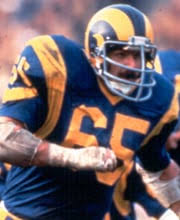
Thomas Lee Mack is an American former football guard who played for the Los Angeles Rams of the National Football League. He was inducted into the Pro Football Hall of Fame in 1999.
A native of Cleveland, Ohio, Mack played college football as an end and tackle for the Michigan Wolverines from 1963 to 1965. He was a starter on the 1964 Michigan team that won the Big Ten Conference championship and defeated Oregon State in the 1965 Rose Bowl. He was selected as a first-team All-Big Ten player in 1965 and was inducted into the University of Michigan Athletic Hall of Honor in 2006.
Mack was selected by the Rams with the second overall pick of the 1966 NFL draft and played at left guard for the Rams for 13 seasons from 1966 to 1978. During his NFL career, Mack played in 11 Pro Bowls and appeared in 184 consecutive games, 176 as a starter, over 13 seasons.
Mack was selected by the Los Angeles Rams in the first round, as the second overall pick, in the 1966 NFL draft. During Mack's rookie season with the Rams, starter Don Chuy was injured during the fifth game of the season, allowing Mack to move into the lineup. He started nine games during the 1966 season and became a fixture for the Rams at the left guard position for the next 13 seasons. During his NFL career, Mack never missed a game due to injury, appearing in 184 consecutive contests, the third longest streak in Rams history behind Merlin Olsen and Jack Youngblood.
During Mack's career with the Rams, the club enjoyed a .720 winning percentage with a won-lost-tie record of 129–48–7, won their division eight times (1967, 1969, and 1973–1978), and reached four NFC championship games. In 1973, the Rams scored led the NFL with 388 points (27.7 points/game). In 1974, the Rams lost to the Minnesota Vikings by four points in the 1974 NFC Championship Game, with a controversial penalty call against Mack costing the Rams a touchdown. The Rams had the ball at the one-yard line on second down when the Vikings' Alan Page made contact with Mack; the referee called illegal procedure on Mack, but replays showed that Mack had not moved. After the game, Mack insisted he had not moved but credited Page with "a smart play" in making contact since a penalty, if called against the Vikings, would have been meaningless.
Mack was selected to 11 Pro Bowls, the first coming after his second season in 1967. He missed only one Pro Bowl appearance the rest of his career (1976). Mack's 11 invitations earned him a third-place tie with Bob Lilly and Ken Houston for the most selections of all time. Mack was selected first-team All-Pro four times (1969, 1971, 1973, 1974) and second-team All-Pro four times (1968, 1970, 1972, and 1975). In addition, he was named All-NFC eight times between 1970 and 1978.
Mack announced in late November 1978 that he would retire at the end of the 1978 NFL season. He was inducted into the Pro Football Hall of Fame in 1999.
After retiring from football, Mack worked as an engineer, using the engineering degree he received at the University of Michigan. He eventually became a lobbyist for Bechtel Group, Inc. Mack has a daughter named Carrie who attended Quince Orchard High School in Gaithersburg, MD (Class of 1992).
"Tom Mack". Pro-Football-Reference.com. Sports Reference LLC. Retrieved March 25, 2015.
"Ray Mack". Baseball-Reference.com. Sports Reference LLC. Retrieved March 26, 2015.
"Distinguished Eagle Scouts" (PDF). Scouting.org. Archived from the original (PDF) on March 12, 2016. Retrieved March 25, 2015.
"All-Time Football Roster Database". University of Michigan, Bentley Historical Library. Retrieved March 25, 2015.
Anthony Broome (October 18, 2012). "TBHR Chats With NFL Hall of Famer Tom Mack". The Big House Reports. Archived from the original on April 2, 2015.
"1964 Football Team". University of Michigan, Bentley Historical Library. Retrieved March 25, 2015.
"1965 Football Team". University of Michigan, Bentley Historical Library. Retrieved March 25, 2015.
"Grabowski Big Ten Choice". Cape Girardeau Southeast Missourian. November 24, 1965. p. 3B.
Michigan Athletic Hall of Honor. Bentley Historical Library (archives of the University of Michigan and the Michigan Athletic Department) website. Retrieved September 9, 2011.
"Fraternity Men in the Pro Football Hall of Fame" (PDF). North American Inter-Fraternity Conference. Retrieved March 25, 2015.
"Mack To Rams". Ocala Star-Banner. November 28, 1965. p. 24.
"It Was a Bruiser For Rams Tom Mack". Lewiston Evening Journal (AP story). October 13, 1966. p. 26.
"Tom Mack". Times Daily. August 6, 1999. p. 10E.
"'I Didn't Move,' Claims Rams' Tom Mack". Sarasota Journal. December 30, 1974. p. 2C.
"Tears Fall As Vikes Top LA, 14-10". Pittsburgh Post-Gazette. December 30, 1974. p. 14.
"Veteran Lineman Tom Mack Announces His Retirement". The Pittsburgh Press. November 25, 1978. p. A-10.
"Michigan alum Mack inducted into Pro Football Hall of Fame". The Michigan Daily. August 9, 1999. p. 14.
Gene Wojciechowski (December 7, 1987). "Tom Mack: Once a Force in Rams' Offensive Line, Now He's a Lobbyist Who Reasons". Los Angeles Times.