Showing posts with label HOF 1995. Show all posts

Monday, May 13, 2024

The Story And Significance Of Kellen Winslow - Tied For The Most Receiving Touchdowns In A Game With Five

Kellen Boswell Winslow Sr. is an American former professional football tight end who played in the National Football League. A member of the Pro Football Hall of Fame (1995), he is widely recognized as one of the greatest tight ends in the league's history. Winslow played his entire NFL career (1979–1987) with the San Diego Chargers after being selected in the first round of the 1979 NFL draft. He played college football for the Missouri Tigers, earning consensus All-American honors in 1978. He was inducted into the College Football Hall of Fame in 2002.

Winslow had a late start to his football career, not playing until his senior year of high school. Noted for his unusual combination of size and speed, he was recruited by the Missouri Tigers, where he played from 1975 to 1978, ranking among the team's reception leaders during his last two seasons. He was named All-American as a senior, entering the NFL draft as one of the highest-regarded prospects for the league.

San Diego traded up to draft Winslow with the 13th overall pick in the draft. Over the next nine seasons, he was named a first-team All-Pro three times and a Pro Bowler five times. After a promising rookie season (1979) was ended by injury, Winslow became a key figure in head coach Don Coryell's offense from 1980 to 1983, twice leading the league in receptions. His success in the passing game had long-term effects on the usage of tight ends, who had previously been perceived as good blockers who would catch occasionally. Highlights for Winslow included a five-touchdown performance against the Oakland Raiders and a starring role in the 1981 playoff game known as the Epic in Miami.

Winslow was progressing at a record-breaking pace in 1984 when a serious knee injury knocked him out of the game for a year. He recovered enough to play from 1985 to 1987, but generally failed to recapture his pre-injury form. Winslow planned to return for a tenth year in the league but after a single appearance in the 1988 preseason the condition of his knees forced him to retire.

Winslow entered the 1979 NFL draft rated as "unquestionably the best prospect at tight end" by analyst Don Heinrich. Chicago Bears general manager Jim Finks said, "Some people can play tight end with two of the three requirements. I hear Winslow has all three—size, speed and strength." Winslow was expected to be chosen early in the first round, with the Kansas City Chiefs (drafting No. 2 overall) and the Cincinnati Bengals (No. 3 overall) both likely destinations.

In the event, Winslow was unexpectedly yet to be chosen by the time the draft reached the Cleveland Browns who had selection No. 13. At that point the San Diego Chargers, who were not scheduled to pick until No. 20, made a deal with Cleveland to move up seven places and select Winslow. The Chargers were delighted with the trade, as they had rated Winslow as the top player in the draft, and had twice unsuccessfully tried to trade up into the top seven picks to get him. Head coach Don Coryell explained that the Chargers had an area of need at tight end, as their current starters Bob Klein and Pat Curran were both in their 30's and likely to retire soon. Winslow himself had expected to go to Cincinnati but was pleased when the Chargers selected him as he liked to catch the ball and was aware of Coryell's affinity for the passing game.

Less than three weeks after the draft, Winslow signed a series of one-year contracts to play for the Chargers. Coryell described him as "a big strong man who has great potential and ability," and suggested Winslow could play both tight end and wide receiver. When the season began, Winslow did serve in both roles, being both the second tight end behind Klein and a third wide receiver behind Charlie Joiner and John Jefferson depending on the formation. He caught his first career touchdown in week 2 of his rookie season on a 5-yard pass from quarterback Dan Fouts. When an injury to Klein forced Winslow into the starting line-up, he responded with a seven-catch performance that left him as the Chargers' leader in receptions. The following week, he lost a key fumble in a 7–0 defeat to the Denver Broncos. A Los Angeles Times article described him as inconsistent, both as a blocker and a receiver, and "like a runaway locomotive without tracks" when carrying the ball.

Winslow's season ended in a week 7 game against the Seattle Seahawks due to a fractured left fibula. While he was initially projected to be out for only six weeks, Winslow was still missing for the Chargers' season-ending playoff loss to the Houston Oilers. Winslow finished with 25 catches, which had led the team at the point when he was injured, for 255 yards and two touchdowns. Winslow later believed that the injury had positive effects, saying in a 2006 interview, "My breaking my leg my rookie year turned out to be a blessing, because I got a chance to sit back and look at some things... from another angle and came back my second year and things really made sense."
Winslow entered the 1980 season with a chance to claim the number one tight end position, as Klein retired during the offseason. Due to a series of minor injuries, Winslow was unable to win the place in preseason, with Greg McCrary beginning the regular season as the starter. In week 2, Winslow had a breakthrough performance against the Oakland Raiders with 9 catches for 132 yards and a touchdown in an overtime win. Coryell used Winslow in various positions and formations throughout the game, trying to force a mismatches where the 6 foot 5 Winslow would be covered by a smaller defender.

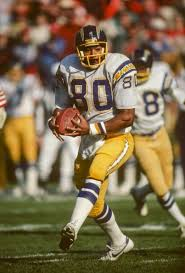
As the season progressed, Winslow established himself as a key component of the Air Coryell offense and eventually led the league with 89 catches, setting a new NFL record for tight ends by breaking the previous mark of 75 held by Mike Ditka. He became the first tight end to exceed 1,000 receiving yards since Jackie Smith in 1967. Some sources credit Winslow's 1,290 yards as having set a new tight end record. He was instrumental in the Chargers' second consecutive AFC West division title, and was voted both a Pro Bowler and first-team AP All-Pro.

Winslow caught only a single pass in San Diego's first playoff game, a 20–14 divisional playoffs victory over the Buffalo Bills. This was partially due to an injury to McCrary early in the game. The Chargers frequently used a two-tight end formation, with McCrary lining up as a regular tight end and Winslow appearing in variable positions, often going in motion. They had no backup to McCrary, so Winslow was forced to replace him as a conventional tight end, with far less scope to catch passes. McCrary attempted to play through the injury the following week, but Winslow still had only 3 catches for 42 yards, and San Diego lost the AFC Championship game 34–27 to Oakland.

The 1981 season began slowly for Winslow, with only five catches in the first two games. He drew more double coverage after Jefferson was traded to the Green Bay Packers; Winslow also theorized that teams were more aware of the threat he posed following his performances the previous year. Aided by the midseason arrival of wide receiver Wes Chandler in place of Jefferson, Winslow saw more single coverage as the season went on and produced better numbers. A highlight was a 55–21 win in Oakland when Winslow caught 13 passes for 144 yards and 5 touchdowns. The five receiving touchdowns tied an NFL single-game record that has not been surpassed as of 2024, while the 13 receptions tied Lance Alworth's franchise record. Winslow said of the performance, "I just happened to get my number called today. A lot of things were going our way and they just happened to go my way in particular."

San Diego were struggling with a 6–5 record before Winslow's five-touchdown game, but recovered to finish 10–6 and win their third consecutive AFC West title. Winslow led the league in receptions for the second consecutive season, finishing with 88 catches for 1,075 yards and 10 touchdowns. He was again named to the Pro Bowl (where he won co-MVP) and the AP All-Pro first team.

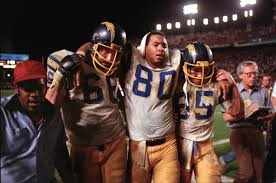
Winslow excelled in the Chargers' divisional playoff game, a 41–38 overtime win over the Miami Dolphins played in draining humidity that became known as the Epic in Miami. He had 13 catches for 166 yards and a touchdown, and blocked a potential game-winning field goal at the end of regulation time. Winslow leaped in the middle of the line to block the kick, barely deflecting the ball with the outside of his right hand: he said, ""For all the receptions and all the yardage, I got more satisfaction out of blocking the field goal. It was something I'd never done before. It had always been a dream of mine." His 13 receptions set a new single-game playoff record, while his yardage total was a playoff record for tight ends. He achieved these statistics despite repeatedly having to leave the game with dehydration and severe cramps; he was also treated for a pinched nerve in his shoulder and received three stitches in his lower lip. After the game, a picture of Winslow being helped off the field by his teammates became an enduring image in NFL lore.

Winslow's performance in the Miami game was greatly praised afterwards. Hall of Fame tight end Mike Ditka said, "Kellen Winslow portrayed in Miami what it takes to be great. The difference between great and good is a matter of heart. He gave a tremendous amount to help his team win one of the great games ever played." Dolphins' tackle Bob Kuechenberg said the game made Winslow's career in a 2017 interview, adding "I deeply resented the fact that they literally carried him off the field five times and he'd come back and do some other miracle." A 2012 ESPN article rated it the second-best single-game playoff performance in NFL history up to that point, while a 2014 San Diego Union-Tribune article named it the joint-best playoff performance by a Charger.

While Winslow scored again the following week, it was the Chargers' only touchdown in a 27–7 AFC Championship game loss at Cincinnati. The game became known as the Freezer Bowl for the unusually frigid and windy conditions. Winslow commented afterwards, "I wouldn't send my dog out in that kind of weather."

The 1982 season was interrupted by a 57-day NFL players strike which reduced the regular season to nine games. Winslow expressed impatience with the process, claiming that players' union director Ed Garvey and management negotiator Jack Donlan were both on "ego trips." While Garvey was seeking a wage scale for the players, Winslow believed that abolishing the NFL draft and encouraging the development of the rival United States Football League (USFL) would do more to increase their salaries. On the field, his success continued—Winslow's 54 receptions were the most in the AFC, while his 721 yards were second to his teammate Chandler. For the third consecutive season, he was named both a Pro Bowler and AP first-team All-Pro.

San Diego qualified for the playoffs for the fourth consecutive season, taking their place in an expanded 16-team Super Bowl tournament as the AFC's fifth seed and travelling to the Pittsburgh Steelers for their first game. The Steelers led 28–17 in the final quarter, but two touchdowns by Winslow gave San Diego a 31–28 win; he had 7 catches for 102 yards and the two scores. A rematch with the Dolphins in Miami followed. Winslow was unable to repeat his performance of the previous year, playing with a twisted ankle for most of the game and finishing with only one catch for 18 yards as Miami won 34–13. Winslow said of the defeat, "You can say it either way: They had a great day, or we had an off day. But really it was both." It was the last playoff game of his career.

An National Football League Players Association (NFLPA) survey released after the season reported his annual salary as $210,000, joint third-most on the Chargers but behind 64 players league-wide, including some tight ends.

The Chargers had a disappointing 1983 season and missed the playoffs for the first time in Winslow's career, although he himself had another statistically productive year. Winslow had 14 catches for 162 yards and 3 touchdowns in a win over the Chiefs, breaking the franchise single-game receptions record he'd previously shared with Alworth. He finished the year with 88 catches for 1,172 yards and 8 touchdowns, and was voted to another Pro Bowl, though this time as the AFC's reserve tight end behind Todd Christensen of Los Angeles. Winslow had caught more passes than any other player over the five-year period 1979–83.

Winslow entered the 1984 season seeking to renegotiate his contract. He had two years remaining on a five-year contract and a verbal agreement from Chargers ownership that he could negotiate a new deal in 1984. He requested an amount which the Chargers refused, with Winslow's agent Jim Steiner stating shortly before the regular season started that the two sides were far apart with their offers. Steiner declared Winslow's intention to play in week 1 at Minnesota, "out of respect for the team, Don Coryell and the coaching staff," then retire if no agreement was forthcoming. On September 2 he followed through on the threat, catching four passes in the game then travelling to East St. Louis instead of flying back to San Diego with his teammates. He criticized ownership for letting players such as Jefferson and Fred Dean leave in the past due to similar contract disputes, saying "I feel cheated... they've turned their back on me. I have nowhere else to go but home." Chargers general manager Johnny Sanders said that there would be no further negotiations with Winslow while he refused to report to camp. San Diego declined to place Winslow on the retirement list, which would have prevented him playing for the rest of the year. On September 5, Steiner suggested that Winslow could still be induced to return, but that they were investigating other means of income, including television work. The Chargers signed veteran tight end Al Dixon as a replacement on September 6. The Houston Gamblers of the USFL declared an interest in signing Winslow, staging a press conference with the player on September 8. Winslow stated at the conference that he would return to San Diego and play the remaining two years there; he was not permitted to sign for the Gamblers until his Chargers contract expired, but expressed an interest in joining them for the 1986 season. Winslow then returned to the Chargers, allowing negotiations to re-open. On September 12, Winslow agreed to a new five-year contract with San Diego.

Winslow had missed one game due to his holdout, but returned in week 3 to face the Oilers at home. The Jack Murphy Stadium crowd booed him when he was announced at the start of the game, a 31–14 victory in which he had 10 catches for 146 yards. Three weeks later, he broke the Chargers single-game receptions record for the second time with 15 catches for 157 yards in a 34–28 win at Green Bay. Despite having missed a game, he was on course to break Charley Hennigan's league record of 101 catches in a season before being stopped by a serious knee injury.

"Jeff Barnes was on the inside, came and hit me low and that's when the doctors say the posterior cruciate went. When I got hit in the front, my knee snapped back and then Rod Martin tackled me over the front, and I got twisted, and that's when probably the medial collateral ligament went during that time. Nothing dirty about it."

In week 8, late in a 44–37 loss to the Raiders, Winslow took a short pass over the middle for his 55th reception of the season. His knee twisted while being tackled by Los Angeles linebackers Jeff Barnes and Rod Martin. In the immediate wake of the injury, Winslow described himself as "flopping on the field like a flounder out of water." Once medical staff reset his knee, Winslow smiled and exchanged jokes with the Raiders as he left the field, but learned in the treatment room that his injury would require season-ending surgery after the game. Team physician Gary Losse, who performed the surgery over the course of two hours, later said that Winslow's knee looked like "spaghetti... like a couple of mop ends." Losse also said, "The ligaments had almost an explosion-like appearance, it was a very, very severe knee injury." The severity was due in part to both the medial collateral ligament (MCL) and anterior cruciate ligament (ACL) being damaged. Reflecting on his season the following week, Winslow was relieved that he had insisted on a guaranteed contract during negotiations, which ensured he would be paid in full for five years even if he was unable to play again.

Interviewed during April 1985, Winslow reported that his recovery was proceeding ahead of schedule. He was optimistic of a midseason return in the coming season, and of again being the best tight end in the league. In August, he was placed on the physically unable to perform list. Winslow returned to action in week 7, two days short of a year after the injury happened. In a loss at the Minnesota Vikings, he caught two passes, produced key blocks on a pair of touchdown runs, and described the game as "like old times." Two weeks later, he was used on only four plays in a win over Denver, all of which were running plays. He was visibly upset over his lack of usage, and failed to report for practice the next day, instead flying to Canada to promote a drink in which he had a financial stake. The following day, he returned to the team and apologised for his absence.
Winslow was used primarily as a blocker or decoy throughout the season, and finished with only 25 catches for 318 yards and no touchdowns from his ten appearances. Compared with his play before the injury, Winslow struggled to break tackles and change directions sharply when running pass routes. He said, "I'll never be the Kellen Winslow of old. There will always be something missing because of the reconstruction."

Winslow improved in 1986, catching 64 passes for 728 yards and 5 touchdowns, with 45 of his catches coming in the final nine games. Offensive coordinator Ernie Zampese described his movement as more fluid and his play as more confident. Winslow would later describe his own play as still being tentative and scared during the 1986 season.

During the offseason Winslow underwent arthroscopic surgery on his knee to clear out scar tissue from his injury; he reported improved running ability afterwards. The 1987 season was shortened by a players strike, which saw one week cancelled and three more played primarily with replacement players. Winslow sat out the entire strike, which he described as frustrating. He taped over his jersey number during a training session in protest at his No. 80 being used by one of the replacement players.

On the field, Winslow was pleased to find that he was that he was better at breaking tackles than the previous year. His play after the strike prompted his new head coach Al Saunders to say that he was once again playing at a league-leading standard. Winslow made his 500th career reception during the season, following Ozzie Newsome as the second tight end to pass the landmark. He finished with 53 catches from his twelve games, second-most among NFL tights ends, though his 9.8 yards per reception was the least of his career. His performances earned him his fifth Pro Bowl nomination (his first since the knee injury) and a place in the AP All-Pro second team, while his teammates named him their offensive player of the year. He said that during the year he had accomplished "the regaining of respect, both on this team and around the league... a resurgence to the level a lot of people wondered I could still play at."

Winslow expected to continue his career in 1988, though he hinted it might be his last season, reporting that the Chargers did not seem eager to extend his contract. Entering the season at 30 years old, he was the second-longest tenured Charger, behind only center Don Macek. He again had arthroscopic surgery during the offseason, and failed one physical before passing a second one and joining his teammates at training camp in August. He was unable to play in the Chargers' first two preseason games and featured briefly in the third. Subsequently, he had to leave training early on consecutive days, missed a third day entirely, and was ruled out of the final preseason game due to his knee. Saunders said, "It's just not coming around. It's concerning him and I know it's concerning us."

On August 29, Winslow announced to journalists that he had been suspended without pay by the Chargers following a meeting with team officials. Describing his physical state during his preseason appearance as "total ineptness," Winslow said he had informed Saunders and director of football operations Steve Ortmayer that he was unable to continue his career. The Chargers maintained that he was fit to play having passed a physical, and had been suspended for refusing to do so. This caused a dispute as to whether Winslow should be paid his guaranteed salary of $795,000 for the coming season. He would forfeit the money if he officially retired; the Chargers offered him half the amount to retire, which Winslow refused. Gene Upshaw, executive director of the NFLPA, supported Winslow—he said that the Chargers had suspended their player while citing an outdated collective bargaining agreement, and that the NFLPA intended to file a lawsuit against the team. Winslow also threatened litigation, but instead decided to wait while Steiner negotiated with Ortmayer to find a compromise retirement settlement.

On September 30, the two sides reached agreement and Winslow's retirement became official. The terms of the agreement were not revealed. Winslow was critical of the Chargers' handling of the situation, saying that they had stripped him of his dignity by imposing the suspension. Ortmayer responded that there no should be no negative connotations to being placed on the suspended players list, as the NFL required all players on the roster to be given one of the available designations.

Interviewed the following year, Winslow described his career as "like a fairy tale," saying that he had been fortunate with his choice of high school and college, and with having a head coach in Coryell who could best exploit his abilities.

Through his nine years in the NFL, Winslow caught 541 passes for 6,741 yards and 45 touchdowns in the regular season. His receptions total ranked 14th in league history at the time of his retirement. Winslow played in five Pro Bowls, and was named to three AP All-Pro first teams and one second team. Further honors followed his retirement, as he was voted into the NFL's All-1980s team, 75th anniversary team, and 100th anniversary team. In 1995, Winslow was inducted into both the Pro Football Hall of Fame and the Chargers Hall of Fame; the Chargers retired his No. 80 jersey in 2023.

Winslow is widely recognized as one of the best to play his position, and credited with revolutionizing the usage of tight ends in the NFL. Tight ends prior to Winslow were primarily blockers who lined up next to an offensive lineman and ran short to medium routes; Winslow said upon being drafted, "I can get just as deep as wide receivers and just as fast," and Coryell quickly identified him as someone who could line up as a wide receiver on some plays and a tight end on others. As his career progressed, the Chargers would use Winslow unpredictably in a number of positions over the course of a game, including flanker, split end, slotback, H-back, wingback or conventional tight end. He might start the play in a three point blocking stance or a two point receiver's stance, or be put in motion so he would not be jammed at the line.

Winslow was credited with creating the H-back position by Joe Bugel, an offensive coordinator with the Washington teams who made use of H-backs to win multiple Super Bowls. He said, "It takes the complete athlete, a guy who can block an end or a linebacker or take a cornerback or strong safety deep." Saunders described Winslow as "a wide receiver in an offensive lineman's body," while Coryell said, "If we're asking Kellen to block a defensive end and not catch passes, I'm not a very good coach." Former head coach Jon Gruden called Winslow the first "joker" in the NFL. Head coach Bill Belichick noted that the pass-catching tight ends who get paid the most money are "all direct descendants of Kellen Winslow" and that there were fewer tight ends in the 21st century who could block on the line. Winslow himself credited Coryell and his coaching staff for thinking outside the box to utilize his abilities in new ways: "There were many athletes before me who could do the things that I did. You talk about Charlie Sanders... Could stand in there and hold his own. Could run good routes. Probably could split him out. But I came into a situation with the offensive system where I could do those things."

Lists of the top 100 NFL players at any position frequently feature Winslow: In 1999, he was ranked No. 73 by The Sporting News, a 2010 NFL Network series had him at No. 67, and a panel of USA Today journalists placed him at No. 79 in 2019.

In the immediate wake of his retirement, Winslow served as marketing vice president and major stockholder for a San Diego-based nutrition company. He earned a Juris Doctor degree from the University of San Diego in 1993 and spent some time as a sports agent, while doubling as a radio commentator for his alma mater the Missouri Tigers. Later, he worked as a college football announcer with Fox Sports Net. Winslow served in various sports administrator roles, having been athletic director at Central State University, vice president for athletics and wellness at Lakeland College, and director of athletics at Florida A&M University.

Winslow has been married twice. He had two sons, Kellen II with his first wife and Justin Winslow with his then-girlfriend. Kellen II also played tight end in the NFL.

Winslow has been a vocal proponent of affirmative action, particularly in football—he dedicated a substantial section of his Hall of Fame induction speech to highlighting the lack of African Americans in non-playing roles. When his son announced his intention to sign with the University of Washington, Winslow objected as the coaching staff featured no African Americans; Winslow II eventually signed with the University of Miami instead. Winslow described this as “a black father teaching his black son about the ways of the world.”

Sources
https://www.pro-football-reference.com/
https://www.profootballarchives.com/index.html
https://americanfootballdatabase.fandom.com/wiki/Football_Wiki
https://www.gridiron-uniforms.com/GUD/controller/controller.php?action=main
https://www.profootballhof.com/hall-of-famers/
 "Kellen Winslow: Class of 1995". Pro Football Hall of Fame. Retrieved January 11, 2024.
 Jaworski, Plaut & Cosell 2011, p. 91.
 Burke, Bill (August 25, 1978). "Chess makes Winslow better gridder". Salina Journal. p. 17 – via newspapers.com.
 DeArmond, Mike (August 25, 1978). "Winslow not just a jock". Kansas City Times. pp. 1D, 3D – via newspapers.com.
 Distel, Dave (May 5, 1979). "Slow starter". Los Angeles Times. p. III-3 – via newspapers.com.
 Distel, Dave (October 11, 1979). "Winslow covered by nine-letter word". Los Angeles Times. pp. III-1, III-15 – via newspapers.com.
 "Flyers top voting in Southwestern". Belleville News Democrat. November 20, 1974. p. 19 – via newspapers.com.
 Kausler, Jr., Don (October 21, 1977). "Tigers' tight end not so crazy". Kansas City Times. p. 4C – via newspapers.com.
 Hummel, Rick (November 24, 1974). "Flyers' dream ends". St. Louis Post-Dispatch. pp. 1F, 9F – via newspapers.com.
 "Missouri Jayvees rip Mo. Western, 57-0". Kansas City Times. October 11, 1975. p. 5D – via newspapers.com.
 "Missouri 34, Nebraska 24". Charlottesville Daily Progress. UPI. October 24, 1976. p. B6 – via newspapers.com.
 "4 Cyclones on all-Big 8 grid team". Des Moines Register. AP. November 29, 1977. p. 21 – via newspapers.com.
 Tucker, Doug (August 25, 1978). "Missouri's Winslow tough in chess too". Grand Island Independent. AP. p. 18 – via newspapers.com.
 "Winslow makes the right moves". Memphis Press-Scimitar. December 21, 1978. p. 4-A – via newspapers.com.
 Goforth, Allan (2003). Tales from the Missouri Tigers. Sports Publishing. p. 188. ISBN 9781582616193. Retrieved March 23, 2014.
 "AP all-Big eight includes NU six". Lincoln Journal-Star. AP. November 21, 1978. p. 13 – via newspapers.com.
 "20-15". St. Petersburg Times. Associated Press. December 24, 1978. p. 7C – via newspapers.com.
 "Hall of Fame". Missouri University Tigers. Retrieved January 1, 2024.
 "Missouri, LSU ready for Liberty Bowl clash". Fort Worth Star-Telegram. AP. December 23, 1978. p. 4e.
 "University of Missouri to retire Kellen Winslow's No. 83 jersey". Belleville News-Democrat. Associated Press. May 4, 1995. p. D2.
 Anderson, Dave (January 7, 1982). "He's in a class by himself". Ventura County Star. New York Times. p. C-1.
 Barnidge, Tom (February 21, 1979). "Consult Heinrich before you draft". St. Louis Post-Dispatch. p. 3D – via newspapers.com.
 "Bills expected to pick Ohio State's Cousineau". La Crosse Tribune. Associated Press. May 2, 1979. p. 18 – via newspapers.com.
 Williams, Marty (April 29, 1979). "Bengals to use first pick on tight end Winslow". Dayton Daily News. p. 4-D – via newspapers.com.
 "Tommy opened the penthouse door?". Palm Springs Desert Sun. AP. May 4, 1979. p. B4 – via newspapers.com.
 Distel, Dave (May 4, 1979). "Fast deal made with the Browns". Los Angeles Times. pp. III-1, III-8 – via newspapers.com.
 Monahan, Terry (October 1, 1979). "Winslow". Escondido Times-Advocate. p. D-3 – via newspapers.com.
 "Kellen Winslow, No.1 Charger draftee, signs". Los Angeles Times. May 23, 1979. p. III-3 – via newspapers.com.
 Klein, Bob (November 7, 1979). "Coryell passes out Winslow's duties". Escondido Times-Advocate. p. D-1 – via newspapers.com.
 Maffei, John (September 10, 1979). "Chargers put it all together to beat up Raiders". Escondido Times-Advocate. pp. D-1, D-3 – via newspapers.com.
 Monahan, Terry (October 1, 1979). "Rookie Winslow steals light from O.J." Escondido Times-Advocate. p. D-1 – via newspapers.com.
 "Turnovers give Broncos victory". Palm Beach Post. AP. October 8, 1979. p. B11 – via newspapers.com.
 "Charger end breaks leg". San Bernardino County Sun. AP. October 15, 1979. p. C-3 – via newspapers.com.
 "Joiner, Jefferson ready for Oilers". Ventura County Star. December 26, 1979. p. 11 – via newspapers.com.
 Maffei, John (September 7, 1980). "From here on out, Coryell gets serious". Escondido Times-Advocate. p. B-1 – via newspapers.com.
 Tobias 2006, p. 122.
 "Chargers could be on the verge of West dynasty". Redding Record Searchlight. Associated Press. August 25, 1980. p. 12 – via newspapers.com.
 "Another 'Star Wars' at Denver". Redding Record Searchlight. September 19, 1980. p. 4 – via newspapers.com.
 Vyeda, Ed (September 15, 1980). "Destiny steps in, Chargers win in OT". Santa Cruz Sentinel. pp. 10, 11 – via newspapers.com.
 Distel, Dave (September 19, 1980). "Chargers play it by the booklet". Los Angeles Times. p. III-6 – via newspapers.com.
 "A Charger reveals his secrets". Camarillo Star. AP. February 12, 1981. p. B-4 – via newspapers.com.
 Moore, David Leon (January 11, 1981). "The men who get Air Coryell off the ground". The Sun. San Bernardino, Calif. p. D-4. Retrieved May 9, 2015 – via Newspapers.com.Open access icon
 "Kellen Who?". Tampa Tribune. December 19, 1980. p. 4-C.
 "1980 Chargers' accomplishments". Escondido Times-Advocate. January 9, 1981. p. C-5 – via newspapers.com.
 "Rob Gronkowski sets TE yardage mark". ESPNBoston.com. January 1, 2012. Archived from the original on January 6, 2012.
 "Benirschke, Fouts pace Chargers to 26–17 win". Sacramento Bee. AP. December 23, 1980. pp. C1, C4 – via Newspapers.com.
 "Eight Chargers named to AFC Pro Bowl team". Muncie Star Press. UPI. December 19, 1980. p. 21 – via Newspapers.com.
 "Chargers put five starters on AFC-heavy All-Pro team". Salem Statesman Journal. AP. January 8, 1981. p. 2D – via Newspapers.com.
 "'Electric' Chargers shock Bills, 20–-14". Santa Cruz Sentinel. AP. January 4, 1981. pp. 47, 50 – via Newspapers.com.
 Distel, Dave (January 9, 1981). "Winslow led Chargers and everybody else too". Los Angeles Times. p. III-6 – via newspapers.com.
 Pierson, Don (January 12, 1981). "Plunkett passing magic works Raider wonders". Chicago Tribune. p. V-3.
 Maffei, John (January 12, 1981). "Chargers' story ends on super sour note". Escondido Times-Advocate. pp. D-1, D-2 – via Newspapers.com.
 Hoff, Rick (September 15, 1981). "For a decoy, Mr. Winslow can still make the big catch". Escondido Times-Advocate. p. D1 – via newspapers.com.
 "When San Diego has the ball". Ukiah Daily Journal. November 13, 1981. p. 12 – via newspapers.com.
 Norcross, Don (September 21, 1981). "Decoy Winslow joins the offense". Escondido Times-Advocate. pp. D-1, D-4 – via newspapers.com.
 Norcross, Don (November 23, 1981). "Chargers turn themselves around to rout Oakland". Escondido Times-Advocate. p. D1 – via newspapers.com.
 "Man who stuffed the Raiders". Santa Rosa Press Democrat. AP. November 26, 1981. p. 2C – via newspapers.com.
 "Chargers in playoffs". Matton Journal Gazette. December 22, 1981. p. 6.
 "Bucs, Chargers enter dangerous territory". Ventura Camarillo Star. Associated Press. January 1, 1982. p. B1 – via newspapers.com.
 "AFC wins Pro Bowl". Redding Record Searchlight. AP. February 1, 1982. p. 15 – via newspapers.com.
 "49ers' Lott, Giants' Taylor names to All-Pro roster". Chico Enterprise-Record. UPI. December 26, 1981. p. 2D – via newspapers.com.
 Maffei, John (January 3, 1982). "This playoff triumph was one for the record books". Escondido Times-Advocate. p. D1 – via newspapers.com.
 Distel, Dave (January 3, 1982). "Chargers pass by Dolphins". Fort Worth Star-Telegram. Los Angeles Times News Service. pp. 1B, 12B – via newspapers.com.
 Anderson, Dave (January 7, 1982). "An untraditional tight end". New York Times. Retrieved January 6, 2024.
 Northrop, Milt (January 7, 1990). "Huddle comment could spark final furor". Buffalo News. p. C-4 – via newspapers.com.
 "NFL Receptions Single Game Playoffs Leaders". Pro Football Reference. Retrieved January 12, 2026.
 Hoffman, Ben (January 17, 2012). "Davis's Performance Recalls Winslow's 'Epic' Day". The New York Times. Archived from the original on January 20, 2012.
 Friend, Tom (October 26, 1985). "Will he reach the same heights". Los Angeles Times. pp. III-1, III-16 – via newspapers.com.
 Soehn 2017, Chapter X.
 Distel, Dave (September 2, 1982). "For Winslow, tight end was only the beginning". Los Angeles Times. p. IX-1 – via newspapers.com.
 Clayton, John; Chadiha, Jeffri; Sando, Mike (June 20, 2012). "The NFL's playoff standouts". espn.co.uk. Retrieved January 4, 2024.
 Jenkins, Chris (January 1, 2014). "Five greatest playoff games by a Charger". San Diego Union Tribune. Retrieved January 5, 2024.
 "Wind took spark out of Chargers". Sacramento Bee. January 11, 1982. p. C2 – via newspapers.com.
 "Tentative agreement reached; NFL to resume play Sunday with nine-week abbreviated season". Eau Claire Leader-Telegram. AP. February 5, 1982. p. 1B – via Newspapers.com.
 "Winslow says 'dump Garvey'". Victorville Daily Press. AP. October 15, 1982. p. A-10 – via newspapers.com.
 Scheiber, Dave (January 9, 1983). "Chargers vs. Steelers and cold". Tampa Bay Times. p. 8C – via newspapers.com.
 "All-Pro teams". Escondido Times-Advocate. AP. December 30, 1982. p. D5.
 "Chargers dominate All-Pro picks; Gibbs top coach". Fresno Bee. Associated Press. January 5, 1983. p. E1 – via newspapers.com.
 Maffei, John (January 10, 1983). "For the Chargers, weather was NF—no factor". Escondido Times-Advocate. p. D4 – via newspapers.com.
 Cobbs, Chris (January 10, 1983). "Chargers boot first play, win on their last". Los Angeles Times. pp. III-1, III-8 – via newspapers.com.
 "NFL playoffs are emotional for winners and losers". Modesto Bee. January 17, 1983. p. C-3 – via newspapers.com.
 "Dolphins prove they can travel by air". Escondido Times-Advocate. AP. January 18, 1983. p. D1.
 "Kellen Winslow playoffs game log". pro-football-reference.com. Retrieved January 5, 2024.
 "The Chargers and their salarie$$$". Escondido Times-Advocate. March 10, 1983. p. D1 – via newspapers.com.
 McCarthy, Bob (April 22, 1983). "Going out in style". Fresno Bee. p. F1 – via newspapers.com.
 Distel, Dave (November 11, 1983). "Kellen Winslow's season nothing to complain about". Los Angeles Times. pp. III-1, III-20 – via newspapers.com.
 Cobbs, Chris (December 14, 1983). "Here's the catch: Winslow gets rest, Chargers get Chiefs". Los Angeles Times. p. III-1 – via newspapers.com.
 "Kellen Winslow: No. 80". Escondido Times-Advocate. August 30, 1984. p. 36 – via newspapers.com.
 "Chargers land 3 on AFC team". Escondido Times-Advocate. December 15, 1983. pp. C1, C3.
 Norcross, Don (August 25, 1984). "Maybe not the best, but easily the most effective". Escondido Times-Advocate. p. 12 – via newspapers.com.
 Norcross, Don (August 29, 1984). "It was Chargers' day of transformation". Escondido Times-Advocate. p. D1 – via newspapers.com.
 Norcross, Don (September 1, 1984). "Winslow will play Sunday, may retire Monday". Escondido Times-Advocate. p. A1 – via newspapers.com.
 Norcross, Don (September 4, 1984). "Chargers won't talk if Winslow stays out". Escondido Times-Advocate. pp. C1, C4 – via newspapers.com.
 "Chargers' Winslow retiring over dispute". San Bernardino County Sun. Associated Press. September 2, 1984. p. E-9 – via newspapers.com.
 Norcross, Don (September 3, 1984). "Chargers come home, Winslow goes home". Escondido Times-Advocate. pp. B1, B2 – via newspapers.com.
 Cobbs, Chris (September 6, 1984). "Coryell turns focus to Seattle, not Winslow". Los Angeles Times. pp. III-1, III-12 – via newspapers.com.
 "Steelers' Woodley, a concussion victim, gives Jets headache". Peninsula Times Tribune. September 7, 1984. p. C-3 – via newspapers.com.
 "Gamblers make plans for Winslow meeting". San Pedro News-Pilot. September 8, 1984. p. A13 – via newspapers.com.
 Norcross, Don (September 9, 1984). "Kellen back soon, now Muncie is AWOL". Escondido Times-Advocate. pp. C1, C7 – via newspapers.com.
 Cobbs, Chris (September 10, 1984). "Winslow returns to Chargers, hopes to settle dispute". Los Angeles Times. p. III-7 – via newspapers.com.
 "Chargers extend Winslow's contract". Fresno Bee. Associated Press. September 13, 1984. p. D3 – via newspapers.com.
 "Kelly overtakes Montana as highest paid". Modesto Bee. February 21, 1987. p. C-5 – via newspapers.com.
 Cobbs, Chris (June 23, 1986). "The transformation of Kellen Winslow". Los Angeles Times. p. III-14 – via newspapers.com.
 "Winslow ends retirement, misses game Sunday". Daily Oklahoman. AP. September 10, 1984. p. 25.
 "Week III". Miami Herald. September 18, 1984. p. 4B.
 "Winslow back, Chargers romp". Oroville Mercury Register. Associated Press. September 17, 1984. p. 7A – via newspapers.com.
 Norcross, Don (October 8, 1984). "Chargers get two big plays from defense to sack Pack". Escondido Times-Advocate. p. C2 – via newspapers.com.
 "Bolts score 30 straight in win". Fort Worth Star-Telegram. September 14, 2015. p. 8B.
 "Gameday heroes". Minneapolis Star Tribune. November 23, 2020. p. C5 – via newspapers.com.
 Norcross, Don (October 30, 1984). "Winslow ponders future knowing he did the right thing". Escondido Times-Advocate. p. C4 – via newspapers.com.
 Tobias 2006, p. 123.
 Greenberg, Alan (October 22, 1984). "Winslow is lost for rest of season with knee injury". Los Angeles Times. pp. III-1, III-18 – via newspapers.com.
 Norcross, Don (October 22, 1984). "Knee injury knocks Winslow out for the year". Escondido Times-Advocate. pp. C1, C3 – via newspapers.com.
 "Injury to Winslow May End Career". The New York Times. Associated Press. October 23, 1984. Retrieved November 16, 2020.
 Norcross, Don (October 23, 1984). "Winslow's injury could end his career". Escondido Times-Advocate. pp. C1, C4 – via newspapers.com.
 Cobbs, Chris (April 20, 1985). "Tight end is ahead of recovery schedule". Los Angeles Times. pp. III-14, III-17 – via newspapers.com.
 "Chargers notes". Escondido Times-Advocate. August 20, 1985. p. C3 – via newspapers.com.
 Posner, Jay (October 21, 1985). "Fouts and Winslow-'It felt like old times'". Escondido Times-Advocate. p. D1 – via newspapers.com.
 "Winslow drops out following brief return". Ventura County Star. November 6, 1985. p. C-4 – via newspapers.com.
 Heisler, Mark (November 10, 1985). "Raider notes". Los Angeles Times. p. III-3 – via newspapers.com.
 Posner, Jay (December 23, 1985). "Chargers notes". Escondido Times-Advocate. p. D2 – via newspapers.com.
 Posner, Jay (April 2, 1986). "This season may belong to Winslow". Escondido Times-Advocate. p. C5 – via newspapers.com.
 Posner, Jay (August 29, 1986). "Is Winslow's power back?". Escondido Times-Advocate. pp. C1, C2 – via newspapers.com.
 Lewis, Marjorie (August 30, 1987). "San Diego". Fort Worth Star-Telegram. p. VIII-39.
 Posner, Jay (May 28, 1987). "Chargers have a ringer running with the rookies". Escondido Times-Advocate. pp. D1, D2 – via newspapers.com.
 Posner, Jay (December 23, 1986). "Defensive of future". Escondido Times-Advocate. p. C3 – via newspapers.com.
 "Kellen Winslow is a happy Charger". Oroville Mercury-Register. November 20, 1987. p. 1B – via newspapers.com.
 Posner, Jay (October 20, 1987). "First-place team tries out driver's seat". Escondido Times-Advocate. p. D2 – via newspapers.com.
 Plaschke, Bill (November 14, 1987). "Winslow is back in forefront". Los Angeles Times. pp. III-1, III-15 – via newspapers.com.
 Posner, Jay (November 10, 1987). "Saunders: Winslow is back to form". Escondido Times-Advocate. p. C3 – via newspapers.com.
 "NFL: Week 7". Sacramento Bee. November 2, 1987. p. F3 – via newspapers.com.
 Posner, Jay (July 24, 1988). "Winslow ready for his new duties on offense". Escondido Times-Advocate. pp. D1, D4 – via newspapers.com.
 "San Diego Chargers (8-7)". Buffalo News. September 1, 1988. p. 20 – via newspapers.com.
 Dave, Distel (August 21, 1988). "Winslow's a winner who wouldn't quit". Los Angeles Times. p. III-9A – via newspapers.com.
 Posner, Jay (December 24, 1987). "Winslow most proud of this Pro Bowl bid". Escondido Times-Advocate. pp. D1, D2 – via newspapers.com.
 "Chargers withdraw offer". Camarillo Star. Associated Press. August 12, 1988. p. B3 – via newspapers.com.
 Hewitt, Brian (August 12, 1988). "Banks ignores ultimatum, stays out of camp". Los Angeles Times. p. III-9A – via newspapers.com.
 Hewitt, Brian (August 21, 1988). "Chargers lost, but that's not the point". Los Angeles Times. p. III-1 – via newspapers.com.
 Scattareggia, Kevin (August 25, 1988). "Chargers notes". Escondido Times-Advocate. p. D3 – via newspapers.com.
 Posner, Jay (August 29, 1988). "Winslow suspended in injury dispute". Escondido Times-Advocate. pp. C1, C2 – via newspapers.com.
 Hewitt, Brian (August 31, 1988). "Winslow, Chargers still apart". Los Angeles Times. p. III-9A – via newspapers.com.
 Dave, Distel (August 31, 1988). "Winslow's a winner who wouldn't quit". Los Angeles Times. p. III-9A – via newspapers.com.
 Hewitt, Brian (September 1, 1988). "Upshaw says Winslow mistreated by Chargers". Los Angeles Times. pp. III-1, III-10 – via newspapers.com.
 Scattareggia, Kevin (September 8, 1988). "Winslow talks show some progress". Escondido Times-Advocate. p. C3 – via newspapers.com.
 Jones, Brian L. (January 13, 1989). "Charger great had "fairy tale" career". Belleville News-Democrat. pp. 1, 11 – via newspapers.com.
 Scattareggia, Kevin (October 1, 1988). "Winslow's retirement official after agreement". Escondido Times-Advocate. pp. B1, B7 – via newspapers.com.
 Hewitt, Brian (October 1, 1988). "Winslow's career ends with settlement". Los Angeles Times. p. III-17A – via newspapers.com.
 "Team of the 80s". White Plains Journal News. March 15, 1990. p. D3 – via newspapers.com.
 "75th anniversary team". Toronto National Post. August 31, 1994. p. 38.
 Ooley, Geoffrey (September 11, 1995). "Chargers notebook". Escondido Times-Advocate. p. C2 – via newspapers.com.
 "Tight end rankings: Do Sharpe, Gonzalez deserve top spot?". USA Today. July 21, 2008. Archived from the original on August 9, 2022.
Scott, J.P. (June 21, 2022). "25 Greatest Tight Ends in NFL History". Athlon Sports. Archived from the original on August 9, 2022. Retrieved August 9, 2022.
Fragoza, James (October 24, 2021). "13 greatest tight ends of all time from Tony Gonzalez to Jackie Smith". Pro Football Network. Archived from the original on August 9, 2022. Retrieved August 9, 2022.
Brandt, Gil. "Gil Brandt's 14 greatest NFL tight ends of all time". NFL.com. Archived from the original on August 9, 2022. Retrieved August 9, 2022.
 Jaworski, Plaut & Cosell 2011, p. 92.
 Jaworski, Plaut & Cosell 2011, p. 112.
 Jaworski, Plaut & Cosell 2011, p. 81.
 Barnes, Craig (January 19, 1984). "Skins' overlooked H-backs just looking for respect". South Florida Sun Sentinel. p. 3C – via newspapers.com.
 "Ex-Chargers coach Don Coryell dies". ESPN.com. Associated Press. July 2, 2010. Retrieved July 2, 2010.
 "Sporting News Top 100 Football Players". Democrat and Chronicle. August 15, 1999. p. 3D. Retrieved November 10, 2016 – via Newspapers.com. Open access icon
 "Jerry Rice named No. 1". nfl.com. Archived from the original on December 7, 2010. Retrieved January 13, 2024.
 "TE Kellen Winslow Sr. named 79th best player in NFL history". USA Today. Retrieved January 13, 2024.
 Canepa, Nick (November 16, 2009). "Greatest Chargers list rings true". The San Diego Union-Tribune. Archived from the original on January 14, 2010.
 "Chargers to Relocate to Los Angeles". Los Angeles Chargers. January 12, 2017. Archived from the original on January 12, 2017. Retrieved February 22, 2017.
 "2023 NFL Record & Fact Book" (PDF). nfl.com. National Football League. p. 555. Retrieved January 13, 2024.
 "Los Angeles Chargers 2023 Media Guide". nfl.com. Los Angeles Chargers. pp. 304, 306, 327–329. Retrieved January 13, 2024.
 Barnes, Jo-Ann (December 24, 1994). "On the other side". Fresno Bee. p. C10.
 Stewart, Larry (November 14, 2003). "Winslow Sr. Has His Say Too". Los Angeles Times. Retrieved January 14, 2024.
 "Winslow Sr. hired to guide Central State into full Division II membership". Wilburforce, Ohio. Associated Press. August 14, 2008. Retrieved October 13, 2014.
 "Pro Football Hall of Famer Kellen Winslow to lead Lakeland athletics, wellness". Sheboygan, Wisconsin: Lakeland College. Archived from the original on August 21, 2012. Retrieved October 13, 2014. Pro Football Hall of Famer Kellen Winslow Sr. today was named vice president for athletics and wellness at Lakeland University.
 McMurphy, Brett (April 7, 2014). "Sources: FAMU hires Kellen Winslow". ESPN. Retrieved October 13, 2014.
 Peter, Josh; Perez, A.J. "How Kellen Winslow II went from NFL star to accused serial rapist". USA today. Retrieved February 14, 2024.
 "Quotebook". Los Angeles Times. April 28, 2004. p. D2.
Jaworski, Ron; Plaut, David; Cosell, Greg (2011). The Games That Changed the Game: The Evolution of the NFL in Seven Sundays. Random House. ISBN 978-0-34551-796-8.
Tobias, Todd (2006). Bombs away! Air Coryell and the San Diego Chargers. Bandana Publishing. ISBN 0-9785729-0-4.
Soehn, Joe (2017). The Epic in Miami: The story of the great '81 San Diego-Miami playoff game (E-book ed.). ISBN 978-0-615-99757-5.

Wednesday, May 8, 2024

The Story And Significance Of Lee Roy Selmon - 1979 Defensive Player Of The Year

Lee Roy Selmon was an American professional football player who was a defensive end for the Tampa Bay Buccaneers of the National Football League. He played college football as a defensive tackle at the University of Oklahoma, the youngest of three brothers to play football there.

He was a consensus All-American in 1974 and 1975 and a member of consecutive national championship teams for the Oklahoma Sooners in 1974 and 1975.

Selmon was selected by the expansion Buccaneers as the first overall pick in the 1976 NFL draft. He played in the NFL for nine seasons, from 1976 to 1984, all with the Buccaneers.

Selmon joined the athletic department at the University of South Florida in 1993 and served as the school's athletic director from 2001 to 2004. He was inducted into the College Football Hall of Fame in 1988, the Pro Football Hall of Fame in 1995, and the Oklahoma Hall of Fame in 2009.

In 1976, Selmon was the first player picked in the NFL draft, the first-ever pick for the expansion Tampa Bay Buccaneers. He was joined by his older brother, Dewey, who was a second-round pick of the Bucs. In his first year, Selmon won the team's 'Rookie of the Year' and MVP awards. Selmon played in six straight Pro Bowls and was named NFL Defensive Player of the Year in 1979. Buccaneer assistant Abe Gibron said, "Selmon has no peers" at defensive end, while former Detroit Lions coach Monte Clark compared him to "a grown man at work among a bunch of boys".

Selmon began his career on a team that lost its first 26 games in franchise history (including a winless inaugural season) and only won a total of seven games in his first three seasons. However, he helped the Bucs rebound to three playoff appearances in four years from 1979 to 1982.

A back injury forced him to leave at the end of the 1984 season; the Bucs retired his number, 63, in 1986. He was elected to the Florida Sports Hall of Fame. In January 2008, Selmon was voted by a panel of former NFL players and coaches to Pro Football Weekly's All-Time 3-4 defensive team along with Harry Carson, Curley Culp, Randy Gradishar, Howie Long, Lawrence Taylor and Andre Tippett. He was the first player to be inducted into the Tampa Bay Buccaneers' Ring of Honor on November 8, 2009.

Selmon stayed in Tampa, Florida, working as a bank executive and being active in many charities.

From 1993 to 2001, Selmon served as an assistant athletic director at the University of South Florida under Paul Griffin. After Griffin was forced to resign, Selmon was promoted to take over the athletic department. As the USF Athletic Director, Selmon launched the football program, spearheaded the construction of a new athletic facility, and led the university's move into Conference USA, and into the Big East Conference.

Citing health issues, Selmon resigned as the USF Athletic Director in 2004. He took the role as president of the USF Foundation Partnership for Athletics, an athletics fund-raising organization.

Selmon was inducted into the College Football Hall of Fame in 1988.

In 1995, he was inducted into the Pro Football Hall of Fame, becoming the first Hall of Famer to have earned his credentials primarily in Tampa Bay. (He was later joined by Warren Sapp in 2013 and Derrick Brooks in 2014.)

Also in 1995, Selmon became the first Buccaneer, former or current, to participate in a Super Bowl when he joined the coin toss ceremonies for Super Bowl XXIX, joining fellow Class of 1995 members Kellen Winslow and then-U.S. Congressman Steve Largent who flipped the coin to end the ceremonies, along with 75th Anniversary team members Ray Nitschke (representing Henry Jordan who was inducted posthumously), Mean Joe Greene, Otto Graham and Gale Sayers.

In 2010, he was ranked #98 on the top 100 greatest players of all time, as surveyed by NFL Network. In 2012, Selmon was posthumously inducted into the University of South Florida Athletic Hall of Fame. The Lee Roy Selmon Expressway is named for him The chain restaurants, Lee Roy Selmon's, was named for him. As of 2018, all seven locations were no longer in business.

Selmon suffered a massive stroke on September 2, 2011, which left him hospitalized in extremely critical condition. His restaurant initially released a statement announcing his death; however, this was later confirmed to be false. In fact, at one point his condition was said to be improving.

On September 4, 2011, Selmon died at the age of 56 from complications of the stroke. Visitation was scheduled for the following Thursday at the Exciting Central Tampa Baptist Church. The funeral was held the next day at Idlewild Baptist Church. Former teammates, the current Buccaneer team, the USF football team, other members of the NFL, and the general public attended. The USF football team wore a #63 decal on their helmets for the 2011 season, as did the Tampa Bay Buccaneers. Both teams conducted a ceremony to honor Selmon the weekend following his death. He is buried in Trice Hill Cemetery in Oklahoma City, Oklahoma.

Sources
https://www.pro-football-reference.com/
https://www.profootballarchives.com/index.html
https://americanfootballdatabase.fandom.com/wiki/Football_Wiki
https://www.gridiron-uniforms.com/GUD/controller/controller.php?action=main
https://www.profootballhof.com/hall-of-famers/
Anon, eds., 2005 NFL Record & Fact Book (New York: Sports Illustrated Almanac, 2005), p. 398.
 "Selmon, Lee Roy | 2009". Oklahoma Hall of Fame. Retrieved January 31, 2023.
 Jim Thorpe Association Archived October 7, 2007, at the Wayback Machine
 Dielschnieder, Jim. "Lee Roy Selmon: A Man Among Boys," The Gainesville Sun. September 6, 1981
 "Volume 22 Issue 29". Pro Football Weekly.[permanent dead link]
 "Tampabay: USF's Griffin forced to quit". Sptimes.com. Retrieved February 2, 2015.
 "Lee Roy Selmon's". Leeroyselmons.com. Archived from the original on February 5, 2015. Retrieved February 2, 2015.
 "msn". Cityguides.msn.com. January 29, 2015. Archived from the original on March 20, 2009. Retrieved February 2, 2015.
 Stroud, Rick (September 3, 2011). "Former Tampa Bay Buccaneer great Lee Roy Selmon in 'extremely critical condition'". St. Petersburg Times. Archived from the original on October 16, 2012. Retrieved September 2, 2011.
 "Lee Roy Selmon, Hall of Fame football player, suffers stroke". 10 News. September 2, 2011. Archived from the original on February 9, 2013. Retrieved September 2, 2011.
 Noah Pransky (September 2, 2011). "Reports conflict about Selmon's health". MyFoxTampaBay.com. Archived from the original on January 30, 2012. Retrieved September 2, 2011.
 "Lee Roy Selmon improving". espn.go.com. Associated Press. September 3, 2011. Retrieved September 5, 2011.
 "Lee Roy Selmon passes away". MyFoxTampaBay.com. September 4, 2011. Retrieved September 4, 2011.[permanent dead link]
 Joey Johnston (September 5, 2011). "Funeral services for Selmon to be held Friday". The Tampa Tribune. Retrieved September 5, 2011.
 Tramel, Berry (September 10, 2011). "Sooner legend Lee Roy Selmon laid to rest". The Oklahoman. Retrieved September 22, 2020.

Monday, May 6, 2024

The Story And Significance Of Steve Largent - First Player To 100 Receiving Touchdowns In A Career

Stephen Michael Largent is an American former football wide receiver and politician who played in the National Football League for 14 seasons with the Seattle Seahawks. A member of the Republican Party, he served in the U.S. House of Representatives for Oklahoma's 1st congressional district from 1994 to 2002. He was also the Republican nominee in the 2002 Oklahoma gubernatorial election.

Largent played college football at Tulsa University, where he studied biology, and began his NFL career with the expansion Seahawks in 1976. Regarded as one of the greatest wide receivers of all time, he held all major NFL receiving records at the time of his retirement. Largent was inducted to the Pro Football Hall of Fame in 1995.

Following his playing career, Largent was elected to the U.S. House of Representatives in 1994 and served four terms, winning over 60% of the vote in each election. He resigned from his seat in 2002 to run for governor of Oklahoma, which he narrowly lost to Democrat Brad Henry.

In 1974 at the University of Tulsa, Largent had 884 yards receiving and 14 touchdown catches. In 1975, he had 51 catches for 1,000 yards and 14 touchdown catches.

Despite an All-American career at Tulsa, Largent was not selected until the fourth round of the 1976 NFL draft by the Houston Oilers (117th pick). After four preseason games, he was slated to be cut, but was instead traded to the expansion Seattle Seahawks for a 1977 eighth-round pick. According to Largent, Bum Phillips called him into his office and told Largent he had all the receivers they needed, and that Houston would be releasing him. Largent feared his career was over before it began.

Largent spent 14 years with the Seahawks, initially reuniting with his college offensive coordinator, Jerry Rhome. His first practice with the team went horribly, as he suffered from sleep deprivation for 9 days while financially struggling to care for his mother and three younger brothers after their mother left her alcoholic and violent second husband.[6] While not particularly fast, Steve was extremely sure-handed and was able to get wide open due to his route-running discipline. He became the first Seahawk selected to the Pro Bowl in 1978, and was selected six more times during his career. In 1979 he led the league in receiving yards with 1,237, and six years later did it again with 1,287 in 1985. His 1985 receiving yardage was a Seahawks franchise record that stood for 35 years until broken by DK Metcalf in 2020.

In 1987, Largent ended his participation in the NFLPA strike after the third and final week of the strike. With the retirement of Charlie Joiner the previous year, Largent became the NFL's active leader in career receiving yards, retaining that lead until his retirement in 1989. He broke Joiner's all-time record for receiving yards (12,146) in Week 3 of 1988. In the same season, he suffered a concussion and lost two teeth when he was hit by Mike Harden of the Denver Broncos. Harden was tackled by Largent and lost a fumble 14 weeks later after Harden's initial interception.

In 1989, Largent became the first Seahawks player to win the Steve Largent Award for his spirit, dedication, and integrity.

During his playing career Largent was given the nickname “Yoda” for his ability to catch anything thrown at him. He attributes this ability from a skeet shooting buddy that focuses only on the edge of the skeet, as he only focuses on the tip of the ball to track and catch balls, in the era where receivers and defensive backs don't wear gloves. This also allowed him to quickly adjust from catching with left-handed Jim Zorn to right-handed Dave Krieg.

When Largent retired, he held all major NFL receiving records, including: most receptions in a career (819), most receiving yards in a career (13,089), and most touchdown receptions (100). He was also in possession of a then-record streak of 177 consecutive regular-season games with a reception. He also holds the distinction as the first receiver in NFL history to achieve 100 touchdown receptions in his career. Largent's record of 100 receiving touchdowns stood until 1992 when it was broken by Jerry Rice.

Largent was inducted into the Pro Football Hall of Fame in 1995, his first year of eligibility. In 1999, he was ranked number 46 on The Sporting News list of the 100 Greatest Football Players, the only Seahawk to make the list.

His #80 was retired in 1992; Largent is the first Seahawk player to be so honored. During Jerry Rice's stint with the Seahawks in 2004, Largent's #80 was temporarily "unretired" after a conversation between Rice (who idolized Largent growing up) and Largent that was reportedly initiated by then Seahawks president Bob Whitsitt.[9] Largent remains the most prolific receiver in team history. On October 26, 2008, Largent's University of Tulsa #83 was also retired.

In 1994, Oklahoma's 1st District Congressman Jim Inhofe resigned to run in a special election to succeed Senator David Boren. Largent won the election to succeed Inhofe in Congress; pursuant to an Oklahoma statute, Governor David Walters designated the special election in which Largent was elected to serve the remainder of Inhofe's term in the 103rd Congress before beginning his term in the 104th Congress.

Largent took office on November 29, 1994, and was reelected to the three succeeding Congresses, never winning less than 60 percent of the vote in the heavily Republican Tulsa-based district.

Like many in the Republican freshman class elected in 1994, when the Republicans took control of the House for the first time in 40 years, Largent's voting record was solidly conservative. Largent was one of the "true believers" in that freshman class, devoting most of his time to issues important to conservative Christians.

One of his first bills was a "parental rights" bill that died in committee after it attracted opposition even from other Christian conservatives. Another of his bills would have abolished the federal tax code at the end of 2001. He opposed ending the 1995 federal government shutdown and played a role in the failed attempt to oust Newt Gingrich as Speaker. Largent introduced a bill that would ban adoptions by gay and lesbian parents in Washington, D. C. Before taking office, in 1993, Largent wrote a letter in which he said "many homosexual practices are immoral and downright repugnant".

He was accused of being anti-Catholic due to his line of questioning of a House of Representatives chaplain in 2000, though he denied this.

After the Republicans lost five seats in the 1998 midterm elections, Largent tried to take advantage of discontent with Majority Leader Dick Armey by challenging Armey for the post. Although Armey was not popular in the Republican caucus, Largent was thought to be far too conservative for the liking of some moderate Republicans, and Armey won on the third ballot. However, when Bob Livingston of Louisiana stood down as Speaker-elect, Armey was still too wounded to make a bid for the job.

Largent decided to run for governor of Oklahoma in 2002. He easily won the Republican nomination and resigned his House seat on February 15 to devote his energy to the race. Initially seen as an overwhelming favorite against Democratic state senator Brad Henry, Largent lost by just under 7,000 votes.

Largent became president and CEO of CTIA-The Wireless Association in November 2003 and served until May 2014. CTIA is an international nonprofit membership organization founded in 1984, representing all sectors of wireless communications: cellular, personal communication services, and enhanced specialized mobile radio.

In 1990, Largent received the Golden Plate Award of the American Academy of Achievement.

People magazine named Largent to its 1996 list of "Most Beautiful People".

Largent has a son Kramer James with spina bifida. He and his wife, Terry, also had three older children, sons Kyle and Kelly and daughter Casie.

Sources
https://www.pro-football-reference.com/
https://www.profootballarchives.com/index.html
https://americanfootballdatabase.fandom.com/wiki/Football_Wiki
https://www.gridiron-uniforms.com/GUD/controller/controller.php?action=main
https://www.profootballhof.com/hall-of-famers/
Kenyon, David (October 3, 2018). "The Top 10 NFL Wide Receivers of All Time". Bleacher Report. Archived from the original on April 5, 2022. Retrieved August 16, 2022.
 Harrison, Elliot (March 8, 2016). "Ten best receivers of all time". NFL.com. Archived from the original on June 3, 2022. Retrieved August 16, 2022.
 Tallent, Aaron (February 18, 2022). "25 Greatest Wide Receivers in NFL History". AthlonSports.com. Archived from the original on April 5, 2022. Retrieved August 16, 2022.
 Patuto, Greg (May 15, 2020). "Ranking The 20 Greatest NFL Wide Receivers Of All Time". ClutchPoints. Archived from the original on February 7, 2022. Retrieved August 16, 2022.
 "1976 NFL Draft Listing". Pro-Football-Reference.com. Retrieved October 11, 2024.
 Archived at Ghostarchive and the Wayback Machine: "Playing Physical, Evolution of Gear, & Lacking Confidence | WR Round Table". YouTube. October 17, 2019.
 Fierle, Pete (April 8, 2011). "Unconventional paths". Pro Football Hall of Fame. Retrieved December 11, 2024.
 Steve Largent: A Football Life, archived from the original on September 25, 2020, retrieved April 19, 2020
 Feek, Gavin (July 1, 2024). "The second-greatest Seahawks bromance". www.fieldgulls.com. Retrieved December 11, 2024.
 "1979 NFL Receiving". Pro-Football-Reference.com. Retrieved October 11, 2024.
 "1985 NFL Receiving". Pro-Football-Reference.com. Retrieved October 11, 2024.
 "Seattle Seahawks Single-Season Receiving Leaders". Pro-Football-Reference.com. Retrieved October 11, 2024.
 "Seattle Seahawks at Detroit Lions - October 18th, 1987". Pro Football Reference. Retrieved December 11, 2024.
 Blount, Terry (July 7, 2014). "Seahawks' top plays: Largent's revenge hit". ESPN. Retrieved December 11, 2024.
 Booth, Tim (December 19, 2008). Holmgren given Largent Award by players. KomoNews.com. Retrieved July 21, 2016.
 Davis, Nate (October 23, 2015). "Seahawks great Steve Largent was nicknamed for 'Star Wars' character". USA Today. Retrieved October 23, 2015.
 Greg Bishop, "Hawks offered No. 80, Rice says", Seattle Times, October 29, 2004.
 Mike Brown, "TU honors standouts", Tulsa World, October 27, 2008.
 LARGENT, Steve, (1954– ). bioguide.congress.gov
 Jim Myers, "Largent Takes Oath of Office", Tulsa World, November 30, 1994.
 "Oklahoma State Election Board". General Election Results. November 5, 1996
 "Oklahoma State Election Board". General Election Results. November 3, 1998
 "Oklahoma State Election Board". General Election Results. November 7, 2000
 "Group Slams Anti-Gay Letter By Steve Largent". The Seattle Times. Associated Press. September 30, 1994. Retrieved September 3, 2025.
 David van Biema, Catholic Bashing?, TIME, February 27, 2000.
 Guy Gugliotta and Juliet Eilperin. House Republicans Embrace Livingston, Armey, Watts. Washington Post, November 19, 1998.
 Calkins, Matt (April 8, 2020). "Hall of Famer Steve Largent enjoys Seahawks' appreciation, and a little Seattle anonymity". The Seattle Times. Retrieved October 11, 2024.
 David Averill, "Eyeing another campaign: Richardson had impact on 2002 governor's race", Tulsa World, March 22, 2009.
 "Henry upsets Steve Largent in governor's race", AP at USA Today, November 5, 2002.
 John M. Broder, "The 2002 Elections: Governors; Bright Spots, Amid Dim Ones, for Democrats", New York Times, November 7, 2009.
 Cillizza, Chris (April 13, 2010). "Holtz for House: The Strange History of Sports Stars and Politics". Washington Post. Archived from the original on August 29, 2012. Retrieved September 3, 2025.
 Matt Richtel, "In the Hall as a Lobbyist After Time in the House", New York Times, March 22, 2004.
 President & CEO Steve Largent at CTIA website.
 "Golden Plate Awardees of the American Academy of Achievement". www.achievement.org. American Academy of Achievement.
 "Steve Largent", People, May 6, 1996.
 Miller, Ted (July 17, 2006). "Largent scandal fans flames of fame". Seattle Post-Intelligencer. Retrieved January 9, 2016.
 "Election Statistics". Office of the Clerk of the House of Representatives. Archived from the original on July 25, 2007. Retrieved August 8, 2007.

Wednesday, May 1, 2024

The Story And Significance Of Henry Jordan - Seven Time All-Pro Selection At Defensive Tackle

Henry Wendell Jordan was an American professional football player who was a defensive tackle for 13 seasons in the National Football League with the Cleveland Browns and Green Bay Packers. He played college football for the Virginia Cavaliers and was selected in the fifth round of the 1957 NFL draft. He played in the NFL from 1957 to 1969 and is a member of the Pro Football Hall of Fame.

Jordan was selected in the fifth round of the 1957 NFL draft by the Cleveland Browns, who traded him two years later to the Green Bay Packers in Vince Lombardi's first season for a fourth-round draft choice. At Green Bay, Jordan was elected to four Pro Bowls (1960, 1961, 1963, and 1966), and he was the Pro Bowl MVP in 1961. Jordan was All-NFL seven times, and he was a defensive leader on a Green Bay Packers team that won five of six NFL title games in eight seasons and won the first two Super Bowls.

A tenacious competitor on the field, Jordan was the vibrant and jovial wit among Lombardi's Packers, and was highly regarded by his teammates. Highly quotable, his outgoing personality put him in demand as an after-dinner speaker.

Most notably: “Lombardi treats us all the same, like dogs.”

Jordan retired at age 35 in February 1970, after an injury-filled 1969 season. In 1970, Jordan relocated south to Milwaukee to create and oversee Summerfest.

In 1974 Jordan was inducted into the Virginia Sports Hall of Fame. In 1975 he was inducted into the Green Bay Packers Hall of Fame.

In 1977, seven years after leaving Green Bay, Jordan died at age 42 of a heart attack after jogging on February 21, 1977.

In 1995, Henry Jordan was inducted into the Pro Football Hall of Fame.

He was represented in the coin toss ceremony at Super Bowl XXIX by former teammate Ray Nitschke, who was also named to the NFL's 75th Anniversary team. The ceremony brought together former NFL stars of the 1950s, 1960s, 1970s, and 1980s, with surviving members of that year's Hall of Fame class representing the latter decade (one of them, then-Congressman Steve Largent flipped the coin on their behalf).

In 2000, the Warwick High School athletics field (Newport News, VA) was named in his honor.

In May 2009, he was named to the Hampton Roads Sports Hall of Fame, which honors athletes, coaches and administrators who contributed to sports in southeastern Virginia.

Sources
https://www.pro-football-reference.com/
https://www.profootballarchives.com/index.html
https://americanfootballdatabase.fandom.com/wiki/Football_Wiki
https://www.gridiron-uniforms.com/GUD/controller/controller.php?action=main
https://www.profootballhof.com/hall-of-famers/
 Lea, Bud (January 30, 1995). "Fun-loving Jordan deserved Hall niche". Milwaukee Sentinel. p. 6B.
 "Henry Jordan | Pro Football Hall of Fame". pfhof. Retrieved April 11, 2025.
 "Henry Jordan Memorial Scholarship Fund". Peninsula Community Foundation of Virginia. Retrieved April 11, 2025.
 "Henry W. Jordan | Virginia Sports Hall of Fame". August 25, 2017. Retrieved April 11, 2025.
 "Seven Virginia Cavaliers Selected to the Atlantic Coast Conference 50th Anniversary Wrestling Team". University of Virginia Athletics. August 15, 2002. Archived from the original on July 3, 2017. Retrieved February 21, 2016.
 "Henry Jordan, Green Bay Packers". www.packers.com. Retrieved April 11, 2025.
 "Sigma Nu At The University Of Virginia, History". Sigma Nu. Retrieved April 11, 2025.
 "1957 NFL Draft Listing". Pro-Football-Reference.com. Retrieved April 11, 2025.
 "Henry Jordan Stats, Height, Weight, Position, Draft, College". Pro-Football-Reference.com. Retrieved April 11, 2025.
 "Packers.com, the official website of the Green Bay Packers". www.packers.com. Retrieved April 11, 2025.
 "Vince Lombardi Record, Statistics, and Category Ranks". Pro-Football-Reference.com. Retrieved April 11, 2025.
 "1960 NFL All-Pros". Pro-Football-Reference.com. Retrieved April 11, 2025.
 "1960 NFL Pro Bowlers". Pro-Football-Reference.com. Retrieved April 11, 2025.
 "Championship - Green Bay Packers at Philadelphia Eagles - December 26th, 1960". Pro-Football-Reference.com. Retrieved April 11, 2025.
 "Championship - New York Giants at Green Bay Packers - December 31st, 1961". Pro-Football-Reference.com. Retrieved April 11, 2025.
 "1961 NFL All-Pros". Pro-Football-Reference.com. Retrieved April 11, 2025.
 "1961 NFL Pro Bowlers". Pro-Football-Reference.com. Retrieved April 11, 2025.
 "Championship - Green Bay Packers at New York Giants - December 30th, 1962". Pro-Football-Reference.com. Retrieved April 11, 2025.
 "1962 NFL All-Pros". Pro-Football-Reference.com. Retrieved April 11, 2025.
 "1963 NFL Pro Bowlers". Pro-Football-Reference.com. Retrieved April 11, 2025.
 "1964 NFL All-Pros". Pro-Football-Reference.com. Retrieved April 11, 2025.
 "1966 NFL Pro Bowlers". Pro-Football-Reference.com. Retrieved April 11, 2025.
 "1965 Green Bay Packers Rosters, Stats, Schedule, Team Draftees". Pro-Football-Reference.com. Retrieved April 11, 2025.
 "Championship - Cleveland Browns at Green Bay Packers - January 2nd, 1966". Pro-Football-Reference.com. Retrieved April 11, 2025.
 "1966 Green Bay Packers Rosters, Stats, Schedule, Team Draftees". Pro-Football-Reference.com. Retrieved April 11, 2025.
 "Championship - Green Bay Packers at Dallas Cowboys - January 1st, 1967". Pro-Football-Reference.com. Retrieved April 11, 2025.
 "1967 Green Bay Packers Rosters, Stats, Schedule, Team Draftees". Pro-Football-Reference.com. Retrieved April 11, 2025.
 "Championship - Dallas Cowboys at Green Bay Packers - December 31st, 1967". Pro-Football-Reference.com. Retrieved April 11, 2025.
 "NFL 100". NFL.com. Retrieved April 11, 2025.
 "Super Bowl I - Kansas City Chiefs vs. Green Bay Packers - January 15th, 1967". Pro-Football-Reference.com. Retrieved April 11, 2025.
 "Super Bowl II - Green Bay Packers vs. Oakland Raiders - January 14th, 1968". Pro-Football-Reference.com. Retrieved April 11, 2025.
 "Divisional Round - Los Angeles Rams at Green Bay Packers - December 23rd, 1967". Pro-Football-Reference.com. Retrieved April 11, 2025.
 "1967 Los Angeles Rams Rosters, Stats, Schedule, Team Draftees". Pro-Football-Reference.com. Retrieved April 11, 2025.
 "Class of 2009 – Hampton Roads Sports Hall of Fame". Retrieved April 11, 2025.
 "Henry Jordan | Pro Football Hall of Fame". pfhof. Retrieved April 11, 2025.
 Hofmann, Dale (February 22, 1977). "Jordan's death real shocker". Milwaukee Sentinel. p. 1, part 2.
 Lea, Bud (February 22, 1977). "Henry Jordan looked at the light side". Milwaukee Sentinel. p. 1, part 2.
 "Henry Jordan is dead of apparent heart attack". Argus Press. Owosso, Michigan. Associated Press. February 22, 1977. p. 16.
 "All-pro Henry Jordan dies". Ellensburg Daily Record. Washington. UPI. February 22, 1977. p. 6.
 Johnson, Chuck (April 2, 1961). "Praise from teammate". Milwaukee Journal. p. 3, sports.
 Kramer, Jerry (January 24, 1997). "Winning Wasn't Everything". archive.nytimes.com. Retrieved April 11, 2025.
 "WARWICK HIGH HONORS JORDAN BY NAMING FIELD". Daily Press. December 9, 1999. Retrieved April 11, 2025.
 "Packers lose Henry Jordan". Pittsburgh Press. UPI. February 3, 1970. p. 31.
 "Funeral of Henry Jordan". Baltimore Sun. February 24, 1977

Monday, April 29, 2024

The Story And Significance Of Jim Finks - Revived Three Franchises From Losers To Greatness

James Edward Finks  was an American football and Canadian football player, coach, and executive.

Finks was born in St. Louis, Missouri, attended high school in Salem, Illinois, and attended college at the University of Tulsa. After being selected as a 12th-round pick of the Pittsburgh Steelers in the 1949 NFL draft, he played for several years as a defensive back and quarterback, retiring after the 1955 season. He was also drafted by the Cincinnati Reds in 1948 to play catcher and accepted that position before moving to the Pittsburgh Steelers to play football.

Finks served as an assistant coach under Terry Brennan at the University of Notre Dame in 1956, after which he went on to the Calgary Stampeders of the Canadian Football League, where he served as a player/coach before becoming the general manager on October 31, 1957. Finks turned the Stampeders into a winning team. He signed many of the players that made Calgary the winningest team in the CFL during the 1960s, though the team did not win a Grey Cup title until 1971. He also signed quarterback Joe Kapp, who would also later play under Finks in the NFL.

In 1964, Finks was named the general manager of the Minnesota Vikings. In 1968, Minnesota won its first NFL Central Division Championship, marking the start of a dynasty that produced 11 division championship teams and four Super Bowl appearances in the following 14 years. In 1969, the Vikings won 12 of 14 games and claimed the NFL championship before losing to the American Football League's Kansas City Chiefs 23–7 in Super Bowl IV.

The Vikings team that Finks put together was powered by a dynamic defensive front four, popularly known as The "Purple People Eaters". The first member of the unit, defensive end Jim Marshall, came to the Vikings in a 1961 trade before Finks arrived. In 1964, the new general manager added two potential stars to the line: end Carl Eller as a first-round pick in the NFL Draft, and tackle Gary Larsen in a trade. He completed "The Purple People Eaters" in 1967 by picking Alan Page in the draft.

In 1967, Norm Van Brocklin resigned as head coach and Finks immediately hired Bud Grant, who had been a successful coach of the Winnipeg Blue Bombers of the CFL for 10 seasons. That year, Finks also brought in a new quarterback, Joe Kapp, from the CFL. Kapp had played for the Calgary Stampeders when Finks was its general manager. During the 1969 NFL championship season, Kapp passed for a record seven touchdowns against the Baltimore Colts and was a major contributor to his team's success.

In 1972, Finks made another daring trade with the New York Giants, this time to bring back Fran Tarkenton, the quarterback he had traded in 1967. In 1973, the Vikings defeated the Dallas Cowboys for the NFC championship but lost to the Miami Dolphins 24–7 in Super Bowl VIII. It turned out to be the last game with the Vikings for Finks, who that season was named the NFL Executive of the Year. Finks, who had been named a club vice-president in 1972 as a reward for his brilliant work, resigned in May 1974, reportedly because the Vikings refused to award him the stock that had been held by Van Brocklin and also because of the decision by NFL Commissioner Pete Rozelle to have all team owners have offices.

Finks joined the Chicago Bears as executive vice-president and general manager. Owner George Halas had made most of the football decisions himself for most of the time since joining the team in 1920 (when it was the Decatur Staleys), even after buying the team in 1921 and overseeing its move to Chicago. However, he finally saw the need to modernize and gave Finks complete control of football operations. Finks spent the 1974 season studying the Bears player talent as well as opposition players from all around the NFL. The next year, he began employing the same formula he used so well in Minnesota to improve the Bears' talent pool.

The Bears under Finks improved. By 1977, they reached the playoffs for the first time since 1963. They were a playoff team again in 1979 with a 10–6 record, best-ever for the Finks-led Bears. But Finks' tenure in Chicago ended suddenly in 1982 when he resigned because Halas did not consult him in the hiring of Mike Ditka as head coach. However, he did stay with the Bears until after the 1983 Draft. By the time he left the Bears he held a minor portion of the franchise, which he relinquished when he resigned.

Finks contributed to one of the most dominant NFL teams of the 1980s. The 1985 Bears went over 15–1 in the regular-season and shut out both the New York Giants and Los Angeles Rams in playoff games leading to the Super Bowl.

After leaving the Bears, Finks joined the Chicago Cubs as president and chief executive officer in September 1983. He remained through the 1984 season when the Cubs captured the 1984 National League's Eastern Division crown.

His record as GM with the Bears from 1974 to 1983 (Including 1983 because that was his last draft) was 65 wins – 80 losses.

On January 14, 1986, Finks took charge of a New Orleans Saints team that never had experienced a winning season in its 19-year history. His first move was to hire a new coach, Jim Mora. Success came more quickly for Finks in New Orleans than it had in either Minnesota or Chicago. In just his second season, the Saints won 12 games for their first winning season ever. Finks was named NFL Executive of the Year for the second time.

When NFL Commissioner Pete Rozelle retired in 1989, Finks was the leading candidate to replace him. He was the only candidate put forward for the job by a six-owner search committee (Wellington Mara, Lamar Hunt, Art Modell, Robert Parins, Dan Rooney, and Ralph Wilson). However, a group of 11 newer owners who wanted more of a voice in the selection process abstained from voting, preventing Finks from receiving the 19 votes necessary to become Commissioner. Six months later, a second meeting was held and it ended with 13 votes for Finks and 13 for attorney Paul Tagliabue. At a third meeting, a compromise was reached by the two groups that would make Tagliabue Commissioner and Finks president in charge of football operations. However, Finks declined this position and Tagliabue was elected by an undisclosed number of votes.

Finks died in 1994 in Metairie, Louisiana from lung cancer. Jim Finks was inducted to the Pro Football Hall of Fame in 1995. Finks enshrinement was based substantially on achievements with the Minnesota Vikings, Chicago Bears and New Orleans Saints franchises. He had also previously built the Vikings and Bears into Super Bowl teams—and the Saints became winners for the first time in franchise history. His longest tenure was spent with the Minnesota Vikings. His son Jim Finks, Jr. authored the 2009 book COLORS: Pro Football Uniforms of the Past and Present.

Sources
https://www.pro-football-reference.com/
https://www.profootballarchives.com/index.html
https://americanfootballdatabase.fandom.com/wiki/Football_Wiki
https://www.gridiron-uniforms.com/GUD/controller/controller.php?action=main
https://www.profootballhof.com/hall-of-famers/
 "NewspaperArchive® |.aspx historic newspaper articles including obituaries, births, marriages, divorces and arrests".
 "Hartman: Mike Lynn's legacy was complicated". Star Tribune. July 23, 2012.
 Pompei, Dan. "Ranking the best decisions in Bears history: Mike Ditka, Jim Finks and the T-formation". The Athletic.
 "Who Will Own the Bears After the End of the McCaskey Epic?".
 George, Thomas (July 8, 1989). "After Election of Finks Is Blocked, N.F.L. to Try Again". The New York Times. Retrieved June 12, 2012.
 Eskenazi, Gerald (July 20, 1989). "Finks May Still Wind Up as Commissioner". The New York Times. Retrieved June 12, 2012.
 Oates, Bob (October 13, 1989). "NFL Deadlock Keeping Rozelle Tied Up". Los Angeles Times. Retrieved June 12, 2012.
 George, Thomas (October 27, 1989). "Tagliabue Is Elected N.F.L. Commissioner". The New York Times. Retrieved June 12, 2012.
 William N. Wallace, "Jim Finks, 66, Football Player Who Became N.F.L. Executive", New York Times, May 10, 1994