Showing posts with label Eastern League of Professional Football. Show all posts

Wednesday, April 20, 2022

Who Were The Gilberton Catamounts?

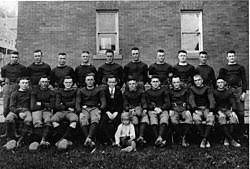
The Gilberton Catamounts, sometimes called the Gilberton Cadamounts and the Gilberton Duck Streeters, were a 1920s-era professional football team based in Gilberton, Pennsylvania. However, the team played many of its home games in nearby Mahanoy City because Gilberton's home field, Stoddard Field, was usually flooded. The borough got its "Ducktown" nickname mainly because of persistent flooding.

The team played independently against other teams from Pennsylvania's "coal country". During the 1920s the teams based here paid large amounts of money to talented pro football players. Many players from the National Football League came to play football in this region because of the amount of money paid out. In 1924 Gilberton, under the managership of Joe Keating and James Rafferty, Gilberton acquired three new star players just days before their season opener. The team signed Ben Shaw, Cecil Grigg, and Lou Smyth. All three players were members of the Canton Bulldogs of the NFL. Ironically in 1924 the team played in the Anthracite League, which was formed to combat the out-of-control hiring of top professional football talent. It is no wonder that league folded after the 1924 season. The team later played in the Eastern League of Professional Football from 1926 until the league folded in 1927. The team had mild success on the football field. As an independent team in 1923 the team went 7-4-1. In 1924, the team went 4-3-1 in the Anthracite League. The team in 1926 in the ELPF went 5-2-2.

Pro Football Hall of Famer Fritz Pollard played with the team in 1923 and 1924. Coach Charlie Copley, a former teammate of Pollard's with the Akron Pros and the Milwaukee Badgers, recruited Pollard to play for the Catamounts. He became the first African-American to play football in the coal region.

Sources
https://www.pro-football-reference.com/
https://www.profootballarchives.com/index.html
https://americanfootballdatabase.fandom.com/wiki/Football_Wiki
https://www.gridiron-uniforms.com/GUD/controller/controller.php?action=main
https://www.profootballhof.com/hall-of-famers/
Zagorski, Joe (1987). "Anthracite League" (PDF). PFRA Annual (8). Professional Football Researchers Association: 1–5.[permanent dead link]
Gill, Bob (1989). "Other Minor League" (PDF). Coffin Corner. 11 (8). Professional Football Researchers Association: 1–5. Archived from the original (PDF) on November 27, 2010.
Carroll, John M. (1999). Fritz Pollard. University of Illinois Press. ISBN 0-252-06799-1.
Peterson, Robert (1997). Pigskin: The Early Years of Pro Football. Oxford University Press. ISBN 0-19-511913-4.
Books, Scott; Charles K. Ross (2005). Race and Sport. Univ. Press of Mississippi. ISBN 1-57806-897-5.
Carroll, J.M. (1998). Fritz Pollard: Pioneer in Racial Advancement. University of Illinois Press. p. 162. ISBN 9780252067990. Retrieved October 24, 2014.
 "Marc's Collection of Mascots: Extinct/Dropped Mascots". halcyon.com. Retrieved October 24, 2014.
 "Sorry, the page you were looking for could not be found" (PDF). Retrieved October 24, 2014.[permanent dead link]
 Ross, C.K. (2005). Race and Sport: The Struggle for Equality on and Off the Field. University Press of Mississippi. p. 11. ISBN 9781578068975. Retrieved October 24, 2014.

Friday, February 18, 2022

Who Were The Coaldale Big Green?

The Coaldale Big Green was an early professional football team based in Coaldale, Pennsylvania. The club played as an independent until joining the Anthracite League in 1924. After leaving the league in 1924, the team spent its 1925 season as an independent, then joined the short-lived Eastern League of Professional Football in 1926. While the most well known Anthracite League team is the Pottsville Maroons, which jumped to the National Football League in 1925 and immediately established itself as a championship contender, the most consistently successful club in the coal region was the Big Green. Coaldale won the coal region's Curran Cup in 1921, 1922 and 1923.

The team was formed in 1912 by the Coaldale Athletic Association and James H. Gildea, who would manage the team for 21 seasons, with a roster of mostly local talent. While nearby towns, such as Pottsville and Gilberton favored importing players for their teams, Gildea preferred searching his own area for players. Arguably the team's two best players were James "Blue" Bonner and Jack "Honeyboy" Evans. Both men were Coaldale natives. In 1912, Gildea combined two smaller and earlier Coaldale football teams, the Old Street Stars and the Coaldale Rosebuds. While the Big Green organization dates back to 1912, the name "Big Green" was not applied to the team until after adopting its famous green jerseys in 1917. From 1912 until 1917, the team was only known as Coaldale Football. The Big Green went on to win the Curran Cup in 1921, 1922, and 1923. The 1923 championship resulted in a 3–0 win over the Maroons.

In 1924 James Gildea set up a meeting at the town hall in Coaldale to establish the league made up of the coal region teams. The managers and owners of every major coal region team and the local sportswriters were all invited.

The main reason for the league was to first put an end to teams raiding their opponents' rosters for big-name players. During this, money was being handed over by several managers in record amounts, as they hoped to lure the finest talent available. When the on-field talent wasn't available for signing, these managers would then steal players from other teams with the offer of higher salaries. As a result of the meeting, the teams agreed that the league teams had to secure all of their players prior to the start of the league season. A required list of eligible players had to also be filed by each team for all the others to observe. The plan was that all teams would be required to finish the season with the same players listed on the roster at the start of the year. Also a monetary forfeit of $500 or $1,000 had to be posted by each team to guarantee that the team would stick to its preseason player roster during league play and that there was no objection to any player being signed.

The second reason for establishing a league was to allow for the development of a concise scheduling format for the teams in the region. In the early 1920s, finding open dates when teams could play each other was difficult. Games were often delayed until the latest possible moment, usually 2–3 days before game day. One reason for this was the inability of some clubs to draw enough people into the ballpark. Many of the teams spent a lot of money signing talented players and in order to play them, the managers and owners relied heavily of the number of people in attendance for both home and road games. Every manager knew the importance and longed for the benefits of a sound, opponent-by-opponent schedule. As a result of the meeting, a schedule was agreed upon of twelve set dates from the beginning of October until the end of November. This move was also designed to allow non-league contests of natural rivals from nearby towns to take place at different intervals during and after the league's scheduled games. Coaldale also constructed a grandstand which could accommodate 8,000 fans at Coaldale Field. Their projects cost an estimated $3,500. Many of the other teams spent a combined $15,000 in stadium repairs in 1924.

With these two issues addressed, the Anthracite League was formed. However, when it became clear that the other teams weren't following the rules pertaining to signing players, Gildea and the Big Green left the league.

The Big Green fell on hard times after they left the Anthracite League. They won only four games in 1924. Around the midpoint mark of the following season, they became strictly a traveling team because every football fan in the region joined the Maroons' fanbase when the team joined the NFL. The team then joined the short-lived Eastern League of Professional Football during its one season in 1926. The team then played independently before folding sometime around 1933.

Sources
https://www.pro-football-reference.com/
https://www.profootballarchives.com/index.html
https://americanfootballdatabase.fandom.com/wiki/Football_Wiki
https://www.gridiron-uniforms.com/GUD/controller/controller.php?action=main
https://www.profootballhof.com/hall-of-famers/
Ghosts of the Gridiron - Virtual Scrapbook Library Vol. 3: Coaldale Big Green
Zagorski, Joe (1986). "Coaldale's Man of Action" (PDF). Coffin Corner. 8 (10). Professional Football Researchers Association: 1–2. Archived from the original (PDF) on November 27, 2010.
Zagorski, Joe (1987). "Anthracite League" (PDF). PFRA Annual (8). Professional Football Researchers Association: 1–5.[permanent dead link]
Coaldale Big Green
 "Coaldale Big Greens".
 "Virtual Scrapbook: Coaldale Big Green". Archived from the original on December 14, 2009. Retrieved January 9, 2009.
 "Archived copy" (PDF). Archived from the original (PDF) on November 27, 2010. Retrieved January 9, 2009.
 http://home.comcast.net/~ghostsofthegridiron/articles/09-An-321.pdf