Showing posts with label 1915. Show all posts

Friday, April 22, 2022

Who Were The Holmesburg Athletic Club?

The Holmesburg Athletic Club was a professional football team from Philadelphia, Pennsylvania, that was in existence from around 1915 until 1923. The team laid claim to the Philadelphia City Championship in 1919 and 1920.

The 1915 Holmesburg lineup featured Lou Little, an college All-American from Penn. Little, at the time a freshman at Penn, played under the assumed name of "Lou Small" to protect his collegiate status. He later went on to play for the Buffalo All-Americans of the National Football League, the Union Club of Phoenixville, the Union Quakers of Philadelphia and the pre-NFL version of the Frankford Yellow Jackets before going on to a highly successful coaching career at both Georgetown and Columbia.

Bert Yeabsley, a pinch hitter for the Philadelphia Phillies, and John B. Kelly, Sr., a three time Olympic gold medalist for sculling, played for the team in 1919. In 1921, Benny Boynton briefly played for Holmesburg for Thanksgiving Day game against the Union Quakers of Philadelphia. Stan Cofall also played for the team over its life span.

In the years following World War I the Holmesburg Athletic Club was a dominant force on the gridirons of Philadelphia. In addition to maintaining regular rivalries with such regional powers as the Frankford Athletic Association and Conshohocken Athletic Club, Holmesburg also competed against such far ranging teams as the Rex Athletic Club of Washington (DC), and the Coaldale Big Green, a powerhouse eleven from the Pennsylvania coal region's Anthracite League. Perhaps Holmesburg's most successful season was 1919. Widely acknowledged in the local press as the city champions of Philadelphia, that season's only defeat came at the hands of Conshohocken, a team generally recognized as that's seasons Eastern professional champions.

Heading into the 1919 season the Holmesburg Athletic Club was widely expected to field the strongest football team in the Philadelphia area. Manager Fred Gerker and Coach Henry Eavis had assembled a powerful lineup of collegiate stars that included team captain William "Doc" Morrison of Bucknell, Charlie MacKracken of Villanova, Kidder Caskey of Muhlenberg, former Swarthmore captain ??? MacKissick and former Lafayette stars Dick Diamond, Johnny Scott and Dick Lake. That season's lineup also included Bert Yeabsley, a player with a well established reputation on the local gridirons who had also played for pro baseball's Philadelphia Phillies, and Jack Kelly, the legendary sculling champion who would go on to capture gold in two Olympics.

The Northeast Philadelphia eleven opened its 1919 grid campaign on the second weekend in October, against West Philadelphia's Hobart AC. Johnny Scott led the charge, scoring four touchdowns and five extra-points, as the "Burg" rolled a 41-0 victory. A week later some 2,000 spectators were on hand at Holmesburg's Crystal Field to witness an even more overwhelming victory, this time over Camden New Jersey's Parkside AC. This game, which saw the first appearance of Bert Yeabsley in the lineup, was largely viewed as a wram-up for the upcoming tilt with Conshohocken. The late arrival of the New Jersey eleven delayed the start of the contest, ...and briefly postponed the inevitable. Jack Kelly's three touchdowns in the first quarter set the tone for the afternoon, then Scott, Knauer, Caskey, Yeabsley and MacKissick made a few contributions of their own to the points total. By the time it was all over Parkside lay buried under the rubble of a 90-0 rout.

With two solid victories under their belts, the Holmesburg squad made the trek out to Conshohocken the following weekend. There, playing before a crowd of about 14,000, the heavily favored visitors got on the board early when Johnny Scott dashed fifty-three yards through the home team for a touchdown. From that point forward, however, Coach Nig Berry's "Conshy" eleven outplayed the Philadelphians in nearly every aspect of the game. Whitey Thomas, the former Penn State and Holmesburg standout, recovered a Bert Yeabsley fumble and dashed thirty yards to endzone for Conshohocken's first touchdown of the game. Then a Johnny Scott fumble gave Conshohocken the ball on the Holmesburg 13-yard line. A few plays later Earl Potteiger took the ball into the endzone, giving Conshy a 13-7 lead heading into halftime. Little changed in the second half. Another Holmesburg error, this time a muffed punt, was combined with a thirty-five yard pass play to give Conshohocken the ball near the Holmesburg goal line. On the very next play Potteiger took it up the middle on a one yard dive for another touchdown, as Conshohocken walked away with a 19-7 upset victory.

Eager to rebound from the disappointing performance against Conshohocken, the Holmesburg eleven anxiously awaited the first club on their November schedule: the Vincome AA. Unfortunately the wait was just a little longer than anticipated, as an unexpected cancellation on the morning of the game sent Manager Fred Gerker scrambling to find another opponent. After a few quick phone calls the Bluejackets of the USS Michigan were on their way up to the Northeast from their ship's berth in the South Philly. Then, behind the strong play and scoring of Johnny Scott, Dick Diamond and Bert Yeabsley, the Berg-men outclassed the sailors in a 32-0 shutout. A week later Holmesburg headed down to Browns Field for a clash with the Frankford Yellow Jackets. Up to this point in the season the only blemish on Frankford's record was a scoreless draw with the Ewing AA. Both Frankford and Holmesburg believed that the outcome of this game would settle the question of which team could claim the bragging rights as champions of Philadelphia. The game was a struggle throughout, with both teams' defenses holding fast. A Johnny Scott field goal from the 20-yard line was the only scoring play of the afternoon, giving Holmesburg a 3-0 shutout victory.

The final three games on the schedule were against strong clubs from of outside the immediate Philadelphia area. In the first of these Holmesburg welcomed the Rex AC to Crystal Field. Rex, touted as the champions of Washington (DC), was composed mostly of former Georgetown and Catholic University players. Undefeated over four seasons, the only blemish of this club's current campaign was a scoreless tie against the Ewing AA, of Philadelphia, just a few weeks earlier. Holmesburg was playing without the services of Johnny Scott, who was still recovering from injuries suffered during the Frankford game. It as a fierce contest throughout, with few scoring opportunities and plenty of injuries for both clubs. The first real scoring chance didn't come until the fourth quarter, when a MacKissick field goal attempt for Holmesburg went wide. A little while later Kidder Caskey made three rushes up the middle to take the ball from the 10-yard line for the only touchdown of the game, providing Holmesburg a 7-0 victory.

The next game on the schedule was against Casey Gildea's Coaldale Big Green, one of the finest teams from the Pennsylvania coal region. The Big Green made the trip down to Philadelphia on the weekend before Thanksgiving, accompanied by some 1,000 supporters. Holmesburg out-played the visitors in every aspect of a game that featured numerous interceptions by Johnny Scott, Dick Diamond and Doc Morrison. The visitors' only points of the game came off a Gildea field goal late in the first quarter. This gave Coaldale a 3-0 lead, but Holmesburg moved ahead late in the second quarter on a short pass from MacKissick to Dick Diamond at mid-field, which Diamond then carried forty-five yards through the entire Coaldale team for a touchdown. Second half touchdowns by MacKissick and Morrison put the game out of reach for the up-state eleven, as Holmesburg went on to win, 19-3.

Finally, on Thanksgiving Day, Holmesburg closed out the season at Crystal Field against the Thomas AC. Thomas, touted as the champions of Bethlehem (PA), forced another tough defensive game. The only points of the game came off a Holmesburg drive that started on their own 35-yard line. A series of runs, that included long gains of twenty-five and eighteen yards, brought the ball to the Thomas 3-yard line. Then Dick Diamond took the ball wide around the wing and into the endzone. MacKissick followed with a successful kick. Both defenses clamped down hard for the remainder of the game, and at the final whistle Holmesburg took a 7-0 decision.

The Philadelphia press began referring to Holmesburg as the city champions of 1919 following the victory over Frankford. This view was cemented by its victories against quality teams from outside the region in the final three games of the season, giving Holmesburg a 7-1-0 record for its championship season.

The 1915 lineup featured University of Pennsylvania All-American Lou Little. Little, at the time a freshman at Penn, played under the assumed name of "Lou Small" to protect his collegiate status. He later went on to play for the Buffalo All-Americans of the APFA/NFL, the Union Club of Phoenixville, the Union Quakers and the (pre-NFL) Frankford Yellow Jackets before going on to a highly successful coaching career at both Georgetown and Columbia.

Over the years the Holmesburg roster featured some other NFL veterans as well, including Stan Cofall and local product Howard "Nig" Berry. In 1921 the team enlisted the services of Benny Boynton as a hired gun for Thanksgiving Day game against the Union Club. Boynton, who also played that season with both the APFA's Buffalo All-Americans and Washington Pros, was selected a first team APFA all-pro by the Buffalo Evening News.

Sources
https://www.pro-football-reference.com/
https://www.profootballarchives.com/index.html
https://americanfootballdatabase.fandom.com/wiki/Football_Wiki
https://www.gridiron-uniforms.com/GUD/controller/controller.php?action=main
https://www.profootballhof.com/hall-of-famers/
Holmesburg Athletic Club Philadelphia Athletic Champs 1919 & 1920

Tuesday, February 8, 2022

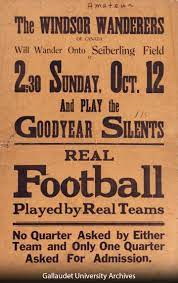
Who Were The Akron Goodyear Silents?

The (Akron) Goodyear Silents was a semi-professional football team based in Akron, Ohio, composed of deaf players. Most, if not all, of the team worked for the Goodyear Tire & Rubber Company. During World Wars I and II, many industrial companies hired deaf people, including Goodyear and Firestone in Akron. In existence from 1915–1927, the team played against local and regional semi-pro teams, and compiled an all-time record of 68-35-11; in the process, they won several league championships.

The most disappointing moments the successful team experienced was their failure to defeat cross-town archrivals Akron Pros, losing all four games to this team. The Akron Pros was one of the pioneering teams in the fledging NFL! The four losing scores were: 9-0, 20-7, 6-0 and 14-0.

Joe Allen, one of the Goodyear Silents players, was the only one to continue his career in semi pro football after the team went out of business
.

Sources
https://www.pro-football-reference.com/
https://www.profootballarchives.com/index.html
https://americanfootballdatabase.fandom.com/wiki/Football_Wiki
https://www.gridiron-uniforms.com/GUD/controller/controller.php?action=main
https://www.profootballhof.com/hall-of-famers/
Susan Burch, Signs Of Resistance: American Deaf Cultural History, 1900 to World War II (NYU Press, (2004), ISBN 978-0814798942, pp. 77-79. Excerpts available at Google Books.
 Robert M. Buchanan, Illusions of Equality: Deaf Americans in School and Factory, 1850-1950 (Gallaudet University Press, 1999), ISBN 978-1563680847, p. 79. Excerpts available at Google Books.
 Barry Strassler, "Deaf Jews in Sports: Louis Seinensohn; The Goodyear Silents Championship Football Team Had A Jewish Fullback", Los Angeles Jewish Deaf Community Center newsletter, September/October 1998.

Tuesday, January 25, 2022

Who Were The Staten Island Stapletons?


The Staten Island Stapletons also known as the Staten Island Stapes were a professional American football team founded in 1915 that played in the National Football League from 1929 to 1932. The team was based in the Stapleton section of Staten Island. They played under the shortened nickname the "Stapes" the final two seasons. Jack Shapiro, who was a blocking back for the Stapletons, was the shortest player in NFL history.

The Staten Island Stapletons were founded in 1915 as a neighborhood team. The team was organized by Dan Blaine, who also served as the team's halfback. Blaine later became rich by building up a chain of restaurants. The Stapletons played similar semi-pro neighborhood teams from the New York City area. During those early years the Stapes played more for fun than money. Crowds were small and player salaries averaged $10 per game. The team won several local semi-pro titles before World War I.

The team was inactive in 1918, due to Blaine's service commitment to the military and involvement in the war. However, the team was renewed in 1919. By that time, Blaine was the team's sole owner. He retired as a player in 1924 but continued as owner and manager of the Stapletons, who were commonly known as the Stapes. By that time the team set up Thompson Stadium, a cozy minor-league park in the neighborhood that gave them their name, as their permanent home field. Today the stadium site is occupied by Stapleton Housing located between Broad, Hill and Warren Streets and Tompkins Avenue. Prior to moving into Thompson Stadium, the Stapletons played in two temporary local parks: Stapleton Field and East Shore Oval.

In 1923-24 Daniel Daley manager of Stapes claimed the New York Metropolitan championship by beating the best independent pro teams in the area. However, in 1925, Tim Mara formed the New York Giants who moved into the Polo Grounds. The Giants presence in New York overshadowed the Stapes, particularly with the sell-out visit by Red Grange and the Chicago Bears on December 6, 1925. The Giants and Stapes began their New York rivalry on Thanksgiving Day 1925. The Giants defeated the Stapes in an exhibition game 7–0.

Over the following couple of seasons, the Stapes would play exhibitions against pro teams from the NFL and various other leagues. On November 14, 1926, the Stapes were routed by the Newark Bears, 33–0. The Bears belonged to Red Grange's American Football League, which served as competitor to the NFL during the 1926 season. Unhappy with the defeat, Blaine promptly hired most of the Newark players, including star rookie Doug Wycoff, who were still owed money because the Newark owner was having financial problems. As a result, the Bears went out of business while the Stapletons benefited from Newark's folding. In 1928, Blaine further upgraded the team by signing some players from New York University.

In 1927, the Stapes fielded their ex-Newark Bears squad, although Wycoff signed with the Giants. The Giants would go on to win the 1927 NFL championship and defeated the Stapes twice in non-league games, 19–0 and 18–0. The Stapes though did manage to beat the NFL's Duluth Eskimos, featuring Ernie Nevers 7–6 on November 27, 1927. By 1928, Blaine wanted the Stapes to become an NFL franchise. He bolstered his squad by re-signing Doug Wycoff back as a player-coach and by signing six graduates from the nationally ranked New York University team. The Stapes had their best season on record, going 10–1–1, including a 3–1 record against NFL teams. They even pulled out a 7–0 victory over the Giants on Thanksgiving Day.

After his team rolled up a 10–1–1 record in 1928, Blaine applied for an NFL franchise in 1929. He needed permission from Tim Mara, the owner of the Giants, because Staten Island was in Mara's exclusive territory. But Mara actually had an extra franchise. It had originally belonged to the Brooklyn Lions and had been given to Mara when the Lions folded in 1927, because they owed him money. Mara had then allowed the New York Yankees, owned by Grange's manager C. C. Pyle, to use the franchise when that team moved from the defunct AFL into the NFL. The Yankees went out of business after the 1928 season, so the franchise again went back to Mara and he passed those franchise's rights on to Staten Island.

Blaine promptly hired Ken Strong, who became a Stapletons Hall of Famer. Strong, who received All-American honors while at New York University, was a speedy, powerful runner who was also one of the best kickers of the era.

The Stapletons would never have a winning season in the NFL. During its first NFL season in 1929, the team went 3–4–3, defeating the Dayton Triangles, Brooklyn Dodgers and the Minneapolis Red Jackets. It also managed to tie the Frankford Yellow Jackets once and Orange Tornadoes twice. The team improved to a 5–5–2 record in 1930. That season the Stapes managed to defeat the rival New York Giants 7–6, after a four-yard touchdown run from Doug Wycoff and an extra point kick from Strong.
In July 1931, the team's official name on the league records was changed from the Stapleton Football Club, Inc., to Staten Island Stapes. At this time, Doug Wycoff left the team to rejoin the Giants. In need of a coach, Blaine hired Hinkey Haines, who had played briefly for the Stapes in 1929. The Stapes opened at home by beating the Dodgers 9–7 before 7,000 fans. However a week later at Ebbets Field, the Dodgers forced 3 interceptions to defeat the Stapes 18–6. The team would post a 4–6–1 record in 1931, defeating the Giants (once), Dodgers (twice) and the Cleveland Indians.

In 1932, the Stapes finished last, defeating only the Giants and the Chicago Cardinals. Blaine was allowed by the NFL to suspend league play for the upcoming 1933 season. The team continued to lose money in 1933. While the team posted losses against the Giants, Dodgers, Portsmouth Spartans, and Green Bay Packers, it did manage to defeat the newly established Philadelphia Eagles. Doug Wycoff and Bob Campiglio stayed with the Stapes in 1933, but their star player Ken Strong signed with the Giants and helped them win the NFL's Eastern Division championship that season and the NFL league championship in 1934.

Blaine went through the formality of getting NFL permission to suspend league operations for the 1934 season. The team played one more season of semi-pro football in 1934 before quietly folding a year later. In June 1935, Blaine's franchise was finally declared forfeit. The franchise's failure can be blamed on a combination of the Great Depression and having too small of a stadium that could never accommodate enough fans to make the team profitable. Therefore, Stapes fans could not afford enough tickets to make a team possible.

Sources
https://www.pro-football-reference.com/
https://www.profootballarchives.com/index.html
https://americanfootballdatabase.fandom.com/wiki/Football_Wiki
https://www.gridiron-uniforms.com/GUD/controller/controller.php?action=main
https://www.profootballhof.com/hall-of-famers/
Staten Island Stapletons Historic Football Records
Hogrogian, John (1985). "The Staten Island Stapletons" (PDF). Coffin Corner. 7 (6). Professional Football Researchers Association: 1–9. Archived from the original (PDF) on November 27, 2010.
Gill, Bob (1994). "Just Staten Out On The Island" (PDF). Coffin Corner. 16 (3). Professional Football Researchers Association: 1–11. Archived from the original (PDF) on December 3, 2013.
Bashore, Mel (1999). ""Cup of Coffee" Players: Jack Shapiro" (PDF). Coffin Corner. 21 (4). Professional Football Researchers Association: 1–2. Archived from the original (PDF) on October 7, 2010.
 "Parkhill". Archived from the original on July 3, 2008. Retrieved January 5, 2009.
 Robinson, George (February 1, 2004). "F.Y.I". The New York Times. Retrieved May 24, 2010.

Friday, April 30, 2021

Buffalo's Forgotten Champion - The Story Of The Buffalo All-Americans

Buffalo operated an early professional football circuit from at least the late 1800s onward. Among notable predecessors to the team discussed here were the Buffalo Oakdales, whose heyday was in the years 1908 and 1909 and who ceased operations c. 1915; the Cazenovias, who were New York's best team in 1910 and 1911; and the Lancaster Malleables, from the neighboring town of Lancaster, New York, who were the best team in the region in 1913 and 1914. These teams played each other and teams from nearby cities (for example, the Rochester Jeffersons).

The All-Stars played from 1915 to 1917 under the leadership of Eugene F. Dooley; in 1917, Dooley, along with his star player Barney Lepper, took the team on a barnstorming tour of midwestern pro football teams. In 1918, the city's teams were not allowed to play outside the area because of the 1918 flu pandemic; Dooley and Lepper discontinued the All-Stars. Shoe salesman Warren D. Patterson, at the same time as this, formed a new team known as the Buffalo Niagaras, signing former Youngstown Patricians quarterback Ernest "Tommy" Hughitt as his quarterback. As the Niagaras, the team won a citywide championship in 1918, going undefeated with a 6–0–0 record (including a forfeit), having only one touchdown scored on them in any of their six games. They were one of the few upper-level teams still able to play games that year, with most of the top level teams (such as the Patricians, Canton Bulldogs and Massillon Tigers) all having suspended operations due to the pandemic and/or World War I player shortages; this allowed Buffalo to get a leg up on its Ohio competition and sign otherwise-unemployed players, setting a course for bringing the region on par with the Ohio League and the ultimate establishment of the NFL. With that, they could have theoretically staked a claim to being the best team in the nation, especially considering how the team would perform over the next three seasons, but the Professional Football Researchers Association is dismissive of any claim that does not come from the Ohio League, and gives the mythical "national title" to the Dayton Triangles, who also went undefeated that year. When the New York Pro Football League reopened in 1919, the team, now reorganized into a franchise known as the Prospects, defeated the Rochester Jeffersons for the league title in a two-game Thanksgiving weekend tournament. The two teams tied the Thanksgiving Day game, but Buffalo handily defeated Rochester 20–0 the following Sunday.

Lepper teamed up with Hughitt and Patterson in early 1920 to create the Buffalo All-Americans, then quickly sold the team to Frank McNeil, a somewhat abrasive and aggressive owner who was able to get the team into the National Football League for its first season. However records indicate he may not have actually entered his team into the American Professional Football Association until 1921, the All-Americans are generally shown as the third-place team in league standings from that year (the confusion stems from a statement in the minutes from the league's April 1921 reorganization meeting admitting an unidentified team from Buffalo; this may have instead been the Tonawanda Kardex, who joined the league in 1921, playing only one game). Patterson held on to the Prospects name and put together a lower quality team that played through 1923, including a 1922 game against the All-Americans themselves.

The All-Americans had success during its first couple of APFA seasons, posting a 9–1–1 regular season record in 1920, becoming the first professional NFL team to win by margins of 20 or more points in each of its first four games, an asterisked record which was not tied until the 2007 New England Patriots' offense duplicated the feat; the asterisk is because, in the early NFL, the All-Americans played five of its 11 games against non-league opponents.

Unique for a professional football team, the All-Americans had a sharing agreement with the Union Club of Phoenixville, a side project managed by All-Americans player Heinie Miller. Miller would take himself and seven other All-Americans to Phoenixville, Pennsylvania to play games on Saturdays (Pennsylvania had blue laws that prevented play on Sunday), and then return to Buffalo on Sundays. This sharing agreement lasted into 1921 when Miller formed the new Union Quakers of Philadelphia, but All-Americans owner Frank McNeil put a halt to the agreement halfway through the 1921 season after the Quakers played the Canton Bulldogs and wore out the All-Americans players. Five All-Americans left the team to play for the Quakers full-time; Buffalo had the pickings of the then-defunct Detroit Tigers to replenish their roster.

In 1920, the Akron Pros held the All-Americans to a scoreless tie in front of only 3,000 fans. At the game, Akron owners Frank Nied and Art Ranney agreed to sell Bob Nash to Buffalo for $300 and five per cent of the gate, in the first known player deal between NFL clubs.

Along with the Decatur Staleys and Akron Pros, Buffalo claimed a share of the 1920 league title. That same season the Pros held the best record in the league, and only had to avoid losing a game. Meanwhile, Buffalo and the Staleys had to win in order to capture the AFPA Championship. The Pros were able to hold the Staleys to a scoreless tie at Cub Park. However, the Pros still had to play the All-Americans who were fresh from a 7–3 win over the Canton Bulldogs at New York City's Polo Grounds. Despite Buffalo's confidence going into the match, the Pros also held the All-Americans to scoreless tie.

Both the All-Americans and the Staleys complained about the championship, arguing that Akron had only tied, but not defeated them. However, Joseph Carr (then serving only as owner of his Columbus Panhandles team) moved at the league's meeting in April 1921 to give Akron the sole title and the rights to the Brunswick-Balke Collender Cup. The motion was accepted, and Buffalo finished in third place, with Chicago in second place. The only loss Buffalo had was against the Canton Bulldogs in 1920. According to modern NFL tie-breaking rules, the 1920 Buffalo All-Americans would be co-champions. They would be tied with the Akron Pros in win percentage, 9 1⁄2 losses (.864), both teams beating out the Decatur Staleys, who would have a season that counted 11 wins to 2 losses (.846).


+1⁄2 wins to 1On November 27, 1921, the All-Americans claimed the AFPA title with a record of 9–0–2. However, for reason still unknown, owner Frank McNeil agreed to play two more games. He did tell the Buffalo media that the two games were exhibitions and would have no bearing on the team's claim to the AFPA title. George Halas and the Chicago Staleys manage to capture second place in the AFPA in 1921, with their only loss of the season against Buffalo. McNeil scheduled the two additional games against the Pros and Staleys back-to-back. The first game was scheduled for December 3 against the tough Pros, after which his team would take an all-night train to Chicago to play the Staleys the next day.

The All-Americans defeated the Pros, arriving in Chicago worn out and in no condition to play the Staleys, and lost. McNeil still believed his team was the AFPA's 1921 champion, and even invested in tiny gold footballs for his players to commemorate the achievement. However Halas declared that the title was Chicago's, basing his claim on his belief that the second game of the Buffalo-Chicago series mattered more than the first. He also pointed out that the aggregate score of the two games was 16–14 in favor of the Staleys. McNeil insisted the Buffalo All-Americans were the champions, still maintaining that the last two games his team played were merely exhibitions. It didn't matter. The league awarded the championship by a vote of the Association's executive committee in January 1922 to the Staleys.

This episode is referred to by several sports historians and Buffalo sports fans as the "Staley Swindle." McNeil eventually went to his grave trying to get the league's decision overturned. In their decision, based on a generally accepted (but now obsolete) rule that if two teams play each other more than once in a season, the second game counts more than the first, the executive committee followed established tradition. Had Buffalo not played the last game, they would have had an undefeated season and won the title.

Under the leadership of player-coach Tommy Hughitt, the All-Americans, though they never equaled the success of the first two seasons, continued to post winning records in 1922 and 1923. Star running back Ockie Anderson's knees deteriorated during the 1922 season, forcing his early retirement and beginning the team's decline. In 1924, owner Frank McNeil sold the team back to Hughitt and Warren D. Patterson, who immediately changed the team name to Bisons (a stock name for Buffalo sports teams) and signed several players (Pete Calac, Benny Boynton and Jim Ailinger being among them) to make another run at the title. After starting the season 6–2, the team lost their last three to once again end up marginally above .500. Hughitt retired at the end of the season. After Hughitt's retirement at the end of the 1924 season, the team struggled for the rest of its lifespan.


Jim Kendrick announced his "Buffalo Rangers" experiment, fielding an exhibition team of players from Texas and the Southwestern United States for the 1926 season. His plan was that this exhibition squad would then represent Buffalo in the NFL. Because most of the players were Texans, the team was nicknamed the "Rangers" in deference to the state's legendary peacekeeping force. Along with the West Coast's Los Angeles Buccaneers and the South's Louisville Colonels, it was one of three teams that represented cities outside the NFL's existing footprint. The Buffalo media alternately referred to the team as the "Bison Rangers," combining the old name with the new so that fans might more easily identify with the team that was on its third name in seven years. The one-year experiment brought a 4–4–2 (.500) season. Buffalo expected Kendrick to return to field the Rangers for the 1927 season, however he signed with the New York Giants, and most of the remaining players went their separate ways, citing their dislike for Buffalo's cold winters as the primary reason for leaving.

1927 season. After five games (all losses, all but one being a shutout), the team suspended operations and failed to finish the season. The team did not return to play in 1928, but returned in 1929 with former Oorang Indian Al Jolley as coach. Among their players that year was Jess Rodriguez, the first Hispanic-American player in the NFL (the Frankford Yellow Jackets had hired Ignacio "Lou" Molinet two years prior, but Molinet was a Cuban national). Much like in 1927, the Bisons failed to win a game until their final game, when in a case of cosmic irony they upset the Chicago Bears 19–7; thus, the very team that had spoiled their undefeated season in 1921 saved them from the indignity of a winless season in 1929. With the Great Depression underway, the Bisons folded, never to return again. During the season, the Bisons set an NFL record of six consecutive games without ever having a lead in regulation play. The record was tied in 2012 by the Kansas City Chiefs.

At least one further game against an NFL team was played in Buffalo in the wake of the Bisons' failure: the independent Buffalo Bears narrowly lost, 8–6, to the Cleveland Indians in a 1931 contest. Buffalo would become a regular "neutral site" for NFL exhibitions from 1938 to 1958. The team has no official relation to future Buffalo pro football franchises: the Buffalo Indians and Tigers of the third American Football League, the Buffalo Bisons of the AAFC, or the Buffalo Bills of today which was one of the new AFL teams (formation announced in 1959) that first played in 1960.

Sources
https://www.pro-football-reference.com/
https://www.profootballarchives.com/index.html
https://americanfootballdatabase.fandom.com/wiki/Football_Wiki
https://www.gridiron-uniforms.com/GUD/controller/controller.php?action=main
https://www.profootballhof.com/hall-of-famers/
 Sye, Roy. Buffalo All-Stars all time results. Professional Football Researchers Association.
 "History of Pro Football in Buffalo". Billsbackers.com. Archived from the original on February 14, 2012. Retrieved November 1, 2012.
 "History of Pro Football in Buffalo". Billsbackers.com. Archived from the original on February 14, 2012. Retrieved November 1, 2012.
 "Buffalo Prospects". Independentfootball.site90.com. October 25, 2011. Archived from the original on February 1, 2011. Retrieved November 1, 2012.
 "Patriots at Bengals: Game notes". October 1, 2007. Archived from the original on May 19, 2011. Retrieved October 2, 2007.
 ESPN Monday Night Football broadcast, October 1, 2007. October 1, 2007. commentator discussion when noting the tied record post-game
 Carroll, Bob (1982). "Akron Pros: 1920" (PDF). Coffin Corner. 4 (12). Professional Football Researchers Association: 1–6. Archived from the original (PDF) on March 11, 2012.
 "Buffalo Faces Canton at the Polo Grounds". Retrieved November 9, 2009.
 "NFL Tie-Breaking Procedures". NFL.com. Retrieved November 1, 2012.
 "Who really won the championship in 1921? (p/o "History of Professional Football in Western New York")". Archived from the original on September 29, 2007. Retrieved October 2, 2007.
 "1921:The Staley Swindle". Retrieved November 9, 2009.
 Miller, Jeffery (2003). "Jim Kendrick: The Man with the Plan" (PDF). Coffin Corner. 25 (6). Professional Football Researchers Association: 1–6. Archived from the original (PDF) on November 26, 2010.
 *Crippen, Ken (2002). "1926 Buffalo Rangers" (PDF). Coffin Corner. 24 (4). Professional Football Researchers Association: 1–6. Archived from the original (PDF) on October 10, 2010.
 "Kansas City Chiefs tie 83-year-old mark of shame". NFL.com.
 "The Pro Football Archives". The Pro Football Archives. November 14, 1915. Archived from the original on April 1, 2012. Retrieved November 1, 2012.
 "1916 All-Buffalo". The Pro Football Archives. Archived from the original on March 18, 2012. Retrieved November 1, 2012.
 "The Pro Football Archives". The Pro Football Archives. Archived from the original on September 4, 2008. Retrieved November 1, 2012.
 "History of Pro Football in Western New York-1918". Billsbackers.com. Archived from the original on March 15, 2012. Retrieved November 1, 2012.
 "Table Of Contents" (PDF). Archived from the original (PDF) on October 22, 2012. Retrieved November 1, 2012.
 "1920 Buffalo All-Americans Statistics & Players". Pro-Football-Reference.com. Retrieved November 1, 2012.
 "1921 Buffalo All-Americans Statistics & Players". Pro-Football-Reference.com. Retrieved November 1, 2012.
 "1922 Buffalo All-Americans Statistics & Players". Pro-Football-Reference.com.
 "1923 Buffalo All-Americans Statistics & Players". Pro-Football-Reference.com.
 "1924 Buffalo Bisons Statistics & Players". Pro-Football-Reference.com.
 "1925 Buffalo Bisons Statistics & Players". Pro-Football-Reference.com.
 "1926 Buffalo Rangers Statistics & Players". Pro-Football-Reference.com.
 "1927 Buffalo Bisons Statistics & Players". Pro-Football-Reference.com.
 "1929 Buffalo Bisons Statistics & Players". Pro-Football-Reference.com.