Monday, September 30, 2024

The Story And Significance Of Dave Casper - Four Straight First Team All-Pro Seasons At Tight End

David John Casper nicknamed "the Ghost", is an American former professional football player who was a tight end in the National Football League, primarily with the Oakland Raiders. Casper has been inducted into both the College Football Hall of Fame (2012) and the Pro Football Hall of Fame (2002).

Casper was selected in the second round of the 1974 NFL draft by the Oakland Raiders. Casper only caught a total of nine passes his first two seasons, but was a top-ten receiver in their championship season in 1976, in which he had 53 catches for 691 yards and 10 touchdowns.

One of Casper's most memorable games as a Raider came in a 1977 Divisional Playoff game against the Baltimore Colts. Casper made an over-the-head catch of a soft pass lofted by Ken Stabler on "The Ghost to the Post." The 42-yard reception set up a game-tying field goal that forced overtime and the Raiders went on to a 37–31 victory with Casper's 10-yard touchdown reception in the second overtime period. He finished the game with four receptions for 70 yards and three touchdowns.

Casper was also involved in another famous NFL contest in 1978 on September 10, between the Raiders and San Diego Chargers. The Raiders trailed the Chargers 20–14 with just ten seconds left in the game when Oakland quarterback Ken Stabler, about to be sacked, dropped the football. He flicked it toward the goal line in an effort to save the game and Raiders running back Pete Banaszak recovered the ball at the San Diego 12-yard line but dropped the ball again, and it rolled further forward. Casper kicked the ball at the San Diego 5-yard line and finally recovered it in the end zone to tie the game. The extra point attempt was good and Oakland won the game by a point, 21–20. Stabler, Banaszak, and Casper all admitted afterwards that they had deliberately fumbled or batted the ball towards the end zone.

The Chargers protested on the grounds that Stabler's fumble was actually a forward pass, and therefore should have been ruled incomplete when it hit the ground. As a result of the play, the NFL changed its rules to make it illegal for the teammate of a ball carrier to advance the ball if the ball carrier fumbles on fourth down or in the last two minutes of the game.

Casper caught the first touchdown of Super Bowl XI, a 32–14 Raiders victory over the Minnesota Vikings. As a Raider, Casper was selected to four straight Pro Bowls (1976–1979).

Along with his three touchdown catches in the "Ghost to the Post" game, Casper caught two more TD's in the 1977 AFC Championship Game. His five TD's in a postseason is an NFL record for tight ends that still stands today.

Midway through the 1980 season Casper was traded to the Houston Oilers for their first and second-round draft picks. He was reunited with his former Raider quarterback, Ken Stabler, when he was traded to the Oilers. He finished the 1980 season with 56 receptions and was named to his fifth Pro Bowl. However, the trade caused him to miss out on a second Super Bowl ring, as the Raiders went on to win the Super Bowl that year, beating Houston in the playoffs on the way there. After the 3rd week of the 1983 season, Casper and quarterback Archie Manning were traded to the Minnesota Vikings. In 1984, he returned to the Raiders (who won another Super Bowl the year before) for his final NFL season.

Casper finished his pro career with 378 receptions, 5,216 yards and 52 touchdowns. In 2002, he was inducted into the Pro Football Hall of Fame. He was the 13th Raider to be inducted.

Sources
https://www.pro-football-reference.com/
https://www.profootballarchives.com/index.html
https://americanfootballdatabase.fandom.com/wiki/Football_Wiki
https://www.gridiron-uniforms.com/GUD/controller/controller.php?action=main
https://www.profootballhof.com/hall-of-famers/
Christopherson, Brett (August 28, 2009). "Brett Christopherson column: 1969 Chilton High School Tigers recall 'the greatest days'". The Post Crescent. Archived from the original on September 24, 2015. Retrieved September 7, 2009.
 "New Hall of Famer Casper reflects on Irish '73 national title win over Alabama". Retrieved December 5, 2012.
 "Dave Casper - Pro Football Hall of Fame Official Site". www.profootballhof.com.
 "1974 NFL Draft Listing". Pro-Football-Reference.com. Retrieved July 31, 2025.
 "1978 NFL Receiving". Pro-Football-Reference.com. Retrieved July 31, 2025.
 Hyman, Mac (September 15, 1978). "Sport Shots". Oakland Post. p. 8. Stabler said he intentionally fumbled, Pete B. said he batted the ball forward and Dave Casper said that he knew that if he fell on the ball on the one- or two-yard line the game would have been over, so he kicked it along into the end zone and fell on it.
 "The "Holy Roller"". Pro Football Hall of Fame. Retrieved November 30, 2009. During the off-season, the league added a provision to the rule book about fumbles after the two-minute warning that allows only the player who fumbled the ball to advance it.
 "Super Bowl XI - Oakland Raiders vs. Minnesota Vikings - January 9th, 1977". Pro-Football-Reference.com. Retrieved November 2, 2024.
 "David John Casper, CLU, ChFC, AEP, CASL". www.david-casper.com.

Wednesday, September 25, 2024

The Story And Significance Of George Allen - Never Coached A Losing Season In The NFL As A Head Coach

George Herbert Allen  was an American football coach. He served as the head coach for two teams in the National Football League, the Los Angeles Rams from 1966 to 1970 and the Washington Redskins from 1971 to 1977. Allen led his teams to winning records in all 12 of his seasons as an NFL head coach, compiling an overall regular-season record of 116–47–5. Seven of his teams qualified for the NFL playoffs, including the 1972 Washington Redskins, who reached Super Bowl VII, losing to Don Shula's Miami Dolphins. Allen made a brief return as head coach of the Rams in 1978, but was fired before the regular season commenced.

Allen began his coaching career at the college football level, serving as head football coach at Morningside College from 1948 to 1950 and Whittier College from 1951 to 1956. He moved to the NFL in 1957 as an assistant coach for the Rams under head coach Sid Gillman. Allen then spent eight years, from 1958 to 1965, as an assistant coach and head of player personnel for the NFL's Chicago Bears before returning to the Rams as head coach in 1966.

After three years as a broadcaster for CBS Sports, from 1978 and 1981, and a short stint as an executive with the Montreal Alouettes of the Canadian Football League (CFL) in 1982, Allen resumed coaching in 1983 as head coach for the Chicago Blitz of the newly formed United States Football League (USFL). The following year, he served as head coach of the USFL's Arizona Wranglers, leading them to the league's title game, where the Wranglers lost to the Philadelphia Stars. After a second hiatus from coaching, Allen returned to the game a final time, serving as head football coach for one season, in 1990, at California State University, Long Beach. In ten seasons as a college football head coach, Allen amassed a record of 53–38–7.

Allen was inducted into the Pro Football Hall of Fame in 2002. His eldest son, also named George Allen, is a Republican politician who served as Governor of and United States Senator from Virginia. His second son, Bruce, followed his father's footsteps as a football coach and executive, serving as general manager for the Tampa Bay Buccaneers and the Redskins of the NFL.

Allen was the head football coach at Morningside College in Sioux City, Iowa. The Morningside team was called the Chiefs at that time. He held that position for three seasons, from 1948 through 1950. His coaching record at Morningside was 16–11–2.

Allen was the head football coach at Whittier College in Whittier, California for six seasons, where he was 32–22–5 from 1951 through 1956. He was also the head baseball coach there from 1952 to 1957.

Allen joined the Los Angeles Rams staff in 1957, under fellow Hall of Fame coach Sid Gillman. Allen was dismissed after one season and, after he resided in Los Angeles out of football for several months, George Halas, founding owner and head coach of the Chicago Bears, brought him to Chicago during the 1958 season. The original purpose of Allen's hiring was to scout the Rams, whom the Bears would play twice during the season; Allen was asked for insights into Gillman's, and the Rams', offensive strategy and signals. Allen's thoroughness and attention to detail so impressed Halas that he eventually earned a full-time position on the coaching staff. During the latter stages of the 1962 season Allen replaced veteran Clark Shaughnessy as Halas' top defensive assistant, effectively making him the Bears' defensive coordinator.

His defensive schemes and tactics—and his strong motivational skills—helped make the Bears' unit one of the stingiest of its era. Allen's presence also had a formative effect on such future Hall of Fame players as linebacker Bill George and end Doug Atkins during their most productive years. By 1963, in his first full season in charge of the Bears' defense, Allen's innovative strategies helped the Bears yield a league-low 144 total points, 62 fewer than any other team, and earn an 11–1–2 record that was a half-game better than the two-time defending league champion Green Bay Packers and allowed the Bears to host the NFL championship game. Following their 14–10 victory over the New York Giants on December 29 at frigid Wrigley Field, the Bears' players awarded Allen the "game ball." NBC's post-game locker-room television coverage infamously captured Bears players singing "Hooray for George, hooray at last; hooray for George, he's a horse's ass!"

Allen was also given responsibility for the Bears' college player drafts; most likely his best-remembered choices were three players who won election to the Pro Football Hall of Fame and became household names in American sport—end Mike Ditka (chosen in 1961), halfback Gale Sayers, and middle linebacker Dick Butkus (1965). Allen's was the most common name to be suggested as a replacement for Halas should the grand old man of the league decide to step down. Jeff Davis's biography Papa Bear states that Halas informally told Allen in 1964 and 1965 that he would ultimately name him as head coach. But in 1965, after a 9–5 Bears finish that earned the iron-willed Halas NFL Coach of the Year honors, Allen decided to look elsewhere to fulfill his head-coaching ambitions. Halas stayed on as head coach through the 1967 season.

On January 10th, 1966, ex-Rams assistant coach Allen reached an agreement with Los Angeles Rams owner Dan Reeves to replace Harland Svare as head coach. He quickly faced a legal battle with Halas, who claimed that Allen's leaving was in breach of his Bears contract. (Halas accused Allen and the Rams of "chicanery.") The Bears' owner did win his case in a Chicago court but immediately allowed Allen to leave, saying he initiated the lawsuit to make a point about the validity of contracts. Halas would not be so magnanimous in an NFL meeting soon after when he attacked Allen's character. Upon hearing this, Green Bay coach Vince Lombardi joked to Reeves, "Sounds like you've got yourself a hell of a coach."

The Rams had only notched one winning season since 1956, and for much of that time been dwelling in or just above the NFL's basement. The team boasted considerable talent at several positions, most notably on the defensive line; the "Fearsome Foursome" (David Deacon Jones, Merlin Olsen, Rosey Grier, and Lamar Lundy) had gained vast attention on a losing team. Allen brought his well-known motivational skills to Los Angeles, and his twice-daily (sometimes three times) rigorous training-camp practices took players by surprise. He revealed the philosophy that he would be known for throughout his NFL career—acquiring veteran players for draft picks to fill specific roles. His motto was "the future is now." He also emphasized the role of special teams (kickoff, punt, and field-goal units) as integral to team success. He revamped the Rams' secondary with trades and installed quarterback Roman Gabriel, previously relegated to the bench, as his starter. Allen vaulted the Rams from a 4–10 record in 1965 to 8–6 in his first year—the team's first winning season since 1958. Allen received 1967 Coach of the Year honors for leading the Rams to an 11–1–2 record and the NFL Coastal Division title, their first post-season berth since 1955. Despite an 11–3 record (while winning their first 11 games) during the 1969 season and losing a conference playoff game to Joe Kapp and the Minnesota Vikings, the offense and the record did not rollover to the 1970 season and Allen was released at the end of season. The news surprised the football world, but subsequent reports revealed that discord between Reeves and Allen had been growing for some time. By some accounts, the owner's lower-key temperament differed from Allen's intense approach; more importantly, some animus had developed between the two men in November 1968. After the favored Rams struggled to a tie at San Francisco, Allen disparaged the sloppy Kezar Stadium turf; a few days later Reeves, addressing reporters, subtly admonished his coach for making what he considered an "alibi." The next week, after a narrow home win over the New York Giants, Allen rebuffed Reeves's handshake and upbraided him for "embarrassing me and my family."

Allen's firing was met not only with criticism from fans and reporters,[citation needed] but an overwhelming show of support from Ram players: 38 members of the team's 40-man roster, including such standouts as Gabriel, Jones, Olsen, Lundy, Dick Bass, Jack Snow, Bernie Casey, Tom Mack, Irv Cross, Ed Meador, and Jack Pardee, stated for the record that they would seek a trade or retire if Allen were not reinstated. Many of these players convened a press conference at a Los Angeles hotel to urge their employer, Reeves, to reconsider his decision. Allen, wearing dark glasses, spoke briefly to thank his players for their support but did not make an appeal for his job. After some negotiation Reeves offered Allen a new two-year contract, although there was no indication that the two men had reconciled their differences.

Allen and the 1969 Rams seemed to justify the coach's renewed presence; their 11–3 record earned them a Coastal Division title as Gabriel won the NFL's Most Valuable Player award. But in both 1969 and 1970 Allen's team could not produce the championship that many had predicted for them. At the end of 1970, with the Rams missing the playoffs and Allen's contract expiring, Reeves dismissed the coach again. It had been tacitly assumed that Allen had been granted the two extra years to bring the Rams a title, and so the second time the firing met with neither fan outrage nor player objection. Allen quietly left Los Angeles as the most successful coach in Rams history; he is currently fourth on the franchise's all-time wins list behind John Robinson, Chuck Knox, and Mike Martz. He was replaced by UCLA head coach Tommy Prothro, almost Allen's opposite in personality and approach.

Allen was hired as head coach and general manager of the Washington Redskins on January 6, 1971. Shortly after joining the Redskins, Allen made a series of trades with his former Ram team and brought seven 1970 Los Angeles players to Washington, including the starting linebacker corps (Maxie Baughan, Myron Pottios, and Pardee). Sportswriters nicknamed the team the "Ramskins" or the "Redrams." Allen continued his practice of bringing in veteran players at all positions; one was quarterback Billy Kilmer, something of an NFL journeyman for a decade, whose wobbly but efficient passing and raw-boned leadership complemented and eventually supplanted strong-armed veteran Sonny Jurgensen. Allen restored the Redskins to competitiveness after over two decades of losing. The 1971 team was undefeated through late October and finished with a surprising 9–4–1 record and its first trip to the playoffs since 1945. Perhaps Allen's most satisfying 1971 victory was a Monday night win in Los Angeles in December that clinched a playoff berth and eliminated the Rams from the postseason.

Allen's 1972 team, with Kilmer by now the starting quarterback, won the NFC East title with an 11–3 record; the defense allowed a conference-low 218 points on the way to a NFC title, which was secured with a 26–3 home victory over the defending Super Bowl champion Dallas Cowboys. The Redskins gained the chance to contest the undefeated Miami Dolphins for the world championship, a team they had beaten in the pre-season, but in Super Bowl VII at the Los Angeles Memorial Coliseum, the "'Skins" were overmatched by the Dolphins' relentless running game and staunch defense and lost, 14–7.

With Allen's painstaking attention to detail and enthusiastic approach, Washington's teams were known for their spirited play and camaraderie, with the coach often leading a chant of "Three Cheers for the Redskins" ("Hip Hip Hooray") in the locker room after wins. The Redskins acquired a reputation of a team that came by its success through hard work and workmanlike play that was rarely reflected in individual statistics. Becoming a household phrase among NFL fans was the "Over-the-Hill Gang"—the aging Redskin veterans who seemed to save their best efforts for the most important games. They reached the playoffs in five of Allen's seven years, but were not able to duplicate their 1972 Super Bowl trip. It was during this time that the Redskins' fierce rivalry with the Dallas Cowboys became a choice subject for pro football fans, and Allen inflamed it with bizarre actions like taunting Cowboys players while wearing an Indian headdress.

As had been the case with the Rams, Allen's intense approach was seen to indicate that winning in the present was all-important, with planning for the franchise's future taking a lesser priority. In 1977, the Redskins were 9–5, but failed to reach the postseason for the second time in three seasons. Although owner Williams did attempt to negotiate a new pact for Allen, there were rumors that he was beginning to question his coach's philosophy.

After rejecting a $1 million, four-year contract offer throughout the 1977 season, Allen was dismissed by the Redskins in mid-January 1978. He was replaced by one of his favorite players, Jack Pardee, by then the promising young head coach of the Bears, who had gained the wild card playoff berth ahead of the Redskins; both had finished at 9–5.

Rams owner Carroll Rosenbloom was searching for a new coach after parting ways with Chuck Knox, and decided to bring Allen back. Allen's hiring was announced on February 1, and he returned to Los Angeles in 1978 with much media fanfare. His second stint as the Rams' head coach was an unfortunate experience for all concerned. Unlike his first stint, Allen did not have full authority over personnel. He thus worked with general manager Don Klosterman to oversee a talented roster that had made the team a perennial playoff challenger.

Allen brought with him his scrupulous discipline and attention to detail, which extended to practice-field protocol and dining-hall decorum. However, his autocratic coaching style did not play well with the new generation of NFL players, and a group of Ram players chafed at the regulations almost immediately. Some made their grievances public; a few, including standout linebacker Isiah Robertson, briefly left camp. As newspaper reports were quoting players expressing confidence that differences would be resolved, the Rams played listlessly and lost the first two games of the 1978 exhibition schedule. Rosenbloom decided that an immediate change was needed to save the season, and announced Allen's firing on August 13. Many of Allen's own players were surprised by the decision. Defensive coordinator Ray Malavasi, well-respected and liked by players (and the only holdover from Chuck Knox' staff), replaced him; the Rams ultimately advanced to that year's NFC Championship Game and the following year to the Super Bowl. Rosenbloom died in April 1979.

Although he was off the sidelines for the first time in three decades, Allen was not unemployed for long. He soon joined CBS Sports as an analyst for NFL network telecasts, and worked in the broadcast booth from 1978 to 1981. For much of his tenure, he was part of CBS' number-two broadcast team with play-by-play announcer Vin Scully. During 1978, Scully and Allen were teamed with former NFL great Jim Brown as the network's only three-man broadcast team.

George Halas biographer Jeff Davis notes that Allen had contacted Halas in late 1981, asking to be considered for the vacant head coaching position with the Bears. However, Halas was still smarting at how Allen left the Bears 15 years earlier. He angrily rejected Allen's overtures and hired his old friend and former player Mike Ditka instead.

Allen had a brief flirtation with the Canadian Football League when he was hired by the Montreal Alouettes as president and chief operating manager on February 19, 1982. Allen also agreed to purchase 20 percent of the team, with an option to become the majority shareholder. However, three months later, Allen resigned after continued financial troubles and a shift in majority ownership from Nelson Skalbania to Harry Ornest soured Allen on the situation.

On June 21 of that same year, Allen became part-owner, chairman and head coach of the Chicago Blitz of the fledgling United States Football League, returning to the city where he had established his NFL coaching credentials two decades earlier. In his first season in 1983, the Blitz were tabbed as the early favorite to capture the league's inaugural title, in part because Allen assembled a roster laden with NFL veterans. The team finished in a tie for first with the Michigan Panthers with a 12–6 record, but the team lost the tiebreaker, making them the wild card team. In their playoff game against the Philadelphia Stars, the Blitz held a commanding 38–17 lead before a late comeback sent the game into overtime, where Chicago lost by a 44–38 score.

Two months after that collapse, the Blitz were part of a bizarre transaction in which the entire franchise was essentially traded for the Arizona Wranglers. Blitz owner Ted Diethrich was disgusted at the team's lackluster attendance figures. Looking for a way out, he found it when Wranglers owner Jim Joseph decided to get out after suffering massive losses of his own. The Diethrich/Allen group sold the Blitz to James Hoffman, then bought the Wranglers from Joseph. Diethrich and Hoffman then engineered a swap of assets that resulted in the 1983 Blitz roster moving virtually en masse to Arizona, while nearly all of the 1983 Wranglers moved to Chicago. Allen, who retained his posts as part-owner, chairman, and head coach, was thus able to retain much of the core of a roster that had been considered NFL-caliber.

During that 1984 season, Allen's Wranglers struggled early before finishing with a 10–8 mark, earning another wild card spot. In the opening round of the playoffs, Arizona staged a comeback to knock off the Houston Gamblers, 17–16. The following week, the Wranglers stopped the Los Angeles Express, 35–23, in the Western Conference final. However, the run of success came to an end in the USFL Championship Game, when Arizona was shut down in a 23–3 defeat.

In September 1984, Allen resigned his positions with the team after the Wranglers' financial troubles necessitated severe budget cuts.

Following several years out of the public eye, he accepted a one-year offer to coach at Long Beach State University in 1990. The 49ers, which had managed only 11 wins against 24 losses their previous three seasons, responded to Allen's mentoring with a 6–5 record.

Following Allen's death, the team played one additional season in 1991 under Willie Brown, then LBSU dropped the football program.

Allen was considered one of the hardest-working coaches in football. He is credited by some with popularizing the coaching trend of 16-hour (or longer) work-days. He sometimes slept at the Redskin Park complex he designed. Allen's need for full organizational control and his wild spending habits would create friction between him and the team owners he worked for. Edward Bennett Williams, the Redskins' president, once famously said, "George was given an unlimited budget and he exceeded it." In ending Allen's second stint as the Rams' head coach after only two preseason games in 1978, Carroll Rosenbloom said, "I made a serious error of judgment in believing George could work within our framework." and "He got unlimited authority and exceeded it." Allen was also notorious for his paranoia, regularly believing that his practices were being spied upon and that his offices were bugged. He even went as far as being the first coach in the NFL to employ a full-time security man, Ed Boynton, to keep potential spies away and patrol the woods outside Redskin Park.

As documented by NFL Films, Allen was known to eat ice cream or peanut butter for many meals because it was easy to eat, and saved time so Allen could get back to preparing for the next game. Allen kept in shape as a coach, and would run several miles at the start of each day. He did not curse, smoke, or drink, instead habitually consuming milk (some suspected that this beverage of choice arose from ulcers they suspected the always-high-strung coach to suffer from). Coach Allen would later be appointed by President Ronald Reagan to the President's Council on Physical Fitness and Sports. It is interesting to note that President Richard Nixon (an armchair coach) once "recommended" the team run an end-around play by wide receiver Roy Jefferson. Allen agreed, choosing to run the play against the San Francisco 49ers in the 1971 NFC Divisional playoff game. Jefferson was tackled by the 49ers' Cedrick Hardman for a 13-yard loss on the play, a game the Redskins lost by four points.

As a coach, Allen was known for his tendency to prefer veteran players to rookies and younger players. During Allen's early years with the Redskins, the team was known as the "Over-the-Hill Gang," due to the predominance of players over the age of 30, such as quarterback Billy Kilmer. Upon becoming Redskins coach, Allen traded for or acquired many players - all veterans of course - he had formerly coached with the Rams, including Jack Pardee, Richie Petitbon, Myron Pottios, John Wilbur, George Burman, and Diron Talbert, leading to the Redskins sometimes being referred to in those days as the "Ramskins." The phrase "the future is now" is often associated with Allen; he made 131 trades as an NFL coach, 81 of which came during his seven years with the Redskins.

Allen was also known for emphasizing special teams play, and in 1969 became the NFL's first coach to hire a special teams coach, 32-year-old Dick Vermeil, to run a standalone special teams unit. (Jerry Williams followed suit a month later when he hired Marv Levy.) When Vermeil went to UCLA in 1970, Allen hired Levy, and then brought Levy with him to Washington in 1971. During the 1971 preseason, Allen coaxed his former long snapper with the Rams, George Burman, out of retirement, bringing him to Washington for the primary purpose of being the snapper on punts, thus making Burman the NFL's first modern specialist long snapper, while Sam Wyche was brought as a specialty Holder.

Allen's coaching tree led to several high-profile special teams coaches and achievements. Vermeil discovered special teams standout Vince Papale in 1976, won a Super Bowl as head coach of the St. Louis Rams, and coached return great Dante Hall with the Chiefs. Levy led the Buffalo Bills to four consecutive Super Bowl appearances in the early 1990s, while coaching perhaps the greatest special teams coverage man ever, Steve Tasker. Allen's longtime offensive assistant Ted Marchibroda gave Bill Belichick his first NFL coaching job. Both Vermeil and Levy would go on to employ Frank Gansz, whom Vermeil called "the finest special teams coach ever."

Allen had the third-best winning percentage in the NFL (.681), exceeded only by Vince Lombardi (.736) and John Madden (.731). He also never coached an NFL team to a losing season. This was particularly notable in the case of the Redskins, who had finished above .500 only once over the past 15 seasons (1969, under Lombardi) before Allen's arrival.

Allen was noted primarily as a defensive innovator and a motivator. He was an early innovator in the use of sophisticated playbooks, well-organized drafts, use of special teams, and daring trades for veterans over new players. He is also known for sparking the Dallas Cowboys–Washington Redskins rivalry to new heights. In the seven seasons that Allen's team played the Cowboys, six of them saw the teams split the two contests they played before the Cowboys finally broke through in winning both contests in Allen's final season as coach in Washington; in total, Allen went 7–8 against the Cowboys in Washington but managed to reach the Super Bowl with Washington's victory over Dallas in the 1973 NFC Championship Game.

Allen was inducted to the Virginia Sports Hall of Fame in 1998. He was inducted to the Pro Football Hall of Fame in 2002.

Allen married the former Henrietta (Etty) Lumbroso (1922–2013), with whom he had four children, three sons and one daughter. His son George is a Republican politician, having served as Governor and U.S. Senator from Virginia. Another son, Bruce, served as an executive for the Oakland Raiders, Tampa Bay Buccaneers, and Washington Redskins of the NFL. Allen's third son, Gregory, is a sports psychologist. His daughter, Jennifer, is an author.

Allen died at age 72 from ventricular fibrillation in his home in Rancho Palos Verdes, California, on December 31, 1990.

There was some speculation afterward that his death may have been caused by a form of Gatorade shower. On November 17, some of his Long Beach State players dumped a Gatorade bucket filled with ice water on him following a season-ending victory over UNLV; in an interview some weeks later, Allen quipped that the university couldn't afford actual Gatorade, and said that he had felt somewhat unwell since then. The sports editor of the Long Beach State newspaper, the Daily Forty-Niner, recalled that the temperature was in the 50s with a biting wind. Allen stayed on the field for media interviews for a considerable length of time in his drenched clothing, and remained in his wet clothing on the bus back to Long Beach state.

However, in 2012, Allen's son George denied that the Gatorade shower caused the death, saying it merely caused a cold, and said that his father had a pre-existing heart arrythmia. He stated that seeing Gatorade showers on television was a reminder that his father "went out a winner".

After Allen's death, the soccer and multipurpose field area on the lower end of campus was dedicated in his honor as George Allen Field. A youth baseball field in Palos Verdes Estates is also named after him.

Sources
https://www.pro-football-reference.com/
https://www.profootballarchives.com/index.html
https://americanfootballdatabase.fandom.com/wiki/Football_Wiki
https://www.gridiron-uniforms.com/GUD/controller/controller.php?action=main
https://www.profootballhof.com/hall-of-famers/
 Gildea, William (January 1, 1991). "Ex-Redskins Coach Allen Dies". The Washington Post. Retrieved February 16, 2022.
 George Allen - Class of 2002 Pro Football Hall of Fame
 "Morningside Football Coach Invents Gadget to Aid Tutors". The Sioux City Sunday Journal. Sioux City, Iowa. May 20, 1951. p. 1, section 4. Retrieved January 3, 2026 – via Newspapers.com Open access icon.
 Rollow, Cooper (January 1, 1991). "'Great motivator' George Allen dies". Chicago Tribune. Retrieved April 2, 2016.
 "George Allen goes to Rams and Papa Bear Halas angry". Lawrence Journal-World. Kansas. Associated Press. January 11, 1966. p. 10.
 "George Allen gets release from Bears for Rams job". Victoria Advocate. Texas. Associated Press. January 19, 1966. p. 8.
 Tobin, Jack; Rogin, Gilbert (January 6, 1969). "A marriage that was doomed". Sports Illustrated. p. 22.
 Brady, Dave (January 7, 1971). "Redskins Hire Allen As Coach". The Washington Post. Retrieved June 12, 2024.
 Seppy, Tom (January 19, 1978). "Redskins fire George Allen". Free Lance-Star. Fredericksburg, Virginia. Associated Press. p. 10.
 "Redskins fire Allen". Pittsburgh Press. UPI. January 19, 1978. p. C8.
 "Rams hire Allen". Prescott. Arizona. Associated Press. February 1, 1978. p. 6.
 "LA's firing shocks Allen". Eugene Register-Guard. Oregon. Associated Press. August 14, 1978. p. 1C.
 Israel, David (August 14, 1978). "Allen fell victim to own tactics". Chicago Tribune. p. 1, sec. 6.
 Anderson, Dave (January 4, 1991). "Sports of the Times; George Allen: Won Games, Lost Jobs". The New York Times. Retrieved April 2, 2016.
 Solomon, George (September 16, 2007). "If You're not spying, you're not trying". Washington Post. Retrieved April 2, 2016.
 Redskins: A History of Washington's Team. Washington Post Company. February 2, 1998. p. 87. ISBN 978-0962597145 – via The Washington Post.
 "George Allen hires Dick Vermeil". Los Angeles Times. April 10, 1969. Retrieved April 9, 2025 – via Newspapers.com.
 "Marv Levy Quits W&M to Join Eagle Staff". www.newspapers.com. May 26, 1969.
 Silverstein, Jack (December 29, 2020). "The First Long Snapper: The untold story of George Burman". Windy City Gridiron. Retrieved March 8, 2024.
 "Dick Vermeil's "Special" Special Teamers". nflfootballjournal.blogspot.com. May 9, 2019.
 Fisher, Marc (January 7, 2013). "Henriette "Etty" Allen, wife of NFL coach and mother of senator, dies". The Washington Post. Washington, D.C. Retrieved April 2, 2016.
 "Friends eulogize George Allen". Eugene Register-Guard. Oregon. Associated Press. January 5, 1991. p. 8C.
 "George Allen, coach, dead at 72; led Redskins to Super Bowl VII". The New York Times. Associated Press. January 1, 1991. Retrieved April 2, 2016.
 Borden, Sam (January 21, 2012). "The Spill of Victory". The New York Times. p. D1. Retrieved April 2, 2016.
 "NCAA Statistics; Coach; George Allen". National Collegiate Athletic Association. Retrieved January 3, 2026.

Monday, September 23, 2024

The Story And Significance Of Jack Youngblood - Played 201 Consecutive Games And Was A Five Time First Team All-Pro

Herbert Jackson Youngblood III is an American former professional football player who was a defensive end for the Los Angeles Rams of the National Football League for fourteen seasons during the 1970s and 1980s. He was a five-time consensus All-Pro and a seven-time Pro Bowl selection and was inducted to the Pro Football Hall of Fame. Before playing professionally, Youngblood played college football for the University of Florida, and was recognized as an All-American. He is considered among the best players Florida ever produced—a member of the College Football Hall of Fame and one of only six Florida Gators to be named to the Gator Football Ring of Honor.

After retiring as a player in 1985, Youngblood worked in the Rams' front office until 1991. He also worked in the front office of the Sacramento Surge of the World League (WLAF) from 1992 to 1993, and the Canadian Football League (CFL)'s Sacramento Gold Miners from 1993 to 1994. He was a vice-president, then president, of the Orlando Predators from 1995 until 1999. From 1999 through 2002, he served as the NFL's liaison for the Arena Football League (AFL).

Youngblood has made forays into broadcasting (both radio and television), acting, and business, and has written an autobiography. He was a popular spokesperson for various products, and he has been consistently involved in charity work, starting in college, continuing throughout his NFL career, and remaining so today. Currently, Youngblood serves on the NFLPA Mackey-White Traumatic Brain Injury Committee.

In 2014, Youngblood opened the Jack Youngblood Center for NeuroEnhancement in Orlando, Florida, which attempts to treat the symptoms of traumatic brain injury and offer care to patients in effort to restore normal brain function. Youngblood has stated, "The bonus with this therapy is that the time invested is minimal, while the results are extraordinary."

Youngblood was selected by the Los Angeles Rams in the first round of the 1971 NFL draft. He was the 20th overall pick in that draft and signed a 3-year $105,000 contract including a $30,000 signing bonus. That season, he backed up Deacon Jones at left defensive end and started four games when Jones was sidelined with a severely sprained arch. He was named All-Rookie by Football Digest and after the season Jones was traded to the San Diego Chargers. In 1972, the left defensive end position was Youngblood's as he led the Rams defensive linemen in tackles with 70, and started 11 of the 14 games he played, recording six sacks.

In 1973, Youngblood was a Second-team All-pro selection and went to the first of his seven Pro Bowls and led the Rams with 16.5 sacks. The Ram defense led the NFL in fewest yards allowed and fewest rushing yards. He was voted the Rams defensive lineman of the year by the Rams Alumni Association. Beginning in the 1973 season, the Rams added the unrelated Jim Youngblood to its roster, so from that time on, both Youngbloods had the unique distinction of having their entire name on the back of their jerseys, the given name appearing above the family name. The following year, 1974, the Rams again led the NFL in rushing defense and Youngblood led the Rams with 15 sacks while being voted a consensus First-team All-Pro and being named to his second Pro Bowl. The Rams advanced to the NFC Championship game, losing 14–10 to the Minnesota Vikings.

Youngblood was honored as the NFC Defensive Player of the Year by United Press International in 1975 and Pro Football Weekly named Youngblood the NFL defensive lineman of the year. For the third consecutive season Youngblood led the Rams in sacks (15) and was named to the Pro Bowl and a consensus All-pro again, repeating his 1974 honors. In a December 1975, 35-23 playoff win over the St. Louis Cardinals, Youngblood pass-rushed Cardinals offensive lineman Dan Dierdorf, penetrated into the backfield, then tipped and intercepted a pass by Jim Hart, returning the interception 47 yards for a touchdown. Later in the game, Youngblood forced a fumble that was recovered by teammate Fred Dryer, blocked an extra point attempt, and sacked Hart to stop a Cardinals drive.

Youngblood repeated his NFC Defensive Player of the Year Award in 1976 while co-leading the Rams in sacks with 14.5, being named to his fourth consecutive Pro Bowl, and being a consensus first-team All-Pro for the third straight season. The following year, 1977, Youngblood was voted to his fifth consecutive Pro Bowl and a consensus All-NFC selection and second-team All-Pro while leading the Rams in sacks for the fifth straight season. In 1978, the Rams led the NFL in total defense and Youngblood was named to his sixth consecutive Pro Bowl and was a consensus first-team All-Pro for the fourth time in five years.

One of the athletic feats for which Youngblood is best known is that of playing in the 1979 playoffs, including Super Bowl XIV, with a fractured left fibula. He also played in the 1980 Pro Bowl with the injured leg, a week after the Super Bowl. In the playoffs, Youngblood sacked Dallas Cowboys quarterback Roger Staubach near the sideline in the waning moments of the divisional playoff game versus the Cowboys. Playing with the fractured leg was noted by Sports Illustrated in their Top 10 list of athletes playing in pain. For that and other achievements Jack was dubbed the "John Wayne of football" by Jim Hanifan, which was echoed by Hall of Fame coach John Madden. The NFL Network series NFL Top 10 selected Youngblood's performance in the 1979 playoffs as top on its list of the "Gutsiest Performances" of all time.

For the 1979 season, Youngblood had a career-high 18 sacks and was a consensus first-team All-Pro for the fifth time. He was voted to his seventh consecutive Pro Bowl. In 1980, he was second-team All-Pro and first-team All-NFC while leading the Rams with 11.5 sacks. In 1981, Youngblood led the Rams with 11.5 sacks and was the Rams outstanding defensive lineman. In the off-season, prior to the 1981 season, Jack had emergency surgery to remove a hot-dog sized blood clot from under his left arm. It was a result of repeated trauma to a nerve in his arm that blocked the flow of blood. Despite the broken leg and numerous other injuries, Youngblood played in 201 consecutive games, a Rams team record; and only missed one game in his 14-year NFL career. He played in seven straight Pro Bowls, five NFC Championships, and one Super Bowl. He was also the Rams' defensive captain from 1977 through 1984 and was voted the Dan Reeves award 3 times, which is awarded to the team's MVP. He had 151.5 career sacks and led the Rams in sacks nine times despite playing first in assistant Coach Ray Malavasi's stop-the-run-first defensive scheme and then in his final two seasons in Defensive Coordinator Fritz Shurmur's 3-4 two-gap scheme which limited some pass rush opportunities to make sure the opponent's running game was handled.

Youngblood faced a challenge in 1983 when the Rams adopted Shurmur's 3-4 defense. Critics thought Youngblood might be too small to play that position, yet he performed in it well (recording 10.5 sacks in 1983 and 9+1⁄2 sacks in 1984 while Rams were among the NFL's best defenses at stopping the run) despite being considered undersized. Among the standout games in Youngblood's final two seasons were the opening game of the 1983 season, against the New York Giants in which Youngblood recorded two sacks; and the 1983 season finale against the New Orleans Saints. In the Saints game Youngblood recorded 10 tackles, two sacks, recorded a safety and was named the NFL Defensive Player of the Year by Pro Football Weekly for the effort. In Week 5 of 1984 against the New York Giants, Youngblood recorded two sacks, drew three holding calls and was named NFC Defensive Player of the Week by the NFL. Then, in Week 10, against the St. Louis Cardinals, he dominated the game sacking Neil Lomax three times and drawing three holding calls, and blocking a potential game-tying field goal on the game's final play to preserve a 16-13 Rams win.

His streak of consecutive games played ended in Week 15 of the 1984 season, when Youngblood had to sit out his first football game since being a collegiate player in 1970. He had suffered a ruptured disc in his lower back two weeks earlier. Despite the injury, he returned for the season finale against the 49ers and the playoffs. He attributed his ability to play to a series of back adjustments that allowed him more freedom of movement, even though team doctors told Youngblood he was out for the season and needed surgery. He was voted the Rams' recipient of the 1984 Ed Block Courage Award by "representing everything that is positive about professional football and serving as an inspiration in their locker rooms being a positive role model in his communities". Though the injury ended his streak, Youngblood still holds the record for most consecutive starts in the NFL by a strong-side defensive end with 1884.

When Youngblood retired on August 27, 1985, he asked his career to be remembered for "dignity, integrity, respect and pride".

Youngblood appeared in two television movies: C.A.T. Squad in 1986 and C.A.T. Squad: Python Wolf in 1988. In these TV movies, Youngblood played a Secret Service agent in the "Counter Assault Technical Squad" named John Sommers who was the "best weapons and munitions man in the business" and who was a fine secret service agent but hated big cities like Washington, D.C., and New York and was thus banished to Alaska. In the plotline of the movies "John Sommers" was a member of the Air Force Reserve who piloted an SR-71 spyplane. In these films, Youngblood starred along with Joe Cortese, Steve James, and Deborah Van Valkenburgh. He was nominated for an Emmy for Best Supporting Actor for his role in C.A.T. Squad: Python Wolf.

Both films were directed by William Friedkin who is most noted for directing The Exorcist, The French Connection, and The Boys in the Band.

Youngblood was a reporter and co-host for ESPN's NFL GameDay show in 1985 and 1986, alongside Chris Berman and was succeeded by co-host, Tom Jackson in 1987. In 1988, he auditioned for the NFL on CBS's NFL Today along with Dick Butkus, Lyle Alzado, and Gary Fencik, with Butkus being hired to fill the co-host slot. Youngblood was also a regular guest on ESPN programs Star-Shot (1988), Sportslook (1984, 1986, 1988) and Great Outdoors (1989) programs.

Youngblood was a radio analyst for the Los Angeles Rams from 1987 to 1991, the Sacramento Surge in 1992, and a television analyst for the Sacramento Gold Miners in 1993.

In 2000, Youngblood was hired as the co-host for Wal-Mart's Great Outdoors (with Bert Jones) and served in that capacity through 2003. Wal-Mart's Great Outdoors was telecast 52 weeks a year and was a mainstay on ESPN's popular Saturday morning outdoors programming block, drawing impressive ratings throughout its 10-year history.

In 1988, Youngblood authored (with Joel Engel) his autobiography, Blood. The book outlined Youngblood's drive and passion for professional football and reviewed his career, his injuries, his successes, and his failures on the football field. The book recounts when, between the 1973 and 1974 seasons, Youngblood traveled to Logan, Utah, to help Rams teammates Merlin and Phil Olsen with their summer football camp. An altercation in the parking lot of a local pub resulted in Youngblood having a .44 pistol stuck in his eye and the trigger pulled and fortunately the chamber was empty, although other chambers were not. A cut eyelid was the only injury he sustained. After initially pleading innocent, the assailant later pleaded guilty and received a one-year suspended sentence. The book was favorably reviewed by Publishers Weekly as "an unusual sports book."

After his retirement, Youngblood worked in player relations and marketing for the Rams from 1985 to 1990 and served as the Rams' color analyst for the Rams Radio Network from 1986 to 1991. Youngblood moved to the World League of American Football as the Director of Marketing for the Sacramento Surge in 1991 (although he remained as Rams color announcer for the 1991 season), during which time the Surge won the 1992 World Bowl. He moved to the Sacramento Gold Miners of the Canadian Football League (CFL) in 1993. He also served as a color analyst for both the Surge and the Gold Miners radio networks and hosted a sports radio talk show at KHTK-AM 1140 in Sacramento, California, when that station became a sports format station in 1994.

In 1995, he returned to his native Florida as vice president and general manager, then later as president, of the Orlando Predators of the Arena Football League. One of his major projects with the Predators was taking the team a publicly traded company on the NASDAQ stock exchange. In 1998, Youngblood's final year with the team, the club won its first Arena League championship, defeating the favored Tampa Bay Storm. In 1999, he began to work for the AFL office as a liaison to the National Football League and served as a special consultant to the Arena Football League and arenafootball2.

Youngblood was a division president of Dave Liles Ethanol Fuels, which produces a fuel additive that purports to boost octane, clean fuel systems, and help the environment by reducing engine emissions and being completely biodegradable. He also owns and maintains a farm in his native North Florida, in which he currently raises pine trees and where he raised cattle until 2002.

During his NFL career, Youngblood partnered with Los Angeles Rams teammate Larry Brooks to open "The Wild Bunch" in 1980, a western clothing store that featured high-end western wear, including cowboy boots, cowboy hats, silver belt buckles, jeans, and other country apparel. Additionally, while still active with the Rams, Youngblood worked with BankAmericard, in a public relations capacity. He also owned and operated the South Coast Club in Huntington Beach, California, during his career.

Additionally, some of the sponsorships and advertising ventures Youngblood was involved with were a Miller Lite TV commercial in 1985 and Honda Power machines in 1985. He had print ads for Pro Tron Weights, regional ad, 1984, Dan Post Handcrafted Boots, national print-ad 1986, Cal-Gym, national print-ad, 1986, and was a national spokesman for Protatonin in 2001. In the mid-1980s he modeled Munsingwear briefs in a series of magazine and billboard ads. In the mid-1970s Jack did television commercials and print-ads for In-N-Out Burger, a California-based fast food chain.

During his career, Youngblood gained a loyal following which seems to continue through today. In July 2006, a game-used Jack Youngblood jersey sold for $6,565 in an online auction. Fox News' Mike Straka listed Youngblood as having one of the NFL's "great names".

In 2007, Sports Illustrated named Youngblood the greatest professional athlete to wear the uniform number 85. Youngblood was given the same honor in the 2004 book Right on the Numbers by Nino Frostino, and the Best Athletes by the Number blog. One of Youngblood's biggest fans, David G. Lewber, died on June 28, 2007. Mr. Lewber was buried in his autographed Jack Youngblood jersey a week later on July 3, 2007.

In October 2011, D.W. Cooper released Because It Was Sunday, a biography about Youngblood's playing career.

Sources
https://www.pro-football-reference.com/
https://www.profootballarchives.com/index.html
https://americanfootballdatabase.fandom.com/wiki/Football_Wiki
https://www.gridiron-uniforms.com/GUD/controller/controller.php?action=main
https://www.profootballhof.com/hall-of-famers/
Popvich, Mike (August 11, 2007). "Youngblood contributes to Arena League success". CantonRep.com. Retrieved August 21, 2008.
 "NFL brain injury committee meets for first time". ESPN.com. Associated Press. January 26, 2010. Retrieved December 9, 2022.
 "Jack Youngblood Center for NeuroEnhancement". JYCNE.com. Archived from the original on April 9, 2014. Retrieved April 8, 2014.
 "Jack Youngblood presents Golden Football Award to JCMHS -". ECB Publishing. December 24, 2015. Archived from the original on March 15, 2018. Retrieved March 14, 2018.
 "FHSAA announces 33-member All-Century football team". fhsaa.org. Florida High School Athletic Association. December 12, 2007. Archived from the original on June 28, 2013. Retrieved May 26, 2011.
 "Famous Alumni". ato.org. Alpha Tau Omega. Archived from the original on May 14, 2008. Retrieved August 21, 2008.
 2011 Florida Gators Football Media Guide Archived April 2, 2012, at the Wayback Machine, University Athletic Association, Gainesville, Florida, pp. 83, 87, 91, 96, 102–103, 186 (2011). Retrieved September 1, 2011.
 "Jack Youngblood". College Football Hall of Fame. Football Foundation. Retrieved February 7, 2009.
 Sharpe, Wilton (2007). Gators Glory: Great Eras in Florida Football. Cumberland House Publishing. p. 236. ISBN 978-1-58182-621-0.
 "1969 Florida Gators Schedule and Results". College Football at Sports-Reference.com. Retrieved March 14, 2018.
 The Greatest Moments of Florida Gators Football. Sports Publishing LLC. 1998. pp. 73–75. ISBN 978-1-57167-196-7.
 "Florida All-Americans" (PDF). gatorzone.com. University of Florida. Archived from the original (PDF) on February 29, 2008. Retrieved January 5, 2008.
 "100 Years of Gator Football" (PDF). gatorzone.com. University of Florida. Archived from the original (PDF) on September 24, 2015. Retrieved January 5, 2008.
 "2006 Gator Football Media Guide" (PDF). Gator Report. Archived from the original (PDF) on September 24, 2015. Retrieved August 21, 2007.
 "Top All-Time SEC Defensive Football Player". secsportsfan.com. SEC Sports Fan. Retrieved August 21, 2008.
 "Florida-Georgia Hall of Fame inductees". City of Jacksonville, Florida official website. Archived from the original (PDF) on October 17, 2009. Retrieved February 11, 2009.
 "Florida Football Ring of Honor". Retrieved June 19, 2008.
 "TIME'S All-America Team: Prime Prospects For the Pros". Time. Time. December 28, 1970. Archived from the original on September 30, 2007. Retrieved June 19, 2008.
 "Countdown: Gators by the Numbers 70-79". Florida Gators Country. July 28, 2006. Retrieved June 19, 2008.
 "Who's the greatest Gator of them all?". Gator Report. Archived from the original on March 10, 2008. Retrieved January 5, 2008.
 "TIME'S All-America Team: Prime Prospects For the Pros". Time. December 18, 1970. Archived from the original on September 30, 2007. Retrieved June 19, 2008.
 Dooley, Pat; Andreu, Robbie (August 28, 2006). "No. 5 Jack Youngblood". Gainesville Sun. Retrieved November 19, 2022.
 "1971 NFL Draft Listing". Pro Football Reference. Retrieved March 14, 2018.
 Youngblood, Jack; Engel, Joel (1988). Blood. McGraw-HillContemporary. p. 10. ISBN 978-0-8092-4588-8.
 "1971 Los Angeles Rams Starters, Roster, & Players". Pro Football Reference. Retrieved March 14, 2018.
 "1973 NFL Pro Bowlers". Pro Football Reference. Retrieved March 14, 2018.
 "1974 NFL Opposition & Defensive Statistics". Pro Football Reference. Retrieved March 14, 2018.
 "1974 NFL All-Pros". Pro Football Reference. Retrieved March 14, 2018.
 "1974 NFL Pro Bowlers". Pro Football Reference. Retrieved March 14, 2018.
 "NFC Championship - Los Angeles Rams at Minnesota Vikings - December 29th, 1974". Pro Football Reference. Retrieved March 14, 2018.
 "1975 NFL Pro Bowlers". Pro Football Reference. Retrieved March 14, 2018.
 "1975 NFL All-Pros". Pro Football Reference. Retrieved March 14, 2018.
 "Divisional Round - St. Louis Cardinals at Los Angeles Rams - December 27th, 1975". Pro Football Reference. Retrieved March 14, 2018.
 "Cardinals' Playoffs Through the Years". Arizona Central. January 16, 2009. Retrieved February 7, 2009.
 Shrake, Edwin (January 5, 1976). "Rush Hour In The Coliseum". Sports Illustrated Vault. Retrieved February 9, 2009.
 Drehs, Wayne (November 19, 2003). "Wait over for Hall-bound Youngblood". ESPN.com. Retrieved November 29, 2008.
 "1976 NFL Pro Bowlers". Pro Football Reference. Retrieved March 14, 2018.
 "1976 NFL All-Pros". Pro Football Reference. Retrieved March 14, 2018.
 "1978 NFL Pro Bowlers". Pro Football Reference. Retrieved March 14, 2018.
 "1978 NFL All-Pros". Pro Football Reference. Retrieved March 14, 2018.
 "Jack Youngblood's Broken Leg Playoff Performance". Complex. June 2013. Archived from the original on January 11, 2019.
 "Super Bowl XIV - Los Angeles Rams vs. Pittsburgh Steelers - January 20th, 1980". Pro Football Reference. Retrieved March 14, 2018.
 "Against All Odds He Played". Tampa Tribune. January 28, 2009. Archived from the original on April 15, 2010. Retrieved February 7, 2009.
 Turney, John (January 22, 2001). "So close but ... Will Hall of Fame vote be another narrow miss for Youngblood?". Pro Football Weekly website. Archived from the original on October 4, 2008. Retrieved November 29, 2008.
 "Top 10 Playing With Pain Moments". Sportsillustrated.cnn.com. October 19, 2004. Archived from the original on June 8, 2009. Retrieved November 29, 2008.
 Madden, John; Anderson, Dave (1987). One Knee Equals Two Feet. Jove Books. p. 113. ISBN 978-0-515-09193-9.
 "NFL's Top 10 kicks off second season on NFL Network". NFL Network. September 13, 2008. Retrieved November 29, 2008.
 "Rams Total Sacks". RamsUSA.com. Archived from the original on July 4, 2008. Retrieved February 7, 2009.
 "1979 NFL All-Pros". Pro Football Reference. Retrieved March 14, 2018.
 "1979 NFL Pro Bowlers". Pro Football Reference. Retrieved March 14, 2018.
 McDermott, Barry (December 12, 1983). "Blood's Young No More". Sports Illustrated Vault. Retrieved February 9, 2009.
 "Highlights of Jack Youngblood's Career". Los Angeles Times. August 28, 1985. ISSN 0458-3035. Retrieved March 14, 2018.
 Wojciechowski, Gene (December 2, 1985). "Jim Collins - Yes, It's True: A Star Is Being Born in Rams Defense". Los Angeles Times. Retrieved February 9, 2009.[dead link]
 Turney, John (June 26, 2000). "Sack Story". Pro Football Weekly. Archived from the original on November 5, 2008. Retrieved February 7, 2009.
 "2008 St. Louis Rams Media Guide" (PDF). Archived from the original (PDF) on March 25, 2009. Retrieved February 9, 2009.
 "2002 St. Louis Rams Media Guide" (PDF). Archived from the original (PDF) on March 25, 2009. Retrieved February 9, 2009.
 "1984 NFL Week 5 Leaders & Scores". Pro Football Reference. Retrieved March 14, 2018.
 Dufrense, Chris (November 5, 1984). "Jumping Jack Flash - Youngblood Runs Circles Around the Cardinals' Tootie Robbins". Los Angeles Times. Archived from the original on July 24, 2012. Retrieved February 10, 2009.
 "Jack Youngblood 1984 Game Log". NFL.com. Retrieved August 21, 2008.
 "SpineTrac - Testimonials". SpineTrac website. Archived from the original on August 27, 2008. Retrieved November 29, 2008.
 "Ed Block Courage Award Foundation". Ed Block Courage Award Foundation website. Archived from the original on July 13, 2007.
 List of most consecutive starts and games played by National Football League players
 Roberts, Rich (August 28, 1985). "Rams' Youngblood Retires; 'The Clock Ran Down on Me'". Los Angeles Times. Archived from the original on July 24, 2012. Retrieved February 7, 2009.
 Terrace, Vincent (2002). Crime Fighting Heroes of Television. McFarland. p. 47. ISBN 978-0-7864-1395-9.
 "Joseph Cortese". IMDB.com.
 "Steve James". IMDB.com. Retrieved November 29, 2008.
 "Deborah Van Valkenburgh". IMDB.com. Retrieved November 29, 2008.
 "The Fan's Guide: University of Florida". Rivals.com. Retrieved January 10, 2006.
 "William Friedkin, Filmography". The Guardian UK. London. December 9, 2008. Retrieved February 11, 2009.
 "Wal-Mart Signs on as New Title Sponsor of Great Outdoors Television Series on ESPN2". Sealsco. December 4, 2000. Archived from the original on July 16, 2011. Retrieved February 7, 2009.
 Youngblood, Jack; Engel, Joel (1988). Blood. McGraw-HillContemporary. pp. 147–148. ISBN 978-0-8092-4588-8.
 Publishers Weekly. Reed Business Information, Inc. 1988. ISBN 0809245884.
 1991 Los Angeles Rams Media Guide. Retrieved September 2, 2009.
 "Four Join Orange County Hall of Fame Youngblood, Meyers Head List". Los Angeles Times. November 23, 1986. Archived from the original on October 30, 2017. Retrieved February 7, 2009.
 1992 Sacramento Surge Media Guide. Retrieved February 9, 2009.
 1996 Orlando Predators Media Guide. Retrieved February 9, 2009.
 1993 Sacramento Gold Miners Media Guide. Retrieved February 9, 2009.
 "Jack Youngblood". Athlete Promotions.com. Retrieved February 9, 2009.
 1999 Orlando Predators Media Guide. Retrieved February 9, 2009.
 "David Liles Ethanol Fuels - Management Team". Lilesoilco.com. Archived from the original on October 22, 2007. Retrieved November 29, 2008.
 "David Liles Ethanol Fuels - Benefits". Lilesoilco.com. Archived from the original on October 11, 2007. Retrieved November 29, 2008.
 Johnston, Joey (January 29, 2009). "Youngblood Right At Home In Florida". Tampa Tribune. Retrieved February 9, 2008.
 1976 Los Angeles Rams Media Guide. Retrieved on February 7, 2009.
 1980 Los Angeles Rams Media Guide Retrieved on February 7, 2009.
 Sullivan, Robert (October 21, 1985). "Scorecard". Sports Illustrated Vault. Retrieved August 11, 2006.
 "What Do Sports-Minded Men Know About Prostate Health?" (PDF). Napsnet website. November 24, 2001. Retrieved May 11, 2006.
 Parker, Lucille (May 1, 2001). "Ignore your prostate at your peril". IAfrica.com. Archived from the original on May 24, 2011. Retrieved February 9, 2007.
 "Jack Youngblood - Biography". The Internet Movie Database. Retrieved February 9, 2009.
 "Lot 104 - Early 1980s Jack Youngblood Game-Worn Rams Jersey". American Memorabelia.com. July 13, 2006. Archived from the original on September 28, 2007. Retrieved February 27, 2009.
 Straka, Mike (August 21, 2006). "GRRR! NFL Names". Fox News. Retrieved February 7, 2009.
 "Best Athletes by Number, Number 85: Jack Youngblood". Sports Illustrated online. July 2007. Archived from the original on October 6, 2007. Retrieved February 7, 2009.
 Frostino, Nino (2004). Right On The Numbers: The Debate of the Greatest Players in Sports to Wear the Numbers 0 to 99. Trafford Publishing. p. 253. ISBN 1-4120-3305-5.
 "Athlete Number 85: Jack Youngblood". Best Athletes by the Numbers. August 2007. Archived from the original on November 11, 2013. Retrieved February 7, 2009.
 Riffle, Randy (July 10, 2007). "A True Rams Fan is Gone". Cromwell's Corner. Retrieved February 7, 2009.
 Hoppes, Lynn. "Jack Youngblood talks about new book, today's game - Page 2 - ESPN". ESPN.com. Retrieved November 19, 2022.
 "Mental Toughness Is A Must". Tampa Bay Online. November 24, 2007. Archived from the original on December 4, 2008. Retrieved June 19, 2008.
 Ryan, Steve (April 9, 2003). "Where are they now? All-American, Bob Newton". Big Red Report. Archived from the original on July 16, 2011. Retrieved June 19, 2008.
 "Senior Bowl Hall of Fame". Senior Bowl. Archived from the original on March 29, 2008. Retrieved June 19, 2008.
 "Senior Bowl History - All Time Team". Senior Bowl. Archived from the original on July 19, 2008. Retrieved June 19, 2008.
 "2005 Gator Football Media Guide" (PDF). GatorZone. Archived from the original (PDF) on September 29, 2007. Retrieved June 19, 2008.
 "Jack Youngblood Bio". GatorZone. Archived from the original on September 27, 2007. Retrieved June 19, 2008.
 Hines III, Raymond (August 7, 2005). "SEC Football: Rating The SEC's All-Time D-Linemen". Scout.com. Retrieved June 19, 2008.
 "Past SEC Football Legends". SECsports.com. Archived from the original on September 27, 2007. Retrieved June 19, 2008.
 "Peterson, Six others await Florida Fame induction". St. Petersburg Times. June 9, 1975. Retrieved June 19, 2008. [dead link]
 F Club, Hall of Fame, Gator Greats. Retrieved December 15, 2014.
 "Writers Cite Best of the Best". Syracuse Herald American. October 30, 1994. Retrieved February 11, 2009.
 Maisel, Ivan (October 6, 1999). "Sports Illustrated NCAA All-Century Football Team". Sports Illustrated. Archived from the original on March 14, 2014. Retrieved June 19, 2008.
 "Top All-Time SEC Defensive Football Player". SEC Sports Fan. Retrieved June 19, 2008.
 "Opponents didn't have a prayer against White". Mobile Register. September 20, 2007. Archived from the original on November 18, 2007.
 "AT&T Announces Finalists for Best SEC DL of All Time". SECsports.com. October 10, 2007. Archived from the original on February 13, 2012. Retrieved June 19, 2008.
 "1984 All Madden Team". ESPN.com. Archived from the original on April 25, 2009. Retrieved February 7, 2009.
 "Rams History - Ring of Honor". St Louis Rams Official website. Archived from the original on September 29, 2008. Retrieved November 29, 2008.
 Terry, Mike (April 24, 1998). "Ahead of the Game". Los Angeles Times. Retrieved February 7, 2009.
 "Jim Nantz Will Be Honored as the 2007 Sportsman of the Year by the Orange County". www.paramountpressexpress.com. January 23, 2008. Retrieved November 19, 2022.
 "Photo Gallery". Orange County Youth Sports Foundation. Retrieved April 9, 2009.
 Turney, John (June 26, 2000). "Sack story: Setting the record straight on all of those QB takedowns". Pro Football Weekly. Archived from the original on November 5, 2008.
 "Class of 2001: Pro Football Hall of Fame prepares to induct seven new members". Pro Football Weekly. July 30, 2001. Archived from the original on February 25, 2007.
 "Youngblood's Induction Speech". Pro Football Hall of Fame Official website. April 4, 2001. Retrieved November 29, 2008.
 "Quotes about Jack Youngblood". Community-2.webtv.net. Archived from the original on December 1, 2008. Retrieved November 29, 2008.
 Reynolds, Neil (October 4, 2006). Pain Gang: Pro Football's Fifty Toughest Players. Potomac Books Inc. pp. 184–189. ISBN 978-1-59797-013-6.
 Robinson, Charles (April 23, 2007). "Best all-time first-round picks". Yahoo! Sports. Retrieved April 28, 2007.
 Zimmerman, Paul (August 28, 2000). "Dr. Z's Alltime Greatest Pass Rushers". Sports Illustrated.com. Archived from the original on March 10, 2006. Retrieved November 20, 2005.
 Turney, John (January 22, 2001). "So close but ..." Pro Football Weekly. Archived from the original on October 4, 2008. Retrieved February 11, 2006.
 Reynolds, Neil (October 4, 2006). Pain Gang: Pro Football's Fifty Toughest Players. Potomac Books Inc. p. 186. ISBN 978-1-59797-013-6.
 "Distant Replay". NFL.com. November 23, 2000. Archived from the original on February 18, 2007. Retrieved November 29, 2008.
 "LA Rams DE Jack Youngblood". Rams USA.com. November 19, 2003. Archived from the original on October 15, 2008. Retrieved November 29, 2008.
 Reynolds, Neil (October 4, 2006). Pain Gang: Pro Football's Fifty Toughest Players. Potomac Books Inc. p. 188. ISBN 978-1-59797-013-6.
 "This Is The NFL". NFL Films Show 14. 1987. Archived from the original on February 2, 2006. Retrieved November 19, 2005.
 Reynolds, Neil (October 4, 2006). Pain Gang: Pro Football's Fifty Toughest Players. Potomac Books Inc. p. 189. ISBN 978-1-59797-013-6.
 Damer, Roy (June 17, 1971). "End Jack Youngblood Moves Fast--on Bike!". Chicago Tribune. Archived from the original on July 24, 2012. Retrieved August 21, 2007.
 "John Tracy Clinic". John Tracy Clinic website. Retrieved November 29, 2008.
 "Orange County Roundup : Youngblood to Receive Hospital Award". Los Angeles Times. March 13, 1987. Retrieved November 19, 2022.
 "Taste of the NFL". Taste of the NFL website. Retrieved November 29, 2008.
 "Feeding America". Feeding America website. Retrieved November 29, 2008.
 "Evening with the Legends". NFL Alumni Official website. Archived from the original on April 6, 2009. Retrieved April 9, 2007.
 "Wisse, Hollman & Co. online". Wisse, Hollmann & Co. Archived from the original on September 28, 2007. Retrieved February 7, 2009.
 "Statement of Faith". Young Life. Archived from the original on February 1, 2009. Retrieved February 7, 2009.
 "2002 St. Louis Rams Media Guide" (PDF). 2002 Rams Media Book. Archived from the original (PDF) on March 25, 2009. Retrieved February 7, 2009.
 "Teammates Not Left Behind". WUSF. January 29, 2009. Archived from the original on June 5, 2011. Retrieved February 7, 2009.
 "Gridiron Greats Super Bowl 2009". Gridiron Greats. Archived from the original on December 6, 2008. Retrieved February 7, 2009.
 Milligan, Del (February 5, 2009). "Youngblood, Bleier at Tenoroc for Clays Event". Lakeland Ledger, Lakeland, Florida. Retrieved February 7, 2009.

Wednesday, September 18, 2024

The Story And Significance Of Ron Yary - The First Offensive Lineman Taken First Overall

Anthony Ronald Yary is an American former professional football offensive tackle who played in the National Football League , primarily for the Minnesota Vikings, and also for the Los Angeles Rams. He was elected to the College Football Hall of Fame in 1987 and the Pro Football Hall of Fame in 2001. Yary gave credit for his Pro Football Hall of Fame induction to his former coaches, John Ashton (high school) John McKay (college) and Bud Grant (professional). He also praised his position coaches Marv Goux, Dave Levy, John Michaels and Jerry Burns.

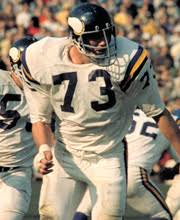
Yary was the first overall pick of the 1968 NFL draft by the Minnesota Vikings, who had traded Fran Tarkenton to the New York Giants for that selection, becoming the first offensive lineman ever to be selected first overall. He played from 1968 to 1981 with the Minnesota Vikings, and 1982 with the Los Angeles Rams. During Yary's tenure with the Vikings, the team won 11 division titles. During that period, Minnesota won the 1969 NFL championship and NFC titles in 1973, 1974 and 1976, and played in Super Bowls IV, VIII, IX and XI where Yary was one of 11 Players to have played in all four games for the Vikings. Yary was named All-Pro 6 consecutive seasons (1971–76) and 2nd Team All-Pro in 1970 and 1977 and was an All-NFC choice from 1970 through 1977. He played in seven consecutive Pro Bowls, and was a major force in a Minnesota team that was highly successful throughout the 1970s. In addition to his All-pro honors, Yary was voted the NFC Offensive Lineman of the Year three times (1973–75) by the NFLPA and was named the NFL Outstanding Blocker of the Year by the 1,000 yard Club for 1975.

Yary won the starting right tackle job (military duty forced him to miss first three games) on the Vikings offensive line in his second season and remained as a fixture at that spot throughout his Minnesota tenure. He was voted to the 1970s All-Decade First Team after the 1979 season.

Yary was also durable and played in spite of injuries. He missed only two games due to injuries—both coming in 1980 with a broken ankle—in 14 years in Minnesota. Later that same year, he continued to play in spite of a broken foot. He was inducted to the Vikings Ring of Honor in 2000. He became a member of the Pro Football Hall of Fame in 2001. He was the last offensive lineman to ever be drafted first overall until Orlando Pace was selected by Rams in 1997.

Yary is married to his wife Jamie and has two sons, Jack and Grant and a daughter, Kinley. Yary resides in Murrieta, California, and once co-owned a sports photography business with his brother Wayne, who bought Ron out in 2001. His son Jack was a tight end for Murrieta Valley High School, and was committed to play at University of Washington before dropping out of the program.

Sources
https://www.pro-football-reference.com/
https://www.profootballarchives.com/index.html
https://americanfootballdatabase.fandom.com/wiki/Football_Wiki
https://www.gridiron-uniforms.com/GUD/controller/controller.php?action=main
https://www.profootballhof.com/hall-of-famers/
 PFBHOF.com
 Infoplease.com
 "nfoplease.com". Archived from the original on May 25, 2011. Retrieved March 24, 2009.
 "FWAA website". Archived from the original on January 2, 2009. Retrieved April 20, 2007.
 "Ron Yary through the years". NFL.com. May 28, 2013. Retrieved August 24, 2025.
 Craig, Mark (May 12, 2007). "So long, SoCal? Yary wants back in the Twin Cities". Star Tribune. Archived from the original on May 15, 2007. Retrieved May 13, 2007.

Tuesday, September 17, 2024

The Story And Significance Of Lynn Swann - Recorded A Super Bowl Record At The Time With 161 Receiving Yards In Super Bowl X

Lynn Curtis Swann is an American former professional football player, broadcaster, politician, and athletic director, best known for his association with the University of Southern California and the Pittsburgh Steelers. He served on the President's Council on Fitness, Sports, and Nutrition from 2002 to 2005. In 2006, he was the Republican nominee for Governor of Pennsylvania.

Swann was born in Alcoa, Tennessee. He attended USC and played football as a wide receiver of the USC Trojans, where he was a consensus All-American. He is regarded as one of the most popular and one of the greatest wide receivers of his generation. He was selected by the Steelers in the first round of the 1974 NFL draft. With the Steelers, Swann won four Super Bowls, was selected to three Pro Bowls, and was named MVP of Super Bowl X. Swann was inducted into the Pro Football Hall of Fame in 2001 and the College Football Hall of Fame in 1993.

Swann was selected in the first round of the 1974 NFL draft by the Pittsburgh Steelers with the 21st overall pick. The Steelers draft class of '74 is considered one of the best in NFL history and includes four Hall of Famers: Swann, Jack Lambert (RD2), John Stallworth (RD4), and Mike Webster (RD5). Undrafted 1974 free agent signee Donnie Shell is also a hall of famer.

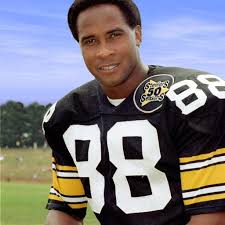
Swann spent his entire NFL career with the Steelers and wore the jersey number 88. As a rookie in 1974, he led the NFL with 577 punt-return yards, a franchise record and the fourth-most in NFL history at the time. He went on to win a championship ring with the Steelers in Super Bowl IX, but did not record any receptions in the tough defensive struggle (Pittsburgh quarterback Terry Bradshaw completed only nine passes in the game). However, he returned three punts for 34 yards.

The following season became the highlight of Swann's career. He caught 49 passes for 781 yards and a league-leading 11 touchdowns. In the AFC title game against the Oakland Raiders, George Atkinson knocked Swann out of the game with a very hard but legal hit. He suffered a severe concussion that forced him to spend two days in a hospital, but surprised many by returning to play for Super Bowl X. Swann recorded four catches for a Super Bowl-record 161 yards and a touchdown in the game, assisting the Steelers to a 21–17 win over the Dallas Cowboys and became the first wide receiver to earn Super Bowl MVP honors.

Three seasons later, in 1978, the Steelers made it to Super Bowl XIII. In the game, Swann caught seven passes for 124 yards and scored the final touchdown for Pittsburgh in their 35–31 win over Dallas.

The Steelers made it back to the Super Bowl again in the 1979 season, and Swann caught five passes for 79 yards and a touchdown at the Rose Bowl in Pittsburgh's 31–19 win over the Los Angeles Rams in Super Bowl XIV. Overall, Swann gained 364 receiving yards and 398 all-purpose yards in his four Super Bowls, which were both Super Bowl records at the time.

Swann retired after the 1982 season with four Super Bowl rings. In his nine-year career, he amassed 336 career receptions for 5,462 yards and 51 touchdowns, 72 rushing yards on 11 attempts and a touchdown, and 739 punt return yards and a touchdown. He was a Pro Bowl selection three times (1975, 1977, 1978), and was selected to the 1970s All-Decade Team.

Swann was unique among football players in that he credited his experiences in dance earlier in life with contributing to his aptitude on the football field. A 1981 interview which aired on Mr. Rogers' Neighborhood showed him on the field, and then in the Pittsburgh dance studio where he later underwrote scholarships.

Swann was named to the All-Pro team in 1975, 1977, and 1978, and was elected to the Pro Football Hall of Fame in 2001, a year before his teammate John Stallworth.

Swann went on to serve as a director on the boards of H J Heinz Co., Hershey Entertainment and Resorts, and Wyndham International. He was a football and sports broadcaster for ABC Sports from 1976 to 2006, but left to run for Pennsylvania governor.

Swann briefly hosted the television game show To Tell the Truth, on which he had previously appeared as a panelist before replacing original host Gordon Elliott, on NBC from 1990 to 1991. His 14-week run as emcee ended, and he was replaced by Alex Trebek. He made guest appearances on Mister Rogers' Neighborhood, where he explained his enthusiasm for ballet, and The Paper Chase.

During his time at ABC, Lynn Swann began his broadcasting career in 1976 while still active with the Pittsburgh Steelers. Upon retirement in January 1983, Swann began his career full-time with ABC Sports, which ended after the 2006 Sugar Bowl. Swann has broadcast a variety of events as a host, reporter, and analyst.

Swann was the sideline reporter on CBS' "Clash of Champions" bowling telecast that aired on May 10–11, 2008. He teamed with color analyst Nelson Burton Jr. and play-by-play man Bill Macatee. The broadcast marked bowling's return to network television for the first time since 1999 when CBS carried it.

In October 2009, Swann joined the Augusta National Golf Club. He is a dues-paying member of the home of the Masters golf tournament, which is held every April.

On August 19, 2010, the Pittsburgh Tribune-Review reported that Swann would be a part of the ownership team for Pittsburgh's AFL expansion franchise, which began playing in the spring of 2011.[8] Named the Pittsburgh Power, the team shared the Consol Energy Center with the Pittsburgh Penguins of the National Hockey League. Swann has said that, despite his football experience, he does not interfere in the day-to-day coaching, although he would occasionally give some advice. The team folded in 2014.

Swann made an appearance, playing himself, in the role of a sideline reporter at the "Bourbon Bowl", in the 1998 Adam Sandler comedy feature film The Waterboy. He was inducted into the Rose Bowl Hall of Fame on December 30, 2013, at the Pasadena Convention Center.

On April 13, 2016, Swann was named as the athletic director of the University of Southern California, succeeding retiring Pat Haden. He assumed the position on July 1, 2016. On September 9, 2019, Swann resigned as the USC AD.

On June 20, 2002, President George W. Bush appointed Swann as the chairman of the United States President's Council on Physical Fitness and Sports during a Fitness Expo at the White House. Swann succeeded Lee Haney, who had been appointed to the post by President Clinton.

In 2003, President Bush and Chairman Lynn Swann launched presidentschallenge.org at the Lakewest Family YMCA in Dallas, Texas. Within the next year, 300,000 individuals registered on the website. Swann spoke at the National Press Club about the council's programs to help Americans "Be Physically Active Every Day," and introduced the Presidential Active Lifestyle Award.

In 2004, Swann and President Bush declared May as an annual "National Physical Fitness and Sports" month, and created the annual HealthierUS Fitness Festival. They also enacted the Healthier Feds Physical Activity Challenge initiative for federal employees. On July 30, 2005, Lynn Swann retired as council chairman to explore a campaign for governor. He was succeeded by John P. Burke.

In December 2004, Swann, who resides in the Pittsburgh suburb of Sewickley Heights, Pennsylvania, indicated that he was considering seeking the Republican nomination for Governor of Pennsylvania in the 2006 election. On February 23, 2005, Swann filed papers with the state elections board stating his intention to run. On the same day, he formed a fundraising committee called Team 88 after his Steeler jersey number. On January 4, 2006, Swann formally declared his candidacy.

Swann's opponents for the Republican primary had initially included Jim Panyard, State Senator Jeff Piccola and former Lieutenant Governor William Scranton, III. After Swann received the endorsement of the Republican state committee on February 11, all three opponents quit the race, leaving Swann as the only Republican to have filed by the deadline of March 7. Swann chose Montgomery County Commissioner Jim Matthews as his running mate.

Polls in early February showed Swann and Ed Rendell in a statistical tie, though Rendell had the advantage of being the popular incumbent. Swann's campaign focused on reforming Harrisburg by addressing mass transit, property tax, law enforcement, the environment and the growing concern of obesity. He also supported giving the Pittsburgh Penguins Pittsburgh's lone slots license so they could build a new arena, free of taxpayer money.

Swann's momentum did not survive a barrage of advertising from Rendell in early spring, and had trouble keeping up with Rendell's effective fundraising. In the end, Swann lost the election with 40% of the vote to Rendell's 60%. Had Swann won, he would have been the first African American Governor of Pennsylvania and only the third African American elected governor of a state in U.S. history. Of the three Republican African American gubernatorial candidates in 2006, all three of them lost; Kenneth Blackwell lost in Ohio, and Randy Daniels lost in New York.

In 2008, Swann confirmed that he was considering running for the United States House of Representatives from Pennsylvania's 4th congressional district against Rep. Jason Altmire. However, Swann did not file for the election and former congresswoman Melissa Hart won the Republican nomination unopposed and then lost to Altmire in the 2008 general election.

In the 2008 presidential election, Swann endorsed and campaigned with Arizona Senator John McCain for the presidency, though Swann had remained neutral through the primaries. In 2012, he did the same for former Massachusetts Governor Mitt Romney, once Romney had become the presumptive Republican nominee.

In 2015, before the primary elections, Swann announced his support of former Florida Governor Jeb Bush, while also criticizing Donald Trump.

On June 10, 1979, during the summer after winning Super Bowl XIII, Swann married Bernadette Robi, the daughter of singer Paul Robi of The Platters. The pair divorced in 1983.

On June 23, 1991, Swann married Charena (née Shaffer), a psychologist, and they have two sons who played football collegiately.

Sources
https://www.pro-football-reference.com/
https://www.profootballarchives.com/index.html
https://americanfootballdatabase.fandom.com/wiki/Football_Wiki
https://www.gridiron-uniforms.com/GUD/controller/controller.php?action=main
https://www.profootballhof.com/hall-of-famers/
 Worden, Amy (October 29, 2006). "Lynn Swann: With star power and a storied life of successes, he makes first electoral bid". The Philadelphia Inquirer. Archived from the original on January 11, 2007. Retrieved December 16, 2019.
 Clark, Joe (October 5, 2024). "How Lynn Swann Inspired A Disney Movie". Steelers Depot. Retrieved March 4, 2025.
 "CIF State Track and Field Championships 1970". ca.milesplit.com. Archived from the original on October 2, 2022. Retrieved October 2, 2022.
 Lynn Swann at the College Football Hall of Fame
 "1974 NFL Draft Listing". Pro Football Reference. Retrieved October 31, 2024.
 Labriola, Bob (April 24, 2024). "Steelers' 1974 draft class still the gold standard". Steelers.com. Retrieved October 31, 2024.
 "1974 NFL Kick & Punt Returns". Pro Football Reference. Retrieved October 31, 2024.
 "1974 NFL All-Rookie Team". Pro Football Reference. Retrieved October 31, 2024.
 "Super Bowl IX - Pittsburgh Steelers vs. Minnesota Vikings - January 12th, 1975". Pro Football Reference. Retrieved October 31, 2024.
 "Lynn Swann 1975 Game Log". Pro Football Reference. Retrieved October 31, 2024.
 "1975 NFL Receiving". Pro Football Reference. Retrieved October 31, 2024.
 "Super Bowl X - Dallas Cowboys vs. Pittsburgh Steelers - January 18th, 1976". Pro Football Reference. Retrieved October 31, 2024.
 "Super Bowl Most Valuable Player Winners". Pro Football Reference. Retrieved October 31, 2024.
 "Super Bowl XIII - Pittsburgh Steelers vs. Dallas Cowboys - January 21st, 1979". Pro Football Reference. Retrieved October 31, 2024.
 "Super Bowl XIV - Los Angeles Rams vs. Pittsburgh Steelers - January 20th, 1980". Pro Football Reference. Retrieved October 31, 2024.
 "1975 NFL Pro Bowlers". Pro Football Reference. Retrieved October 31, 2024.
 "1977 NFL Pro Bowlers". Pro Football Reference. Retrieved October 31, 2024.
 "1978 NFL Pro Bowlers". Pro Football Reference. Retrieved October 31, 2024.
 "Pro Football Hall of Fame All-Decade Teams - 1970s". Pro Football Reference. Retrieved October 31, 2024.
 "Mister Rogers' Neighborhood Volume 2: Amazon Digital Services LLC". Amazon. Archived from the original on February 18, 2017. Retrieved March 18, 2017.
 "1978 NFL All-Pros". Pro Football Reference. Retrieved October 31, 2024.
 "Lynn Swann Stats". NFL site. NFL Player. Archived from the original on June 19, 2018. Retrieved June 18, 2018.
 "1484: Competition". IMDB. Archived from the original on February 9, 2017. Retrieved September 30, 2017. Mister Rogers visits a dance studio where football great Lynn Swann shows his football uniform and how he dances ballet.
 "The Paper Chase, Season 2, Episode 19: "Billy Pierce" (YouTube)". YouTube. Archived from the original on April 24, 2021. Retrieved November 15, 2017.
 "Arena Football League coming to Pittsburgh". Pittsburgh Tribune-Review. August 19, 2010. Archived from the original on August 22, 2010. Retrieved August 19, 2010.
 Ward, Hines (March 2, 2012). "Interview: Lynn Swann, Owner Pittsburgh Power, Steelers Wide Receiver, 1974–1982". Pittsburgh Sports Daily Bulletin. Archived from the original on October 20, 2015. Retrieved July 23, 2012.
 "Lynn Swann Named New USC Athletic Director - University of Southern California Official Athletic Site". Usctrojans.com. Archived from the original on February 26, 2017. Retrieved March 18, 2017.
 Bonagura, Kyle (September 9, 2019). "Swann resigns after 3-year stint as Trojans' AD". ESPN. Archived from the original on December 5, 2019. Retrieved April 3, 2020.
 "USC athletic director Lynn Swann resigns after three seasons with Trojans, effective immediately". CBS News. September 9, 2019. Archived from the original on September 15, 2019. Retrieved September 9, 2019.
 Jet. Johnson Publishing Company. July 22, 2002. p. 46. Retrieved March 18, 2017 – via Internet Archive. Lynn Swann George Bush.
 "Lynn Swann Announces Pa. Gubernatorial Bid". Fox News. January 5, 2006. Archived from the original on April 14, 2008. Retrieved January 10, 2009.
 "Rendell, Swann in dead heat - Pittsburgh Tribune-Review". Archived from the original on April 8, 2008.
 "50 State Governor 05/06 Sort By State". SurveyUSA. Archived from the original on March 3, 2016. Retrieved March 18, 2017.
 Barnes, Tom; Roddy, Dennis B. (November 8, 2006). "Rendell cruises to 2nd term as governor". Pittsburgh Post-Gazette. Archived from the original on June 29, 2011. Retrieved December 13, 2016.
 "88 in '08?". Pittsburgh Post-Gazette. April 12, 2007. Archived from the original on November 16, 2018. Retrieved February 24, 2021.
 "Voting & Elections". Pennsylvania Department of State. Archived from the original on April 22, 2021. Retrieved April 24, 2021.
 "Lynn Swann endorses Mitt Romney - Olympians and other athletes playing politics - Pictures". CBS News. July 27, 2012. Archived from the original on November 1, 2018. Retrieved March 18, 2017.
 "Former NFL player Lynn Swann endorses Jeb Bush for president". CBS News. October 1, 2015. Archived from the original on June 20, 2016. Retrieved March 18, 2017.
 "Interview With USC Athletics Director Lynn Swann - Football Matters". Archived from the original on March 1, 2017. Retrieved February 28, 2017.