Pro Football Historian (PFH) is a blog page written by Flint Given. Pro Football Historian or PFH is a page to inform people on prior NFL events that people might not know about. Learning about teams from the 1920s or even the first few NFL World Championships in the 1930s fascinates me. It's these kinds of events that I want to discuss in this blog. Hopefully you are interested and will continue to check up on my blogs. Check out the website at https://profootballhistorian.lovable.app/
Bruce Rankin Matthews is an American former professional football player who played as a guard, center, offensive tackle, and long snapper in the National Football League for 19 seasons, from 1983 to 2001. He spent his entire career playing for the Houston / Tennessee Oilers / Titans franchise. Highly versatile, Matthews played every position on the offensive line throughout his NFL career, starting in 99 games as a left guard, 87 as a center, 67 as a right guard, 22 as a right tackle, 17 as a left tackle, and was the long snapper on field goals, PATs, and punts. Having never missed a game due to injury, Matthews' 293 NFL games started is the third most of all time, behind quarterbacks Brett Favre and Tom Brady.
Matthews played college football for the University of Southern California, where he was recognized as a consensus All-American for the USC Trojans football team as a senior. Matthews was selected in the first round of the 1983 NFL draft by the Oilers and was a 14-time Pro Bowl selection, tied for the second-most in NFL history, and a nine-time first-team All-Pro. Matthews was inducted into the Pro Football Hall of Fame in 2007, and his number 74 jersey is retired by the Titans.
After retiring as a player, Matthews served as an assistant coach for the Houston Texans and Titans. A member of the Matthews family of football players, he is the brother of linebacker Clay Matthews Jr.; father of center Kevin Matthews and tackle Jake Matthews; and uncle of linebacker Clay Matthews III and linebacker Casey Matthews.
Matthews is considered to be one of the most versatile offensive linemen to play in the NFL. He started in 99 games as a left guard, 67 as a right guard, 87 as a center, 22 as a right tackle, 17 as a left tackle, and was the snapper on field goals, PATs, and punts. Matthews was selected to 14 Pro Bowls, which at the time tied a league record set by Merlin Olsen. Matthews was also named a first-team All-Pro nine times and an All-American Football Conference selection 12 times. An extremely durable player, Matthews retired after the 2001 season having played more games (296) than any NFL player, excluding kickers and punters, and played in more seasons (19) than any offensive lineman. He never missed a game due to injury, and started 229 consecutive games. Matthews is the only player who played against the Baltimore Colts in their last game at Memorial Stadium in 1983 and against the Baltimore Ravens in their last game at Memorial Stadium in 1997.
The Houston Oilers drafted Matthews with the ninth overall pick in the first round of the 1983 NFL draft. During his first two seasons, Matthews blocked for future Hall of Fame running back Earl Campbell. As a rookie, Matthews played guard and was named to the PFWA All-Rookie Team. Before his second season, Matthews was moved from right guard to center, snapping to rookie quarterback Warren Moon. However, Matthews played multiple positions that season due to injuries on the offensive line; at one point he played center, guard, and tackle in successive weeks. In 1985 and 1986, Matthews alternated between right and left tackle.
Matthews sat out of the first eight games of the 1987 season due to a contract dispute. When he returned, Matthews was moved back to right guard. He remained at the right guard position in 1988, 1989, and 1990, being named to the Pro Bowl each season. Matthews also earned first-team All-Pro recognition each year from the Associated Press (AP), Pro Football Weekly, and The Sporting News. He thrived in the run and shoot offensive scheme adopted by the Oilers around this time, which required linemen to be exceptionally agile. The holes Matthews opened up helped running back Mike Rozier to consecutive Pro Bowls in 1987 and 1988.
The Oilers placed Matthews at center for the final game of the 1990 season in an effort to bolster the team's running game. Of the move, Matthews said, "I'd like to stay at guard, but forces greater than myself make these adjustments." Behind blocking by Matthews and fellow future Hall of Fame guard Mike Munchak, Oilers quarterback Warren Moon led the league in passing yards in 1990 and 1991, and running back Lorenzo White was a 1992 Pro Bowl selection. Matthews remained the team's center through the 1994 season, being named to the Pro Bowl each year.
Prior to the 1995 season, Matthews signed a four-year, $10.3 million contract extension with the Oilers. That year, the Oilers signed free agent center Mark Stepnoski, and as a result, Matthews moved to left guard. He spent the majority of the rest of his career at the position, occasionally filling in for injured players along the offensive line. During this time, the Oilers left Houston for Tennessee after the 1996 season. Matthews' blocking helped running back Eddie George to four straight Pro Bowl seasons.
In 1999, at age 37, Matthews signed another four-year contract to remain with the Oilers. That season, the Oilers rebranded as the Tennessee Titans. The team won 13 games, plus three more in the playoffs before losing to the St. Louis Rams in Super Bowl XXXIV.
Matthews retired from football prior to the 2002 season at the age of 40.
On February 27, 2009, Matthews returned to Houston where he was signed on as an offensive assistant with the Houston Texans after volunteer coaching at his children's high school, Elkins High School.
On February 9, 2011, Matthews was hired as offensive line coach by new Tennessee Titans head coach Mike Munchak. Both were Hall of Fame linemen for the Houston Oilers. Regarding his new job, Matthews stated, "For me this is an opportunity of a lifetime. It is such a unique opportunity to work with Mike because I think he will do a great job. It is just one of those things I couldn't pass up."
After the Titans finished the 2013 season with a 7–9 record, general manager Ruston Webster and president/CEO Tommy Smith met with Munchak and gave him the option to fire a large contingent of assistant coaches, which included Matthews, in exchange for an extension and a raise, or lose his job as head coach. Munchak was not willing to fire everyone they were ordering him to fire, so Munchak parted ways with the Titans, along with Matthews and the other assistant coaches they wanted him to fire.
In his first year of eligibility, Matthews was elected to the Pro Football Hall of Fame as part of the class of 2007. He was inducted during the Enshrinement Ceremony on August 4, 2007, with the unveiling of his bust, sculpted by Scott Myers. Matthews was the first player from the Tennessee Titans to be given this honor since the relocation from Houston. He was the fifth player from the 1983 NFL draft class to be enshrined, joining Dan Marino, Eric Dickerson, John Elway, and Jim Kelly; Darrell Green, Richard Dent, and Jim Covert later became the sixth, seventh, and eighth members. Matthews was selected as a guard on the NFL's All-Decade Team of the 1990s. In 2010, he was ranked 78th on The Top 100: NFL's Greatest Players by the NFL Network. At the 2020 Super Bowl, Matthews was named to the NFL 100 All-Time Team as one of the top 100 players of the first 100 years of the NFL.
Matthews comes from a football family. A devout Christian as evidenced in his Hall of Fame Speech, Matthews is the son of Clay Matthews Sr., who played in the NFL in the 1950s. His brother, Clay Jr., also played 19 seasons in the NFL. Bruce is the uncle of linebacker Clay Matthews III, former NFL linebacker Casey Matthews, and Kyle Matthews of USC football. Bruce and his wife, Carrie, have seven kids: Steven, Kevin, Marilyn, Jake, Mike, Luke, and Gwen. Kevin Matthews played center for Texas A&M until the 2009 football season and then played in the NFL for five years as a member of the Titans and Carolina Panthers. Jake Matthews played offensive tackle for Texas A&M and is currently the starting left tackle of the Atlanta Falcons. Mike Matthews played on the offensive line for Texas A&M, where he was the starting center. His youngest son, Luke, is currently a senior at Texas A&M. Matthews is also the uncle of tight end Troy Niklas by way of his wife's sister.
Branch, John (January 14, 2011). "For Matthews Clan, N.F.L. Is All in the Family". The New York Times. Retrieved November 27, 2017.
"Gittens CIF Player of Year; Millikan's Caldarella honored". Independent. December 23, 1977. p. 32. Retrieved November 28, 2017 – via Newspapers.com.
"Jacson, Bennett get Shrine team starts". The San Bernardino County Sun. May 3, 1979. p. 87. Retrieved November 28, 2017 – via Newspapers.com.
Dwyre, Bill (February 3, 2007). "Bottom line: Matthews deserves nod". Los Angeles Times. Retrieved November 28, 2017.
"USC notes". The San Bernardino County Sun. April 29, 1982. p. 79. Retrieved November 27, 2017 – via Newspapers.com.
Scarborough, Alex; Gemmell, Kevin (August 30, 2016). "College football royalty collides: The all-time best Tide and Trojans lineups". ESPN.com. Retrieved November 28, 2017.
Wilner, Barry (August 2, 2007). "Versatile Bruce Matthews was hard to ignore as Oiler and Titan". NFL.com. Associated Press. Archived from the original on December 1, 2017. Retrieved November 29, 2017.
Walker, Teresa M. (December 5, 1999). "Ironman". Los Angeles Times. Associated Press. Retrieved November 29, 2017.
"Bruce Matthews Bio". Pro Football Hall of Fame. Retrieved December 2, 2017.
"Bruce Matthews's Career Highlights". Pro Football Hall of Fame. Retrieved December 2, 2017.
Ginsburg, David (December 14, 1997). "Oilers help close out another Baltimore era". The Capital. Associated Press. p. 48. Retrieved December 1, 2017 – via Newspapers.com.
"Dickerson voted top NFL rookie". Santa Cruz Sentinel. Associated Press. January 22, 1984. p. 50. Retrieved November 28, 2017 – via Newspapers.com.
"Oilers try Matthews at center". The Galveston Daily News. Associated Press. April 13, 1984. p. 19. Retrieved November 28, 2017 – via Newspapers.com.
"Injuries have slowed progress of Oiler offensive line". The Galveston Daily News. Associated Press. July 28, 1985. p. 30. Retrieved November 28, 2017 – via Newspapers.com.
"Bruce Matthews Stats". Pro-Football-Reference.com. Sports Reference. Retrieved December 1, 2017.
"Moon has become leader". The Galveston Daily News. Associated Press. December 20, 1987. p. 28. Retrieved November 28, 2017 – via Newspapers.com.
Burke, Chris (March 23, 2012). "Best of the Firsts, No. 9: Bruce Matthews". Sports Illustrated. Retrieved December 2, 2017.
"Veteran OL Bruce Matthews to retire". United Press International. July 15, 2002. Retrieved December 2, 2017.
"Oilers replace 4 players". Del Rio News Herald. Associated Press. December 28, 1990. p. 8. Retrieved December 2, 2017 – via Newspapers.com.
Boclair, David (April 29, 2016). "Titans continue to bolster offensive line". Nashville Post. Retrieved December 2, 2017.
"Oilers, All-Pro center agree to $10.3 million deal". Santa Cruz Sentinel. Associated Press. July 31, 1995. p. 16. Retrieved December 2, 2017 – via Newspapers.com.
"Oilers offensive line taking shape". The Brazosport Facts. Associated Press. August 9, 1995. p. 11. Retrieved December 2, 2017 – via Newspapers.com.
Shapiro, Leonard (January 27, 2000). "For Titans' Matthews, a Long Time Coming". The Washington Post. Retrieved December 9, 2017.
"Plus: Pro Football – Tennessee; Veteran Oiler Remains as a Titan". The New York Times. Associated Press. May 19, 1999. Retrieved December 2, 2017.
Freeman, Mike (January 31, 2000). "Superbowl XXXIV; Rams Win Super Bowl Thriller, as Titans Fall a Yard Short". The New York Times. Retrieved December 9, 2017.
"ESPN.com: NFL - Matthews announces retirement after 19 seasons". www.espn.com. Retrieved July 28, 2025.
"Titans Name Matthews Offensive Line Coach". Tennessee Titans. February 9, 2011. Retrieved November 27, 2017.
Kuharsky, Paul (January 6, 2014). "Munchak: Firing wasn't over two assistants". ESPN.com. Retrieved November 27, 2017.
Weisman, Larry (April 17, 2007). "Greatest draft ever? Class of 1983 has Hall of a résumé". USA Today. Retrieved November 27, 2017.
"NFL's All-Decade Team of the 1990s". Pro Football Hall of Fame. Retrieved December 9, 2017.
"Official All-Time Team Roster". NFL.COM. Retrieved July 12, 2021.
McClain, John (August 10, 2008). "NFL Notebook: Touchdown Club to honor Matthews". Houston Chronicle. Retrieved November 27, 2017.
Galatzan, Matt (April 5, 2022). "Jimbo Fisher: Aggies OL Luke Matthews 'Medically Done'". Sports Illustrated. Retrieved August 23, 2025.
"Luke Matthews". matthews.com. April 21, 2025. Retrieved August 23, 2025.
Feldman, Bruce (July 14, 2015). "The next Matthews brother is 15 and already 6-foot-4, 320 pounds". Fox Sports. Retrieved November 30, 2017.
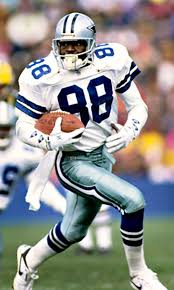
Michael Jerome Irvin is an American sports commentator and former professional football player. He played his entire 12-year career as a wide receiver for the Dallas Cowboys of the National Football League. In 2007, he was inducted into the Pro Football Hall of Fame.
Irvin played college football for the Miami Hurricanes and was selected in the first round of the 1988 NFL draft by the Dallas Cowboys. He spent his entire 12-year NFL career from 1988 to 1999 with the Cowboys before it ended abruptly from a cervical fracture of his spine sustained in a game against the Philadelphia Eagles at Veterans Stadium on October 10, 1999, in which Irvin was carted off the field and transported to a Philadelphia hospital.
Irvin was nicknamed "The Playmaker" due to his penchant for making big plays in big games during his college and pro careers, and he relished the nickname, even acquiring "PLY MKR" as his Texas vanity license plate. Along with Troy Aikman and Emmitt Smith, Irvin was one of three key Cowboys offensive players, known as "The Triplets", who led the Cowboys to three Super Bowl wins in 1992, 1993, and 1995.
Irvin is widely considered to be one of the greatest wide receivers of all time.
Irvin is a former broadcaster for ESPN's Sunday NFL Countdown and currently an analyst for NFL Network. In 2009, he competed in Season 9 of Dancing with the Stars in which he was the season's ninth contestant to be eliminated.
He is one of the co-hosts of the FS1 weekday debate show Speak with Paul Pierce, Keyshawn Johnson, and Joy Taylor.
Irvin was selected by the Dallas Cowboys as the 11th pick in the first round of the 1988 NFL draft. He was the last first-round draft pick made by the Cowboys under the leadership of long-time general manager Tex Schramm, player personnel director Gil Brandt, and head coach Tom Landry. Schramm predicted that Irvin would accelerate the Cowboys' "return to the living".
As a rookie in the 1988 season, Irvin became the first rookie receiver in Cowboys' history to start a season opener in 20 years. In the opening game of his rookie season against the Pittsburgh Steelers at Three Rivers Stadium on September 3, 1988, Irvin caught his first NFL career touchdown. He also caught three touchdown passes in the Cowboys' win over the Washington Redskins on December 11, 1988, at RFK Stadium, which represented one of only three wins in the Cowboys' 3-13 1988 season, which was the final season of Landry's career. For the season, Irvin led the NFC in average yards per catch with a 20.4 yard average per catch.
In 1989, the Cowboys hired Jimmy Johnson, Irvin's coach at the University of Miami, to replace Landry. The Cowboys' misfortunes continued in 1989, and they finished the season with a 1–15 record, the worst season record in Cowboys franchise history. Injuries limited Irvin to only six games during the season. He had been on pace to gain over 1,000 receiving yards until tearing his anterior cruciate ligament in his right knee in a game against the San Francisco 49ers on October 15, 1989, after which he was placed on the injured reserve list for the rest of the 1989 season and the first three games of the 1990 season.
In 1990, Irvin did not register his first reception until the seventh game and finished the season with just 20 receptions for 413 yards, but he also averaged 20.7 yards per catch.
Before the injury, Irvin was nearly traded to the Los Angeles Raiders to help bring talent to the Cowboys and potentially pair Irvin up with Tim Brown, but Raiders owner Al Davis essentially talked Johnson out of the trade by saying, "You sure you want to do that? Who is going to catch passes for you?" Johnson instead traded Herschel Walker to the Minnesota Vikings in what would come to be known as the Herschel Walker trade. One factor in Irvin almost being traded was that then-offensive coordinator David Shula thought Irvin was slow and not a team player. When the Cowboys fired Shula and replaced him with Norv Turner, the notion of trading Irvin became nonexistent in part because Turner believed Irvin would become a superstar in his system.
In 1991, Irvin was a major factor in the Cowboys reaching the playoffs. He finished the season with 93 receptions (second in the NFL for the season), 1,523 receiving yards (first in the NFL for the season), eight receiving touchdowns, and set a Cowboys franchise record with seven 100-yard games. Irvin was named to the 1991 Pro Bowl, the first of five consecutive seasons in which he was selected to Pro Bowls.
In 1992 and 1993, Irvin was a key player on the Cowboys' Super Bowl teams. In 1994, he enjoyed another stellar campaign with his fourth consecutive Pro Bowl season, but that year the Cowboys lost to the San Francisco 49ers in the NFC Championship Game. For his part, however, Irvin had one of the most productive games in NFL playoff history, with 12 catches for an NFC championship record 192 yards and two touchdowns.
One of his greatest performances was in Super Bowl XXVII (1993), where he caught six passes for 114 yards and two touchdowns. His two touchdowns catches were both in the second quarter and occurred in a span of just 18 seconds, the fastest pair of touchdowns ever scored by one player in Super Bowl history. He also became only the second player ever to score 2 touchdowns in one quarter of a Super Bowl, after Washington Redskins wide receiver Ricky Sanders in Super Bowl XXII.
Irvin was a key contributor in the Cowboys' victories in Super Bowl XXVIII in 1993 over the Buffalo Bills and Super Bowl XXX in 1995 over the Pittsburgh Steelers. In the 1993 Super Bowl against the Bills, Irvin recorded five receptions for 66 yards. In the 1995 Super Bowl against the Steelers, he had five receptions for 76 yards.
Irvin's best season with the Cowboys was 1995 during which he set franchise records for receptions (111) and receiving yards (1,603) while scoring 10 touchdowns and setting an NFL record with 11 games with over 100 receiving yards. Irvin had seven receptions for 100 yards and two touchdowns against the Green Bay Packers in the NFC Championship Game, which led the Cowboys to Super Bowl XXX, the team's third Super Bowl win in a span of four seasons.
Irvin is the only player to play for each of the first four Cowboys coaches since the team has been owned by Jerry Jones (Landry, Johnson, Barry Switzer, and Chan Gailey). Irvin officially announced his retirement after Dave Campo became the fifth Cowboys coach, but never played on the field for Campo.
After recovering from his collar bone injury, Irvin returned to have solid years in 1997 and 1998.
During the fifth game of the 1999 season, Irvin was tackled by Philadelphia Eagles defensive back Tim Hauck and was driven head-first into the turf at Veterans Stadium in Philadelphia. He sustained a non-life-threatening cervical spine injury, but was carted off the field and transported to the Thomas Jefferson University Hospital in Philadelphia. Irvin did not play again that season. He was subsequently diagnosed with cervical spinal stenosis. After being advised that he was at higher risk for injury if he suffered another blow to the neck or head, Irvin announced his retirement in May 2000.
Irvin was the last Tom Landry-coached player to retire from the NFL. Landry died on February 12, 2000, several months after Irvin's injury in Philadelphia but before Irvin had announced that he was retiring due to the severity of that injury.
In 2000, Irvin was inducted into the University of Miami Sports Hall of Fame.
Irvin finished his career with 750 receptions (tied with Charlie Joiner for 30th all-time in the NFL) for 11,904 yards (21st all-time in the NFL) and 65 touchdowns. His 47 100-yard receiving games is eighth-most in NFL history, tied with Torry Holt. Irvin was selected to five Pro Bowls (two more than any other wide receiver in franchise history) and was named the MVP of the 1992 Pro Bowl (following the 1991 season) after catching eight passes for 125 yards and a touchdown in the NFC's 21–15 triumph. Irvin was a key playmaker for the Dallas Cowboys that won 6 division titles and three Super Bowls.
As part of Dallas' starting lineup on offense, Irvin was a consistent force to be reckoned with in the regular season but also excelled in the playoffs, where his six career 100-yard receiving games are just two shy of the NFL record held by Jerry Rice, who had eight such games. Irvin's 87 postseason receptions place him second in NFL playoff history behind Rice, who had 151, and Irvin's 1,315 post-season receiving yards ranks second to Rice, who recorded 2,245 post-season yards.
From 1991 through 1998, Irvin recorded 1,000-yard seasons in all but one year, racking up an impressive 10,292 yards over an eight-year span. Along the way, the Cowboys made four straight appearances in the NFC Championship Game (1992–1995) and captured three Super Bowl championships with back-to-back wins over the Buffalo Bills in Super Bowl XXVII and Super Bowl XXVIII, and the Pittsburgh Steelers in Super Bowl XXX.
Along with his former Cowboy teammates Troy Aikman and Emmitt Smith, Irvin was inducted into the Dallas Cowboys Ring of Honor on September 19, 2005.
Irvin was one of three former NFL players with Cowboys ties selected for induction into the 2007 class of the Texas Sports Hall of Fame, all of whom were inducted at a February 2008 ceremony in Waco, Texas. The other two were Jim Ray Smith of the Cleveland Browns, who finished his career with the Cowboys (1963–64), and Ray Childress, a five-time Pro Bowl defensive end for the Houston Oilers who wrapped up his NFL career with the Cowboys in 1996.
In 2007, Irvin was named to the Florida High School Athletic Association's All-Century Team that listed the Top 33 football players in the state of Florida's 100-year history of high school football.
Irvin became eligible for induction to the Pro Football Hall of Fame in 2005. He was selected in his third year of eligibility, on February 3, 2007, alongside Gene Hickerson, Bruce Matthews, Thurman Thomas, Charlie Sanders, and Roger Wehrli. He was formally inducted into the Pro Football Hall of Fame during the Hall of Fame's August 4, 2007, induction ceremony in Canton, Ohio.
On August 4, 2007, Irvin was inducted into the Pro Football Hall of Fame, delivering a tearful acceptance speech in which he referenced both his life as a football player and the many mistakes he has made in his life. His speech has been praised by many NFL commentators as heartfelt, including those who had been inclined to dislike him.
On October 14, 2007, Irvin accepted his Hall of Fame ring at Texas Stadium during halftime of the Cowboys–New England Patriots game. In his speech, he proposed to Commissioner Roger Goodell that all drafted rookies will have a tour of the Pro Football Hall of Fame to better understand their football history.
At 6'2" and 207 pounds, Irvin was a big, physical receiver who manhandled cornerbacks and often was able to make tough catches in defensive traffic. In part because of Irvin's ability to push off the defender with such ease, the NFL eventually changed its rules to adjust to wide receivers who emulated Irvin's physical style.
Irvin was a vocal, emotional leader who set every significant career receiving mark in Cowboys history, including catches and receiving yards. At the time of his retirement, he owned or was tied for 20 team receiving records. In November 2008, his Cowboys teammate Daryl Johnston said, "Michael was the hardest working guy on our team. He was a guy who made some wrong decisions, but he never took anything public, and he never spoke out against anyone on our team. He wasn't a problem. He was more of an inspiration."
Irvin has high regard for players from "The U," as he likes to call the University of Miami, including Frank Gore, Edgerrin James, and others.
Irvin has been married to Sandy Harrell since 1990. They have one daughter and two sons together. Irvin also has another daughter from a previous relationship.
Irvin is a Christian. He has said, “I turned my life over to Christ in early 2001 with help from Pastor T.D. Jakes and my friend and fellow believer, Deion Sanders. It took me forty years to really realize the hand that God had on me. I did almost every bad thing you could do, but it's through the power of God I can live this life.”
In 1996, as the Cowboys prepared to play the Carolina Panthers in the NFC Divisional Playoff game, media reports stated that Irvin and teammate Erik Williams, while under the influence of cocaine, had sexually assaulted a Dallas Cheerleader, Nina Shahravan, and, with a gun to her head, videotaped the interaction.
Despite Williams' and Irvin's denials of the allegations, the story largely overshadowed the game, which the Cowboys lost. The accuser was later proven to have fabricated the entire incident. She recanted her story, pled guilty to perjury and filing a false police report, and was sentenced to 90 days in jail and a fine. In the game against Carolina, Irvin was injured in the opening minutes and did not return.
On July 29, 1998, Irvin allegedly assaulted fellow Cowboys offensive lineman Everett McIver. The initial dispute stemmed from Irvin demanding that McIver vacate a barber's chair so that Irvin would not have to wait for a haircut. McIver and Irvin soon began a brawl in the shop with fellow Cowboy Leon Lett attempting to break it up.
During the course of the dispute, Irvin grabbed a pair of scissors and stabbed McIver in the neck, barely missing his carotid artery. Cowboys owner Jerry Jones reportedly brokered a six-figure settlement between Irvin and McIver in exchange for McIver's silence and to prevent McIver from pursuing criminal charges against Irvin.
In June 2001, a year following his NFL retirement, Irvin was arrested for felony cocaine possession. Irvin was in a Dallas apartment with an unrelated woman, and neither answered the door when police drug task force agents arrived with a search warrant. Police then entered the apartment forcibly, finding drugs. Irvin and the woman were placed under arrest, though charges against Irvin were later dropped.
On November 25, 2005, Irvin was pulled over in Plano, Texas, for speeding. Irvin was arrested on an outstanding warrant for an unpaid speeding ticket in Irving, Texas, and was also cited for misdemeanor possession of drug paraphernalia after police searched his car and found a pipe and plastic bags with marijuana residue. Irvin was arrested for a Class C misdemeanor, and was later released on bond.
On December 1, 2005, in response to his arrest, ESPN suspended Irvin for the Sunday and Monday night Countdown shows on December 4 and 5, 2005. He returned to both shows with no mention or consequence of the past incident.
On July 4, 2007, Irvin was accused of sexual assault while he was at the Seminole Hard Rock Casino in Hollywood, Florida. Charges were never filed, but a civil suit was filed against him in 2010. Irvin filed a $100 million defamation countersuit, which was dropped when the case was settled out of court in January 2011.
On January 12, 2009, Irvin claimed he was a victim of a possible carjacking attempt while stopped at a light in Dallas. He filed a police report claiming that two men flashed a gun at him but eventually drove away after commenting that they were Cowboys fans. Dallas police suspended their investigation two weeks later, stating that Irvin did not cooperate in the investigation and that they could not proceed without his cooperation.
On March 22, 2017, Fort Lauderdale police investigated Irvin for allegedly sexually assaulting a woman in Florida. Irvin denied the allegations. On July 24, the Broward County State Attorney's Office announced they had closed the investigation and would not charge Irvin in the case.
NFL Network removed Irvin from its coverage of Super Bowl LVII in February 2023 after allegations of sexual misconduct toward a woman at his hotel in the Phoenix area. Though surveillance video showed him interacting with the woman, Irvin told a Dallas-Fort Worth radio station that he had no recollection of any incident because he had been inebriated. He also denied there was any wrongdoing.
In a November 2006 radio interview on Dan Patrick's radio show, Irvin joked that Dallas Cowboys quarterback Tony Romo's athletic ability may have been due to African-American heritage and jokingly remarked that Romo's maternal relatives might have been involved with "slave brothers". Irvin later apologized and said, "this is how I joke around with Romo when we're playing basketball. There's a difference from me the player and me the broadcaster".
On February 17, 2007, during the late edition of SportsCenter, ESPN announced that Irvin was no longer with the network. ESPN Communications Vice President Josh Krulewitz said, "We thank Michael for his contributions to ESPN and wish him well." However, eleven months later, in January 2008, Irvin rejoined ESPN as a host on ESPN Radio owned and operation station KESN (103.3 FM) in Dallas, hosting The Michael Irvin Show. This locally aired program ended on February 5, 2010, and Irvin was let go after his contract expired. An ESPN spokesman cited declining ratings and that news of a lawsuit filed against Irvin for a 2007 incident "simply expedited the situation".
On a February 2017 episode of The Rich Eisen Show, Irvin admitted to having snuck out of the locker room during the halftime of Super Bowl XXVII to watch Michael Jackson perform.
Irvin was a co-star in the 2005 remake of The Longest Yard, starring Adam Sandler and Chris Rock. Irvin also guest starred in Sandler's film Jack & Jill, which was released on November 11, 2011. He was one of the "Pros" on an episode of Pros vs. Joes, which pitted former professional athletes against average people. He was the host of 4th and Long, a football-themed reality series which aired on Spike TV. The winner, Jesse Holley, earned a spot at the Dallas Cowboys' training camp. Irvin had a supporting role in the 2017 basketball drama Slamma Jamma as a sleazy sports agent.
In 2011, Irvin spoke to Out magazine about his homosexual older brother, who died of stomach cancer in 2006. He claimed his initial feelings of homophobia in relation to his brother led to womanizing during his playing days but eventual acceptance and feelings of love toward his older brother initiated his understanding for people with difficulty sharing their circumstances.
In August 2011, officials from the Elite Football League of India announced that Irvin would be among the primary investors and advisers for the league. Other prominent backers included former Chicago Bears head coach Mike Ditka, former Philadelphia Eagles quarterback Ron Jaworski, and NFL linebacker Brandon Chillar.
In July 2023, management from Asset Entities announced that Irvin would be among the primary investors and advisers for the company. Other prominent backers included TRITON FUNDS.
"Sports figures and their license plates". Sports Illustrated. February 8, 2012.
"'Triplets' honored: Aikman, Emmitt, Irvin in Dallas' Ring". ESPN.com. September 20, 2005.
"Dancing With The Stars Season 9 Cast". Archived from the original on August 19, 2009. Retrieved August 17, 2009.
Eng, Joyce (August 17, 2009). "Dancing with the Stars 2009 Season 9 Cast Revealed!". TVGuide.com. Archived from the original on August 18, 2009. Retrieved August 17, 2009.
Zeigler, Sid. "Michael Irvin: The Playmaker Preaches". Out Magazine. Retrieved July 14, 2011.
"NEA 1985 All-America football team". Lead (SD) Daily Call. December 6, 1985. p. 7.
Murray Olderman (December 26, 1986). "Miami leads All-Americans". Del Rio, Texas News Herald. p. 5B.
George Robinson (November 22, 1987). "NEA/World Almanac Team: Here Are the 1987 All-Americans". Del Rio, Texas News-Herald. p. 3B.
"1988 NFL Draft Listing". Pro-Football-Reference.com. Retrieved September 23, 2023.
"Moment 24: The Triplets Enter The Ring Of Honor - CBS Texas". www.cbsnews.com. January 14, 2016. Retrieved September 25, 2023.
"Irvin Makes Retirement Official". CBS News. July 10, 2000.
"Report Says Irvin to Retire Because of Spinal Condition". Los Angeles Times. May 24, 2000. Retrieved December 25, 2024.
Horn, Barry (November 11, 2005). "Comment on Eagles another sign Irvin is go-to guy in a new field". The Dallas Morning News website. Retrieved November 28, 2008.
"Michael Irvin College Stats, School, Draft, Gamelog, Splits". College Football at Sports-Reference.com. Retrieved March 10, 2026.
"Cowboys' Pressure Sacks Seahawks". Dallascowboys.com. November 27, 2008. Archived from the original on March 6, 2008. Retrieved November 28, 2008.
"Michael Irvin: 2007 Hall of Fame enshrinement speech". ESPN. August 5, 2007. Retrieved November 28, 2008.
"Irvin's HOF project". NFL.com. Retrieved November 28, 2008.
Rasmussen, Karl (January 5, 2022). "Michael Irvin's Wife Has Been By His Side Over 30 Years". Retrieved October 7, 2023.
Romano, Jason (May 2, 2018). "Pro Football Hall of Famer Michael Irvin says he gave his life to Christ in 2001". Sports Spectrum. Retrieved October 7, 2023.
Sam Howe Verhovek (January 13, 1997). "A Woman's False Accusation Prompts Reflection". The New York Times. Retrieved November 19, 2014.
The Associated Press (August 10, 1998). "N.F.L.: ROUNDUP -- DALLAS; McIver Was Paid For Silence, Paper Says". The New York Times. Retrieved June 8, 2017.
"Irvin arrested on charge of cocaine possession". Espn.go.com. June 18, 2001. Retrieved March 11, 2009.
"Irvin: pipe belonged to friend, not brother". ESPN. November 19, 2005. Retrieved November 28, 2008.
"Irvin won't appear on ESPN shows this weekend". ESPN. December 1, 2005. Retrieved November 28, 2008.
"Broward prosecutors decline to charge Irvin in rape investigation". Miami Herald. February 24, 2010. Retrieved February 24, 2010.
"Report: Michael Irvin suit settled". ESPNDallas.com. January 28, 2011. Retrieved November 1, 2013.
"Michael Irvin: Would-Be Carjackers Recognized Me". NBC-DFW. January 12, 2009.
Police Halt Investigation on Irvin Case SI.com, January 29, 2009
Grautski, Amara (April 4, 2017). "Michael Irvin says surveillance footage will prove his innocence in sexual assault investigation: 'Nothing happened'". The New York Daily News. Retrieved April 5, 2017.
Trischitta, Linda (April 5, 2017). "In TV interview, Michael Irvin denies rape allegation, says he's a longtime, platonic friend of accuser". The Sun-Sentinel.
Spencer, Terry (July 24, 2017). "State attorney: No sex assault charges for Michael Irvin". ABC News. Associated Press. Retrieved August 4, 2017.
George, Brandon (July 24, 2017). "Michael Irvin won't be charged with sexual assault in Florida case". Dallas Morning News. Retrieved August 4, 2017.
"Michael Irvin won't be charged with sexual assault in Florida case". July 24, 2017.
"Irvin pulled from NFL Network's Super Bowl coverage". AP News. Associated Press. February 7, 2023.
"Michael Irvin's Tony Romo Comments, Revisited". Mondesishouse.blogspot.com. November 22, 2006. Retrieved November 28, 2008.
"Irvin on comments: 'Inappropriate and insensitive'". ESPN. November 28, 2006. Retrieved November 28, 2008.
Wilonksy, Robert (February 5, 2010). "Michael Irvin Out at ESPN's Dallas Radio Station. His Replacements: Ben and Skin". Unfair Park. Dallas Observer.
Horn, Barry (February 5, 2010). "Michael Irvin out ESPN 103.3; Ben & Skin are in". The Dallas Morning News. Archived from the original on February 8, 2010.
"Irvin left locker room at Super Bowl to watch MJ". NFL.com. February 1, 2017. Retrieved February 2, 2017.
Dehnart, Andy (January 22, 2009). "Michael Irvin-hosted Reality Competition Winner Will Join Dallas Cowboys Training Camp". reality blurred. Retrieved April 5, 2017.
"4th and Long Official Show Webpage". Spike. Archived from the original on February 23, 2011. Retrieved April 5, 2017.
"Topic Galleries". Chicago Tribune.[permanent dead link]
"American football coming to India?". Dawn. August 6, 2011. Retrieved April 5, 2017.
"Topic Galleries". Benzinga. Retrieved July 6, 2023.
"TRITON FUNDS agrees to Invest $1m". Dawn. July 6, 2023. Retrieved July 5, 2023.
Robert Gene Hickerson was an American professional football player who was an offensive guard for 15 years with the Cleveland Browns of the National Football League from 1958 to 1960 and 1962 to 1973. Hickerson was a six-time Pro Bowler from 1965 to 1970. He was inducted to the Pro Football Hall of Fame on August 4, 2007.
Gene was drafted in the seventh round of the 1957 NFL draft by the Browns. He was promptly shifted from tackle to the guard position on the offensive line in 1958 to better utilize his speed, which was unusually fast for a lineman and made him valuable as a pulling guard. He originally was used as a "messenger" guard by Coach Paul Brown, or a guard that delivered the plays in the huddle, while blocking for Hall of Famers Jim Brown, Bobby Mitchell, and Leroy Kelly. But after three seasons in the league, he broke his leg in 1961 and fractured the leg again later in the season while watching a game from the sidelines.After missing two games in 1962, he recovered from the injury and never missed another game in his professional tenure. Hickerson only earned accolades after Jim Brown had retired and he was blocking for Leroy Kelly, but he earned first-team all-NFL honors five straight seasons from 1966 to 1970 and was voted to six consecutive Pro Bowls from 1966 to 1971. During his career, Hickerson's Browns never experienced a losing season and was a starter in four NFL title games, including a 1964 NFL Championship win over the Baltimore Colts 27–0. During Gene's 10 pro seasons, the Browns featured a 1,000-yard rusher every season but one in the era where the NFL season consisted of 14 games. They also had the NFL's leading rusher seven seasons of those ten. He was elected to the Browns' legends team and the NFL 1960s All-Decade Team. In 2003, he was named to the Professional Football Researchers Association Hall of Very Good in the association's inaugural HOVG class.
Hickerson was inducted into the National Football League Hall of Fame in 2007. Jim Brown, one of the greatest college and professional football players of all time, and the first person selected to the NFL's 100th Anniversary team, considered Hickerson "'the greatest downfield blocker in the history of pro football.'"In 2007, during his induction at the Pro Football Hall of Fame in Canton, Ohio, and already suffering from the health problems that plagued the final years of his life, including dementia, Hickerson was brought onstage in his wheelchair, propelled by Bobby Mitchell, Jim Brown, and Leroy Kelly. It was announced as "one last time, Gene Hickerson leads Bobby Mitchell, Jim Brown, and Leroy Kelly." He was inducted by his friend and former teammate at The University of Mississippi and the Cleveland Browns, Bobby Franklin. His hall of fame bust was presented to Ole Miss in 2013.
On October 20, 2008, Hickerson died just outside Cleveland, Ohio. The Browns added a "GH" tribute badge to their helmets for the 2008 season in his honor. The question has been raised as to whether football related chronic traumatic encephalopathy contributed to his dementia and death.
"Plenty of Company Now". The Memphis Press-Scimitar. July 3, 1961. p. 11.
Russell, Fred (October 12, 1957). "Sidelines, Tennessean Hickerson". Nashville Banner. p. 7.
"Rebel Great & Hall Of Famer Gene Hickerson Passes Away". Ole Miss Athletics - Hotty Toddy. Retrieved October 24, 2024.
"Gene Hickerson Pro Football Hall Of Fame Bust Presented To Ole Miss". Ole Miss Athletics - Hotty Toddy. Retrieved October 24, 2024.
"Cleveland Browns". www.clevelandbrowns.com. Retrieved October 24, 2024.
"NFL's All-Decade Teams | Pro Football Hall of Fame | Pro Football Hall of Fame". pfhof. Retrieved October 24, 2024.
"Hall of Very Good Class of 2003". Retrieved November 29, 2021.
"Jim Brown, football great and activist, dies at 87". ESPN.com. May 19, 2023. Retrieved October 24, 2024.
Kasabian, Paul. "Browns Legend Jim Brown Becomes 1st Player Named to NFL's All-Time Team". Bleacher Report. Retrieved October 24, 2024.
Matt Crossman (July 11, 2011). "John Mackey and other retired NFL players experience living hell". sportingnews.com. Archived from the original on July 8, 2012. Retrieved December 22, 2012.
Brown, Gary. "Hickerson led the way one last time". Canton Repository. Retrieved October 24, 2024.
Cleveland, Rick (August 11, 2017). "Blows to the head may have defeated NFL great Gene Hickerson decades ago; how do we protect today's players from CTE?". Mississippi Today. Retrieved October 24, 2024.
"Gene Hickerson enshrinement speech transcript | Pro Football Hall of Fame". pfhof. Retrieved October 24, 2024.
Plain Dealer article: "The Gene Hickerson Story: The hard times of a tough Cleveland Brown"
Gene Hickerson, 73, Browns Hall of Fame guard, is dead; The Plain Dealer, October 20, 2008
"Countdown to 2020: Best Cleveland Browns player to wear No. 66". Dawg Pound Daily. July 9, 2020. Retrieved October 24, 2024.
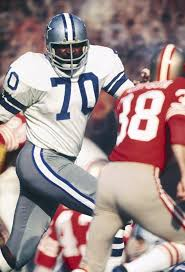
Larry Rayfield Wright was an American professional football player who was an offensive tackle for the Dallas Cowboys of the National Football League for 13 seasons. He is a member of the Pro Football Hall of Fame, having been inducted in 2006.
Nicknamed "Big Cat" for his nimble feet, Wright played on five NFC Championship teams that advanced to the Super Bowl (1970, 1971, 1975, 1977, and 1978 seasons), winning twice. He also participated in the Ice Bowl against the Green Bay Packers for the NFL championship in his rookie season in 1967.
Wright was selected by the Dallas Cowboys in the seventh round of the 1967 NFL/AFL draft, 182nd overall, as a tight end. During his first three years with Dallas, the 6 feet 6 inches, 225 pounds "Big Cat" was a tight end, defensive lineman, and offensive tackle.
In his third season in 1969, Wright got his first chance as a starter after Ralph Neely was sidelined by injury. His opponent in his first start was Los Angeles Rams future Hall of Fame defensive end Deacon Jones, who was in his prime. Wright's performance was so strong that he won a starting role as right tackle before the first day of training camp in 1970.
For thirteen seasons, Wright played more than 200 games, started at right tackle in six NFC Championship games, and played in five Super Bowls, winning two of them: (VI, XII). He earned his first of four All-Pro honors in 1971 and was voted that same year to the first of six straight Pro Bowls.
Wright was named first- or second-team All-Pro each season from 1971 through 1976, earned three All-NFC honors, and the Cowboys led the league for total offense five times (ranked 6th all-time at retirement in 1979). His blocking and leadership as the team's co-captain for seven years helped the Cowboys win 10 division titles and six conference crowns.
Released by the Cowboys in March 1980, Wright signed in April with division rival Philadelphia, but retired early in training camp in July 1980.
He anchored the line for an offense that finished in the top ten in scoring all ten seasons of the 1970s, while helping pave the way for the first five 1,000-yard rushers in Cowboys' history.
Wright played at a time when the right tackle was the most important spot on the offensive line, and was usually paired against the opponent's best pass rusher. He broke every time-honored mold previously held for men of his size. He was light on his feet and possessed an athleticism that had him miscast as a tight end and defensive end for the first three years of his NFL career.
"Rayfield could do it all," said former Cowboys running back Calvin Hill after Wright's election to the Pro Football Hall of Fame. "He could pull. He could run in the open field. He could finesse-block and power-block in the run game. And there was no one better in pass-blocking. He was dominant."
"He was absolutely the best," said Roger Staubach. "Rayfield was a big, strong guy that was able to transfer his size and strength from tight end to tackle. He also had such quick feet that he was able to deal with some of the faster defensive ends and even the linebacker blitzes. If he got beat, I don't remember it."
Was voted the NFLPA NFC Offensive Lineman of the Year in 1972.
Wright was also presented with a number of individual awards following the conclusion of his career, including the NFL All-Super Bowl Team (1990), the Dallas Cowboys 25th Anniversary Team (1985), the Cowboys' own Ring of Honor (2004), the Texas Sports Hall of Fame (2005) and was named to the NFL’s All-Decade Team of the 1970s.
Wright was inducted into the Georgia Sports Hall of Fame in 1988. He was a member of the NFL All-Time Super Bowl Team in 1990 and received the NFL Legends Award that same year. He was inducted into the Texas Black Sports Hall of Fame in 2002. In 2004, Rayfield Wright was inducted in the Dallas Cowboys Ring of Honor and the Texas Sports Hall of Fame. In 2006, he was elected to the Pro Football Hall of Fame. He was officially inducted, with introduction by college coach Leon J. "Stan" Lomax, during the Enshrinement Ceremony on August 6, 2006 where his bust, sculpted by Scott Myers, was unveiled.
He was also inducted into the State of Georgia Hall of Fame, the Fort Valley Georgia Hall of Fame and the Griffin Georgia Hall of Fame.
In 1992, Wright served as an assistant coach to the Arizona Rattlers of the Arena Football League. Wright's post-football involvement with at-risk, inner city youth resulted in his appointment to the Juvenile Supreme Court in Arizona. He also served as president of the NFL Alumni Chapter, "Caring for Kids" program in the mid-90s. His philanthropic endeavors, including the non-profit "Kids 4 Tomorrow" organization he co-founded with some other NFL players, were featured in Volume 9 of the Philanthropy World Magazine, along with former Cowboy teammate, Cliff Harris.
Wright founded the Rayfield Wright Foundation, which helps children obtain grants to attend college. He authored and published his autobiography Wright Up Front.
In his later years, Wright battled early-onset dementia, the result of numerous head injuries he says he had in 13 seasons, more than 180 regular-season and playoff games from 1967 to 1979. Wright claimed to have suffered several concussions throughout his career, and struggled with memory loss, and claimed to have been in several car accidents caused by seizures. Wright joined other former NFL players in a class-action suit against the NFL accusing the league of hiding evidence of head trauma causing degenerative brain disease; the lawsuit was settled in 2015.
Wright died on April 7, 2022, at the age of 76. At the time of his death, he was survived by his wife Di; his three daughters Courtney Minor, Anitra Hernandez, and Ariel Wright; his sons Laray and Larry Jr; and his brother Lamar.
"1967 NFL Draft Listing". Pro-Football-Reference.com. Retrieved March 29, 2026.
"Rayfield Wright signs with Philly". Observer-Reporter. Washington, Pennsylvania. Associated Press. April 21, 1980. p. C2.
"Rayfield Wright retires". Reading Eagle. Pennsylvania. Associated Press. July 27, 1980. p. 77.
"Years - Hall of Famers - Pro Football Hall of Fame Official Site". www.profootballhof.com.
"Cliff Harris and Rayfield Wright's Profile in Philanthropy World Magazine". Archived from the original on December 14, 2005. Retrieved December 15, 2005.
"Cowboy greats file concussion suit against NFL". ESPN.com. Associated Press. April 24, 2012. Retrieved October 25, 2024.
Baca, Michael (April 7, 2022). "Rayfield Wright, longtime Cowboys tackle and Hall of Famer, dies at 76". NFL.com. Retrieved April 7, 2022.
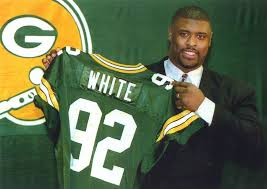
Reginald Howard White was an American professional football defensive end who played in the National Football League for 15 seasons. White played college football for the Tennessee Volunteers, earning unanimous All-American honors. After playing two seasons for the Memphis Showboats of the United States Football League (USFL), he was selected in the first round of the 1984 NFL Supplemental Draft, and then played for the Philadelphia Eagles, the Green Bay Packers and the Carolina Panthers, becoming one of the most awarded defensive players in NFL history.
The two-time NFL Defensive Player of the Year, Super Bowl XXXI champion, 13-time Pro Bowl, and 13-time All-Pro selection holds second place all-time among NFL career sack leaders with 198. He was selected to the NFL 75th Anniversary All-Time Team, NFL 100th Anniversary All-Time Team, NFL 1990s All-Decade Team, and the NFL 1980s All-Decade Team. During his professional career, White is credited with pioneering free agency in sports. Outside of football he was also known for his Christian ministry as an ordained evangelical minister, leading to his nickname, "the Minister of Defense". White is a member of the College Football Hall of Fame and the Pro Football Hall of Fame.
After his college football career, White was chosen by the Memphis Showboats in the 1984 USFL Territorial Draft, and the opportunity to play pro ball in the same state where he went to college was enough enticement for him to sign. He played for Memphis for two seasons, starting in 36 games. As a member of the Showboats, he racked up 23.5 sacks, one safety and one forced fumble recovered for a touchdown.
When the USFL collapsed in 1985, White took a salary cut in Philadelphia. The Eagles signed him to a four-year deal after buying out the remaining three years on his Memphis contract.[29] White was still considered an unproven entity, but his anonymity did not last long. He joined the Eagles after the 1985 season had begun, missing the first few games. When he finally did start, he made ten tackles and two-and-a-half sacks in his first game. By season's end he had turned in 13 sacks in as many games, and he was named NFC Defensive Rookie of the Year.
He played with the Eagles for eight seasons, He played in 121 games and picked up 124 sacks, becoming the Eagles' all-time sack leader. He also set the Eagles' regular-season record with 21 sacks in a single season (1987, a season shortened to 12 games). The lowest number of sacks he ever recorded in Philadelphia was 11 in 1989. White also became the only player ever to accumulate 20 or more sacks in just 12 games. He set an NFL regular-season record during 1987 by averaging the most sacks per game, with 1.75. Over the course of his tenure with the Eagles, White actually accumulated more sacks than the number of games he played. In 2008, he was voted by ESPN Sportsnation as the greatest player in Eagles' franchise history. In 1991, he set the record for most passes defended in a single season by a defensive lineman with 13, a mark that has been since broken by J. J. Watt.
In 1993, White became a free agent. His transaction started a new era in the NFL of player-requested free agency. He was signed by the Green Bay Packers and agreed to terms on a four-year contract worth $17 million. At the time, he was the third highest paid player in the NFL, trailing only John Elway and Dan Marino. He played for the Packers for six seasons. White notched up another 68.5 sacks to become, at the time, the Packers' all-time leader in that category (third now to Clay Matthews III and Kabeer Gbaja-Biamila). White was also just as valued for his role as a team leader. He helped the Packers win a Super Bowl, with a game-ending sack, in Super Bowl XXXI. During the game, White had three sacks to set the single game record for a Super Bowl. That victory was his only championship at any level. In 1998, White was named the NFL Defensive Player of the Year for the second time.
In 2000, White came out of a one-year retirement and started all 16 games for the Carolina Panthers. He had five and a half sacks and one forced fumble while with the team. He again retired at the end of the 2000 season.
At the time of his retirement, White was the NFL's all-time sacks leader with 198. (He has since been surpassed by Bruce Smith, who accumulated 200 in 47 more games played.) Counting his time in the USFL, White has 221.5 sacks in professional football, making him professional football's all-time sacks leader. White also recorded three interceptions, which he returned for 79 yards. He recovered 20 fumbles, which he returned for 137 yards and three touchdowns. His nine consecutive seasons (1985–1993) with at least 10 sacks remain an NFL record. He was named an All-Pro for 13 of his 15 seasons, including eight as a first-team selection. Reggie White is considered by many to be one of the best defensive players in NFL history.
White appeared on screen at two professional wrestling events, wrestling one match. In April 1995, he was ringside as part of Lawrence Taylor's "All-Stars" for his match against Bam Bam Bigelow at WrestleMania XI. During the show, he participated in one backstage segment with the All-Stars, calling out The Million Dollar Corporation member King Kong Bundy. Before and during the actual match, the All-Stars and the Million Dollar Corporation were involved in a scuffle, in which White participated.
On May 18, 1997, White wrestled his only professional wrestling match for WCW at Slamboree. He wrestled fellow NFL (and LT's All-Star teammate) alumnus Steve McMichael. The two men emulated football tackles during their bout. White received a warm response from the professional wrestling crowd in Charlotte, North Carolina, but nonetheless lost to McMichael after being hit with a steel Zero Halliburton briefcase secretly given to McMichael by his Four Horsemen teammate, Jeff Jarrett.
White became involved with the Fellowship of Christian Athletes while at the University of Tennessee, and expressed an interest in becoming an evangelist as early as his sophomore year in 1981. He became an ordained Baptist minister during this period. He had acquired the nickname "Minister of Defense" by the time he was a senior.
In White's last year of football, a friend reportedly gave White a teaching CD from Messianic teacher Monte Judah. Following his retirement, White began studying Torah and Torah-observant Messianic theology. White also studied Hebrew under Nehemia Gordon. In October 2003, White was interviewed by Messianic teacher and televangelist Michael Rood, and he discussed his studies of Torah. The interview was broadcast on February 4 and 6, 2005, on the Sky Angel cable channel. White went on to co-produce Rood's half-hour "A Rood Awakening From Israel" TV programs. Following White's death, the January 2005 edition of Messianic magazine Yavoh was dedicated to him as a "Messianic believer", leading to confusion regarding White's religious beliefs. Some reported – incorrectly – that White had abandoned Christianity and was studying Judaism.
White was touched by the African American church arson scares during the mid-1990s. The Inner City Church in Knoxville, Tennessee, where White was an associate minister, burned to the ground in 1996. That same year, he starred with Pat Morita in Reggie's Prayer, a Christian film. He played protagonist Reggie Knox, a football player who retires after the 1996 season to become a 10th-grade history teacher and head coach of a high school football team in Portland, Oregon. The film also had appearances by his Packers teammates Brett Favre and Mike Holmgren as janitors, and Keith Jackson as an assistant coach. M.C. Hammer plays a park ranger.
In an interview with ABC's 20/20, White made comments about gays and lesbians. White became an ally of organizations opposed to homosexuality; he appeared in a newspaper advertising campaign to convince gays and lesbians that they could "cease" their homosexuality. As a result, CBS withdrew a five-year, $6-million contract for being a part of The NFL Today because of his statements calling homosexuality a sin. Both the Green Bay Packers and the NFL objected to the ads, since White had appeared in his football uniform without the consent of the team or the league. Later versions of the ad removed the uniform.
On March 25, 1998, White was invited to address the Wisconsin Legislature and, in an infamous speech, stunned the assembly by reiterating his belief that homosexuality was sinful and a "decision," while also using racial tropes to stress why God made different races. He said that blacks are gifted at worship and celebration, Japanese and other Asians "can turn a television into a watch," Hispanics are gifted at the "family structure" and "can put 20, 30 people into one home," Indians are gifted in spirituality, and "you guys (meaning the predominately white legislature) do a good job of building businesses and things of that nature, and you know how to tap into money." On April 2 he faxed the Milwaukee Journal Sentinel asking for forgiveness, but in 2000, shortly after signing with the Carolina Panthers, he reversed himself by saying "I wouldn’t change anything" about the speech.
On the morning of December 26, 2004, White was rushed from his home in Cornelius, North Carolina, to a nearby hospital in Huntersville, North Carolina, where he was pronounced dead. The cause of death was arrhythmia. According to the Mecklenburg County Medical Examiner's Office, the most likely cause of the arrhythmia was cardiac and pulmonary sarcoidosis, which White had lived with for years. It was also stated that sleep apnea, with which White had been diagnosed, may have contributed to his death.
White's widow, Sara, in conjunction with the Sleep Wellness Institute, founded the Reggie White Sleep Disorders Research and Education Foundation, dedicated to all people having access to treatment for sleep disorders, regardless of their socio-economic status.
"Crescent Rising" is another program of the Reggie White Foundation, begun in May 2007, that offers free demolition services to homeowners in the metropolitan New Orleans area affected by Hurricane Katrina. The Crescent Rising program was created to expedite demolition through the encouragement of private sector involvement in order to speed the recovery of the community from hurricane damage. The foundation demolished its first home in June 2007.
During the 2005 season, the Philadelphia Eagles, the Green Bay Packers, and the University of Tennessee retired White's number 92 jersey.
The University of Tennessee retired White's jersey at a halftime presentation on October 1, 2005, during their game against Ole Miss, the third such retirement in the modern era of football at the school; a commemorative sign was also unveiled in the south end of Neyland Stadium. During a halftime presentation at Lambeau Field on September 18, 2005, White became the fifth Green Bay Packer to have his number retired by the franchise. On December 5, 2005, the Philadelphia Eagles retired his jersey in a halftime ceremony during the Eagles' Monday Night Football game with the Seattle Seahawks, which were coached by Mike Holmgren, White's former coach in Green Bay. White became the first (and so far only) player in NFL history to have his number officially retired by multiple teams. The Packers and the Eagles also wore a helmet decal honoring White for the remaining games in the season.
White was posthumously elected to the Professional Football Hall of Fame on his first ballot on February 4, 2006. He was enshrined at a ceremony on August 5, 2006, in Canton, Ohio. White's widow, Sara White, delivered her husband's acceptance speech at the ceremony. She was introduced by their son, Jeremy White, who also released the first copies of his autobiography, In His Shadow: Growing Up With Reggie White, during the Hall of Fame weekend in honor of his father. Jeremy thanked the "God of Abraham, Isaac, and Jacob" in his introduction, echoing Reggie White's dedication to his faith.
White was elected to the Wisconsin Athletic Hall of Fame in 2005, and the Philadelphia Sports Hall of Fame in 2007. He was inducted into the Green Bay Packers Hall of Fame in 2006.
The official sign-hanging for Reggie White Boulevard took place on Monday, December 8, 2008, at 2 p.m. at the intersection of 20th and Carter Street in Chattanooga, Tennessee. White's mother, Thelma White Collier, along with other family and friends, were on hand to witness the change to Reggie White Boulevard. The official name change was approved by the Chattanooga City Council on November 4, 2008.
Reggie White Way in Green Bay, Wisconsin, is off Lombardi Avenue near Lambeau Field.
"Top 5 NFL free agent signings". Sports Illustrated (video). March 13, 2013. Retrieved March 16, 2026.
"Chattanooga native, NFL star Reggie White getting an ESPN '30 for 30' documentary". WTVC-FOX. May 4, 2023. Retrieved March 17, 2024.
"Reggie White - Biography". IMDb. Retrieved January 9, 2025.
Branton, B. B. (April 17, 2013). "Reggie White, Howard HS to be Honored by Pro Football HOF". Chattanoogan.com. Retrieved March 17, 2024.
"1980 Tennessee Signees Archived November 11, 2013, at the Wayback Machine", 1980 Tennessee Volunteers Football Guide (University of Tennessee, 1980), p. 57.
London, Mike (October 9, 2007). "Ex-Vol Robert Pulliam dies". Scout.com. Archived from the original on November 11, 2013. Retrieved March 17, 2024.
Zimmerman, Paul (November 27, 1989). "The Eagles' Dominating Defensive End, Reggie White, a Baptist Minister, Reaps as Much Mayhem as He Sows". vault.SI.com.
"Reggie White, 1983 Vol Captain and Consensus All-America, Deat at Age 43". University of Tennessee Athletics. December 26, 2004. Retrieved March 17, 2024.
"1981 Squad Archived February 3, 2014, at the Wayback Machine", 1981 Tennessee Volunteers Football Guide (University of Tennessee, 1981), pp. 54–55.
"Honors Archived February 3, 2014, at the Wayback Machine", 1981 Tennessee Volunteers Football Guide (University of Tennessee, 1981), p. 95.
"1981 Defensive Statistics Archived March 4, 2016, at the Wayback Machine", 1982 Tennessee Volunteers Football Guide (University of Tennessee, 1982), p. 92.
"1982 Squad Archived November 22, 2015, at the Wayback Machine", 1982 Tennessee Volunteers Football Guide (University of Tennessee, 1982), p. 58.
"1981 Honorees Archived March 4, 2016, at the Wayback Machine", 1982 Tennessee Volunteers Football Guide (University of Tennessee, 1982), p. 94.
"1983 Squad Archived March 4, 2016, at the Wayback Machine", 1983 Tennessee Volunteers Football Guide (University of Tennessee, 1983), p. 59.
"1982 Defensive Statistics Archived October 29, 2013, at the Wayback Machine", 1983 Tennessee Volunteers Football Guide (University of Tennessee, 1983), p. 90.
"Bowl Halls of Fame Archived 2016-03-04 at the Wayback Machine", Records (University of Tennessee, 2012), p. 384.
Tim Hix, "Vol Profile: Reggie White", 1983 Tennessee Volunteers Football Guide (University of Tennessee, 1983), pp. 47–48.
"1983 Defensive Statistics Archived November 14, 2013, at the Wayback Machine", 1984 Tennessee Volunteers Football Guide (University of Tennessee, 1984), p. 92.
Tim Hix, "Reggie White: Minister of Defense Archived March 4, 2016, at the Wayback Machine", Tennessee vs. Georgia Tech Football Program (University of Tennessee, 1983), pp. 47–48.
"Orange Overpowering in Romp at Memphis Archived February 3, 2014, at the Wayback Machine", Tennessee vs. LSU Football Program (University of Tennessee, 1983), p. 16.
"1983 University of Tennessee Season Review Archived February 3, 2014, at the Wayback Machine", 1983 Citrus Bowl Press Guide, pp. A10–A12.
"Victory Over Terps in Florida Citrus Bowl Climaxes Best UT Campaign Since 1972 Archived November 14, 2013, at the Wayback Machine", 1984 Tennessee Volunteers Football Guide (University of Tennessee, 1984), p. 90.
"1983 Honorees Archived February 3, 2014, at the Wayback Machine", 1984 Tennessee Volunteers Football Guide (University of Tennessee, 1984), p. 94.
"Tennessee Football Career Statistics Archived 2015-11-17 at the Wayback Machine", UTSports.com. Retrieved: July 30, 2013.
Murray, Patrick (November 19, 2016). "Vols' Derek Barnett ties Reggie White's sack record". WBiR. Retrieved March 17, 2024.
Fraychineaud, Jason (December 30, 2016). "Derek Barnett breaks Reggie White's sack record at Tennessee". Saturday Down South. Retrieved March 17, 2024.
"Tennessee beats Kentucky, 27–14". ESPN.com. November 30, 2013. Retrieved March 17, 2024.
"Reggie White – USFL". United States Football League. Retrieved March 17, 2024.
Pearlman, Jeff (October 8, 2018). "Exclusive: New USFL book highlights Memphis Showboats' crazy times and Reggie White". The Commercial Appeal. Retrieved March 17, 2024.
"Reggie White Stats". Pro Football Hall of Fame Official Site. Retrieved May 18, 2017.
Beech, Mark (December 26, 2019). "Book excerpt: How Reggie White changed the Packers and Green Bay". The Athletic. Retrieved March 17, 2024.
Didinger, Ray (September 29, 2019). "Didinger: 34 years ago, the NFL was introduced to Reggie White". PhiladelphiaEagles.com. Retrieved March 17, 2024.
"Philadelphia Eagles Career Defense Leaders". Pro-Football-Reference.com. Retrieved March 17, 2024.
"Who is the greatest in Eagles history?". ESPN. ESPN Sportsnation. August 2, 2008. Archived from the original on August 23, 2008. Retrieved November 7, 2008.
"Five things to watch: Texans vs. Bills". Archived from the original on November 5, 2012. Retrieved January 30, 2017.
Judge, Clark (March 20, 2021). "How did NFL free agency begin? With Reggie White and the sound of a gavel". Talk of Fame. Retrieved May 23, 2025.
McGinn, Bob (April 6, 1993). "17 million reasons convince Reggie White". Milwaukee Journal. Retrieved March 17, 2024.
"Green Bay Packers Career Defense Leaders". Pro-Football-Reference.com. Retrieved March 17, 2024.
"Super Bowl XXXI – New England Patriots vs. Green Bay Packers – January 26th, 1997". Pro-Football-Reference.com. Retrieved March 17, 2024.
Kloepping, Sarah (May 4, 2023). "From the archives: Reggie White through the years with the Green Bay Packers". Packers News. Retrieved March 17, 2024.
Wilner, Barry (January 7, 1999). "White named defensive player of year". Herald-Journal. Associated Press. p. D1. Retrieved July 11, 2016.
"Reggie White 2000 Game Log". Pro-Football-Reference.com. Retrieved March 17, 2024.
Radclliffe, JR (December 13, 2023). "This was the original coverage of Reggie White's shocking death in 2004". Milwaukee Journal Sentinel. Retrieved March 17, 2024.
"NFL Sacks Career Leaders (since 1960)". Pro-Football-Reference.com. Retrieved March 17, 2024.
Kerr, Jeff (March 15, 2024). "Ranking greatest defensive players in NFL history: Where Aaron Donald fits on all-time list after retirement". CBSSports.com. Retrieved March 17, 2024.
Brandt, Gil (July 13, 2016). "Reggie White, J.J. Watt among best defenders I've ever seen". NFL.com. Retrieved March 17, 2024.
Whitlock, Jason. "The unstoppable Reggie White". ESPN.com. Retrieved March 17, 2024.
Gehman, Jim (October 21, 2023). "Reggie White was simply the greatest". PhiladelphiaEagles.com. Retrieved March 17, 2024.
"Reggie White and Jerome Brown". A Football Life. September 29, 2011. NFL Network. After retiring as the NFL's all-time sack leader, Reggie continued his spiritual journey by learning Hebrew and taking a pilgrimage to Israel.
Video on YouTube
"Reggie's Prayer". Dove.org. Retrieved January 9, 2025.
Full Cast and Crew for Reggie's Prayer, IMDb.com. Retrieved: August 14, 2013.
Berkowitz, Bill (August 9, 2000). "The Return of Reggie White". Working for Change. Archived from the original on December 31, 2006. Retrieved June 23, 2007.
Zirin, Dave (December 28, 2004). "The Death of Reggie White: an Off the Field Obituary". Common Dreams News Center. Archived from the original on June 12, 2007. Retrieved June 23, 2007.
"White Stuns Lawmakers With Speech - CBS News". www.cbsnews.com. March 25, 1998. Retrieved October 25, 2024.
"White issues letter of apology for being "clumsy, inappropriate'". Tampa Bay Times. April 4, 1998. Retrieved October 25, 2024.
Chandler, Charles (July 31, 2000). "White has no regrets about controversial 1998 speech Panthers star wouldn't change highly criticized address". GoUpstate. Retrieved September 28, 2024.
Pasquarelli, Len (May 20, 2005). "Thursday roundup: Maddox rides to Ben's defense". ESPN.com. Retrieved January 30, 2017.
"AASM Accredits 1,000th Facility – News – Sleep Review". Archived from the original on October 19, 2006.
Hiestand, Michael; Mihoces, Gary (December 29, 2004). "Apnea a weighty matter". USA Today. Retrieved May 22, 2010.
"The Sleep Wellness Institute, Wisconsin sleep disorders treatment center". Retrieved January 30, 2017.
"Reggie White Sleep Disorders Foundation". Retrieved January 30, 2017.
Weil & Associates Teams Up With Reggie White Foundation's Crescent Rising Program[dead link] Forbes. May 24, 2007. Accessed August 7, 2007.
Merrill, Elizabeth (July 20, 2007). "New Orleans opens arms to ArenaBowl". ESPN.com. Retrieved March 17, 2024.
"Eagles honor Reggie White, retire his jersey". ESPN.com. Associated Press. December 5, 2005. Retrieved October 6, 2023.
"No. 10 Vols jump to early lead, beat Rebels". ESPN.com. Associated Press. October 1, 2005. Archived from the original on March 17, 2024. Retrieved March 17, 2024.
"Packers To Retire Reggie White's Number Sept. 18". Packers.com. May 30, 2005. Retrieved March 17, 2024.
"Eagles retire White' No. 92 in special ceremony". ESPN.com. Associated Press. December 6, 2005. Retrieved March 17, 2024.
"Reggie White, 2006 Pro Football Hall Of Fame Class". Sports Illustrated Covers. Retrieved March 17, 2024.
Wilner, Barry (August 6, 2006). "White's induction dominates Hall of Fame ceremony". Pittsburgh Post-Gazette. Associated Press. Retrieved March 17, 2024.
"Reggie White". Wisconsin Athletic Hall of Fame. Retrieved March 17, 2024.
"Reggie White". Philadelphia Sports Hall of Fame. Retrieved March 17, 2024.
"Green Bay Packers Hall of Fame Members". Green Bay Press-Gazette (clipping). July 23, 2006. p. C-2. Archived from the original on November 16, 2023. Retrieved November 16, 2023 – via Newspapers.com.
"Reggie White Boulevard Sign Hanging Is Monday". Chattanoogan.com. December 5, 2008. Retrieved March 17, 2024.
"Oneida Nation Walk of Legends". GreenBay.com. Retrieved March 17, 2024.
Harold Warren Moon is an American former professional football quarterback who played for 23 seasons. He spent the majority of his career with the Houston Oilers of the National Football League (NFL) and the Edmonton Eskimos of the Canadian Football League (CFL). Moon also played for the NFL's Minnesota Vikings, Seattle Seahawks, and Kansas City Chiefs. He is considered one of the greatest undrafted players in NFL history.
Moon began his professional career with the Eskimos in 1978 after not generating interest from NFL teams. His success during his six CFL seasons, five of which ended in Grey Cup victories, resulted in him being signed by the Oilers in 1984. During his 17 NFL seasons, Moon was named Offensive Player of the Year in 1990 after leading the league in passing yards and passing touchdowns. He led the NFL in passing yards twice, while also receiving nine Pro Bowl selections. Moon spent 10 seasons with the Oilers, whom he led to seven playoff appearances, and made an eighth postseason run with the Vikings before retiring in 2000.
At the time of his retirement, Moon held several all-time professional gridiron football passing records. Although relatively unsuccessful in the NFL postseason, his five consecutive Grey Cups from 1978 to 1982 remain a CFL record and he was named Grey Cup MVP twice. He was inducted to the Pro Football Hall of Fame in 2006, becoming the first African-American quarterback and the first undrafted quarterback to receive the honor. Moon is also the only player inducted to both the Pro Football Hall of Fame and the Canadian Football Hall of Fame.
Despite his collegiate success, Moon was led to believe he would only be a late-round NFL pick and was fearful that would lead to a limited opportunity to make it in the NFL.
Six weeks before the NFL draft, Moon signed with the Edmonton Eskimos. He and Tom Wilkinson shared signal-calling duties from 1978 to 1981, winning four consecutive Grey Cups during this span.
Moon became Edmonton's No. 1 quarterback midway through the 1980 season. That year, the team won their third consecutive Grey Cup, and Moon won his first Grey Cup Offensive MVP award as Edmonton defeated Hamilton 48–10.
In 1981, Moon started his first year as Edmonton's No. 1 quarterback with Wilkinson, who would retire after the season, as the team's No. 2 quarterback. Moon was moved to the reserve list for Edmonton's game against Ottawa on October 12. During the Grey Cup, Moon was struggling and Edmonton was trailing Ottawa 20–0 in the second quarter. At this time, Moon was replaced by Wilkinson. Moon returned in the second half and directed drives for three touchdowns and the game winning field goal with three seconds remaining in the game. Edmonton defeated Ottawa 26–23 to win a CFL record fourth consecutive Grey Cup.
In 1982, Moon became the first professional quarterback to pass for 5,000 yards in a season by reaching exactly 5,000 yards. Edmonton would recover from a 3–5 start to finish the regular season 11–5, and first place in the West Division for the sixth consecutive season. The team qualified for the Grey Cup for the sixth consecutive season, and won the Grey Cup for the fifth consecutive year. Moon was named the Grey Cup Offensive MVP for the second time in his career.
In his final CFL season, 1983, Moon threw for a league-record 5,648 yards and won the CFL's Most Outstanding Player Award. However, the season was not as successful for the Eskimos as they finished with an 8–8 record. Having barely made the playoffs (which they would have missed altogether if not for a loss by the Calgary Stampeders to the last place Saskatchewan Roughriders in the last week of the regular season), Moon's Eskimos were throttled in Winnipeg by the Blue Bombers in the West semi-final.
In his six years in the CFL, Moon amassed 1,369 completions on 2,382 attempts (57.4 completion percentage) for 21,228 yards and 144 touchdown passes. He also led his team to victory in nine of 10 postseason games. Moon was inducted into the Canadian Football Hall of Fame in 2001 and the Eskimos' Wall of Honour. In 2006, he was ranked fifth on a list of the greatest 50 CFL players presented by Canadian sports network TSN.
Moon's decision to enter the NFL touched off a bidding war for his services, won by the Houston Oilers, led by Hugh Campbell, his head coach for his first five seasons in Edmonton.[3] Gifford Nielsen—the starting quarterback in 1983—retired after Moon joined the team, stating that Moon becoming the starter was inevitable. Moon had a difficult adjustment period, but threw for a franchise-record 3,338 yards in his first season in 1984, but Campbell was just 8–22 (.267) at the helm and did not finish the 1985 season. When new head coach Jerry Glanville found ways to best use Moon's strong arm in 1986, the team began having success. In the strike-marred 1987 season, the Oilers posted a 9–6 record, their first winning season since 1980. In his first postseason game in the NFL, Moon passed for 237 yards and a touchdown in the Oilers' 23–20 overtime win over the Seattle Seahawks in the wildcard round of the playoffs.
Prior to the 1989 season, Moon signed a five-year, $10-million contract extension, which made him the highest-paid player in the NFL at that time. In 1990, Moon led the league with 4,689 passing yards. He also led the league in attempts (584), completions (362), and touchdowns (33), and tied Dan Marino's record with nine 300-yard games in a season. That included throwing for 527 yards against Kansas City on December 16, 1990, the second-most passing yards ever in a single game. The following year, he again led the league in passing yards, with 4,690. At the same time, he joined Marino and Dan Fouts as the only quarterbacks to post back-to-back 4,000-yard seasons. Moon also established new NFL records that season with 655 attempts and 404 completions.
In 1992, Moon played only 11 games due to injuries, but the Oilers still managed to achieve a 10–6 record, including a victory over the Buffalo Bills, in the final game of the season. A week later, the Oilers faced the Bills again in the first round of the AFC playoffs. Aided by Moon's 222 passing yards and four touchdowns in the first half, Houston built up a 28–3 halftime lead and increased it to 35–3 when Buffalo quarterback Frank Reich's first pass of the third quarter was intercepted and returned for a touchdown. The Bills stormed back with five unanswered second-half touchdowns to take a 38–35 lead with time running out in the final period. Moon managed to lead the Oilers on a last-second field goal drive to tie the game at 38 and force overtime, but threw an interception in the extra period that set up Buffalo kicker Steve Christie's game-winning field goal. The Bills' rally from a 32-point deficit[24] at that time was the largest comeback victory in NFL history and became known in NFL lore simply as the Comeback. Moon finished the game with 36 completions for 371 yards, four touchdowns, and two interceptions. His 36 completions was an NFL postseason record.
The 1993 season was the Oilers' best with Moon, but was his last with the team. Despite a drama-filled 1–4 start and early struggles from Moon, Houston went 12–4 and won the AFC Central division crown, but lost to Joe Montana and the Kansas City Chiefs 28–20 in the divisional round of the playoffs.
Moon set a franchise record with Houston for wins with 70, which stood until Steve McNair broke it in 2004, long after the team had become the Tennessee Titans. Moon also left the Oilers as the franchise leader in passing touchdowns, passing yards, pass attempts, and pass completions, all of which still stand today.
Moon was traded to the Minnesota Vikings after the season, where he passed for over 4,200 yards in each of his first two seasons, but missed half of the 1996 season with a broken collarbone. The Vikings' starting quarterback job was given to Brad Johnson and Moon was released after he refused to take a $3.8-million pay cut to serve as Johnson's backup.
Moon signed with the Seattle Seahawks as a free agent in 1997, made the Pro Bowl, and was named Pro Bowl MVP. He played for them for two seasons.
Moon signed as a free agent with the Kansas City Chiefs as a backup in 1999. He played in only three games in two years with the Chiefs and announced his retirement at age 44 in January 2001. His 291st and final touchdown pass was an 8-yard pass to Troy Drayton against the Rams on October 22, 2000, a game in which the Chiefs defeated the defending champs, 54–34.
Combining his NFL and CFL stats, Moon's numbers are nearly unmatched in professional football annals: 5,357 completions in 9,205 attempts for 70,553 yards and 435 touchdowns. Even if his Canadian Football League statistics are discounted, Moon's NFL career numbers are still exceptional: 3,988 completions for 49,325 yards, 291 touchdown passes, 1,736 yards rushing, and 22 rushing touchdowns. Moon also held individual NFL lifetime records for most fumbles recovered (56) and most fumbles made (162), but this was surpassed by Brett Favre in 2010. Moon was in the top five all-time when he retired for passing yards, passing touchdowns, pass attempts, and pass completions.
Moon was named to nine Pro Bowls (1988–1995, 1997). He worked as a broadcaster for the Seattle Seahawks on both TV and radio until 2017. Moon was elected to the Pro Football Hall of Fame in 2006, becoming both the first Canadian Football Hall of Fame player, first undrafted quarterback, and first African-American quarterback honored; he was elected in his first year of eligibility. The Tennessee Titans retired Moon's number at halftime on October 1, 2006, in a game against the Dallas Cowboys. Moon won his first Super Bowl ring in 2014 as a broadcaster for the Seahawks.
Moon has mentored Cam Newton, the first overall pick of the 2011 NFL draft, alluding to their common experiences as prominent African-American quarterbacks. He was suspended indefinitely from his sportscaster position after he was sued in December 2017 for sexual harassment.
In 1981, Moon married Felicia Hendricks, whom he had known since they were 16 years old. They had three children together and divorced in 2001.
Moon married his second wife Mandy Ritter in 2005. They had one child and are currently separated.
Moon currently lives in Redmond, Washington. In 1989, he launched the Crescent Moon Foundation, which provides college scholarships for economically disadvantaged students. Moon also supports various charitable organizations including the United Negro College Fund, Ronald McDonald House, Muscular Dystrophy Association, Cystic Fibrosis Foundation, American Heart Association, and Cerebral Palsy Foundation.
Curtis, Jake (April 26, 2022). "Top 10 Undrafted NFL Players the Past 25 Years, and Top 10 Undrafted Players from Cal". Sports Illustrated. Archived from the original on May 21, 2022. Retrieved August 18, 2022.
May, Jeffrey (April 28, 2022). "Who were the best undrafted players in NFL history?". Diario AS. Archived from the original on May 27, 2022. Retrieved August 18, 2022.
"Moon and Oilers agree to terms". Spokesman-Review. Spokane, Washington. February 5, 1984. p. D4 – via Google News.
"Warren Moon". Contemporary Black Biography. The Gale Group, Inc. 2006. Retrieved February 16, 2009.
Plaschke, Bill (July 30, 2006). "Moon Made His Position Clear From Start". Los Angeles Times. Retrieved February 16, 2009.
Bishop, Greg (July 30, 2006). "The man that is Moon". The Seattle Times. Retrieved February 16, 2009.
George, Thomas (October 21, 1990). "Moon: He Wears No. 1, And He's Playing Like It". The New York Times. Retrieved February 16, 2009.
"Warren Moon's enshrinement speech transcript". Pro Football Hall of Fame. August 5, 2006. Retrieved February 16, 2009.
"How Warren Moon Improved His Athleticism In High School". Archived from the original on November 25, 2006. Retrieved January 19, 2007.
Missildine, Harry (January 3, 1978). "Jackson rescues Washington". Spokesman-Review. Spokane, Washington. p. 19.
"Huskies go from rags to roses". Eugene Register-Guard. Oregon. Associated Press. January 3, 1978. p. 1C.
Dodds, Tracy (January 3, 1978). "Bo's rare gamble backfires in Rose Bowl". Milwaukee Journal. p. 8, part 2.[permanent dead link]
"Moon landing: Legendary QB signed with Esks 42 years ago". CFL.ca. April 13, 2020. Retrieved September 2, 2024.
"CFL Legends >> Warren Moon". Retrieved January 22, 2007.
Tucker, David (November 23, 1980). "Warren Moon, embarrassing the best defense in the league, threw three touchdown passes and ran circles around the blitz Sunday to give the Edmonton Eskimos a 48-10 victory over the Hamilton Tiger-Cats and their third consecutive Grey Cup". UPI. Retrieved September 2, 2024.
Blackburn, Jess (May 15, 1984). "Quarterback Gifford Nielsen, a six-year veteran with the Houston..." UPI. UPI. Retrieved September 17, 2018.
"Oilers fire Campbell as". Spokane Chronicle. Washington. Associated Press. December 9, 1985. p. C1.
"Moon Says New Pact Is Richest in N.F.L." New York Times. April 8, 1989. Retrieved January 19, 2007.
"1990 NFL Passing". Pro Football Reference. Retrieved September 2, 2024.
"Houston Oilers at Kansas City Chiefs - December 16th, 1990". Pro Football Reference. Retrieved September 2, 2024.
"NFL Passing Yards Single Game Leaders". Pro Football Reference. Retrieved September 2, 2024.
"1991 NFL Passing". Pro Football Reference. Retrieved September 2, 2024.
"1992 Houston Oilers Rosters, Stats, Schedule, Team Draftees". Pro Football Reference. Retrieved September 2, 2024.
"Bills and Eagles Turn Mountains Into Molehill; Buffalo Erases 32-Point Deficit". New York Times. January 4, 1993. Retrieved July 12, 2016.
"1993 Houston Oilers Rosters, Stats, Schedule, Team Draftees". Pro Football Reference. Retrieved September 2, 2024.
"Houston '93". A Football Life. Season 3. Episode 15. December 10, 2013. NFL Network.
"Divisional Round - Kansas City Chiefs at Houston Oilers - January 16th, 1994". Pro Football Reference. Retrieved August 29, 2024.
"VIKINGS CLOSE TO A DEAL WITH MOON". The Washington Post. Associated Press. April 14, 1994. Retrieved May 28, 2025.
"SPORTS PEOPLE: FOOTBALL; Vikes Have Themselves a Quarterback in Moon". The New York Times. April 15, 1994.
Litsky, Frank (April 14, 1994). "PRO FOOTBALL; Vikings Near On a Deal To Acquire Oilers' Moon". The New York Times. Retrieved September 2, 2024.
Tomasson, Chris (December 1, 2015). "Warren Moon wishes he could have had more time with Vikings". Twin Cities. Retrieved September 2, 2024.
"Vikings release Warren Moon - UPI Archives".
"Vikings Release Moon". The New York Times. Associated Press. February 22, 1997. Retrieved September 2, 2024.
"On this date: Warren Moon finally signs with Seahawks". Seahawks.com. March 7, 2016. Retrieved September 2, 2024.
"Moon Joins Chiefs". The New York Times. Associated Press. April 27, 1999. Retrieved January 19, 2007.
"St. Louis Rams at Kansas City Chiefs - October 22nd, 2000". Pro Football Reference.
"Warren Moon 1999 Game Log". Pro Football Reference. Retrieved September 2, 2024.
"Warren Moon 2000 Game Log". Pro Football Reference. Retrieved September 2, 2024.
"Warren Moon makes retirement official". Brainerd Dispatch. January 26, 2001. Retrieved September 2, 2024.
"NFL Passing Yards Single-Season Leaders". Pro Football Reference.
"History". Nfl.com. Archived from the original on April 10, 2010. Retrieved October 18, 2010.
"NFL Leaders, Football Records, NFL Leaderboards". Pro Football Reference.
"Retired Jersey Numbers". Tennessee Titans Official Website. Archived from the original on July 8, 2017. Retrieved January 27, 2017.
"Warren Moon". www.facebook.com. Archived from the original on February 26, 2022.
"Warren Moon on Twitter". Twitter. Retrieved January 27, 2017.
Wyatt, Jim (April 25, 2025). "Oilers Legend Warren Moon Gives New Titans QB Cam Ward Permission to Wear His Previously Retired No.1 Jersey". tennesseetitans.com. Retrieved May 2, 2025.
"Warren Moon Career Stats". nfl.com. Retrieved February 13, 2025.
"Husky Legends Come Alive in New Stadium". University of Washington. Archived from the original on February 2, 2014. Retrieved January 23, 2014.
"Tennessee Titans Career Passing Leaders". Pro Football Reference. Retrieved September 2, 2024.
"Tennessee Titans Single-Season Passing Leaders". Pro Football Reference. Retrieved September 2, 2024.
"Oilers/Titans Rookie Passing Records". Pro Football Reference. Retrieved December 4, 2018.
"NFL Week 9 takeaways: What We Learned from Sunday's 12 games". November 2, 2025. Retrieved November 6, 2025.
Davis, Nate (October 24, 2012). "Is criticism of Cam Newton racially motivated? Warren Moon thinks so". USA TODAY. Retrieved September 2, 2024.
Keown, Tim (January 13, 2016). "From The Mag: How Newton's joy made (great) football fun". ESPN.com. Retrieved September 2, 2024.
Garafolo, Mike (February 1, 2016). "Is race really a factor in how Cam Newton is perceived?". FOX Sports. Retrieved September 2, 2024.
Whitlock, Craig (December 6, 2017). "Seahawks broadcaster and former Husky star Warren Moon sued for sexual harassment". The Seattle Times. Retrieved September 2, 2024.
Hanson, Eric (February 14, 2001). "Moons file for divorce". Chron. Retrieved October 15, 2024.
"Vikings' Moon Acquitted In Spousal Assault Case". Los Angeles Times. February 23, 1996. Retrieved February 13, 2026.
"Warren Moon IMDB Mini-Biography". IMDb.
Reid, Jason (April 1, 2020). "Warren Moon welcomes NFL as distraction: 'Sports have always been there for us'". Andscape. Retrieved September 2, 2024.
"Warren Moon". www.blackhoustonhalloffame.weebly.com. Retrieved March 25, 2023.