Monday, May 15, 2023

The Story And Significance Of Dick Butkus - Regarded As One Of The Greatest And Most Intimidating Linebackers In Pro Football History

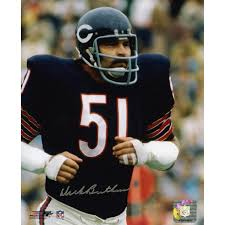
Richard Marvin Butkus is an American former professional football player, sports commentator, and actor. He played football as a middle linebacker for the Chicago Bears of the National Football League from 1965 to 1973. He was invited to eight Pro Bowls, named a first-team All-Pro six times, and was twice recognized by his peers as the NFL's Defensive Player of the Year. He was renowned as a fierce tackler and for the relentless effort with which he played and is widely regarded as one of the greatest and most intimidating linebackers in pro football history.

Butkus was born in Chicago and played his entire football career in his home state of Illinois, which began at Chicago Vocational High School. He was a linebacker and a center at the University of Illinois. He was a two-time consensus All-American, and he led the Illini to a Rose Bowl victory in 1963 and was deemed the most valuable player in the Big Ten Conference. He was named college football's Lineman of the Year in 1964 by United Press International (UPI). He was inducted into the College Football Hall of Fame in 1983.

Butkus was drafted by the Bears as the third overall pick in the 1965 NFL Draft. He soon established himself as a ball hawk with his penchant for forcing turnovers. In his NFL career, he intercepted 22 passes and recovered 27 fumbles (a record when he retired), and he was responsible for causing many more fumbles with his jarring tackles. His tackling ability earned him both admiration and trepidation from opposing players. According to Hall of Fame defensive end Deacon Jones, Butkus "was a well-conditioned animal, and every time he hit you, he tried to put you in the cemetery, not the hospital." In 2009, the NFL Network named Butkus the most feared tackler of all time.

Butkus is credited with having defined the middle linebacker position, and is still viewed as the "gold standard by which other middle linebackers are measured." He was inducted into the Pro Football Hall of Fame in 1979, and his No. 51 jersey is retired by the Bears. Following his playing career, Butkus began careers in acting, sports commentary, and celebrity endorsement. He is active in philanthropy through the Butkus Foundation, which manages various charitable causes.

Butkus was drafted in the first round of the 1965 NFL draft by the Chicago Bears and also in the second round of the 1965 AFL draft by the Denver Broncos of the American Football League. After several days of recruiting by both the teams and leagues, his decision to sign with the Bears was viewed as a major victory for the NFL. Although the Bears offered him less money than the Broncos, playing for his hometown team and coach George Halas was more enticing. His rookie contract was worth $200,000. Along with fellow future Hall of Famer Gale Sayers, Butkus was one of three first-round picks for the Bears in the 1965 NFL Draft. The pick they used for Butkus had been acquired in a trade with the Pittsburgh Steelers.

Succeeding Hall of Famer Bill George at middle linebacker, Butkus made an immediate impact as a rookie. He established himself as a ball hawk by intercepting five passes and recovering six opponents' fumbles, and he was also credited unofficially with having forced six fumbles. Against the New York Giants on November 28, he intercepted a pass and recovered a fumble, and was named the NFL Defensive Player of the Week by the AP for the first of four times in his career.

He finished third in balloting for the AP's rookie of the year award, behind Sayers and Ken Willard of the San Francisco 49ers, with AP sportswriter Jack Hand remarking that Butkus would have certainly won if there was a separate award for defenders. He was named a first-team All-Pro by the AP and was invited to his first of eight straight Pro Bowls.

In 1966, Butkus was named the second-team middle linebacker on the All-Pro teams of the AP, UPI, Newspaper Enterprise Association (NEA), and New York Daily News, with each selector placing him behind Ray Nitschke of the Green Bay Packers. He reclaimed the first-team spot on the UPI and NEA teams in 1967, the AP team in 1968, and the Daily News team in 1969, all of which he occupied through the 1970 season.

Butkus scored the first points of his career on November 9, 1969, when he tackled Steelers quarterback Dick Shiner in the end zone for a safety. He also recorded 25 tackles in the game, and for his efforts was recognized as the NFL Defensive Player of the Week by the AP. That 38–7 win for the Bears was their only one of the season; they finished with a 1–13 record, which was the worst in franchise history. Additionally, Butkus' five-year contract had reached its end. A number of Bears players, including Butkus, expressed interest in being traded or cut by the team, but he signed a multi-year contract extension prior to the 1970 season to remain in Chicago. The contract raised his salary from $50,000 per year to around $80,000 to $100,000 per year.

Despite the ineptitude of the Bears as a team, Butkus developed a reputation around the league as one of its best players. In both 1969 and 1970, he was named the NFL Defensive Player of the Year by the NEA, which was voted on by NFL players. He appeared on the cover of Sports Illustrated in September 1970 with the caption, "The Most Feared Man in the Game". A panel of NFL coaches that year named Butkus the player they would most prefer to start a team with if they were building one from the ground up.

Prior to the 1971 season, Butkus underwent preventive surgery on his right knee; he had torn ligaments in high school, but was able to continue playing due to strong muscles compensating for the injury. In the Bears' first ever game at Soldier Field on September 19 against the Pittsburgh Steelers, Butkus turned in a great performance. With the Bears down 15–3 in the 4th, Butkus picked off quarterback Terry Bradshaw twice. Butkus did intercept a pass from Bradshaw a third time but was called back by a penalty against the Bears. In the final minutes with the Bears down 15–10, Butkus forced a fumble on running back Warren Bankston which was recovered by Bears defensive end Ed O'Bradovich on the Steelers' 12 yard line. The turnover led the Bears to score and win 17–15. In 1971, he recorded 117 tackles and four interceptions, leading the Bears in both statistics. He also scored a point; in the closing minutes of a game against the Washington Redskins on November 14, the score was tied at 15 and the Bears had lined up to kick an extra point. The snap went over the head of holder Bobby Douglass, who then raced back to retrieve the ball and looked to pass it. Butkus, who was playing as a blocking back, ran into the end zone and leapt to receive the pass for the winning score. Butkus later called the play his favorite of his career. Despite the statistical output, for the first time since 1966 Butkus was not named to a major All-Pro first-team, instead earning second-team honors from the NEA and Pro Football Writers Association.
Butkus sparked controversy in 1972 with the release of Stop-Action, a memoir describing the final week of the 1971 season. The Bears had lost their final five games in 1971, and Butkus used the memoir as an outlet for his frustrations and grievances. In particular, he harshly criticized the Detroit Lions organization, saying, "I think they are a lot of jerks, from the owner, the general manager, the coach on down... If we were voting for a jerk team or organization they'd have my vote all the way." The Lions responded with a 38–24 win over the Bears in Week 3 of 1972. After the game Lions linebacker Mike Lucci, whom Butkus had labeled a "crybaby", denied that the book had any bearing on the game's outcome, but told reporters, "Butkus should just keep his mouth shut and play football." Butkus, who was notoriously surly with reporters, also denied any connection and accused the media of sensationalism. Bears teammate Gale Sayers later said he did not like the book, feeling Butkus was above such name-calling. The season as a whole was another productive one for Butkus, who reclaimed the first-team middle linebacker spot on the major All-Pro teams and was invited to his final Pro Bowl.

Early in the first quarter against the Oilers in 1973, Butkus pounced on a fumble in the end zone for the only touchdown of his career. Houston tight end Mack Alston accused Butkus of intimidating the officials, saying he "grabbed the ball and started yelling 'touchdown, touchdown,'" after which "the officials looked at each other, shrugged their shoulders and called it a touchdown." His season was cut short after nine games by a lingering right knee injury, which he had been playing through for years, but was further aggravated after it gave out in Week 5 against the Atlanta Falcons. Prior to the 1974 season an orthopedic surgeon told him, "I don't know how a man in your shape can play football or why you would even want to." The injury ultimately forced him to retire in May 1974 at age 31.

Butkus's retirement came with four years remaining on a five-year contract with the Bears, which was to pay him $115,000 per year through 1977, came with a no-cut, no-trade clause, and was payable even if surgery was needed. The contract also promised necessary medical and hospital care which, according to Butkus, the Bears neglected to provide him, causing irreparable damage to his knee. The Bears then told him he would not be paid if he could not play. Butkus filed suit against the Bears' team doctor in May 1974 asking for $600,000 in compensatory damages and $1 million in punitive damages. It was eventually settled out of court when the Bears agreed to pay Butkus the full value of his contract. The episode caused a rift between Butkus and Bears owner George Halas, and the two did not speak for the next five years.

USA Today called Butkus the "gold standard by which other middle linebackers are measured." Although not the creator of the middle linebacker position—which is credited to his predecessor Bill George. Butkus is recognized as having defined the role. He is also recognized for having set the benchmark for the success of Bears middle linebackers, which continued with Mike Singletary and Brian Urlacher. Hall of Fame running back Earl Campbell, known for his hard-hitting running style, cited Butkus as his hero growing up.

After his university years, Butkus continued to receive recognition for his college career. He was inducted into the College Football Hall of Fame in 1983. His No. 50 jersey is one of only two retired by the Illinois Fighting Illini football program, the other being the No. 77 of Red Grange, and he was an inaugural inductee into the Illinois Athletics Hall of Fame in 2016. Butkus was named to the Walter Camp Football Foundation's All-Century Team in 1999, compiled to honor the best college players of the 20th century. In November 2017, Illinois announced it would erect a statue of Butkus on campus to overlook a future football performance center.

Butkus was elected to the Pro Football Hall of Fame in 1979, his first year of eligibility. The Hall's voters also named him to the NFL's 1960s All-Decade Team and 1970s All-Decade Team, deeming him one of the best players of both decades. On October 31, 1994, the Bears retired Butkus's No. 51 jersey along with Sayers's No. 40 jersey during a ceremony at Soldier Field. In 2004, a sculpture featuring Butkus, Halas, and seven other former Bears greats was unveiled at Soldier Field.

Butkus has been repeatedly ranked among the top players in NFL history, being named the ninth-best player in NFL history by The Sporting News in 1999, the tenth-best by the NFL Network in its The Top 100: NFL's Greatest Players series in 2010, and the eighth-best by the New York Daily News in 2014. In 2017, NFL senior analyst Gil Brandt ranked Butkus as the third greatest linebacker of all time, behind Derrick Thomas and Lawrence Taylor. He was also selected the 70th greatest athlete of the 20th century by ESPN. In 1994, he was named to the NFL 75th Anniversary All-Time Team, compiled to recognize the best players of the NFL's first 75 years as adjudged by NFL officials and media personnel. In 2019, Butkus was named to the NFL 100th Anniversary All-Time Team.

Butkus was ranked #1 on NFL Top 10: Most Feared Tacklers when the episode aired in 2008.

Honoring his contributions to Chicago sports, Butkus was inducted into the Chicagoland Sports Hall of Fame in 2008. On August 24, 2013, he was inducted into the National Lithuanian American Hall of Fame. In 2018 Butkus was inducted as a laureate of The Lincoln Academy of Illinois and awarded the Order of Lincoln, the state's highest honor, by the Governor of Illinois.

In 1985, the Downtown Athletic Club of Orlando, Florida created the Butkus Award, which is given annually to the most outstanding linebacker at the high school, college, and professional levels as chosen by a nationwide panel of 51 coaches and sportswriters. Butkus sued the Downtown Athletic Club for rights to the award in 2007, which it relinquished after a yearlong court battle. It has since been presented by the Butkus Foundation.

As an homage, actor Sylvester Stallone named his pet Bullmastiff Butkus after the dog ate a security blanket. He decided to name him after "possibly the fiercest football player in history". The dog later starred alongside Stallone in the Rocky film series.

Sources
https://www.pro-football-reference.com/
https://www.profootballarchives.com/index.html
https://americanfootballdatabase.fandom.com/wiki/Football_Wiki
https://www.gridiron-uniforms.com/GUD/controller/controller.php?action=main
https://www.profootballhof.com/hall-of-famers/
 "Chris Berman: No player intimidated opponents more than Dick Butkus". ESPN. ESPN Enterprises, Inc. Retrieved January 26, 2025.
 Mullin, John (November 8, 2016). "Bears Classics: Dick Butkus Profiles the Standard for MLB Greatness". CSN Chicago. Retrieved June 27, 2017.
 Davis, Nate (November 4, 2010). "Who is NFL's greatest player ever? NFL Network reveals No. 1 Thursday night". USA Today. Retrieved July 25, 2017.
 Nelson, Murry R. (2013). American Sports: A History of Icons, Idols, and Ideas (illustrated ed.). ABC-CLIO. pp. 212–214. ISBN 978-0313397530. Retrieved June 25, 2017.
 Pompei 2012, p. 1.
 Acocella, Nick (November 19, 2003). "Butkus was ferocious for struggling Bears". ESPN. Retrieved June 23, 2017.
 Telander, Rick (July 12, 2004). "Forever Growlin'". Sports Illustrated. Vol. 101, no. 2. Retrieved August 5, 2017.
 "Tops Have Busy Weekend of Ball". The Daily Calumet (Ill.). June 15, 1960. p. 8. Retrieved August 27, 2022 – via Newspapers.com.
 "1962 All-Big Ten Teams". Toledo Blade. Associated Press. November 27, 1962. p. 24. Retrieved June 24, 2017.
 "Pick Big Ten All-Star Squad". Galesburg Register-Mail. United Press International. November 27, 1962. p. 12. Retrieved June 24, 2017 – via Newspapers.com.
 "Dick Butkus Named MVP By Tribune". Freeport Journal-Standard. December 23, 1963. p. 13. Retrieved June 24, 2017 – via Newspapers.com.
 Johnson, Lew (December 29, 1963). "Four Unanimous Choices". The Lawton Constitution. p. 11. Retrieved June 24, 2017 – via Newspapers.com.
 Liska, Jerry (September 15, 1964). "Like a Rich Banker, Pete Elliott Has Gilt-Edge Assets At Illinois". Mt. Vernon Register-News. Associated Press. p. 8. Retrieved June 25, 2017 – via Newspapers.com.
 "Dick Butkus Top Lineman". Valley Morning Star. United Press International. December 10, 1964. p. 10. Retrieved June 23, 2017 – via Newspapers.com.
 Bradley, Ken (December 16, 2014). "Sporting News all-time College Football Players of the Year". Sporting News. Retrieved August 13, 2017.
 Rosenthal (December 7, 2017). "As Dick Butkus turns 75, Bears fans can embrace 51, who's more than media image". Chicago Tribune. Retrieved April 8, 2018.
 "Dick Butkus". Encyclopædia Britannica. Retrieved June 23, 2017.
 "Illinois: The Record Book" (PDF). University of Illinois. 2011. Archived from the original (PDF) on March 4, 2016. Retrieved June 22, 2017.
 "Dick Butkus Stats". Pro Football Reference. Sports Reference. Retrieved July 3, 2017.
 Rathet, Mike (December 3, 1964). "Butkus Will Sign With Bears Today". Times Daily. Associated Press. p. 22. Retrieved August 1, 2017.
 "Butkus Takes Lesser Sum of Money To Play for Chicago". Dixon Evening Telegraph. Associated Press. December 4, 1964. p. 11. Retrieved August 13, 2017 – via Newspapers.com.
 Eubanks, Lon (September 13, 1970). "Bear linebacker Butkus monster on Sunday". Southern Illinoisan. p. 45. Retrieved August 2, 2017 – via Newspapers.com.
 Pierson, Don (April 16, 1989). "Bears Didn't Blow It The Last Time They Had 3 First-rounders". Chicago Tribune. Retrieved August 1, 2017.
 Cosgrove, Ben (December 3, 2013). "Dick Butkus in 1965: The Baddest Rookie the NFL Has Ever Seen". Time. Archived from the original on May 21, 2015. Retrieved July 24, 2017.
 "Dick Butkus Proving Budding Football 'Thief'". News-Journal. December 19, 1965. p. 36. Retrieved June 24, 2017 – via Newspapers.com.
 Hand, Jack (December 1, 1965). "Butkus Defensive Player Of Week". Anderson Daily Bulletin. Associated Press. p. 19. Retrieved August 13, 2017 – via Newspapers.com.
 Hand, Jack (December 22, 1965). "Chicago's Gale Sayers Named Rookie of Year; Polls All But 7 Votes". The Post-Crescent. Associated Press. p. 10. Archived from the original on February 17, 2017. Retrieved June 27, 2017 – via Newspapers.com.
 "1966 NFL All-Pros". Pro-Football-Reference.com. Sports Reference. Retrieved July 23, 2017.
 "Bears' Star Dick Butkus Selected Best On Defense". Fond du Lac Commonwealth Reporter. Associated Press. November 13, 1969. p. 39. Retrieved July 23, 2017 – via Newspapers.com.
 "Virgil Carter's Outburst Draws Stiff Fine from Chicago Bears". Great Bend Tribune. Associated Press. December 17, 1969. p. 11. Retrieved July 23, 2017 – via Newspapers.com.
 "Chicago Bears Sign Butkus To Multi-Year Pact". Anderson Herald. United Press International. May 31, 1970. p. 20. Retrieved July 23, 2017 – via Newspapers.com.
 "Butkus Beats Out All Other 'Front Four'". Pampa Daily News. Newspaper Enterprise Association. December 22, 1969. p. 4. Retrieved July 3, 2017 – via Newspapers.com.
 Berkow, Ira (January 10, 1971). "Dick Butkus Named NFL's Defensive Player Of Year". Post-Herald and Register. Newspaper Enterprise Association. p. 22. Retrieved July 3, 2017 – via Newspapers.com.
 McDill, Kent (2013). 100 Things Bears Fans Should Know & Do Before They Die. Triumph Books. p. 16. ISBN 978-1617495779. Retrieved August 6, 2017.
 "Bears in the Hall – Dick Butkus". Chicago Bears. Archived from the original on August 2, 2017. Retrieved July 24, 2017.
 "Surgery slated for Dick Butkus". Star-News. United Press International. January 28, 1971. p. 1-D. Retrieved August 1, 2017.
 Freedman 2006, p. 9.
 Lowitt, Bruce (November 15, 1971). "Bears Nip Redskins, 16–15 On Butkus' Conversion Grab". The Journal News. Associated Press. p. 23. Retrieved July 24, 2017 – via Newspapers.com.
 Freedman 2006, p. 8.
 Olmert, Michael (October 16, 1972). "In 'Stop-Action,' the Bears' Dick Butkus may have taken his title too seriously". Sports Illustrated. Vol. 37, no. 16. Retrieved July 25, 2017.
 "Angry Lions Smash Bears, Butkus 38–24". The Times Recorder. United Press International. October 2, 1972. p. 10. Retrieved July 25, 2017 – via Newspapers.com.
 Smith, John (October 3, 1972). ""Back off" Dick Butkus". Belvidere Daily Republican. p. 5. Retrieved July 25, 2017 – via Newspapers.com.
 Claus, Jimmy (October 5, 1972). "Sporting Around". The Terre Haute Tribune. p. 31. Retrieved July 25, 2017 – via Newspapers.com.
 "Bears Find Someone To Pick On In Oilers". Freeport Journal-Standard. Associated Press. October 29, 1973. p. 13. Retrieved August 1, 2017 – via Newspapers.com.
 "Dick Butkus' knee is worse than ever". The Post-Crescent. Associated Press. October 20, 1973. p. 7. Retrieved August 2, 2017 – via Newspapers.com.
 Nightingale, Dave (February 3, 1974). "Dick Butkus' knee—almost beyond repair". The Billings Gazette. p. 47. Retrieved August 2, 2017 – via Newspapers.com.
 "Bears' Dick Butkus Retires". York Daily Record. United Press International. May 21, 1974. p. 17. Retrieved August 2, 2017 – via Newspapers.com.
 "Butkus Sues Bears for $1.6 Million, Charging Breach of Contract". The New York Times. May 30, 1974. Retrieved August 3, 2017.
 Rollow, Cooper (May 30, 1974). "Butkus sues Bears for 1.6 million". Chicago Tribune. p. 1, section 3. Retrieved August 3, 2017.
 Pompei 2012, p. 3.
 Gershman, Michael (1996). "Dick Butkus: Born to Play Football" (PDF). The Coffin Corner. 18 (2). Retrieved August 6, 2017.
 "Illini Center Dodges The Trees". Mt. Vernon Register-News. September 15, 1964. p. 8. Retrieved June 27, 2017 – via Newspapers.com.
 "Dick Butkus Bio". Pro Football Hall of Fame. Retrieved July 2, 2017.
 Chicago Tribune 2015, p. 128.
 Wojciechowski, Gene (January 25, 2012). "Toughness defined". ESPN. Retrieved August 4, 2017.
 Murray, Jim (May 23, 1976). "Name Inspired Terror". News-Journal. p. 27. Retrieved August 4, 2017 – via Newspapers.com.
 Jones, Robert F. (September 21, 1970). "Nobody thinks I can talk". Sports Illustrated. Retrieved December 6, 2015.
 Chicago Tribune 2015, p. 130.
 Magee, Jerry (August 30, 1970). "Dick Butkus— 'I Personally Don't Like Anybody'". The San Bernardino County Sun. p. 21. Retrieved August 2, 2017 – via Newspapers.com.
 Rand, Jonathan (2006). 300 Pounds of Attitude: The Wildest Stories And Craziest Characters The NFL Has Ever Seen. Rowman & Littlefield. pp. 88–89. ISBN 1461749824. Retrieved July 3, 2017.
 Pompei 2012, p. 2.
 "Top Ten Most Feared Tacklers: Dick Butkus". National Football League. January 7, 2009. Retrieved March 24, 2014.
 Center, Bill (January 12, 2013). "Prototype Butkus still No. 1 among NFL linebackers". The San Diego Union-Tribune. Retrieved August 6, 2017.
 "ESPN Chicago Hall of Fame". ESPN. Archived from the original on August 6, 2017. Retrieved August 6, 2017.
 Freedman 2006, p. 2.
 Mayer, Larry (November 8, 2016). "Butkus featured on 'Bears Classics'". Chicago Bears. Archived from the original on August 5, 2017. Retrieved August 4, 2017.
 Hopkins, Doc (March 22, 2013). "Chicago Bears Breakdown: The Best 8 Players in Team History". Yahoo! Sports. Archived from the original on March 25, 2013. Retrieved March 22, 2013.
 Isaacson, Melissa (August 11, 2011). "Bears' legacy deep up the middle". ESPN. Retrieved August 2, 2017.
 Peter, Josh (January 31, 2017). "NFL legend Earl Campbell still hits hard, compares current NFL to wrestling". USA Today. Retrieved August 2, 2017.
 "Simpson, Cannon head Hall of Fame list". The Salina Journal. United Press International. February 11, 1983. p. 19. Retrieved August 4, 2017 – via Newspapers.com.
 Asmussen, Bob (September 1, 2003). "Grabowski, Howard join Butkus, Grange on stadium scoreboard". The News-Gazette. Retrieved August 4, 2017.
 "Illini start sports Hall of Fame, Dick Butkus in 1st class". The Washington Times. Associated Press. October 27, 2016. Retrieved August 4, 2017.
 "Walter Camp Football Foundation All-Century Team". Tallahassee Democrat. December 29, 1999. p. 24. Retrieved August 4, 2017 – via Newspapers.com.
 Ryan, Shannon (November 20, 2017). "Illinois to build Dick Butkus statue". Chicago Tribune. Retrieved April 18, 2018.
 "Butkus, Unitas among grid Hall of Fame picks". The Pantagraph. Associated Press. January 30, 1979. p. 11. Retrieved August 4, 2017 – via Newspapers.com.
 Sullivan, Paul (October 22, 1994). "Richly Deserved Retirement For Butkus, Sayers Numbers". Chicago Tribune. Retrieved July 22, 2017.
 "Sporting News Top 100 Football Players". Democrat and Chronicle. August 15, 1999. p. 3D. Retrieved November 10, 2016 – via Newspapers.com.
 Barall, Andy (November 5, 2010). "Jim Brown Should Be No. 1, but What About Most Underrated?". The New York Times. Retrieved July 25, 2017.
 Myers, Gary (December 3, 2014). "NFL Top 50: Jim Brown is best player in league history, edges Giants' Lawrence Taylor in Daily News' rankings (Nos. 1–10)". Daily News. New York. Retrieved July 13, 2017.
 Brandt, Gil (June 30, 2017). "Gil Brandt's greatest NFL linebackers of all time". National Football League. Retrieved July 25, 2017.
 "Top N. American athletes of the century". ESPN. Retrieved September 30, 2008.
 "Very Best of the NFL". Detroit Free Press. August 24, 1994. p. 1D. Retrieved November 10, 2016 – via Newspapers.com.
 Mayer, Larry (November 29, 2019). "Butkus, Atkins, Hewitt named to NFL All-Time Team". chicagobears.com. Retrieved November 30, 2019.
 Stinson, Scott (April 7, 2012). "Scott Stinson: NFL sends mixed messages on violent hits". National Post. Retrieved October 5, 2023.[dead link]
 "Self, Sayers to Hall of Fame". The Topeka Capital-Journal. September 26, 2008. Archived from the original on August 5, 2017. Retrieved August 5, 2017.
 "Football legends, actress to be inducted into Lithuanian Hall of Fame in Lemont". Suburban Life Media. August 20, 2013. Retrieved July 25, 2017.
 "Gov. Rauner announces recipients of 2018 Order of Lincoln award" (PDF). illinois.gov. Office of the Governor. September 15, 2017. Retrieved June 10, 2018.
 "College football: 2016 Butkus Award preseason watch list announced". NCAA.com. July 18, 2016. Retrieved June 23, 2017.
 Schmadtke, Alan (April 29, 2008). "Downtown Athletic Club of Orlando relinquishes rights to the Dick Butkus Award". Orlando Sentinel. Archived from the original on January 21, 2017. Retrieved April 8, 2018.
 Shepatin, Matthew (2009). "Then Madden Said to Summerall. . .": The Best NFL Stories Ever Told. Triumph Books. p. 134. ISBN 978-1617491986. Retrieved August 2, 2017.
 Hernandez, Victoria; Henderson, Cydney. "Dick Butkus wasn't just a Chicago Bears legend. He became a busy actor after football". USA Today. Retrieved October 6, 2023.
 Nelson, Mark (October 6, 2023). "Remembering Dick Butkus and the XFL". XFL News and Discussion. Retrieved October 6, 2023.
 Browning, Matt; Browning, Matthew A. (September 15, 2021). The Definitive "Golden Girls" Cultural Reference Guide. Rowman & Littlefield. ISBN 978-1-4930-6337-6.
 Stewart, John (1994). Italian film: a who's who. McFarland. p. 66. ISBN 978-0-89950-761-3.
 LuKanic, Steven A. (1991). Film actors guide. Lone Eagle Publ. p. 91. ISBN 978-0-943728-38-4.
 Leonard Maltin's movie and video guide 1993. Penguin Group. 1992. pp. 499, 1166, 1181, 1209. ISBN 978-0-452-26857-9.
 Colangelo, B. J. (February 9, 2022). "Let's Revisit Gremlins 2's Wonderfully Strange Cameos". /Film. Archived from the original on October 6, 2023. Retrieved October 6, 2023.
 Conner, Floyd (September 1, 2000). Football's Most Wanted™: The Top 10 Book of the Great Game's Outrageous Characters, Fortunate Fumbles, and Other Oddities. Potomac Books, Inc. ISBN 978-1-57488-309-1.
 Marill, Alvin H. (1987). Movies Made For Television: The Telefeature and the Mini-series, 1964–1986. New York: Baseline/New York Zoetrope. pp. 53–54. ISBN 0-918432-85-5.
 Terrace, Vincent (January 17, 2020). Encyclopedia of Television Pilots. McFarland. ISBN 978-1-4766-3810-2.
 Batchelor, Bob; Coombs, Danielle Sarver, eds. (2014). We Are What We Sell: How Advertising Shapes American Life. . . And Always Has. ABC-CLIO. p. 161. ISBN 978-0313392450. Retrieved April 8, 2018.
 Alfano, Peter (October 9, 1983). "Athletes Advertising Images: Bullies to 'Beefcake'". The New York Times. Retrieved April 8, 2018.
 "Dick Butkus Out To Give Echo Greater Exposure". Chicago Tribune. July 11, 1985. Retrieved April 8, 2018.
 McCallum, Jack (2012). Sports Illustrated Book of the Apocalypse: Two Decades of Sports Absurdity. Diversion Books. p. 20. ISBN 978-1938120152. Retrieved June 23, 2017.
 "Butkus Joins CBS Team". Logansport Pharos-Tribune. Associated Press. July 19, 1988. p. 10. Retrieved August 5, 2017 – via Newspapers.com.
 Stewart, Larry (March 23, 2001). "Butkus Believes XFL Had Bad Marketing". Los Angeles Times. Retrieved June 23, 2017.
 Sandomir, Richard (September 20, 2005). "Mr. Butkus Goes Back to High School". The New York Times. Retrieved August 5, 2017.
 White, Mike (October 10, 2005). "Butkus leaves Montour". Pittsburgh Post-Gazette. Retrieved August 5, 2017.
 Telander, Rick (September 6, 1993). "The Last Angry Men". Sports Illustrated. Retrieved December 6, 2015.
 "Where are they now: Dick Butkus". University of Illinois. June 20, 2014. Retrieved December 6, 2015.
 Bisheff, Steve (December 26, 1993). "Butkus' USC Work Habits Deserve Hall Of Fame Vote". The Seattle Times. Archived from the original on October 6, 2023. Retrieved October 6, 2023.
 "Matthew "Matt" Butkus". National Lithuanian American Hall of Fame. Archived from the original on October 6, 2023. Retrieved October 6, 2023.
 Evans, Thayer (March 8, 2016). "Jaguars' Luke Butkus will be new offensive line coach at Illinois". Sports Illustrated. Retrieved June 23, 2017.
 "Luke Butkus". packers.com. Retrieved October 6, 2023.
 "2018 Men's Volleyball Roster". UCLA Bruins. Retrieved April 18, 2018.
 Butkus, Dick (September 4, 2017). "Dick Butkus: Don't overlook football's benefits". USA Today. Retrieved April 18, 2018.
 Farrar, Doug (November 20, 2012). "Outside the Game: Long after his retirement, Dick Butkus shows more heart than ever". Yahoo! Sports. Archived from the original on August 5, 2017. Retrieved August 5, 2017.
 Mitchell, Fred (October 5, 2023). "Dick Butkus, legendary Chicago Bears linebacker and Hall of Famer, dies at 80". Chicago Tribune. Retrieved October 5, 2023.
 DeArdo, Bryan (November 8, 2023). "Dick Butkus, Bears legend and Hall of Fame linebacker, cause of death at 80 revealed". CBS Sports. Retrieved November 15, 2023.
 "Fields and Moore lead the Bears to their first win of the season, beating the Commanders 40-20". ESPN. October 5, 2023. Retrieved October 9, 2023.
 Taylor, Ryan (October 6, 2023). "Bears win after Dick Butkus' death reminiscent of Walter Payton 1999 game". NBC Chicago. Retrieved October 9, 2023.
 Pompei 2012, p. 4.
 Reyes, Lorenzo (February 28, 2014). "Through 'I Play Clean' campaign, Butkus creates awareness". USA Today. Retrieved June 23, 2017.
Chicago Tribune staff (2015). The Chicago Tribune Book of the Chicago Bears: A Decade-By-Decade History. Agate Publishing. ISBN 978-1572847583.
Freedman, Lew (2006). Game of My Life: Chicago Bears. Sports Publishing LLC. ISBN 1596701005.
Pompei, Dan (December 15, 2012). "Bear for all seasons". Chicago Tribune. Retrieved June 22, 2017.
Butkus, Dick (1997). Butkus: Flesh and Blood. Doubleday. ISBN 0385486480.
Butkus, Dick (1972). Stop-Action. Dutton. ISBN 0525210059.

Wednesday, May 10, 2023

History Of NFL Europe

NFL Europe League (simply called NFL Europe and known in its final season as NFL Europa League) was a professional American football league that functioned as the developmental minor league of the National Football League. Originally founded in 1989 as the World League of American Football (or WLAF), the league was envisioned as a transatlantic league encompassing teams from both North America and Europe. Initially, the WLAF consisted of seven teams in North America and three in Europe. It began play in 1991 and lasted for two seasons before suspending operations; while the league had been "wildly popular" in Europe, it failed to achieve success in North America. After a two-year hiatus, it returned as a six-team European league, with teams based in England, Germany, the Netherlands, Scotland, and Spain. NFL Europa was dissolved in 2007 due to its continued unprofitability and the NFL's decision to shift its focus towards hosting regular-season games in Europe; at the time of its closure, the league consisted of five German teams and one team based in the Netherlands.

The league operated under rules nearly identical to the NFL, but featured some differences and experimental rules changes designed to appeal to fans of association football (soccer) and rugby football. NFL teams were incentivized to allocate players through the granting of additional training camp positions for each allocated player, and each team in NFL Europe was required to employ a number of "local" players. Most of the league's players were American, with "local" players tending to be converted rugby or soccer players playing at the punter or placekicker positions. Several NFL Europe alumni – including quarterbacks Brad Johnson, Kurt Warner, and Jake Delhomme – went on to have successful careers in the NFL, and two NFL Europe alumni (Adam Vinatieri and Dante Hall) made the National Football League 2000s All-Decade Team.

The league's schedule went through several formats throughout its existence, but each season always culminated in the championship World Bowl game. In its initial run, each team played a ten-game schedule, and the winners of each of the three divisions (Europe, North America East, and North America West), along with the team with the best record that didn't win a division, would play in a four-team playoff. Following its revival as a six-team European league, the ten-game schedule was retained as double round-robin regular season. From 1995 to 1997, the World Bowl was played between the team with the best record in the first half of the season and the team with the best record in the second half of the season; from 1998 on, the two teams with the best records across the entire season played in the World Bowl. The Frankfurt Galaxy – the only team to play all 15 seasons of the league's existence – won the most World Bowl titles (four) and recorded the most World Bowl appearances (eight), while the final league title was won by the Hamburg Sea Devils.

In 1974, the National Football League announced plans to launch a professional American football league in Europe, the Intercontinental Football League (IFL). Aiming for a launch in the spring of 1975, the IFL would feature six teams (located in Istanbul, Rome, Munich, Berlin, Vienna, and Barcelona, respectively) and would be a satellite league of the NFL, with initial funds made by the NFL owners and the rosters consisting of "second-line athletes and rookies from established NFL teams". The brainchild of Bob Kap, the proposed league had already sold six franchises and had secured the rights to loan players from the NFL. The league had also pre-selected four more cities for expansion teams, and Al Davis and Tex Schramm were assigned to head the committee that would put the league together. The IFL did not materialize – the Pro Football Researchers Association attributed this failure to Europe not being ready for American football, potential competition with the World Football League (WFL), a players' strike during the summer of 1974, and the recession. Another factor was the turmoil in Europe in 1974: Turkey had invaded Cyprus, the American ambassador to Cyprus had been assassinated, Basque separatists had assassinated the prime minister of Spain, and terrorist groups like the Red Brigades had engaged in kidnapping. The State Department discouraged NFL Commissioner Pete Rozelle from pursuing the league, and the IFL also suffered a potentially fatal blow when Pan American World Airways, who Kap had brought on as a sponsor, pulled out of the project. Ultimately, Rozelle deemed the creation of the league "impractical".

By 1980, the popularity of American football was increasing in Europe without any push by the NFL. The NFL capitalized on this newfound interest by holding American Bowl games (pre-season exhibition contests held overseas), and the popularity of these games, particularly in London, led to a renewed interest from Rozelle in creating an American football league in Europe. In 1989, the NFL announced plans to create an international spring football league. The NFL initially wanted the new league to be known as the International Football League, but it had to change the name after discovering that the name was already owned by Donald Trump and Charley Finley, who were allegedly in the process of forming their own league (which would never come to fruition). The name World League of American Football (WLAF) was eventually settled on; this name was chosen to avoid associating it with the dissolved World Football League, and the term "American football" was included in the league's name because "football" in Europe typically refers to association football, known in the United States as soccer. The NFL and WLAF attempted to downplay its status as a minor league and refused to acknowledge the WLAF as a farm league of the NFL. The NFL approved the creation of the WLAF in July 1989, with Schramm to head up the project and the league expected to begin play in 1990 or 1991. The league was expected to have 12 teams (six in the United States, four in Europe, one in Canada and one in Mexico), and it secured a two-year television deal with ABC and a four-year television deal with USA Network to air regular and post-season games. Schramm was fired as league president in October 1990 due to differences between him and the NFL as to the direction the WLAF would take; Schramm had wanted the WLAF to be an "independent, major international league which would be strong enough to stand on its own feet", while the NFL had wanted the WLAF to be a small league with close ties to the NFL.

On November 14, 1990, the WLAF announced it would begin play in 1991 with ten teams (six of them in the United States, three of them in Europe, and one in Canada) split into three divisions (North America West, North America East, and Europe). A 50-game schedule stretching from March 23, 1991, to May 27, 1991, was agreed upon, and a draft was held from February 14, 1991, to February 24, 1991.[6] Unlike the NFL draft, the World League draft was a position-by-position draft – potential draftees were divided into ten position groups, meaning each of the ten teams would have the number-one pick at a position group. All players were to receive a base salary of $20,000, but players could receive more money by meeting performance-based incentives with a maximum total salary of $100,000. Each NFL team could allocate up to four players to the WLAF, although only two, the New Orleans Saints and Kansas City Chiefs opted to do so.

The World League of American Football, described by The New York Times as the "first trans-Atlantic major sports league", began play on March 23, 1991, with three games held in Frankfurt, Germany, Birmingham, Alabama, and Sacramento, California, respectively. After the conclusion of the regular season, the WLAF playoffs were held, featuring the three division champions (London Monarchs, New York/New Jersey Knights, and Birmingham Fire) and one wild-card team (Barcelona Dragons). London and Barcelona won their playoff games to meet in World Bowl '91 at Wembley Stadium, which London won 21–0.

Following its first season, the World League of American Football was at risk of folding. It suffered a loss of nearly $7 million, and none of its teams made a profit. In addition to the monetary loss for the league, television ratings on ABC and USA network were poor. According to Dan Rooney, the NFL chairman of the World League, cost estimates were accurate, but the league overestimated the amount of revenue the WLAF would make. The league's television contracts were also at risk due to poor ratings, with USA Network having lost money. The WLAF averaged around 26,000 fans a game in its first season; the European teams had a higher attendance than the North American teams, bolstering the average. Ultimately, the NFL decided to bring the league back for a second season in 1992. The league name was shortened to World League by league officials, who felt the surprising success of the league in Europe made the "American football" part unnecessary, and the Raleigh-Durham Skyhawks folded, replaced by the Ohio Glory.

Although the league was "wildly popular" in Europe, with attendance averaging 45,000 for the London Monarchs, it was "ignored" in the United States. The World League suspended play for the 1993 and 1994 season before returning in 1995 as a six-team, exclusively European league. All three of the original European teams returned along with three new teams (the Amsterdam Admirals, Rhein Fire, and Scottish Claymores). Each team was required to have seven "local" players on their 40-man roster. Fox became a co-owner of the WLAF and a major financial contributor in return for broadcasting rights. The league was renamed the NFL Europe League (NFLEL) in 1998, and the London Monarchs were renamed the England Monarchs in an attempt to spur attendance, which had fallen below 10,000 per game. The Monarchs would fold the following season and were replaced by the Berlin Thunder.

NFL Europe commemorated its 10th season in 2002, but still remained far from being profitable. The league announced a three-year with the soccer club FC Barcelona to jointly promote American football in Europe and soccer in the United States; the Barcelona Dragons franchise was renamed FC Barcelona Dragons. The collaboration with FC Barcelona would prove to be unsuccessful, however, and the Barcelona Dragons would fold after the 2003 season due to declining attendance. The team's attendance had fallen to under 7,000 per game, a 50% decline since the 1997 season, when the team had won the World Bowl. The Dragons were replaced by the Cologne Centurions in 2004, and the following year the Scottish Claymores folded; although the team boasted the largest following of any Scottish sports team outside the Old Firm, averaging 10,799 per game, the league had determined an additional German team could bring in 30,000 per game.

The Claymores were replaced the following year by the Hamburg Sea Devils, which left the Amsterdam Admirals as the only team in the league not to be based in Germany. This was part of a strategic pivot to Germany, which had been the most receptive country to the league and the sport in general. Accordingly, the league changed its name to NFL Europa in 2006, ahead of the league's 15th season, to reflect the league's focus on Germany and the Netherlands.

On July 29, 2007, less than a week after World Bowl XV, the NFL announced the closure of NFL Europa. The league had been losing a reported US$30 million a year, and the NFL had decided to shift their strategy in marketing football abroad towards holding NFL regular-season games outside the United States. The NFL owners who funded the league were reportedly dissatisfied with NFL Europa's lack of revenue as well as its decreasing success in player development. The league had nearly folded in 2003, when eight of the 32 NFL owners voted against funding it, one short of the nine votes needed to end the league, and its gradual progression into a German-dominated league had run counter to the NFL's goals of selling merchandise throughout the European continent. The league's inability to garner a live television contract with local media markets also played a role in its demise, as the potential revenue from a deal could have helped the league financially.

Andrei S. Markovits and Lars Rensmann described the league as an "abysmal failure", noting its poor quality of play, frequent name changes, and franchise relocations as well as the accessibility of regular NFL games in Europe as reasons for its collapse. Len Pasquarelli of ESPN.com noted that the league had strayed from its original goal, with the allocation system of players gradually being abused to amass training camp exemptions rather than to develop players. John Mara, the co-owner of the New York Giants, said that the league "had some useful purpose in developing players" and that it helped the NFL determine that there was an interest in American football in Europe.

Looking back on NFL Europe in 2017, Kevin Seifert of ESPN.com noted its strong record in developing quarterbacks: Kurt Warner (a Super Bowl champion and two-time MVP), Brad Johnson (who won a Super Bowl in 2002 with the Tampa Bay Buccaneers), Jake Delhomme (who led the Carolina Panthers to an NFC championship in 2003), and journeyman quarterback Jon Kitna all spent time in NFL Europe. Two NFL Europe alumni (kicker Adam Vinatieri and return specialist Dante Hall) were included on the NFL's 2000s All-Decade Team. The league also provided an opportunity for the NFL to experiment with rules and to develop officials and coaches. Some NFL coaches and executives have suggested reviving the concept of a developmental league, and several independent leagues have been created to fill the need, but with little success. At a press conference before Super Bowl LI, league commissioner Roger Goodell said the NFL had been "actively considering" creating a new developmental league.

Since the closure of NFL Europa, the NFL has held regular-season games annually in London and has also hosted regular-season games in Mexico City and Toronto. The league is pursuing the goal of a franchise in London, as well as potential regular-season games in China. In 2021, the NFL announced it was looking for partners to host a regular-season game in Germany. In 2022, the league announced four regular-season games would be held in Germany, the first set for November 13, 2022 between the Tampa Bay Buccaneers and Seattle Seahawks to be played at Munich's Allianz Arena. NFL.com writer Judy Battista noted Germany was the "fastest-growing international community" for the league, and attributed this in part to the popularity of the former NFL Europe's German teams, but argued the large number of expats as well as the American military presence were greater factors.

In 2007, fans and former members of the Frankfurt Galaxy – the most successful of NFL Europe's teams on the field and in crowd attendance – created the Frankfurt Universe. The new team was promoted to the German Football League 2 in 2011, and won promotion to the German Football League (GFL) in 2015. The European League of Football (ELF), a pan-European league that began play in 2021, signed an agreement with the NFL allowing them to utilize the branding of the former teams of NFL Europe. The ELF's Barcelona Dragons, Berlin Thunder, Cologne Centurions, Hamburg Sea Devils, Frankfurt Galaxy, and Rhein Fire all share the names and imagery of their NFL Europe predecessors.

Sources
https://www.pro-football-reference.com/
https://www.profootballarchives.com/index.html
https://americanfootballdatabase.fandom.com/wiki/Football_Wiki
https://www.gridiron-uniforms.com/GUD/controller/controller.php?action=main
https://www.profootballhof.com/hall-of-famers/
Eskenazi, Gerald (July 20, 1989). "Global N.F.L. Game Plan: New League, New Lands". The New York Times. Archived from the original on May 25, 2015. Retrieved August 17, 2013.
 "Passport expires: NFL Europa folds after 16 years". ESPN.com. June 29, 2007. Archived from the original on October 16, 2018. Retrieved August 7, 2019.
 Maher, Tod (1992). "Origins of the WLAF" (PDF). The Coffin Corner. 14 (2). Professional Football Researchers Association. Archived from the original (PDF) on December 18, 2010. Retrieved August 17, 2013.
 Ford, Mark L.; Foglio, Massimo (2005). "The First 'NFL Europe'" (PDF). The Coffin Corner. 27 (6). Pro Football Researchers Association. Archived (PDF) from the original on September 8, 2015. Retrieved August 13, 2019.
 "World League To Get TV Money". The Seattle Times. February 6, 1990. Archived from the original on March 4, 2016. Retrieved August 18, 2013.
 "NFL Europe League Chronology". NFL.com. Archived from the original on July 19, 2009. Retrieved August 18, 2013.
 Bricker, Charles (October 12, 1990). "Fired Schramm: NFL Narrowed Its View Of The World". Sun-Sentinel. Archived from the original on March 3, 2016. Retrieved August 18, 2013.
 "WLAF Will Succeed With Tight Rein on Dollar, League President Believes". Los Angeles Times. February 13, 1991. Archived from the original on May 28, 2014. Retrieved August 18, 2013.
 Thomas, George (May 5, 1991). "W.L.A.F. Seasoning in the Sun". The New York Times. Archived from the original on May 28, 2014. Retrieved August 18, 2013.
 Reilly, Rick (June 17, 1991). "One To Remember". Sports Illustrated. Archived from the original on April 22, 2014. Retrieved August 18, 2013.
 Eskenazi, Gerald (March 24, 1991). "Live From Barcelona: W.L.A.F.'s Kickoff on TV". The New York Times. Archived from the original on May 28, 2014. Retrieved August 18, 2013.
 "Scoreboard". The Item. May 28, 1991. pp. 4B. Archived from the original on June 14, 2022. Retrieved August 18, 2013.
 Smith, Timothy W. (August 25, 1991). "Initials For W.L.A.F. May Soon Be R.I.P." The New York Times. Archived from the original on May 28, 2014. Retrieved August 18, 2013.
 Eskenazi, Gerald (March 21, 1992). "It's Baaack! World League Set to Begin Second Season". The New York Times. Archived from the original on April 11, 2015. Retrieved August 18, 2013.
 Cress, Doug (April 4, 1995). "The New World League: Retooled, and Ready to Start Saturday". The New York Times. Archived from the original on August 11, 2019. Retrieved August 10, 2019.
 O'Hagan, Simon (March 26, 1995). "Monarchs seek to rule the world". The Independent. Archived from the original on May 27, 2014. Retrieved May 27, 2014.
 Halling, Nick (December 13, 1996). "London Monarchs to play World League matches at Stamford Bridge". The Independent. Archived from the original on November 22, 2014. Retrieved May 27, 2014.
 Weaver, Paul (October 24, 2007). "British Dolphin pursues long journey to top". The Guardian. Archived from the original on August 11, 2019. Retrieved August 11, 2019.
 Wade, Stephen (April 10, 2002). "NFL Europe Begins 10th Season". Midland Daily News. Archived from the original on August 12, 2019. Retrieved August 12, 2019.
 "Bicknell joins Claymores". BBC Sport. October 28, 2003. Archived from the original on August 12, 2019. Retrieved August 12, 2019.
 "Barcelona disbands NFL Europe franchise". United Press International. October 28, 2003. Archived from the original on August 12, 2019. Retrieved August 12, 2019.
 "Axe falls on Scottish Claymores as league drop team 11,000 crowds not enough". The Herald. October 21, 2004. Archived from the original on September 29, 2022. Retrieved September 28, 2022.
 Tzortzis, Andreas. "Germany Embraces the 'Other' Football". Deutsche Welle. Archived from the original on August 12, 2019. Retrieved August 12, 2019.
 "Welcome to NFL Europa". NFL Europe. November 10, 2006. Archived from the original on November 15, 2006. Retrieved August 11, 2019.
 Seifert, Kevin (June 23, 2017). "Ranking QBs who benefited from NFL Europe". ESPN.com. Archived from the original on February 3, 2019. Retrieved August 12, 2019.
 Pasquarelli, Len (June 29, 2007). "NFL Europa failed to produce players, profits". ESPN.com. Archived from the original on May 25, 2014. Retrieved May 24, 2014.
 Bouchette, Ed (May 16, 2005). "Will NFL Europe survive? It's a developing situation". Pittsburgh Post-Gazette. Archived from the original on August 8, 2019. Retrieved August 12, 2019.
 Sandomir, Richard (June 30, 2007). "N.F.L. Pulls the Plug on Its League in Europe". The New York Times. Archived from the original on July 16, 2019. Retrieved August 13, 2019.
 Markovits, Andrei S.; Rensmann, Lars (2013). Gaming the World: How Sports Are Reshaping Global Politics and Culture. Princeton University Press. pp. 97–98. ISBN 9780691162034. Archived from the original on September 26, 2022. Retrieved August 12, 2019.
 Gold, Jon (June 23, 2017). "10 years after NFL Europe's demise, alumni remember league fondly". ESPN.com. Archived from the original on April 13, 2019. Retrieved August 12, 2019.
 Keeler, Sean (June 23, 2016). "'You didn't play to get rich': what killed NFL Europe?". The Guardian. Archived from the original on July 24, 2019. Retrieved August 12, 2019.
 McClymont, Michael (February 2017). "6 takeaways from Goodell's state of the league press conference". theScore.com. Retrieved August 13, 2019.
 Barrabi, Thomas (October 12, 2018). "NFL 'nearer than ever' to permanent London team, exec says". Fox Business. Archived from the original on August 13, 2019. Retrieved August 13, 2019.
 Margolis, Jason (February 1, 2019). "Many international fans of American football are 'born' on Super Bowl Sunday". Public Radio International. Archived from the original on August 13, 2019. Retrieved August 13, 2019.
 Breer, Albert. "Game Plan: London is ready for NFL team; 2022 a target". Sports Illustrated. Archived from the original on March 31, 2019. Retrieved August 14, 2019.
 "NFL requesting proposals for future regular-season games in Germany". NFL. June 9, 2021. Archived from the original on August 10, 2022. Retrieved September 26, 2022.
 Battista, Judy (May 4, 2022). "Tom Brady will take international stage in NFL's regular-season debut in Germany". NFL.com. Archived from the original on September 24, 2022. Retrieved September 26, 2022.
 "Frankfurt Galaxy vor Auferstehung". Hessischer Rundfunk (in German). Archived from the original on April 27, 2015. Retrieved September 26, 2022.
 "Chronik Frankfurt Universe". Frankfurt Universe (in German). Archived from the original on March 18, 2022. Retrieved September 26, 2022.
 "Neues Hamburger Footballteam spielt im Stadion Hoheluft". Hamburger Abendblatt (in German). February 17, 2021. Archived from the original on February 17, 2021. Retrieved February 17, 2021.
 Leinweber, Lorenz (March 9, 2021). "European League of Football agrees to cooperation with the NFL". Sports Illustrated. Archived from the original on September 23, 2022. Retrieved September 23, 2022.
 D'Andrea, Christian (February 9, 2022). "Why the NFL playing games in Germany makes too much sense for the league". USA Today. Archived from the original on February 15, 2022. Retrieved September 26, 2022.
 "NFL Europe League kicks off Saturday". Hattiesburg American. Associated Press. April 3, 1998. p. 18. Archived from the original on September 26, 2022. Retrieved August 14, 2019.
 "NFL Europe". NFL Europe. Archived from the original on July 1, 2007. Retrieved August 14, 2019.
 "Dragons Make WLAF Playoffs". Los Angeles Times. May 28, 1991. Archived from the original on August 14, 2019. Retrieved August 14, 2019.
 "A rookie's guide to the World League – the NFL's Spring League". WorldLeague.com. Archived from the original on July 9, 1997. Retrieved August 14, 2019.
 "NFL Europe League Explanations". NFL Europe. Archived from the original on November 22, 1999. Retrieved August 11, 2019.
 Gonsalves, Rick (2014). Placekicking in the NFL: A History and Analysis. McFarland & Company. p. 277. ISBN 978-0-7864-4879-1. Archived from the original on September 26, 2022. Retrieved August 11, 2019.
 "All Tied Up". NFL Europe. April 1, 2006. Archived from the original on November 15, 2006. Retrieved August 11, 2019.
 Andrews, Edmund L. (June 27, 1999). "Selling the Other Football To the Europeans". The New York Times. Archived from the original on September 17, 2017. Retrieved September 29, 2022.
 "NFL Europe/World League of American Football". The Football Database. Archived from the original on July 11, 2019. Retrieved August 13, 2019.
 DeLessio, Joe (January 22, 2014). "What to Call Sports Teams That Play in Northern New Jersey: An Awkward History". New York. Archived from the original on August 15, 2019. Retrieved August 15, 2019.
 Oller, Rob (September 9, 2014). "Football: Hard to believe, but Glory days are 20 years gone". The Columbus Dispatch. Archived from the original on August 15, 2019. Retrieved August 15, 2019.
 "50 things to know as N.C. State's Carter-Finley Stadium turns 50". News and Record. September 21, 2016. Archived from the original on August 15, 2019. Retrieved October 7, 2016.
 Gold, Jon (June 23, 2017). "10 years after NFL Europe's demise, alumni remember league fondly". ESPN.com. Archived from the original on April 13, 2019. Retrieved August 15, 2019.
 Balf, Celia (October 23, 2015). "Kurt Warner, Jake Delhomme found their way in Europe before NFL success". Yahoo! Sports. Archived from the original on September 29, 2022. Retrieved September 28, 2022.
 Reilly, Rick (June 17, 1991). "One to Remember". Sports Illustrated. Archived from the original on August 21, 2019. Retrieved August 21, 2019.
 La Roche, Julie (September 18, 2015). "The 46 best football players on Wall Street". Business Insider. Archived from the original on August 21, 2019. Retrieved August 21, 2019.
 "Galaxy's Galloway honored". NFL Europe. April 12, 2005. Archived from the original on January 3, 2007. Retrieved September 29, 2022.
 "Honors announced". NFL Europe. Archived from the original on November 24, 2006. Retrieved September 29, 2022.
 "Fire's Brantley earns WLAF Honor". Montgomery Advertiser. June 1, 1991. p. 2B. Archived from the original on September 26, 2022. Retrieved September 29, 2022.
 "Sports digest". The Cincinnati Enquirer. May 30, 1991. p. C-2. Archived from the original on September 26, 2022. Retrieved September 29, 2022.
 "Surge nudge Dragons in semis". Dayton Daily News. June 1, 1992. p. 3C. Archived from the original on September 29, 2022. Retrieved September 29, 2022.
 Woods, Mark (May 29, 1992). "World League picks Thunder coach as best". Florida Today. p. C. Archived from the original on September 26, 2022. Retrieved September 29, 2022.
 Thomas, Jim (May 31, 1992). "Keeping Up With Jones". St. Louis Post-Dispatch. Archived from the original on September 26, 2022. Retrieved September 29, 2022.
 "Sports". Pharos Tribune. August 20, 1995. Archived from the original on August 24, 2019. Retrieved September 29, 2022.
 "Yello Strom World Bowl XIV preview". OurSports Central. May 22, 2006. Archived from the original on August 24, 2019. Retrieved September 29, 2022.
 "Around the NFL". Washington Post. Archived from the original on August 24, 2019. Retrieved August 24, 2019.
 "1997 All-World League team". World League. June 20, 1997. Archived from the original on July 9, 1997. Retrieved September 29, 2022.
 Maynard, John (June 12, 1988). "NFL Europe MVPs". The Tennessean. p. 31. Archived from the original on September 29, 2022. Retrieved September 29, 2022.
 "Galaxy-Coach Dick Curl ist "Trainer des Jahres"". Der Spiegel (in German). June 25, 1999. Archived from the original on September 26, 2022. Retrieved September 26, 2019.
 "Claymores scoop awards". NFL Europe. June 22, 2002. Archived from the original on November 24, 2006. Retrieved September 29, 2022.
 "Stars of 2001 rewarded". NFL Europe. June 28, 2001. Archived from the original on November 23, 2006.
 "Stars of 2002 rewarded". June 20, 2002. Archived from the original on November 24, 2006. Retrieved September 29, 2022.
 "NFLE Honors 2003's Top Players". OurSports Central. June 12, 2003. Archived from the original on August 22, 2019. Retrieved September 29, 2022.
 "All League team revealed". NFL Europe. Archived from the original on January 3, 2007. Retrieved June 9, 2005.
 "Former TSU Football State Mike Jones NFL Europe Coach of the Year". Tennessee State University Tigers. June 1, 2006. Archived from the original on August 22, 2019. Retrieved August 22, 2019.
 "Honors handed out". NFL Europe. Archived from the original on June 26, 2007. Retrieved September 29, 2022.
 Dufresne, Chris (May 21, 1991). "Europe Takes to WLAF, but Will It Catch On Here?". Los Angeles Times. Archived from the original on August 19, 2016. Retrieved February 23, 2021.
 Smith, Timothy W. (May 7, 1992). "World League vs. N.F.L., In a Board Room, That Is". The New York Times. Archived from the original on May 27, 2014. Retrieved May 27, 2014.
 Deacon, James (April 15, 1991). "Football in spring". Maclean's. Archived from the original on November 27, 2020. Retrieved February 25, 2021.
 Eichel, Larry (June 8, 1991). "In Europe, WLAF's Game Was More Than Football". The Philadelphia Inquirer. Archived from the original on March 3, 2016. Retrieved May 26, 2014.
 Halling, Nick (June 19, 1995). "WLAF to build on a fitting finale". The Independent. Archived from the original on May 29, 2014. Retrieved May 29, 2014.
 Halling, Nick (April 13, 1996). "Three-pronged attack in quest for credibility". The Independent. Archived from the original on May 28, 2014. Retrieved May 28, 2014.
 Kepner, Tyler (June 22, 1997). "In Another World, the WLAF's No Longer Young or Restless". Washington Post. Retrieved February 25, 2021.
 Marvel, Alex (April 21, 2001). "Too Much Football". Sun-Sentinel. Archived from the original on June 28, 2021. Retrieved February 25, 2021.
 "NFL Network To Air 22 NFL Europe Games". Green Bay Packers. March 18, 2004. Archived from the original on October 24, 2021. Retrieved September 27, 2022.
 "All 31 NFL Europe League Games To Air On NFL Network In 2006". Green Bay Packers. March 5, 2006. Archived from the original on May 7, 2021. Retrieved September 27, 2022.
 "1991 WLAF Season". The Football Database. Archived from the original on March 23, 2019. Retrieved August 13, 2019.
 "1992 WLAF Season". The Football Database. Archived from the original on March 23, 2019. Retrieved August 13, 2019.
 "1995 WLAF Season". The Football Database. Archived from the original on March 23, 2019. Retrieved August 13, 2019.
 "1996 WLAF Season". The Football Database. Archived from the original on March 23, 2019. Retrieved August 13, 2019.
 "1997 WLAF Season". The Football Database. Archived from the original on March 23, 2019. Retrieved August 13, 2019.
 "1998 NFL Europe Season". The Football Database. Archived from the original on March 23, 2019. Retrieved August 13, 2019.
 "1999 NFL Europe Season". The Football Database. Archived from the original on March 23, 2019. Retrieved August 13, 2019.
 "2000 NFL Europe Season". The Football Database. Archived from the original on March 23, 2019. Retrieved August 13, 2019.
 "2001 NFL Europe Season". The Football Database. Archived from the original on March 23, 2019. Retrieved August 13, 2019.
 "2002 NFL Europe Season". The Football Database. Archived from the original on March 23, 2019. Retrieved August 13, 2019.
 "2003 NFL Europe Season". The Football Database. Archived from the original on March 23, 2019. Retrieved August 13, 2019.
 "2004 NFL Europe Season". The Football Database. Archived from the original on March 23, 2019. Retrieved August 13, 2019.
 "2005 NFL Europe Season". The Football Database. Archived from the original on March 23, 2019. Retrieved August 13, 2019.
 "2006 NFL Europe Season". The Football Database. Archived from the original on March 23, 2019. Retrieved August 13, 2019.
 "2007 NFL Europe Season". The Football Database. Archived from the original on March 23, 2019. Retrieved August 13, 2019.

Wednesday, May 3, 2023

The Story And Significance Of Larry Wilson - Named To The NFL 75th Anniversary All-Time Team At Free Safety

Larry Frank Wilson was an American professional football player who was a free safety with the St. Louis Cardinals of the National Football League. An eight-time Pro Bowl selection, he played his entire 13-year career with the Cardinals and remained on the team's payroll until 2003, long after the team moved to Arizona in 1988.

Wilson was inducted into the Pro Football Hall of Fame in 1978, his first year of eligibility, was named to the NFL 75th Anniversary All-Time Team in 1994 and was named to the NFL 100th Anniversary All-Time Team in 2019.

Despite his skill and adaptability, Wilson's small size (he was only six feet tall) resulted in him not being selected until the 7th round of the 1960 NFL draft by the Chicago Cardinals. The draft was held in November 1959, and the franchise moved to St. Louis before the start of the 1960 season.

Shortly before Wilson's signing, defensive coordinator Chuck Drulis crafted a play that called for the free safety to take part in a blitz. The play was code-named "Wildcat", but Drulis didn't think he had anyone with the skills and athleticism to run it until Wilson's arrival. Drulis was impressed enough with Wilson that he persuaded the Cardinals to convert him to free safety. When the Cardinals first ran the safety blitz, the pressure was severe since most teams did not (and still do not) expect a defensive back to take part in a pass rush. This single play also helped to set up today's defenses where a blitz can come from anywhere. Wilson became so identified with the play that "Wildcat" became his nickname.

Wilson was named All-Pro six times in his career and represented the Cardinals on eight Pro Bowl teams. During 1966, he had at least one interception in seven consecutive games, en route to a 10-pick season that led his league. Fellow Idahoan Jerry Kramer, a guard for the Green Bay Packers and author of Instant Replay, called Wilson "the finest football player in the NFL." Kramer described Wilson's play during an October 30, 1967 game, "...he fired up their whole team ... his enthusiasm was infectious."

Wilson is renowned for not only playing, but intercepting a pass, with casts on both hands due to broken wrists. On the September 18, 2006 edition of SportsCenter, Mike Ditka challenged Terrell Owens' toughness by not playing for 2–4 weeks due to a broken finger. He cited Wilson's interception with casts on both hands as proof of a tougher football player. He ended his career with 52 career picks for 800 yards and five touchdowns, as well as 14 fumble recoveries for 173 yards and 2 more scores.

Wilson retired after the 1972 season. He is one of the few players to have played in the NFL for at least 10 years without having taken part in an official playoff game. The closest he came to postseason play was in 1964, when the Cardinals played in and won the Playoff Bowl, a postseason third-place game. It was one of only five winning seasons the Cardinals had during his 13-year career.

Following his retirement as a player, Wilson was named secondary coach and director of scouting. He stepped down as secondary coach after the 1973 season. In 1977, he was named general manager, a post he would hold (under various titles) for the next 17 years. He also served as interim head coach in 1979 after the dismissal of Bud Wilkinson. Wilson added the title of vice president in 1988, after the team's move to Arizona. He stepped down as GM in 1993, but remained as vice president until his retirement after the 2002 season.

Wilson was inducted into the Pro Football Hall of Fame in 1978, making him one of four Hall of Famers to have never played in the postseason. In 1999, he was ranked number 43 on The Sporting News' list of the 100 Greatest Football Players, making him the highest-ranked player to have played a majority of his career with the Cardinals. The team has also retired his uniform number 8. In 2007, NFL Network ranked him ninth on its list of the "Top 10 Draft Steals" in NFL history. Wilson was named to the NFL 75th Anniversary All-Time Team in 1994 and was named to the NFL 100th Anniversary All-Time Team in 2019.

Wilson was married to Nancy Wilson for over forty years and had two children. He died on September 17, 2020 in Scottsdale, Arizona.
Sources
https://www.pro-football-reference.com/
https://www.profootballarchives.com/index.html
https://americanfootballdatabase.fandom.com/wiki/Football_Wiki
https://www.gridiron-uniforms.com/GUD/controller/controller.php?action=main
https://www.profootballhof.com/hall-of-famers/
Benson, Lee (February 3, 1978). "Football returns favor, surprises Wilson". Deseret News. p. B8.
 "Wilson looks to future after taking general manager's role". Mohave Daily Miner. Kingman, Arizona. Associated Press. September 7, 1988. p. 6.
 "Larry Wilson ends 43-year career with Cardinals". Daily Courier. Sedona, Arizona. Associated Press. April 15, 2003. p. 11A.
 "Hall inducts Wilson". Deseret News. UPI. July 29, 1978. p. 3A.
 "Ewbank, Alworth lead five new Hall of Fame pro grid entries". Lodi News-Sentinel. California. UPI. January 24, 1978. p. 11.
 "75th Anniversary All Time Team". National Football League. 1994. Retrieved February 5, 2015.
 Battista, Judy. "NFL's All-Time Team: Defensive backs, special teams revealed". NFL.com.
 Belson, Ken (September 18, 2020). "Larry Wilson, Who Made Safety an N.F.L. Threat, Dies At 82". New York Times.
 Nelson, Rett (August 28, 2021). "Monument honoring NFL Hall-of-Famer from Rigby unveiled and dedicated at Trojan's stadium". East Idaho News. Retrieved December 6, 2024.
 Underwood, Bob (March 24, 2020). "Big Red Legends: Larry Wilson". THE BIG RED ZONE. Retrieved December 6, 2024.
 "Larry Wilson, 1938 - 2020 | Pro Football Hall of Fame". pfhof. Retrieved December 6, 2024.
 "Town Honors All Pro Athlete Larry Wilson". Idaho Statesman (Boise, Idaho). July 2, 1967. p. 11.
 Lasley, Kevin R. Great Athletes, Larry Wilson. Salem Press.
 "Northern Idaho Schools Take Team Honors in State Track Meet". The Idaho Statesman (Boise, Idaho). May 20, 1956. p. 13.
 "Larry Wilson honored in hometown | Pro Football Hall of Fame". pfhof. Retrieved December 5, 2024.
 Woods, Greg (August 26, 2021). "The complicated legacy of Larry Wilson at Rigby". Post Register. Retrieved December 5, 2024.
 "Utah Athletics Mourns the Passing of Larry Wilson". University of Utah Athletics. September 18, 2020. Retrieved December 5, 2024.
 Kostecka, Ryan (October 4, 2020). "Former Utah great Larry Wilson passed away at the age of 82". Utah Utes On SI. Retrieved December 6, 2024.
 "1960 AFL Draft Listing". Pro-Football-Reference.com. Retrieved December 5, 2024.
 "Larry Wilson | Pro Football Hall of Fame". pfhof. Retrieved December 5, 2024.
 Urban, Darren (September 28, 2020). "Cardinals Hall Of Famer Larry Wilson Passes Away". www.azcardinals.com. Retrieved December 6, 2024.
 "Larry Wilson Stats, Height, Weight, Position, Draft, College". Pro-Football-Reference.com. Retrieved December 5, 2024.
 Cox, Seth (September 18, 2020). "Arizona Cardinals legend Larry Wilson has passed away". Revenge of the Birds. Retrieved December 5, 2024.
 Harner, Andrew (November 11, 2020). "Arizona Cardinals Hall of Fame Players: A Complete History". SI. Retrieved December 6, 2024.
 Donahue, Ben (February 1, 2022). "The Life And Career Of Larry Wilson (Complete Story)". Pro Football History. Retrieved December 9, 2024.
 Underwood, Bob (December 27, 2019). "Cardinals Defensive Coordinator Chuck Drulis: Innovator, Controversial". THE BIG RED ZONE. Retrieved December 9, 2024.
 Somers, Kent (September 18, 2020). "Larry Wilson, lifetime Cardinals icon and an NFL all-time great, dies at age 82". The Arizona Republic. Retrieved December 9, 2024.
 "Jerry Norton Stats, Height, Weight, Position, Draft, College". Pro-Football-Reference.com. Retrieved December 9, 2024.
 Shrake, Edwiin (November 1965). "THE OUTLAW AND THE WANT-TO CARDS". Sports Illustrated. 23 (18).
 Pollack, Joe (1968). "Cardinals 1968 Official Guide, St. Louis Football Cardinals Guide and Record Book, Cardinals Coaching Staff, Chuck Drulis Assistant Coach (p. 6)" (PDF).
 "Cards' Wilson to get control of operations". The Arizona Republic. September 3, 1988. p. 101.
 "1966 NFL Pro Bowlers". Pro-Football-Reference.com. Retrieved May 18, 2025.
 "1966 Awards Voting". Pro-Football-Reference.com. Retrieved May 18, 2025.
 "1966 Green Bay Packers Rosters, Stats, Schedule, Team Draftees". Pro-Football-Reference.com. Retrieved May 18, 2025.
 "1966 St. Louis Cardinals Rosters, Stats, Schedule, Team Draftees". Pro-Football-Reference.com. Retrieved May 18, 2025.
 "Arizona Cardinals Career Defensive Leaders | The Football Database". FootballDB.com. Retrieved December 9, 2024.
 Rohan, Tim (June 22, 2017). "The Playoff Bowl: The Worst Kind of Garbage Time". SI. Retrieved December 6, 2024.
 Dillon, Dennis (November 15, 2022). "1964 "Mud Bowl" Tie Cost Big Red Chance for Title". THE BIG RED ZONE. Retrieved December 6, 2024.
 "The Playoff Bowl: A Post Season Exhibition". RetroCards. November 21, 2016. Retrieved December 6, 2024.
 "Arizona Cardinals Team Records, Leaders, and League Ranks". Pro-Football-Reference.com. Retrieved December 6, 2024.
 "How many Pro Football Hall of Famers never made the playoffs?". March 17, 2018.
 "Joe Thomas | Pro Football Hall of Fame". pfhof. Retrieved December 6, 2024.
 "Unitas QBs NFL Team". Tampa Tribune. September 7, 1969. p. 34.
 "From the Hall of Fame Archives: The 1960's All-Decade Team". NFL.com. Retrieved December 6, 2024.
 "From the Hall of Fame Archives: The 1970's All-Decade Team". NFL.com. Retrieved December 6, 2024.
 "The Sporting News 100 Greatest Players of All-Time". Future Football Legends. Retrieved December 6, 2024.
 "1967 NFL Pro Bowlers". Pro-Football-Reference.com. Retrieved May 18, 2025.
 "1968 NFL Pro Bowlers". Pro-Football-Reference.com. Retrieved May 18, 2025.
 "1969 NFL Pro Bowlers". Pro-Football-Reference.com. Retrieved May 18, 2025.
 "1963 NFL Pro Bowlers". Pro-Football-Reference.com. Retrieved May 18, 2025.
 "1965 NFL Pro Bowlers". Pro-Football-Reference.com. Retrieved May 18, 2025.
 "Non quarterbacks and running backs who received an MVP vote - Professional Football Researchers Association Forum". www.profootballresearchers.com. Retrieved December 5, 2024.
 "Arizona Cardinals: Every Individual Award Winner in Franchise History". Raising Zona. June 21, 2022. Retrieved December 6, 2024.
 "NFL's top 10 draft steals in league history". NFL.com. Retrieved December 6, 2024.
 Kramer, J. (1968). Instant Replay: The Green Bay diary of Jerry Kramer. New York: The World Publishing Company, p. 173.
 "Cardinals fire Bud Wilkinson; Larry Wilson interim coach". Pittsburgh Press. November 29, 1979. p. C-14.
 "Cardinals Hall Of Famer Larry Wilson Passes Away". www.azcardinals.com. Retrieved December 5, 2024.
 "100 Greatest, Greatest Plays, NFL 100". NFL.com. Retrieved December 6, 2024.
 "Larry Wilson – Missouri Sports Hall of Fame". Retrieved December 6, 2024.
 Moore, Tim. "Larry Wilson". St Louis Sports Hall of Fame. Retrieved December 6, 2024.
 "Ring of Honor members". www.azcardinals.com. Retrieved December 6, 2024.
 Belson, Ken (September 18, 2020). "Larry Wilson, Who Made Safety an N.F.L. Threat, Dies at 82". The New York Times.
 "Cardinals Hall Of Famer Larry Wilson Passes Away". www.azcardinals.com. Retrieved September 18, 2020.

Monday, May 1, 2023

The Story And Significance Of Ray Nitschke - Named The NFL's All-Time Top Linebacker By The NFL In Honor Of The NFL's 50th Anniversary

Raymond Ernest Nitschke was an American professional football player who spent his entire 15-year career as a middle linebacker in the National Football League with the Green Bay Packers. Enshrined in the Pro Football Hall of Fame in 1978, he was the anchor of the defense for head coach Vince Lombardi in the 1960s, leading the Packers to five NFL championships and victories in the first two Super Bowls.

Growing up in the outskirts of Chicago, Nitschke had idolized the Bears and he hoped to be chosen by them in the 1958 NFL Draft, held on December 2, 1957. However, he was chosen by the Green Bay Packers late in the third round (36th overall) of what is considered the greatest draft in the franchise's history. It included three other significant Packers of the 1960s, linebacker Dan Currie of Michigan State (3rd overall), fullback Jim Taylor of LSU (15th overall) and right guard Jerry Kramer of Idaho (39th overall). Their rookie season in 1958 under first-year head coach Ray "Scooter" McLean was dismal, with just one win and one tie for the worst record in the 12-team league. Nitschke wore number 33 in 1958 and 66 the rest of his career with the Packers.

A month after the 1958 season ended, Vince Lombardi was hired as head coach. Nitschke became a full-time starter in 1962, the anchor of a disciplined defense that helped win five NFL titles and the first two Super Bowls in the 1960s. He was the MVP of the 1962 NFL Championship Game, accepting the prize of a 1963 Chevrolet Corvette. In the game, Nitschke recovered two fumbles and deflected a pass that was intercepted. The Packers won 16–7 and finished the season with a 14–1 record. In Super Bowl I, Nitschke contributed six tackles and a sack. In Super Bowl II, Nitschke led Green Bay's defense with nine tackles.

Nitschke remained a starter through the 1970 season, but in 1971 he was benched by new coach Dan Devine and became a reserve to Jim Carter. At the end of the 1972 season, the 9–4 Packers traveled to New Orleans to play the 2–10–1 Saints on December 17 at Tulane Stadium, which turned out to be Nitschke's last regular season game. He recorded the only pass reception of his career, a 34-yard gain after a blocked Packer field goal attempt, and they won 30–20 to finish at 10–4, their best regular season record since 1966. Green Bay had clinched the NFC Central division title the week before at Minnesota for their first playoff berth in five seasons. In the divisional round of the playoffs on Christmas Eve, Green Bay lost 16–3 at Washington. Nitschke returned for a 16th training camp in 1973, then retired in late August.

Nitschke was known for his strength and toughness, exhibited prior to his third season in 1960. On the Packers' practice field on September 1, a 1,000-pound steel coaching tower was blown over by a strong gust of wind, on top of Nitschke. (It was erroneously first reported as 5,000 lb.) Lombardi ran over to see what had happened, but when told it had fallen on Nitschke, said, "He'll be fine. Get back to work!" According to Nitschke's biography, a spike was driven into his helmet, but did not injure him. The helmet (with the hole) is currently on display in the Packer Hall of Fame in Green Bay. Although Nitschke was known for his hard hitting, he was an athletic all-around linebacker who also intercepted 25 passes over his career.

His No. 66 was retired in 1983, the fourth of six numbers retired by the Packers. The only other Lombardi-era player to have his number retired is quarterback Bart Starr, whose number 15 was retired in 1973. Also, the team has named one of its two outdoor practice fields "Ray Nitschke Field". Prior to its retirement, number 66 had remained in circulation and was last worn in 1983 by offensive lineman Lawrence Pfohl, who would go on to fame as a professional wrestler under the ring name Lex Luger.

In 1969, he was named the NFL's all-time top Linebacker by the NFL in honor of the NFL's 50th Anniversary. Thus he is the only linebacker to have made both the NFL's 50th and 75th Anniversary Teams.

He was elected to the Pro Football Hall of Fame in 1978. Every year, the Pro Football Hall of Fame has a luncheon the day before its induction ceremony, attended by most of the living members and honoring the new inductees. Nitschke always spoke at this luncheon, telling the new inductees what a great honor they were receiving, and that they were now members of the greatest team of them all. Following his death, the Hall named the luncheon after him. He was elected to the Wisconsin Athletic Hall of Fame in 1981.

Upon the election of former teammate Henry Jordan to the Pro Football Hall of Fame on the eve of Super Bowl XXIX in Miami Gardens, Florida, Nitschke flew down to Florida to participate in the game's coin-toss ceremonies, joining three other 75th Anniversary Team representatives--Otto Graham (1950s), Mean Joe Greene (1970s) and Gale Sayers (1960s), all three of whom had been announced as representatives of their respective decades in the ceremony months prior to the PFHOF election—as well as three of Jordan's fellow Class of 1995 newcomers, all of whom represented the 1980s: Kellen Winslow, Lee Roy Selmon, and then-U.S. Congressman Steve Largent, who ended the pregame ceremonies by flipping the coin.

In 1999, he was ranked number 18 on The Sporting News' list of the 100 Greatest Football Players, making him the highest-ranked player coached by Vince Lombardi, second among Packers behind Don Hutson, and third among linebackers behind Lawrence Taylor and Dick Butkus.

The Ray Nitschke Memorial Bridge, a twin-leaf bascule bridge over the Fox River on Main Street (US 141) in Green Bay, was named in honor of Nitschke. The bridge was constructed in 1998 to replace the former Main Street Bridge built in 1923.
Sources
https://www.pro-football-reference.com/
https://www.profootballarchives.com/index.html
https://americanfootballdatabase.fandom.com/wiki/Football_Wiki
https://www.gridiron-uniforms.com/GUD/controller/controller.php?action=main
https://www.profootballhof.com/hall-of-famers/
McGinn, Bob (March 9, 1998). "Packers legend Nitschke dies". Milwaukee Journal Sentinel. p. 1A. Archived from the original on March 2, 2016. Retrieved January 24, 2016.
 Goldstein, Richard (March 9, 1998). "Ray Nitschke, 61, linebacker during Packers' glory years". The New York Times. Retrieved January 23, 2016.
 "Fierce linebacker anchored Packers". Toledo Blade. Ohio. Associated Press. March 9, 1998. p. 13.
 Gruver, 2002 pg. 20
 Gruver, 2002 pg. 21
 Gruver, 2002 pg. 25
 Gruver, 2002 pg. 29
 Gruver, 2002 pg. 37
 Gruver, 2002 pg. 44
 Gruver, 2002 pg. 62
 "The face of a smashmouth approach".
 Gruver, 2002 pg. 54
 Markus, Robert (January 25, 1972). "Along the sports trail". Chicago Tribune. p. 3-3. Retrieved August 23, 2022 – via newspapers.com.
 Cary, Bill (August 29, 1973). "No. 66 Is Gone – But Forgotten? Hardly". The Reporter. p. 27. Retrieved August 19, 2022 – via newspapers.com.
 Lea, Bud (December 18, 1972). "Packers leave 'em laughing". Milwaukee Sentinel. p. 1, part 2.[permanent dead link]
 Beldsoe, Terry (December 18, 1972). "Packers get last laugh in slapstick game". Milwaukee Journal. p. 14, part 2.[permanent dead link]
 "Packers win division title". Milwaukee Sentinel. December 11, 1972. p. 1, part 1.
 Lea, Bud (December 25, 1972). "Redskins burst Packers' bubble". Milwaukee Sentinel. p. 1, part 2.
 Johnson, Chuck (August 28, 1973). "Nitschke retires, with some reluctance". Milwaukee Journal. p. 11, part 2.[permanent dead link]
 Lea, Bud (August 29, 1973). "Ray of hope dies for old pro Nitschke". Milwaukee Sentinel. p. 1, part 2.[permanent dead link]
 "'No hard feelings' says Ray Nitschke". Spokesman-Review. Spokane, Washington. (Associated Press). August 29, 1973. p. 17.
 "5,000 pound tower falls on Nitschke". Milwaukee Sentinel. Associated Press. September 2, 1960. p. 3, part 2.[permanent dead link]
 "Crashing tower falls on player". Lewiston Morning Tribune. Idaho. Associated Press. September 2, 1960. p. 10.
 "(Photos)". Milwaukee Journal. Associated Press. September 2, 1960. p. 11, part 2.[permanent dead link]
 "Chicago Tribune - Historical Newspapers".
 "Nitschke OK: Vince names vet starters". Milwaukee Sentinel. Associated Press. September 3, 1960. p. 4, part 2.[permanent dead link]
 Gruver, 2002 pg. 103-105
 "MEAN ON SUNDAY: The Autobiography of Ray Nitschke" Kirkus Reviews. September 1, 1973.
 Ray Nitschke - Class of 1978 Green Bay Packers.
 Venci, Scott (September 18, 2018). "Green Bay Packers passed on Larry Pfohl who became Lex Luger". Press Gazette Media. Retrieved April 7, 2025.
 Hofmann, Dale (July 29, 1978). "Hard nosed Ray Nitschke just a softie over induction". Milwaukee Sentinel. p. 4, part 2. Archived from the original on March 2, 2016. Retrieved January 24, 2016.
 Christl, Cliff. "Ray Nitschke". Packers.com. Archived from the original on September 29, 2023. Retrieved September 20, 2023.
 Bridgehunter Main Street Bridge (New) Archived December 11, 2013, at the Wayback Machine
 Merit Award: Moveable Span "Ray Nitschke Memorial Bridge" Archived September 21, 2013, at the Wayback Machine
Gruver, Edward (2002), Nitschke. Lanham:Taylor Trade Publishing. ISBN 1-58979-127-4
Kaplan, Richard (1970), Great Linebackers of the NFL, ISBN 0-394-90152-5

Monday, April 24, 2023

The Story And Significance Of Tuffy Leemans - Received First Or Second Team All-Pro Honors From 1936 Through 1942

Alphonse Emil "Tuffy" Leemans was an American professional football player who was a fullback and halfback who played on both offense and defense for the New York Giants of the National Football League. He was inducted into the Pro Football Hall of Fame in 1978 and was named in 1969 to the NFL 1930s All-Decade Team.

A native of Superior, Wisconsin, Leemans played college football for Oregon's freshman team in 1932 and for George Washington from 1933 to 1935. He was drafted by the Giants in the second round of the 1936 NFL Draft and played eight years for the Giants from 1936 to 1943. He led the NFL as a rookie with 830 rushing yards and was selected as a first-team All-Pro in 1936 and 1939. He was also selected to play in the Pro Bowl in 1938 and 1941 and helped lead the Giants to the 1938 NFL Championship and the 1939 and 1941 NFL Championship Games.

After his playing career ended, Leemans worked briefly as a backfield coach for the Giants and at George Washington. He also operated a laundry and dry cleaning business and a duckpin bowling alley.

Leemans was drafted by the New York Giants in the second round (18th overall pick) of the 1936 NFL Draft. Wellington Mara, son of Giants owner Tim Mara, saw Leemans play for George Washington and recommended to his father that the Giants sign him. Mara later said, "If I'm remembered for nothing else, I'd like to be remembered for discovering Tuffy Leemans."

In his first NFL season, Leemans played at the fullback position for the Giants and led the NFL with 830 rushing yards and an average of 69.2 rushing yards per game. He also impressed with his defensive play at the safety position. He was the only rookie to be honored by the NFL as a first-team player on the 1936 All-Pro Team. After the season ended, Leemans reported that he found it easier to make long gains in the NFL rather than college, citing better blocking in the professional ranks.

Following rumors that he intended to retire from professional football after one season, Leemans signed a contract in August 1937 to return to the Giants. During the 1937 season, Leemans did not have the same level of success as in 1936. Hank Soar took over as the Giants' leading rusher in 1937, and Leemans gained only 429 rushing yards, roughly half his total from the prior year. Despite the reduced offensive output, Leemans continued to garner credit for his overall play and was selected by the NFL and the New York Daily News as a second-team player on the 1937 All-Pro Team.

Leemans also played professional basketball during the off-season, joining the Heurich Brewers in Washington, D.C., after the 1937 NFL season.

Leemans continued to be one of the NFL's leading players, . He received first-team honors in 1936 and 1939 and second-team honors in each of the remaining years. He was also selected to play in the Pro Bowl in 1938 and 1941. He ranked second in the NFL in rushing yardage in 1938 with 463 yards and third in 1940 with 474 yards. He also helped lead the Giants to the 1938 NFL Championship as well as the 1939 and 1941 NFL Championship Games.

On December 7, 1941, the Giants celebrated "Tuffy Leemans Day," presenting him with a silver tray and $1,500 in defense bonds. The radio broadcast of the game on WOR was interrupted with an announcement of the Japanese attack on Pearl Harbor, and an urgent announcement was made at the Polo Grounds asking William J. Donovan (wartime head of the Office of Strategic Services) to call Operator 19 in Washington. However, most of the spectators and players at the Polo Grounds remained unaware of the attack until after the game. Leemans' attempts to enlist in the Navy and Army during World War II were rejected on multiple occasions due to defective hearing in one ear caused by a concussion sustained in a football game as well as poor eyesight.

Leemans retired from football after the 1942 season. He signed on as a backfield coach with the Giants in 1943, but shortly before the season started, he opted to return as a player for one final year. He appeared in 10 games during the 1943 season, only one as a starter. He retired again after the 1943 season.

appeared in 80 NFL games with the Giants from 1936 to 1943. He totaled 3,132 rushing yards on 919 carries (3.4 yards per carry) and 17 rushing touchdowns, 2,318 passing yards and 25 passing touchdowns, 422 receiving yards on 28 receptions, and 339 yards on punt and kickoff returns. Leemans also played on defense. Alex Wojciechowicz, a fellow Pro Football Hall of Fame inductee who played against Leemans, recalled: "Leemans was probably greater on defense than he was on offense. He was a bugger on defense, all over the field, always in on the action."

After his playing career ended, Leemans continued for one year as the Giants' backfield coach in 1944.

However, he retired from coaching in August 1945 to devote his time to his laundry business.

He returned to coaching in 1946 as the part-time backfield coach for the George Washington Colonials while continuing to operate his laundry and dry cleaning business.

Leemans also coached football at St. John's College High School and Archbishop Carroll High School, both in Washington, D. C.

In June 1937, after his great rookie season, Leemans married Theodora Rinaldi at St. Michael's Catholic Church in Silver Spring, Maryland. They remained married for 41 years (until Leemans' death) had two children, Joseph, who died in 1977, and Diane.

Leemans and his wife lived in Silver Spring, Maryland. Leemans operated a duckpin bowling alley known as Tuffy Leemans' Glenmont Lanes. He also operated a laundry and dry cleaning business in the Washington, D. C., and Silver Spring dating back to and following his years as a football player. He was also active in the Washington D.C. Touchdown Club and was elected as the organization's president in 1956.

In 1969, Leemans was selected as one of the backs on the NFL 1930s All-Decade Team.

In 1978, Leemans was inducted into the Pro Football Hall of Fame. At the induction ceremony, he was introduced by his high school football coach Peter Guzy. In his speech, Leemans mentioned two of his teammates, Mel Hein, the Hall of Fame center, and Leland Shaffer, who Leemans credited as "my top blocker".

Leemans' weight rose in his later years to 300 pounds from his playing weight of 180 pounds. In January 1979, less than six months after his induction into the Hall of Fame, Leemans died from a heart attack at age 66 at his condominium in Hillsboro Beach, Florida. He was interred at Gate of Heaven Cemetery in Silver Spring.
Sources
https://www.pro-football-reference.com/
https://www.profootballarchives.com/index.html
https://americanfootballdatabase.fandom.com/wiki/Football_Wiki
https://www.gridiron-uniforms.com/GUD/controller/controller.php?action=main
https://www.profootballhof.com/hall-of-famers/
"Tuffy Leemans". Pro-Football-Reference.com. Sports Reference LLC. Retrieved October 3, 2017.
 1930 U.S. Census entry for Joseph Leemans and family. Son Alphonse age 17 born in Wisconsin. Census Place: Superior, Douglas, Wisconsin; Roll: 2570; Page: 1B; Enumeration District: 0042; FHL microfilm: 2342304. Ancestry.com. 1930 United States Federal Census [database on-line].
 Draft Registration Card for Joseph Leemans dated June 5, 1917. Registration State: Wisconsin; Registration County: Douglas; Roll: 1674994; Draft Board: 2. Ancestry.com. U.S., World War I Draft Registration Cards, 1917-1918 [database on-line].
 Addie, Bob (January 20, 1979). "'Tuffy' Leemans Dies". The Washington Post.
 The Oregana (University of Oregon yearbook), 1933, pp. 187, 254.
 "Leemans Has Fine Record on Gridiron". The Hartford Daily Courant. December 20, 1935. p. 24 – via Newspapers.com.
 Barry Gottehrer, The Giants of New York: The History of Professional Football's Most Fabulous Dynasty. New York: G.P. Putnam's Sons, 1963; pp. 134–135.
 "Wellington Mara: A Giant" (PDF). The Coffin Corner. Pro Football Researchers. 1997. Retrieved October 3, 2017.
 "Herber Sets New Passing Records in Pro Football". Chicago Tribune. December 10, 1936. p. 26 – via Newspapers.com.
 "Leemans Signs Grid Contract". The Evening News. August 11, 1937. p. 13 – via Newspapers.com.
 "Alphonse Leemans". Pro Football Hall of Fame. Retrieved October 3, 2017.
 "Pro Football Not So Tough Says Leemans". Chicago Tribune. December 10, 1936. p. 26 – via Newspapers.com.
 "1937 New York Giants Statistics & Players". Pro-Football-Reference.com. Sports Reference LLC. Retrieved October 3, 2017.
 "Leemans, Pro Gridder, Joins Brewers Quintet". Cumberland Sunday Times. December 12, 1937. p. 6 – via Newspapers.com.
 "Lazy Sunday turned into Day of Infamy". Longview News-Journal (from New York Times Service). December 7, 1980. p. 6 – via Newspapers.com.
 "Tuffy Leemans Day turned tragic in 1941". The Washington Times. December 5, 2005.
 "Tuffy Leemans Is Rejected by Army". Journal and Courier. July 8, 1943. p. 19 – via Newspapers.com.
 "Mel Hein, Leemans To Leave Pro Ranks". Arizona Republic. December 3, 1942. p. 14 – via Newspapers.com.
 "Leemans to Play Again With Football Giants". The Brooklyn Daily Eagle. October 8, 1943. p. 13 – via Newspapers.com.
 "Leemans Put Giants on NFL Map". Asbury Park Press. January 24, 1979. p. C6 – via Newspapers.com.
 "Hutson, Herber Head Selections For 1930s Team". Fremont (OH) News-Messenger. August 26, 1969. p. 11 – via Newspapers.com.
 "'Tuffy' Leemans Inducted Into Hall". Fort Lauderdale News and Sun-Sentinel. July 30, 1978. p. 8C.
 "Giants Appoint Assistant Coach". Arizona Republic. February 29, 1944. p. 9 – via Newspapers.com.
 "One-Minute Sport Page". Corsicana Daily Sun. August 22, 1945. p. 7 – via Newspapers.com.
 "Tuffy Leemans Chosen". The Cincinnati Enquirer. April 21, 1946. p. 26 – via Newspapers.com.
 ""Tuffy" Leemans Wed to Theodora Rinaldi". The Eau Claire Leader. June 13, 1937. p. 10 – via Newspapers.com.
 "Obituary information for Diane Leemans Kelley".
 "'Tuffy's Place' to close". The Gazette. July 31, 2002. Archived from the original on October 3, 2017. Retrieved October 3, 2017.
 "Marshall, Leemans Rivals In Business". Cumberland Evening Times. December 18, 1939. p. 10 – via Newspapers.com.
 "untitled". Press and Sun-Bulletin. February 21, 1948. p. 13.
 "Tuffy Leemans Named Touchdown Club Prexy". Green Bay Press-Gazette. September 26, 1956. p. 23 – via Newspapers.com.
 "Tuffy Leemans Dies; Giants' Star Was 66". The New York Times. January 20, 1979.